
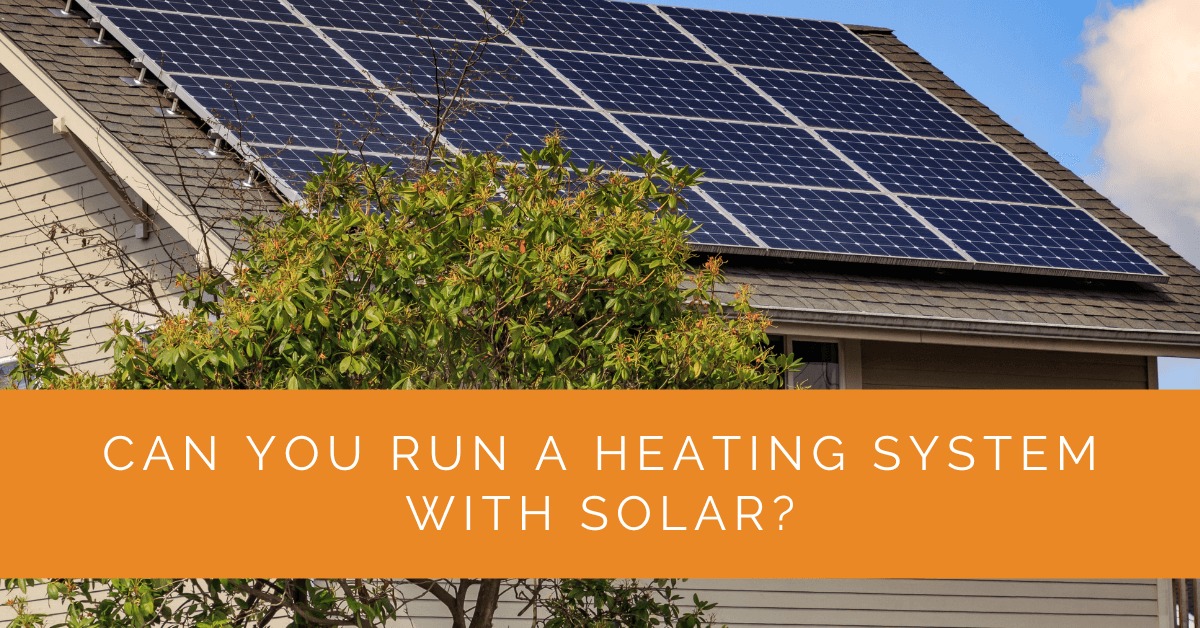
Can You Run a Heating System with Solar Panels? A Complete Guide for 2026
Yes, you can run a heating system with solar panels, but not year-round heating in most climates without grid support or battery storage. Solar panels generate electricity that powers electric heat pumps (4x more efficient than resistance heating) or electric boilers. However, winter heating demand peaks when solar output drops 50–70%, requiring grid electricity or battery backup. A hybrid solar + heat pump system can cover 50–80% of heating needs annually while cutting energy costs by 60–80% compared to fossil fuel heating.
Table of Contents
Two Methods to Heat with Solar
Solar thermal heating uses dedicated solar thermal panels (different from PV panels) to directly warm water for radiant heating or baseboard systems. Thermal panels reach temperatures of 120–180°F and heat water through a heat exchanger. This approach is simple and efficient for specific climates but cannot power HVAC systems with forced-air distribution.
Solar photovoltaic (PV) heating converts sunlight to electricity that powers electric heating systems: heat pumps, electric boilers, or radiant floor heaters. This is far more flexible and works with any heating system (forced air, radiant, baseboard, hydronic). Heat pumps are the most efficient, delivering 3–4 kWh of heat per kWh of electricity input (vs. 1 kWh heat per 1 kWh for resistance heating).
This guide focuses on solar PV powering heat pumps and electric heating, which is the modern standard for solar-powered homes.
Solar PV System Sizing for Heating
Heating load varies dramatically by season and climate. A 2,500 sq ft home in a cold climate (Maine, Minnesota) requires 60,000–80,000 BTU/hour heating capacity in winter, while the same home in a mild climate (Texas, Arizona) needs only 20,000–30,000 BTU/hour.
Energy consumption examples:
- Cold climate (Boston): 18,000–25,000 kWh annual heating, 60–70% of total home energy. Air source heat pump COP 2.5–3.0.
- Moderate climate (Kansas City): 12,000–15,000 kWh annual heating, 45–50% of total home energy. Air source heat pump COP 3.0–3.5.
- Mild climate (Atlanta): 4,000–8,000 kWh annual heating, 20–25% of total home energy. Heat pump COP 3.5–4.0.
- Very mild climate (Phoenix, Southern California): 1,000–3,000 kWh annual heating, 5–10% of total home energy. Heat pump COP 4.0+.
To size solar for heating, calculate total annual home energy (heating + cooling + appliances + hot water + EV charging if applicable), then add 15–25% for system losses. A home with 15,000 kWh annual heating + 8,000 kWh cooling/appliances = 23,000 kWh total demand.
A 10 kW solar system in a sunny location (Phoenix, Las Vegas) produces 15,000–17,000 kWh annually. In a moderate location (Denver, Kansas City), 12,000–14,000 kWh. In a cloudy location (Seattle, Boston), 9,000–11,000 kWh. Most homes require oversizing solar or grid supplementation to meet 100% of winter heating needs.
Heat Pump Systems Powered by Solar
Air source heat pumps are the most practical heating choice for solar-powered homes. They extract heat from outside air (even at 0°F, outdoor air contains usable heat) and pump it indoors, converting 1 kWh input electricity to 3–4 kWh heating output (measured as coefficient of performance, or COP).
Air source heat pump performance by temperature:
- +50°F outdoor: COP 4.0–4.5 (most efficient)
- +32°F: COP 2.5–3.0 (efficiency declines)
- 0°F: COP 2.0–2.5 (inefficient, often requires electric resistance backup)
- Below 0°F: Many units disable, requiring 100% electric resistance heating
Modern cold-climate air source heat pumps (Fujitsu, Daikin, Mitsubishi, Trane) operate efficiently down to –13°F, with COP 1.8–2.2 at that temperature. Older models cut off at 0–20°F, switching to resistance heating with 100% energy inefficiency.
Ground source (geothermal) heat pumps extract heat from stable ground temperatures (45–55°F year-round), delivering COP 3.5–5.0 even in winter. Cost $25,000–$40,000 installed (2–3x air source), but achieve the highest efficiency and payback where ground space is available. Annual heating energy use drops 30–40% vs. air source for equivalent heating output.
Cost comparison:
- Air source heat pump: $7,000–$15,000 installed, COP 2.5–4.0
- Ground source heat pump: $25,000–$40,000 installed, COP 3.5–5.0
- Electric boiler (backup): $2,000–$4,000 installed, COP 1.0 (no efficiency gain)
For solar homes, air source heat pumps are the standard choice due to reasonable cost and good efficiency even in moderate climates.
Solar + Heat Pump System Design
A practical solar heating system combines three components:
1. Solar PV array (8–15 kW): Sized to generate 40–70% of annual heating energy. No solar system can cost-effectively cover 100% of winter heating in cold climates.
2. Air source heat pump (3–5 tons): Sized for heating capacity during design winter conditions (typically minus 5°F to 0°F). Below that temperature, electric resistance heating supplements.
3. Battery storage (optional, 10–15 kWh): Stores afternoon solar generation for evening/night heating use. Eliminates need to draw grid power at night during winter heating season. Increases solar self-consumption from 40–60% to 70–85%.
System cost for a 2,500 sq ft home:
- 10 kW solar PV system: $21,000–$27,000 after 30% ITC
- 4-ton air source heat pump: $7,000–$12,000
- Hybrid inverter (solar + battery ready): $3,000–$5,000
- Battery storage (optional, 10 kWh LiFePO4): $3,500–$7,000
- Electrical and HVAC integration: $2,000–$3,500
- Total without battery: $33,000–$47,500
- Total with battery: $36,500–$54,500
After state and utility rebates (if available), total cost may drop 15–25%. A $40,000 system with $6,000 in rebates nets to $34,000 final cost.
Seasonal Performance and Realistic Expectations
Solar heating systems perform unevenly across seasons, requiring honest expectations.
Summer (June–August): Solar PV generates peak output (25–35 kWh/day in sunny regions). Heating load is near zero. Excess solar is exported to the grid (or stored in battery if installed). No grid heating required.
Spring and fall (March–May, September–November): Solar output moderate (15–20 kWh/day). Heating load moderate (5–10 kWh/day equivalent). Solar often covers 80–100% of heating needs. You may export surplus to grid.
Winter (December–February): Solar output drops 50–70% (8–12 kWh/day in sunny regions, 5–8 kWh/day in cloudy regions). Heating load peaks (20–30 kWh/day equivalent). Solar covers 20–40% of heating needs; grid or battery provides remainder.
In a cold climate with standard net metering, the economics work like this:
- Summer and spring/fall exports cover 60–70% of winter heating cost via net metering credits.
- Winter heating cost = (20,000 kWh annual heating) × 40% solar contribution × net metering credit (varies, $0.05–$0.15/kWh depending on state).
- Remaining 60% of winter heating = grid electricity at full retail rate ($0.12–$0.18/kWh).
- Net annual heating cost reduction: 40–60% depending on location and net metering policy.
NEM 3.0 impact: California and some states adopted NEM 3.0, which pays wholesale rates for exported solar (typically $0.05–$0.08/kWh, much lower than retail $0.20+/kWh). In NEM 3.0 areas, battery storage becomes critical to avoid selling summer solar at low wholesale rates and buying winter electricity at high retail rates.
Electric Boiler as Backup Heating
Some solar homes add electric boilers as backup heating when air source heat pumps cannot meet peak demand or when outdoor temperature drops below heat pump operating range.
Electric boiler specifications:
- Power rating: 5–15 kW (larger systems require 240V 60A service or subpanel)
- Cost: $2,000–$4,000 installed
- Efficiency: 99–100% (all input electricity becomes heat)
- Disadvantage: 1:1 energy conversion (1 kWh electricity = 1 kWh heat) vs. heat pump 3–4:1
A 5 kW electric boiler powering a 2,500 sq ft home at peak winter demand might run 4–6 hours/day in extreme cold, consuming 20–30 kWh/day just for backup heating. Not practical for solar systems without massive oversizing.
Better approach: Use heat pump as primary system. Accept grid supplementation during winter peak demand or add battery storage to shift solar generation to peak winter hours (7–9 a.m., 4–8 p.m. when heating demand and grid rates are highest).
Battery Storage Benefits for Solar Heating
Adding battery storage (10–15 kWh LiFePO4) optimizes solar heating economics:
Time-shifting generation to match demand: Battery stores peak afternoon solar (1–5 p.m.) and discharges during evening/night heating (6–10 p.m., 6–10 a.m.). This reduces grid electricity purchases during expensive peak hours, saving $50–$150/month on TOU (time-of-use) rates in regions with dynamic pricing.
Reducing grid draw during winter peak demand periods: In winter, heating peaks at 6–9 a.m. and 4–9 p.m. Battery charged during midday (10 a.m.–3 p.m. solar peak) can discharge during these peak periods, avoiding utility demand charges ($10–$30/kW per month in some areas).
Backup power during outages: Battery supplies 10–15 kWh (4–8 hours of heating on mild days, 2–4 hours in extreme cold). Critical for resilience in storm-prone regions.
True solar independence (NEM 3.0 workaround): In NEM 3.0 areas with low export credits, battery allows self-consumption of 70–85% of solar generation instead of exporting at wholesale rates.
Cost: Battery adds $3,500–$7,000 to system but recovers through 15–20 year energy savings in high-rate or TOU-billing regions.
Integration with Hot Water and Other Loads
Solar + heat pump systems can also supply domestic hot water (DHW), reducing overall solar and heating equipment cost:
Heat pump water heaters (HPWH): Use the same heat pump technology as space heating (COP 2.5–4.0), consuming 2,000–4,000 kWh annually for DHW. A solar system sized for space heating has spare capacity in spring/fall/summer to power HPWH with minimal grid support.
Integrated heat pump systems: Some manufacturers offer combination space heating + DHW systems from a single 4–5 ton unit, reducing equipment and installation cost by 15–25%.
Dual-zone design: Size solar for combined space heating + DHW load, then use battery or grid backup to manage seasonal imbalances. Example: a 12 kW solar system covering 25,000 kWh annual (20,000 kWh heating + 5,000 kWh DHW) is more cost-effective than separate 10 kW + 3 kW systems.
Combining Solar Heating with EV Charging
Homes with electric vehicles can optimize solar use across three loads: heating, hot water, and EV charging. This requires strategic design:
Load shifting: Charge EVs during peak solar hours (11 a.m.–3 p.m.) when heat pump demand is low (mild weather). This avoids grid electricity for EV charging and avoids overloading solar/battery during peak heating hours (early morning, late evening).
System sizing: A 15–20 kW solar array supplies 25,000–30,000 kWh annually, covering 20,000 kWh heating + 5,000 kWh hot water + 5,000 kWh EV charging (10,000 miles/year at 0.5 kWh/mile).
Battery coordination: 15 kWh battery can supply overnight EV charging (typical 7.4 kW onboard charger at 2 hours = 15 kWh) or early morning heating before solar ramps up.
Cost-benefit: Combined solar heating + EV system (15 kW PV + 15 kWh battery) costs $35,000–$50,000 but eliminates 90%+ of energy costs for heating, hot water, and driving. Payback: 8–12 years depending on location and electricity rates.
State-Specific Incentives for Solar Heating
Beyond the 30% federal ITC, many states offer additional incentives for heat pump and solar integration:
California: Home Energy Renewal Assistance (CalHEAP) provides rebates up to $2,000 for heat pump replacement. SoCalGas also offers $1,000–$4,000 heat pump rebates (utility dependent).
New York: Heat pump rebates $500–$2,000 plus Home Electrification and Appliance Rebates (HEAR) for combined solar + heat pump + hot water projects.
Massachusetts: Mass Save provides $1,000–$3,000 for air source heat pumps plus solar rebates.
Colorado: Xcel Energy offers $1,000 rebate for air source heat pumps plus solar incentives.
Illinois: ComEd and Ameren provide solar rebates ($250–$500) plus heat pump incentives through various programs.
Check DSIRE.org for your state’s complete rebate offerings. Many homeowners overlook utility-specific rebates that combine with federal ITC to reduce net cost 40–50%.
Permitting and Interconnection for Solar Heating Systems
Adding solar to power a heat pump is simpler than adding battery storage. Permitting typically requires:
- Electrical permit for solar installation (standard)
- HVAC permit if replacing or upgrading heating system
- Utility interconnection approval (typically 2–4 weeks)
- Possible electrical service upgrade if solar + heat pump exceed current panel capacity
Timeline: 6–12 weeks for design, permitting, and installation. Most solar + heat pump projects complete in 8–10 weeks.
If adding battery storage, additional structural and electrical engineering required (adds 2–4 weeks to timeline).
Frequently Asked Questions
Can I heat my entire home year-round with solar panels alone?
Not in most climates without massive oversizing or extensive battery storage. A practical solar system covers 40–70% of annual heating needs, with grid or gas backup for winter peaks. Mild climates (Southern California, Arizona) can approach 80–100% solar heating, but cold climates require grid support.
What size heat pump do I need for solar?
Size for your design heating temperature (typically –5°F to 0–15°F depending on location). Oversizing increases cost without benefit since heat pump runs less frequently at higher efficiency. A qualified HVAC contractor performs load calculation (Manual J) to right-size the unit. Typical sizes: 2–3 tons for mild climates, 3–5 tons for cold climates.
Do I need to replace my existing furnace?
Heat pump systems are best installed in homes with forced-air or radiant distribution (which 90% of US homes have). If you have baseboard or radiator heating, heat pump retrofit is complex and expensive. In that case, solar powering your existing boiler (with resistance heating backup) is simpler but less efficient than heat pump replacement.
Can solar heat pump systems work in very cold climates like Minnesota or Maine?
Yes, but with caveats. Modern cold-climate air source heat pumps (Fujitsu Halcyon, Daikin Fit, Mitsubishi H2i) operate efficiently to –13–15°F with COP 1.8–2.2. Below that, they switch to electric resistance heating or shut down. Expect 50–70% solar offset of annual heating in northern climates, with 30–50% grid supplementation.
Summing Up
Solar panels can power heating systems efficiently when paired with electric heat pumps, which deliver 3–4x more heat per unit of electricity than resistance heating. A 10–15 kW solar system with a 3–5 ton heat pump costs $33,000–$50,000 and covers 40–80% of annual heating needs depending on climate and solar resources.
Realistic expectations: solar heating works best in mild and moderate climates (cover 60–80% of needs) and provides 40–60% offset in cold climates. Winter heating peaks require grid support or battery storage. Combined solar heating + EV charging systems offer the highest ROI, paying back in 8–12 years through avoided electricity and fuel costs.
Ready to design a solar heating system for your home? Call our heating and solar specialists at (855) 427-0058 for a free consultation on solar + heat pump integration and available incentives in your state.
Updated