

The balance of system (BOS) refers to every component in a solar installation except the solar panels themselves. This includes the inverter, racking and mounting hardware, wiring, disconnect switches, charge controllers (for off-grid systems), monitoring equipment, and all structural and electrical components required to connect panels to the grid or battery bank. BOS components typically represent 50–60% of the total cost of a residential solar installation.
What’s Included in the Balance of System?
BOS covers a broad range of components across three categories: electrical, structural, and safety/monitoring systems.
Inverter: The single most expensive BOS component. Converts direct current (DC) from the solar panels to alternating current (AC) used by your home and the grid. Inverter types include string inverters ($1,000–$2,500), microinverters ($150–$300 per panel, so $3,000–$7,500 for a 20-panel system), and hybrid inverters ($2,000–$4,000) for systems with battery storage. The inverter determines much of the system’s overall performance, monitoring capability, and shade tolerance.
Racking and mounting hardware: The structural system that attaches solar panels to your roof or ground. For roof-mounted systems, this includes aluminum rails, clamps or hooks that attach to roof rafters, flashing to prevent water infiltration at penetration points, and end/mid clamps to secure the panels. For ground-mounted systems, it includes driven piles or concrete footings, galvanized steel frames, and additional bracing. Good racking hardware is engineered for wind and snow loads — cheap racking is a common area where installers cut corners, which can lead to panel damage or structural issues in extreme weather.
Wiring and conduit: DC wiring runs from panels to the inverter; AC wiring runs from the inverter to the main electrical panel. Solar wiring uses USE-2 or PV Wire rated for outdoor UV exposure, typically in a range of wire gauges (AWG 10–14 for DC wiring depending on current and run length). MC4 connectors are the industry-standard weatherproof connector for solar panel strings. All wiring should be run in conduit where required by local code, and should be sized to limit voltage drop to 2–3% maximum on DC runs.
Disconnects and overcurrent protection: National Electrical Code (NEC) Article 690 requires specific disconnect switches and fuse/breaker protection in solar systems. A DC disconnect (between panels and inverter) and AC disconnect (between inverter and electrical panel) are minimum requirements. String fuses or breakers protect individual panel strings. Main breakers in the electrical panel protect the AC output. These are non-negotiable safety components.
Rapid shutdown system: NEC 2014 and later editions require rapid shutdown capability for all rooftop solar systems. Rapid shutdown brings the DC voltage in the array down to safe levels (below 30V) within 30 seconds when the system is switched off — a critical safety feature for firefighters. Microinverter systems are inherently rapid-shutdown compliant. String inverter systems require a rapid shutdown controller (module-level power electronics or a dedicated rapid shutdown device).
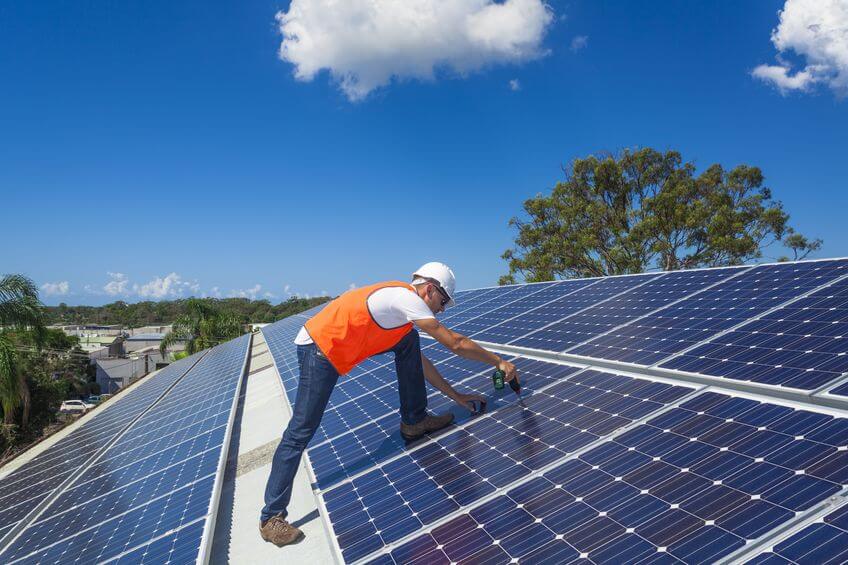
BOS Costs: How Much of Your Solar Bill Is Not Panels?
On a typical 8 kW residential system installed at $24,000–$28,000 total, the cost breakdown roughly looks like:
Solar panels (320W × 25 panels): $3,500–$5,500 (15–22% of total)
Inverter: $1,500–$3,000 (6–12%)
Racking and mounting: $1,000–$2,500 (4–10%)
Wiring, conduit, connectors: $500–$1,500 (2–6%)
Disconnects, breakers, rapid shutdown: $300–$800 (1–3%)
Monitoring system: $100–$500 (0.5–2%)
Installation labor: $7,000–$12,000 (28–45%)
Permitting and interconnection: $500–$2,000 (2–8%)
Overhead and profit: $3,000–$6,000 (12–20%)
The solar panels themselves represent only 15–22% of the total installed cost in a typical system. This is a critical insight for consumers comparing quotes: a quote with cheaper panels but the same total price as a competitor is not necessarily a better deal — check the inverter brand and warranty, racking quality, and labor terms.
Inverter Types and Their Role in BOS
The inverter is the most performance-critical BOS component and deserves careful selection.
String inverter: One central inverter for the entire panel array. All panels in a “string” are wired in series, and the string’s total output goes into the inverter’s DC input. Advantages: lowest cost per watt, simpler maintenance, proven reliability. Disadvantage: one shaded or underperforming panel reduces output for the entire string. Best for systems with unshaded, single-plane roofs. Leading brands: SMA, Fronius, Sungrow.
Microinverter: One small inverter per panel, mounted on the racking under each panel. Each panel operates independently — one shaded panel doesn’t affect the others. Built-in panel-level monitoring. Advantages: shade tolerance, granular monitoring, easier system expansion, no high-voltage DC on the roof (inherent rapid shutdown). Disadvantage: higher upfront cost. Best for roofs with shade from trees, chimneys, or complex shapes. Leading brand: Enphase IQ8 series.
Power optimizer + string inverter (SolarEdge architecture): A DC optimizer is mounted under each panel, maximizing its individual output, while a single string inverter handles the AC conversion centrally. Provides panel-level monitoring and shade mitigation with a lower cost than full microinverters. SolarEdge is the dominant brand in this architecture.
Hybrid inverter: Designed to interface with both the solar array and a battery bank, managing charging, discharging, and grid connection in one device. Required for systems with storage. Leading brands: Enphase (integrated with IQ Battery), SolarEdge (with SolarEdge Home Battery), Sol-Ark, Victron (off-grid oriented).
Racking Quality: What to Look For
Racking quality varies substantially and affects both safety and longevity. Key criteria when evaluating racking:
Material: Anodized aluminum or marine-grade stainless steel fasteners are standard for residential systems. Galvanized steel is acceptable for ground mounts. Painted or bare steel in roof-mounted applications will rust, weakening the structure over time.
Wind and snow load ratings: Quality racking is engineered to specific wind and snow loads — typically rated for wind speeds up to 100–150 mph and snow loads of 25–50 lbs/sq ft, though local requirements vary. Installers should select racking certified to meet your area’s local building codes (derived from ASCE 7). Cheap racking may not be load-rated at all.
Waterproofing: Every roof penetration point is a potential leak point. Quality installations use purpose-made flashing (Unirac, QuickMount PV, or equivalent) with EPDM gaskets that form a watertight seal around the lag bolt. Amateur installations sometimes use generic L-brackets with silicone sealant — these tend to fail within 5–10 years.
Manufacturer warranty: Quality racking (IronRidge, Unirac, Quick Mount PV, Schletter) carries 10–25 year structural warranties. Warranty-less racking from unknown manufacturers is a red flag.
Monitoring Systems
Most modern inverters (SMA, Fronius, Enphase, SolarEdge) include cloud-based monitoring accessible via smartphone apps and web dashboards. These systems report production data by hour, day, month, and year; current power output; and alert you to faults or underperformance. Monitoring is included in the inverter cost for most brands.
For systems without built-in monitoring, third-party monitoring devices (Emporia Vue, Sense, SolarEdge Smart Energy) can be added to the electrical panel. These monitor both production and consumption, providing a complete energy dashboard. Cost: $100–$500.
Panel-level monitoring — seeing the output of each individual panel — is available with microinverter systems (Enphase) and power optimizer systems (SolarEdge) but not with basic string inverter systems. Panel-level monitoring makes fault diagnosis and performance verification much faster.
BOS for Off-Grid Systems
Off-grid BOS differs significantly from grid-tied BOS. In addition to the components above, off-grid systems require:
Charge controller: Manages the charging of the battery bank from the solar array. MPPT (Maximum Power Point Tracking) charge controllers are the standard for modern systems — they extract 10–30% more power from the panels than older PWM controllers. Sized by array amperage. Cost: $100–$800 for residential-scale systems.
Battery bank: Stores energy for use when the sun isn’t shining. Lithium iron phosphate (LiFePO4) has become the dominant chemistry for off-grid storage: 10–15 year lifespan, 80–100% usable depth of discharge, no maintenance. Lead-acid (AGM or gel) remains a lower-cost alternative with shorter lifespan (3–7 years) and lower usable capacity. A properly sized off-grid battery bank represents the largest single BOS cost for off-grid installations.
Off-grid inverter: Creates stable AC power from the battery bank regardless of solar production. Must be sized for the peak surge loads of the appliances it powers. Leading brands for off-grid: Victron MultiPlus, Outback Radian, Magnum Energy, Sol-Ark.
Generator input: Most off-grid systems include a generator connection as a backup for extended cloudy periods. The charge controller or hybrid inverter manages automatic generator start/stop based on battery state of charge.
Frequently Asked Questions
What percentage of solar system cost is balance of system vs. panels?
In a typical 2026 residential installation, solar panels represent 15–22% of the total installed cost. Balance of system components (inverter, racking, wiring, disconnects, monitoring, labor, permits) represent the remaining 78–85%. This ratio has shifted over the past decade as panel prices dropped dramatically while labor, permitting, and inverter costs have remained relatively stable. This is why overall installed system costs haven’t fallen as steeply as raw panel hardware prices.
Can I buy BOS components separately to save money?
Technically yes — you can purchase inverters, racking, and wiring independently and hire an electrician for installation. In practice, most licensed solar installers prefer to source their own BOS components to ensure compatibility and maintain warranty coverage. For DIY systems on secondary structures (sheds, off-grid cabins, RVs), purchasing BOS components independently from solar wholesalers or retailers is common. For permitted residential grid-tied systems, local code typically requires licensed installation.
What BOS components need replacement during a solar system’s lifespan?
Solar panels last 25–30 years with minimal degradation. Among BOS components, the inverter is most likely to need replacement: string inverters typically last 10–15 years and cost $1,000–$2,500 to replace; microinverters typically carry 25-year warranties. Wiring, racking, and disconnects last 25–30+ years with no maintenance. Batteries (if included) last 10–15 years for LiFePO4, requiring replacement once during a system’s lifespan. Plan for one inverter replacement ($1,000–$2,500 in real terms) over the system’s 25-year life.
Is the balance of system covered by warranty?
Yes — each component has its own warranty. Quality inverters: 10–25 years depending on brand. Racking: 10–25 years structural warranty. MC4 connectors: 25 years. Labor warranty (installer workmanship): typically 5–10 years. When evaluating an installer’s quote, ask specifically about warranty coverage for all BOS components — this is often where budget installers cut corners relative to premium ones.
Does the balance of system affect solar system efficiency?
Yes — BOS inefficiencies reduce the system’s overall output below what the panel nameplate ratings suggest. Inverter efficiency (95–99% for quality inverters), wiring losses from voltage drop (1–3%), and mismatch losses from stringing panels with slightly different characteristics all reduce total output. A high-quality BOS with an efficient inverter and properly sized wiring will typically outperform a cheap BOS by 3–8% in annual output, even with identical panels.
Summing Up
The balance of system — inverter, racking, wiring, disconnects, and monitoring equipment — represents the majority of the cost and complexity of a solar installation. Solar panels get the attention, but the inverter, racking quality, and wiring workmanship determine whether your system performs reliably for 25 years or develops problems within 5. When evaluating solar quotes, ask specifically about inverter brand and warranty, racking manufacturer and load ratings, and rapid shutdown compliance. The BOS you invest in determines far more of your system’s long-term performance than the panel brand alone.
Updated