
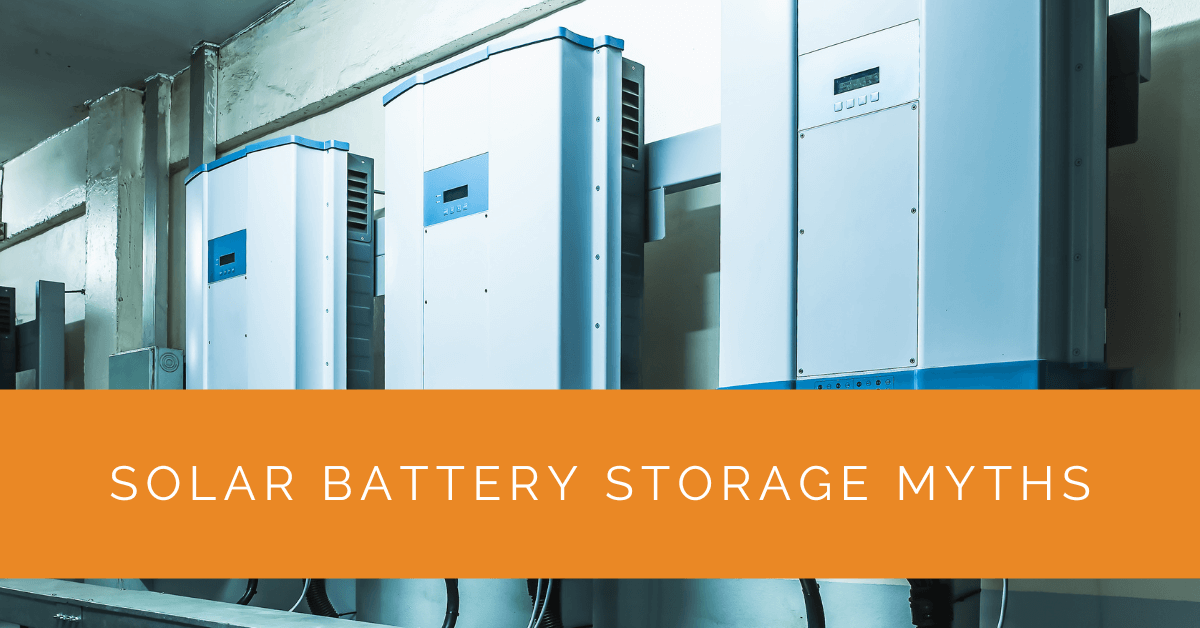
Solar battery storage has become increasingly popular, but myths and misconceptions about performance, cost, and necessity persist. Understanding the reality behind common myths helps homeowners make informed decisions about whether battery storage adds value to their solar systems.

Myths about solar batteries range from exaggerated performance claims to unfounded durability concerns. This article separates fact from fiction, helping homeowners decide whether battery systems justify their cost in specific situations.

Myth 1: Batteries Are Essential for Solar

The Myth: You cannot have an effective solar system without batteries; batteries are a standard solar component.

The Reality: 95%+ of residential solar systems operate without batteries, relying on net metering for energy banking. Batteries are optional add-ons providing backup power during outages and time-of-use optimization.

Truth: Grid-tied solar without batteries is highly effective and provides excellent ROI (5–10 year payback). Batteries add substantial cost ($10,000–$20,000 for 10–15 kWh) and extend payback to 10–15+ years. Batteries are valuable in specific situations (frequent outages, high time-of-use rates, desire for energy independence) but not necessary for most homeowners.

Myth 2: Batteries Provide Days of Independence

The Myth: A residential battery system (Powerwall, other 10–15 kWh systems) provides days of backup power during outages or grid failures.

The Reality: A 10 kWh battery provides 4–6 hours of typical home electricity consumption, not days. During a 24-hour outage, battery depletion occurs within hours unless solar production or backup generator provides charging.

Truth: Batteries extend outage resilience to 4–8 hours of critical loads (refrigerators, lights, communications) or 2–4 hours of whole-home loads. For true multi-day independence, batteries must be massive (40–50+ kWh) or paired with backup generators. Most residential batteries are modest insurance against outages, not complete independence.

Myth 3: Batteries Pay for Themselves Through Bill Savings

The Myth: Battery time-of-use optimization creates sufficient bill savings to pay back the battery cost within 5–10 years.

The Reality: Time-of-use optimization saves 10–25% of electricity bills in states with aggressive TOU pricing (California, parts of Hawaii, New York). For a $150/month electricity bill, savings are $15–$37/month, or $180–$444 annually. A $12,000 battery requires 27–67 years of savings to break even—longer than battery lifespan (10–15 years).

Truth: Batteries do not pay for themselves through bill savings alone in most markets. Payback occurs through combination of: modest bill savings, backup power value (estimates vary, $500–$2,000 annually in outage-prone areas), potential demand response payments ($50–$200 annually), and home value increases (negligible to modest). Total value over system life may justify batteries in specific scenarios (frequent outages, expensive electricity, home resilience prioritized) but not universally.

Myth 4: Batteries Improve Environmental Impact

The Myth: Adding batteries to solar systems dramatically increases environmental benefit and carbon reduction.

The Reality: Battery manufacturing has substantial environmental impact (mining lithium, cobalt, nickel; manufacturing energy). Lifecycle carbon payback for batteries is 2–4 years, meaning 2–4 years of operation required to offset manufacturing carbon. Over 10–15 year battery lifespan, net environmental benefit is positive but modest.

Truth: Batteries add environmental benefit compared to home reliance on grid electricity (which may be partly fossil-fuel generated). However, adding batteries to existing solar systems provides less incremental environmental benefit than expanding solar array size (add more solar panels instead of batteries for greater carbon reduction per dollar spent).

Myth 5: All Batteries Are Lithium-Ion

The Myth: Modern solar batteries are all lithium-ion; other chemistries are obsolete or unavailable.

The Reality: Lithium-ion (LFP, NMC) dominates residential market, but lead-acid batteries remain available and sometimes viable for off-grid systems. Flow batteries, saltwater batteries, and other technologies are emerging. Each chemistry has distinct cost, lifespan, and performance characteristics.

Truth: Lithium-ion (particularly LFP) is optimal for most residential applications due to high cycle life (3,000–5,000 cycles vs. 1,000 for lead-acid), fast charging, and compact size. Lead-acid is less ideal (shorter lifespan, heavier, slower charging) but costs 40–50% less and remains viable for budget-conscious off-grid systems. Emerging chemistries may offer advantages in future but are not yet cost-effective for residential scale.

Myth 6: Batteries Eliminate Electricity Bills

The Myth: Combining solar panels with batteries eliminates electricity bills entirely.

The Reality: Even large battery systems (15–20 kWh) provide only partial bill offset. Typical homes need 30–50 kWh daily; batteries can store 10–15 kWh. Winter production (shorter days, lower irradiance) drops 50–70% compared to summer, requiring grid electricity on many days. True bill elimination requires massive overbuilding (solar array 2–3x normal size, battery 30–50+ kWh).

Truth: Solar + batteries can reduce electricity bills 50–80% in high-sunlight regions with careful system sizing and load management. Complete bill elimination requires exceptional conditions (excellent solar resource, low consumption, oversized systems) or off-grid configuration. Most hybrid systems provide partial offset (30–60%), not elimination.

Myth 7: Batteries Last 20+ Years

The Myth: Lithium-ion batteries last 20+ years like solar panels, matching solar system lifetime.

The Reality: Lithium-ion residential batteries degrade with cycling. Typical lifespan: 10–15 years (or 3,000–5,000 full charge/discharge cycles, whichever comes first). After 10–15 years, most batteries retain 70–80% capacity; replacement becomes economically justifiable.

Truth: Batteries require replacement during typical solar system life (25–30 years). Budget $8,000–$15,000 for replacement battery around year 12–15. This adds 30–50% to long-term system cost compared to solar-only systems (no replacement required). Factor replacement cost into financial projections.

Myth 8: Backup Generators Are Obsolete with Batteries

The Myth: Battery systems eliminate need for backup generators; generators are outdated technology.

The Reality: Batteries provide 4–8 hours of backup power; extended outages (2–3+ days) exhaust batteries without external charging (solar production during outage, generator, or grid restoration). Backup generators extend autonomy indefinitely, using propane or diesel fuel.

Truth: Batteries and generators serve complementary roles. Batteries handle short outages (1–8 hours) cost-effectively; generators handle extended outages. Many hybrid systems use both: batteries handle daily cycling and short outages, generators provide extended backup during rare extended outages. Sole reliance on batteries for complete independence requires 30–50+ kWh capacity ($30,000–$50,000+), making backup generators economically superior for extended outage scenarios.

Myth 9: Batteries Cannot Freeze or Overheat

The Myth: Modern lithium batteries are unaffected by temperature; climate doesn’t impact battery performance.

The Reality: Lithium batteries have temperature limits. LFP chemistry operates optimally 0–40°C (32–104°F). Below freezing or above 110°F, performance degrades and lifespan shortens. Some systems include heaters/coolers for thermal management, adding cost.

Truth: Extreme climates (very hot deserts, very cold regions) require battery thermal management. Most U.S. homes (moderate climates) experience acceptable battery performance. Alaska and Arizona homes should verify temperature management; cold regions may require heated battery enclosures ($1,000–$3,000), and hot regions may need cooling. This is a legitimate consideration but not a reason to avoid batteries in moderate climates.

Myth 10: Batteries Are Dangerous/Explosive

The Myth: Lithium-ion batteries present fire/explosion risks; residential battery systems are unsafe.

The Reality: Residential lithium-ion batteries have safety systems preventing fires. Fire incidents in residential systems are extremely rare (<0.01%). Commercial and automotive battery fire incidents (Tesla vehicles, etc.) are well-publicized but represent even smaller percentages of systems.

Truth: Modern lithium-ion battery systems (Powerwall, LG, Generac) meet stringent safety standards (UL, IEC). Fire risk is lower than propane generators and comparable to vehicles. Risks are managed through BMS (battery management system), thermal management, and proper installation. Residential batteries are safe for residential use when properly installed and maintained.

Myth 11: Smart Inverters Make Batteries Obsolete

The Myth: Smart inverters provide such sophisticated control and optimization that batteries are no longer necessary.

The Reality: Smart inverters improve on-grid system efficiency and grid services but do not provide backup power during outages (on-grid systems shut down). Batteries remain necessary for outage resilience and time-of-use optimization with stored energy.

Truth: Smart inverters complement batteries; they don’t replace them. Smart inverters manage optimal timing for battery charging/discharging based on electricity prices and grid signals. For backup power or bill optimization, batteries are still required. Smart inverters alone provide neither backup resilience nor the ability to shift energy use across time (without storage).

Myth 12: Installing Batteries Automatically Qualifies You for the Federal Tax Credit

The Myth: Any solar battery system qualifies for the 30% federal Investment Tax Credit (ITC), reducing the effective cost substantially.

The Reality: Battery systems must meet specific criteria to qualify for the ITC. Under the Inflation Reduction Act, standalone batteries (not connected to solar) qualify for the ITC only if charged exclusively from solar (100% solar-charged). Batteries that can charge from the grid do not qualify unless primarily solar-charged. Additionally, the ITC is a tax credit, not a rebate—it reduces federal tax liability. Homeowners must owe sufficient federal taxes to utilize the full credit; those with low tax liability may not capture the full 30%.

Truth: Solar-charged batteries installed alongside (or after) solar panels do qualify for the 30% ITC, which substantially reduces net cost. A $12,000 battery system becomes $8,400 after ITC for qualifying installations. However, verify your tax situation with a tax professional before relying on the full ITC benefit. Low-income households and retirees with modest tax liability may capture only partial credit in the installation year, though unused credits can be carried forward to future tax years.

Myth 13: Newer Batteries Will Be Dramatically Cheaper Next Year, So You Should Wait

The Myth: Battery technology is advancing so rapidly that waiting 1–2 years will result in dramatically cheaper and more capable systems, making current purchase decisions premature.

The Reality: Battery costs are declining, but at a moderate rate (10–15% annually), not dramatic year-over-year drops. The industry has been “1–2 years from dramatic improvements” for most of the past decade. Real cost declines are gradual; a system costing $12,000 today might cost $10,200–$10,800 in two years—savings of $1,200–$1,800 while forgoing two years of benefits (backup power, TOU savings, VPP income).

Truth: Incremental cost improvements are real, but the opportunity cost of waiting (foregone savings, foregone backup resilience, potentially expiring incentives) typically exceeds the savings from waiting. If batteries provide genuine value for your situation today (frequent outages, expensive TOU rates), waiting rarely improves the financial case. If the financial case for batteries is marginal today, waiting for cost declines may eventually justify them—but this could be 3–5 years away rather than the perpetually-promised “next year.”

Frequently Asked Questions

Do I need batteries with my solar system?

Not necessarily. If you have reliable utility grid access and don’t prioritize outage backup, batteries add cost without proportional benefit. Batteries are valuable if you experience frequent outages, have time-of-use rates making peak-hour costs 3–4x off-peak rates, or strongly prioritize energy independence. Evaluate your specific situation; batteries are optional, not required.

How long do solar batteries really last?

Lithium-ion residential batteries (Powerwall, LG, Generac) last 10–15 years typically, or 3,000–5,000 charge/discharge cycles (whichever comes first). After 10–15 years, capacity is 70–80% of original; replacement is economically justified. Plan for battery replacement in financial projections.

Can batteries power my whole house during an outage?

For 4–8 hours, yes (depending on battery size and home consumption). Beyond that, battery capacity depletes unless solar production or backup generator provides charging. For full-home power 24+ hours, you need 30–50+ kWh battery (very expensive) or a backup generator.

Are batteries worth it if I don’t have frequent outages?

Batteries provide value through time-of-use bill savings and outage resilience. If your area has stable grid and no time-of-use rates, financial return is weak. Batteries remain valuable if you prioritize energy independence or home resilience for personal reasons beyond pure financial ROI.

Summing Up

Solar battery storage myths often exaggerate performance, independence, and financial returns while also sometimes overstating dangers or durability concerns. Reality is more nuanced: batteries are valuable in specific situations (frequent outages, high TOU rates, desired independence, VPP income) but add substantial upfront cost and require replacement during the solar system’s life. Evaluate your situation carefully; batteries are optional add-ons that enhance an already-effective solar system, not required components for reducing electricity bills.

For personalized battery recommendations and detailed financial analysis covering your local electricity rates, outage history, time-of-use pricing, and ITC eligibility, contact Solar Panels Network USA at (855) 427-0058. We provide realistic, data-driven assessments of whether battery storage systems justify their cost in your specific situation and help you choose between the best available battery options for your home.

Updated