
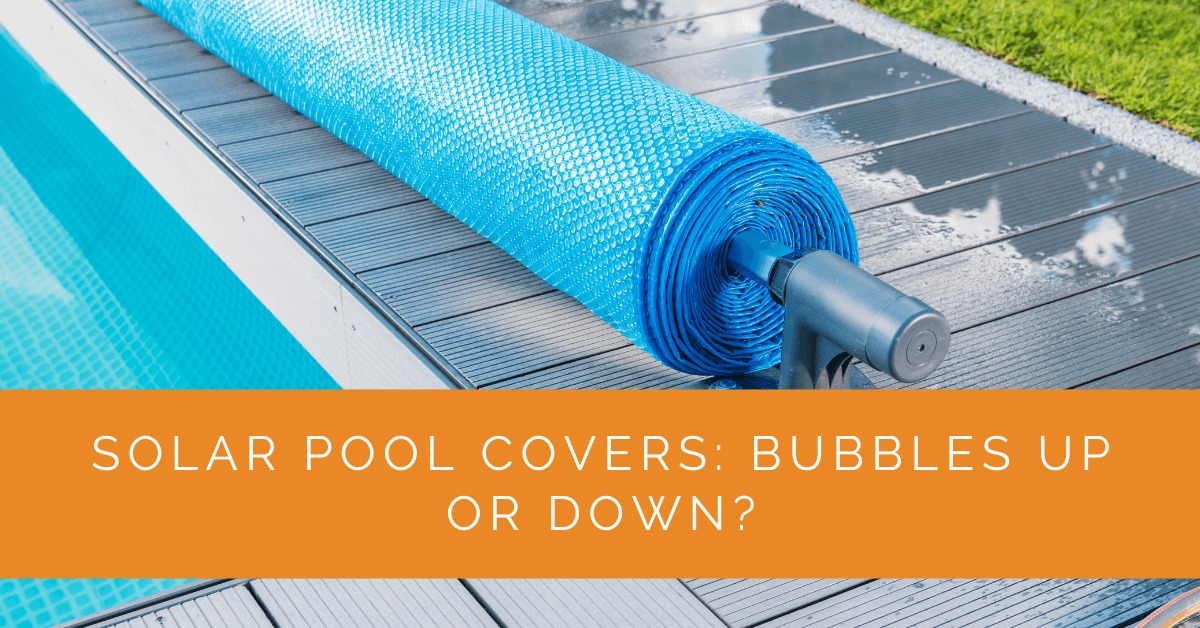
The bubbles on a solar pool cover go face down, touching the water. The bubble side acts as an insulating air pocket between the cover and the water, trapping heat and reducing evaporation. Placing the cover flat side down traps no heat and significantly reduces its effectiveness.
It’s one of the most common questions pool owners have when they first unroll a solar blanket — and getting it wrong means paying for a cover that does almost nothing. This guide explains why bubble-side-down is correct, how solar covers actually work, and what else affects their performance.
Why Bubbles Go Down: How Solar Pool Covers Work
A solar pool cover (also called a solar blanket) works through two separate mechanisms: heat gain and heat retention.
The clear or blue plastic surface collects solar radiation and transmits it into the water — similar to how a greenhouse works. Sunlight passes through the cover, is absorbed by the water, and the cover prevents that heat from escaping back into the atmosphere.
The bubbles are the insulation layer. Each bubble is a sealed pocket of air. Air is an excellent thermal insulator (thermal conductivity of ~0.025 W/m·K, compared to water at ~0.6 W/m·K). When the bubbles face down toward the water surface, they create a thermal barrier between the warm water and the cooler air above the cover. This is what slows overnight heat loss — without the bubble layer in contact with the water, the cover is just a thin sheet of plastic with minimal insulating value.
The flat side faces up, exposed to the sun. On clear or lightly tinted covers, sunlight passes through the flat surface and the bubble walls into the water. The bubbles also help the cover float, keeping it in contact with the water surface even as the water level changes.

What Happens If You Put It Bubbles Up?
If the bubbles face up, the flat side rests directly on the water. This means:
The insulating air pockets are on the wrong side — they’re between the cover and the open air above, not between the cover and the water. Heat that would otherwise be retained in the water is free to escape through the thin, uninsulated plastic surface.
Evaporation reduction is still partially effective — any cover reduces evaporation just by covering the water surface — but you lose the greenhouse heating effect. With the flat side down, sunlight still enters the water, but heat escapes more quickly overnight because there’s no air-bubble insulation layer in contact with the water.
In practice, a bubble-up installation can reduce the cover’s effective heat retention by 30–50% compared to correct installation. You’ll still lose less water to evaporation than with no cover at all, but the heating contribution is substantially diminished.
How Much Heat Do Solar Pool Covers Add?
Correctly installed solar pool covers typically add 10–15°F (5.5–8.3°C) to pool water temperature over a sunny day, depending on cover thickness, transparency, and ambient conditions. Thicker covers with larger bubbles retain heat better overnight; thinner covers with smaller bubbles heat water faster but lose heat more quickly after sunset.
Here’s what the research shows on pool heat dynamics:
Evaporation accounts for 70% of pool heat loss. Covering the pool surface eliminates most evaporative cooling — this is the single biggest benefit of any pool cover, regardless of orientation. A solar blanket correctly oriented adds solar heat gain on top of that evaporation reduction.
Overnight retention depends on insulation. Without a cover, a pool in a mild climate can lose 3–5°F overnight. A correctly installed solar cover reduces that loss to 1–2°F by trapping heat with the bubble layer.
Color affects heat gain. Clear covers allow the most sunlight through (maximum heating) but also allow more nighttime radiation to escape. Blue or dark covers absorb more heat at the cover surface but transmit less into the water. For most residential pools, clear or light blue covers offer the best overall performance.
Solar Cover Thickness: What the Numbers Mean
Solar pool covers are rated by thickness, usually expressed in mils (thousandths of an inch) or microns. Common thicknesses range from 8 mil to 16 mil.
| Thickness | Bubble Size | Heating Speed | Heat Retention | Durability |
|---|---|---|---|---|
| 8 mil | Small | Fastest | Lower | 2–3 seasons |
| 12 mil | Medium | Moderate | Good | 3–5 seasons |
| 16 mil | Large | Slower | Best | 5–7 seasons |
Thicker covers with larger bubbles hold more air volume and retain heat better overnight — ideal for pools used in the evening or in cooler climates. Thinner covers heat water faster on sunny days but offer less overnight insulation. A 12 mil cover is the most common choice for residential pools balancing heat gain, overnight retention, and cost.
How to Put On and Take Off a Solar Pool Cover
The process is straightforward but is easier with two people for larger covers.
Putting the cover on: Unroll the cover across the pool starting from one end. The bubble side goes down — you’ll feel the textured surface when you run your hand across it. Spread the cover so it fully overlaps the pool edges. Trim edges if needed with scissors to fit your pool shape. A slight overhang at the edges helps keep the cover from sliding off in wind.
Taking the cover off: For pools with a solar reel, feed the cover onto the reel by walking it across the pool as it rolls up. For covers without a reel, fold the cover accordion-style toward one end (never bunch it into a pile — this traps moisture and accelerates degradation). Store off the ground, away from UV exposure when not in use.
Reel systems: A solar cover reel makes deployment and removal much faster — critical for pools where the cover needs to come off before every swim. A quality reel with UV-resistant tubing costs $150–$350 and pays for itself quickly in time saved and reduced cover wear from improper folding.

How Long Should You Leave a Solar Cover On?
Leave the cover on whenever the pool isn’t in use. This includes:
Overnight, always. Most pool heat loss occurs overnight through evaporation and convection. Removing the cover even for a few hours on a cool night can cost 2–3°F that took hours to accumulate.
During the day when no one’s swimming. A covered pool on a sunny day can gain 5–10°F in 8 hours. An uncovered pool may actually lose heat on windy days even in full sun, because wind drives evaporative cooling faster than solar gain can offset it.
Remove during chemical treatments. Chlorine, shock, and algaecide treatments should be added with the cover off. High chlorine concentrations trapped under the cover degrade the plastic significantly faster. Wait at least 30–60 minutes after shocking before replacing the cover.
Remove during heavy rain or storms. Debris, standing water, and high winds can damage the cover or drive it off position. Remove it during severe weather and replace once conditions clear.
Solar Covers vs. Solar Panels for Pool Heating
A solar pool cover is the simplest and cheapest way to use solar energy to heat your pool. But for pools in cooler climates or for those who want to extend the swimming season significantly, dedicated solar pool heating panels are a more powerful option.
Solar pool heating panels (typically unglazed black polypropylene collectors mounted on the roof) circulate pool water through the collectors to heat it directly. A properly sized solar thermal system can raise pool temperature by 10–20°F and extend the swimming season by 2–4 months in many US climates.
The two systems work well together: solar panels do the heavy heating work, and a solar cover retains the heat overnight and when the pool isn’t in use. Using both can maintain pool temperatures 15–25°F warmer than an uncovered, unheated pool.
For more on solar pool heating systems and how to size them, call (855) 427-0058 for a free consultation. Our network covers all 50 states.
Solar Cover Care and Lifespan
Most solar covers last 3–7 seasons depending on thickness and care. The main degradation mechanisms are UV exposure, chlorine exposure, and physical wear from improper storage.
To maximize cover lifespan:
Store the cover out of direct sunlight when not in use — UV degradation is cumulative and significantly shortens cover life. Keep chlorine levels within normal range (1–3 ppm) before replacing the cover. Covers degrade rapidly in pools with consistently high chlorine or low pH. Avoid dragging the cover across the pool deck or concrete coping — abrasion wears through the bubble layer. Rinse the cover periodically with fresh water to remove chlorine residue and scale buildup.
Signs a cover needs replacement: bubbles that have collapsed, deflated, or separated from the backing; cover material that feels brittle or shows cracking; a cover that no longer floats flat but bunches or curls at the edges.

Frequently Asked Questions
Which side of a solar pool cover goes down?
The bubble side goes down, touching the water. The bubbles act as an insulating air layer between the cover and the water, retaining heat and improving the cover’s thermal performance. The flat side faces up toward the sun.
Can I use a solar cover and a pool heater at the same time?
Yes — they work well together. A pool heater (gas, heat pump, or solar thermal) raises the water temperature; the solar cover retains it overnight and when the pool isn’t in use. Without a cover, most heaters run significantly longer cycles because heat loss is constant. Adding a solar cover typically reduces heater energy consumption by 50–70%.
How much does a solar pool cover cost?
Solar pool covers for standard residential pools (10×20 ft to 18×36 ft) typically cost $50–$250 depending on size and thickness. An 8 mil cover runs $50–$100; a 12–16 mil cover $100–$250. Solar cover reels add $150–$350. Custom-cut covers for irregular pool shapes cost more.
Does a solar cover work on cloudy days?
A solar cover still reduces heat loss and evaporation on cloudy days — these benefits don’t depend on direct sunlight. The heat gain benefit is reduced (diffuse light transmits some heat but much less than direct sun), but the cover earns its keep primarily by stopping evaporative cooling, which occurs regardless of cloud cover.
How warm can a solar cover get a pool?
Under optimal conditions (warm, sunny climate; pool in full sun; cover left on during daylight hours), a correctly installed solar cover can raise pool temperature by 10–15°F compared to an uncovered pool. Results are lower in cool climates, shaded pools, or when the cover is only used overnight.
Should I remove the solar cover when it rains?
For light rain, leaving the cover on is fine — it continues to reduce evaporation and heat loss. For heavy rain, thunderstorms, or high winds, remove and store the cover. Storm debris, pooling water on top of the cover, and strong winds can damage the cover or push it off position.
Can a solar pool cover replace a safety cover?
No. Solar pool covers are not safety covers. They are designed to float on the water surface and are not load-bearing. A child or pet who steps onto a solar blanket will fall through. If safety is a concern, use a certified ASTM F1346 safety cover for winter or extended non-use periods, and use a solar blanket only when adults are present.
Summing Up
Bubbles go down — always. The bubble-side-down orientation is what makes a solar pool cover work: the air pockets insulate the water from heat loss, the flat surface transmits sunlight, and together they can raise pool temperature 10–15°F while cutting evaporation losses by up to 95%.
For homeowners in cooler climates or those who want a longer swimming season beyond what a cover alone can deliver, a dedicated solar pool heating system combined with a solar blanket is the most cost-effective way to heat a pool using free solar energy. To get a quote for solar pool heating or a full home solar installation, call (855) 427-0058 — our vetted installers cover all 50 states.
Updated