
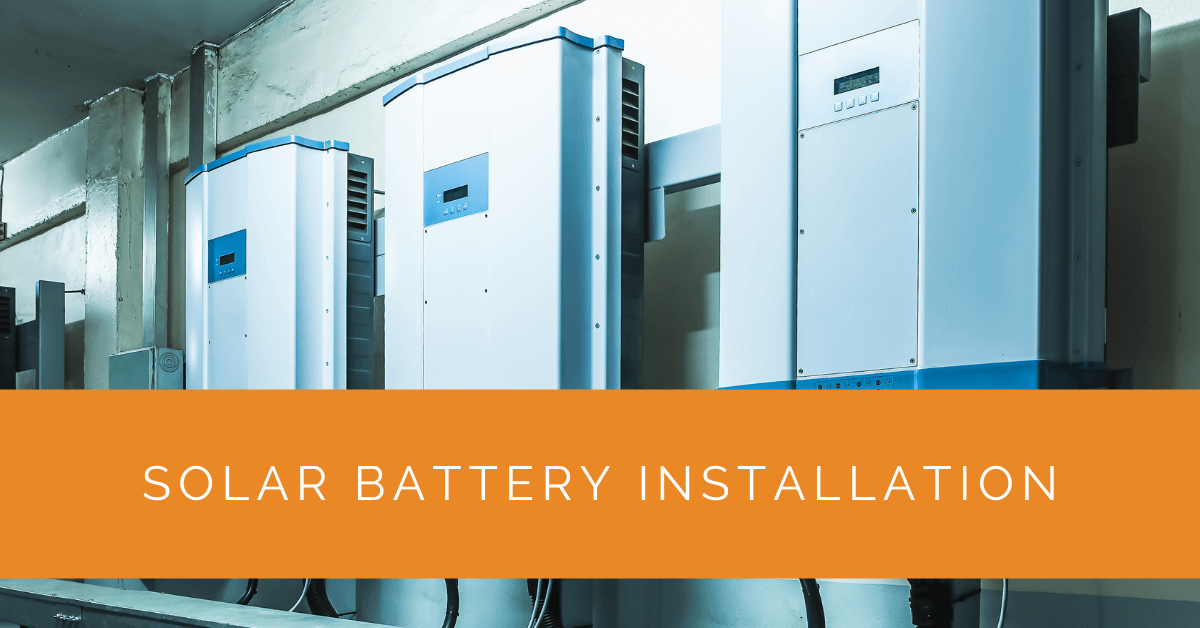
Solar battery installation adds energy storage to your solar photovoltaic system, allowing you to store excess daytime generation and use it at night or during grid outages. In 2026, battery installation costs range from $9,000 to $18,000 before incentives, with most homeowners paying $6,000 to $12,000 after applying the 30% federal Investment Tax Credit. The process involves electrical design, permitting, hardware installation, and utility interconnection.
When to Add a Battery to Solar
Grid-tied systems with favorable net metering: If your utility offers retail rates for exported solar power (net metering at 1:1), a battery adds little economic value. You already receive full credit for excess generation, making the grid your effective battery. Skip battery and invest that money in more panels.
Time-of-use (TOU) rates: If your utility charges 2–3x higher rates during peak hours (typically 4–9 PM), a battery becomes valuable. Store daytime solar generation and discharge it during peak hours to avoid expensive grid purchases. Batteries often pay for themselves in 6–10 years under aggressive TOU rates.
NEM 3.0 and low avoided-cost rates: Some utilities (especially California) have switched from retail rate net metering to lower “avoided cost” rates ($0.04–$0.08/kWh instead of $0.12–$0.16/kWh). In these markets, battery backup becomes essential to maximize the value of your solar production.
Backup power and resilience: Outages are rare in most U.S. locations, but if you live in an area prone to blackouts or want energy independence, a battery provides 8–20 hours of backup power depending on capacity.
EV charging optimization: If you drive an electric vehicle and charge during off-peak hours, a battery can discharge cheap off-peak power for EV charging, maximizing your bill savings.
Battery Options and Costs
| Battery Type | Capacity | Cost (Installed) | Lifespan | Best For |
|---|---|---|---|---|
| Lithium (LiFePO4) | 5–15+ kWh | $6,000–$20,000 | 15–20 years | Daily cycling, TOU optimization |
| Lead-acid (AGM/Gel) | 5–20 kWh | $4,000–$12,000 | 5–10 years | Off-grid, budget backup |
| Hybrid inverter (no separate battery) | Variable | $1,000–$2,000 extra | 10–15 years | Future battery addition |
| Integrated solar + battery | 5–20 kWh | $8,000–$18,000 | 10–15 years | New installations, all-in-one simplicity |
Lithium-iron-phosphate (LiFePO4) is now the dominant technology for residential solar batteries, accounting for 95%+ of new installations. They tolerate thousands of charge/discharge cycles, offer round-trip efficiencies of 85–95%, and have 15–20 year lifespans—justifying the upfront cost.
System Design and Sizing
AC-coupled vs. DC-coupled systems:
AC-coupled: A battery and inverter/charger are added to an existing grid-tied system. The solar inverter feeds AC power to the home; excess AC power charges the battery. Simpler retrofit because no DC rewiring is needed. Less efficient (3–5% losses in conversion). Most common retrofit approach.
DC-coupled: The solar array feeds DC power to the battery first. The battery then feeds a hybrid inverter for home consumption. More efficient (1–2% losses) but requires DC-wired installation, typically at new system design time. Cannot retrofit easily to existing string inverter systems.
Capacity sizing: For a home using 30 kWh/day, a 10 kWh battery covers 8 hours of nighttime consumption. For TOU optimization with peak rates from 4–9 PM (5 hours), a 5–8 kWh battery handles typical peak load. Larger systems (15+ kWh) provide 24-hour autonomy but cost significantly more.
Round-trip efficiency: Most lithium systems operate at 85–95% round-trip efficiency. A 10 kWh battery can deliver 8.5–9.5 kWh of usable energy, with 0.5–1.5 kWh lost to charging and inverter losses.
The Installation Process
Phase 1: Electrical Design (1–2 weeks)
Your installer designs the battery system based on:
- Current solar system capacity and configuration
- Your daily energy consumption profile
- Your utility’s rates (TOU schedule, backup requirements)
- Available electrical panel capacity and space
- Local codes and utility requirements
Output: Single-line diagram showing battery, inverter, breakers, disconnect switches, and grounding.
Phase 2: Permitting (2–6 weeks)
Battery installations require electrical permits and sometimes building permits, depending on jurisdiction. Battery enclosures must comply with the National Electrical Code (NEC 706 for energy storage) and local fire codes.
Permitting timelines vary: some jurisdictions approve in 1–2 weeks; others take 4–6 weeks. You may need:
- Electrical permit for battery and inverter installation
- Building permit if battery is indoors (basement, utility room)
- Utility notification for grid interconnection changes
Phase 3: Installation (1–3 days)
Battery placement: Lithium batteries are indoors—typically a utility room, basement, or garage. Temperature range 32–104°F is ideal; extreme heat or cold reduces lifespan. Battery enclosures must be well-ventilated but protected from moisture.
Electrical work: Installer runs AC wiring (for AC-coupled) or DC wiring (for DC-coupled) from the solar inverter to the battery/charging system. New breakers, disconnects, and overcurrent protection are installed per code.
Metering and monitoring: Gateway or monitoring device communicates between battery, inverter, and your utility meter. Most systems log all production, storage, consumption, and export data to a cloud dashboard.
Testing: Battery is charged, discharged, and tested to confirm proper operation before handoff.
Phase 4: Inspection and Activation (1–2 weeks)
Local electrical inspector verifies the installation meets code. Once approved, the utility is notified of the new battery. If the system has grid-forming capabilities (supporting the grid during outages), utility activation may take additional time.
Costs Breakdown
For a 10 kWh lithium battery system with hybrid inverter:
- Battery (LiFePO4): $3,500–$6,000 (installed cost ~$350–$600/kWh)
- Hybrid inverter (5–10 kW): $1,500–$3,000
- Electrical hardware (wiring, breakers, disconnects): $1,000–$2,000
- Installation labor: $2,000–$4,000
- Permitting and inspection: $500–$1,000
- Monitoring and commissioning: $500–$1,000
- Total: $9,000–$17,000 (before tax credits)
Federal Investment Tax Credit (30% through 2032): The ITC applies to standalone battery storage (as of 2023 rule changes). A $12,000 battery system qualifies for a $3,600 tax credit, reducing net cost to $8,400. This is a federal income tax credit; you claim it when filing taxes.
State incentives: Some states (California, New York) offer additional rebates or credits for battery storage, reducing costs further.
Operating a Battery-Paired System
Automatic operation: Most systems operate automatically via software. Battery charges when solar production exceeds home consumption; discharges during peak hours or grid outages. No manual switching is required.
Discharge modes: Common modes include:
- Maximize self-consumption: Use solar first; charge battery from excess; discharge battery at night to minimize grid purchases.
- Peak shaving: Discharge battery during expensive peak hours (e.g., 4–9 PM) to avoid high-rate grid consumption.
- Backup/storm mode: Keep battery charged to 80–100% in case of outages.
- Grid services mode: Participate in virtual power plants; discharge battery on utility request for demand response payments.
Monitoring: Cloud dashboards show real-time charge level, daily production, consumption, and savings. Most systems send alerts if battery charge drops unexpectedly or maintenance is needed.
Maintenance and Longevity
Lithium batteries: Require almost zero maintenance. Most warranties guarantee 70–80% capacity retention after 10 years. With proper management (avoiding full discharge cycles, moderate temperature), lifespan extends to 15–20 years.
Inverter maintenance: Inverters typically last 10–15 years and may require replacement once during the battery’s lifespan. Preventive maintenance (cleaning ventilation, checking connections) extends lifespan.
Warranty coverage: Lithium batteries typically carry 10-year warranties guaranteeing 70%+ capacity. Some manufacturers (Tesla Powerwall, LG Chem) offer up to 15-year warranties. Review warranty terms carefully.
Frequently Asked Questions
Can I add a battery to my existing solar system?
Yes. Most existing grid-tied systems can be retrofitted with a battery. If you have a string inverter, you’ll add a battery + charging inverter (AC-coupled retrofit). If your inverter is hybrid-capable, retrofit is simpler. Only certain older inverters (pre-2015) cannot accept battery retrofit; ask your installer.
How long does a battery last?
Lithium-iron-phosphate (LiFePO4) batteries last 15–20 years for residential use, assuming proper temperature control and not deep-discharging daily. Warranties typically guarantee 10 years and 70%+ capacity retention. Lead-acid batteries last 5–10 years but tolerate lower temperatures better.
Is battery backup worth it?
It depends on your electricity rates and outage frequency. Under high TOU rates (peak 3x off-peak), a battery typically pays back in 6–10 years through bill savings. Under low TOU rates or with 1:1 net metering, economic payback is 12–20+ years. For outage protection alone, payback is indefinite (insurance value, not bill savings).
What happens if the power goes out?
With a hybrid inverter and battery, your home switches to battery power automatically (usually within 50–100 milliseconds). You’ll notice a brief flicker. The battery supplies power until depleted, then you’re without power unless the battery is recharged by your solar array the next day. To maintain 24-hour outage protection, batteries must be sized for your nighttime load.
Do I need a battery to get a tax credit for solar?
No. The federal 30% ITC (through 2032) applies to solar panels alone. Battery storage qualifies for a separate 30% ITC if you meet eligibility requirements (residential, new installation). Both can be claimed on the same property, stacking benefits.
Summing Up
Solar battery installation transforms your solar system from a production-only asset into a storage and optimization tool. Modern lithium batteries cost $9,000–$18,000 installed, reduced to $6,000–$12,000 after the 30% federal ITC. Installation takes 1–3 days; permitting and activation add 4–8 weeks. Batteries pay for themselves economically under high TOU rates or low avoided-cost net metering policies. They also provide outage resilience and enable demand response participation. If your utility has favorable net metering and stable rates, a battery may not improve your ROI significantly—but for resilience and TOU optimization, battery-paired systems are increasingly valuable.
If you’re considering solar installation for your home, call Solar Panels Network USA at (855) 427-0058 for a free quote.
Updated