
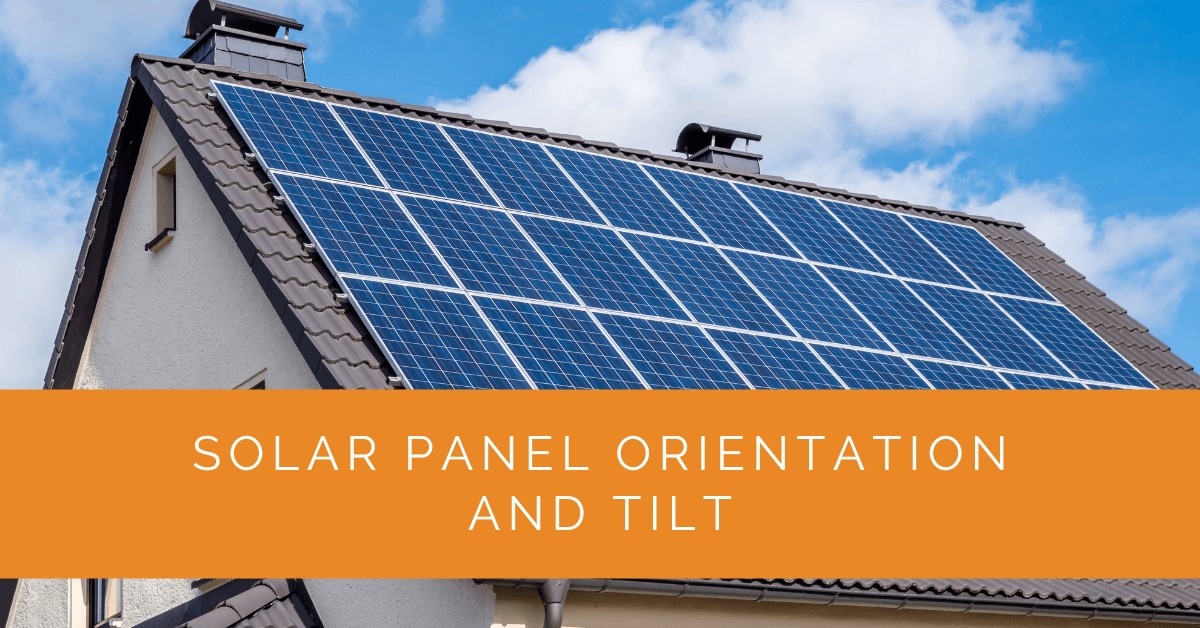
Solar panel orientation (the compass direction the panels face) and tilt angle (the slope of the panels relative to horizontal) together determine how much sunlight the panels capture over a year. For most US homes, the optimal setup is due south orientation at a tilt angle equal to your latitude — this configuration maximizes annual energy production. Deviations from the optimum reduce output by varying amounts, and the penalty is smaller than most people assume.
Optimal Solar Panel Orientation
In the northern hemisphere, the sun travels across the southern sky. Solar panels should face south — specifically, true south, not magnetic south. The difference matters: magnetic declination (the difference between true north and magnetic north) varies from about 20° west in Washington State to 15° east in Maine. If you’re using a compass to orient panels, you’ll need to adjust for your local magnetic declination. GPS-based true north references are more reliable.
How much does orientation affect output? The penalty for deviation from true south is smaller than most people expect:
True south (180°): 100% of maximum production — baseline
Southeast (135°) or Southwest (225°): approximately 95–98% of maximum
East (90°) or West (270°): approximately 80–88% of maximum
Northeast (45°) or Northwest (315°): approximately 60–70% of maximum
North (0°): approximately 40–55% of maximum (generally not cost-effective)
These figures vary with latitude and tilt angle. At southern US latitudes (Florida, Texas), east/west-facing panels perform relatively better because the sun arc is broader and lower in the sky. At northern latitudes (Minnesota, Maine), south-facing orientation is more critical for maintaining production.
East-west split orientation: Increasingly common in utility-scale solar, east-west installation (panels on both sides of a ridgeline, or split between east- and west-facing roof sections) trades some maximum production for a more even morning/evening production profile. For homeowners on Time-of-Use (TOU) rate plans where afternoon/evening electricity is most expensive, a west-facing array can be worth more in dollar savings than a south-facing array even at slightly lower total energy production. This is a key consideration in California under NEM 3.0, where export rates are highest in the late afternoon.
Optimal Solar Panel Tilt Angle
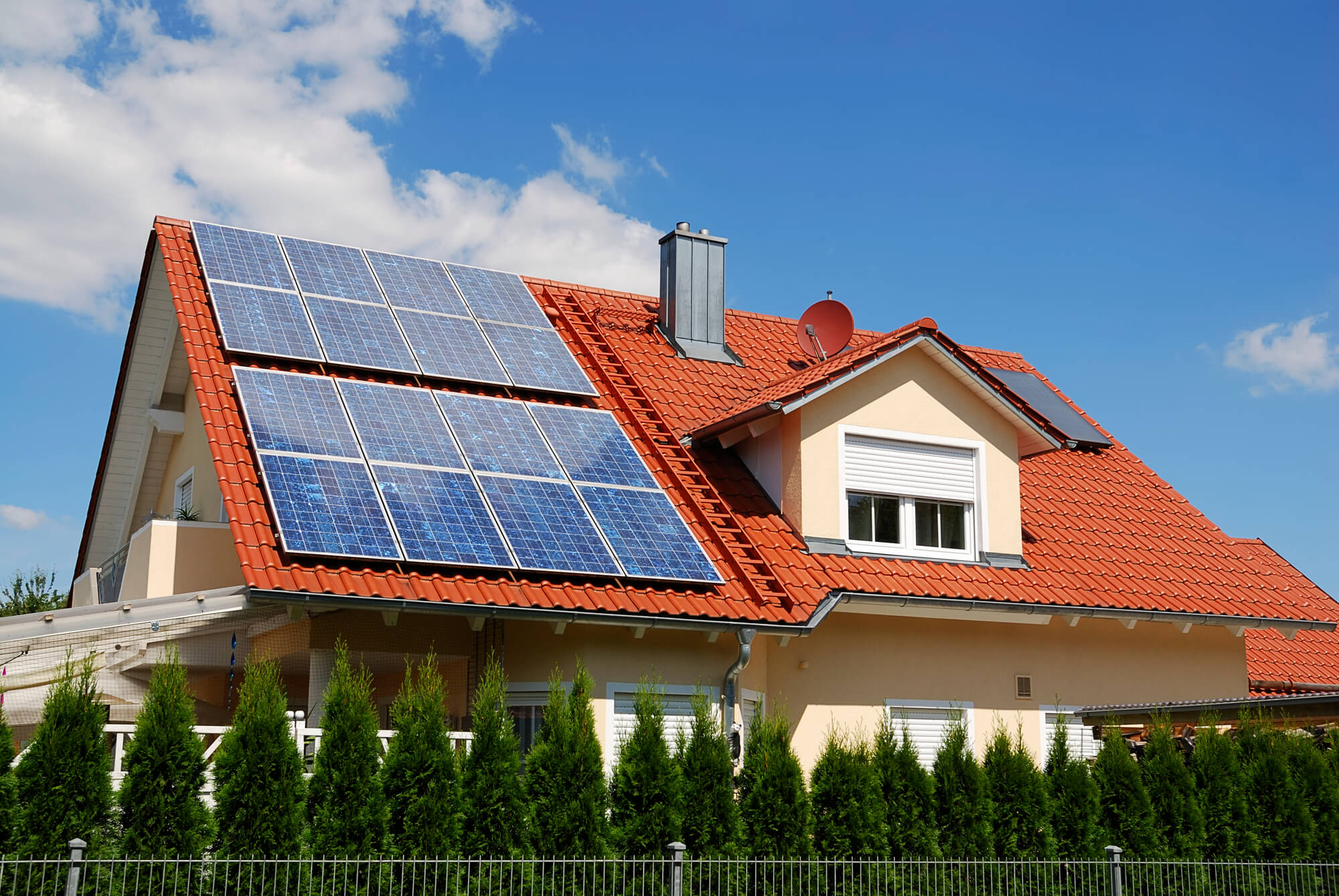
Tilt angle is the angle of the panel surface from horizontal. A flat panel (0°) faces straight up; a vertical panel (90°) faces the horizon. The optimal tilt angle for maximum annual energy production is approximately equal to your site’s latitude.
Latitude-based optimal tilt angles for major US cities:
Miami, FL (25.8°N): optimal tilt ≈ 26°
Los Angeles, CA (34.1°N): optimal tilt ≈ 34°
Atlanta, GA (33.7°N): optimal tilt ≈ 34°
Dallas, TX (32.8°N): optimal tilt ≈ 33°
Washington, DC (38.9°N): optimal tilt ≈ 39°
Chicago, IL (41.9°N): optimal tilt ≈ 42°
New York, NY (40.7°N): optimal tilt ≈ 41°
Seattle, WA (47.6°N): optimal tilt ≈ 48°
Minneapolis, MN (44.9°N): optimal tilt ≈ 45°
Anchorage, AK (61.2°N): optimal tilt ≈ 61°
In practice, roof pitch determines the tilt angle for most residential installations. Standard residential roof pitches range from 4:12 (18.4° from horizontal) to 6:12 (26.6°) to 8:12 (33.7°). These are typically within 5–15° of the optimal tilt angle for most US locations — a deviation that reduces annual production by only 2–7% compared to the theoretical optimum.
Adjusting for seasonal optimization: Steeper tilt (latitude + 15°) captures more winter sun when the sun is lower in the sky; shallower tilt (latitude – 15°) captures more summer sun. For locations with significant seasonal variation in solar resource — New England winters vs. summers — adjusting tilt seasonally is theoretically beneficial, but the complexity and cost of adjustable racking systems typically doesn’t justify the 5–10% annual gain for fixed residential arrays. Dual-axis solar trackers that adjust both tilt and orientation throughout the day are used in commercial/utility contexts but are rare in residential installations due to cost and maintenance requirements.
The Effect of Tilt Angle on Self-Cleaning
Tilt angle affects more than just solar capture — it also affects how well rain cleans the panel surface. At steeper tilts (30°+), rainwater flows across the panel surface efficiently, washing away dust, pollen, and bird droppings. At shallow tilts (below 10–15°), water pools or flows slowly, leaving mineral deposits as it evaporates. In dry climates (Arizona, Nevada, California valleys), panels mounted at very shallow tilts accumulate soiling faster and may require manual cleaning more frequently than steeply tilted installations in the same location.
In climates with snow, tilt angle affects snow shedding. Panels at 30°+ typically shed snow naturally as the panel warms up under sunlight — snow slides off the smooth glass surface. Panels at shallow tilts accumulate snow that stays until manually removed or until temperatures rise enough to melt it.
Flat Roof Installations
Commercial buildings and some residential structures have flat or low-slope roofs where the roof pitch doesn’t provide useful tilt. In these cases, racking systems with adjustable tilt legs mount the panels at the desired angle — typically 10–25° for commercial flat roofs (a compromise between production optimization and wind load on the racking structure). At steeper angles on flat roofs, rows of panels must be spaced further apart to avoid front-row panels shading the row behind them, reducing the number of panels that can be installed per unit of roof area.
Ground mounts offer the most flexibility — the installer can set any tilt angle from 0–90° at any orientation. Single-axis trackers (tracking east-to-west through the day) and dual-axis trackers (tracking east-to-west and adjusting for seasonal declination) are used on ground mounts where production optimization justifies the additional cost. Single-axis trackers increase annual output by 15–25%; dual-axis trackers by 25–35% — both at significant added cost per watt compared to fixed ground mounts.

Using PVWatts to Model Orientation and Tilt Effects
NREL’s free PVWatts Calculator lets you model any combination of orientation, tilt, location, and system size to see the projected annual energy output. Before finalizing a solar installation, run your specific address, roof orientation, and roof pitch through PVWatts and compare it to the default south-facing, latitude-tilt output. This gives you a concrete estimate of any production penalty from your actual roof conditions.
For example: A 10 kW system in Denver, CO (latitude 39.7°) south-facing at 40° tilt produces approximately 14,200 kWh/year in PVWatts. The same system west-facing at 25° (matching a typical west-slope roof pitch) produces approximately 12,100 kWh/year — 85% of the south-facing output. Whether this 15% reduction is a dealbreaker depends on your electricity consumption, utility rate structure, and whether the west-facing panels align better with your TOU rate periods.
Frequently Asked Questions
What if my roof doesn’t face south?
East, west, or mixed-orientation roofs are very common, and solar still makes financial sense on most of them. East-facing panels produce primarily in the morning; west-facing panels produce primarily in the afternoon/evening. On a flat-rate utility tariff, east and west panels produce approximately 80–88% of south-facing output — still worthwhile. On TOU rate plans where afternoon electricity is most expensive, west-facing panels may actually deliver more dollar value than south-facing panels even though they produce less total energy. Only north-facing roofs (40–55% of south output) typically don’t make economic sense.
Does a 5° or 10° difference in tilt really matter?
A 5° tilt deviation from the theoretical optimum reduces annual output by approximately 0.5–2%. A 10° deviation costs 2–5%. For most residential systems, this amounts to 200–700 kWh per year on a 10 kW system — meaningful but not a deal-breaker. The roof pitch is fixed, and the production difference from deviating from optimal tilt is usually small relative to other factors like shade, soiling, and local irradiance variability.
Should I add a tracker to maximize output?
For residential roof-mounted systems: no — tracking systems are too complex and expensive for typical residential rooftops. For ground-mounted systems with at least 20–30 kW capacity: possibly, if the additional 15–25% production from a single-axis tracker justifies the $0.15–$0.30/W added cost over the tracker’s life. Most residential ground mounts use fixed racking for simplicity and cost efficiency.
Does orientation matter differently by state?
Yes. In southern states (Florida, Texas, Arizona), where the sun arc is broad and the solar resource is abundant, east and west panels perform proportionally better relative to south-facing compared to northern states. In states with high TOU rates and summer afternoon peaks (California, parts of the Northeast), west-facing panels that capture late-afternoon sun may be economically superior to south-facing panels even at lower annual kWh production.
What’s the best tilt for a ground-mounted system?
Use your latitude as the starting point. If you want to bias toward summer production (more total kWh), subtract 10–15°. If you want to bias toward winter production (better performance in December–February), add 10–15°. Most fixed residential ground mounts are set at the homeowner’s latitude or within 5–10° of it. Run the numbers in PVWatts for your specific location to compare options.
Summing Up
Optimal solar panel orientation is true south at a tilt equal to your latitude — but most rooftops deviate from this without significant production penalties. East or west-facing panels produce 80–88% of south-facing output; deviating 10° from optimal tilt costs 2–5%. For homeowners on TOU rates, west-facing panels may actually deliver more bill savings despite lower total production. Use NREL’s free PVWatts calculator to model your specific roof orientation and tilt before installation — it takes 5 minutes and gives you realistic production estimates for your exact conditions. For a professional assessment of your roof’s solar potential and a free installation quote, call (855) 427-0058.
Updated