
Our blog is reader-supported. When you buy through links on our site, we may earn an affiliate commission. Thank you for your support!
The best camping solar panels combine portability with reliable charging power. When you’re off-grid and miles from a power outlet, a quality foldable solar panel can be the difference between a fully charged phone and a dead battery. After testing dozens of options and comparing real-world performance in backcountry conditions, we’ve found that the Jackery SolarSaga 100W stands out for its balance of output, durability, and ease of use. But whether you’re a minimalist backpacker or a car camper who needs serious charging capacity, there’s a panel in this lineup that fits your needs.
Below, we’ve reviewed eight of the best portable solar panels for camping, with detailed specifications, pros and cons, and a power calculator to help you figure out exactly how much wattage you need. Whether you’re powering phones and smartwatches or running a laptop and portable fridge on a longer expedition, you’ll find the information to make an informed choice.
Our Top Picks
| Image | Name | |
|---|---|---|
| Jackery SolarSaga 100W Bifacial Portable Solar Panel | |
| Renogy 100W Portable Solar Panel Suitcase (N-Type, 25% Efficiency) | |
| Goal Zero Nomad 200 Portable Solar Panel | |
| EcoFlow 110W Portable Solar Panel with Carry Case | |
| BioLite SolarPanel 100 Folding Solar Panel | |
| BigBlue SolarPowa 200W Solar Panel Charger | |
| Anker 625 Solar Panel with Adjustable Kickstand | |
| ROCKPALS SP003 100W Portable Solar Panel |
8 Best Camping Solar Panels
1. Jackery SolarSaga 100W Bifacial Portable Solar Panel
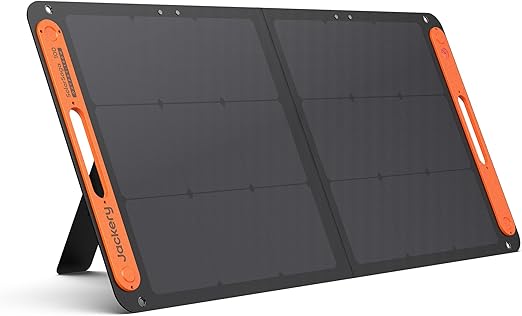
The Jackery SolarSaga 100W Bifacial stands out as the top choice for campers who want serious performance packed into a lightweight, foldable package. The bifacial design is the real game-changer here. Instead of capturing sunlight on just one side, this panel harvests energy from both the front and back surfaces, giving you up to 30 percent more power than traditional single-sided panels. That means faster charging for your power station on sunny days and better output even in less-than-ideal conditions.
Setup takes seconds. Two magnetic kickstands flip open with minimal fuss, and the TPE rubber handle makes it genuinely comfortable to carry. The panel folds to a compact size and weighs only around 8.8 pounds, which matters when you are hiking to a remote campsite. Real-world performance is solid. Reviewers consistently report charging times of 6 to 8 hours under full sun, depending on panel angle and local conditions. The IP65 waterproof rating means light rain and morning dew are not concerns.
The 100W output works well for anyone charging phones, tablets, or small power stations. If you pair it with a 200Wh to 500Wh power station, the charging speed is noticeably faster than smaller panels. You’re getting premium efficiency at 23 percent conversion, which is competitive with bigger-name brands but at a more reasonable price point. The magnetic closure is a thoughtful touch that prevents the panel from accidentally unfolding during transport.
This is the solar panel to buy if weight and performance are your priorities. The bifacial technology genuinely delivers a boost, the build quality is solid, and the magnetic design makes every setup and breakdown smooth. For backpackers and car campers who appreciate smart engineering, this is the standard to beat.
Features
- 100W bifacial monocrystalline cells with 30% more output than single-sided panels
- 23% conversion efficiency, monocrystalline silicon technology
- Folds to 17.7 x 10 x 0.7 inches, weighs 8.8 lbs
- Two magnetic kickstands, TPE rubber handle
- IP65 waterproof, ETFE lamination for durability
- MC4 connector for power station compatibility
- 12-month manufacturer’s warranty
- Charges Jackery power stations and other MC4-compatible generators
- Bifacial technology boosts output by up to 30 percent
- Super lightweight at 8.8 lbs with compact folded size
- Magnetic closure prevents accidental unfolding during travel
- Fast setup time and easy to angle for optimal sun exposure
- Built tough with IP65 waterproofing
- Higher price point than basic single-sided panels
- MC4 connector only, no integrated USB ports
- Requires compatible power station for optimal use
2. Renogy 100W Portable Solar Panel Suitcase (N-Type, 25% Efficiency)
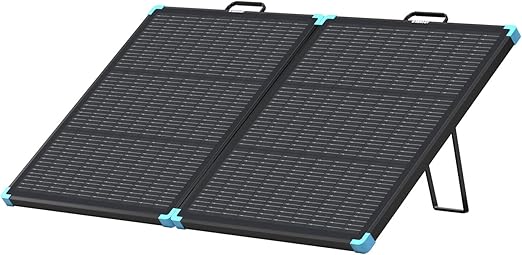
The Renogy 100W Portable Solar Panel Suitcase brings industrial-grade reliability to the camping world. This is a panel built for long-term durability, with N-Type cells and 25 percent conversion efficiency putting it among the most efficient foldable options on the market. The hail-resistant ETFE coating means it can handle whatever weather you throw at it, from desert sun to mountain hail to coastal salt spray.
What separates this panel from competitors is the engineering. The suitcase design is more substantial than typical camping panels. It weighs 8.86 pounds and folds to 20.6 by 24.6 by 1.6 inches, which is compact but still noticeable in a backpack. Once deployed, the kickstands are solid and reliable, and the IP67 waterproof rating is a genuine upgrade from IP65 on many competitors. The connector is MC4, which pairs with most power stations and solar generators on the market.
The 100W output delivers solid performance even in cloudy conditions, thanks to the N-Type cells which have better low-light performance than standard monocrystalline. Reviewers frequently mention charging times of 7 to 9 hours for a typical 300Wh power station under full sun. The build quality is noticeably heavier than some competitors, which can feel like a drawback initially but becomes an asset if you are leaving the panel in place for days at a time.
Renogy is known for warranty and customer support, and this panel backs that reputation. You are looking at 25-year output guarantee coverage, which is unusual for portable panels. If durability and efficiency matter more to you than shaving ounces from your pack, this panel deserves serious consideration.
Features
- 100W N-Type monocrystalline cells with 25% conversion efficiency
- Weighs 8.86 lbs, folds to 20.6 x 24.6 x 1.6 inches
- IP67 waterproof, hail-resistant ETFE lamination
- Adjustable aluminum kickstands with rubberized feet
- MC4 connector with XT60 compatibility via adapter
- 16BB cell configuration for improved durability
- 25-year output warranty plus 5-year full warranty
- Compatible with Jackery, Bluetti, EcoFlow power stations
- Exceptional 25% conversion efficiency with N-Type cells
- Industrial-strength IP67 waterproofing and hail resistance
- Solid build quality with reliable aluminum kickstands
- Outstanding 25-year warranty coverage
- Works with major power station brands
- Heavier than some competing 100W panels (8.86 lbs)
- Larger folded dimensions, less pocket-friendly
- Premium price reflects the industrial-grade construction
3. Goal Zero Nomad 200 Portable Solar Panel
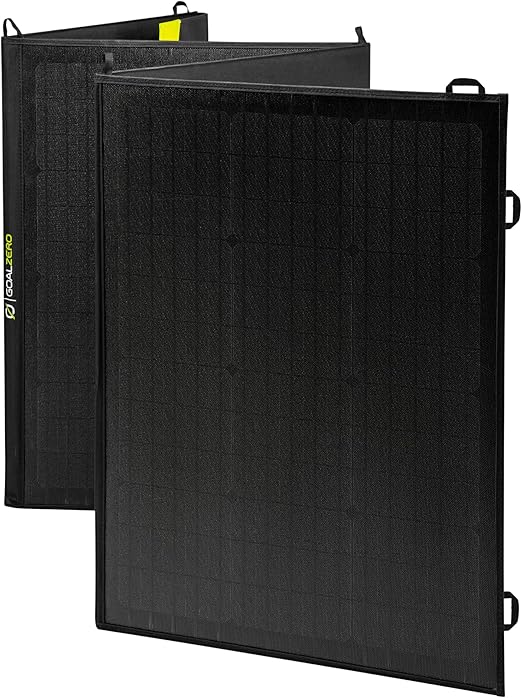
For campers with larger power needs, the Goal Zero Nomad 200 is the go-to solution. At 200 watts, it packs double the output of most portable camping panels. This is the panel you choose when you are powering multiple devices or running higher-draw equipment like small laptop chargers or CPAP machines. The four monocrystalline panels are housed in a protective case that doubles as a stand, and the whole thing folds down to roughly one quarter of its open size.
The weight is a factor. At 13.4 pounds, this is not a backpacker’s panel. This is a car camper’s tool, a van lifer’s workhorse, or a base camp solar charger. Once in place, those hanging loops and stake-down loops anchor the panel securely even in windy conditions. The case handle makes transport manageable, though it does require real space in your vehicle. The 200W output means you are charging a typical 500Wh power station in 5 to 7 hours under full sun, which is genuinely fast for a portable system.
Durability is built in. Goal Zero is an established name in portable solar, and this panel reflects their decades of experience. The protective case keeps the panels safe during travel, and the rubber feet prevent slipping on smooth surfaces. Connection options include MC4, Anderson, and USB (via a separate adapter), making this panel compatible with nearly any camping power system you might own.
Features
- 200W monocrystalline solar output
- Four panels in protective briefcase-style carry case
- Weighs 13.4 lbs, folds to roughly one quarter of open size
- Integrated stand functionality with case design
- Hanging loops and stake-down loops for secure placement
- MC4 connectors for power station compatibility
- USB adapter available separately for direct device charging
- Durable aluminum frame and rubberized feet
- 200W output, the highest in this list for serious power needs
- Protective briefcase case also functions as a stand
- Proven Goal Zero reliability and customer support
- Hanging loops and stake-down options for secure setup
- Fast charging times for larger power stations
- Heavy at 13.4 lbs, not ideal for backpacking
- Bulky when folded, requires vehicle storage space
- Expensive compared to 100W alternatives
- MC4 connector only, USB charging requires separate adapter
4. EcoFlow 110W Portable Solar Panel with Carry Case
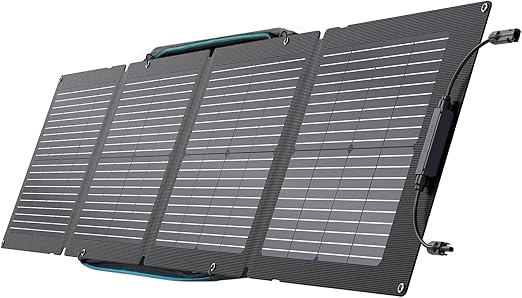
The EcoFlow 110W Portable Solar Panel sits in a sweet spot for campers who want a step up from 100W without the weight penalty of 200W panels. The 110W output edges past most competitors in its class, and the carrying case that doubles as a kickstand is a design win that saves space and setup time. The 23 percent conversion efficiency is solid, though not quite matching the premium N-Type panels, the real advantage here is the integrated case approach.
Build quality is robust. The IP68 waterproof rating is one of the best in this category, meaning dust and light submersion are both handled. The ETFE coating protects against UV degradation and weathering, which matters if your panel spends months mounted on an RV or cabin roof. The carry case is heavy-duty nylon, and when unfolded, it becomes a stable stand that holds the panel at a fixed angle. This removes the guesswork about optimal positioning and keeps the panel secure in windy conditions.
Compatibility is straightforward. The panel includes multiple output connectors, making it work with EcoFlow power stations as well as other major brands through simple adapters. Reviewers frequently mention the ease of setup and the reliability of the case-stand design. If you are looking for a panel that prioritizes convenience and waterproofing, this is a smart choice.
Features
- 110W monocrystalline solar output
- 23% conversion efficiency, good performance in partial cloud cover
- IP68 waterproof and dustproof rating
- Carrying case with integrated kickstand design
- ETFE lamination protects against UV and weathering
- Multiple connector options for broader compatibility
- MC4 connector standard with adapter compatibility
- Weighs approximately 9.5 lbs
- 110W output is higher than most 100W competitors
- IP68 waterproof rating is among the best in its class
- Carrying case doubles as a stable kickstand
- Multiple connector options for broad compatibility
- Excellent UV and weather protection
- 23% efficiency is good but not best-in-class
- Case-stand design is less flexible than adjustable kickstands
- Slightly heavier than the lightest alternatives
5. BioLite SolarPanel 100 Folding Solar Panel
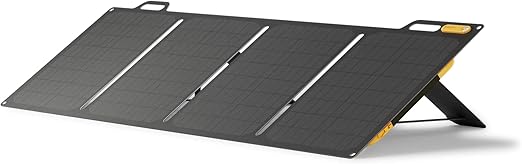
BioLite brings a different philosophy to camping solar. The SolarPanel 100 is designed for direct device charging as much as power station feeding. Built into the panel are USB-A and USB-C PD ports, which means your phone or tablet can charge directly from the sun without needing an intermediary power station. That simplicity appeals to minimalist campers who want to pack light and avoid extra gear.
The build is thoughtful. Integrated kickstands hold the panel steady without external tools, and the analog sundial helps you find direct rays for maximum output. The monocrystalline cells deliver solid efficiency, and the IP67 waterproof rating keeps moisture at bay. The panel weighs about 9.2 pounds and folds to a compact profile for vehicle storage. The design emphasizes usability over raw specs, which resonates with recreational campers more than hardcore off-gridders.
Real-world use shows the USB ports are genuinely useful. Charging a phone or small battery bank directly from the panel takes about 4 to 6 hours depending on sunlight. If you pair it with the BioLite BaseCharge power station, the full solar generator ecosystem becomes powerful. The two devices work seamlessly together, and the charging cables dock magnetically. For car campers who want integrated design and direct charging capability, this panel punches above its weight class.
Features
- 100W monocrystalline solar output
- Integrated USB-A and USB-C PD ports for direct device charging
- Analog sundial helps optimize sun exposure
- IP67 waterproof rating, weather-resistant design
- Integrated kickstands, no external tools needed
- Weighs approximately 9.2 lbs
- Folds to compact carry-friendly size
- Compatible with BioLite BaseCharge 1500 power station
- USB-A and USB-C ports allow direct device charging
- Integrated kickstands require no assembly
- Analog sundial is a clever usability feature
- Good waterproofing with IP67 rating
- Seamless integration with BioLite BaseCharge ecosystem
- USB ports mean limited power station flexibility
- No MC4 connector, proprietary design
- Requires BioLite ecosystem for full functionality
6. BigBlue SolarPowa 200W Solar Panel Charger
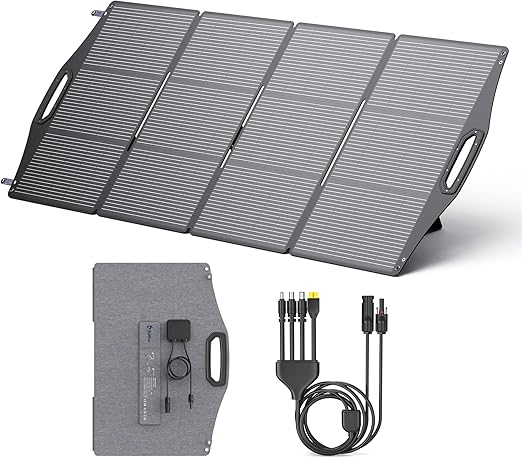
The BigBlue SolarPowa 200W is built for campers who want maximum power without the full weight of Goal Zero’s offering. At 11.46 pounds and 200 watts, this is a power panel that fits somewhere between the nimble 110W units and the heavyweight 200W briefcase. The N-Type solar cell technology pairs with 25 percent conversion efficiency to make this one of the most efficient large portable panels on the market. The efficiency gain translates to faster charging and better output in cloudy conditions.
The construction is robust. The ETFE lamination handles UV exposure and weathering without degradation, and the IP68 waterproof rating means this panel laughs at rain and morning dew. The four kickstands lock into position with audible clicks, giving you confidence the panel won’t shift in wind. Folded dimensions are 18.31 by 25.83 by 1.65 inches, which is compact for the wattage delivered. The MC4 connector is standard, and BigBlue includes adapter cables for compatibility with most power stations, including Jackery, EcoFlow, Bluetti, and Anker.
Performance in the field is strong. Reviewers consistently report charging a 500Wh power station in 4 to 5 hours under ideal sun, which is excellent for a portable panel. The biggest trade-off is weight, but that becomes less of a factor once you realize this is a tool designed for vehicles, not for backpacking. For van lifers and car campers who want serious power and durability, this panel delivers.
Features
- 200W N-Type monocrystalline solar output
- 25% conversion efficiency, high performance in all light conditions
- IP68 waterproof and dustproof rating
- ETFE lamination for UV and weather protection
- Four adjustable kickstands with locking mechanism
- Weighs 11.46 lbs, folds to 18.31 x 25.83 x 1.65 inches
- MC4 connector with XT60, 8020, and 7909 adapter cables included
- Compatible with major power station brands
- 200W output with excellent 25% N-Type efficiency
- IP68 waterproofing is top-tier for portables
- Locking kickstands provide secure wind-resistant positioning
- Adapter cables included for broad compatibility
- Fast charging times for large power stations
- Heavy at 11.46 lbs, not suitable for backpacking
- Folded size is larger than some competitors
- Premium pricing reflects the high-end components
7. Anker 625 Solar Panel with Adjustable Kickstand
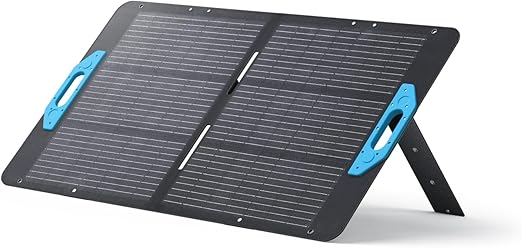
The Anker 625 Solar Panel brings engineering discipline to portable camping solar. This is a straightforward 100W panel designed to do one job well: charge your power station with speed and reliability. The 23 percent conversion efficiency is backed by Anker’s proprietary Suncast technology, which helps you angle the panel to catch direct rays. The foldable design is clean and functional without unnecessary complexity.
What makes the 625 special is Anker’s manufacturing standards. The monocrystalline cells are sorted for consistency, the MC4 connector is solid, and the adjustable kickstand holds position under tension. IP67 waterproofing keeps moisture out, and the overall construction feels precision-engineered rather than rushed. The panel weighs about 8.4 pounds, making it one of the lighter 100W options. Folded dimensions are compact enough to fit in a typical car storage area.
Anker’s track record with power banks and solar chargers gives this panel credibility. The 625 works seamlessly with Anker’s Powerhouse power stations, though it is also compatible with Jackery, Goal Zero, and other major brands through basic adapters. Reviewers appreciate the no-nonsense design and the reliable charging performance. This is a panel for campers who want solid performance without flashy features or premium pricing.
Features
- 100W monocrystalline solar cells with 23% conversion efficiency
- Anker Suncast technology for optimal sun angle positioning
- IP67 waterproof rating, weather-resistant design
- Adjustable aluminum kickstand with rubber feet
- Weighs 8.4 lbs, compact foldable design
- MC4 connector for standard power station compatibility
- 12W USB-A and 15W USB-C PD ports for direct device charging
- Works with Anker Powerhouse and other major power stations
- Lightweight at 8.4 lbs, among the lighter 100W options
- Anker’s reputation for reliability and warranty support
- Suncast technology makes positioning intuitive
- USB ports offer direct device charging option
- Good value for the quality delivered
- 23% efficiency is good but not best-in-class
- USB ports limit power station pairing flexibility
- Adjustable kickstand is less stable than locking designs
8. ROCKPALS SP003 100W Portable Solar Panel
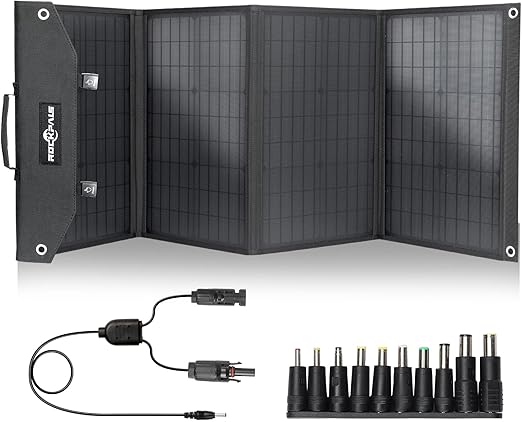
The ROCKPALS SP003 is the budget champion of this list, delivering solid 100W performance without the premium price tag. Grade A monocrystalline cells and 23 percent conversion efficiency mean this panel performs on par with panels costing significantly more. The MC4 connector is standard, and compatibility spans Jackery, EcoFlow, Bluetti, Anker, and Goal Zero power stations. If you are trying to assemble a complete solar setup without breaking the bank, this panel is a sensible starting point.
Build quality is adequate for the price point. The metal frame is sturdy, the folding mechanism is straightforward, and the rubber feet prevent sliding on smooth surfaces. The panel weighs around 9.5 pounds and folds to a reasonable carry size. IP67 waterproofing keeps it safe during typical camping weather. The kickstand design is simple but effective. This is not a premium panel, but it is not a cheaply made one either. It is a workhorse built to do the job without unnecessary cost.
Real-world charging times are respectable. Users report about 8 to 10 hours to charge a 300Wh power station from empty under full sun. The output is consistent and predictable, which matters more than peak specs for most camping scenarios. If you are new to portable solar and want to avoid a large initial investment, the ROCKPALS delivers the fundamentals without compromise.
Features
- 100W Grade A monocrystalline solar cells
- 23% conversion efficiency, proven performance
- IP67 waterproof, weather-resistant design
- Metal frame construction with rubber feet
- Weighs approximately 9.5 lbs
- Folds to compact carry-friendly dimensions
- MC4 connector for standard power station compatibility
- Compatible with major power station brands
- Excellent value, lowest price in this lineup
- Grade A cells deliver consistent performance
- Broad compatibility with major power station brands
- Solid IP67 waterproofing for the price
- Straightforward design with no unnecessary complexity
- 23% efficiency is average, not best-in-class
- Simple kickstand design is less sophisticated
- Heavier than some premium alternatives
Camping Solar Panel Buying Guide
Camping Solar Panel Types: Foldable, Rigid, and Flexible
Camping solar panels divide into three physical formats, each suited to different camping styles. Foldable panels are the dominant format for camping — they collapse to a compact flat package for transport and unfold to expose multiple panels at the campsite. The fold-out design allows the user to position the panel toward the sun and adjust angle during the day. Foldable panels range from 20W ultra-portable designs (briefcase-sized, 2–3 lbs) to 200W+ high-capacity panels (suitcase-sized, 10–15 lbs) for larger power needs. Rigid monocrystalline panels — the same format used in rooftop solar installations — are used in semi-permanent camp setups (established base camps, cabins) where the panel stays in one place for multiple days or weeks. They deliver the highest efficiency per square inch but are heavy and difficult to transport. Flexible panels are lightweight and thin, designed for surfaces where a rigid panel won’t lie flat — kayak decks, curved RV roofs, hammock tarps. They sacrifice some efficiency (17–19% vs 21–23% for rigid monocrystalline) for the portability advantage. For most car camping and backpacking applications, foldable panels in the 40–100W range hit the right balance of portability, output, and setup simplicity.
Wattage Sizing: Matching Output to Your Power Needs
Correct wattage selection prevents both undersizing (running out of power) and oversizing (carrying unnecessary weight). Start by inventorying your camping power needs. A smartphone charges from 0–100% using approximately 10–15Wh; a tablet uses 20–40Wh; a CPAP machine overnight consumes 30–60Wh; a 12V car-style cooler (compressor type) draws 40–60Wh per hour running. Total your daily energy need, add 25% for system losses, then divide by your location’s peak sun hours (Southwest US: 5–6 hours, Southeast: 4–5 hours, Pacific Northwest: 3–4 hours, overcast locations: 2–3 hours on bad days). At 5 peak sun hours, a 40W panel produces 200Wh per day — enough for 2–3 smartphone charges, some lighting, and moderate device use. At the same 5 hours, a 100W panel produces 500Wh — adding a CPAP night or running a small cooler through the day. For weekend camping with phone charging and minimal power needs, a 20–40W panel is adequate. For extended trips or higher consumption (laptops, cameras, CPAP, coolers), 60–100W is the practical range. For full basecamp setups with significant power consumption, 150–200W is appropriate.
MPPT vs. PWM Charge Controllers: Why It Matters for Camping
The charge controller converts solar panel output into the correct voltage and current for your battery or device. Two technologies dominate: PWM (Pulse Width Modulation) and MPPT (Maximum Power Point Tracking). PWM controllers are simple and inexpensive — they work by switching the panel’s connection to the battery on and off rapidly, maintaining battery voltage at the panel level. They’re adequate for small systems where panel and battery voltages closely match. MPPT controllers continuously track the panel’s maximum power point (the voltage-current combination that maximizes power output) and efficiently convert excess voltage to charging current — typically 20–30% more efficient than PWM in real conditions. For camping with a portable power station (Jackery, EcoFlow, Goal Zero, Bluetti), the controller is built into the power station — you just need a panel that delivers the right voltage range. For DIY battery setups or larger systems, choosing MPPT over PWM at the controller stage adds a one-time cost ($20–$80 premium) that pays back quickly in additional energy harvested over a season. In partial shade or morning/evening low-irradiance conditions, MPPT’s advantage over PWM is most pronounced.
Compatibility with Portable Power Stations
The most common camping solar setup pairs a foldable panel with a portable power station (PPS) — a self-contained battery-inverter unit with multiple output ports. Compatibility between panel and PPS requires matching the panel’s maximum power point voltage (Vmp) to the PPS’s solar input voltage range. Most portable power stations accept 11–25V input for 12V battery systems; larger units accept up to 60V or 150V. Panel specifications list Vmp: a 100W panel typically has a Vmp around 18–20V. Most PPS units in the 200–1,000Wh range accept this voltage. Check the PPS manufacturer’s solar input specs before purchasing a panel — some units limit input wattage (a 500Wh EcoFlow RIVER 2 Pro accepts up to 220W of solar input, while an EcoFlow DELTA Mini accepts up to 300W). Connecting panels in series (positive to negative to positive) adds voltages — two 20V Vmp panels in series deliver 40V to the PPS, which must be within the PPS’s maximum input voltage. Connecting panels in parallel (positive to positive, negative to negative) adds currents while keeping voltage at the single-panel level. Most PPS units connect easily to foldable panels via MC4 connectors with an included or separately purchased adapter cable.
Weight and Packability for Backpacking vs. Car Camping
The weight-to-power tradeoff is the central design tension in camping solar panels. Backpackers who carry everything on their back optimize for watts-per-pound; car campers who drive to a site optimize for total output at a reasonable price. For backpacking, panels weighing under 2 lbs for 20–40W are the realistic range — anything heavier than 3 lbs for its wattage output represents poor value for pack weight. Foldable panels in the 20–40W range from Goal Zero, BigBlue, and Anker weigh 1.5–2.5 lbs and fold to 10–14 inch profiles that fit in or strap to a pack. Car campers can realistically carry 100W panels weighing 5–10 lbs without meaningful hardship. The packability also includes the folded dimensions: a panel that folds to 12×8 inches is easy to store in a vehicle; a panel that only folds to 24×18 inches takes up significant cargo space. Carrying case quality matters for longevity: panels with padded zipper cases protect the panel cells from the sharp corners and compression that damage panels in the bottom of a gear bag. Check that handles and kickstands (for propping the panel toward the sun) are robust — these are the first components to fail on cheaper panels.
Weather Resistance and Durability for Outdoor Conditions
Camping panels operate in conditions ranging from desert heat to alpine cold, morning dew to afternoon thunderstorms. Panel cells themselves are robust — monocrystalline silicon handles temperature cycling and UV exposure well. The vulnerable components are the junction box (where cables exit the panel), the cable connections, and on foldable panels, the fabric housing and seam sealing. ETFE (ethylene tetrafluoroethylene) laminated panels are more UV-stable and abrasion-resistant than PET laminated alternatives — relevant for panels that are handled repeatedly across many camping trips. Foldable panel canvas or nylon carriers should be treated as camping gear, not office equipment: check that seams are reinforced, zippers are weather-resistant, and the carry handle is stitched to a structural panel of the carrier rather than just the fabric. The output cables should be MC4 format (industry standard, weatherproof) rather than proprietary connectors — proprietary cables that become unavailable end the panel’s useful life even if the cells still work. For monsoon-season camping or multi-day trips through wet conditions, store the panel in a dry bag when not in use — most camping panels are splash-resistant but not fully waterproof at the cable junction points.
Output Ports and Device Compatibility
Camping solar panels are available with integrated USB ports, DC barrel outputs, or bare MC4 cables (for connection to a separate charge controller or power station). Panels with integrated USB-A and USB-C ports allow direct device charging without a separate charge controller — useful for ultra-minimal setups where you’re charging phones and small devices only. Integrated USB ports typically output 5V at 2–3A per port, adequate for phones and small electronics but insufficient for large tablets or laptops. DC output ports (barrel connectors, Anderson Powerpole) connect to charge controllers for battery bank charging. MC4 outputs provide the most flexibility — compatible with the widest range of power stations, charge controllers, and combiner boxes. If you’re using a portable power station as the battery, bare MC4 or an MC4-to-XT60 adapter cable is the cleanest solution. For multiple device types, a panel with both integrated USB ports and an MC4 output handles both direct device charging and battery bank charging from the same panel. Avoid panels with USB ports as the only output if you plan to eventually upgrade to a power station — you’ll need an MC4 output to maximize the power station’s solar charging capability.
Price Tiers and Value by Camping Style
Camping solar panels span from under $30 to over $400, with the tiers reflecting genuine differences in efficiency, durability, and reliability. Budget tier (under $60): basic foldable designs with ETFE or PET cells at 20–40W, adequate USB ports, minimal accessories — adequate for occasional weekend camping with light power needs and manageable expectations around durability. Mid-range ($60–$150): quality monocrystalline ETFE panels at 60–100W, MPPT-compatible outputs, proper MC4 connectors, padded carry cases, kickstands for angling — the right choice for regular campers who want reliable performance across multiple seasons. Premium ($150–$300): high-efficiency N-type or HJT cells, 100–200W, robust construction with multiple output options, multi-year warranties — appropriate for extended expeditions, frequent users, or setups where panel failure has high consequences. For most weekend campers pairing a panel with a 200–500Wh portable power station, the mid-range tier at $80–$130 for a 100W foldable panel delivers the best value. The additional output of a premium panel rarely justifies double the cost for recreational camping use.
Frequently Asked Questions
Can I use a camping solar panel to charge a power station?
Yes, absolutely. Most camping solar panels have MC4 connectors that plug directly into power station solar input ports. A 100W panel will charge a 1000Wh power station in about 10-12 hours of good sunlight. Check that your panel’s connectors match your power station’s input.
How long does it take to charge a phone with a camping solar panel?
With a 100W panel in direct sun, expect 2-4 hours for a full phone charge. A 28W panel will take 6-10 hours. A 5W panel will take 24+ hours. These timelines assume the panel is angled toward the sun and the weather is clear. Cloudy conditions will double or triple the charging time.
What’s the difference between monocrystalline and polycrystalline camping solar panels?
Monocrystalline panels (which all the panels in this roundup are) are more efficient, lighter, and more expensive. Polycrystalline panels are heavier, less efficient, and cheaper. For camping—where every ounce counts and you want maximum output in a small footprint—monocrystalline is the clear winner. You won’t find many polycrystalline portable panels anymore.
Can camping solar panels work on cloudy days?
They work, but with drastically reduced output. On a cloudy day, expect 10-30% of the panel’s rated wattage. That means a 100W panel might put out 10-30W. This is why weather prediction matters so much for camping solar. Clear skies are essential for meaningful charging.
Do I need a charge controller with a camping solar panel?
If you’re charging a power station, the station has a built-in charge controller—no extra equipment needed. If you’re charging directly to a battery or device, most panels include protection circuitry to prevent overcharging. Read the specs to confirm, but generally, portable camping solar panels are designed to be plug-and-play without additional controllers.
What’s the best solar panel for a multi-week camping trip?
For trips longer than a week, pair a 100W+ solar panel with a mid-capacity power station (1000-2000Wh). The power station acts as a battery buffer that keeps your devices charged even on cloudy days or when the sun isn’t at peak angle. The 100W Jackery or ROCKPALS panel with a Jackery or EcoFlow power station is the setup that balances weight, cost, and reliability for extended trips.
Summing Up
The best camping solar panel depends on your power station or battery. If you’re running a Jackery Explorer, the SolarSaga 100W bifacial is the natural match. Renogy’s N-Type suitcase is the value leader for most setups. For serious off-grid camping with high draw devices, the BigBlue 200W gives you the charging speed to keep everything topped up. Whatever you pick, keep the panel angle adjusted toward the sun throughout the day — a well-positioned 100W panel in peak sun consistently outperforms a poorly angled 200W one.
If you’re also thinking about solar panels for your home, call (855) 427-0058 for a free quote — it takes just a few minutes to find out what installation would cost and save you in your area.
Updated