
Our blog is reader-supported. When you buy through links on our site, we may earn an affiliate commission. Thank you for your support!
Solar-powered food dehydrators are an intriguing concept: use the same sun that dries food naturally to power a fan and heating element that does it more reliably and quickly. In practice, the options range from simple passive solar dehydrators (essentially enclosed racks that use the sun’s heat directly) to electric dehydrators that run on solar-charged batteries. Both have their place depending on your goals and setup.
This guide covers eight of the best options, including both passive solar designs for off-grid homesteaders and conventional electric dehydrators that pair well with solar power systems.
Our Top Picks
| Image | Name | |
|---|---|---|
| Nesco FD-75A Snackmaster Pro | |
| Excalibur 3926TB 9-Tray Dehydrator | |
| Colzer Portable Solar Food Dehydrator | |
| LEM Products Mighty Bite 5-Tray Dehydrator | |
| DIY Passive Solar Dehydrator Kit | |
| Tribest Sedona Express SD-6280 | |
| Cosori Premium CP267-FD Dehydrator | |
| Magic Mill MFD-7500 Commercial Dehydrator |
8 Best Solar Powered Food Dehydrators
1. Nesco FD-75A Snackmaster Pro (Solar-Compatible Electric)
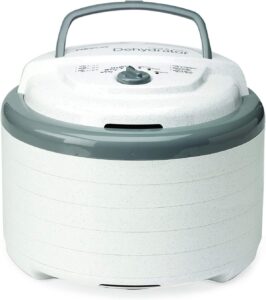
The Nesco FD-75A is one of the best-regarded food dehydrators in its price range, and its 600-watt draw makes it one of the more practical choices for running on a solar power system. With a generator or whole-home solar system, 600 watts is manageable. It dehydrates jerky, fruits, vegetables, and herbs efficiently across its five expandable trays.
The patented Converge-Flow drying system forces air through the center of the unit and outward across each tray, eliminating the need to rotate trays during drying as with top-down or bottom-up designs. An adjustable thermostat covers 95 to 160°F for different foods. It’s a reliable, well-reviewed unit that will work with any solar power system capable of supplying 600 watts.
If you’re using rooftop solar with a battery bank and inverter, this is the kind of appliance you can run during the sunny afternoon hours when your system has surplus power, drying your harvest without drawing grid power.
For dedicated off-grid use or portable solar setups, the power draw is too high for small battery systems. But for homeowners with grid-tied solar or a robust off-grid system, the Nesco is an excellent choice.
Features
- 600-watt heating element
- 5 trays (expandable to 12)
- Converge-Flow drying technology
- 95-160°F adjustable thermostat
- 1.5 sq ft of drying space per tray
Pros:
- No tray rotation needed
- Expandable to 12 trays for large batches
- Reliable and well-reviewed
- Compatible with home solar systems
Cons:
- 600W too high for small portable solar setups
- Not designed for direct solar use
2. Excalibur 3926TB 9-Tray Electric Dehydrator
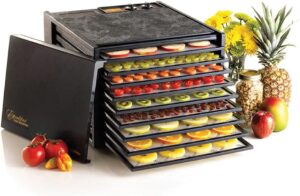
Excalibur is the professional standard in home food dehydration, and the 3926TB’s 600-watt draw, nine large trays, and horizontal airflow design make it the preferred unit for serious food preservation enthusiasts. The horizontal airflow dries food more evenly than radial designs, and the 15 square feet of drying space handles large harvest batches in one session.
For solar system users, 600 watts is exactly the same draw as the Nesco, making it compatible with robust home solar systems or off-grid systems with battery banks rated for the load. The main advantage over the Nesco is the significantly larger drying capacity and more even drying without any tray management.
The 26-hour timer and adjustable thermostat from 105 to 165°F cover every food type. This is the unit that fruit orchards and small-scale food producers use, and it performs at that level. If capacity matters and you have the solar power to run it, the Excalibur is the best electric dehydrator on this list.
Price is higher than most competitors, but for serious food dehydration use the investment is worthwhile.
Features
- 600-watt, 9 trays, 15 sq ft drying space
- Horizontal Parallex airflow
- 26-hour timer
- 105-165°F thermostat range
- Dishwasher-safe polyscreen trays
Pros:
- 15 sq ft drying space for large batches
- Even horizontal airflow
- Professional-grade performance
- 26-hour timer
Cons:
- Highest price on this list
- 600W requires substantial solar capacity
3. Colzer Portable Solar Food Dehydrator
The Colzer portable solar dehydrator takes a different approach: a small direct-solar unit with a built-in solar panel that powers a low-wattage heating element and fan directly. This is a true off-grid solar dehydrator that requires no separate power system, just sunlight.
The limitation is capacity and temperature control. Direct solar-powered dehydrators produce lower, more variable temperatures than mains-powered units, which makes them better suited for herbs, flowers, and thin fruit slices than for meat jerky (which requires sustained higher temperatures for food safety). The three-tray design handles small batch dehydration for homesteaders and campers.
For true off-grid use without any power infrastructure, this is the most accessible option. It won’t match the throughput or food safety assurance of a high-power electric unit, but for herbs and garden produce it works reliably with nothing but sun.
Features
- Direct solar-powered (no grid or battery required)
- Built-in solar panel
- 3 trays for small batches
- Variable temperature based on sun intensity
- Portable for camping and homesteading
Pros:
- True off-grid solar operation
- No infrastructure needed
- Portable for camping
Cons:
- Variable temperatures — not ideal for meat jerky
- Small capacity
- Dependent entirely on sun availability
4. LEM Products Mighty Bite 5-Tray Dehydrator
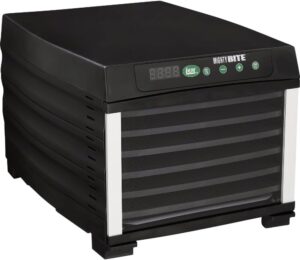
The LEM Products Mighty Bite runs at 320 watts, making it one of the more power-efficient electric dehydrators on the market while still delivering adequate drying performance across its five trays. The lower wattage makes it more compatible with mid-sized portable solar setups like a 200-watt panel with a 100Ah battery bank.
The top-mounted fan and heating element create downward airflow across the trays. Unlike the Nesco Converge-Flow design, this requires occasional tray rotation for even results, but the five trays provide 7.5 square feet of drying space, suitable for moderate harvest quantities.
The 160°F maximum temperature reaches safe jerky-making territory, and the adjustable thermostat gives control over the drying speed for delicate herbs and flowers at lower settings. For solar system users who need a capable dehydrator at lower wattage than the Nesco or Excalibur, the LEM is a worthwhile consideration.
Features
- 320 watts (lower than most competitors)
- 5 trays, 7.5 sq ft drying space
- Top-mounted fan for even airflow
- 95-160°F thermostat
- BPA-free trays
Pros:
- Lower 320W draw suitable for mid-sized solar setups
- Reaches jerky-safe 160°F
- Reasonable capacity for the wattage
Cons:
- Requires tray rotation for even drying
- Less efficient than horizontal airflow designs
5. DIY Passive Solar Dehydrator (Plywood and Screen Kit)
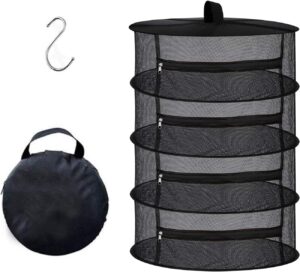
For true zero-electricity solar food dehydration, a passive solar dehydrator uses the sun’s heat directly, trapped in a dark-painted wooden box with screen trays and vents that create natural convection airflow. No motor, no heating element, no power of any kind. Just sun, wood, glass, and screens.
Pre-cut passive solar dehydrator kits are available on Amazon and at homesteading supply stores. They typically include the wooden frame components, mesh screens for the trays, and a glazed front panel. Assembly takes a weekend afternoon. The resulting dehydrator produces temperatures of 100 to 130°F in full sun, which is appropriate for herbs, fruits, and vegetables but not reliable enough for meat jerky.
The advantages are obvious: no running costs ever, no moving parts to fail, and no power infrastructure required. The trade-offs are weather dependency (clouds halt drying), slower drying times than electric units, and limited food safety temperature range. For herbs, mushrooms, and sliced fruits, passive solar works beautifully. For serious food preservation operations including meat, a powered unit is necessary.
Features
- Zero electricity requirement
- Natural convection airflow via vents
- 100-130°F passive solar temperature range
- DIY assembly from kit components
- Unlimited lifespan with no mechanical parts
Pros:
- Zero operating cost ever
- No power infrastructure needed
- Simple and durable with no moving parts
Cons:
- Weather dependent — stops in clouds
- Not suitable for meat (food safety concern)
- Slower than electric units
6. Tribest Sedona Express SD-6280
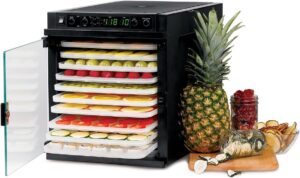
The Sedona Express is a premium electric dehydrator with one important feature for solar users: it has both a fast mode (167°F, high airflow) and a raw food mode (118°F, low airflow) selectable via its digital controls. The lower-wattage raw food mode can run at approximately 400 watts, which is more manageable on mid-sized solar systems than full-power operation.
It has 11 stainless steel trays, BPA-free construction throughout, a 10-hour programmable timer, and glass door for monitoring without opening. The dual-mode design makes it more versatile than single-setting units, and the build quality is significantly higher than budget plastic designs.
Price is premium. This is the unit for homesteaders who take food preservation seriously and want a dehydrator that will last 20 years with proper care. The stainless steel trays and glass door resist staining and retain no odors, which matters if you’re cycling through batches of different foods.
Features
- 11 stainless steel trays
- Dual-mode: 400W raw food or 600W fast mode
- BPA-free, glass door
- 10-hour programmable timer
- 85-167°F temperature range
Pros:
- Stainless steel trays for long-term durability
- Raw food mode at lower wattage
- Premium build quality
- Wide temperature range
Cons:
- Highest price on this list
- Full-power mode at 600W still demands robust solar
7. Cosori Premium Dehydrator CP267-FD
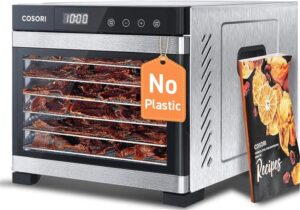
The Cosori Premium dehydrator is the best value electric unit on this list for moderate solar systems. At 600 watts, it matches the Nesco and Excalibur in power draw but provides 6.5 square feet of drying space across six stainless steel trays. The square tray design maximizes usable surface area compared to round competitors, and the rear horizontal fan creates even airflow without tray rotation.
It has a digital timer up to 48 hours, adjustable from 95 to 165°F, and includes a recipe book. The stainless interior is easy to clean and resists staining. For homeowners with a rooftop solar system or robust off-grid battery bank, this is a capable and well-priced electric dehydrator that performs at a higher level than its price point suggests.
Features
- 600 watts, 6 stainless trays
- 6.5 sq ft drying space
- Rear horizontal fan, no tray rotation needed
- 48-hour digital timer
- 95-165°F temperature range
Pros:
- Best value-to-performance ratio on this list
- Square trays maximize space
- Stainless steel construction
- No tray rotation needed
Cons:
- 600W requires robust solar system
- Digital controls can be confusing initially
8. Magic Mill MFD-7500 Commercial Dehydrator
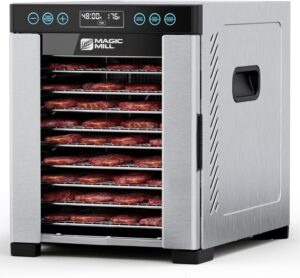
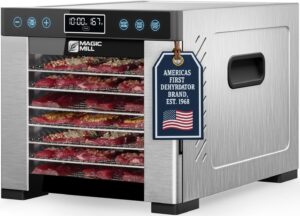
The Magic Mill MFD-7500 is the high-capacity option on this list, with 10 large stainless trays providing 16.5 square feet of drying space and a 1000-watt heating element for faster drying times. This is a commercial-grade dehydrator in a home-friendly form factor, suited for homesteaders processing large garden harvests or small food businesses.
At 1000 watts, it requires a solar system capable of sustained 1000+ watt output, which means a substantial rooftop array with inverter, not a portable panel. But for homesteaders with real solar infrastructure, the throughput advantage of the Magic Mill over lower-wattage competitors can significantly reduce drying time and process larger quantities of food in a single session.
If you’re preserving 50 pounds of apples or running batch after batch of jerky, the capacity matters. For normal household food dehydration, the Cosori or Nesco is more than adequate.
Features
- 1000 watts, 10 trays, 16.5 sq ft
- Stainless steel construction throughout
- 95-167°F digital thermostat
- 24-hour timer
- Commercial-grade capacity
Pros:
- Largest capacity on this list
- Commercial-grade throughput
- Stainless construction
Cons:
- 1000W requires substantial solar infrastructure
- Overkill for typical household use
Solar Powered Food Dehydrators Buying Guide
How Solar-Powered Food Dehydrators Differ from Grid-Powered Models
Solar food dehydrators operate on fundamentally different principles than electric units, and understanding the distinction sets appropriate expectations. Electric dehydrators heat air with a resistance element and circulate it with a fan, maintaining a precise setpoint temperature (135–165°F) regardless of ambient conditions or time of day. This control produces consistent results across batches and in any season. Solar dehydrators work by two mechanisms: passive solar designs that use the greenhouse effect in an enclosed box to heat air naturally (with no electrical components), or hybrid solar designs that use a photovoltaic panel to power a small heating element or fan. Passive solar dehydrators are fully off-grid and require no electricity, but temperatures fluctuate with sun intensity (typically 100–140°F in good conditions, lower on cloudy days) and drying times are longer and less predictable than electric units. Hybrid solar dehydrators provide more consistent performance but still depend on solar availability and may include battery backup for nighttime drying continuation. For off-grid homesteaders and preparedness-oriented buyers seeking food preservation without grid dependency, solar dehydrators are valuable tools. For consistent high-volume food preservation where batch predictability matters, electric dehydrators are more reliable.
Passive Solar Box Design: How It Heats Food
Passive solar box dehydrators work through three mechanisms: a glazed transparent cover (glass or polycarbonate) allows solar radiation to enter and traps re-radiated infrared heat inside — the greenhouse effect; a dark-colored interior absorbs incoming radiation and converts it to heat; and natural convection draws fresh air through bottom vents, passes it over the food trays absorbing moisture, and exhausts humid air through top vents. The efficiency of this system depends heavily on design quality. An insulated back panel and side walls reduce heat loss. A reflective concentrator panel (essentially a flat mirror angled toward the glazing) can increase incoming radiation by 30–50%, meaningfully raising interior temperature and drying speed. Mesh screen tray inserts allow air circulation over and under the food surfaces simultaneously, accelerating moisture removal. The critical temperature range for food safety in dehydration is 130–140°F for most fruits and vegetables — this kills surface pathogens and achieves the moisture removal necessary for shelf stability. Well-designed passive solar dehydrators regularly exceed this range in good summer sun; poorly designed or cloudy-day operation may fall below it, requiring longer processing times to achieve safe moisture levels.
Hybrid PV-Powered Designs: Fan-Assisted Performance
Hybrid solar dehydrators add a photovoltaic panel — typically 5–20W — to power a small circulation fan, a low-wattage heating element, or both. A fan-only addition to a passive solar box design significantly improves performance by reducing boundary layer thickness (the stagnant humid air layer immediately adjacent to food surfaces), speeding moisture evaporation rate by 30–50% compared to natural convection alone. A combined fan and heating element provides more consistent temperatures on partially cloudy days when solar gain alone falls below the effective drying threshold. Battery-backed hybrid designs allow drying to continue through the night or on overcast days, though most small dehydrator batteries provide only a few hours of backup. The photovoltaic panel in hybrid designs is typically integrated into the lid or top surface — appropriately positioned for direct sun incidence when the dehydrator is placed in a sunny outdoor location. For buyers who want the off-grid character of solar drying without the slower results and weather dependency of purely passive designs, hybrid models are a meaningful middle ground — still relying primarily on solar thermal gain but with electrical assistance for air circulation.
Tray Capacity and Batch Sizing for Practical Use
Solar food dehydrator capacity is measured in tray count and tray area. Standard trays range from 10×10 to 14×14 inches; a 4-tray unit with 12×12 inch trays provides approximately 4 square feet of drying area. A pound of sliced vegetables or fruit covers roughly 1–1.5 square feet of tray area in a single layer (the only correct loading method — overlapping slices don’t dry evenly). So a 4-tray unit handles approximately 3–4 pounds of fresh produce per batch. For typical home use — drying summer garden surplus, making jerky from a pound or two of meat, or preserving herbs — 4–6 trays is adequate. For serious food preservation, canning-season volume, or homestead use where drying large harvests in parallel is required, 8–12 tray units or building/buying multiple units is more appropriate. Solar dehydrators with removable divider screens that convert each tray level into two half-height levels effectively double tray count for small, thin-cut items like herbs and thin fruit slices. One practical consideration: in passive solar designs, the trays closest to the transparent top receive the most direct radiation and may dry faster than trays at the bottom — rotate trays midway through drying for even results.
Food Safety: Temperature Monitoring and Pre-Treatment
Food safety in solar dehydration requires attention to temperature management in a way that electric dehydrators with precise thermostats handle automatically. The USDA recommends minimum temperatures of 130°F for vegetables, 130–140°F for fruits, and 160°F for meat jerky. In passive solar designs, actual temperatures fluctuate with sun conditions and ambient temperature — morning temperatures may be 10–15°F lower than peak temperatures at noon. For this reason, many solar food preservation experts recommend pre-treating produce with brief blanching (vegetables) or sulfuring/ascorbic acid dipping (fruits) before solar drying to minimize microbial risk during the variable early stages of the drying process. For meat jerky, USDA guidance recommends heating meat to 160°F internally before dehydrating — a step that can be accomplished in a conventional oven before moving to the solar dehydrator for the moisture-removal stage. A dial thermometer with a probe hung inside the dehydrator chamber (not touching the food) allows monitoring of actual chamber temperature throughout the day, enabling you to respond to temperature drops (moving to a sunnier position, adding a reflector panel, or returning to conventional finishing) when conditions deteriorate.
Construction Materials and Durability for Outdoor Use
Solar dehydrators spend their operating time outdoors in direct sun — conditions that test material durability. UV degradation is the primary long-term concern: acrylic glazing yellows and becomes brittle within 3–5 seasons of UV exposure; tempered glass holds up indefinitely but is heavier and more fragile if dropped; polycarbonate (twin-wall or solid) offers the best balance of UV stability and impact resistance, making it the preferred glazing material for long-service-life designs. The cabinet body material determines weight and longevity: plywood with exterior-grade paint or waterproof coating works well for DIY builds or semi-permanent outdoor setups but requires periodic repainting to prevent moisture damage. Cedar and redwood are naturally rot-resistant and appropriate for permanent outdoor installations. Polypropylene and ABS plastic units resist moisture and UV better than wood but may degrade in the highest-UV summer conditions without UV stabilizers added during manufacturing. Stainless steel tray frames and screen mesh are far more durable than galvanized or aluminum in the acidic environment created by the moisture and organic acids released during food drying.
DIY vs. Commercial: Build vs. Buy Considerations
Solar food dehydrators occupy an interesting space where DIY builds are very common and commercially available units are relatively limited compared to electric dehydrators. Commercial passive solar dehydrators typically cost $80–$200 for small to medium units; building a comparably capable unit from plans using plywood, polycarbonate glazing, and screen material typically costs $40–$100 in materials, plus several hours of construction time. DIY builds allow customization: tray dimensions matched to your typical harvest size, glazing angle optimized for your latitude, reflector panels sized for your sun conditions. Kits combining design plans with pre-cut polycarbonate and hardware are available in the $30–$60 range. Commercial units offer convenience and a finished appearance — important for buyers who want to start dehydrating without a construction project. For hybrid PV-powered units with fans and solar panels, commercial options are more practical than DIY equivalents unless you’re comfortable with basic electrical wiring. The most capable commercial solar dehydrators for off-grid homestead use — with large tray capacity, quality glazing, and reflector panels — typically cost $150–$300, a price point where DIY builds provide meaningful savings for buyers willing to spend the construction time.
Complementary Uses Beyond Food: Herbs, Seeds, and Crafts
Solar dehydrators serve purposes beyond food preservation that many buyers don’t initially consider. Herb drying is one of the highest-value applications: fresh culinary and medicinal herbs are typically dried at 95–115°F — lower than most food applications — and solar dehydrators with their somewhat variable temperatures are ideal for this use. A solar dehydrator can process an entire garden herb harvest in a single long summer day. Seed saving is another application: vegetable and flower seeds that need to be fully dried before storage dehydrate beautifully in a low-temperature solar chamber without the overheating risk that would reduce viability with higher electric dehydrator settings. Floral crafts (drying flowers, leaves, and pods for wreaths, arrangements, and decorations) are naturally suited to solar drying’s slower, gentler process — blooms that brown quickly in an electric dehydrator at 130°F hold their color better at solar temperatures. Soap and fermentation curing are additional applications where gentle warmth in the 80–100°F range accelerates the process — the solar dehydrator chamber is naturally in this range on milder spring and fall days when temperatures are too low for efficient food drying but ideal for these alternative uses.
Frequently Asked Questions
Yes, if the generator’s watt output and battery capacity match the dehydrator’s requirements. A Jackery 1000 (1002Wh) can run a 600-watt dehydrator for about 1.5 hours on battery alone. With simultaneous solar charging from a 200W panel, you can extend that significantly on sunny days. For full drying cycles of 8 to 12 hours, a larger generator or multiple panels are needed.
No. Food safety guidelines require meat to reach at least 160°F during dehydration to eliminate pathogens. Passive solar dehydrators typically reach 100 to 130°F, which is below the safe threshold for meat and poultry. Use passive solar dehydrators for herbs, fruits, and vegetables only. For jerky and other meat products, use a powered electric dehydrator that can reliably reach and sustain 160°F.
Electric dehydrators powered by solar run at the same speed as grid-powered units, typically 6 to 12 hours for most foods depending on moisture content and thickness. Passive solar dehydrators run slower because temperatures are lower and variable, often 2 to 3 times longer than electric units for the same food. In either case, thin slicing and low-moisture foods dry fastest.
Summing Up
Solar-powered food dehydrators let you preserve fruits, vegetables, and jerky without touching the grid — ideal for homesteaders, off-grid kitchens, and anyone looking to cut energy use. The models above range from compact portable units to full-capacity dehydrators built for serious preservation work.
If you’re also thinking about solar panels for your home, call (855) 427-0058 for a free quote — it takes just a few minutes to find out what installation would cost and save you in your area.
Updated