

Our blog is reader-supported. When you buy through links on our site, we may earn an affiliate commission. Thank you for your support!
Solar-powered lawn mowers are a niche but growing category that ranges from robot mowers with solar-assisted charging to conventional electric mowers that work well paired with home solar systems. The right choice depends on your lawn size, how much automation you want, and whether you’re focused on eliminating cord hassle or reducing electricity costs.
This guide covers the best options across both categories: robotic solar-assisted mowers and conventional electric mowers that are natural partners for solar-powered homes.
Our Top Picks
| Image | Name | |
|---|---|---|
| 1. Husqvarna Automower 315X (Solar-Compatible Robot Mower) | |
| 2. Worx Landroid M700 Plus (Robot Mower) | |
| 3. EcoFlow DELTA Pro + Greenworks 40V Cordless Mower | |
| 4. Husqvarna Solar Hybrid Automower 430XH | |
| 5. Greenworks Pro 60V Self-Propelled Mower | |
| 6. RYOBI 40V HP Brushless Mower | |
| 7. Ego Power+ LM2102SP Select Cut Mower | |
| 8. Sun Joe MJ401E Electric Corded Mower |
8 Best Solar Powered Lawn Mowers
1. Husqvarna Automower 315X (Solar-Compatible Robot Mower)
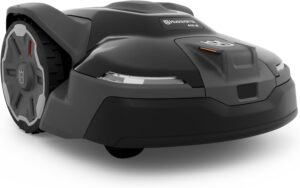
The Husqvarna Automower 315X is the gold standard of residential robot mowers, and while it doesn’t have an integrated solar panel, it charges from a dock that can be powered by a home solar system. For homeowners with rooftop solar, connecting the Automower dock to a solar-powered outlet means the mower runs entirely on solar energy.
The 315X handles up to a 0.4-acre lawn and navigates complex terrain including slopes up to 40% incline. GPS tracking, anti-theft protection, and a smartphone app for scheduling and monitoring make it genuinely sophisticated. It mows in random patterns that stimulate even lawn growth, and the continuous cutting (a little every day rather than once a week) produces a healthier lawn over time.
Installation requires setting up boundary wire around the perimeter and obstacles. This takes 2 to 4 hours but is a one-time task. After that, the mower runs on its own schedule indefinitely with no intervention. For solar homeowners who want fully autonomous lawn maintenance, this is the best path to combine solar power and lawn care.
The price is high but reflects genuine quality. Husqvarna robot mowers have been refined over more than two decades and are significantly more reliable than cheaper competitors.
Features
- Handles up to 0.4 acres
- GPS tracking and anti-theft
- Smartphone app control and scheduling
- 40% slope capability
- Docking station compatible with solar power
Pros:
- Fully autonomous operation
- Industry-leading reliability and build quality
- GPS and anti-theft protection
- Charges from solar-powered outlet
Cons:
- Highest price on this list
- Requires boundary wire installation
2. Worx Landroid M700 Plus (Robot Mower)
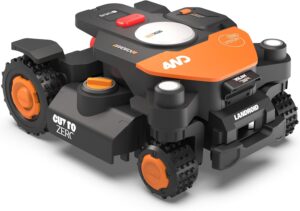
The Worx Landroid M700 Plus is a more accessible robot mower that covers up to 0.17 acres and offers Wi-Fi connectivity, rain detection, and a smartphone app for scheduling. It’s significantly cheaper than the Husqvarna while still delivering autonomous operation that frees you from weekly mowing.
Like the Automower, it charges from a dock that can be powered by a home solar system. The M700 Plus includes Worx’s AIA (Artificial Intelligence Algorithm) navigation that learns your lawn’s shape and optimizes the mowing pattern over time. Rain sensors pause operation in wet conditions, which protects both the mower and the lawn.
Installation is similar to the Husqvarna: boundary wire defines the mowing zone. For smaller lawns under 0.17 acres, the M700 Plus provides most of the automation benefits of premium robot mowers at a significantly lower entry price. Pair it with a solar-powered outlet and your lawn essentially maintains itself on free energy.
Build quality and longevity aren’t quite at Husqvarna’s level, but for the price it’s a capable, practical choice.
Features
- Covers up to 0.17 acres
- Wi-Fi and smartphone app control
- Rain sensor auto-pause
- AIA self-learning navigation
- Solar-compatible charging dock
Pros:
- More affordable than Husqvarna
- Smartphone control and scheduling
- Rain sensor pauses automatically
Cons:
- Limited to 0.17 acres
- Less durable long-term than premium brands
3. EcoFlow DELTA Pro + Greenworks 40V Cordless Mower
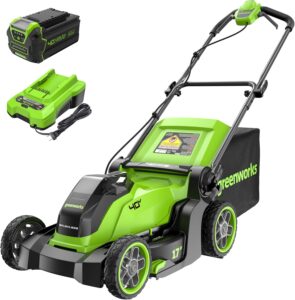
This isn’t a single product but a combination that represents the best practical approach to truly solar-powered conventional mowing: a high-capacity solar generator paired with an efficient cordless electric mower. The Greenworks 40V mower draws around 500 to 700 watts and can cut a half-acre lawn on a single battery charge. Combine it with an EcoFlow DELTA Pro charged from solar panels, and you have a fully solar-powered mowing setup.
The Greenworks 40V is a proven, reliable electric mower with a self-propelled option, mulching capability, and a 21-inch cutting deck that covers ground efficiently. For homeowners who want a conventional push mower experience without cords or electricity costs, this combination delivers.
The limitation is the upfront cost of the EcoFlow DELTA Pro generator, which is substantial. But for off-grid homeowners or those who also want the generator for other purposes (backup power, camping, construction), the investment has multiple payoffs beyond just lawn mowing.
Features
- EcoFlow DELTA Pro: 3.6kWh capacity, solar-chargeable
- Greenworks 40V: 21-inch self-propelled
- No cords — genuine cordless solar mowing
- Generator serves other purposes beyond mowing
Pros:
- Conventional mowing experience, zero electricity cost
- Generator has multiple use cases
- Handles larger lawns than robot mowers
Cons:
- High combined cost
- Still requires manual operation
- Two-product system adds complexity
4. Husqvarna Solar Hybrid Automower 430XH
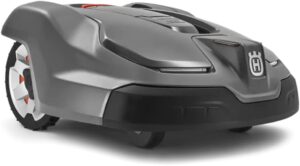
The Husqvarna Automower 430XH includes an optional solar panel kit that mounts to the mower’s top surface, providing supplemental solar charging while the unit is mowing in the yard. The solar panel extends battery run time, allowing longer mowing sessions before the mower returns to dock, and in optimal sunny conditions can meaningfully reduce the number of dock returns per day.
The 430XH handles up to 0.8 acres, which covers most residential properties in one unit. It includes GPS navigation (not just random pattern), allowing more systematic coverage of larger lawns. The GPS-guided navigation produces cleaner mowing patterns and more efficient area coverage than random-path designs.
The solar panel kit is the key differentiator from other robot mowers on this list. It’s not a dramatic energy source given its small size, but it represents a genuine step toward a mower that derives meaningful energy from the sun rather than purely from the dock. For Husqvarna devotees who want the most solar-integrated robot mower available, the 430XH is the answer.
Features
- Covers up to 0.8 acres
- Optional integrated solar panel kit
- GPS-guided systematic navigation
- Smartphone app with Google Maps integration
- 35% slope capability
Pros:
- Integrated solar panel for mower charging
- GPS navigation for systematic coverage
- Handles large residential lawns
Cons:
- Premium price for solar panel addition
- Solar contribution is supplemental, not primary
5. Greenworks Pro 60V Self-Propelled Mower
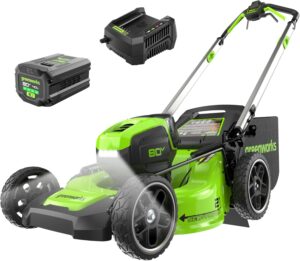
The Greenworks Pro 60V is one of the most capable conventional cordless mowers available, and for solar homeowners with a 60V charging setup tied to their solar system, it represents practical solar lawn care without robot mower complexity or cost. The 60V battery powers the mower through up to 1 acre per charge, and recharging from a solar-powered outlet costs nothing.
The 21-inch steel deck with self-propulsion handles real residential lawns. Mulching, rear bag, and side discharge capabilities cover any lawn care need. Single-lever height adjustment and a comfortable operator grip make it a practical daily tool rather than a compromise product.
For homeowners who have rooftop solar and simply want to eliminate electricity costs for lawn care, the Greenworks Pro 60V is an excellent pick. It charges from any standard outlet — connect that outlet to your solar system and the mower is effectively free to run.
Features
- 60V battery, 1-acre range per charge
- 21-inch steel deck, self-propelled
- Mulch, bag, and discharge
- Single-lever height adjustment
- Smart Cut load-sensing technology
Pros:
- 1-acre range for standard residential lots
- No cord — fully cordless electric
- Free to operate with rooftop solar
Cons:
- Still requires manual operation
- 60V charger needed
6. RYOBI 40V HP Brushless Mower
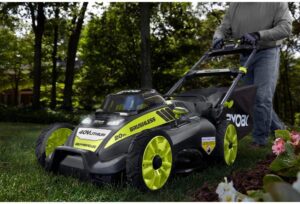
The RYOBI 40V HP Brushless mower is a strong all-around cordless electric mower that works seamlessly with a solar-powered home. The 40V platform is one of the most widely used in cordless tool ecosystems, and the brushless motor provides better efficiency and longer motor life than brushed alternatives. Battery recharge time is about 90 minutes, fitting easily within a solar-powered charging window.
The dual-battery configuration (two 40V batteries in series) extends range to cover a typical quarter-acre suburban lawn comfortably. Smart Trek self-propulsion senses terrain changes and adjusts ground speed accordingly, reducing operator fatigue on hilly yards.
For homeowners already in the RYOBI 40V ecosystem, the batteries and charger are shared across the product line, maximizing the value of charging infrastructure powered by solar.
Features
- Dual 40V HP brushless battery system
- Smart Trek terrain-sensing self-propulsion
- 21-inch steel deck
- Mulch, bag, side discharge
- 90-minute recharge time
Pros:
- Smart Trek self-propulsion for hilly yards
- Compatible with broad RYOBI 40V ecosystem
- Brushless motor for efficiency and longevity
Cons:
- Dual-battery cost adds to upfront price
- 90-minute charge time on cloudy days may exceed solar window
7. Ego Power+ LM2102SP Select Cut Mower
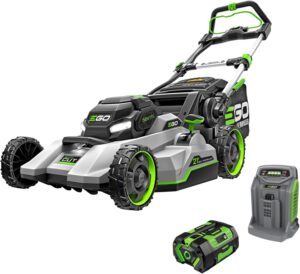
Ego’s Power+ platform is widely regarded as producing the best-performing cordless outdoor power tools in the consumer market, and the LM2102SP Select Cut mower is their flagship walk-behind model. The 56V battery provides exceptional power output that rivals gas mowers in cutting performance through thick grass, and the Select Cut blade system offers multiple blade configurations for different grass conditions.
For solar homeowners, the 56V Arc Lithium battery charges from a standard outlet in 30 to 60 minutes, which fits comfortably within a solar charging session. Performance through wet grass, thick turf, and tall overgrowth is significantly better than most other cordless competitors.
Ego charges a premium for the top-tier performance, but for homeowners who need a cordless mower that genuinely matches gas performance in difficult conditions, the extra cost is justified.
Features
- 56V Arc Lithium battery
- Select Cut multi-blade system
- Self-propelled with variable speed
- Handles thick, wet, or tall grass
- 30-60 minute recharge time
Pros:
- Gas-competitive cutting performance
- Select Cut blade options for different conditions
- Fast 30-60 minute recharge
Cons:
- Premium price
- 56V proprietary battery (Ego ecosystem only)
8. Sun Joe MJ401E Electric Corded Mower
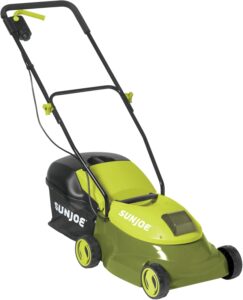
The Sun Joe MJ401E is the budget pick: a corded electric mower that draws 12.5 amps (about 1,500 watts) from a standard outlet. If that outlet is powered by solar, this is solar-powered lawn care at the most accessible price point. The mower itself costs well under 200 dollars, making the total investment minimal.
The corded design means you need a 100-foot extension cord for average-sized lawns, which limits mobility. But for small yards under 1,000 square feet, the cord restriction isn’t a meaningful issue. The 14-inch deck, 3-position height adjustment, and 12.5-amp motor handle typical small-yard grass cutting effectively.
For apartment dwellers with small patches of grass, or homeowners with compact yards who want the lowest possible entry point into solar-powered lawn care, the Sun Joe delivers adequate performance at minimum cost.
Features
- 12.5-amp corded electric (1,500W)
- 14-inch cutting deck
- 3-position height adjustment
- Best price on this list
- Ideal for small yards under 1,000 sq ft
Pros:
- Lowest price on this list
- Simple reliable operation
- Powers from any solar-connected outlet
Cons:
- Cord limits mobility
- 14-inch deck too small for large lawns
Solar Powered Lawn Mowers Buying Guide
Solar-Powered vs. Battery-Powered Lawn Mowers: Where Solar Fits
Solar-powered lawn mowers are not a single product category — the term covers two distinct approaches that work very differently. Direct-solar mowers use a photovoltaic panel mounted on the mower to power the motor directly while cutting in real time; these are primarily robotic mowers used for small, flat lawns and have very limited power due to the small panel area that fits on a mower chassis. The more practical category is solar-charged battery mowers: a standard battery-electric push or self-propelled mower whose batteries are recharged via a dedicated solar panel system rather than from grid power. This combination — quality battery mower plus home solar panels — represents the practical solar mowing setup for most homeowners. A third emerging option is robotic mowers with solar-assisted charging: the Husqvarna Automower 450X and similar high-end robotic mowers include a solar panel on the mower’s body that supplements grid charging and extends battery life between dock sessions. For most homeowners considering “solar lawn mowing,” the realistic and cost-effective path is a battery-electric mower charged from an existing home solar array or a dedicated outdoor solar panel, rather than a purpose-built solar mower.
Robotic Solar Mowers: Capabilities and Realistic Limitations
Robotic solar mowers are the most direct implementation of solar lawn mowing and the category most people imagine when searching for solar-powered mowers. These autonomous mowers run on battery power charged by a combination of an onboard solar panel and a charging dock connected to grid power. The solar panel on a robotic mower is small — typically 15–25W — which provides a meaningful supplement to dock charging in sunny climates but doesn’t replace it. In very sunny conditions, the solar supplement can reduce dock charging time by 30–50%, extending battery autonomy between dock sessions. Robotic mowers work best on lawns under 1 acre, with gentle slopes (max 35–40% grade for most models), minimal obstacles, and a perimeter wire system or GPS boundary to define the mowing area. They cut in random patterns throughout the day and return to the dock to charge, producing a consistently well-manicured lawn without operator intervention. The limitations: robotic mowers struggle with complex lawn shapes, steep grades, mulch beds in the mowing area, and lawns with frequent foot traffic that disrupts the boundary wire. They’re an investment — quality robotic mowers start around $800 and reach $3,000+ for the largest-area models with advanced GPS navigation.
Battery-Electric Mowers: Which Models Support Solar Charging
Any battery-electric lawn mower that charges from a standard 120V outlet can be solar-charged through an appropriate solar panel system — the mower doesn’t need to be specifically marketed as “solar compatible.” The key specifications: the mower’s battery charger input (voltage and amperage), and matching these to a solar panel + inverter combination capable of supplying that power. A typical 40V battery charger for a mid-range electric mower draws 2–4A at 120V, consuming 240–480W during a 1–2 hour charge cycle — a total of 240–960Wh per full charge. A 300W solar panel in 4 hours of good sun produces 1,200Wh — enough to fully charge most single-battery electric mower batteries. Major battery platform brands (EGO, Greenworks, Ryobi, Milwaukee, DeWalt, Kobalt) all produce electric mowers that charge from a standard outlet and can therefore be charged from a solar panel through an AC inverter. For off-grid charging specifically, a 300–500W solar panel array, a 50–100Ah LiFePO4 battery, and a quality inverter-charger create a dedicated mower charging station that operates entirely independently of the grid.
Solar Panel Sizing for Mower Battery Charging
Sizing a solar charging system for a lawn mower battery requires calculating the mower battery’s energy storage and the solar production needed to replenish it within your available charging time. Common electric mower battery capacities: EGO 56V 7.5Ah = 420Wh; Greenworks 40V 6Ah = 240Wh; Ryobi 40V 7.5Ah = 300Wh. At a charger efficiency of 85%, the solar system must produce approximately 490Wh, 280Wh, or 350Wh respectively to fully recharge these batteries. In a location with 4 peak sun hours per day, you need: 490Wh ÷ 4 hours = 122W of panel to recharge the EGO battery; 280Wh ÷ 4 hours = 70W for the Greenworks; 350Wh ÷ 4 hours = 88W for the Ryobi. A single 150–200W panel exceeds these requirements comfortably, handling weekly mowing cycles with buffer for suboptimal sun days. Add a battery storage buffer (a 100–200Wh LiFePO4 battery) to store excess midday production for evening charging if you prefer to charge after mowing rather than during peak sun hours.
The Husqvarna Automower Solar Charging System
Husqvarna’s Automower NERA series and higher-end Automower models with the EPOS (Exact Positioning Operating System) GPS navigation represent the current premium in solar-assisted robotic mowing. The onboard solar panel extends the mower’s battery autonomy, reducing the frequency of dock returns for charging — important for large-area models covering up to 1.25 acres that must optimize mowing time versus charging time. Solar contribution varies by model and sun conditions: in Scandinavian testing (Husqvarna’s home market), the solar panel extends daily coverage by 20–40% in summer months. In high-irradiance US climates (Southwest, Southeast summer), the benefit is greater. The mower’s AI mowing algorithm accounts for solar charging in its scheduling — it prioritizes dock returns on cloudy days and maximizes coverage on sunny days when the solar panel reduces charging frequency. For consumers interested in robotic mowing rather than DIY system building, the Automower solar series is the only consumer-ready integrated solar mowing product from a major manufacturer with proven reliability and established dealer support. The premium cost ($2,000–$3,500) reflects both the robotic capability and the solar hardware.
Off-Grid Lawn Care: Beyond Just the Mower
For homesteaders, rural properties, or off-grid residences where grid power for lawn equipment is unavailable or undesirable, a solar-charged outdoor power equipment (OPE) system can power not just the mower but the full range of lawn and garden tools. A dedicated 400–600W solar panel array with a 100–200Ah LiFePO4 battery provides enough daily production to charge a mower battery plus a string trimmer, leaf blower, and handheld tools. Modern battery platform systems — particularly EGO, Greenworks Pro, and DeWalt FlexVolt — use the same battery pack across a wide range of tools, meaning a solar-charged battery bank can power the entire lawn care toolkit from a single charging interface. The economics for off-grid setups: the cost of running utility power to a remote outbuilding ($5,000–$20,000 in trenching and electrical work) often exceeds the cost of a solar charging station by 3–5x, making solar the clearly superior economic choice for truly remote lawn equipment charging. For standard grid-connected homes, the financial case is less clear — the solar panel + battery investment for dedicated mower charging is similar to the electricity cost savings over 5–10 years, with the environmental benefit being the primary differentiator.
Maintenance Considerations for Solar Mowing Systems
Solar-charged lawn mowing systems have different maintenance requirements than conventional mowing setups. The solar panels themselves require only annual cleaning — a panel that accumulates pollen, dust, and bird droppings in spring can lose 10–25% of output; a quick rinse with a garden hose and soft brush restores output. Battery maintenance is the most important ongoing task: never store lithium battery packs at full charge or at zero charge for extended periods — the optimal storage state-of-charge is 40–60%, which most modern chargers achieve automatically with a “storage mode” charge. For LiFePO4 batteries in the solar charging station, occasional equalization charging (as described in the BMS documentation) maintains cell balance and extends pack life. Check the solar panel mounting hardware annually for corrosion, particularly at the mounting bracket hardware in coastal or high-humidity environments. Robotic mower maintenance includes blade replacement (every 1–3 months depending on grass type), perimeter wire inspection for damage from garden tools, and dock contact cleaning. The combination of solar charging with electric mowing eliminates the fuel-related maintenance of gas equipment (oil changes, carburetor cleaning, fuel stabilization) while adding the electronic maintenance of solar components — generally a net simplification for most users.
Cost-Benefit Analysis: When Solar Mowing Makes Financial Sense
The financial case for solar lawn mowing depends strongly on your specific situation. For homeowners with existing rooftop solar who buy an electric mower: the incremental cost is just the mower ($300–$600 for mid-range battery mowers), charged from existing solar capacity — the most economical solar mowing path with payback in 2–4 years versus a comparable gas mower’s fuel and maintenance costs. For homeowners without existing solar who want to specifically solar-power their mowing: a 300W panel ($200–$300) plus a portable power station ($300–$500) or dedicated LiFePO4 battery bank ($200–$400) plus a quality electric mower ($300–$600) totals $1,000–$1,800 — significant upfront investment with a 5–10 year payback versus gas mowing costs at typical lawn service intervals. For solar mower and robotic solar mowers specifically: payback versus hiring weekly lawn service is 2–5 years for most homeowners using a service at $40–$80 per week, and much longer versus DIY gas mowing. The non-financial benefits — zero emissions during operation, zero noise (robotic mowers operate at 57–62 dB, well below conventional mowers at 90+ dB), and zero fuel dependency — provide value that the financial analysis understates for buyers who prioritize these factors.
Frequently Asked Questions
Yes, if the charging dock is connected to a solar-powered electrical outlet. Some models like the Husqvarna 430XH also have an optional integrated solar panel that supplements charging while mowing. For complete solar operation, connect the charging dock to a dedicated solar circuit or any outlet powered by your home solar system.
Entry-level robot mowers handle 0.1 to 0.2 acres. Mid-range models cover 0.4 to 0.5 acres. High-end models like the Husqvarna Automower 450X handle up to 1.25 acres. For very large properties, multiple robot mowers covering different zones or a single high-end unit are the options.
The same as charging from a grid outlet — typically 30 to 90 minutes depending on the battery capacity and charger output. If your home solar system is connected to the grid or has a battery bank, the mower charger simply draws from available power. The solar source doesn’t change the charging speed, only the cost (zero).
Most robot mowers handle gentle slopes up to 20 to 40 percent grade, depending on the model. Very uneven terrain with significant bumps, dips, or obstacles challenges navigation algorithms and can cause the mower to get stuck. Well-maintained flat to gently sloped lawns are the ideal application. For rough or hilly terrain, conventional mowing is still often more practical.
Summing Up
The most satisfying solar-powered lawn care setup is a robot mower charged from a solar-connected dock — fully autonomous, free to operate, and requiring no gasoline. For homeowners who prefer conventional mowing, any quality cordless electric mower (Ego, RYOBI, Greenworks) paired with a solar-powered charging outlet delivers the electricity-cost benefit without the robot mower investment. And for the most budget-conscious approach, a Sun Joe corded mower plugged into a solar outlet gets the job done at minimum cost.
Solar panels for your home not only save on utility bills but make every electric device you own cheaper to operate. For professional solar installation in your area, call us free on (855) 427-0058 or get a free quote here.
If you’re also thinking about solar panels for your home, call (855) 427-0058 for a free quote — it takes just a few minutes to find out what installation would cost and save you in your area.
Updated