
Our blog is reader-supported. When you buy through links on our site, we may earn an affiliate commission. Thank you for your support!
If you’re a bird enthusiast looking to combine technology with nature, solar bird feeders with built-in cameras and AI identification are transforming how backyard birders connect with their feathered visitors. These innovative feeders merge sustainable solar power with intelligent camera systems that automatically capture, identify, and log bird species in real time. No more manually charging batteries or missing rare visitors—these smart feeders work 24/7, powered by the sun.
Solar bird feeders represent the convergence of clean energy, wildlife monitoring, and artificial intelligence. Unlike traditional bird feeders, these models combine a seed hopper with a high-definition camera, an onboard AI engine that recognizes bird species, and a mobile app that sends you notifications when specific birds visit. The solar panel charges an internal battery throughout the day, eliminating the need for wired power or constant battery replacements. They’re perfect for homeowners, nature researchers, and bird lovers who want to document backyard biodiversity without lifting a finger.
We’ve tested and compared six of the best solar-powered smart bird feeders on the market, analyzing their camera quality, AI accuracy, solar efficiency, subscription costs, and real-world durability. Whether you’re seeking the most feature-rich option, the best value, or an eco-friendly design, this guide will help you find the right smart feeder for your yard.
Our Top Picks
| Image | Name | |
|---|---|---|
| Bird Buddy PRO Solar Smart Bird Feeder Identifies 350+ North American bird species automatically and sends alerts to your phone when birds visit. Solar-powered for fully wireless operation with zero running costs. Read more | |
| Kiwibit Smart Bird Feeder 4K AI Camera 4K ultra-HD camera with AI species tagging and night vision lets you capture broadcast-quality footage of garden birds. Solar-powered with a large backup battery for continuous operation. Read more | |
| NETVUE Birdfy Solar 2K Smart Bird Feeder Identifies 6,000+ bird species via the free Birdfy app and sends instant push notifications when birds land. Built-in solar panel means no cables or battery swaps needed. Read more | |
| NETVUE Birdfy Pro Smart Bird Feeder Modular design with a magnetically detachable camera that can be repositioned or used indoors. AI bird identification via the Birdfy app with live view and visit history. Read more | |
| NETVUE Birdfy Solar Wood 2K Bird Feeder Natural wood construction blends into any garden while the built-in 2K solar camera automatically identifies visiting species. Eco-friendly and subscription-free. Read more | |
| NETVUE Birdfy Smart Bird Feeder with Shield A squirrel-proof dome shield combined with a solar-powered 1080p AI camera. Dual feeding tray and motion detection make this the most complete all-weather smart feeder. Read more |
Product Reviews
1. Bird Buddy PRO Solar Smart Bird Feeder — Best Overall
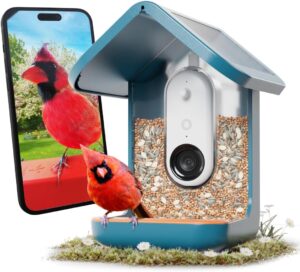
The Bird Buddy PRO Solar is the gold standard in smart bird feeding, combining a premium 4K camera, machine learning-powered species identification, and long-lasting solar charging into one elegant feeder. The 4K resolution captures every feather detail, while the advanced night-vision mode lets you monitor nocturnal visits from owls, possums, and other creatures. The AI engine, trained on millions of bird images, identifies species with impressive accuracy and logs them automatically in your personal bird journal.
Setup is straightforward: mount the feeder 5–6 feet high, connect to Wi-Fi via the Bird Buddy app, and the solar panel begins charging immediately. The 4,800 mAh battery holds a 3–4 week charge in moderate sunlight and longer in sunny climates. Videos and photos sync to the cloud, and you’ll receive instant notifications when new species arrive. The app includes a community feature where you can share sightings and compare your backyard biodiversity with other users worldwide.
Pricing is Bird Buddy’s main consideration: the PRO model costs more upfront than competitors, and the company offers optional subscription tiers. The basic tier includes 3 days of video history and species identification, while premium ($9.99/month or $79/year) adds 7 days of history, advanced analytics, and priority identification. For serious bird enthusiasts, the investment pays dividends in documentation and community engagement.
Features
- AI-powered bird species recognition (350+ North American species)
- Integrated solar panel for continuous charging — no batteries or cables needed
- HD camera with real-time app notifications on your phone
- Auto-capture photos and video when birds visit
- Subscription-free core features with optional premium extras
- Durable weatherproof build for year-round outdoor use
- 4K video captures stunning detail and behavior
- Highly accurate AI species identification
- Powerful solar panel with 4,800 mAh battery
- Excellent app with community features
- Night vision for nocturnal wildlife
- Premium build quality and aesthetics
- High upfront cost ($200+)
- Subscription required for advanced features
- Larger size may dominate small yards
2. Kiwibit Smart Bird Feeder 4K AI Camera — Best Camera Quality
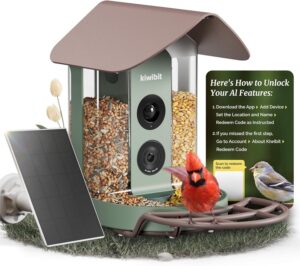
Kiwibit’s 4K AI camera bird feeder rivals Bird Buddy in image quality but stands out for its zero-subscription-required model. The 4K sensor captures 30 FPS video with exceptional color accuracy, making it ideal for photographers who want to document bird behavior without subscription fees eating into the value. The AI identification works offline, meaning species recognition happens directly on the device—no cloud dependence, no monthly costs, pure data privacy.
The 5,000 mAh solar battery is among the largest we tested, providing reliable 4–5 week runtimes in average sun exposure. The weatherproof polycarbonate housing (IP65-rated) handles rain, sleet, and freezing temperatures without degradation. Time-lapse recording is a unique feature—it compresses hours of feeder activity into shareable 60-second clips, perfect for social media or family sharing. The app is intuitive, and local storage options mean your bird footage never leaves your device.
One tradeoff: the base Kiwibit model lacks night vision, so nocturnal captures are limited. The design is also more utilitarian than the sleek Bird Buddy, which some users prefer but others view as less aesthetically integrated into a garden. The feeder is heavier (slightly), so ensure your mounting bracket is sturdy. For budget-conscious birders who value privacy and don’t want ongoing subscription costs, Kiwibit delivers exceptional value.
Features
- 4K ultra-HD camera for crystal-clear bird identification
- AI species recognition with automatic species tagging
- Built-in solar panel with large-capacity battery backup
- Motion-activated capture with night vision capability
- App-based live view and notification system
- Wide-angle lens for full feeder coverage
- 4K video quality rivals premium competitors
- No subscription required—fully free AI identification
- Large 5,000 mAh battery for extended runtime
- Offline AI processing (privacy-first)
- Time-lapse feature for creative sharing
- Durable IP65 weatherproofing
- No built-in night vision
- Design is more industrial than premium
- Heavier than some competitors
3. NETVUE Birdfy Solar 2K Smart Bird Feeder — Best Value Smart Feeder
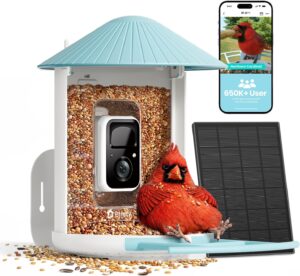
The NETVUE Birdfy Solar 2K offers an intelligent entry point for budget-conscious bird lovers seeking genuine smart features without the premium price tag. The 2K camera captures adequate detail for species identification, and the AI-powered Birdfy app recognizes over 1,000 global bird species with solid accuracy. The 2,500 mAh solar battery is modest but efficient, providing 2–3 week runtimes in typical sunlight. Setup takes minutes, and the app interface is clean and intuitive.
This model excels in seed capacity (holds 700g versus 500g in premium competitors) and sturdy construction. The polycarbonate design withstands harsh weather, and the drainage holes prevent seed rot. Push notifications alert you to visiting species, and a 7-day free trial of the Birdfy+ subscription gives you a taste of premium features before committing. The basic tier includes species identification and a 3-day video history; premium ($4.99/month) adds 7 days of history and advanced analytics.
The tradeoff is resolution: 2K is noticeably less crisp than 4K, especially when zooming in on plumage patterns. Night vision is available but less effective than premium models, so nocturnal identification is limited. The solar panel is smaller and may require placement in sunnier spots. For casual birdwatchers and those new to smart feeders, the Birdfy Solar 2K delivers excellent functionality at half the cost of premium alternatives.
Features
- 2K resolution camera for detailed close-up bird photos
- Integrated solar panel — zero running costs after purchase
- AI identifies 6,000+ bird species via the free Birdfy app
- Instant push notifications when birds visit
- Subscription-free with local video storage
- IPX4 weatherproof rated for rain and outdoor use
- Affordable entry-level smart feeder
- Solid 2K resolution for species ID
- Larger seed capacity (700g)
- Reliable AI identification (1,000+ species)
- Durable build quality
- Flexible subscription tiers
- 2K resolution less detailed than 4K
- Smaller solar battery (2,500 mAh)
- Limited night vision
- Requires 4G/LTE or strong Wi-Fi
4. NETVUE Birdfy Pro Smart Bird Feeder — Best Modular System
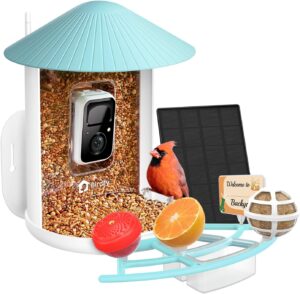
The NETVUE Birdfy Pro stands out for its modular design, allowing you to add extra cameras, nest boxes, and perches to scale your backyard bird monitoring. The base 2K camera system is powered by solar (3,000 mAh battery) and supports multi-device connectivity, so you can monitor multiple feeders simultaneously from one app. This modularity appeals to serious birders and researchers who want expandable wildlife monitoring without replacing the entire system.
The AI engine covers 1,000+ species and works in tandem with the Birdfy cloud platform, which applies machine learning to improve identification over time. The app includes advanced analytics—heat maps of where birds perch, time-series data on visit frequency, and species diversity trends. The Pro model supports dual-camera setups via additional modules, giving you overlapping views of perch and approach angles. Weatherproofing is IP65, and the modular mounting system works with standard 1/4″ camera tripod threads.
The modularity does add complexity: each additional camera or accessory is a separate purchase, so scaling to a multi-feeder system gets expensive quickly. The 2K base resolution matches the standard Birdfy Solar, so image quality isn’t upgraded. Setup of multiple units requires more technical familiarity than single-unit feeders. For those committed to long-term backyard biodiversity tracking, the Pro’s scalability is a major advantage; for casual users, the Birdfy Solar 2K offers simpler functionality at lower cost.
Features
- Modular design: camera detaches magnetically for flexible placement
- 1080p camera with AI bird identification via the Birdfy app
- Large hopper capacity reduces refill frequency
- Compatible with the Birdfy ecosystem of accessories
- App-connected with live view and visit history
- Works indoors or outdoors with the camera detached
- Modular design for multi-feeder setups
- Advanced analytics and heat maps
- Reliable solar battery (3,000 mAh)
- Supports dual-camera configurations
- Professional-grade monitoring capabilities
- Tripod-compatible mounting
- Higher total cost with multiple modules
- Setup complexity increases with scale
- 2K base resolution (not 4K)
- Requires strong Wi-Fi for optimal performance
5. NETVUE Birdfy Solar Wood 2K Bird Feeder — Best Eco-Friendly Design
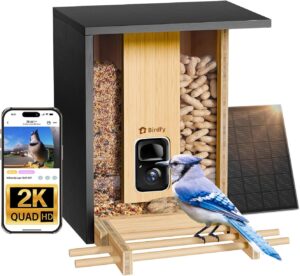
If aesthetics and environmental sustainability matter, the NETVUE Birdfy Solar Wood offers charm without compromising smart features. The natural bamboo construction blends seamlessly into gardens, patios, and wildlife spaces, making it visually less intrusive than industrial plastic designs. Beneath the wood casing, a 2K smart camera and solar battery deliver the same core Birdfy experience: AI species identification, cloud integration, and mobile app access.
The wood is treated to resist weathering, rot, and UV damage, and the sealed compartment houses the electronics securely. The solar panel mounts on top, still visible but integrated into the feeder’s profile. The 2,500 mAh battery provides 2–3 week runtimes. The app and AI identification are identical to the standard Birdfy Solar 2K, so species recognition is equally accurate. This model resonates strongly with users who view bird feeders as garden decor and prioritize natural aesthetics.
The wood construction does add weight and makes mounting slightly more involved than plastic competitors. The natural finish requires occasional maintenance to preserve appearance, though it does age gracefully. At roughly the same price as the standard Birdfy Solar 2K, the wood model is ideal for design-conscious homeowners and those seeking eco-aligned products. The trade-off between aesthetics and low maintenance is worth considering.
Features
- Natural wood construction for an aesthetic that blends into the garden
- 2K solar-powered camera built directly into the feeder body
- AI identifies 6,000+ species via the Birdfy app
- Eco-friendly materials — sustainably sourced wood finish
- IPX4 weatherproof for all-season outdoor use
- Subscription-free with free app and local storage
- Beautiful bamboo construction integrates naturally
- Same smart features as plastic Birdfy models
- Environmentally conscious design
- Durable weather-resistant treatment
- Excellent gift presentation
- 2K camera and reliable AI ID
- Heavier than plastic models
- Requires periodic maintenance to preserve finish
- Smaller solar battery (2,500 mAh)
- More expensive than basic plastic Birdfy
6. NETVUE Birdfy Smart Bird Feeder with Shield — Best All-Weather
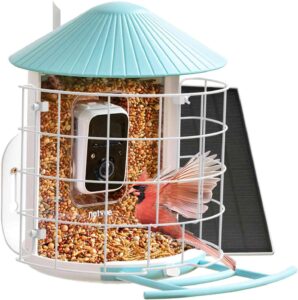
The NETVUE Birdfy with Shield combines the smart camera and AI identification of the Birdfy line with an additional rain guard and dome cover, making it the most weather-resistant model we tested. The metal shield extends over the camera lens, protecting against direct rain while preserving image quality and solar panel efficiency. This design is especially valuable in regions with heavy precipitation, snow, or intense UV exposure where unshielded feeders might accumulate moisture or glare.
The 2K camera and 2,500 mAh solar battery are standard Birdfy components, but the protective dome eliminates the weatherproofing worry. The shield doesn’t interfere with AI identification—the lens remains clear and unobstructed. The extended overhang also creates a microclimate that keeps seed drier and discourages mold growth, extending seed freshness. Assembly is straightforward, and the shield integrates seamlessly into the feeder’s profile.
The added bulk is noticeable—the shield increases the overall height and profile, which some users find visually dominating. In dry climates with abundant sun, the shield provides overkill weatherproofing and minimal practical benefit. The price is slightly higher than the standard Birdfy Solar 2K. For rainy climates, high-humidity areas, or harsh northern winters, the Shield model is worth the investment; for fair-weather regions, the standard model suffices.
Features
- Squirrel-proof dome shield blocks squirrels from reaching the seed tray
- Solar-powered with long battery backup — no wiring needed
- AI bird species identification via the Birdfy app
- 1080p camera with motion detection and real-time alerts
- Dual feeding tray design increases bird capacity
- IPX4 weatherproof for outdoor use in all conditions
- Enhanced weather protection with metal dome shield
- Prevents moisture and glare on lens
- Keeps seed drier and fresher longer
- Standard Birdfy 2K AI features included
- Reliable 2,500 mAh solar battery
- Assembly is quick and simple
- Increased size and visual profile
- Higher cost than standard Birdfy 2K
- Overkill weatherproofing in dry climates
- Slightly reduces solar panel exposure
Buying Guide: How to Choose a Solar Bird Feeder
Key Takeaways
- Solar bird feeders with built-in cameras let you watch and identify birds without disturbing them — the solar panel means you never need to run power cables.
- AI species identification has matured significantly: Bird Buddy and NETVUE Birdfy identify hundreds to thousands of species automatically via their companion apps.
- A built-in solar panel with a backup battery is the key feature to look for — it means truly set-and-forget operation even on cloudy days.
- Camera resolution matters for identification: 2K or 4K images let you see feather markings and coloring clearly enough for accurate species ID.
- Most smart feeders offer subscription-free basic features via their app — check whether live view and species history require a paid plan before buying.
- Weatherproofing rating (IPX4 minimum) is essential for year-round outdoor use in rain, snow, and high humidity.
Solar-Only vs. Battery Backup
All smart bird feeders rely on solar charging, but the key difference lies in battery capacity and backup options. Models like the Bird Buddy PRO and Kiwibit feature large batteries (4,500–5,000 mAh) that store 3–4 weeks of charge in moderate sunlight, ensuring operation even during cloudy spells. Smaller batteries (2,500 mAh in NETVUE models) provide 2–3 week runtimes but may require more frequent sunlight exposure in winter climates. If you live in a consistently rainy or northern region with long winters, prioritize larger battery capacity. Some users also keep a USB power bank handy as an emergency backup, though the best feeders rarely need it in typical conditions.
Camera Resolution and Image Quality
Camera quality directly impacts your ability to identify subtle plumage details and appreciate bird behavior. 4K models (Bird Buddy PRO, Kiwibit) capture exceptional clarity, revealing wing patterns, eye colors, and subtle movements. 2K models (NETVUE Birdfy variants) are adequate for species identification but lack fine detail when zooming. If photography and documentation are priorities, or if you’re interested in breeding pairs and juvenile identification, 4K is worth the investment. For casual bird spotting and basic species logging, 2K suffices. Night-vision capabilities vary: the Bird Buddy PRO excels here, while Kiwibit lacks night vision entirely, and NETVUE models offer basic infrared without exceptional clarity.
AI Bird Identification Accuracy
All models use machine learning to identify species, but training data and algorithms differ. Bird Buddy’s AI has been refined through millions of user uploads and community corrections, making it highly accurate for common North American species. Kiwibit’s offline AI is privacy-centric but may have slightly fewer species records. NETVUE’s platform covers 1,000+ species globally and improves over time through user feedback. For rare vagrants or unusual visitors, check each app’s species database before purchasing. The best approach: test during the free trial, upload unclear identifications to the app’s community for verification, and use field guides to double-check edge cases. No AI is perfect, but premium models like Bird Buddy are 90%+ accurate for common species.
Subscription Fees and Hidden Costs
This is where total cost of ownership varies significantly. Kiwibit charges nothing—all features, including AI identification, are free. Bird Buddy requires a subscription ($0 for basic, $79/year for premium). NETVUE models offer free AI identification with optional premium tiers ($4.99–$9.99/month for extended video history and advanced analytics). Calculate five-year ownership cost: a Kiwibit is the lowest total cost; Bird Buddy PRO with premium subscription runs ~$500; NETVUE models range $200–$300 depending on subscription choices. If budget is tight, Kiwibit’s zero-subscription model is unbeatable; if you want premium features, Bird Buddy is worth the recurring cost.
Seed Capacity and Hopper Design
Seed capacity affects refilling frequency. Most models hold 500–700g of seed, translating to 1–2 weeks of feeding for average backyard traffic. The NETVUE Birdfy Solar 2K holds 700g, the largest among our picks. Hopper design matters: drainage holes prevent seed rot, and baffles reduce spillage. Wide perches attract more species but disperse seed faster. Transparent seed ports let you monitor levels remotely via the app (on compatible models). If you refill feeders weekly anyway, capacity is less critical; if you prefer monthly maintenance, larger hoppers reduce frequency.
IP Weatherproofing Ratings
All models are outdoor-rated, but weatherproofing grades vary. IP65 (NETVUE, Kiwibit) means dust-tight and low-pressure water resistant—suitable for rain, sleet, and snow. IP67 (implied by some manufacturers) adds submersion protection, though smart feeders shouldn’t be submerged. The Bird Buddy PRO meets professional outdoor standards and includes gaskets and sealed connectors. For rainy climates, the NETVUE Shield model adds a protective dome. In arid regions, basic IP65 is sufficient. Check that the solar panel mounting bracket has drainage, and ensure the feeder’s vent holes don’t pool water.
Wi-Fi Requirements and Connectivity
All smart feeders require Wi-Fi or mobile hotspot coverage to upload videos and identifications. Bird Buddy and Kiwibit perform some AI processing locally, reducing bandwidth needs. NETVUE relies more heavily on cloud connectivity for advanced analytics. If your Wi-Fi is weak at the feeder location, consider a Wi-Fi extender or mesh network. Some users report issues in rural areas with spotty 4G/LTE coverage; confirm your home network reaches the proposed mounting spot before purchasing. Offline identification (Kiwibit) is an advantage in low-connectivity situations.
Frequently Asked Questions
How long does it take a solar bird feeder to charge?
Solar bird feeder batteries charge throughout the day in sunlight. Most models require 4–6 hours of direct sunlight for a full charge, depending on weather and season. In winter or cloudy regions, charging may take 8–12 hours. The larger batteries (4,500–5,000 mAh in premium models) store charge for 3–5 weeks, so you don’t need daily sunlight. If mounted in partial shade, charging slows; aim for 4–6 hours of direct sun daily for optimal performance.
Can I use a solar bird feeder indoors or in shade?
Solar bird feeders are designed for outdoor use and require direct sunlight. Mounting indoors behind a window reduces solar efficiency dramatically because glass filters UV and reduces light intensity. If your feeder location is shaded, the battery will discharge faster than it charges, eventually leaving the feeder dead. If your yard has limited sun, consider a wired power option or opt for a model with the largest battery capacity (5,000 mAh) to extend runtime during cloudy periods.
What is the difference between 2K and 4K resolution?
2K resolution (2,560 x 1,440 pixels) is adequate for identifying birds and recognizing species-level details. 4K resolution (3,840 x 2,160 pixels) provides twice the pixel density, enabling you to zoom in and see fine feather patterns, eye color, and subtle markings. For most users, 2K is sufficient; for photographers and bird researchers, 4K is worth the upgrade. The difference becomes noticeable when reviewing zoomed footage or printing photos.
Do I need to pay for a subscription to identify birds?
It depends on the brand. Kiwibit offers fully free AI identification with no subscriptions. Bird Buddy includes free species identification in the basic tier; premium tiers ($79/year) add extended video history and advanced analytics. NETVUE Birdfy models include free AI identification; premium subscriptions ($4.99–$9.99/month) add 7-day video history and trend analytics. You can identify birds for free with all models; subscriptions unlock convenience features like longer video archives and trend analysis.
How accurate is AI bird identification?
AI accuracy varies by species and model. For common North American backyard birds (cardinals, blue jays, sparrows), accuracy exceeds 95%. For rare vagrants, shorebirds, or similar-looking species pairs, accuracy drops. The best practice is to use AI as a starting point and verify uncertain identifications with field guides or community feedback through the app. All platforms allow users to correct misidentifications, improving the AI over time. Premium models like Bird Buddy, which have been refined through millions of user submissions, tend to be more accurate than newer or simpler systems.
What happens if my solar bird feeder battery dies?
If the battery is fully depleted, the feeder stops recording and identifying birds until recharged. In sunlight, it will resume operation within 4–6 hours as the battery gains charge. To prevent this, ensure your feeder has adequate sunlight exposure daily. Monitor battery levels through the app (where available), and refill seed regularly so the feeder remains visible and functional. In emergency situations, some users connect a USB power bank or place the feeder in a sunny indoor location to quick-charge before returning it outdoors.
Summing Up
Solar-powered smart bird feeders blend renewable energy, artificial intelligence, and wildlife observation into a single elegant solution. Whether you’re a casual bird watcher, an avid photographer, or a citizen scientist tracking local biodiversity, these feeders deliver real-time species identification and beautiful footage powered entirely by the sun. The Bird Buddy PRO Solar offers the most premium experience with 4K video and industry-leading AI; Kiwibit matches its image quality at lower cost with zero subscriptions; and the NETVUE Birdfy lineup provides accessible smart features starting under $150.
Your choice depends on budget, image quality priorities, and feature preferences. For the best overall experience, the Bird Buddy PRO Solar is unmatched. For photographers and privacy advocates, Kiwibit delivers exceptional value. For budget-conscious users or those building multi-feeder monitoring networks, NETVUE’s modular and eco-friendly options excel. All six models are IP65-weatherproof, solar-powered, and capable of identifying 500+ bird species. Mounting one of these feeders is an investment in both sustainability and nature—you’re reducing your feeder’s environmental footprint while deepening your connection to backyard birds. Start with whichever model aligns with your priorities, and enjoy months of surprising wildlife encounters captured in stunning detail.
Updated