

Our blog is reader-supported. When you buy through links on our site, we may earn an affiliate commission. Thank you for your support!
If your solar battery bank is underperforming, the culprit is often a degraded cell you can’t spot by looking. The TOPDON BT300P is our top pick for solar battery testing — it handles 12V and 24V systems, covers AGM and deep-cycle batteries, and prints a paper record of every test for your maintenance log.
The eight testers below cover everything from professional-grade diagnostic units with built-in printers to simple handheld meters that get the job done in under 30 seconds. All of them connect directly to your battery terminals without draining your system.
Our Top Picks
| Image | Name | |
|---|---|---|
| TOPDON BT300P Battery Tester | |
| TOPDON BT100 Battery Tester | |
| Veepeak 12V Battery Tester | |
| ANCEL BT410 Battery Tester | |
| ANCEL BT310 Battery Tester | |
| ANCEL BA101 Battery Tester | |
| KINGBOLEN BM550 Battery Monitor | |
| VDIAGTOOL BT500 Battery Tester |
8 Best Solar Battery Testers
1. TOPDON BT300P Battery Tester
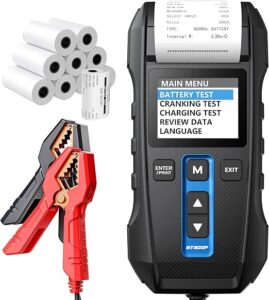
The BT300P sits at the top of TOPDON’s consumer lineup for good reason. It tests 12V and 24V batteries across the full range of types you’ll encounter in a solar installation — standard lead-acid, AGM, GEL, EFB, and deep-cycle. The 100-2000CCA range covers everything from a small cabin battery bank to a large RV or off-grid home setup.
What sets it apart is the built-in thermal printer. Every test generates a paper receipt you can file with your maintenance records. Over time, serial tests of the same battery reveal a degradation trend — far more useful than a single point-in-time reading. Mechanics love this feature; solar homeowners running their own maintenance will too.
The alternator and starter motor tests are a bonus if your solar setup is paired with a generator or backup vehicle charging. The clamps are metal rather than plastic, which matters when you’re testing frequently and want connectors that survive real use. Ten rolls of thermal paper are included, which should last most users a couple of years.
Battery voltage holds steady at 12.45V one morning and drops to 11.9V the next? The BT300P shows CCA capacity alongside internal resistance, giving you two separate data points to triangulate whether you’re looking at a discharged battery or an actually degraded one. That distinction saves you replacing good batteries prematurely.
Features
- Tests 12V and 24V batteries up to 2000CCA
- Supports lead-acid, AGM, GEL, EFB, and deep-cycle battery types
- Built-in thermal printer with 10 paper rolls included
- Tests alternator charging output and starter motor draw
- Metal clamps with spark-free connection technology
- Backlit LCD display for low-light use
- Built-in printer produces records you can file and compare over time
- Tests both 12V and 24V, covering most solar battery configurations
- CCA + internal resistance gives two diagnostic angles
- Metal clamps are durable for frequent testing
- More expensive than simpler testers
- Thermal paper needs occasional restocking
- Overkill for homeowners who test once a year
2. TOPDON BT100 Car Battery Tester
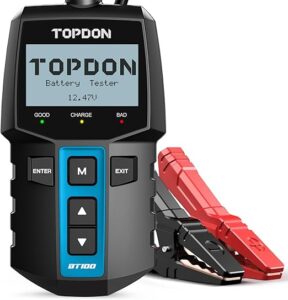
If you’re buying your first battery tester and don’t need a printer, the BT100 is the most sensible starting point in TOPDON’s range. It handles 12V lead-acid and AGM batteries in the 100-2000CCA range and completes a full diagnostic test in about ten seconds.
The load test function is particularly relevant for solar users. It tells you the battery’s actual capacity under a simulated load, which is far more informative than just checking voltage. A battery that reads 12.6V at rest but collapses under load is a battery that needs replacing — the BT100 catches this where a simple multimeter wouldn’t.
Build quality is solid without being luxurious. The clamps grip well and the cable is long enough to reach into tight battery compartments. The display is clear and the results are shown in plain language rather than cryptic codes, which makes it accessible for non-mechanics managing their own solar setups.
Features
- Tests 12V lead-acid and AGM batteries, 100-2000CCA range
- Load test simulates real demand to reveal capacity under pressure
- Alternator and cranking system tests included
- Plain-language results on backlit LCD
- Compact and lightweight — fits in a tool drawer easily
- Load test reveals capacity collapse that voltage checks miss
- Trusted TOPDON brand with strong warranty support
- Simple enough for non-technical users
- 12V only — doesn’t test 24V systems
- No printer for record-keeping
- Doesn’t support GEL or EFB battery types
3. Veepeak Car Battery Tester 12V 24V
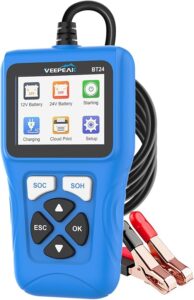
Veepeak’s battery tester earns its place here by covering 12V and 24V systems at a price that undercuts the TOPDON models. If your solar setup uses a 24V battery bank — common in larger off-grid systems — the Veepeak gives you dual-voltage coverage without stepping up to a premium price.
The 100-2000CCA range handles most residential solar batteries. AGM batteries, which are the most common choice for off-grid solar storage, are fully supported. The display shows voltage, CCA rating, health status, and a pass/warning/replace recommendation that takes the guesswork out of interpretation.
It’s not as polished as the TOPDON units — the casing feels a little lighter — but the measurements are consistent and accurate. For an owner running an annual check on their battery bank rather than daily diagnostics, this is more than capable.
Features
- Supports 12V and 24V systems, 100-2000CCA
- Tests standard, AGM, EFB, and GEL battery types
- Alternator and starting system tests included
- Color-coded pass/warning/replace result display
- Good value for dual-voltage capability
- 12V and 24V coverage at a competitive price
- Simple pass/warning/replace recommendation is easy to act on
- Supports AGM and GEL types used in solar installations
- Build quality slightly behind TOPDON and ANCEL
- Fewer reviews than the established brands
- No printer capability
4. ANCEL BT410 12V 24V Battery Tester
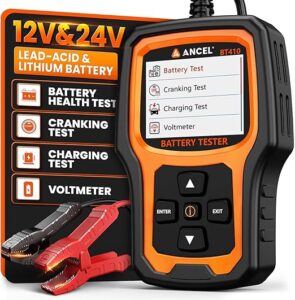
ANCEL has been a staple in the battery tester market for years and the BT410 represents their current mid-range offering. What distinguishes it from the BT310 below is expanded battery type coverage and a wider range of charging/discharging tests that go beyond a simple health snapshot.
The BT410 tests 12V and 24V systems and covers lead-acid, AGM, GEL, EFB, and deep-cycle batteries. If you’re using flooded lead-acid batteries in a budget off-grid setup or premium AGM batteries in a marine solar system, it handles both equally well. The CCA range of 100-2000 covers the battery sizes you’d typically find in residential solar storage.
One thing ANCEL does well is present results in plain text with actionable recommendations. Rather than showing you a number and leaving you to interpret it, the BT410 displays “Good,” “Weak,” “Replace,” or “Bad Cell” — direct language that tells you what to do next. For a solar owner who isn’t a trained mechanic, this matters.
Features
- 12V and 24V, 100-2000CCA range
- Tests lead-acid, AGM, GEL, EFB, and deep-cycle
- Alternator and starter test functions
- Color LCD with plain-language recommendations
- Memory function stores previous test results
- Deep-cycle battery support is ideal for solar installations
- Memory function lets you track battery condition over time
- Plain-language results — no interpretation needed
- No built-in printer
- Similar in price to TOPDON units that may offer more
5. ANCEL BT310 12V 24V Battery Tester
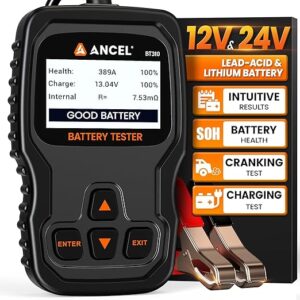
The BT310 is ANCEL’s entry point to the 12V/24V market. It costs less than the BT410 and drops a couple of the more advanced features, but the core battery health test is identical. If you need to check your solar battery bank once or twice a year rather than running regular maintenance checks, the BT310 is probably all you need.
It handles the same battery types as its more expensive sibling — lead-acid, AGM, GEL, EFB — and provides the same plain-language result display. The 100-2000CCA range covers residential and light commercial solar battery banks without issue. The alternator test works with solar charge controllers that have 12V or 24V output stages.
Compared to the BT410, you lose the memory function and the color display. The LCD is still clear and readable, just monochrome. For occasional users, these are reasonable trade-offs at a lower price point.
Features
- 12V and 24V, 100-2000CCA
- Tests lead-acid, AGM, GEL, and EFB batteries
- Alternator and starter test functions
- Clear LCD display with pass/fail results
- Compact handheld design
- Lower cost entry point for dual-voltage testing
- ANCEL reliability at a budget price
- Covers all common solar battery types
- No memory function for tracking battery trends
- Monochrome display vs. color on BT410
- Step up to BT410 is worth it if budget allows
6. ANCEL BA101 12V Digital Automotive Battery Tester
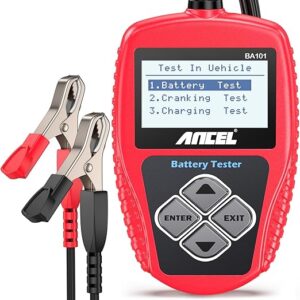
The BA101 is ANCEL’s best-selling battery tester and one of the most popular handheld units on Amazon, period. Tens of thousands of verified reviews tell you this is a product that works as advertised. For 12V solar batteries, it’s a reliable and inexpensive way to run quick health checks.
It’s 12V only, which is the main limitation for solar users with 24V systems. But for standard 12V setups — a single battery or a 12V bank — it’s hard to beat at this price. The 100-2000CCA range, plain-language display, and under-30-second test time make it something you’ll actually use rather than leaving in a drawer.
This is the tester to recommend to a friend who just installed their first off-grid solar setup and wants something simple to monitor battery health over time. It won’t handle GEL batteries or advanced chemistry, and it won’t print records. But it catches failing batteries before they take your system down, which is the job.
Features
- 12V, 100-2000CCA
- Tests standard lead-acid and AGM batteries
- Alternator and cranking test functions
- Pass/weak/bad cell recommendations on LCD
- One of the highest review counts in the category
- Outstanding track record with tens of thousands of reviews
- Inexpensive enough to keep as a backup tool
- Simple and fast — under 30 seconds per test
- 12V only — no 24V support
- Doesn’t support GEL or EFB battery types
- No memory function
7. KINGBOLEN BM550 6V 12V 24V Battery Tester
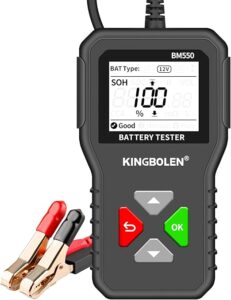
The BM550 stands out by testing 6V, 12V, and 24V systems — the widest voltage range of any unit on this list. That matters for solar setups using 6V golf-cart batteries in series (a common choice for deep-cycle capacity) that most testers ignore.
The 100-3000CCA range also extends higher than competitors at this price, making it better suited for heavy commercial battery banks. The color display and plain-language results follow the KINGBOLEN standard of accessible diagnostics. Alternator and starter tests round out the feature set.
It’s the most divisive tester on this list in terms of reviews — some users report excellent accuracy, others have found units that read inconsistently. Build quality is a step below TOPDON and ANCEL. But the 6V capability and 3000CCA ceiling justify considering it if those specs match your system. At a budget price point, the coverage is genuinely impressive.
Features
- 6V, 12V, and 24V — widest voltage range on this list
- 100-3000CCA range — highest ceiling here
- Tests lead-acid, AGM, GEL, and EFB batteries
- Color display with plain-language recommendations
- Alternator and starter tests included
- Only tester here that handles 6V batteries
- 3000CCA ceiling covers large commercial banks
- Build quality below TOPDON and ANCEL
- Inconsistent review quality — some units underperform
- Look elsewhere if you want rock-solid reliability
8. VDIAGTOOL BT500 Battery Tester 6V 12V 24V
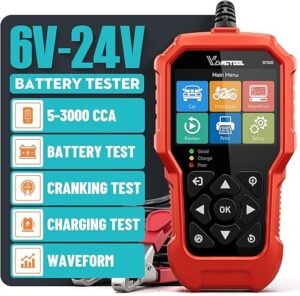
The BT500 from VDIAGTOOL rounds out this list as a budget-friendly multi-voltage option. At 6V, 12V, and 24V with a 5-3000CCA range, it technically covers more ground than most units on this list. The key question is whether that coverage comes with accuracy you can trust.
For casual testing — checking a solar battery bank once a season to confirm it’s still healthy — the BT500 performs adequately. It’s not the tester you’d rely on for a professional service center, but for a homeowner who wants a sanity check rather than a precision diagnostic, it does the job.
The display is clear, connection is straightforward, and the test takes under a minute. If you’re on a tight budget and need 6V or 24V coverage, this is the entry point. Just don’t expect it to match the accuracy or durability of TOPDON or ANCEL units.
Features
- 6V, 12V, and 24V voltage range
- 5-3000CCA range
- Tests lead-acid, AGM, GEL battery types
- LCD display with pass/fail indicator
- Budget price point
- Widest CCA range (5-3000) at lowest price
- Covers 6V, 12V, and 24V systems
- Accuracy less reliable than TOPDON or ANCEL
- Build quality reflects the budget price
- Fewer reviews than established brands
Solar Battery Tester Buying Guide
Battery Tester Types: Analog, Digital, and Dedicated Solar Testers
Solar battery testers divide into three categories with meaningfully different capability levels. Analog testers use a moving needle gauge to display battery state — they’re simple, require no power source of their own, and give an instant visual reading, but they’re imprecise (readings vary with temperature and load) and unsuitable for lithium chemistries. Digital multimeters with battery test functions are the most versatile tool: they measure voltage to three decimal places, can apply a load to simulate real-world conditions, and work with any battery chemistry. A quality digital multimeter in the $30–$80 range does everything most solar system owners need. Dedicated solar battery analyzers go further — they measure capacity in amp-hours, calculate state of health (SoH) as a percentage of original capacity, test internal resistance, and sometimes include Bluetooth data logging for trend analysis over time. These are the right tool for system installers and serious off-grid users who need to track battery degradation across a fleet of batteries or verify a used battery bank’s condition before purchase.
Voltage Testing: What the Numbers Tell You by Chemistry
Voltage is the most fundamental battery measurement, but interpreting readings correctly requires knowing your battery chemistry. A fully charged 12V flooded lead-acid battery reads 12.6–12.8V at rest (no load, no recent charge). At 12.4V it’s approximately 75% charged; at 12.0V it’s about 25% charged and beginning to sulfate if left at that level. AGM lead-acid reads slightly higher at full charge (12.8–13.0V). LiFePO4 (lithium iron phosphate) tells a different story: a 12V LiFePO4 battery reads 13.2–13.4V fully charged, 12.8–13.0V at 80%, and 12.0V at approximately 10% — the voltage curve is flatter, making state-of-charge harder to judge from voltage alone. Standard lithium-ion (NMC) reads 12.6V fully charged and drops more steeply. The key practical point: a reading that indicates a problem in one chemistry may be normal in another. Always reference the voltage chart for your specific battery chemistry, and always allow the battery to rest for 2+ hours after charging or discharging before taking a resting voltage reading for accurate state-of-charge assessment.
Load Testing: Why Resting Voltage Alone Is Not Enough
A battery can read 12.6V at rest but fail immediately under load — a common failure mode for aging lead-acid batteries with high internal resistance. Load testing applies a controlled current draw (typically the battery’s cold-cranking amps rating for automotive batteries, or a fraction of capacity for deep-cycle solar batteries) and measures the voltage drop under load. A healthy battery holds voltage well under load; a failing battery drops sharply. For solar storage batteries, apply a load of approximately C/5 (one-fifth of the amp-hour capacity) for 15 seconds and measure the voltage. A 100Ah battery should sustain a 20A load without dropping below 11.8V — if it drops below 11V under load, the battery is failing. Dedicated battery analyzers automate this process with internal load circuits; on a basic multimeter you need an external load resistor or a real load (inverter running a light, for example). Load testing is particularly important when buying used batteries for off-grid systems, where a bad cell in an aging battery can compromise the entire bank.
Internal Resistance: The Key to Predicting Battery Health
Internal resistance (measured in milliohms, mOhm) is the most accurate single predictor of battery health and remaining service life. A new 100Ah AGM battery typically has 3–6 mOhm internal resistance; as it ages and sulfation accumulates, resistance rises. Above 20–25 mOhm, the battery can no longer deliver rated current efficiently — it overheats under load, loses capacity, and begins failing. LiFePO4 batteries have very low internal resistance (1–3 mOhm when new) and this rises much more slowly with age, which is one reason they last 3–5x longer than lead-acid in daily cycling applications. Measuring internal resistance requires a dedicated battery analyzer with an AC impedance measurement circuit — a basic multimeter cannot do this. Mid-range battery analyzers in the $60–$150 range typically include internal resistance testing. For solar system owners with aging lead-acid banks, annual internal resistance testing of each cell identifies weak batteries before they cause system problems, allowing targeted replacement rather than replacing the entire bank at once.
Capacity Testing: Verifying Actual Amp-Hours
Nameplate capacity is the manufacturer’s claim; actual capacity is what your battery delivers in practice. Capacity testing — also called discharge testing or C-rate testing — measures how many amp-hours the battery actually delivers from full charge to a defined cutoff voltage. The standard method: fully charge the battery, apply a C/20 discharge rate (for a 100Ah battery, that’s 5A), and measure total amp-hours delivered until voltage reaches the cutoff (10.5V for lead-acid, 10.0V for LiFePO4). The result tells you the battery’s true current capacity as a percentage of nameplate. New batteries typically deliver 95–105% of rated capacity; batteries at 80% of original capacity are typically considered end-of-life for grid-backup applications (though still usable at reduced capacity for off-grid systems with appropriate derating). Dedicated capacity testers automate this process with electronic loads and built-in logging. For manual testing, you need an accurate ammeter, a voltmeter, a fixed load, and patience — a 100Ah battery at C/20 takes 20 hours to discharge.
Chemistry Compatibility: Matching Tester to Battery Type
Not all battery testers work correctly with all chemistries, and using the wrong tester can give misleading readings. Basic load testers calibrated for flooded lead-acid produce incorrect state-of-charge readings when used on AGM, gel, or lithium batteries — the voltage curves and internal resistance characteristics are different. Always verify that your tester explicitly supports your battery chemistry. For LiFePO4, look for a tester with a separate LiFePO4 mode or one that allows manual cutoff voltage and capacity settings rather than relying on fixed presets. Some testers support a wide range including 6V, 12V, 24V, and 48V battery banks — important for off-grid solar systems that commonly use 24V or 48V configurations. Testers that require manual configuration (input battery capacity, nominal voltage, chemistry) are more flexible than auto-detect models, which sometimes misidentify battery type. For mixed battery banks (common in DIY systems where different batteries have been added over time), the ability to test individual batteries separately is essential for identifying underperforming units.
Display and Data Logging Features
Entry-level battery testers display a single reading — voltage or a pass/fail indicator — which is sufficient for quick checks. Mid-range models display multiple parameters simultaneously: voltage, state of charge percentage, internal resistance, and temperature. Premium analyzers add data logging, which records measurements over time and allows trend analysis — watching internal resistance increase month by month is more informative than any single reading. Bluetooth connectivity to a smartphone app provides graphical displays and long-term history storage. For professional installers or commercial off-grid operators managing multiple battery banks, data export to CSV for spreadsheet analysis enables systematic tracking of the entire fleet. Backlit displays are worth specifying for basement or outdoor panel installations where ambient light is limited. Large numeric displays with separate color-coded indicators (green/yellow/red for battery health) reduce interpretation time during routine checks. For on-the-go use, battery-powered testers with automatic shutoff preserve the tester’s own battery.
Price Tiers and Right-Sizing for Your Application
Solar battery testers span a wide range from under $20 to over $300, with the tiers representing real capability differences. Under $30: basic digital multimeters with voltage measurement — adequate for monitoring state of charge in simple 12V systems if you know the voltage-to-SoC table for your chemistry. $30–$80: quality digital multimeters with load test capability, accurate to 0.1% — the right choice for most solar homeowners doing periodic health checks on lead-acid banks. $80–$150: dedicated battery analyzers with internal resistance measurement, capacity testing, and chemistry-specific modes — appropriate for serious off-grid installations or anyone running a mixed battery bank where individual battery health matters. $150–$300+: professional-grade analyzers with Bluetooth logging, multi-cell testing, and fleet management capability — designed for installers, battery retailers, and commercial off-grid operators. For a typical residential solar homeowner with a single battery bank, a quality multimeter plus a mid-range analyzer covers all meaningful testing scenarios without overspending on professional-grade features that will rarely be used.
Frequently Asked Questions
Can I use a regular battery tester on solar batteries?
Yes, as long as your solar batteries are lead-acid, AGM, or GEL chemistry — the same types used in vehicles. All testers on this list work with these chemistries. Lithium (LiFePO4) batteries require different testing methods and most standard battery testers are not designed for lithium chemistry.
How often should I test my solar battery bank?
Twice a year is a reasonable minimum — once before heavy summer use and once before winter. If you notice shorter runtimes, slower charging, or unexpected power drops, test immediately. Regular testing is especially important for batteries approaching 3-5 years of age, when degradation accelerates.
What does “bad cell” mean on a battery tester?
A “bad cell” reading means one or more of the battery’s internal cells has failed or shorted. A 12V lead-acid battery has six cells — one failed cell drops total voltage by about 2V and significantly reduces capacity. A battery with a bad cell cannot be recovered and should be replaced.
Can I test my battery while it’s connected to the solar system?
Yes, for most tests. Connect the tester clamps directly to the battery terminals with the solar charge controller connected. For the most accurate load test, disconnect the charge controller first so no charging current is flowing into the battery during the test. Most testers will still give reasonable readings without disconnecting, but isolated testing is more accurate.
Why does my battery show good voltage but the tester says “weak”?
Voltage at rest tells you the battery’s state of charge, not its health. A degraded battery can show 12.6V at rest but collapse under load — the tester catches this by applying a simulated load during the test. A battery that reads 12.6V but tests as “weak” is one that looks full but can’t actually deliver current when it matters.
Do battery testers work with 48V solar systems?
Not directly. Battery testers are rated for individual 6V, 12V, or 24V units. For a 48V system built from four 12V batteries in series, disconnect the series string and test each 12V battery individually. This gives you the most useful diagnostic information anyway, since you’re looking for the weakest link in the chain.
What’s the difference between CCA and RC ratings on a battery?
CCA (Cold Cranking Amps) measures short-burst current delivery. RC (Reserve Capacity) measures how long the battery sustains a moderate 25-amp load — more relevant to solar storage use. Most battery testers measure CCA, which correlates with overall battery health. Some advanced testers also measure internal resistance, which is an even more direct indicator of health independent of the CCA standard.
Should I charge the battery before testing?
Yes. Test a fully charged battery for meaningful results. A discharged battery will test as “weak” even if it’s perfectly healthy — the tester is measuring capacity it doesn’t currently have. Charge to full, let it rest 30 minutes, then test. Most testers will alert you if battery voltage is too low for an accurate reading.
Summing Up
A quality battery tester is an essential diagnostic tool for any solar installation — it tells you whether a sluggish system is a panel, charge controller, or battery problem before you start swapping out expensive components. The TOPDON BT300P is our top pick for its CCA testing accuracy and Bluetooth app integration. For a budget pick without compromising on 12V/24V compatibility, the ANCEL BA101 delivers solid results at a lower price point.
If you’re also thinking about solar panels for your home, call (855) 427-0058 for a free quote — it takes just a few minutes to find out what installation would cost and save you in your area.
Updated