
Solar energy has clear advantages for most US homeowners — reduced electricity bills, energy independence, and environmental benefits — but also real limitations that affect whether it makes financial sense for a specific property. Understanding both sides helps you make an informed decision rather than one based on marketing claims or outdated concerns.
Pros of Solar Energy
Lower electricity bills. The most direct financial benefit: solar panels reduce or eliminate the portion of your electricity that comes from the grid. A well-sized system in a high-sun state can offset 80–100% of annual household electricity use. Average US savings: $1,000–$2,500 per year depending on system size, local electricity rates, and net metering policy. Over a 25-year system life, this accumulates to $25,000–$60,000 in avoided electricity costs.
Long lifespan with predictable performance. Modern monocrystalline solar panels are warranted for 25–30 years of performance, with most manufacturers guaranteeing at least 80% of rated output at year 25. Degradation rates for premium panels (TOPCon, HJT) are 0.3–0.4%/year — predictable and slow. A 10 kW system installed in 2026 will still be producing 7.5–8 kW by 2051.
Energy independence and price protection. Solar locks in a large portion of your energy costs at installation rather than exposing you to utility rate increases. US electricity rates have risen an average of 2–3% per year historically. With solar, the energy your panels produce is effectively “purchased” at installation-day rates for the next 25 years.
Low operating costs. Solar panels have no moving parts and require minimal maintenance — typically just periodic cleaning and an annual visual inspection. Inverters require replacement after 10–15 years ($1,000–$3,000 depending on type). Beyond that, operating costs are near zero.
Increased home value. Studies by Lawrence Berkeley National Laboratory (LBNL) show that owned solar systems increase home sale prices by approximately $4 per watt of installed capacity — about $32,000 for an 8 kW system. Zillow data suggests solar homes sell 4.1% faster than comparable non-solar homes. The premium varies by market and electricity rates.
Environmental benefits. A typical 8 kW residential solar system offsets 3–5 tonnes of CO2 per year — equivalent to taking a car off the road. Over 25 years, that’s 75–125 tonnes of avoided emissions. The carbon payback period (time for a panel to offset the CO2 used in manufacturing) is 1–3 years, leaving 22–24 years of net-zero operation.
Grid resilience with battery storage. Paired with a battery (Tesla Powerwall 3, Enphase IQ, Franklin sFlex), solar provides backup power during grid outages. As extreme weather events increase grid disruptions, backup capability is increasingly valued by homeowners — particularly in areas prone to hurricanes, wildfires, or ice storms.

Cons of Solar Energy
High upfront cost. A residential solar system costs $20,000–$35,000 installed for a typical 8–10 kW system (2026 US national average: $2.50–$3.50/W). This is a significant capital outlay. The Section 25D federal residential tax credit (30%) expired December 31, 2025, removing a major cost offset that previously reduced the effective cost by $6,000–$10,000. Some state-level incentives remain, but the overall payback period has lengthened as a result.
Longer payback period without the federal ITC. Post-ITC, payback periods for homeowners who purchase their own system have extended to 9–14 years in many markets, up from 6–10 years when the 30% credit was available. In states with low electricity rates or unfavorable net metering (like California’s NEM 3.0), payback can extend further.
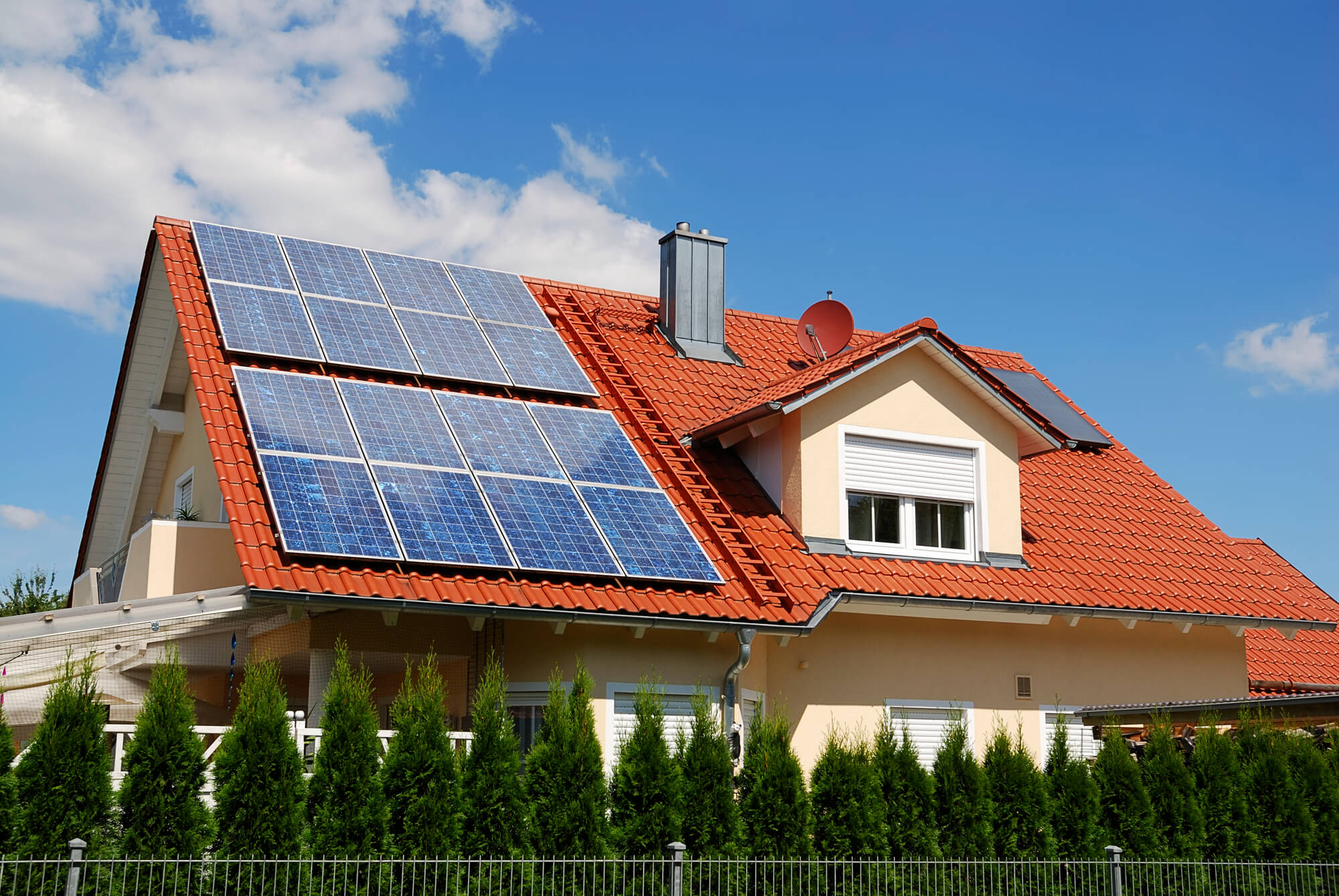
Not suitable for all roofs. Solar requires a structurally sound roof with sufficient south-facing (or east/west) unshaded surface area. Roofs with heavy shade from trees or neighboring structures, roofs nearing end of life, or roofs with complex architecture (multiple dormers, minimal south-facing area) may not be good candidates. Metal and asphalt shingle roofs work well; Spanish tile, slate, and shake roofs have higher installation complexity and cost.
Intermittent generation — no power at night. Solar panels only generate electricity during daylight hours. Without battery storage, a grid-tied solar home draws grid power at night and on cloudy days. Net metering addresses this economically (exporting surplus daytime energy as credits), but if grid power is unavailable (outages), a solar-only system provides no backup.
Net metering policy risk. The financial model for grid-tied solar depends heavily on net metering — the policy that credits you for exported solar power. California’s NEM 3.0 (2023) cut export credit rates from near-retail to 5–8 cents/kWh, significantly reducing solar economics for new California installations. Other states may follow. Net metering policy is set by state utility commissions and can change.
Lease complications. If you lease solar panels rather than own them, the lease is attached to the property and must be transferred to a buyer if you sell your home. Some buyers are hesitant to assume a solar lease. Loan-financed owned systems avoid this issue (they’re paid off or transferred at sale like any other home improvement).
Panel recycling is a growing concern. The first wave of solar panels installed in the 2000s is reaching end of life. Dedicated solar panel recycling is available but not universally accessible, and some panels end up in landfills. Silicon and glass recycling is well-established; silver and other metals are increasingly recovered, but the industry-scale recycling infrastructure is still developing.
How to Decide If Solar Is Right for You
Solar makes strong financial sense when: your annual electricity bill exceeds $1,500 (higher bills = faster payback); your roof has good south or southwest exposure with minimal shading; you plan to stay in the home 8–15+ years; your utility has reasonable net metering policy; and electricity rates in your area are above the national average (~$0.18/kWh in 2026).
Solar is less compelling when: you’re in a low-electricity-rate market (under $0.12/kWh); your roof has significant shading or a short remaining life; you expect to move within 5–7 years; or your utility has weak net metering (avoided-cost rates).
The best way to assess your specific situation is to get multiple installer quotes — they’ll conduct a site assessment, pull your electricity usage data, and model expected production and savings for your exact roof and location. Most quotes are free and no-obligation. Call (855) 427-0058 to speak with a solar advisor about whether your home qualifies.
Frequently Asked Questions
What are the main disadvantages of solar energy?
The main disadvantages of residential solar are: (1) High upfront cost — $20,000–$35,000 for a typical 8–10 kW system, with the federal residential ITC (Section 25D) expired as of December 31, 2025, extending payback periods; (2) Intermittent generation — panels don’t produce power at night or during outages without a battery; (3) Roof requirements — not all roofs are suitable (shade, orientation, condition); (4) Net metering policy risk — export credits may be reduced as California’s NEM 3.0 demonstrated; (5) Long payback period in low-electricity-rate markets or states with weak net metering — 10–14 years in some cases.
What are the pros of solar panels?
Key advantages: significant electricity bill reduction ($1,000–$2,500/year average savings); long lifespan with predictable 25-30 year performance warranty; increased home resale value (approximately $4/W installed per LBNL research); protection from future electricity rate increases; low maintenance requirements; environmental benefit (3–5 tonnes CO2 offset per year for a typical system); and backup power capability when paired with battery storage. In states with strong net metering, solar economics are particularly compelling.
Is solar worth it in 2026 without the tax credit?
For many homeowners, yes — but the math is tighter than it was in 2025. The Section 25D residential tax credit expired December 31, 2025, adding $6,000–$10,000 to the effective cost for homeowners buying their own systems. Payback periods have extended to 9–14 years in most markets. Solar still makes financial sense if: your electricity bill is above $1,500/year, you have good roof exposure, you’ll stay in the home long enough for payback, and your state has reasonable net metering. Leased systems and PPAs remain available — installers can still claim the Section 48E commercial credit through 2027 and may pass some savings on.
What are the pros and cons of solar panels for the environment?
Environmental pros: zero emissions during operation; offsets 3–5 tonnes CO2/year for a typical home system; carbon payback period (manufacturing emissions offset by clean generation) of 1–3 years; reduces local air pollution vs. fossil fuel plants. Environmental cons: manufacturing is energy-intensive (though offset within 1–3 years); silicon purification uses significant electricity; silver in panel metallization is a critical mineral with mining impacts; end-of-life panel recycling infrastructure is still developing with some panels reaching landfills. Over a 25-year life cycle, solar panels generate 20–50g CO2e/kWh — compared to 820g CO2e/kWh for coal and 490g for natural gas — making them one of the lowest-carbon electricity sources available.
Do solar panels work on cloudy days?
Yes, but at reduced output — typically 10–25% of rated capacity on heavily overcast days, compared to 100% under direct full sun. Diffuse light (scattered sunlight through clouds) still generates electricity in solar panels; only complete darkness stops generation. Germany, one of the world’s top solar markets, has significantly less sunshine than most of the US — demonstrating that solar works economically even in relatively cloudy climates. Seasonal variation matters more: winter months with lower sun angles and shorter days produce meaningfully less than summer months, which is why annual production averages (peak sun hours × panel wattage) are used for system sizing rather than individual day estimates.
Summing Up
Solar energy’s advantages — substantial electricity savings, 25-30 year lifespan, home value increase, price protection, and environmental benefits — are well-documented and consistent across the literature. Its disadvantages — high upfront cost (now without the federal residential ITC), intermittent generation, roof limitations, and net metering policy risk — are real but manageable in most situations. The key is running the numbers for your specific location, roof, electricity usage, and utility net metering policy. For most homeowners with above-average electricity bills and suitable roofs, solar remains a financially sound investment in 2026 despite the ITC expiry — the question is simply how long the payback period is for your specific circumstances.
Updated