
Our blog is reader-supported. When you buy through links on our site, we may earn an affiliate commission. Thank you for your support!
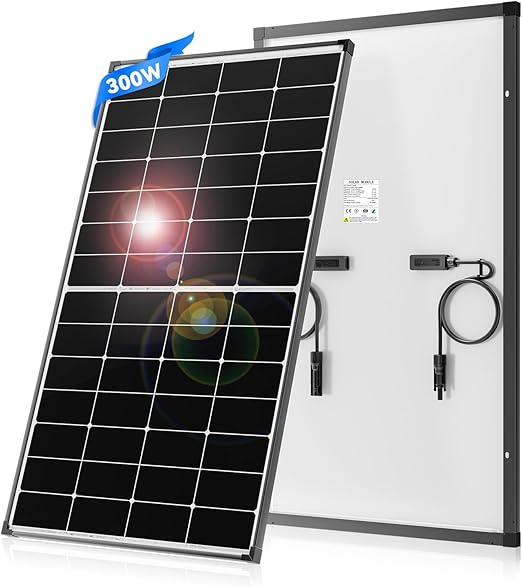
The BougeRV 300W Bifacial 12BB Monocrystalline Solar Panel is our top pick right now. It captures light from both faces, ships with a genuine 23.1% efficiency rating, and works for permanent rooftop installs, ground mounts, and off-grid cabin setups alike. But depending on whether you need portability, a complete kit, or a specific cell type, there are better options for your situation.
We’ve combed the current Amazon market to find the best 300 watt solar panels available. Below are eight panels, reviewed honestly, with specs, pros and cons, and a buying guide to help you choose.
Our Top Picks
| PRODUCT IMAGE | PRODUCT | PRICE |
|---|---|---|
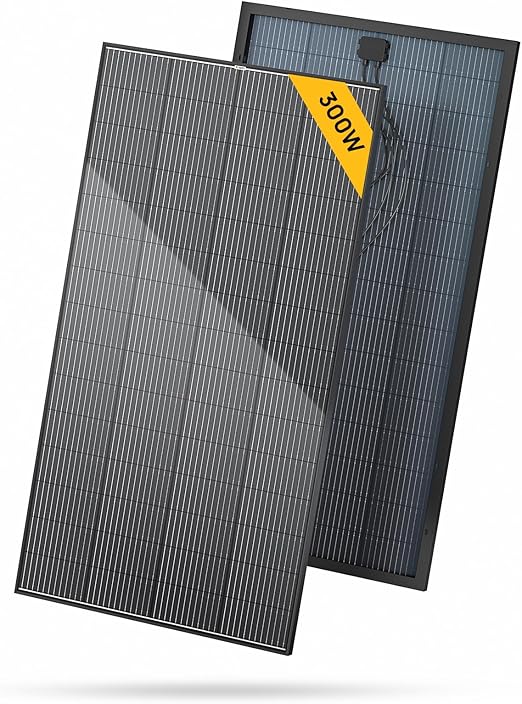 | BougeRV 300W Bifacial 12BB Monocrystalline Solar Panel Bifacial design captures rear diffuse light, 12BB cell technology, 22%+ efficiency, IP68 junction box, ideal for RV and off-grid. | CHECK PRICE |
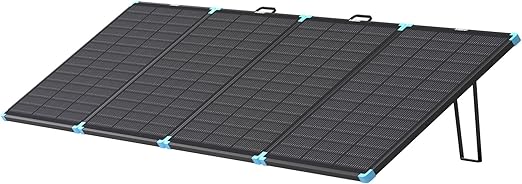 | Renogy 300W Portable Foldable Suitcase Solar Panel Foldable briefcase design with kickstand, built-in 40A MPPT controller, waterproof, ready to use out of the box. | CHECK PRICE |
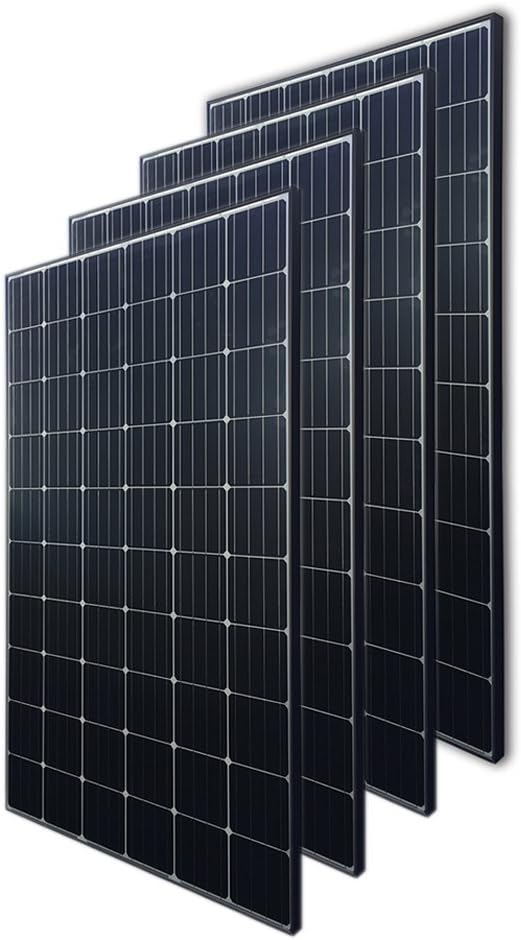 | Renogy 300W 24V Monocrystalline Solar Panel 4-Pack 4 x 75W panels totalling 300W, 24V system compatible, high efficiency mono cells, pre-drilled mounting holes. | CHECK PRICE |
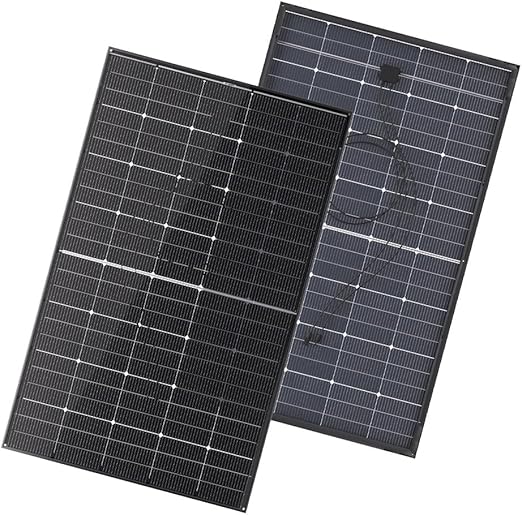 | BougeRV 300W N-Type 16BB Bifacial Solar Panel N-type TOPCon cells with 16 busbars, higher efficiency and lower degradation than P-type, bifacial for extra rear gain. | CHECK PRICE |
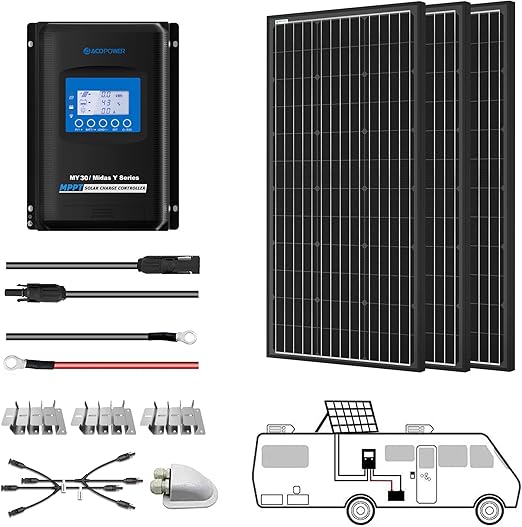 | ACOPOWER 300W Complete Solar Kit 3 x 100W Panels Complete kit with 3×100W panels, 30A PWM controller, mounting brackets and cables — everything needed to start. | CHECK PRICE |
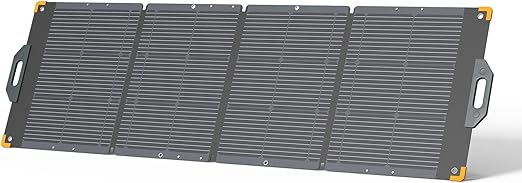 | Pecron 300W Foldable Solar Panel Lightweight foldable design, compatible with most portable power stations, ETFE surface, MC4 connectors included. | CHECK PRICE |
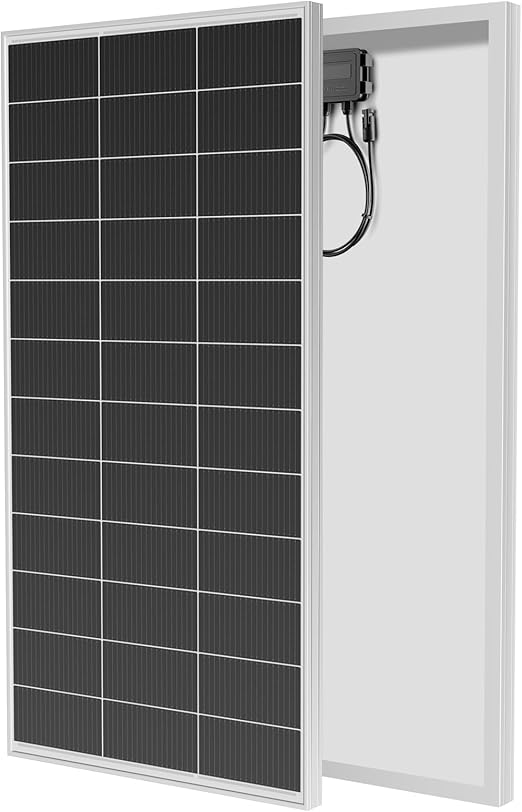 | 300W N-Type 18BB All-Black Monocrystalline Panel All-black aesthetic with N-type 18BB cells, high efficiency, low-light performance, suitable for residential rooftops. | CHECK PRICE |
 | 300W 10BB N-Type Half-Cut Monocrystalline Panel Half-cut cell design reduces resistive losses, N-type base, 10BB, improved shade tolerance over standard mono panels. | CHECK PRICE |
8 Best 300 Watt Solar Panels
1. BougeRV 300W Bifacial 12BB Monocrystalline Solar Panel
Of all the rigid 300W panels on the market right now, the BougeRV 12BB bifacial is the standout. It generates power from both faces, and in the right conditions, the rear side can contribute a meaningful production boost. On a white roof, a light-colored gravel ground mount, or any reflective surface, you can see rear-side gains of 15 to 25% on top of the rated 300W front output. That’s real money over a 25-year system life.
The 12 busbar design spreads electrical current across more pathways, reducing resistive losses. Pair that with half-cut cell architecture and you get better shade tolerance than older full-cell designs. If one section of the panel is shaded, the rest keeps producing at closer to full output rather than the whole panel dropping. BougeRV rates efficiency at 23.1%, which is genuinely competitive for consumer-grade rigid panels.
Build quality is solid throughout. The anodized aluminum frame is rated for wind and snow loads, the junction box carries an IP68 waterproofing rating, and 3.3 feet of MC4-compatible cable comes pre-attached. Most MPPT charge controllers and combiner boxes will connect directly without adapters.
With 50 customer reviews averaging 4.3 stars, there’s enough real-world feedback here to draw conclusions. Buyers consistently mention the dual-sided production and straightforward installation. This is our first recommendation for anyone building a permanent off-grid or hybrid system who wants a single high-quality rigid panel.
Features
- 300W rated output at 23.1% efficiency
- Bifacial design generates power from both faces
- 12 busbar half-cut monocrystalline PERC cells
- IP68 junction box with 3.3ft MC4-compatible cables pre-attached
- Anodized aluminum frame rated for wind and snow loads
- 25-year power output warranty
- Bifacial design adds meaningful rear-side production
- 23.1% efficiency is at the top of consumer-grade panels
- 12BB half-cut cells improve shade tolerance
- IP68 waterproofing handles wet climates
- Rear-side gain only useful over reflective surfaces
- Smaller review count than major brands like Renogy
2. Renogy 300W Portable Foldable Suitcase Solar Panel
If portability matters as much as output, Renogy’s 300W foldable suitcase panel is the one to look at first. It folds in half for transport and storage, opens on a built-in kickstand for instant angle adjustment, and connects to most MPPT controllers via a pre-attached MC4 cable. For RV owners, overlanders, and anyone who moves their system between locations, this is a genuinely practical format.
Renogy is one of the most established names in consumer solar. Their products consistently earn high marks for build quality and the panels hold up through repeated deployments. This model averages 4.6 stars across 71 reviews, which is strong for a product in this output range. Users mention that setup takes minutes and the foldable hinge holds up through repeated field use.
It’s not a rooftop panel. The folding design and kickstand make it ground-deployable, not suitable for permanent fixed mounting. Think of it as a high-output portable charger for battery banks, power stations, or direct-load applications when you need off-grid power temporarily.
Features
- 300W foldable suitcase design with built-in kickstand
- Monocrystalline cells, high efficiency
- Pre-attached MC4-compatible cable for controller connection
- Folds in half for transport and storage
- Compatible with 12V and 24V systems
- Renogy 1-year materials and workmanship warranty
- Folds for easy transport and compact storage
- Established Renogy brand with solid support
- Kickstand adjusts angle without extra hardware
- Not designed for permanent rooftop mounting
- Higher cost per watt than fixed rigid panels
- Folding hinge is a potential long-term weak point
3. Renogy 300W 24V Monocrystalline Solar Panel (4-Pack)
This Renogy listing ships as a 4-panel pack — four 300W panels for a combined array capacity of 1,200W. Each panel is a standard rigid monocrystalline unit designed for 24V systems. It’s the right choice for building a larger off-grid or grid-tied setup from scratch, where sourcing four matched panels from a single trusted supplier simplifies both installation and warranty management.
At 4.6 stars across 66 reviews, the feedback is consistently positive. Buyers specifically praise the consistency between panels, and that matters. When wiring panels in series or parallel, matching Voc and Isc values across the array prevents one underperforming panel from dragging the others down. Renogy’s manufacturing quality control earns genuine praise here.
One planning note: these are 24V nominal panels. They pair best with a 24V or 48V battery bank and an MPPT charge controller. Running them through a basic 12V PWM controller would be a mismatch that costs you output. If you’re learning more about system design, our guide on how solar panels work covers the basics of voltage, current, and charge controller selection.
Features
- 300W per panel, sold as a 4-panel pack (1,200W total)
- 24V nominal monocrystalline cells
- High-transmission tempered glass face
- Pre-drilled holes for mounting bracket attachment
- MC4 connectors included
- 25-year power output warranty, 5-year materials warranty
- 4-panel pack simplifies building a larger array
- Renogy brand consistency across panels in each batch
- 25-year performance warranty with real brand backing
- Requires 24V-compatible system design
- Higher upfront cost as a multi-panel purchase
- Significant shipping weight
4. BougeRV 300W N-Type 16BB Bifacial Solar Panel
N-type silicon cells have structural advantages over the more common P-type: lower light-induced degradation, better performance at elevated temperatures, and a flatter output decline curve over the panel’s lifetime. A 300W N-type panel rated today is likely to hold closer to that 300W at year 20 than a P-type equivalent. The BougeRV 16BB version pairs N-type cells with 16 busbars, pushing resistive losses lower than the 12BB model above.
The caveat is straightforward: 11 reviews. A 4.1-star average across 11 buyers is not a statistically meaningful sample. This panel may be excellent. It may have quality control issues that haven’t surfaced yet in public feedback. If you’re building a high-value permanent installation and want the best available cell technology, the specs are compelling. But you’re accepting early-adopter risk on this specific product.
On the spec sheet, the bifacial design adds the same rear-face production benefit as product #1. The combination of N-type cells, 16 busbars, and bifacial architecture represents genuinely premium panel engineering for the 300W class.
Features
- 300W N-type bifacial monocrystalline cells
- 16 busbar design for minimum resistive loss
- Lower temperature coefficient than standard P-type panels
- IP68 junction box, MC4 cables included
- Suitable for roof, ground mount, or elevated installations
- 25-year performance warranty
- N-type cells degrade more slowly over time
- 16BB reduces electrical losses further than 12BB
- Bifacial adds rear-side production potential
- Only 11 reviews — insufficient real-world reliability data
- Premium price for the spec level
- Early adopter risk on this specific model
5. ACOPOWER 300W Complete Solar Kit (3 x 100W Panels)
ACOPOWER packages three 100W monocrystalline panels with a 30A MPPT charge controller, wiring, and mounting hardware. Total rated output is 300W. The appeal here isn’t raw spec value — it’s the complete kit format. Everything you need to start producing power is in one order, with components that are confirmed to work together without additional sourcing or compatibility checking.
At 4.6 stars across 18 reviews, the kit is well received. Buyers specifically call out how straightforward it is to wire up compared to building a system from separate components. The 30A MPPT controller is a meaningful inclusion — PWM controllers waste a portion of panel output that MPPT captures, and many budget kits cut costs here. ACOPOWER doesn’t.
The three-panel format means more roof or ground space to manage and more MC4 connections to make than a single 300W unit. If a clean single-panel install is your goal, look at the rigid panels above. But for a complete first system that gets you from zero to producing power with minimum research time, this is a solid answer.
Features
- 3 x 100W monocrystalline panels (300W total rated output)
- 30A MPPT charge controller included
- Pre-wired cables and MC4 connectors
- Mounting hardware provided
- Supports 12V and 24V battery configurations
- ACOPOWER warranty on all components
- Complete kit — panels, MPPT controller, cables, and brackets
- Components are confirmed compatible from the manufacturer
- MPPT controller captures more output than PWM alternatives
- Three panels require more roof space than a single 300W unit
- More wiring connections to manage
- Moderate review count for confidence
6. Pecron 300W Foldable Solar Panel
Pecron designs this foldable 300W panel specifically as a companion charger for their portable power station lineup. It folds to a compact footprint, includes built-in handles for carrying, and opens on a kickstand for easy angle adjustment during ground deployment. Of the portable options on this list, it’s the most compact when folded.
The 4.3-star average across 21 reviews is respectable. Buyers note fast charging times when paired with Pecron power stations and reliable MC4 compatibility with third-party MPPT controllers. Pecron’s customer support has a solid reputation within their product ecosystem. And if you already own a Pecron power station, this panel is the obvious choice for field charging.
If you don’t own Pecron gear, the brand ecosystem advantage disappears and you’re comparing it directly against the Renogy suitcase on portability and value. It’s worth noting that Renogy’s panel range is broader and their review counts are higher. Pecron wins for existing customers; Renogy wins for everyone else.
Features
- 300W foldable design with carry handles
- Monocrystalline cells
- DC5521, USB-A, and USB-C output options
- Adjustable kickstand for ground deployment
- MC4-compatible for third-party MPPT controllers
- Optimized for Pecron power station ecosystem
- Compact fold with integrated carry handles
- Multiple output options beyond MC4
- Best choice for Pecron power station owners
- Brand ecosystem advantage only relevant for Pecron users
- Not suited for permanent mounting
- Moderate review count
7. 300W N-Type 18BB All-Black Monocrystalline Panel
All-black solar panels — black frame, black backsheet — exist for one reason: aesthetics. On a residential rooftop where appearance matters, a fully black panel blends in where silver-framed panels stand out. This 300W N-type 18BB all-black model delivers on the spec sheet too: 18 busbars represent the highest busbar count on this list, and N-type cells bring the same degradation and temperature performance advantages covered in product #4.
The review count is the problem. Five reviews at 5 stars is a meaningless sample. It’s too small to draw any conclusions about quality control, long-term durability, or whether the specs match real-world output. Look elsewhere if proven reliability matters to you. But if you need an all-black panel for aesthetic reasons and you’re willing to accept some uncertainty in exchange for the appearance, the specs are at least compelling on paper.
Features
- 300W N-type monocrystalline cells
- 18 busbar design for lowest resistance on this list
- All-black frame and backsheet for rooftop aesthetics
- IP67 junction box with MC4 cables included
- Anodized aluminum alloy frame
- All-black design for cleaner residential rooftop appearance
- 18BB N-type cells are top-spec for the 300W class
- Only 5 reviews — no meaningful real-world data
- 5-star rating on 5 reviews cannot be trusted
- Unknown quality control track record
8. 300W 10BB N-Type Half-Cut Monocrystalline Panel
The budget option on this list. This 300W 10BB N-type half-cut panel offers solid fundamental specs at a lower price than the named-brand alternatives. Half-cut cell technology splits each cell in two, reducing the current each cell carries and improving performance in partially shaded conditions compared to standard full-cell designs. N-type silicon adds the lower-degradation advantage covered earlier.
But the five-review sample at 5 stars tells you almost nothing. Buy this if you’re supplementing an existing system at minimum cost or building a test array where long-term reliability isn’t the primary concern. If you need a panel that will perform consistently for 20-plus years with a warranty you can actually enforce, spend the extra money on Renogy or BougeRV.
Features
- 300W N-type half-cut monocrystalline cells
- 10 busbar (BB) design
- Half-cut cells for better partial-shade tolerance
- IP67 rated junction box
- Pre-attached MC4 cables
- Half-cut cells improve shade performance over standard cells
- N-type silicon reduces long-term degradation
- Minimal reviews — no track record
- Generic brand with uncertain warranty enforcement
- 5-star rating on 5 reviews is not meaningful
300 Watt Solar Panel Buying Guide
Key Takeaways
- 300W panels are a practical size for off-grid cabins, RV systems, boat installs, and supplemental home power
- N-type cells degrade more slowly than P-type — worth paying extra for permanent installs
- Bifacial panels add meaningful output only if you have a reflective surface beneath them
- Higher busbar counts reduce resistive losses — 10BB to 18BB all help, but the gains diminish above 12BB
- Review count matters as much as star rating — 5 reviews at 5 stars tells you almost nothing
- For a complete first system, a kit with an MPPT controller saves time and compatibility headaches
What Is a 300 Watt Solar Panel?
A 300 watt solar panel is a photovoltaic module rated to produce 300 watts of electrical power under Standard Test Conditions (STC). STC means 1,000 watts per square meter of irradiance, 25°C cell temperature, and an air mass of 1.5 — conditions that approximate a clear midday sun in a temperate climate.
In real-world use, your panel will rarely hit exactly 300W output. Output varies with actual sunlight intensity, cell temperature (panels produce less as they heat up), shading, and wiring losses. A well-installed 300W panel in a good location typically produces 240 to 270 watts on average during peak sun hours, accounting for these real-world factors. Use the calculator above to estimate your daily energy production.
How Do 300 Watt Solar Panels Work?
Solar panels work by using the photovoltaic effect. Photons from sunlight knock electrons loose in the semiconductor material (typically silicon), creating a flow of electrical current. Each individual solar cell produces a small amount of direct current (DC). Cells are wired together in the panel to add up their voltages and currents to hit the rated panel output.
The DC electricity flows from the panel through MC4 cables to a charge controller (for battery-based systems) or a solar inverter (for grid-tied or AC systems). The charge controller regulates the charging voltage and current to protect your batteries. An MPPT controller is significantly more efficient than a PWM unit, particularly with higher-voltage panels like the 24V Renogy pack on this list. For a deep dive into the full process, see our guide on how solar panels work.
Benefits of 300 Watt Solar Panels
The 300W class sits in a useful middle ground. Individual 100W panels are lightweight and easy to handle but you need three of them to match one 300W unit. Larger 400W and 500W panels are more efficient per installation hour but are physically larger, heavier, and harder to install on curved or irregular surfaces like RV roofs.
At 300W, you get a panel large enough to make a meaningful power contribution from a single unit, with a physical size and weight that one or two people can manage without specialized lifting equipment. For boat installs, RV rooftops, small cabin arrays, and supplemental home power systems, this is often the right size class. You can explore how full home solar installations work at our guide to the best solar panels for homes.
Matching a 300W Panel to Your Charge Controller and Battery Bank
A 300-watt solar panel produces roughly 15 to 18 amps at 18 to 20 volts under peak conditions. Before buying, make sure your charge controller is rated to handle that current. A common 10A or 20A PWM controller is undersized for a 300W panel and will either blow a fuse or clip output. You need at minimum a 20A MPPT controller, and a 30A or 40A unit gives you headroom and better efficiency through MPPT’s voltage conversion.
On the battery side, a single 100Ah 12V battery can accept a charging current of around 10 to 20A before it starts to get warm. A 300W panel pushing 15 to 17A is right at the upper end of what a single 100Ah battery can absorb safely, so either a 200Ah battery bank or two batteries in parallel is the better match. Get the system sizing right before the panel arrives and you will avoid the frustration of a new panel that underperforms because its output has nowhere to go.
Monocrystalline vs. Polycrystalline vs. Bifacial at the 300W Class
At 300 watts, you can find all three cell technologies. Monocrystalline panels are the most efficient per square foot, which matters if you have limited roof or mounting space. A monocrystalline 300W panel is typically around 65 by 39 inches. Polycrystalline panels at the same wattage need to be slightly larger to compensate for lower cell efficiency, and their blue speckled appearance is a visual difference some buyers prefer and others do not.
Bifacial panels are the newest entrant in this class and generate additional power from reflected light hitting the back of the panel. They work best when elevated off a reflective surface like white gravel, a light-colored roof, or snow. In a flush ground-mount or roof installation where the back is close to the surface, the bifacial gain is minimal. If you have a ground-mount system with several inches of clearance, bifacial is worth the modest price premium. For a direct roof mount, standard monocrystalline gives you the best value per dollar.
How Many 300W Panels You Need for Common Applications
Running the numbers upfront saves a lot of second-guessing. A single 300W panel produces around 1.2 to 1.5 kWh per day in most US locations, assuming 4 to 5 peak sun hours. An average US home uses 30 kWh per day, so full-home offset requires 20 to 25 panels. That is a realistic grid-tied rooftop system.
For off-grid or supplemental purposes, the math is more encouraging. A 300W panel can comfortably run a 12V refrigerator, LED lighting, phone charging, and a fan through the day with enough surplus to charge a battery bank for overnight use. Two or three panels cover an RV or cabin without much compromise. Four panels with a 400Ah battery bank handle all but the highest-draw appliances. Knowing your target daily watt-hour consumption before buying the panels is the single most important step in system planning.
Things to Consider Before Buying
System voltage is the first decision. Are you building a 12V, 24V, or 48V battery system? A 24V-rated panel wired into a 12V system with a PWM controller wastes most of its potential output. Match your panels to your battery bank voltage, or use an MPPT controller which can handle the voltage conversion efficiently.
Mounting surface matters more than most buyers expect. A bifacial panel installed flush against a dark roof with no space underneath captures almost no rear-side benefit. That same panel elevated above white gravel or a reflective membrane roof can see 15 to 25% gains. Think about where you’re installing before deciding whether the bifacial premium is worth paying.
Warranty enforcement is a real consideration with no-name panels. A 25-year performance warranty from a generic brand with no US presence is difficult to enforce at year 10 if panel output has degraded significantly. Renogy and BougeRV have US operations and established customer support channels. Generic brands listed here may not exist by the time you need to make a claim.
Types of 300 Watt Solar Panels
Rigid monocrystalline panels are the most common type at this output class. A single solid panel with an aluminum frame, tempered glass face, and polymer backsheet. Suitable for permanent rooftop and ground mount installations. The panels from BougeRV and the Renogy 4-pack on this list fall into this category.
Foldable and suitcase panels use the same monocrystalline cell technology but package it in a hinged format for portability. They sacrifice some output density for convenience and are not suitable for permanent mounting. The Renogy suitcase and Pecron foldable panels fit this description.
Complete kits bundle multiple smaller panels (typically 3 x 100W) with a controller and hardware. They sacrifice the single-panel simplicity for a plug-and-play first-system experience. The ACOPOWER kit is the example on this list.
Frequently Asked Questions
How much power does a 300 watt solar panel actually produce per day?
In real-world conditions with 4 peak sun hours and 80% system efficiency, a single 300W panel produces roughly 0.96 kWh per day. In sunnier locations like Arizona or New Mexico with 5.5 to 6 peak sun hours, the same panel can generate 1.3 to 1.4 kWh daily. Use the calculator above for a more precise estimate based on your specific inputs.
What can a 300 watt solar panel power?
A single 300W panel produces enough daily energy to run LED lighting, a small refrigerator for several hours, phone and laptop charging, and a low-draw water pump. It won’t run air conditioning, electric water heaters, or electric cooking appliances. For larger loads, you’ll want multiple panels or a higher-wattage setup.
What charge controller do I need for a 300 watt solar panel?
For a single 300W panel into a 12V battery bank, a 30A MPPT charge controller is the standard recommendation. MPPT controllers are significantly more efficient than PWM, particularly with higher open-circuit voltages from modern 300W panels. At 24V, a 20A MPPT controller typically works. Always check the controller’s maximum input voltage against your panel’s Voc spec.
Is N-type or P-type better for a 300 watt solar panel?
N-type is the better technology for long-term installs. N-type silicon has lower light-induced degradation and a better temperature coefficient, meaning it loses less output on hot days and holds its rated wattage more consistently over 20 to 25 years. For temporary or portable applications where you’ll replace the panel within a decade, the P-type vs N-type distinction matters less, and P-type panels generally cost less.
How many 300 watt solar panels do I need to power a house?
The average US home uses around 900 kWh per month. To cover that with 300W panels at 4 peak sun hours and 80% efficiency, you’d need roughly 25 panels (7,500W total). Most homes targeting full offset install 20 to 30 panels. But the exact number depends on your actual consumption and your local sun hours. For professional sizing and a free installation quote, call us at (855) 427-0058.
What is the difference between a bifacial and a standard solar panel?
A standard solar panel generates power only from its front face, which faces the sun. A bifacial panel also captures reflected and diffuse light on its rear face. The practical gain from the rear depends entirely on what’s beneath and around the panel. White or reflective surfaces can contribute 15 to 25% additional output. Dark rooftops with no clearance beneath offer almost no bifacial benefit. If you’re mounting panels flat on a dark roof, a standard panel is fine. If you’re doing a ground mount or elevated roof install over a reflective surface, bifacial is worth the price.
Summing Up
300W solar panels hit a sweet spot between compact portability and serious off-grid output. BougeRV’s bifacial and N-type options lead for efficiency; Renogy’s foldable suitcase is the easiest plug-and-play solution for camping and van life. For permanent installs, the N-type 18BB all-black and half-cut panels offer excellent long-term performance with lower degradation than standard P-type mono panels.
If you’re thinking about a full home solar installation rather than off-grid panels, call (855) 427-0058 for a free quote — it takes just a few minutes to find out what installation would cost and save you in your area.
Updated