
The best type of solar panel for your home is a high-efficiency monocrystalline panel from a tier-1 manufacturer with a strong warranty—but the true answer depends on your specific roof, budget, and goals. Monocrystalline panels now dominate 85% of the global market, having largely displaced polycrystalline as the gold standard. They offer 20-22% efficiency, durability, excellent cold-weather performance, and premium build quality. However, the best panel is ultimately the one that produces the most kilowatt-hours over 25 years at the lowest cost per watt. In this guide, we’ll explore the three main panel types, emerging technologies, and how to choose the right panels for your situation.
This comprehensive guide walks you through monocrystalline, polycrystalline, thin-film, and next-generation solar technologies, along with practical criteria for comparing panels.
Monocrystalline Solar Panels: The Industry Standard
Monocrystalline panels are made from a single large crystal of silicon. During manufacturing, silicon is melted, a seed crystal is dipped into the melt, and the crystal slowly cools as it’s pulled upward, forming a single ingot. This ingot is sliced into wafers, which become cells, which are assembled into panels.
Performance and Specifications
- Efficiency: 20-22% standard; premium models 22-23%
- Cost per watt: $0.30-$0.50 (residential, fully installed)
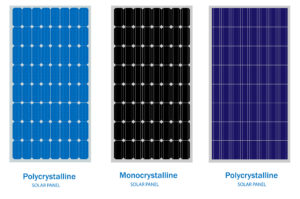
- Appearance: Uniform black or dark color; sometimes with a diamond-patterned waffle texture on the surface
- Degradation: 0.5-0.7% annually (industry average)
- Lifespan: 25-30+ years; many manufacturers warrant 80-90% output after 25 years
- Temperature coefficient: -0.35 to -0.45%/degree Celsius (output drops as temperature rises)
Top Monocrystalline Brands
- SunPower Maxeon (USA/Singapore): Premium tier. 22.3% efficiency, SunPower’s proprietary back-contact technology, 25-year full warranty. Cost: 10-15% premium.
- Canadian Solar (China/Canada): Tier-1 manufacturer. 20.8-22% efficiency, solid durability, competitive pricing.
- Enphase (USA): Known for microinverters but also panels. 20-22% efficiency, integrated monitoring.
- REC (Norway/Singapore): High-efficiency monocrystalline. 22-22.5% efficiency via Twin Peak technology, excellent cold-weather performance.
- Panasonic EverVolt (Japan): Premium efficiency. 22.3% efficiency, HJT (heterojunction) technology, discontinued for residential in some markets but still available in others.
- Jinko, Longi, Risen (China): Mass-market tier-1. 20-22% efficiency, lower cost, acceptable reliability despite volume manufacturing.
Monocrystalline Advantages
- Highest efficiency per square meter (saves roof space on small roofs)
- Excellent performance in cold weather and partial shade
- Long lifespan and predictable degradation
- Strongest warranties from tier-1 manufacturers
- Mature, proven technology with 25+ year track record
- Best resale value if upgrading or adding panels later
Monocrystalline Disadvantages
- Higher upfront cost than polycrystalline
- Temperature-dependent: output drops 0.35-0.45% per degree Celsius above 25 degrees
- Manufacturing still dominated by China (tariff concerns)
Polycrystalline Solar Panels: The Declining Tier
Polycrystalline panels are made from multiple silicon crystals melted and cooled together, creating a grainy crystalline structure visible as a speckled blue appearance. Polycrystalline was the market standard from 2005-2018, but monocrystalline has now displaced it due to superior efficiency and declining price differential.
Performance and Specifications
- Efficiency: 15-18% (lower than mono due to grain boundaries reducing electron flow)
- Cost per watt: $0.25-$0.40 (overlaps with mono at the low end)
- Appearance: Speckled blue color; distinctive grainy pattern visible at close range
- Degradation: 0.5-0.8% annually (slightly higher than mono)
- Lifespan: 25-30 years; warranty often 80% output after 25 years
- Temperature coefficient: -0.40 to -0.50%/degree Celsius (slightly worse than mono)
Polycrystalline Advantages
- Historically lower cost (though price differential has shrunk)
- Adequate performance for most installations with abundant roof space
- Familiar technology with decades of field data
Polycrystalline Disadvantages
- Lower efficiency means 10-20% more panels needed for same output (takes more roof space)
- Poor performance in shade or cloudy conditions
- Polycrystalline panels now cost nearly the same as monocrystalline—eliminating the main price advantage
- Most tier-1 manufacturers no longer produce polycrystalline; it’s now a budget/offshore segment
When to Consider Polycrystalline
Polycrystalline makes sense only if (1) you have abundant roof space and don’t mind a larger footprint, (2) your budget is very tight, and (3) your installer still offers them. In most cases, monocrystalline is the better choice because the price difference has evaporated while efficiency advantage remains.
Thin-Film Solar Panels: The Specialty Alternative
Thin-film panels use a different technology: instead of crystalline silicon wafers, a thin layer of photovoltaic material (cadmium telluride, copper indium gallium selenide, or amorphous silicon) is deposited directly onto a substrate. The layers are 100-1,000 times thinner than silicon cells, hence “thin-film.”
Thin-Film Types and Performance
- Amorphous Silicon (a-Si): Least efficient (6-8%), rarely used residentially anymore.
- Cadmium Telluride (CdTe) — First Solar: 16-21% efficiency. First Solar is the dominant manufacturer. Used mainly for utility-scale solar farms and commercial rooftops. NOT common residential.
- CIGS (Copper Indium Gallium Selenide): 13-16% efficiency. Flexible, lightweight. Emerging commercial technology; rarely residential.
Thin-Film Advantages
- Superior high-temperature performance: -0.25%/degree Celsius vs. -0.40 to -0.50% for crystalline (output holds better in heat)
- Better diffuse light performance: cloudy day output is higher relative to rated capacity
- Lightweight and flexible (CIGS): can be applied to curved surfaces or integrated into building materials
- Lower manufacturing cost per unit (though per-watt cost is higher due to lower efficiency)
- Less susceptible to light-induced degradation (LID)
Thin-Film Disadvantages
- Lower efficiency (13-21% vs. 20-22% for mono): you need 30-50% more panels or roof area for same output
- Higher cost per watt due to lower efficiency (even if manufacturing cost is lower)
- Faster degradation in first few years (often 2-3% in year 1, then 0.5-1% annually)
- Shorter warranty: often 10-15 years vs. 25 years for crystalline
- Poor resale value: if you want to expand later, finding compatible thin-film panels is difficult
- Cadmium concerns (CdTe): cadmium is toxic; though encapsulated in panels, public perception is negative
When to Use Thin-Film
Thin-film is rarely chosen for residential installations. It’s mainly used for utility-scale solar farms (First Solar CdTe) and large commercial rooftops where flat space is abundant and high-temperature performance matters. For residential, crystalline (mono or poly) is the standard.
Emerging High-Efficiency Technologies
Next-generation solar technologies are moving toward commercialization and could reshape the market over the next 5-10 years:
PERC Cells (Passivated Emitter Rear Cell)
PERC is now the standard in monocrystalline. A rear passivation layer increases efficiency by reflecting wasted photons back through the cell. PERC monocrystalline panels achieve 21-22% efficiency. Essentially all tier-1 panels sold today use PERC. Not a separate “type” to choose—it’s the baseline.
HJT (Heterojunction) Cells
A thin amorphous silicon layer on top of crystalline silicon creates a heterojunction, boosting efficiency to 23-24%. Panasonic EverVolt and REC Alpha use HJT. These are commercially available now but cost 10-15% more than standard PERC mono. Expected to become mainstream by 2027-2028 as manufacturing scales.
TOPCon (Tunnel Oxide Passivated Contact)
An extremely thin oxide layer passivates the rear of the cell, achieving 23-24% efficiency. Developed by Fraunhofer ISE and commercialized by Longi, JA Solar, and others starting 2024. Expected to be the next mainstream efficiency standard (2025-2027) as costs drop toward parity with PERC.
IBC (Interdigitated Back Contact) Cells
All electrical contacts are on the back of the cell (no front grid lines), reducing shading losses and enabling 24-25% efficiency. SunPower pioneered this. IBC is the highest efficiency commercial residential panel available today (~24.8%) but costs 20-30% more. Best for roof-space-constrained homes.
Bifacial Panels
Bifacial panels generate electricity from both front and rear surfaces. If mounted on a light-colored roof or ballasted ground-mount, the rear can capture reflected light from the ground. Real-world gain: 10-20% additional output depending on albedo (reflectivity) of surfaces below. Bifacial panels cost 10-15% more but are increasingly popular for commercial and utility-scale. Emerging for residential.
Perovskite-Silicon Tandem Cells
Stacking a perovskite layer on top of crystalline silicon theoretically achieves 30-33% efficiency (vs. 24-25% for single-junction silicon). Lab records: 34.6%. Commercial production expected 2026-2028. These will be a game-changer if manufacturing scales: same size panel, 30% more output. However, perovskite longevity and lead toxicity (perovskites use lead halide) must be addressed before mass adoption.
How to Choose the Right Panel Type for Your Home
The “best” panel depends on your priorities. Here’s how to think about it:
Criterion 1: Roof Space and Orientation
- Small roof or poor orientation: Choose high-efficiency monocrystalline (20-22%) or HJT (23-24%). You need maximum output per square meter.
- Large roof with ample space: Standard monocrystalline or polycrystalline both work. More roof space means you can use lower-efficiency panels and still generate enough power.
Criterion 2: Budget
- Tight budget: Standard monocrystalline from a tier-1 manufacturer (Canadian Solar, Jinko, Longi). Avoid premium brands and emerging tech.
- Flexible budget: HJT or IBC for maximum future-proofing. Cost premium is recovered through smaller system size (fewer panels) and higher output.
Criterion 3: Climate
- Hot climate (Arizona, Florida, Texas): Choose panels with good temperature coefficient (-0.35%/degree or better, like SunPower or HJT). Output loss in heat matters more. Thin-film’s superior temperature performance (-0.25%/degree) is theoretical advantage but rarely justifies thin-film’s lower efficiency.
- Cold/cloudy climate (Pacific Northwest, New England): Monocrystalline with excellent low-light performance. REC is known for good diffuse light response.
Criterion 4: Warranty and Reliability
- Peace of mind: Tier-1 manufacturer with 25-year output warranty and strong track record (Bloomberg Tier 1 list: SunPower, Canadian Solar, Enphase, REC, Panasonic, Longi, JA Solar, Jinko, Risen).
- Budget constraints: Tier-1 manufacturers guarantee reliability even in volume production. Avoid unknown brands with vague warranties.
Criterion 5: Performance Monitoring
- Want granular monitoring: Microinverter brands like Enphase panels + Enphase IQ microinverters offer per-panel monitoring and optimization. Higher cost but excellent diagnostics.
- Standard monitoring: Any monocrystalline + string inverter (Fronius, SMA, Enphase) with system-level monitoring. Adequate for most.
Evaluating Panel Quality: Beyond Efficiency
Efficiency is important, but it’s not the only factor. Here’s how to evaluate overall quality:
Bloomberg Tier 1 Rating
Bloomberg compiles annual lists of tier-1 PV manufacturers based on scale, financials, and deployment history. Tier-1 manufacturers have deployed 500+ MW, have strong financials, and have a 5+ year track record. Choosing a Tier-1 brand ensures you won’t be left without warranty support if the company fails.
PVEL (PV Evolution Labs) ScoreCard
PVEL tests solar panels for durability, reliability, and performance. They rank panels on a scorecard: “top performers,” “leaders,” “relative risk.” Panels tested include long-term exposure, thermal cycling, humidity, and light-induced degradation. Higher PVEL scores correlate with real-world longevity.
Degradation Rate
Standard expectation: 0.5-0.7% annual degradation. Some premium panels (SunPower, REC) degrade at 0.5% or less. Budget panels (mass-market mono) may degrade at 0.7-1.0%. Over 25 years, this 0.5% difference compounds: a panel at 0.5% degradation retains 87% output by year 25, while one at 1% degradation retains 78% output. Choose panels with published degradation rates from independent testing.
Temperature Coefficient
Temperature coefficient determines how much output drops per degree Celsius above standard test conditions (25 degrees C). Better (less negative) coefficients: -0.35%/degree or better. Worse: -0.45%/degree or higher. In hot climates, better temperature coefficients save 2-5% annual output loss.
Frequently Asked Questions
Which solar panel is best: monocrystalline or polycrystalline?
Monocrystalline is superior for residential. It’s now 85%+ of the market because it offers 20-22% efficiency (vs. 15-18% for poly), better performance in shade, and a long 25-year warranty. The price difference between mono and poly has shrunk to near parity, making mono the obvious choice. Polycrystalline is only worth considering if your installer heavily discounts it and you have abundant roof space.
What is the most efficient solar panel available?
IBC (interdigitated back contact) panels like SunPower Maxeon achieve 24-25% efficiency—the highest for commercial residential panels. HJT (heterojunction) panels like Panasonic EverVolt and REC Alpha achieve 23-24% efficiency and cost less. Standard monocrystalline with PERC achieves 21-22%. Perovskite-silicon tandem cells are in labs at 30-34% efficiency but won’t be mass-market until 2026-2028.
Should I choose SunPower panels or Canadian Solar?
SunPower offers premium efficiency (24%+) and longest warranties, but costs 15-25% more per panel. Canadian Solar offers excellent efficiency (20-22%) and proven reliability at lower cost. For most homeowners with adequate roof space, Canadian Solar makes better financial sense (faster payback). SunPower makes sense if roof space is very limited. Both are tier-1 manufacturers with strong warranties.
Are thin-film panels worth considering for residential?
No, for residential. Thin-film offers better high-temperature and diffuse light performance, but lower efficiency (13-21% vs. 20-22%) means you need 30-50% more panels. The cost per watt ends up higher, not lower, and you get shorter warranties (10-15 years vs. 25 years). Thin-film is better for utility-scale solar farms and large commercial rooftops. Crystalline mono is the clear choice for homes.
What do I need to know about panel degradation?
Solar panels degrade 0.5-1.0% in output annually, with an average of 0.6-0.7%. This is normal and expected. A panel losing 0.5%/year retains 87% of its rated output after 25 years. Better (lower) degradation rates come from premium brands (SunPower, REC). Faster degradation (0.8-1.0%/year) comes from budget brands. Choose panels with published degradation data from independent testing (PVEL, Fraunhofer, or manufacturer lab reports).
Are bifacial or perovskite solar panels available for residential?
Bifacial panels are emerging for residential but still rare. They cost 10-15% more and require specific mounting (reflective surfaces below) to gain the 10-20% rear-side bonus. Worth considering only for special cases. Perovskite-silicon tandem panels are not yet commercial (as of 2026)—they’re in labs achieving 30%+ efficiency but need 2-3 more years of development for mass production and long-term reliability testing.
Summing Up
The best solar panel type for most homeowners is high-efficiency monocrystalline from a tier-1 manufacturer (Canadian Solar, SunPower, REC, Longi, JA Solar) with 20-22% efficiency and a 25-year warranty. Monocrystalline now dominates 85%+ of the market, having displaced polycrystalline due to superior efficiency and similar pricing. Within monocrystalline, you can choose standard PERC (21-22%), premium HJT (23-24%), or ultra-premium IBC (24-25%) depending on roof space and budget. Polycrystalline and thin-film are rarely the best choice for residential anymore. Emerging perovskite-silicon tandem and TOPCon technologies promise 30%+ efficiency within the next 3-5 years. The real question isn’t which panel type is “best,” but which panel will produce the most kilowatt-hours over 25 years at the lowest cost per watt for your specific home.
Get expert guidance on the right panel type for your roof, location, and budget. Call our solar specialists at (855) 427-0058 for a free consultation and personalized panel recommendations. Or visit https://us.solarpanelsnetwork.com/ to request quotes from vetted installers who’ll compare panel options.
Updated