
Our blog is reader-supported. When you buy through links on our site, we may earn an affiliate commission. Thank you for your support!
Newpowa 10W Monocrystalline Solar Panel is the best 10-watt solar panel for most buyers. It delivers reliable trickle charging for RV batteries, boats, and remote equipment at a price that makes sense for a panel this size. If you want a no-fuss bare panel with excellent efficiency and a proven track record, start here.
Ten-watt solar panels fill a specific niche that larger panels can’t touch. They’re lightweight, affordable, and ideal for maintaining batteries, powering gate openers, running trail cameras, and keeping small off-grid setups alive without draining your wallet. We’ve rounded up the eight best options on the market right now, covering everything from bare panels to complete kits with controllers included.
Our Top Picks
| Image | Name | |
|---|---|---|
| Newpowa 10W Monocrystalline Solar Panel 10W monocrystalline panel with aluminum frame, ideal for trickle-charging 12V batteries on boats, RVs, and gate openers. Read more | |
| SUNER POWER 10W Solar Panel with MPPT Controller Kit Complete 10W kit with built-in MPPT charge controller and adjustable mount for cars, boats, and RVs. Read more | |
| ECO-WORTHY 10W Monocrystalline Solar Panel Portable 10W panel for charging 12V batteries, powering gate openers, and running electric fences. Read more | |
| SUNER POWER 10W Solar Panel Gate Opener Kit 10W solar panel kit with tubular mount bracket designed specifically for automatic gate opener systems. Read more | |
| SOLPERK 10W Solar Panel with 8A PWM Charge Controller Kit Complete 10W solar kit with 8A PWM charge controller for maintaining 12V batteries on ATVs, boats, and trailers. Read more | |
| POWOXI 10W Magnetic Solar Battery Trickle Charger Magnetic-mount 10W solar trickle charger with MPPT controller for cars, trucks, and RVs. Read more | |
| Topsolar 10W Solar Panel Battery Trickle Charger Budget-friendly 10W trickle charger with cigarette lighter and alligator clip connectors for car and marine batteries. Read more | |
| FM123 10W Solar Panel Kit for Mighty Mule Gate Openers 10W replacement solar panel kit compatible with Mighty Mule and GTO PRO automatic gate openers. Read more |
8 Best 10-Watt Solar Panels
1. Newpowa 10W Monocrystalline Solar Panel
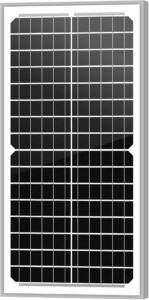
Of all the 10-watt panels on this list, Newpowa’s monocrystalline option has the most consistent real-world reviews. Over 4,000 ratings and a 4.6-star average tell you this panel performs the way it’s advertised, and that’s rare at this price point. The monocrystalline cells give it a slight efficiency edge over polycrystalline alternatives, which matters when your mounting location doesn’t get ideal sun angles all day.
The aluminum frame is rigid and corrosion-resistant, built to handle years of outdoor exposure without warping or cracking. Pre-drilled mounting holes on the frame back make installation straightforward whether you’re mounting to an RV roof, a fence post, or a garden shed wall. The tempered glass surface resists hail and minor impacts, and the junction box carries an IP65 rating so it handles rain without any issues.
Output sits at a genuine 10 watts under standard test conditions. In full summer sun, you’re looking at around 40-50 watt-hours per day depending on your location and panel angle. That’s enough to keep a 100Ah battery topped off during seasonal storage or to run a 12V trail camera indefinitely. The panel ships with 3-foot leads terminated with ring connectors, which work fine with most charge controllers and battery setups.
You’ll need to pair this with a charge controller if you’re wiring it to a battery. Newpowa sells compatible controllers separately, or any PWM or MPPT controller with 12V compatibility will work. At under $30, this is the panel to buy when you need reliable solar output without spending more than the project warrants.
Features
- Cell type: Monocrystalline
- Power output: 10W
- Open circuit voltage (Voc): 21.6V
- Short circuit current (Isc): 0.61A
- Operating temperature: -40°F to 176°F
- Frame: Anodized aluminum
- Junction box: IP65 waterproof
- Connector: Ring terminals, 3ft leads
- Excellent 4.6-star rating across thousands of reviews
- Monocrystalline cells for better efficiency
- Solid aluminum frame holds up outdoors
- Very competitive price for the quality
- No charge controller included
- Short 3ft leads may need extending
- Not a complete kit
2. SUNER POWER 10W Solar Panel with MPPT Controller Kit
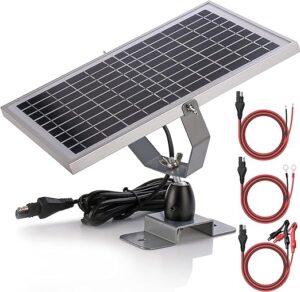
This is the one to buy if you want a complete, plug-and-play setup without sourcing a charge controller separately. SUNER POWER bundles a 10W panel with a genuine MPPT controller, which is a step up from the PWM controllers that come with most budget kits. MPPT technology squeezes more charge out of low-light conditions, making this setup noticeably more effective in cloudy or partially shaded situations.
The kit includes cables, crocodile clips for direct battery connection, and the MPPT controller pre-wired for 12V systems. Setup takes about 20 minutes even for someone who has never touched solar equipment before. The controller has an LCD display showing charge status, current voltage, and charging mode, which takes the guesswork out of knowing whether your battery is actually receiving power.
Build quality is solid throughout. The panel uses a monocrystalline cell array with an anodized aluminum frame and IP65-rated junction box. The controller itself is compact and can be mounted inside a storage compartment or under a seat. SUNER POWER backs this kit with a 30-day return policy and customer support that actually responds, which matters when you’re troubleshooting an off-grid setup remotely.
At around $60, this costs more than a bare Newpowa panel, but you’re paying for the complete system. If you factor in the cost of a separately purchased MPPT controller (typically $20-35), the price difference narrows considerably. For anyone who wants to open a box and have a working solar charging system the same afternoon, this kit is the easiest path.
Features
- Panel type: Monocrystalline 10W
- Controller type: MPPT (not PWM)
- System voltage: 12V
- Includes: Panel, MPPT controller, cables, crocodile clips
- Controller display: LCD readout
- Waterproof rating: IP65 (panel), IP32 (controller)
- Cable length: 5 feet included
- Complete kit with genuine MPPT controller
- LCD display for charge monitoring
- Ready to use out of the box
- Better low-light performance than PWM kits
- Higher price than bare panels
- Controller not fully weatherproof
- Overkill for simple battery maintenance
3. ECO-WORTHY 10W Monocrystalline Solar Panel
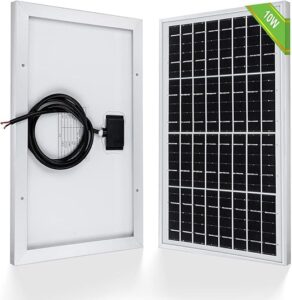
ECO-WORTHY has built a strong reputation in the budget solar market, and this 10W panel is one of their most reliable offerings. The monocrystalline cells deliver genuine 10W output at standard test conditions, and the build quality is better than the price suggests. It’s a smart choice for anyone who already owns a charge controller and just needs a panel.
The compact dimensions (13.8 x 11.2 x 0.9 inches) make this one of the smaller 10W panels available, which helps when mounting space is limited. Weight comes in under 2 pounds, so it’s easy to reposition or take with you camping. The tempered glass surface and aluminum frame hold up in rain, snow, and summer heat without issue.
ECO-WORTHY ships this panel with a short set of leads, so you’ll need to extend them for most installations. At around $25, this is the most affordable monocrystalline option on this list. It works well paired with any 12V PWM or MPPT controller, and ECO-WORTHY sells their own controllers separately if you need a matched system.
Features
- Cell type: Monocrystalline
- Power output: 10W
- Dimensions: 13.8 x 11.2 x 0.9 inches
- Weight: 1.8 lbs
- Frame: Anodized aluminum
- Junction box: IP65 waterproof
- Operating temp: -40°F to 185°F
- Lowest price on the list for a mono panel
- Compact and lightweight
- Established brand with good support
- Short leads require extension for most installs
- No controller included
- Slightly lower build quality than Newpowa
4. SUNER POWER 10W Solar Panel Gate Opener Kit
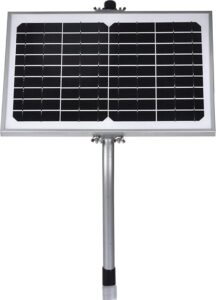
If you want something that hangs rather than stakes, or more accurately, something that mounts on a post or gate to power an automatic gate opener, this kit from SUNER POWER is purpose-built for that job. The panel comes with a mounting bracket designed for vertical pole or post installation, and the wiring is pre-configured to connect directly to most standard gate opener battery terminals.
At 4.6 stars with over 1,200 ratings, this is one of the best-reviewed gate opener solar kits available. The kit works with Linear, Ghost Controls, MIGHTY MULE, and other brands that use a 12V sealed lead-acid battery. The panel keeps the opener battery charged without any grid connection, which is particularly valuable for driveways more than 100 feet from the nearest power source.
Installation is straightforward with the included bracket hardware. The panel mounts at roughly a 45-degree angle on a post, catches sun most of the day, and keeps the gate opener battery consistently topped off. Real-world users report gate openers running for years without touching the battery. At $50, this kit represents good value for a purpose-specific application.
Features
- Panel type: Monocrystalline 10W
- Designed for: Automatic gate openers (12V battery systems)
- Includes: Panel, mounting bracket, wiring harness
- Compatible with: Linear, MIGHTY MULE, Ghost Controls, most 12V gate openers
- Junction box: IP65 waterproof
- Pole/post mounting hardware included
- Purpose-built for gate openers
- Mounting bracket included
- Works with most major gate brands
- Not versatile for other applications
- Bracket limits panel angle options
- Pricier than bare panels
5. SOLPERK 10W Solar Panel with 8A PWM Charge Controller Kit
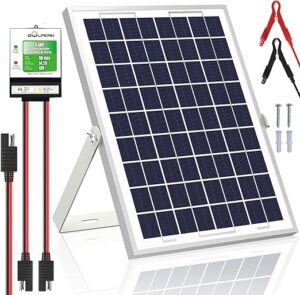
SOLPERK’s 10W kit comes with an 8A PWM charge controller, which is adequate for most 12V battery maintenance applications. The panel and controller are a matched pair, so you don’t have to worry about compatibility. Everything arrives in one box with enough cable to connect the system without buying extension wire.
The panel itself uses standard monocrystalline cells with a tempered glass face and aluminum frame. Output is consistent with other 10W panels, and the included controller handles battery protection functions like overcharge prevention and low-voltage disconnect. At $39, this kit sits in the middle of the price range and delivers a working system without compromise.
One honest note: this uses a PWM controller, not MPPT, so charging efficiency in low-light conditions won’t be as high as the SUNER POWER MPPT kit. For maintenance charging in a sunny climate, the difference is negligible. But if you’re in the Pacific Northwest or somewhere with frequent cloud cover, spending the extra money on an MPPT controller is worthwhile.
Features
- Panel type: Monocrystalline 10W
- Controller type: 8A PWM
- System voltage: 12V
- Includes: Panel, PWM controller, mounting hardware, cables
- Junction box: IP65 waterproof
- Package contents: Panel, controller, screws, connectors
- Complete kit at mid-range price
- Matched panel and controller
- Good battery protection features
- PWM controller, not MPPT
- Lower efficiency in cloudy conditions
- Basic controller without display
6. POWOXI 10W Magnetic Solar Battery Trickle Charger with MPPT Controller
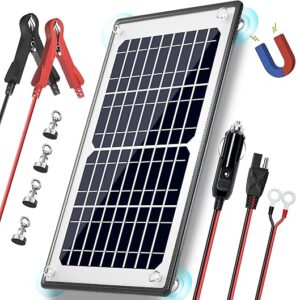
The POWOXI stands out for one specific feature: a strong magnetic backing that sticks to any metal surface, no drilling or brackets required. Stick it on the roof of a car, the hood of a truck, or the top of a metal shed and you’re done. The integrated MPPT controller means it charges efficiently and protects your battery from overcharging without any additional hardware.
It comes with alligator clips and an OBD2 plug, so you can connect to most vehicle batteries in under two minutes. This makes it ideal for trickle-charging vehicles that sit in storage, which is exactly what many buyers use it for. Boats, RVs, motorcycles, and classic cars all benefit from a 10W panel keeping the battery alive during off-season storage.
The magnetic mount is genuinely strong and has held up on vehicle roofs at highway speeds according to multiple user reports. At $46, it costs a bit more than basic bare panels, but the combination of MPPT technology and magnetic mounting make it a unique solution that no other product on this list offers.
Features
- Mounting: Strong magnetic backing (no drilling needed)
- Controller: Built-in MPPT
- Connection options: Alligator clips, OBD2 plug
- System voltage: 12V
- Waterproof rating: IP65
- Best for: Vehicle battery maintenance and storage
- Unique magnetic mounting, no hardware needed
- Built-in MPPT for efficient charging
- Multiple connection options included
- Magnetic mount limits placement on non-metal surfaces
- Not ideal for permanent installations
- Higher cost than basic trickle chargers
7. Topsolar 10W Solar Panel Battery Trickle Charger
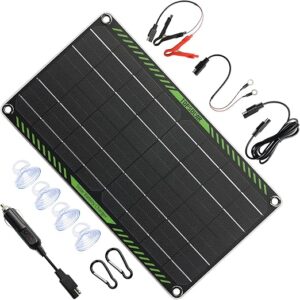
Push the stake in, point the panel south, done. Topsolar’s approach is pure simplicity. This is a trickle charger-style panel designed for vehicle battery maintenance, packaged with alligator clips and an SAE connector for easy hookup. At $20, it’s the most affordable option on this list.
The monocrystalline cells produce honest 10W output in good sun, and the built-in blocking diode prevents reverse current at night so your battery doesn’t discharge back through the panel. It’s not a full kit with a charge controller, so for anything more than basic maintenance charging you’ll want to add a controller. But for keeping a boat, RV, or tractor battery charged during storage, this does exactly what you need at the lowest possible price.
Features
- Panel type: Monocrystalline 10W
- Includes: Panel, alligator clips, SAE connector
- Built-in reverse blocking diode
- Best for: Vehicle storage battery maintenance
- Waterproof rating: IP65
- Dimensions: 14.2 x 11.8 x 0.9 inches
- Lowest price on the list
- Simple plug-and-maintain design
- Built-in blocking diode
- No charge controller included
- Not suitable for heavy charging applications
- Basic build quality compared to higher-priced options
8. FM123 10W Solar Panel Kit for Mighty Mule Gate Openers
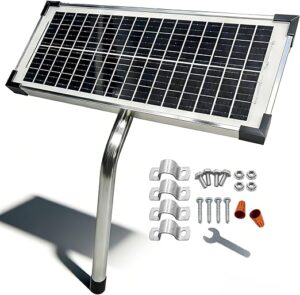
This is the most specialized product on the list. The FM123 solar kit is designed specifically to replace the OEM solar panels sold for Mighty Mule automatic gate openers, including the FM350, MM260, MM560, FM200, FM500, FM502, FM700, MM571W, MM271, and MM360 models. If you own one of those gate openers and want to replace the solar panel with a better-performing aftermarket option, this is exactly what you need.
At 10 watts, this panel outperforms most OEM replacement panels that ship at 5 or 6 watts, giving your gate opener more consistent power and faster battery recovery after cloudy periods. The kit includes the bracket hardware that matches Mighty Mule’s mounting system, so the swap is direct without any fabrication or improvised mounting. Four-star ratings from buyers specifically mention improved gate reliability after switching from the stock OEM panel.
Features
- Designed for: Mighty Mule gate opener series
- Compatible models: FM350, MM260, MM560, FM200, FM500, FM502, FM700, MM571W, MM271, MM360
- Power output: 10W
- Includes: Panel, OEM-compatible mounting hardware
- Junction box: IP65 waterproof
- Replaces: FM350 and similar OEM panels
- Perfect fit for Mighty Mule gate openers
- Higher output than most OEM replacements
- Only useful for Mighty Mule systems
- Not a general-purpose panel
- Limited application outside its designed use
10-Watt Solar Panel Buying Guide
Key Takeaways
- A 10W panel produces 40-50 watt-hours per day in most US locations
- Monocrystalline panels are worth the modest price premium over polycrystalline
- MPPT controllers outperform PWM in low-light and partially shaded conditions
- A complete kit saves time but costs more than a panel alone
- Always use a charge controller when wiring a panel to a battery
- IP65 waterproofing is the minimum acceptable rating for outdoor installations
What Is a 10-Watt Solar Panel?
A 10-watt solar panel is a small photovoltaic panel that produces up to 10 watts of electrical power under ideal test conditions (1000 W/m² irradiance, 77°F cell temperature). In practice, you’ll see 7 to 8 watts of usable output during peak sun hours, which translates to roughly 40 to 50 watt-hours of daily energy in a typical US location with 5 to 6 peak sun hours.
These panels aren’t designed to power a house or charge a laptop quickly. Their strength is in low-drain applications: trickle charging 12V batteries, powering trail cameras, running small water pumps, or keeping gate opener batteries from going flat during winter. At 10 watts, they’re large enough to make a real difference but small enough to mount almost anywhere without structural concerns.
How Do 10-Watt Solar Panels Work?
Like all photovoltaic panels, 10W solar panels convert sunlight into direct current (DC) electricity using semiconductor cells, almost always silicon-based. When photons from sunlight hit the silicon cells, they knock electrons loose and create a flow of electrical current. The panel’s internal wiring combines the output from multiple cells into a usable voltage and current.
Most 10W panels are built for 12V systems. The open-circuit voltage (the voltage with no load connected) typically runs 18 to 22V, which is higher than the 12V nominal to ensure the panel can drive current into a 12V battery even when the battery is partially charged. A charge controller sits between the panel and battery to regulate this voltage and prevent overcharging.
Benefits of Using 10-Watt Solar Panels
The main benefit is cost-effective battery maintenance. A 10W panel costs $20 to $60, and once installed, it eliminates the need to manually charge a battery before each seasonal use. Leave a boat, RV, or tractor in storage for six months and the solar panel keeps the battery at full charge so it’s ready when you need it.
They’re also genuinely portable. At under 2 pounds for most models, a 10W panel can move with you, which makes them useful for camping, hunting trips, or temporary off-grid setups. The small form factor means they mount on surfaces where a 100W panel would be impractical or impossible.
Monocrystalline vs. Polycrystalline at 10 Watts: Does Cell Type Matter?
At 10 watts, the difference between monocrystalline and polycrystalline cells matters more than it does at higher wattages. Here’s why: a 10W panel has limited surface area, so efficiency directly affects the physical size of the panel. Mono panels are around 20 to 22% efficient, poly panels around 15 to 17%. That gap means a monocrystalline 10W panel is noticeably smaller than a poly 10W panel at the same wattage rating.
For mounting on a small surface or keeping weight low, mono is the better choice. For a fixed flat-ground installation where size doesn’t matter, poly will cost a bit less and performs fine in direct sun. In partially shaded conditions, mono panels also handle shade better because their individual cells are more resistant to the “weakest cell drags down the whole string” problem that affects poly arrays.
Most 10W panels on the market today are monocrystalline, so you may not even have to choose. But if you see a significantly cheaper poly option, know what you’re trading: slightly larger size and marginally worse shade tolerance, not a major difference in longevity or output under full sun.
Charge Controller Pairing: PWM vs. MPPT for Small Panels
A 10W panel paired with a 12V battery needs a charge controller between them to regulate voltage and prevent overcharge. The question for small systems is whether to use PWM (pulse width modulation) or MPPT (maximum power point tracking). For a 10W panel, PWM is the right answer almost every time.
MPPT controllers are more efficient at extracting power, which pays off on larger arrays. But a quality MPPT controller costs $25 to $50 or more, which is often more than the 10W panel itself. PWM controllers for small systems cost $10 to $20 and handle a 10W panel perfectly well. The efficiency gain from MPPT on a 10W input is measured in tenths of a watt, not enough to justify the price difference.
When buying a 10W panel kit, check that the included charge controller’s maximum input voltage is compatible with your panel’s open-circuit voltage (Voc). A 10W panel typically has a Voc around 22V, and most small PWM controllers accept up to 25V input. If you’re wiring multiple 10W panels in series, the voltage adds up and you’ll need a controller rated accordingly, or keep them in parallel.
Things to Keep in Mind Before Buying
The biggest thing to understand is that 10 watts is not very much power. It’s enough for battery maintenance and small, continuous loads, but not for running appliances, charging phones quickly, or powering anything with a significant wattage rating. If you’re trying to run a 12V refrigerator or charge multiple batteries, you need a larger system.
Also consider whether you need a complete kit or just a panel. If you already own a compatible charge controller, buying just a panel saves money. If you’re starting from scratch, a kit that includes a controller, cables, and mounting hardware saves you the hassle of sourcing components separately.nel plus a small charge controller costs under $100 and requires no permits or professional installation. You mount it, run a cable to a battery, and you’re generating power. For people maintaining an RV battery, running a remote camera, or keeping a small shed’s electrical system alive, this is the easiest entry into solar energy.
Another advantage is portability. At around 2-4 pounds, a 10W panel can be moved and remounted without effort. RV owners often carry spare panels for flexibility, installing one on the roof for permanent charging and keeping another for camps or supplemental power at the site. The compact footprint fits anywhere without looking out of place.
Cost-effectiveness rounds out the case. A quality 10W panel costs $20-60, while a 100W panel costs $100-200. If you only need 10 watts of charging capacity, buying more panel is wasteful. Small panels also reduce the size and cost of charge controllers, battery banks, and wiring. For folks testing solar viability before committing to a larger system, this is the smart starting point.
First, verify that 10 watts is enough for your application. A 10W panel in full sun generates roughly 40-50 watt-hours per day in a good location. If you’re maintaining a single 12V battery through storage season, that’s plenty. If you’re trying to power lights, pumps, or multiple appliances, you’ll need more watts. Check out our guide to solar sizing if you’re planning a larger system.
Second, choose between monocrystalline and polycrystalline. Monocrystalline panels are 2-5% more efficient and perform better in low light and high temperatures. Polycrystalline panels cost less upfront. At the 10W level, most products on the market are monocrystalline, and the price difference is small enough that you should lean toward mono unless you find a polycrystalline option at a notably lower price.
Third, decide whether you need a complete kit or a bare panel. If you already have a charge controller, buy just the panel and save money. If you’re starting from scratch, a kit with a matched controller is easier to get right the first time, and the total cost is often lower than buying components separately from different vendors.
Types of 10-Watt Solar Panels
Most 10W panels fall into two categories: rigid and flexible. Rigid panels use aluminum frames with tempered glass faces. They’re the standard choice for fixed installations on RVs, boats, sheds, and gate openers. Flexible panels use thin-film cells on a bendable plastic substrate, which lets them conform to curved surfaces like boat hulls or curved roofs. Flexible panels are lighter but less efficient and typically have shorter warranties (5-10 years vs 20-25 years for rigid panels).
Within these categories, you’ll find bare panels (panel only, no controller) and complete kits (panel plus controller and wiring). Kit configurations vary from basic PWM setups to premium MPPT kits. For gate openers, there’s also a niche category of purpose-built panels designed to bolt directly onto specific gate opener models without any adaptation hardware.
Frequently Asked Questions
How many amps does a 10W solar panel produce?
A 10W panel produces roughly 0.6 amps at its maximum power voltage (around 17V). When charging a 12V battery through a PWM controller, you’ll see around 0.5A delivered to the battery after losses. Over a day with five peak sun hours, that’s around 2.5-3Ah added to your battery. An MPPT controller will push that closer to 3.5-4Ah per day by operating the panel at its optimal power point.
Can a 10W solar panel charge a 100Ah battery?
Yes, but slowly. A 10W panel delivers around 3-4Ah per day in good sun. Charging a completely flat 100Ah battery from empty would take 25-35 days. But for maintenance charging (keeping a battery topped off during storage), a 10W panel works well. It adds more charge each day than a stored battery loses to self-discharge, which is the main job for most buyers.
Do I need a charge controller with a 10W solar panel?
For anything connected to a battery, yes. Without a charge controller, a solar panel will keep pushing current into a full battery, which causes overcharging and shortens battery life significantly. The one exception is if the panel includes a built-in blocking diode and you’re using it purely for very light maintenance on a large battery (over 200Ah), where the panel can’t physically put in enough current to overcharge. For all other cases, add a controller. They cost $15-30 and protect a much more expensive battery.
What can a 10-watt solar panel power?
In a continuous sense, not much on its own. A 10W panel produces an average of 30-50Wh per day, which is enough to run a 12V trail camera, a small motion sensor, a gate opener battery, or an LED light for a few hours each night. It’s not enough to run appliances, charge laptops continuously, or power anything with a compressor. Think of it as a battery maintainer or a small remote-device power source, not a standalone power system.
What is the difference between PWM and MPPT charge controllers for 10W panels?
PWM (Pulse Width Modulation) controllers are simpler and cheaper. They work by connecting and disconnecting the panel rapidly to regulate voltage. MPPT (Maximum Power Point Tracking) controllers are more sophisticated. They track the panel’s optimal operating point and convert excess voltage to usable current, typically delivering 10-30% more charge per day. For a 10W panel, the dollar difference between a basic PWM and a basic MPPT controller is around $15-20. In cloudy climates or with panels at non-ideal angles, MPPT pays off quickly. In sunny Arizona with a well-aimed panel, PWM is fine.
How long do 10-watt solar panels last?
Quality monocrystalline panels degrade at around 0.5% per year under normal conditions. After 25 years, a quality panel will still produce around 87% of its original output. Most 10W panels from reputable brands carry 10-25 year power output warranties. The physical components (frame, glass, junction box) typically last as long as the cells. Budget panels from unknown brands may degrade faster or have junction box failures within a few years.
Summing Up
The best 10-watt solar panel for most buyers is the Newpowa 10W Monocrystalline. It combines proven efficiency, solid build quality, and a competitive price with thousands of real-world reviews backing it up. Pair it with any basic PWM or MPPT charge controller and you have a maintenance charging setup that will last years.
If you’re also thinking about solar panels for your home, call (855) 427-0058 for a free quote — it takes just a few minutes to find out what installation would cost and save you in your area.
Updated