
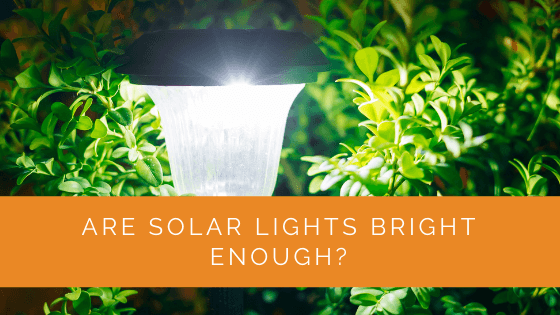
Solar lights have improved dramatically over the past decade, but whether they’re bright enough depends on the application. High-quality solar lights in the right category can match or exceed the brightness of wired alternatives for pathway lighting, security lighting, and garden accent lighting. For applications requiring sustained very high output — large commercial floodlights, streetlights in low-sun climates — grid-powered fixtures still have advantages.
This guide explains solar light brightness in measurable terms, what brightness levels work for which applications, and how to evaluate brightness claims on product listings.
How Solar Light Brightness Is Measured
Solar light brightness should be measured in lumens — the total amount of visible light emitted. Unfortunately, product listings often use misleading metrics:
Lumens (lm): The correct unit. 800 lumens from a solar light is directly comparable to 800 lumens from any other light source. Most quality solar lights list lumen output in their specifications.
Watts (W): Panel or LED wattage, not brightness. A 5W solar panel powers the light; a 5W LED is a separate specification. Neither tells you how bright the light actually is. Product listings sometimes show “equivalent to 60W incandescent” as a reference — a 60W incandescent produces approximately 800 lumens, so this is a useful rough translation (1W modern LED ≈ 100–130 lumens).
Lux (lx): Illuminance — lumens per square meter at a specific distance. Relevant for evaluating coverage, but varies with distance. A light producing 1,000 lux at 1 meter produces only 250 lux at 2 meters (inverse square law). Lux measurements in product listings are only useful if the measurement distance is specified.
When comparing solar lights, always use lumens as the primary brightness metric. Ignore wattage claims for brightness purposes.
Brightness Levels for Common Applications
Here’s a practical guide to what lumen levels accomplish for typical solar light applications:
Pathway and step lighting: 50–200 lumens. Accent illumination for safe navigation. These lights don’t need to flood the area with light — soft pools of light along a path are the goal. Most solar pathway stakes fall in this range. 50 lumens is adequate for a residential pathway; 150–200 lumens is brighter and more visible from a distance.
Garden accent and decorative lighting: 20–100 lumens. For visual appeal rather than functional illumination. Solar string lights typically produce 1–5 lumens per bulb. Solar lanterns for decks: 50–200 lumens.
Security and motion-sensor flood lighting: 400–2,500+ lumens. This is where solar lighting has seen the most dramatic improvement. Premium solar motion security lights (LITOM, GLORIOUS-LITE, Baxia Technology, Leonlite) produce 1,000–2,500 lumens — genuinely comparable to wired floodlights. For a residential driveway or garage area, 800–1,500 lumens covers the space effectively. 400–600 lumens is adequate for smaller entryway coverage.
Solar wall-mounted garage/porch lights: 200–1,000 lumens. For functional porch or garage area lighting. Mid-range solar wall lights (250–500 lumens) handle typical porch lighting well. High-output models (800–1,000 lumens) can light a driveway entrance.
Solar area/pole lights: 1,000–5,000 lumens. For parking lots, large yards, or commercial-grade area lighting. High-end solar pole lights (SANSI, SOLLA, Classy Caps) can produce 2,000–5,000 lumens with large panels and lithium iron phosphate (LFP) batteries. These genuinely compete with wired streetlights for low-traffic applications.
Solar string lights: 1–10 lumens per bulb. Purely decorative — not for functional illumination. 50 bulbs at 5 lumens each = 250 total lumens spread across the entire string, creating atmosphere rather than visibility.
Why Some Solar Lights Disappoint
Not all solar light brightness claims are reliable. Common disappointments:
Peak vs. sustained brightness: Some solar lights advertise peak lumen output achieved only in high-sensitivity motion mode for the first 30 seconds after triggering. In standard or low-brightness mode (what the light defaults to for battery preservation), output may be 20–40% of the advertised maximum. Look for products that specify brightness in standard continuous mode, not just peak motion-triggered mode.
Small panels, cheap batteries: Solar lights are powered by the energy stored in their batteries from daytime charging. A light with a small solar panel (2W or less) and a low-capacity NiMH battery can only sustain high output for 1–2 hours after dark — then dims or shuts off. Budget lights often demonstrate full brightness in unboxing tests but struggle through a full night.
LED quality matters: 100 lumens from a high-quality LED (high Color Rendering Index, good beam pattern) is more useful than 100 lumens from a cheap LED with poor color quality and a poorly aimed beam that scatters light ineffectively.
Sensor sensitivity causing unwanted behavior: A security light set to its most sensitive setting may trigger frequently, draining the battery faster and reducing available brightness by morning. Setting sensitivity appropriately for the application preserves battery for actual lighting needs.
Solar Lights in Low-Sun Climates: What to Expect
Solar lights in the Pacific Northwest, upper Midwest, or northeastern US face more challenging charging conditions in winter than in Arizona or California. A solar light that performs admirably in summer may deliver noticeably shorter run times or lower sustained brightness in December in Seattle. This is primarily a battery charging issue, not an LED capability issue.
Mitigation strategies for low-sun climates: choose lights with larger panels (5W+), larger batteries (2,000 mAh+ LiFePO4 or lithium-ion rather than NiMH), and adjustable brightness settings so you can reduce output to extend runtime. High-quality solar lights with LFP chemistry also handle cold temperatures better — NiMH batteries lose capacity significantly below 0°C, while LFP retains 70–80% capacity at −20°C.
Frequently Asked Questions
How many lumens do I need for solar outdoor lights?
It depends on the application. For pathway lighting: 50–200 lumens per fixture. For porch or wall lights providing functional illumination: 200–500 lumens. For security floodlights covering a driveway or large area: 800–2,500 lumens. For large area lighting comparable to commercial security lights: 2,000–5,000 lumens. As a reference point: a 60W incandescent bulb produces approximately 800 lumens; a typical LED streetlight produces 3,000–5,000 lumens.
Are solar lights as bright as regular lights?
For many residential applications, yes — premium solar lights in the appropriate category match wired lights in brightness. A solar security light producing 1,500–2,500 lumens is as bright as a comparable wired floodlight. Where solar lights still lag wired alternatives: sustained very high output (>3,000 lumens continuously all night) in climates with limited winter sun, and high-power commercial applications requiring consistent brightness regardless of seasonal solar availability.
Why are my solar lights not very bright?
The most common causes: the battery is not fully charged (shaded panel, dirty panel, insufficient sunlight hours), the light is in a dim or automatic brightness mode rather than full-power mode, or the battery has degraded from age (NiMH batteries lose capacity after 1–2 years). Check the panel is in full direct sunlight for the recommended charging time (typically 6–8 hours) and that the panel surface is clean. If the light is old and charging fully but still dim, replace the rechargeable battery — a fresh NiMH or lithium cell often restores original brightness.
What is the brightest type of solar light?
Area/pole lights and high-powered floodlights are the brightest solar lights. Premium pole-mounted solar area lights with large monocrystalline panels (20W+) and LFP battery banks can produce 3,000–8,000 lumens — comparable to commercial LED streetlights. For residential use, solar motion security floodlights are the brightest practical category: products like the GLORIOUS-LITE and LITOM Premium reach 2,000–2,500 lumens in high mode. Pathway lights and string lights are much dimmer by design — they serve decorative rather than functional illumination purposes.
How do solar light lumens compare to incandescent bulbs?
As a reference guide: 50 lumens ≈ a very dim nightlight; 200 lumens ≈ a 25W incandescent; 400 lumens ≈ a 40W incandescent; 800 lumens ≈ a 60W incandescent; 1,600 lumens ≈ a 100W incandescent; 2,600 lumens ≈ a 150W incandescent. Most residential pathway solar lights (50–200 lumens) are much dimmer than a standard household bulb by design — they’re meant for accent illumination, not task lighting. Security floodlights (800–2,500 lumens) deliver performance equivalent to 60W–150W incandescent equivalents.
Summing Up
Solar lights are bright enough for most residential outdoor lighting needs — pathway lighting (50–200 lumens), porch/wall lighting (200–500 lumens), and security floodlighting (800–2,500 lumens) — provided you buy a quality product matched to the application. Budget solar lights often disappoint due to small panels, weak batteries, and misleading peak-lumen claims. For reliable brightness, look for products with genuine lumen specifications (not just wattage), LFP or quality lithium-ion batteries, and appropriately sized solar panels. In low-sun climates, choose lights with larger panels and batteries to maintain brightness through winter months.
Updated