
Different Types of Solar Lights: Complete Buyers Guide for 2026
Solar outdoor lights come in dozens of styles and configurations, each designed for specific applications. From pathway lighting to security floods to decorative strings, understanding the different types helps you choose the right solution for your home. This guide walks you through the major categories and their best use cases.
Modern solar lights offer efficiency and flexibility that traditional wired lighting cannot match. No trenching, no electrical permits, no energy bills—just charge during the day and light up at night automatically.
Pathway and Stake Lights
Stake lights (also called pathway lights or garden lights) are the most popular solar lighting category. They’re installed by pushing a plastic or metal stake into loose soil or a flower bed.
Design and Features
- Light head: Small integrated fixture (1-5 inches tall) with LED, solar panel, and battery
- Stake: 6-12 inches long to secure the light in soil
- Brightness: Typically 20-100 lumens
- Runtime: 6-12 hours on a single charge
Best Uses
- Illuminating walkways and garden paths
- Highlighting landscape features (flower beds, hedges, trees)
- Marking driveway edges
- Creating ambient accent lighting on patios
Budget Range
Budget models: $5-15 each. Premium models: $25-50 each.
Disk Lights and Step Lights
Disk lights are flat, round fixtures designed to mount flush on the ground or stairs. They’re smaller and lower-profile than stake lights.
Design and Features
- Diameter: 3-5 inches, usually round or square
- Mounting: Stake-driven into ground or screwed to deck/step risers
- Light distribution: Downward-facing, low intensity (5-30 lumens)
- Primary function: Subtle ambient lighting and hazard marking
Best Uses
- Marking deck or patio edges
- Illuminating porch steps (safety lighting)
- Creating subtle pathway definition
- Stairs and stair risers
- Low-light perimeter marking
Budget Range
$8-30 each for quality disk lights.
Solar String Lights
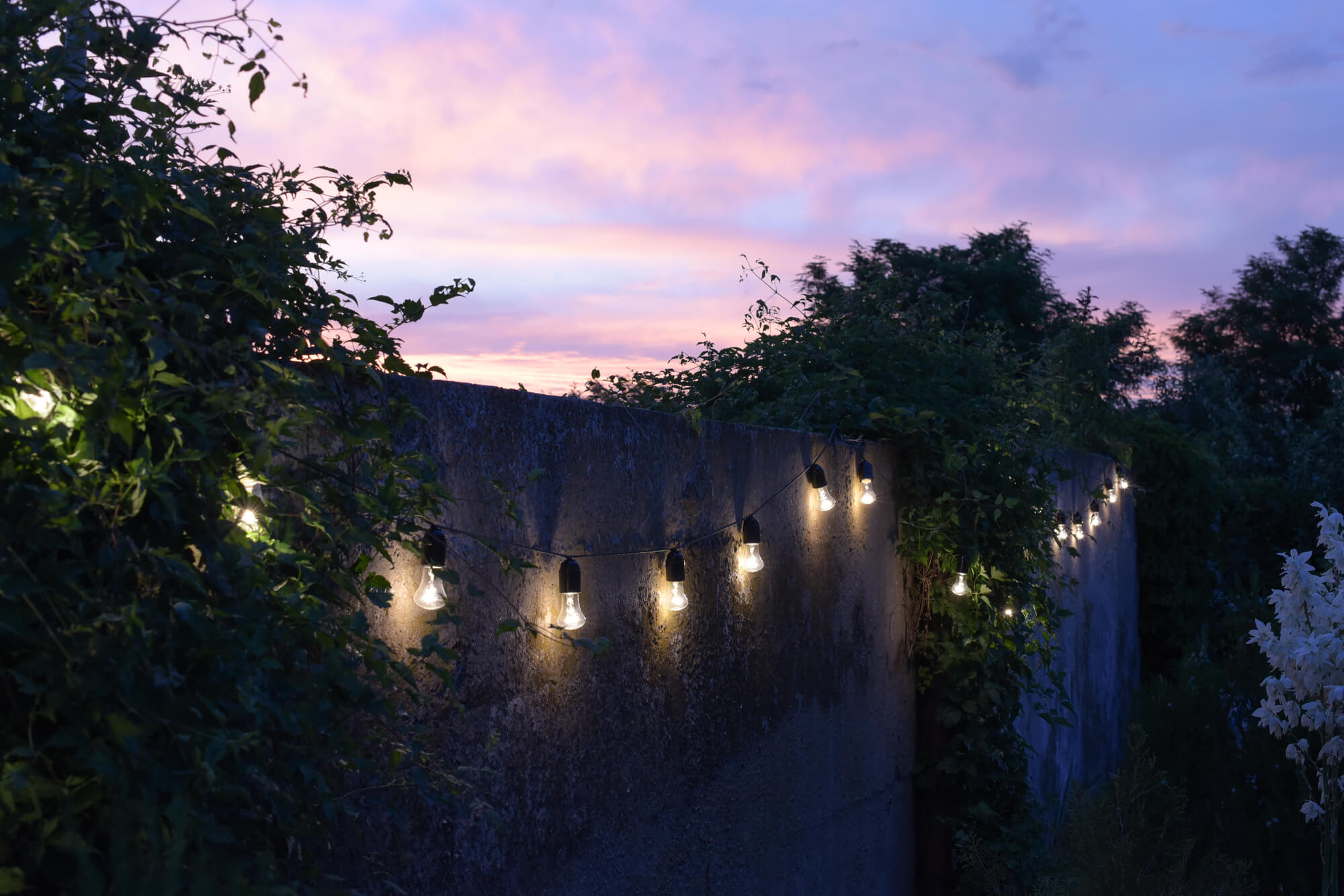
String lights are solar-powered versions of traditional plug-in fairy lights and bistro lights. A central solar panel charges a battery that powers multiple small LEDs on a long wire.
Design and Features
- Panel and battery unit: One large solar panel with integrated battery (usually at one end of the string)
- Wire length: Typically 20-50 feet
- LED count: 20-100 small bulbs
- Brightness: Low (2-10 lumens per bulb) for decorative effect
- Spacing: Bulbs spaced 4-12 inches apart along the wire
Best Uses
- Wrapping pergolas, arbors, or trellises
- Creating festive atmosphere on patios and decks
- Overhead lighting for outdoor entertaining areas
- Garden wedding or event lighting
- Decorative perimeter lighting around fences
Budget Range
$30-80 for standard 30-50 foot strings. Premium designer strings can exceed $100.
Spotlights
Solar spotlights are directional lights designed to highlight specific features like trees, shrubs, architectural elements, or dark corners.
Design and Features
- Mount style: Typically on a stake or bracket
- Brightness: 50-200+ lumens
- Focus: Narrow beam (40-60 degree cone) for targeted illumination
- Dual functionality: Often serve as security lights by illuminating dark spots
Best Uses
- Uplighting trees and large shrubs
- Highlighting architectural details (stone walls, water features, statues)
- Creating dramatic shadow effects
- Security lighting for dark corners and entryways
- Deterring wildlife from specific areas
Budget Range
$20-60 per spotlight depending on brightness.
Flood Lights
Solar flood lights provide broad-area illumination with wide beam angles (90-120 degrees), covering larger spaces with higher brightness.
Design and Features
- Brightness: 200-1000+ lumens
- Beam angle: 90-120 degrees (wide spread)
- Mount: Wall-mounted, pole-mounted, or stake-driven
- Optional features: Motion sensor, adjustable mounting bracket, dusk-to-dawn auto on/off
Best Uses
- Illuminating driveways and parking areas
- Backyard and patio area lighting
- General property security lighting
- Commercial or residential entrance illumination
- Large garden areas and open spaces
Budget Range
$40-150 depending on brightness and motion sensor inclusion.
Motion-Sensor Solar Lights
Motion-activated lights have built-in PIR (passive infrared) sensors that detect movement and trigger illumination on demand.
Design and Features
- Sensor type: PIR motion detector with 20-30 foot range
- Activation modes: Motion-only, dusk-to-dawn + motion, or manual
- Brightness: 100-800+ lumens depending on model
- Battery conservation: Only lights up when motion detected, extending battery runtime 2-4x versus always-on lights
Best Uses
- Security lighting (entryways, perimeter, dark spots)
- Wildlife deterrent (detecting and startling animals)
- Energy-efficient illumination for occasional use areas
- Pet or visitor detection
- Emergency lighting during outages
Budget Range
$30-120 per unit depending on brightness and sensor quality.
Fairy Lights
Fairy lights are the most decorative solar option, with tiny LEDs (sometimes called micro lights) closely spaced along a thin wire for a magical, twinkle-light effect.
Design and Features
- LED size: 3-5mm (very small for subtle glow)
- Wire length: 20-100+ feet
- Color options: Warm white (most popular), cool white, RGB color-changing
- Effects: Steady, flashing, color-cycling (on RGB models)
- Brightness: Very low (0.5-2 lumens total) for intimate ambiance, not functional lighting
Best Uses
- Creating enchanting garden ambiance
- Decorative outdoor entertaining spaces
- Romantic wedding or event lighting
- Wrapping indoor plants near windows (with extended wire)
- Decorative tree wrapping and shrub highlighting
Budget Range
$20-60 for quality fairy light strings.
Deck and Railing Lights
These lights mount directly to deck railings, posts, or balusters, providing both ambient lighting and safety illumination for stairs and deck edges.
Design and Features
- Mount style: Clamps, brackets, or adhesive installation
- Brightness: 10-50 lumens per light
- Durability: Built to withstand outdoor weather and foot traffic pressure
- Styles: Traditional post caps, modern linear rail lights, and accent post lights
Best Uses
- Marking deck edges for nighttime safety
- Creating defined pathways on multiple-level decks
- Railing and baluster highlighting
- Ambient deck entertaining lighting
Budget Range
$15-40 per light depending on size and style.
Solar Tube Lights (Sky Lights)
Daylight-harvesting tube lights (like Solatube and Velux), which channel sunlight during the day and can integrate with solar nighttime lighting systems.
Design and Features
- Function: Captures and diffuses natural daylight through reflective tubes
- Nighttime option: Some models include dimmable LED backups powered by solar battery
- Installation: Roof-mounted tube running through ceiling to living space
- Brightness: Natural daylight levels (500-1000+ lumens in sunny conditions)
Best Uses
- Bringing natural light to interior spaces (especially kitchens, bathrooms)
- Reducing daytime lighting electricity consumption
- Creating warm, natural light aesthetic (unlike harsh electrical fixtures)
- Hybrid solution combining solar heat and solar-powered nighttime lights
Budget Range
$300-800 for installation (more expensive than other solar light types, but serves multiple functions).
Choosing the Right Solar Lights for Your Space
| Application | Best Light Type | Brightness | Typical Cost |
| Pathway marking | Stake lights | 20-100 lumens | $8-30 each |
| Step/deck safety | Disk lights | 5-30 lumens | $8-30 each |
| Ambiance/parties | String or fairy lights | 2-20 lumens | $30-80 per strand |
| Feature highlighting | Spotlights | 50-200 lumens | $20-60 each |
| Large area lighting | Flood lights | 200-1000 lumens | $40-150 each |
| Security/motion | Motion-sensor flood | 200-800 lumens | $40-120 each |
| Decorative effect | Fairy lights | 0.5-2 lumens (total) | $20-60 per string |
Frequently Asked Questions
What’s the difference between warm white and cool white solar lights?
Warm white (2700-3000K) looks like traditional incandescent bulbs—cozy and inviting. Cool white (5000-6500K) looks like daylight or fluorescent—crisp and bright. For ambiance, choose warm white. For security or functional lighting, cool white is often preferred.
Are motion-sensor solar lights worth the extra cost?
Yes, for security and occasional-use areas. They extend battery life 2-4x by only lighting when motion is detected. For constant-use areas (patios, pathways), standard always-on lights are better.
Can I mix different solar light types in one yard?
Absolutely. Combining stake lights for pathways, flood lights for security, and string lights for ambiance creates layered outdoor lighting. Mix brands freely—all solar lights work independently.
How many lumens do I need for outdoor lighting?
Rule of thumb: 20-50 lumens for accent lighting, 50-200 lumens for pathways, 200-500 lumens for security/functional lighting, 500+ lumens for broad-area illumination.
Summing Up
Solar lights span a wide performance range in 2026, from 10-lumen pathway markers to 2,000-lumen security floodlights. Pathway lights (10–30 lumens) create soft borders along walkways; they’re decorative, not functional lighting. Spotlights and accent lights (100–500 lumens) illuminate specific features or entry points. Solar floodlights with motion sensors (800–2,000 lumens) are the fastest-growing category — they provide genuine security lighting comparable to wired fixtures, with top models like Aootek and Baxia delivering bright, reliable output in most US climates.
For any solar light purchase in 2026, prioritize: IP65 or higher water resistance rating, a lithium (LiFePO4) rather than NiMH battery, and a panel measured in actual watts (not lumens — lumens measure light output, not panel power). A 5W panel with a 2,000mAh LFP battery will outperform a “3,000 lumen” light with a 0.5W panel and NiMH battery every time.
To explore solar options for your home, call (855) 427-0058 for a free, no-obligation quote from vetted local installers across all 50 states.
Updated