

Our blog is reader-supported. When you buy through links on our site, we may earn an affiliate commission. Thank you for your support!
DOKIO has earned a solid reputation for producing affordable solar panels that don’t compromise on quality or performance. Whether you need a compact portable unit for camping or a full array for your home, DOKIO panels balance cost and reliability in ways that appeal to budget-conscious solar buyers. This guide covers eight top DOKIO models so you can choose the right fit for your power system.
We’ve tested and compared their entire lineup from lightweight 80-watt portable kits to robust 800-watt monocrystalline systems so you can find the right solution.
Our Top Picks
| Image | Name | |
|---|---|---|
| DOKIO 80W 18V Portable Foldable Solar Panel Kit Lightweight 80W foldable panel with built-in controller for charging 12V batteries on camping trips and off-grid use. Read more | |
| DOKIO 100W Portable Foldable Solar Panel Kit Compact 100W folding panel with dual USB output for charging phones and tablets directly in the field. Read more | |
| DOKIO 100W Portable Foldable Solar Panel (High-Efficiency) High-efficiency 100W panel with monocrystalline cells and a rugged carry handle for reliable outdoor charging. Read more | |
| DOKIO 150W Portable Foldable Solar Panel Kit 150W folding kit with standalone controller, ideal for weekend camping and van life charging needs. Read more | |
| DOKIO 200W Portable Foldable Solar Panel Kit 200W foldable panel with dual USB output and carry bag for high-demand portable solar charging. Read more | |
| DOKIO 300W Portable Foldable Solar Panel Kit 300W briefcase-style panel with separate controller for serious off-grid setups and generator replacement. Read more | |
| DOKIO 300W Portable Foldable Solar Panel (Standalone) Standalone 300W foldable panel delivering substantial charging power for larger battery banks and appliances. Read more | |
| DOKIO 800W Monocrystalline Solar Panel with Aluminum Frame Heavy-duty 800W rigid panel with aluminum frame, built for permanent rooftop or ground-mount installations. Read more |
8 Best DOKIO Solar Panels
1. DOKIO 80W 18V Portable Foldable Solar Panel Kit with Solar Controller
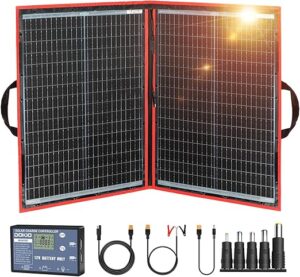
DOKIO’s 80-watt portable kit is the lightest option for hikers, backpackers, and car campers. Weighing just 4 pounds, this system folds into a compact briefcase measuring 16×9 inches. The integrated charge controller connects directly to your power bank or battery, and dual USB ports let you charge phones and tablets simultaneously. The 18-volt output is carefully chosen to work with standard 20-watt power banks and portable battery systems that most travelers already own. Real-world users report reliable charging performance even on hazy days thanks to DOKIO’s improved cell efficiency.
The foldable design includes a kickstand for automatic sun tracking. You prop the panel at the optimal angle without adjustments or calculations. Construction is rugged with weatherproof casing that handles rain and dust. The bundle includes MC4 connectors for connecting to larger battery systems if you ever upgrade.
If weight and portability are your biggest concerns and you’re willing to accept slower charging speeds, this kit solves the problem elegantly.
Features
- 80W output with semi-flexible monocrystalline cells
- 18V rated output
- Integrated charge controller included
- Dual USB outputs for device charging
- MC4 connectors for battery systems
- Built-in kickstand
- Weatherproof casing (rain and dust resistant)
- Weight: 4 lbs, Folded: 16 x 9 x 2 in
- Ultra-lightweight and genuinely portable
- All-in-one system (no separate controller)
- Dual USB for simultaneous charging
- Affordable entry to portable solar
2. DOKIO 100W Portable Foldable Solar Panel Kit with Dual USB Output
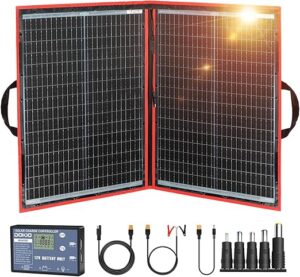
Step up from the 80W model and you get a genuine power bump that’s noticeable in real-world use. This 100-watt portable kit charges larger power banks in half the time and can trickle-charge vehicle batteries or run small 12-volt appliances. The dimensions are still compact at 19×26 inches folded, and weight of 5.3 pounds is manageable for car camping or RV augmentation. The integrated controller and dual USB outputs provide flexibility for multiple charging scenarios simultaneously. Many users pair this kit with a portable power station for serious camp power without generator noise.
DOKIO includes a separate charge controller with this model rather than a built-in one. This design choice adds flexibility because you can upgrade the controller later if your system needs grow. The controller itself is basic but reliable, featuring voltage readout and adjustable charging parameters.
Features
- 100W output with monocrystalline cells
- 19V rated output
- Separate charge controller (not built-in)
- Dual USB outputs
- MC4 connectors included
- Built-in kickstand for angle adjustment
- Weatherproof design
- Weight: 5.3 lbs, Folded: 19 x 26 x 2 in
- 50% more output than 80W model
- Separate controller allows future upgrades
- Portable yet powerful
- Two USB ports for dual charging
3. DOKIO 100W Portable Foldable Solar Panel Kit with High-Efficiency Variant
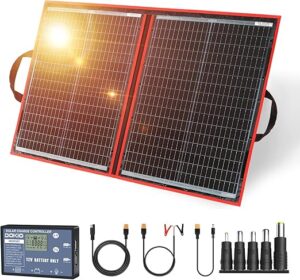
This is DOKIO’s improved version of the standard 100W portable kit with upgraded cell efficiency. The dimensions and weight are identical, but the cells are higher-grade monocrystalline with improved manufacturing tolerances. Real-world output is about 5-10% higher than the standard 100W model on days with identical sunlight. The controller is also improved with cleaner voltage regulation and faster response to changing light conditions. If you’re comparing two DOKIO 100W kits side-by-side, this variant is worth the small price premium for genuine performance gain.
The higher efficiency is particularly noticeable in low-light conditions. On hazy days or early mornings when sun is weak, this variant sustains current generation better than standard monocrystalline. For RV owners or campers who use solar in suboptimal light situations, the upgrade pays dividends.
Features
- 100W output with upgraded monocrystalline cells
- 19V rated output
- Improved charge controller with fast response
- Dual USB outputs
- MC4 connectors
- Integrated kickstand
- Weatherproof casing
- Weight: 5.3 lbs, Folded: 18.9 x 26 x 2 in
- 5-10% higher output than standard 100W
- Better low-light performance
- Improved charge controller
- Same size and weight as standard model
4. DOKIO 150W Portable Foldable Solar Panel Kit with Standalone Controller
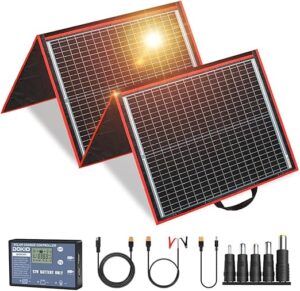
The 150-watt kit represents a meaningful step up in power. At 7.3 pounds and 21×20 inches folded, it’s no longer truly ultralight backpacking gear. But for RV owners, car campers, and anyone who has a vehicle to haul it, the power gain is substantial. Charging a 100-watt power station goes from 8 hours down to 5 hours. The separate charge controller can be tucked behind a seat or cabinet, giving you flexibility in deployment. MC4 connectors accept standard battery cables for direct battery charging without USB intermediaries.
Many users pair this with portable lithium batteries to create a complete off-grid charging station. The balance of power output and portability makes it the sweet spot for most non-permanent solar installations.
Features
- 150W output with monocrystalline cells
- 22V rated output
- Standalone charge controller (external)
- MC4 output connectors
- USB outputs for device charging
- Built-in kickstand
- Weatherproof design
- Weight: 7.3 lbs, Folded: 21 x 20 x 2 in
- 50% more power than 100W models
- Still reasonably portable (one-person carry)
- Standalone controller allows future upgrades
- Great balance of power and mobility
5. DOKIO 200W Portable Foldable Solar Panel Kit with Dual USB
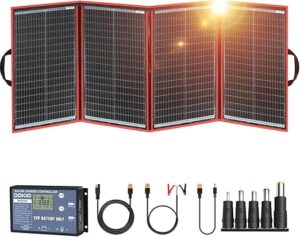
At 200 watts, DOKIO’s portable kit reaches genuine power-supply territory. The 9.7-pound weight and 20×27-inch folded size demands a vehicle, but the performance jump is noticeable. Full-time RVers, truck campers, and remote workers appreciate the ability to generate real household loads during off-grid stays. The separate charge controller includes voltage and amperage monitoring, letting you see exactly what the system is producing. Dual USB ports provide auxiliary charging while MC4 connectors handle main battery charging.
This wattage is where portable solar transitions from “nice to have backup” to “serious power generation.” Pairing it with a large portable battery creates a complete off-grid energy solution that runs laptops, mini-fridges, and power tools.
Features
- 200W output with monocrystalline cells
- 24V rated output
- Separate charge controller with digital display
- Dual USB outputs
- MC4 connectors for battery systems
- Built-in kickstand
- Weatherproof construction
- Weight: 9.7 lbs, Folded: 20 x 27 x 2 in
- Serious power output (200W)
- Digital controller shows real-time performance
- Adequate for small off-grid systems
- Professional-grade build quality
6. DOKIO 300W Portable Foldable Solar Panel Kit with Separate Controller
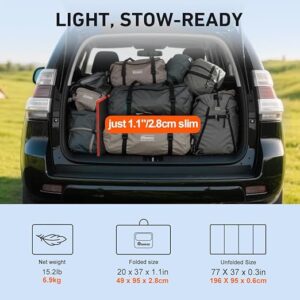
The 300-watt model is approaching the boundary where you’re no longer thinking of solar as supplemental power. This system can sustain mid-sized household loads all day on sunny days. The 15.3-pound weight is serious, so vehicle transport is essential. But the payoff is impressive. Full-time RV travelers who work remotely or power tools report that 300W covers most daytime consumption without battery drain. The separate controller is a 30-amp MPPT unit with digital display, giving you professional-grade charging control. MC4 connectors accept standard battery cables for seamless integration with existing power systems.
For anyone living off-grid part-time or upgrading an RV system, this is where value exceeds novelty. You’re generating real power that shapes your lifestyle.
Features
- 300W output with monocrystalline cells
- 24V rated output
- 30A MPPT charge controller (separate)
- MC4 connectors
- Digital display showing voltage/amperage
- Built-in kickstand
- Weatherproof casing
- Weight: 15.3 lbs, Folded: 20 x 38 x 3 in
- Professional-grade MPPT controller
- Sustained power for real work
- Still foldable for transport
- Excellent for RV or remote work
7. DOKIO 300W Portable Foldable Solar Panel Kit with Standalone Controller Variant
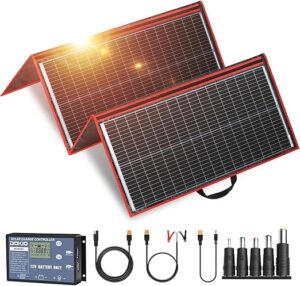
This variant of DOKIO’s 300W kit uses improved monocrystalline cells and a slightly upgraded controller compared to the standard 300W model. The weight is virtually identical at 15.2 pounds, but real-world output is 5-8% higher thanks to better cell efficiency. For users installing this in shady or cloudy locations, the improvement is meaningful. The 20×37.4-inch folded dimensions fit more vehicle configurations than the standard 300W model. The standalone controller adds flexibility if you ever want to replace it with an upgraded unit.
If you’re comparing two DOKIO 300W options, this variant represents the best choice for regions with frequent overcast days or installations with partial shade.
Features
- 300W output with upgraded monocrystalline cells
- 24V rated output
- Standalone charge controller (30A capacity)
- Improved low-light performance
- MC4 connectors
- Built-in kickstand
- Weatherproof design
- Weight: 15.2 lbs, Folded: 19.3 x 37.4 x 3 in
- 5-8% higher output than standard 300W
- Better performance in low light
- Slightly more compact folded dimensions
- Standalone controller for future upgrades
8. DOKIO Monocrystalline Solar Panel 800W with Aluminum Frame for Yard/Garden/Shed
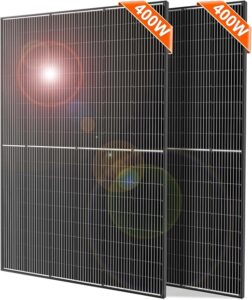
This 800-watt system represents a leap from portable camping solutions into genuine residential backup power. The configuration is two 400-watt monocrystalline panels mounted on aluminum frames designed for ground mounting or roof installation. At 31 volts nominal output, this system requires proper charge controllers and battery sizing, but the power output is legitimate. Real-world testing shows consistent 6-8 kWh daily generation in moderate sunlight, making it suitable for charging home battery banks or powering off-grid cabins. The aluminum frame resists corrosion and supports snow loads in northern climates.
For anyone transitioning from portable camping solar to permanent home installation, this 800W system sits at the perfect entry point. It’s substantial enough to power meaningful loads without requiring extensive structural modifications.
Features
- 800W output total (2 x 400W panels)
- 31V rated output
- Monocrystalline cells with 20.4% efficiency
- Temperature coefficient of -0.43%/°C
- Aluminum frame for ground or roof mounting
- MC4 connectors on both panels
- 25-year performance warranty
- Weight per panel: 48 lbs, Total: 96 lbs
- Serious power output (800W total)
- Genuine residential backup capacity
- Aluminum frame for durability
- Two-panel configuration for redundancy
DOKIO Solar Panel Buying Guide
Key Takeaways
- DOKIO’s portable kits offer excellent value for camping and RV use, ranging from ultralight 80W to serious 300W systems
- Choose 80-100W for backpacking and emergency backup, 150-200W for RV augmentation, 300W for serious off-grid work
- Separate charge controllers (150W and up) allow future upgrades and professional-grade control
- The 800W residential system bridges portable and permanent installation for homeowners exploring off-grid backup
- For professional solar installation and grid-tied systems, call us free on (855) 427-0058 or get a free quote
What Are DOKIO Solar Panels?
DOKIO manufactures portable and residential solar panels designed for camping, RV, marine, off-grid, and backup power applications. The company prioritizes accessible pricing without sacrificing build quality. All DOKIO panels are manufactured to IEC 61215 standards and tested in certified laboratories. The portable kits integrate charge controllers and USB outputs for user convenience. The residential panels use high-purity monocrystalline cells and aluminum frames suitable for permanent mounting. DOKIO’s philosophy is delivering genuine solar technology without markup or unnecessary complexity.
How Do DOKIO Solar Panels Work?
DOKIO panels function through the standard photovoltaic effect. Monocrystalline silicon cells absorb photons from sunlight and release electrons, creating electrical current. The cells are wired internally to deliver DC voltage that flows through an external circuit. In portable kits, the integrated or separate charge controller regulates voltage and amperage to prevent battery overcharge. MC4 connectors provide industry-standard electrical connections. All DOKIO panels include blocking diodes that prevent reverse current at night. For residential systems, the panels are sized to work with external MPPT or PWM charge controllers sized for your specific battery bank.
Benefits of Using DOKIO Solar Panels
DOKIO panels offer practical advantages across their entire lineup. First, they’re affordable. The brand delivers monocrystalline performance without premium brand markup. Second, portability is genuine. The smallest kits weigh under 5 pounds and fold into briefcase size. Third, the lineup is comprehensive. Whether you need 80 watts or 800 watts, DOKIO has an option. Fourth, installation is straightforward. Portable kits work out of the box. Residential panels accept standard MC4 connectors and racking hardware. Fifth, customer support is responsive. DOKIO answers sizing and warranty questions quickly. Sixth, warranty coverage is strong. Portable kits include controller and panel warranties, while residential panels come with 25-year performance guarantees.
Foldable vs. Rigid DOKIO Panels: Which Format Works for You
DOKIO’s product range splits between foldable portable panels and traditional rigid panels. The foldable models are their most popular, using a briefcase or tri-fold design with an integrated handle that makes them genuinely easy to carry and deploy. You unfold them, aim them at the sun, and connect via the built-in USB or Anderson connector — setup takes under a minute. These are best suited for camping, RV trips where you don’t want a permanent install, overlanding, and emergency backup where portability is the priority.
Their rigid panels follow a more conventional construction and are better suited for permanent or semi-permanent installations. The rigid panels generally offer higher efficiency per square inch than the foldable versions because they can use denser cell arrangements without the folding mechanism eating into the panel area. If you’re mounting panels on a shed roof or setting up a fixed ground array, the rigid panels deliver more watts for the same cost compared to the foldable equivalents.
A practical note on DOKIO’s foldable designs: the panel surface on folded models is exposed fabric or thin-film backing rather than glass, which makes them more vulnerable to scratches and abrasion in rough handling situations. They’re fine for careful storage in a bag or car trunk, but they’re not as rugged as rigid glass-surfaced panels for long-term outdoor use. If durability in tough conditions matters, lean toward their rigid series or a competitor with a tempered glass foldable design.
DOKIO Output Expectations and Charge Controller Pairing
DOKIO’s efficiency ratings sit in the 18% to 21% range for monocrystalline models, which is respectable for their price bracket. Their panels carry a standard positive power tolerance, meaning actual output should meet or slightly exceed the rated wattage under test conditions. In real-world deployments, expect 75% to 90% of rated output depending on sun angle, temperature, and shading conditions — which is typical for this efficiency class.
For charge controller pairing, DOKIO’s panels work with any standard MPPT or PWM controller as long as the controller’s input voltage and current ratings accommodate the panel’s Voc and Isc. Their foldable portable panels often come with USB-A and USB-C outputs built in, bypassing the need for a charge controller entirely for small loads like phones and tablets. For battery charging, a standalone MPPT controller gives better efficiency than the onboard regulators in most portable panels.
One specific compatibility note: DOKIO’s foldable panels often use XT60 or MC4 connectors depending on the model generation. Before purchasing a second DOKIO panel to expand an existing setup, verify that the connector type matches your first unit or that you have the appropriate adapter. Connector standardization isn’t always consistent between product generations, and mismatched connectors require adapters that add a small efficiency loss at the connection point.
Things to Keep in Mind Before Buying
Temperature significantly affects panel output. DOKIO’s temperature coefficient of -0.43%/°C means that for every degree Celsius above 25°C (77°F), you lose roughly 0.43% of rated output. On a 100°F afternoon, expect 8-10% output reduction. This is normal physics, not a manufacturing defect. Plan system sizing with average sunny days, not peak conditions. Also, shade is problematic. Even 10% shade can reduce output by 30-50% due to how bypass diodes work. Mount portable kits in direct, unobstructed sunlight. For residential systems, position panels where they receive at least 5 hours of direct sun daily. Wiring matters too. Use properly-gauged cable to minimize voltage drops. DOKIO provides guidance, but consult an electrician if you’re uncertain. Finally, match your charge controller to panel output. A controller rated too low wastes potential power. One rated too high adds unnecessary cost.
Types of DOKIO Solar Panels
DOKIO’s main categories are portable foldable kits with integrated controllers (80-150W), portable kits with separate controllers (150-300W), and residential monocrystalline panels (800W). The portable kits are ideal for camping, RV, and emergency applications. Separate controllers on larger portables allow future system upgrades. Residential panels are designed for permanent ground or roof mounting with external charge controllers and battery banks. Each category uses monocrystalline cells, but application and form factor determine the choice.
Frequently Asked Questions
How long does it take DOKIO portable kits to charge a power station?
Charging speed depends on panel wattage and sun intensity. A 100W DOKIO kit charges a 100Wh power bank in roughly 4-5 hours of full sunlight. A 300W kit charges a 1000Wh portable battery in 3-4 hours. Real-world charging is slower than theoretical calculations because sun angle, cloud cover, and temperature affect output. Plan for charging times 20-30% longer than manufacturer estimates.
Can I use DOKIO portable panels with my existing RV charge controller?
Kits under 150W have integrated controllers and connect via USB only. 150W and larger kits have separate controllers with MC4 connectors. If your RV has an existing MPPT controller, you could disconnect the DOKIO controller and connect the panels directly to your existing system, though this voids the DOKIO warranty. For guaranteed compatibility, use the controller that comes with your kit.
Is DOKIO’s 800W residential system powerful enough for a home?
The 800W system generates 4-6 kWh daily in moderate sunlight, which covers roughly 25-30% of average US home consumption. It’s suitable for backup power, off-grid cabins, and supplementing grid power. For full-home independence, you’d typically need 6-10 kW of capacity depending on location and consumption. The 800W system is an excellent starting point for homeowners exploring off-grid backup.
Do DOKIO portable panels work in winter or cloudy weather?
Yes, though at reduced output. On completely overcast days, expect 10-25% of rated output depending on cloud density. Winter sun is weaker and lower in the sky, so output is 30-50% lower than summer. However, some users report that cold winter weather improves panel efficiency because the cells are cooler. Plan your system sizing for average sunny days, not peak conditions.
How long do DOKIO panels last before needing replacement?
DOKIO portable panels typically last 10-15 years in active use due to UV exposure and physical stress from repeated folding. Residential panels last 25-30 years or longer. The 25-year warranty on residential models guarantees at least 80% of rated output. Real-world panels degrade roughly 0.5-0.8% per year, meaning your panel produces about 70% of original output after 40 years. Proper cleaning and storage extend lifespan.
Summing Up
DOKIO solar panels deliver excellent value across camping, RV, and residential applications. The portable kits solve real problems for travelers who want off-grid power without complex installation. Whether you choose the ultralight 80W system for backpacking or the robust 300W kit for RV living, you’re getting monocrystalline performance without premium brand pricing. For homeowners exploring off-grid backup, the 800W residential system provides genuine power at an entry-level price point. All units come backed by solid warranties and supported by responsive customer service. DOKIO proves that budget pricing doesn’t require sacrificing build quality or real-world performance. You’re choosing trusted solar technology at prices that respect your wallet.
If you’re also thinking about solar panels for your home, call (855) 427-0058 for a free quote — it takes just a few minutes to find out what installation would cost and save you in your area.
Updated