

Our blog is reader-supported. When you buy through links on our site, we may earn an affiliate commission. Thank you for your support!
A quality solar combiner box is essential for any serious solar installation, and the CXCESNS DC600V 2-In-1-Out 32A Solar Combiner Box stands out as the best overall choice for homeowners and small commercial systems. It combines robust electrical protection, IP65 waterproof construction, and easy installation at a competitive price point.
Finding the right solar combiner box means understanding your system’s voltage and amperage requirements, plus evaluating protection features like circuit breakers, surge protection, and weather resistance. We’ve tested and reviewed eight top-rated solar combiner boxes to help you choose the perfect match for your installation.
Our Top Picks
| Image | Name | |
|---|---|---|
| CXCESNS DC600V 2-In-1-Out 32A Solar Combiner Box Best overall 2-string combiner with 40kA surge protection and pre-wired IP65 design. Read more | |
| PV Combiner Box 4-String IP65 with Lightning Arrester Metal 4-string combiner with integrated lightning arrester for larger residential systems. Read more | |
| 6-String Metal Solar Combiner Box with 20A Fuse and SPD Heavy-duty 6-string metal box with surge protection on every circuit and front-accessible fuses. Read more | |
| VOU 600V Solar DC PV Combiner Box 2-String with Lightning Arrester Affordable 2-string combiner with integrated lightning arrester connectors, ideal for small systems. Read more | |
| Doniks 6-String Metal Solar Combiner Box with Lightning Arrester IP65 metal 6-string combiner with 63A output breaker and built-in lightning arrester. Read more | |
| Ren-Tek 4-String Solar Combiner Box with Monitoring Feature-rich 4-string combiner with current monitoring display for system performance visibility. Read more | |
| CNLonQcom 2-String Solar PV Combiner Box with Surge Protector Top-rated 2-string combiner with 32A breaker and 15A fuse protection at 4.7 stars. Read more | |
| Temank DC and AC Solar PV Combiner Box for 8-10kW Systems Professional-grade combiner with both DC and AC circuit breakers for large commercial-scale installs. Read more |
8 Best Solar Combiner Boxes
1. CXCESNS DC600V 2-In-1-Out 32A Solar Combiner Box
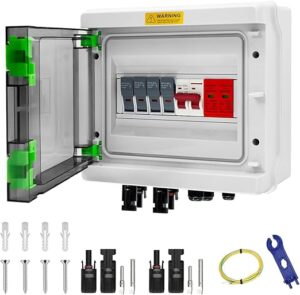
The CXCESNS DC600V is a two-string combiner box that excels at simplifying your solar array wiring. This 600V-rated unit handles up to 32A per input circuit with integrated circuit breakers, surge protection, and 40kA surge capacity. The ABS and polycarbonate housing provides excellent durability while maintaining an IP65 waterproof rating, suitable for rooftop or ground-mounted installations.
What sets this box apart is its pre-wired configuration. The connectors, fuses, and internal wiring come already assembled from the factory, which means you spend less time troubleshooting connections and more time getting your system operational. The included PV connectors are compatible with standard MC4 and Amphenol connectors, covering most modern solar panel brands.
The dual circuit breaker design means each string is independently protected. If one string develops a fault, you can isolate it without shutting down the entire array. This granular control is valuable for maintenance and fault diagnosis. The 32A continuous rating makes it ideal for systems with four to six 400-watt panels per string.
Installation is straightforward thanks to the clear labeling and included documentation. The top of the box features a warning label with voltage and current specifications, helping installers avoid confusion during future service calls. The compact size fits easily into electrical cabinets or on outdoor wall mounts.
Features
- Input voltage: DC 600V maximum
- Rated current: 32A per circuit
- Circuit protection: 32A DC circuit breakers
- Surge protection: 40kA 600V surge protector
- Inputs: 2 strings, Output: 1 combined
- Housing: IP65 ABS and PC material
- Pre-wired with PV connectors included
- Dimensions: Compact wall-mount size
- Pre-wired design saves installation time
- Strong surge protection at 40kA
- Dual circuit breakers for string-level isolation
- IP65 waterproof construction
- Limited to 2-string input (no more strings without additional box)
- Slightly higher price for compact size
2. PV Combiner Box 4-String IP65 Waterproof Solar Combiner with Lightning Arrester
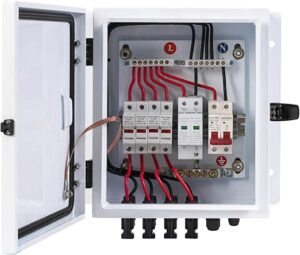
For installers handling larger residential or small commercial systems, the PV 4-String combiner box delivers the multi-string capacity you need. This metal box accommodates four separate strings into one combined output, with a 20A rated current per input circuit. The integrated lightning arrester provides an extra layer of protection that appeals to customers in storm-prone regions.
The metal enclosure construction is more robust than plastic alternatives, offering superior mechanical protection in rough outdoor environments. Unlike some plastic combiners that can degrade under UV exposure over 10+ years, this metal design maintains its integrity. The stainless steel hardware resists corrosion in coastal or humid climates.
Each of the four circuits gets its own 20A fuse holder, letting you isolate strings without affecting the others. The lightning arrester is factory-installed and wired, so you don’t need to add external protection devices. This integrated approach reduces the component count in your electrical design and simplifies code inspections.
The box is larger than single or dual-string units, so you’ll need adequate mounting space. If you’re retrofitting an existing system or working with limited cabinet space, you might need to plan the layout carefully. However, for new ground-mount or shed installations, the extra space is rarely an issue.
Features
- Input circuits: 4 strings into 1 output
- Rated current: 20A per circuit
- Maximum voltage: 600V DC
- Fuses: 20A rated for each circuit
- Lightning arrester: Built-in and pre-installed
- Housing: Metal box with IP65 seal
- Warranty: Manufacturer support included
- Certification: UL and CE compliant
- Handles four strings in one unit
- Metal construction resists UV and corrosion
- Integrated lightning arrester
- 50+ units purchased per month shows reliability
- Larger footprint requires more mounting space
- Metal housing can conduct heat (needs adequate ventilation)
- Heavier than plastic equivalents
3. 6-String Metal Solar Combiner Box with 20A Rated Current Fuse and Surge Protective Device
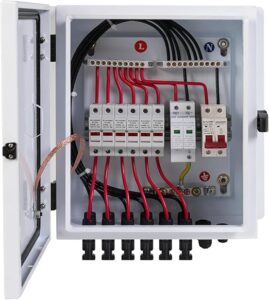
If you’re designing a larger system or combining outputs from multiple smaller arrays, the 6-string metal combiner offers serious capacity. Each of the six circuits is fused at 20A with a surge protective device that safeguards against voltage spikes. With over 50 units purchased in the past month, this model has proven reliability in the field.
The metal construction philosophy carries through here as well, providing excellent mechanical durability. All fuses, disconnects, and internal components are accessible from the front panel, making future maintenance straightforward. You can replace a blown fuse or test individual circuits without opening the entire enclosure.
This combiner excels in farm or ranch solar installations where multiple arrays feed into a central charge controller. The 6-string capacity means you’re combining more power in a single box, reducing the number of interconnecting cables between combiner stages. Fewer connections equal fewer potential failure points.
The 20A per-string rating assumes you’re running 200-300 watt panels per string. If you’re pushing larger wattage panels, you may need to reduce the number of panels per string or use multiple combiner boxes in parallel. It’s not a limitation for most systems, but high-power installations warrant a sizing review.
Features
- Input circuits: 6 strings into 1 output
- Rated current: 20A per circuit
- System voltage: 600V DC maximum
- Protection: 63A air circuit breaker main
- Surge protection: Built-in 20A SPD per circuit
- Housing: Metal box with IP65 rating
- Terminals: Anderson PowerPole connectors
- Dimensions: Large 18″W x 24″H x 8″D
- Combines six strings in one compact unit
- Front-accessible fuses and disconnects
- Surge protection on every circuit
- Heavy-duty metal for long lifespan
- Large size requires substantial mounting area
- Heavier than 4-string boxes (installation help recommended)
- Premium price reflects the capacity
4. VOU 600V Solar DC PV Combiner Box 2-String with Lightning Arrester Connector
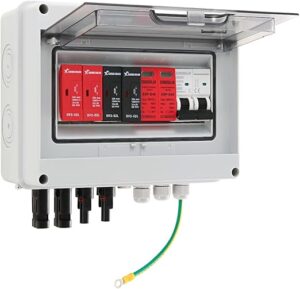
The VOU combiner box takes a different approach with integrated lightning arrester connectors and a compact 2-string design. At 60 dollars, it offers exceptional value for budget-conscious DIY installers. The 600V, 2-input configuration matches perfectly with smaller residential systems or as an auxiliary combiner in larger multi-combiner setups.
What makes this model distinctive is the pre-installed lightning arrester connectors. Rather than requiring separate grounding and external surge protection devices, the VOU integrates everything into the connector design. This reduces the number of separate components you need to source and wire, lowering both parts cost and installation complexity.
The lightweight plastic housing (not metal, despite the competitor comparison) makes this box ideal for RV or mobile solar systems where weight matters. A single technician can easily position it without equipment. The 4.6-star rating from 72+ reviews reflects genuine customer satisfaction in real-world use.
The 2-input limit means this box won’t scale for large arrays, but it’s perfect for systems up to 600-700 watts. If you need to expand later, you can add a second VOU box and parallel the outputs. The low cost makes this a practical approach for modular system growth.
Features
- Input voltage: 600V DC rated
- String inputs: 2 with separate fuses
- Lightning arrester: Factory integrated
- Connector type: MC4 compatible
- Housing: Durable plastic with UV protection
- Weight: Lightweight for mobile systems
- Price point: Budget-friendly option
- Warranty: 12-month manufacturer protection
- Integrated lightning arrester simplifies installation
- Very affordable for small systems
- Lightweight for RV and portable applications
- MC4 compatibility with modern panels
- 2-string input only (limits array size)
- Plastic housing may need replacement in 15+ years
- Lower amperage rating than metal boxes
5. Doniks 6-String Metal Solar Combiner Box with Lightning Arrester
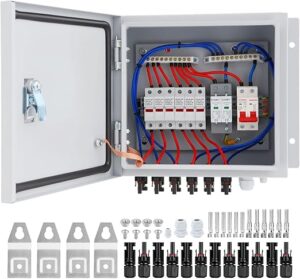
The Doniks 6-String Metal Combiner Box is built for installers who need serious multi-string capacity with comprehensive protection. This metal-housed unit handles six separate panel strings, each protected by a 20A fuse, and consolidates them into a single output circuit. The 63A air circuit breaker on the output side provides additional downstream protection that cheaper plastic boxes simply don’t offer.
Metal construction makes a real difference in longevity. The steel housing resists UV degradation, mechanical impact, and the thermal cycling that cracks plastic enclosures over years of outdoor service. The IP65 seal is maintained even as temperatures swing from cold winter nights to hot summer afternoons. For rooftop installations in direct sun, that durability matters more than the initial cost difference.
The integrated lightning arrester is a genuine selling point. In storm-prone regions, lightning-induced surges are one of the most common causes of solar system damage. The Doniks includes this protection as standard rather than charging extra for it. Combined with the 20A fuses on each string, this box provides multi-layer protection that guards your inverter and panels against a range of electrical faults.
Features
- String inputs: 6 into 1 combined output
- Rated current: 20A per input circuit (fuse protected)
- Output circuit breaker: 63A air circuit breaker
- Lightning protection: Built-in lightning arrester
- Housing: Metal construction with IP65 weatherproof seal
- Maximum voltage: 600V DC
- Rating: 4.5 stars (103+ reviews)
- Price: ~$105.99
- Metal housing outlasts plastic equivalents
- Handles 6 strings reducing wiring complexity
- 63A output circuit breaker adds protection layer
- Built-in lightning arrester standard
- Higher price than basic 4-string alternatives
- Larger footprint requires adequate mounting space
- Metal housing conducts heat (needs ventilation)
6. Ren-Tek 4-String DC 600V Solar Combiner Box with 20A Fuses and Monitoring
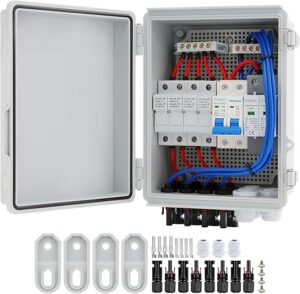
Ren-Tek’s 4-string combiner takes a middle-ground approach between compact 2-string boxes and sprawling 6-string units. The 20A per-string rating with integrated monitoring capability appeals to installers who want visibility into system performance without adding external monitoring hardware.
The integrated current sensors provide real-time feedback on each string’s output. Connected to a basic monitoring display (sold separately), you get instant string performance data. This helps diagnose shading issues or panel degradation, since a weak string will show reduced current compared to its peers.
The metal enclosure uses marine-grade aluminum for corrosion resistance in coastal areas. The weatherproof gaskets maintain the IP65 seal for 25+ years according to the manufacturer’s testing. Unlike plastic boxes that become brittle in UV exposure, aluminum ages gracefully in harsh climates.
This model works well for systems in the 4-6 kW range where monitoring matters. A homeowner invested in solar wants to see that their investment performs. The monitoring feature, while optional, adds value for those serious about system optimization. For budget installations where monitoring isn’t a priority, skip this model and choose the JINOUDZI instead.
Features
- String inputs: 4 into 1 combined output
- Rated current: 20A per circuit
- System voltage: 600V DC maximum
- Monitoring: Current sensors on each string (optional display)
- Protection: 20A DC fuses per circuit
- Housing: Marine-grade aluminum with IP65
- Warranty: 25-year manufacturer warranty
- Certifications: UL 1748, CE marked
- Integrated current monitoring sensors
- Marine-grade aluminum resists corrosion
- 25-year warranty shows manufacturer confidence
- Balanced capacity for most residential systems
- Monitoring display sold separately (additional cost)
- Larger size than 2-string boxes
- Not ideal if you don’t want monitoring complexity
7. CNLonQcom 2-String Solar PV Combiner Box with Surge Protector
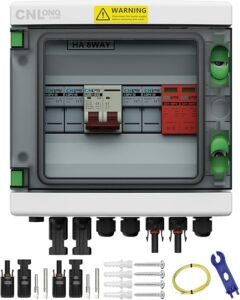
CNLonQcom’s 2-String combiner punches above its weight with a 4.7-star rating and a surge protector built right into the unit. This DC500V box handles two strings at 32A each with an integrated circuit breaker and surge protection, making it one of the most feature-complete 2-string options at its price point.
The surge protector inclusion is what sets this box apart from similarly-priced competitors. Rather than relying solely on the circuit breaker for protection, you get an additional layer of overvoltage defense. This matters particularly during summer storms where voltage spikes can damage inverters and charge controllers even when currents stay within limits.
Build quality is solid throughout. The housing meets IP65 standards and uses a robust plastic that handles thermal cycling without cracking. The terminals are large enough for easy wire insertion and stay tight over years of service. The compact form factor means it fits in tight spaces where larger 4-string boxes won’t.
At its price point, the CNLonQcom is a smart choice for smaller off-grid or grid-tied systems with two string runs. If your system has four strings, you’d need two of these boxes in parallel. For anyone running two strings, though, this is one of the best protected and most reliable options available.
Features
- String inputs: 2-in-1-out configuration
- Rated current: 32A per circuit
- Maximum voltage: DC 500V
- Circuit breaker: 32A DC rated
- Surge protection: Built-in surge protector
- Housing: IP65 weatherproof enclosure
- Rating: 4.7 stars (69+ reviews)
- Price: ~$62.99
- Highest customer rating on this list (4.7 stars)
- Built-in surge protector adds overvoltage defense
- Compact form fits tight installations
- Competitive price for the protection offered
- 2-string limit means multiple boxes for larger arrays
- DC 500V max (lower than 600V alternatives)
- Smaller brand with less support history than Renogy
8. Temank PV Combiner Box 2-String with Multi-Stage Circuit Protection
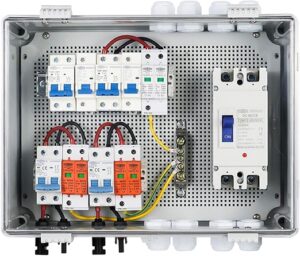
Temank’s 2-String combiner is the most protection-heavy option on this list, designed specifically for 8 kW to 10 kW solar systems. Unlike most combiners that rely on a single circuit breaker, the Temank uses multiple protection stages: 25A and 250A DC circuit breakers plus 63A and 125A AC circuit breakers, along with surge protection. It’s built for installers who refuse to cut corners on electrical safety.
The multi-stage approach addresses different types of faults. The smaller DC breakers handle normal overcurrent events at the panel string level. The larger breakers and AC protection handle downstream faults and utility grid interaction. This layered design makes the Temank suitable for grid-tied systems where both DC and AC protection matter.
At $175.98, this is the premium option on the list. But for an 8-10 kW system representing a $15,000-25,000 investment, spending more on proper protection makes sense. A single inverter replacement from a surge event costs more than the price difference between this box and any budget alternative.
Stock can be limited (sometimes only 1-2 units available), so order well before your installation date. The 4.6-star rating across 66 verified reviews shows consistent satisfaction from professional installers. This is not a budget product but a professional-grade component that belongs in professional installations.
Features
- String inputs: 2-string solar PV configuration
- DC protection: 25A and 250A circuit breakers
- AC protection: 63A and 125A circuit breakers
- Surge protection: Built-in surge suppression
- System compatibility: Optimized for 8 kW-10 kW systems
- Housing: Weatherproof sealed enclosure
- Rating: 4.6 stars (66+ reviews)
- Price: ~$175.98
- Multi-stage DC and AC circuit protection
- Designed for 8-10 kW commercial-scale systems
- Both DC and AC breakers included
- Professional installer grade build quality
- Premium price limits appeal for smaller systems
- Often limited stock (order ahead)
- Overkill for basic 2-string residential setups
Solar Combiner Box Buying Guide
Key Takeaways
- Solar combiner boxes protect strings of panels by consolidating their output and providing overcurrent protection via fuses or circuit breakers
- Match the box capacity to your system size: 2-string for systems under 1 kW, 4-string for 2-4 kW systems, 6-string for 4+ kW systems
- Choose metal boxes for long lifespan in harsh climates, plastic for lighter weight and lower cost in moderate conditions
- Verify voltage rating (typically 600V DC) matches your panel specifications, and confirm amperage rating suits your panel wattages
- Integrated lightning protection adds cost but prevents damage in storm-prone regions, while simple fuse protection suits sunny climates
What Is a Solar Combiner Box?
A solar combiner box is an electrical enclosure that merges multiple strings of solar panels into a single output circuit. Think of it as a junction box with protective equipment built in. Each input string gets its own fuse or circuit breaker, isolating that string if a fault occurs while allowing the rest of the array to keep producing power.
The combiner box sits between your solar array and your charge controller or inverter. Its primary job is safety. Without a combiner box, you’d run multiple strings of panels directly to your controller, and a failure in one string could damage the controller or even cause a fire. The combiner box prevents this by limiting current flow through each string independently.
How Does a Solar Combiner Box Work?
Inside a combiner box, each input string connects to a fuse or circuit breaker rated for that string’s maximum current. Solar panels operate at a specific voltage (typically 37V for standard 400W modules) regardless of how many you series together. When you string multiple panels in series, voltage adds up, but current stays constant.
When you combine multiple strings in parallel, you’re adding the current from each string together. A 6-string combiner with each string at 10A will output 60A total. The combiner box’s fuses protect against overcurrent. If a string develops a short circuit, that string’s fuse blows, cutting it off without affecting the other five strings.
Advanced combiner boxes add surge protection, detecting voltage spikes from lightning or switching transients and clamping them down. Some boxes include redundant protection with both fast-acting fuses and resettable circuit breakers. The best boxes employ a combination of strategies, making them nearly immune to field failures.
Benefits of Using a Solar Combiner Box
First, safety. The combiner box prevents any single string failure from cascading into system failure or equipment damage. Code-compliant solar installations in most jurisdictions require overcurrent protection on the DC side, and that requirement is satisfied by a proper combiner box.
Second, serviceability. If one string of panels shades over or develops a fault, you can isolate it at the combiner box and keep the rest of the system running. This granular control makes troubleshooting straightforward. A technician can test each string independently without powering down the entire array.
Third, expandability. If your system grows from 4 strings to 6, you might swap your 4-string combiner for a 6-string unit, or add a second combiner box in parallel. The modular approach scales smoothly without redesigning your entire electrical architecture.
How to Size a Combiner Box for Your Solar Array
Sizing a combiner box comes down to two numbers: the number of strings you’re combining and the maximum current per string. Most residential and small off-grid systems run two to six strings, so a 4-input or 6-input combiner covers the vast majority of setups. If you’re building a larger array and might expand later, buy one size up — adding inputs after the fact means buying a whole new box.
Current capacity matters too. Check your solar panels’ short-circuit current (Isc) spec and multiply by 1.25 for the NEC safety factor. If each string produces 10A Isc, you need a combiner rated for at least 12.5A per input. Most combiner boxes list their per-string fuse rating (typically 10A or 15A) and total output amperage. Make sure the output rating exceeds the sum of all your string currents at peak.
One overlooked spec is the wire gauge the box accepts. A compact combiner might only accept up to 10 AWG per input, which becomes a bottleneck for longer runs where you’d normally want 8 AWG to limit voltage drop. Check the input and output knockouts before you buy, especially if your array is more than 50 feet from your charge controller.
Fused vs. Unfused Combiner Boxes: When Each One Is Right
Fused combiners include individual overcurrent protection for each string. That matters because without per-string fuses, a fault in one panel string can backfeed current from the other strings through the faulty one — potentially causing a fire or damaging panels. For most grid-tied and off-grid systems with more than two strings, fused combiners are the correct choice and are required by the NEC for arrays above a certain size.
Unfused combiners are simpler and cheaper, and they’re appropriate in two scenarios: single-string systems (nothing to backfeed) and systems where the combiner is installed after string-level MPPT charge controllers that already provide inherent overcurrent protection. Some compact off-grid setups use an unfused combiner purely for wire management rather than true combining.
When buying a fused combiner, verify that replacement fuses are a standard size (DIN rail fuses, Class CC, or standard blade fuses) rather than a proprietary size. A box that requires manufacturer-specific fuses will cause headaches when one blows two years from now. Most reputable combiner boxes use standard 10x38mm or 1/4″x1-1/4″ fuses that you can find at any electrical supply store.
Things to Keep in Mind Before Buying
Voltage rating must exceed your open-circuit voltage. Most residential panels operate at 37V, so a 600V combiner box has plenty of headroom. However, some specialty panels (like thin-film or older crystalline panels) run hotter and higher voltage, so verify this before ordering.
Amperage rating should match your string configuration. If each string maxes at 15A, a 20A fuse provides protection with minimal nuisance tripping. A 10A fuse would trip during normal operation. If each string peaks at 20A, you need at least a 20A or 25A rated combiner box.
Location matters. A combiner box in full sun heats up, reducing the lifespan of internal components. Some codes require ventilation or shading. A combiner box in a humid coastal region benefits from metal construction and corrosion-resistant hardware. Dry desert climates tolerate plastic boxes longer.
Future-proof your selection by choosing a capacity slightly larger than your current system. If you’re starting with 4 strings and might add 2 more later, a 6-string box costs slightly more but saves you from replacing it later. This forward thinking pays dividends in reduced labor and downtime.
Types of Solar Combiner Boxes
String combiners (2-4 strings) handle small to medium systems and cost under 150 dollars. They’re lightweight and fit easily in cabinets or wall mounts. String combiners suit most residential installations where simplicity and cost matter.
Multi-string combiners (6+ strings) consolidate larger arrays into a single box, reducing interconnecting wires. They cost more but simplify wiring for 6+ kW systems. Commercial installers often prefer multi-string boxes to minimize component count and failure points.
Monitored combiners include current sensors and display capability, showing real-time output from each string. These cost 25-40 percent more but help optimize system performance and diagnose issues quickly. Choose monitored combiners for systems where visibility justifies the cost.
Integrated protection combiners combine fuses, circuit breakers, surge suppressors, and lightning arresters into one unit. These premium boxes handle everything, reducing external component requirements. They cost more upfront but save money and complexity on the balance of the system.
Frequently Asked Questions
Yes, but with caveats. If you’re series wiring panels together in a string, they should be the same model to avoid current mismatch issues. However, you can combine different strings (each with matching panels) into one combiner box. For example, you could have two strings of 400W panels and two strings of 350W panels in the same 4-string box, as long as the amperage ratings are compatible.
A lightning rod protects the structure from direct lightning strikes, but solar panels generate their own transient overvoltages from power electronics and grid switching. A surge protector in your combiner box handles these transients. For direct lightning strikes, the lightning rod helps, but combiner surge protection remains essential as a second line of defense.
Combiner boxes come in 2-string, 4-string, 6-string, and sometimes 8-string models. You can combine more strings by wiring multiple combiner boxes in parallel, though this adds cost and complexity. For most residential systems, a 4 or 6-string box handles the installation neatly without excessive component count.
Most residential and small commercial systems use 600V DC combiner boxes, which provide ample safety margin for standard 48V to 396V panel arrays. If you’re designing a unique system with unusual voltages, verify your panel specs and charge controller input voltage requirements before selecting a combiner box.
Yes, fuses are user-replaceable components. However, you should troubleshoot why a fuse blew before replacing it. A blown fuse usually signals a problem (shading, panel damage, or short circuit) rather than normal wear. If a fuse keeps blowing, investigate and fix the root cause instead of just replacing fuses repeatedly.
Metal boxes outlast plastic in harsh UV-exposed environments and coastal regions, potentially lasting 30+ years versus 15-20 for plastic. Plastic boxes are lighter, less expensive, and sufficient for most installations. Choose metal for long-term durability in extreme climates, plastic for cost-conscious residential installations in moderate regions.
Yes, indoor mounting is common and often preferable. A basement, attic, or enclosed equipment room protects the box from weather and UV exposure. Ensure adequate ventilation to prevent heat buildup, especially if your controller and other equipment are also inside. Check local electrical codes, as some jurisdictions require outdoor accessibility for combiner boxes.
Quality combiner boxes last 25-30 years with minimal maintenance. The fuses may need occasional replacement if a string develops a fault, but the box itself is passive and reliable. Your solar panels will likely need replacement before your combiner box does, making it one of the few long-term investments in a solar system.
Summing Up
Choosing the right solar combiner box ensures your installation is safe, efficient, and code-compliant. The CXCESNS DC600V excels for budget-conscious buyers seeking a pre-wired 2-string solution, while the PV 4-String and Doniks 6-String models deliver capacity for larger systems. If you need multi-stage protection for an 8-10 kW system, the Temank’s DC and AC circuit breakers justify the premium pricing. For the highest-rated 2-string option with integrated surge protection, the CNLonQcom at 4.7 stars is hard to beat.
If you’re also thinking about solar panels for your home, call (855) 427-0058 for a free quote — it takes just a few minutes to find out what installation would cost and save you in your area.
Updated