
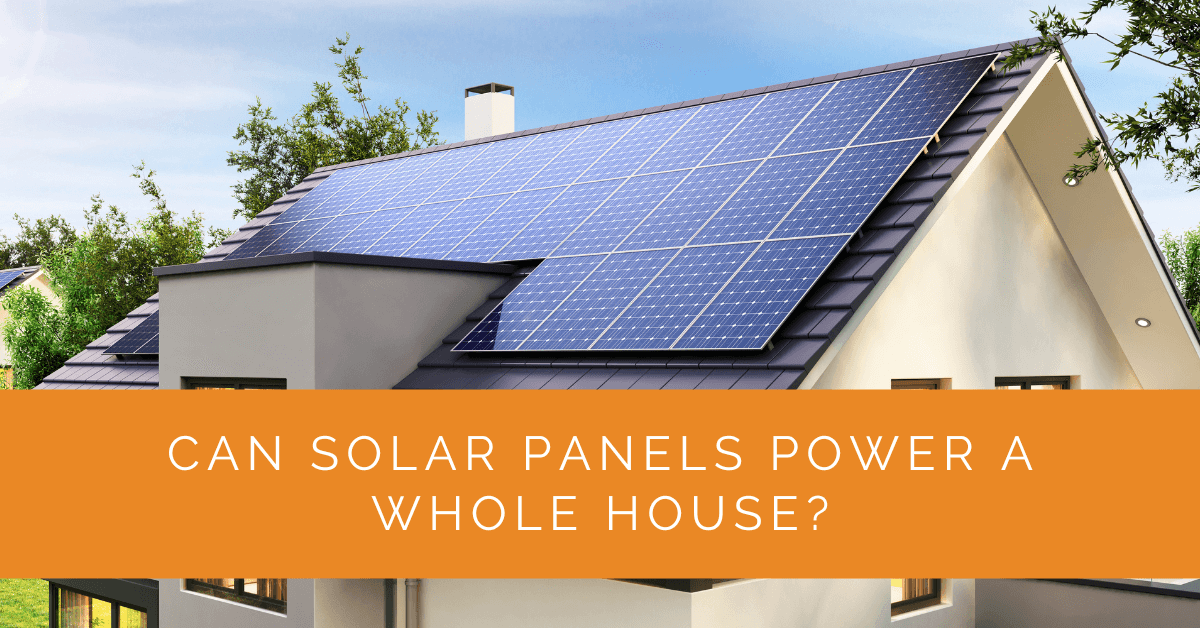
Yes — solar panels can power a whole house. A properly sized grid-tied system generates enough electricity to cover 100% of a typical home’s annual consumption, with excess power exported to the utility grid during sunny months and grid power drawn at night or during overcast periods. For true independence from the grid, a system with battery storage is required. Most US homeowners who go solar still remain grid-connected, letting the utility serve as a virtual battery through net metering.
What It Takes to Power a Whole House with Solar
To determine whether solar can power your whole house, three numbers are needed: your annual electricity consumption (from your utility bills), the solar production potential of your location (measured in peak sun hours), and the system size those two factors imply.
Step 1 — Know your annual consumption. Find the total kWh you used over the last 12 months on your utility bills. The average US household uses approximately 10,500 kWh per year, but this varies widely: 6,000–8,000 kWh for smaller homes or mild climates; 14,000–20,000+ kWh for large homes, electric vehicles, pool heaters, or households in extreme climates (heavy AC in the South, heavy heating in the North).
Step 2 — Find your location’s peak sun hours. Peak sun hours (PSH) is the daily equivalent hours of 1,000 W/m² irradiance your location receives on average. It varies from about 3.5 PSH/day (Seattle, Pacific Northwest) to 6.5+ PSH/day (Phoenix, Las Vegas). NREL’s PVWatts calculator provides location-specific values. Most US locations fall between 4.0 and 5.5 PSH/day.
Step 3 — Calculate required system size. System size (kW) = Annual consumption (kWh) ÷ (PSH × 365 days × 0.80 system efficiency factor).
Example for an average home in a typical US location:
10,500 kWh ÷ (4.5 PSH × 365 × 0.80) = 10,500 ÷ 1,314 = 8.0 kW system
This confirms that the standard 8 kW residential system — 20 × 400W panels — is roughly the right size to offset 100% of average US home consumption in a moderate solar resource location. In Phoenix, the same consumption requires only a 6–6.5 kW system. In Seattle, it might require 11–12 kW.
Grid-Tied vs. Off-Grid: Which Actually Powers Your Whole House?
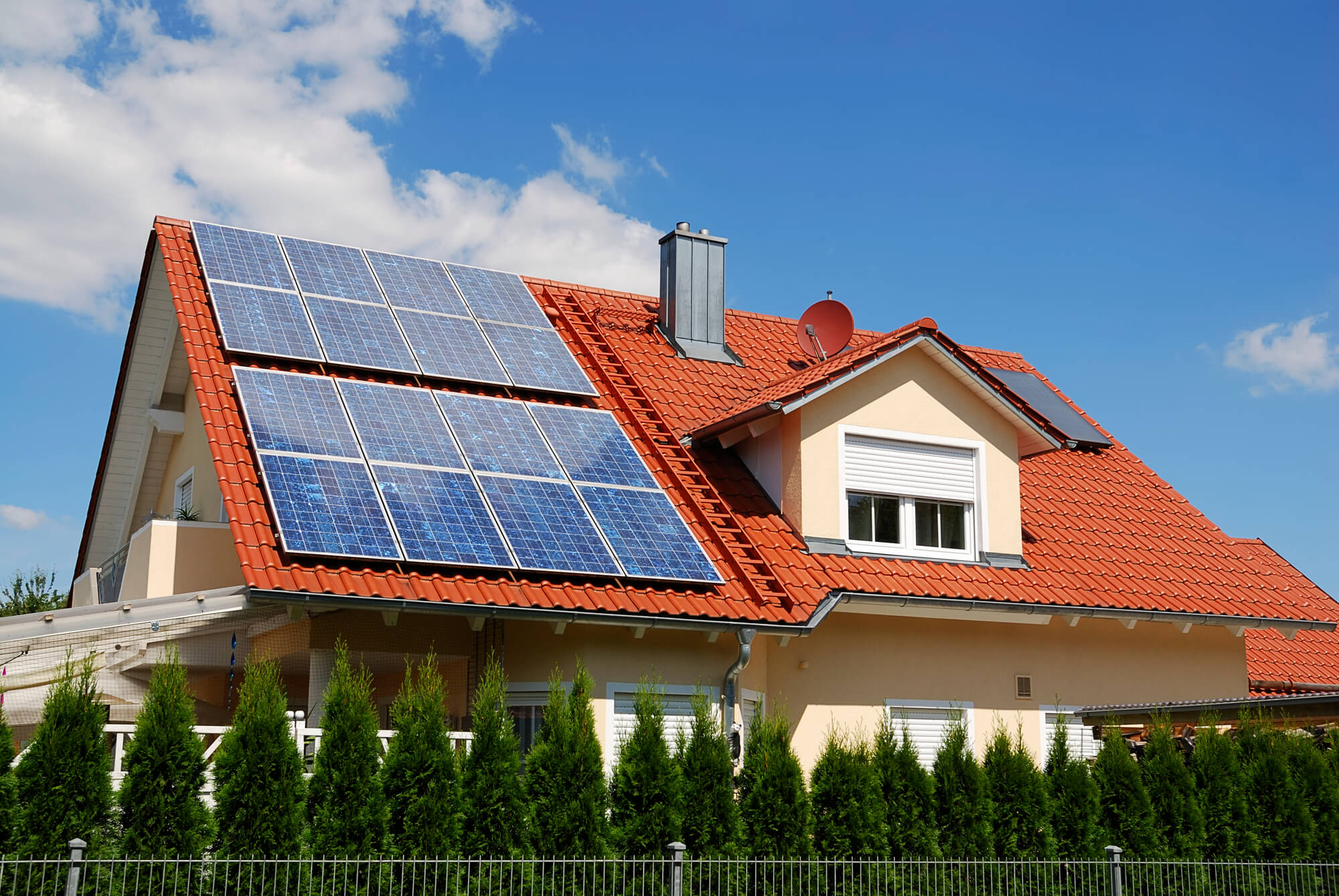
Grid-tied system (the most common option): Your solar panels generate DC electricity, the inverter converts it to AC, and this AC power is used directly in your home. When your panels produce more than you’re currently consuming (typically midday), the excess flows back to the utility grid through net metering. At night and on cloudy days, you draw from the grid as usual. At the end of each billing period, your net consumption (grid draw minus solar export) appears on your bill. A properly sized system nets out to near-zero annual electricity costs.
Key limitation: during a grid outage, a standard grid-tied system automatically shuts off (anti-islanding protection per NEC Article 690 and IEEE 1547). Even if your panels are producing, you lose power when the grid goes down — unless you add battery storage.
Grid-tied with battery backup: Adding a home battery (Powerwall 3, Enphase IQ Battery, Franklin aGate) creates backup power during outages while still using net metering during normal operation. The battery stores excess solar production during the day and powers your home when the grid is down or during evening hours. A single Powerwall 3 (13.5 kWh usable) can power essential loads (lights, refrigerator, outlets) for 24 hours or more, or the entire home for 12–18 hours depending on consumption. This is the most popular “whole house solar” option for homeowners who want backup power without full off-grid complexity.
True off-grid system: Sized to power the home entirely without any grid connection, even during winter weeks with minimal sun or extended cloudy periods. This requires a significantly oversized solar array (typically 1.3–2× what a grid-tied system needs) plus a large battery bank (100–300+ kWh of storage for most homes). Cost is dramatically higher — often $60,000–$150,000+ for a properly sized system — but provides full energy independence. Appropriate for remote rural locations where grid connection would cost more than off-grid system installation.
How Many Solar Panels Does It Take to Power a Whole House?
Using 400W panels as the standard (the most common current panel wattage):
Small home (6,000 kWh/year, average sun location): ~4.6 kW system → 12 × 400W panels
Average home (10,500 kWh/year, average sun location): ~8.0 kW system → 20 × 400W panels
Large home (15,000 kWh/year, average sun location): ~11.5 kW system → 29 × 400W panels
High-consumption home with EV (20,000 kWh/year, average sun location): ~15.3 kW system → 38 × 400W panels
High-solar locations (Arizona, California, Nevada, Texas) need fewer panels for the same consumption because each panel produces more electricity per day. Low-solar locations (Pacific Northwest, New England in winter, Upper Midwest) need more panels.
Does Solar Work Well in Cloudy Climates?
Yes — solar still powers whole houses in cloudy climates, it just requires a larger array. Germany, one of the world’s top solar markets, has a solar resource similar to the Pacific Northwest (about 3.5–4 PSH/day). What matters is that panels are sized to the actual local resource, not the theoretical maximum.
On overcast days, solar panels still produce electricity from diffuse light — typically 10–25% of their rated output. Rain-heavy climates also benefit from self-cleaning of panel surfaces, offsetting some of the reduced irradiance. Over a full year, well-sized solar in Seattle offsets the same percentage of annual consumption as well-sized solar in Phoenix — the Seattle system is simply larger.
Practical Roof Space Required
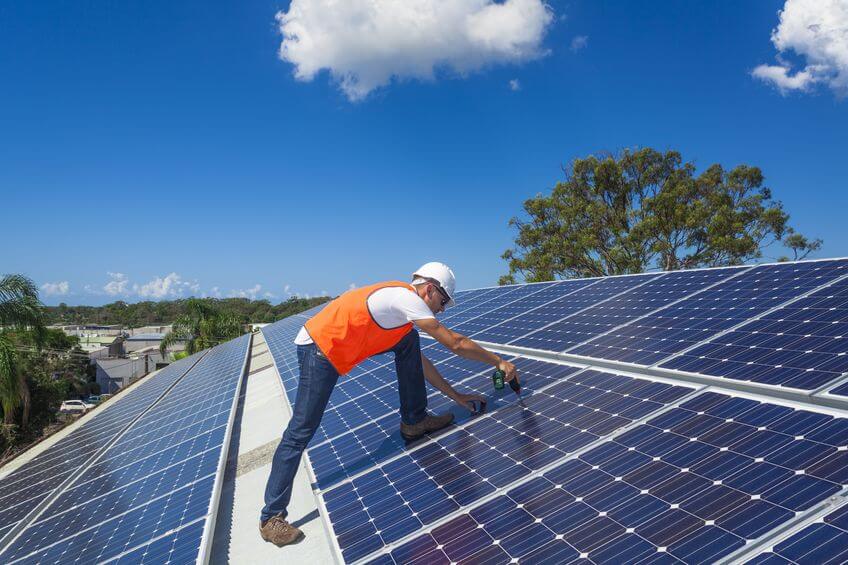
A 400W panel requires approximately 26 square feet of roof area. For a complete home solar system:
20 panels (8 kW system): approximately 520 square feet of usable south-facing roof area
25 panels (10 kW system): approximately 650 square feet
30 panels (12 kW system): approximately 780 square feet
This is net panel area — the actual roof section needed is somewhat larger to accommodate roof obstructions (vents, chimneys, skylights), required setbacks from roof edges (typically 12–18 inches from each edge under many fire codes), and inter-panel spacing for racking. A typical 2,000 square foot single-story home with a simple roofline has 1,000–1,500 square feet of total roof area, but only 400–800 square feet may be suitable for solar after excluding north-facing sections, heavily shaded areas, and obstructed sections.
If your roof doesn’t have enough suitable space for a full-offset system, options include: ground-mounted panels in your yard, using premium high-efficiency panels (SunPower Maxeon, REC Alpha) to generate more power from the same area, or accepting partial offset (70–80% of consumption) from the available roof space with the rest from the grid.
Cost to Power a Whole House with Solar
For a grid-tied system sized to cover 100% of annual consumption:
Average US home (8 kW system, 2026 pricing): $20,000–$28,000 installed before incentives
Large home (12 kW system): $30,000–$42,000 installed before incentives
With battery backup (8 kW + Powerwall 3): $30,000–$42,000
The federal Section 25D homeowner tax credit expired December 31, 2025 — homeowners purchasing systems in 2026 do not receive the 30% credit on their investment. Solar leases and PPAs remain available with lower upfront costs because the installer (not the homeowner) claims the Section 48E commercial credit through 2027. State incentives (New York’s 25% credit, property and sales tax exemptions in most states) partially offset the expiry of Section 25D.
For a free quote on a solar system sized to power your specific home, call (855) 427-0058 or visit us.solarpanelsnetwork.com to get connected with a qualified local installer.
Frequently Asked Questions
Can solar power a house 24/7?
A grid-tied solar system without battery storage cannot power a house 24/7 independently — it relies on the grid at night and during heavy overcast periods. To power a house 24 hours a day without grid dependence, battery storage is required. For truly 24/7 grid independence, an off-grid system with an oversized array and large battery bank is needed — significantly more expensive than a standard grid-tied installation.
Does my house need to face south to go solar?
No — south-facing is optimal (producing about 100% of maximum output), but east, west, and even northeast/northwest-facing roofs can still support effective solar installations. East and west-facing panels produce approximately 80–88% of south-facing output. The system is simply sized slightly larger to compensate. North-facing roofs (40–55% of south output) generally don’t make economic sense for solar.
What happens to my electric bill when solar powers my whole house?
With a properly sized grid-tied system and net metering, your electric bill typically drops to near zero for energy consumption — but most utilities charge a fixed monthly service fee ($5–$30/month) that cannot be offset by solar. Net metering allows your excess solar production to earn credits that offset power drawn at night. In California under NEM 3.0, export credits are lower (5–8 cents/kWh) versus retail rates (25–35 cents/kWh), so maximizing self-consumption and pairing with battery storage has become more important.
How long will solar panels actually power my house?
Most solar panels carry 25-year linear power warranties and are expected to last 30+ years. Over 25 years, panel output degrades by about 10–20% depending on technology (0.25–0.55%/year). At year 25, a system producing 100% of your needs at installation produces approximately 85–94% of its original rated output. The inverter needs replacement once during the system’s life (around year 12–15 for string inverters; 25-year warranty for Enphase microinverters).
Summing Up
Solar panels can absolutely power a whole house — and do so for millions of US homeowners. The key is correct system sizing based on your actual consumption and local solar resource, not a one-size-fits-all estimate. An average US home needs an 8–10 kW system (20–25 × 400W panels) in most locations. Grid-tied systems with net metering effectively cover 100% of annual consumption with the grid serving as a backup. Adding battery storage provides protection during outages. For true off-grid independence, a larger array and battery bank are required at significantly higher cost. To get a properly sized system quote for your home and location, call (855) 427-0058.
Updated