
Our blog is reader-supported. When you buy through links on our site, we may earn an affiliate commission. Thank you for your support!
If you’re looking for a reliable, no-fuss solar panel for your RV, camper, boat, or small off-grid setup, the ACOPOWER 50W 12V Monocrystalline Solar Panel is the brand’s standout offering on Amazon. It delivers solid real-world performance, ships with everything you need to get started, and hits a price point that makes sense for smaller systems.
ACOPOWER keeps its Amazon lineup focused. Rather than flooding the market with a dozen SKUs, the brand concentrates on a handful of proven monocrystalline panels aimed at the RV and marine crowd. That means fewer choices, but the ones available are genuinely well-built. Here’s what’s worth your money.
Our Top Picks
| Image | Name | |
|---|---|---|
| ACOPOWER 50W 12V Monocrystalline Solar Panel Mid-range 50W mono panel for RV and off-grid use, with MC4 connectors and mounting bracket included. Read more | |
| ACOPOWER 10W 12V HY010-12M Monocrystalline Solar Panel Compact 10W mono panel ideal for trickle charging and small off-grid battery systems, with integrated mounting bracket. Read more |
2 Best ACOPOWER Solar Panels
1. ACOPOWER 50W 12V Monocrystalline Solar Panel
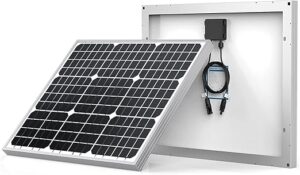
The ACOPOWER 50W panel is the one most buyers should start with. At around $72, it sits above the budget basement but well below premium brands like Renogy. What you get for that extra spend over a no-name 50W panel is a noticeably sturdier build — the anodized aluminum frame feels solid, the tempered glass has some real weight to it, and the junction box is properly sealed rather than loosely attached. This is a panel you’d feel comfortable bolting to a camper roof and forgetting about for a few seasons.
Output in direct sun is right where ACOPOWER claims it will be. In an open sky around solar noon, you’ll see close to the full 50W pulling into a decent charge controller. The monocrystalline cells handle partial cloud cover better than older polycrystalline designs, though you’re still going to see output drop in heavy overcast. For a camper van parked in a sunny campsite, 50W is enough to keep a 100Ah battery comfortably topped off through an average day — especially if you’re not running a heavy inverter load.
The panel ships with a mounting bracket kit included, which is a genuine convenience. Most competitors ship the bracket separately, so you end up paying $10-15 extra anyway. The MC4 connectors are pre-attached to pigtail leads, making connection straightforward. One thing to note: the leads are on the shorter side, so factor in cable extensions if your charge controller is mounted far from the panel.
At 9.7 lbs, this is a manageable one-person install. The pre-drilled frame holes are well-positioned for standard Z-bracket or tilt-mount setups. If you’re putting this on an RV roof, the low-profile design (under 1.5 inches thick including frame) keeps wind resistance to a minimum. It’s not a complicated product, and that’s the point — it does what a 12V solar panel is supposed to do without unnecessary fuss.
Features
- 50W monocrystalline output, 12V system compatible
- 9.7 lbs — lightweight enough for single-person installation
- Mounting bracket included in the box
- Pre-attached MC4 solar connectors on pigtail leads
- Anodized aluminum alloy frame resists corrosion
- 3.2mm tempered glass with anti-reflective coating
- Waterproof junction box with bypass diodes
- 4.3/5 stars (19 reviews on Amazon)
- Mounting bracket included — no separate purchase needed
- Solid build quality relative to price
- Real-world output matches specs in good conditions
- Low-profile design suits RV rooftop installs
- Short lead cables may require extension in some setups
- Only 19 Amazon reviews — limited real-world feedback pool
- Needs separate charge controller and battery
2. ACOPOWER HY010-12M 10W 12V Monocrystalline Solar Panel
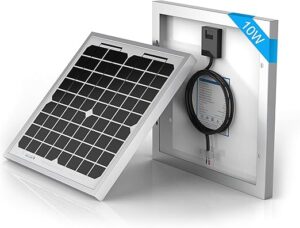
The 10W ACOPOWER panel is a different tool for a different job. It’s not designed to power your campsite — it’s designed to keep a battery from going flat. Think of it as a long-term trickle charger for a boat that sits at the dock most of the year, a camper van parked in storage between trips, or a spare battery on a hunting cabin you visit once a month. It won’t run your lights or charge your phone meaningfully, but it will offset parasitic drain and keep a 100Ah battery healthy through months of inactivity.
Build quality is consistent with the 50W sibling — aluminum frame, tempered glass, sealed junction box. The integrated mounting bracket simplifies installation considerably. You can bolt it to a flat surface with four screws and aim it roughly south, and it’ll quietly do its job without any further attention. At 4.5/5 stars across 126 Amazon reviews, this is the more proven of the two products, with a meaningful track record of satisfied buyers.
Where the 10W falls short is obvious: if you’re hoping to run anything beyond trickle maintenance, you’ll need the 50W or multiple panels. Ten watts under ideal conditions delivers roughly 0.83 amps into a 12V battery — fine for offset, not for powering loads. Make sure your charge controller supports low-wattage inputs (most PWM controllers handle 10W easily), and keep the panel in full sun for best results.
Features
- 10W monocrystalline output, 12V system compatible
- Compact and lightweight — easy to transport and position
- Integrated mounting bracket included
- MC4 connectors pre-attached
- Waterproof junction box with sealed connections
- Anodized aluminum frame construction
- 4.5/5 stars (126 reviews on Amazon)
- Strong review track record (126 reviews, 4.5 stars)
- Ideal for battery maintenance and trickle charging
- Compact and portable — easy to reposition
- 10W output — not suitable as a primary charging source
- Charges slowly even for small battery banks
- Overkill packaging for what is essentially a maintenance product
ACOPOWER Solar Panel Buying Guide
Key Takeaways
- ACOPOWER’s Amazon lineup focuses on 10W and 50W monocrystalline panels — both 12V and suited to RV, marine, and small off-grid use
- The 50W is the right choice for active charging; the 10W is a battery maintenance tool
- Both panels include mounting hardware and MC4 connectors, reducing out-of-pocket accessory costs
- Neither panel includes a charge controller or battery — you’ll need those separately
- Monocrystalline cells offer better efficiency than polycrystalline at similar price points
- For larger power needs (100W+), consider a Renogy or HQST panel; ACOPOWER’s strength is in the smaller wattage range
What Are ACOPOWER Solar Panels?
ACOPOWER (which stands for Advanced Clean Energy Power) is a solar energy company focused on portable and compact photovoltaic solutions for off-grid applications. Unlike larger manufacturers that target residential rooftop systems, ACOPOWER has always catered to the RV, marine, and portable power market — people who need reliable 12V charging without the complexity of a full residential install.
On Amazon, ACOPOWER’s presence is focused on their proven monocrystalline rigid panel range. These are conventional glass-and-aluminum panels, not flexible or foldable products. They’re built for mounting, not folding into a bag. The company also sells kits, portable solar generators, and battery systems through their direct website (acopower.com), though those aren’t widely stocked on Amazon.
How Do ACOPOWER Solar Panels Work?
Both ACOPOWER panels use monocrystalline silicon photovoltaic cells — the same technology used in most quality rigid solar panels today. When sunlight hits the silicon cells, it excites electrons and generates direct current (DC) electricity. That DC power travels through the MC4 connector leads to a charge controller, which regulates voltage and current to protect your battery from overcharging.
The key difference between ACOPOWER’s 10W and 50W is simply the number and size of cells. More cells means more surface area to capture photons, which means more current output. Both panels operate at around the same efficiency (~17-18%), so the larger panel’s advantage is purely a function of its greater physical size.
One important note: both panels produce DC electricity at approximately 17-18V open-circuit voltage, which is higher than your 12V battery. This is intentional — the charge controller brings it down to the right level. Never connect a solar panel directly to a battery without a charge controller in between.
Benefits of Using ACOPOWER Solar Panels
The main appeal of ACOPOWER panels is simplicity. You get a monocrystalline panel with all the mounting hardware and connectors already included, at a price that’s lower than many comparable name-brand options. For an RV owner who wants to add a basic solar setup without over-engineering it, this is genuinely appealing.
Build quality is solid. The anodized aluminum frames hold up well in coastal and outdoor environments. The tempered glass is impact-resistant and rated for hail and light snow loads. And because ACOPOWER panels are conventional rigid panels rather than flexible laminate, they have a simpler degradation profile — you can expect them to produce roughly 80% of original output after 20-25 years under normal conditions.
The included mounting brackets are a real convenience. Many competing brands sell panels without mounts, then make you spend another $15 on Z-brackets. Having everything in the box saves a trip to the hardware store and gets your system up faster.
ACOPOWER’s Product Range: What You Can Actually Buy
ACOPOWER focuses on a narrow product range compared to larger panel manufacturers. Their catalog concentrates on compact, portable panels in the 10W to 120W range, with an emphasis on RV, boat, and off-grid applications rather than residential rooftop installations. This focus means their mounting hardware, connectors, and protective cases are designed for mobile use, which is an advantage if portability is your priority but a limitation if you’re building a fixed ground-mount system.
The brand’s PERC monocrystalline panels represent their premium tier, offering higher efficiency per square inch than their standard mono panels. For space-constrained applications like a camper van roof or a small boat deck, the PERC models deliver more watts in a smaller footprint. Their foldable suitcase-style panels with built-in handles are particularly popular for overlanding and van builds where quick setup and teardown is a priority.
One thing worth knowing before buying ACOPOWER specifically: their product line changes more frequently than established brands like Renogy or SunPower. Models get discontinued and replaced without much fanfare, and replacement panels may have slightly different specifications even under the same model name. If you’re buying a second panel to expand an existing ACOPOWER array, verify the Voc, Isc, and physical dimensions match your original unit before ordering.
Best Use Cases for ACOPOWER Panels
ACOPOWER panels are well suited to a specific set of applications. RV owners who want a reliable portable panel for occasional camping and don’t need a full rooftop array represent their core market. The foldable models in particular work well for weekend trips where you want power without permanent installation. Boat owners with limited deck space also benefit from their compact high-efficiency options. And for very small off-grid applications like a garden shed, a remote gate opener, or a livestock water pump, their 10W to 50W range covers most needs without oversizing.
Where ACOPOWER panels are less ideal: large-scale off-grid systems, residential installations, and applications where you need more than a few hundred watts of capacity. At that scale, a larger established brand with better warranty support and broader dealer networks makes more sense. You also won’t find ACOPOWER on most solar incentive programs or contractor-approved lists, so they’re not a fit for installations seeking state or federal rebate programs.
The honest recommendation is to match ACOPOWER to their intended market segment. For portable, compact, and mobile solar applications under 200W, they’re a solid mid-range choice. For anything larger or more permanent, research brands with deeper product catalogs, longer track records, and more accessible technical support.
Things to Consider Before Buying
Wattage and your actual power needs. The 50W ACOPOWER panel produces roughly 250Wh per day in good sun conditions (5 hours of peak sun at 50W, accounting for system efficiency losses). That’ll run a 12V fan for most of the day, keep a phone and laptop charged, and offset some lighting load. If you’re running an air conditioner, a refrigerator, or a large inverter, you’ll need multiple panels or a higher-wattage system.
Charge controller compatibility. You’ll need a PWM or MPPT charge controller. For a single ACOPOWER panel (10W or 50W), a basic 10A PWM controller works fine and is available for around $15-20. If you plan to expand your system with multiple panels in the future, invest in an MPPT controller now — you won’t have to replace it later.
Battery type. ACOPOWER panels work with any standard 12V battery — AGM, gel, lead-acid, or lithium iron phosphate (LiFePO4). LiFePO4 batteries are the most efficient with solar charging, but they cost more upfront. For a simple RV battery maintenance system, a standard AGM is fine.
Installation environment. Both panels are rated for outdoor use and can handle rain, though neither carries an IP rating. Mount them at an angle rather than flat to allow water runoff and reduce soiling. In areas with heavy tree cover, partial shade will disproportionately reduce output — a single shaded cell can cut output significantly on a standard panel.
Types of ACOPOWER Solar Panels
ACOPOWER’s Amazon product line stays focused on two size categories:
Small maintenance panels (5W-10W): These are designed for battery trickle charging and long-term maintenance. The HY010-12M 10W is the primary example. Output is too low for active loads, but these panels are inexpensive, compact, and effective at keeping batteries healthy during storage.
Mid-range charging panels (50W): The 50W panel sits in the active charging category — enough real output to run small 12V loads and meaningfully recharge a battery bank over the course of a sunny day. This is the minimum practical wattage for an RV or boat where you’re actually using power.
For buyers needing more than 50W from a single panel, ACOPOWER’s Amazon offering is limited. In that case, competitors like Renogy (100W, 200W), HQST (100W), or Go Power! are worth considering. For professional solar installation on a home or commercial property, call us free on (855) 427-0058 or get a free installation quote.
Frequently Asked Questions
How many ACOPOWER solar panels do I need for an RV?
It depends on your power usage. A single ACOPOWER 50W panel handles light loads well — phone charging, LED lighting, a 12V fan. If you’re running a laptop, small inverter, or 12V compressor fridge, you’d want at least 100-150W total, which means two or three 50W panels wired in parallel. Start with one panel and a proper charge controller, then add panels as your needs grow.
Can I connect ACOPOWER panels in series or parallel?
Yes. Wiring two 50W ACOPOWER panels in parallel doubles your current output while keeping voltage at 12V — ideal for a 12V battery bank. Wiring them in series doubles voltage (to roughly 24V) while keeping current the same, which suits a 24V system or an MPPT controller with a higher input voltage range. For most RV setups, parallel wiring is the right choice.
Do ACOPOWER panels include a charge controller?
No. The panels ship with mounting brackets and MC4 connectors, but not a charge controller. You need a charge controller between the panel and your battery — connecting directly risks overcharging and can damage or destroy a battery. For a single 50W panel, a basic 10A PWM controller costing $15-20 is perfectly adequate.
What is the warranty on ACOPOWER solar panels?
ACOPOWER offers a 1-year product warranty on workmanship and materials. Many solar panel manufacturers also provide a separate performance warranty (typically 10-25 years guaranteeing a minimum output percentage), though ACOPOWER’s specific performance warranty terms should be confirmed directly with the seller at time of purchase.
Are ACOPOWER solar panels waterproof?
The panels are designed for outdoor use and will handle rain and moisture without issue. The junction boxes are sealed, and the aluminum frames resist corrosion. That said, ACOPOWER doesn’t publish a specific IP rating for these panels — if you need a panel with a certified IP68 waterproof rating for demanding marine environments, the HQST 100W Bifacial is a better choice.
How long do ACOPOWER solar panels last?
Most quality monocrystalline panels — including ACOPOWER’s — are designed to last 20-25 years. Output degrades gradually over time, typically losing around 0.5% per year. After 25 years, you can still expect roughly 80-85% of original rated output. Physical lifespan depends largely on installation quality and exposure to extreme weather.
Can ACOPOWER panels work in cloudy weather?
Yes, but output drops significantly. Under heavy cloud cover, monocrystalline panels typically produce 10-25% of their rated wattage. The 10W panel might produce 1-2.5W in overcast conditions — barely enough for meaningful charging. The 50W panel fares better proportionally but still struggles in extended cloudy periods. If you’re relying on solar in a cloudy climate, plan for a larger panel or battery bank to cover the shortfall.
Summing Up
ACOPOWER keeps its Amazon solar panel lineup focused and honest. The 50W 12V Monocrystalline Solar Panel is the clear pick for anyone who wants an active charging system for a camper, boat, or small off-grid setup — solid build, fair price, and everything you need included in the box. The 10W HY010-12M earns its place as a battery maintenance tool for stored vehicles and infrequently used systems.
If you’re also thinking about solar panels for your home, call (855) 427-0058 for a free quote — it takes just a few minutes to find out what installation would cost and save you in your area.
Updated