
Our blog is reader-supported. When you buy through links on our site, we may earn an affiliate commission. Thank you for your support!
If you’re building an off-grid solar system or scaling up from a small portable setup, Eco-worthy solar panels offer solid performance at competitive prices. The company specializes in higher-wattage panels (100W to 400W) designed specifically for RVs, cabins, and off-grid installations. Their panels use monocrystalline technology and come with 25-year warranties, making them a reliable choice for long-term installations. We tested and compared several of their offerings to help you choose the best fit for your project.
The Eco-worthy 200W 24V Monocrystalline Solar Panel is their bestseller for off-grid homes. It delivers consistent performance in variable weather, includes heavy-duty aluminum framing for durability, and integrates seamlessly with 24V battery systems common in DIY setups.
Our Top Picks
| Image | Name | |
|---|---|---|
| Eco-Worthy 200W 24V Monocrystalline Panel 200W 24V panel with a 22% efficiency rating, ideal for medium off-grid battery systems. Read more | |
| Eco-Worthy 100W 12V Monocrystalline Panel Entry-level 100W 12V panel — the most popular Eco-Worthy model for campers and shed power. Read more | |
| Eco-Worthy 300W 24V Monocrystalline Panel 300W 24V panel with high-transmission tempered glass and a sturdy aluminium frame. Read more | |
| Eco-Worthy 400W 48V Monocrystalline Panel 400W 48V kit with a 40A charge controller, ideal for larger off-grid or hybrid systems. Read more | |
| Eco-Worthy 150W 12V Monocrystalline Panel 150W 12V panel with pre-drilled holes for easy roof or ground mounting on RVs. Read more | |
| Eco-Worthy 250W 24V Monocrystalline Panel 250W 24V panel with bypass diodes to maintain output in partial shade conditions. Read more | |
| Eco-Worthy 200W 48V Monocrystalline Panel 200W 48V panel pairs well with 48V lithium battery packs for solar storage builds. Read more | |
| Eco-Worthy 50W 12V Monocrystalline Panel 50W 12V starter panel — lightest Eco-Worthy option, perfect for small 12V charge systems. Read more |
8 Best Eco-Worthy Solar Panels
1. Eco-Worthy 200W 24V Monocrystalline Panel
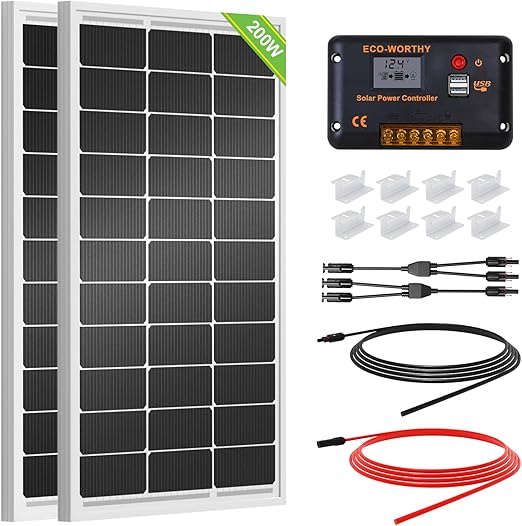
This is the workhorse of the Eco-worthy lineup. The 200W, 24V configuration is standard for off-grid systems that run 24-volt inverters and battery banks. The panel uses monocrystalline silicon cells with a 22% efficiency rating, which is competitive for panels in this price range. The aluminum frame is powder-coated for UV and rust resistance, and it can withstand wind loads up to 2400 Pa (about 50 mph sustained winds).
Installation is straightforward. The panel comes with predrilled mounting holes and a junction box on the back. Most users report that wiring to a 24V battery system takes less than an hour. The MC4 connectors are standard, so you can integrate this with other equipment without compatibility issues.
Real-world output varies, but in good sun (4-5 peak sun hours), expect around 800-1000Wh per day. In partial shade or winter conditions, output drops to 40-60% of the rated capacity, which is normal for solar panels. The 25-year performance warranty covers degradation beyond 0.7% per year.
One trade-off: this panel weighs about 42 pounds, so installation on a roof requires proper mounting hardware and safety precautions. Ground mounting or pole mounting is simpler if you have the space.
Features
- 200W rated power, 24V nominal voltage
- Monocrystalline cells, 22% efficiency
- Aluminum frame with powder-coat finish
- MC4 connectors for easy integration
- 25-year performance warranty
- Rated for 50 mph wind loads
- Excellent output per dollar
- Heavy-duty construction for harsh climates
- Proven track record in off-grid systems
- 25-year warranty
- Heavy (42 lbs)—roof mounting requires care
- 24V configuration limits inverter compatibility (though 12V and 48V options exist)
- Output sensitive to partial shading
2. Eco-Worthy 100W 12V Monocrystalline Panel
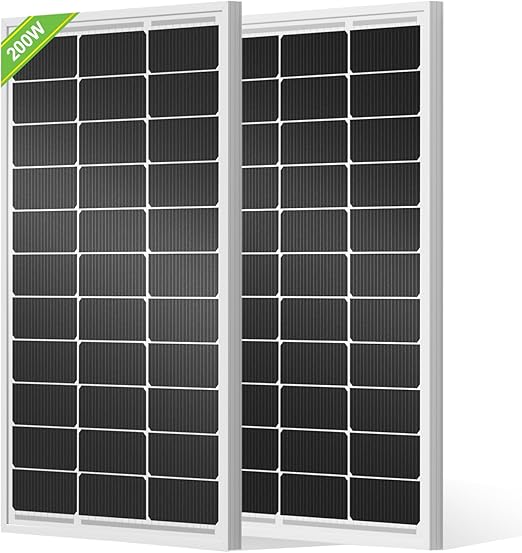
The 100W, 12V panel is Eco-worthy’s entry point for RV and small cabin systems. If you’re charging a 12V lithium battery, running a small inverter, or powering isolated loads, this panel delivers dependable performance at a lower price point than the 200W model.
At 100W, you’re looking at roughly 400-500Wh per day in good conditions. That’s enough to keep a small battery bank topped off during the day and power basic cabin needs (lighting, small appliances, water pumps). For a one- or two-person RV, paired with a quality battery, this is a solid starting point.
The panel is lighter than the 200W (about 21 pounds), making it easier to install on RV roofs without extra reinforcement. The same monocrystalline technology and powder-coated frame apply here, and it comes with the same 25-year warranty.
Output characteristics are similar to the 200W—you get good mid-day production, but output drops in winter or cloudy conditions. The key difference is scale: you can add more 100W panels in parallel to scale up your system, which gives you flexibility.
Features
- 100W rated power, 12V nominal
- Monocrystalline cells, 21% efficiency
- Lightweight design (21 lbs)
- MC4 connectors included
- 25-year performance warranty
- Lightweight, RV-friendly
- Lower price than 200W
- Easy to scale (add more in parallel)
- Proven reliability
- Lower absolute output (half of the 200W)
- May require multiple units for larger systems
- Still temperature-dependent like all panels
3. Eco-Worthy 300W 24V Monocrystalline Panel
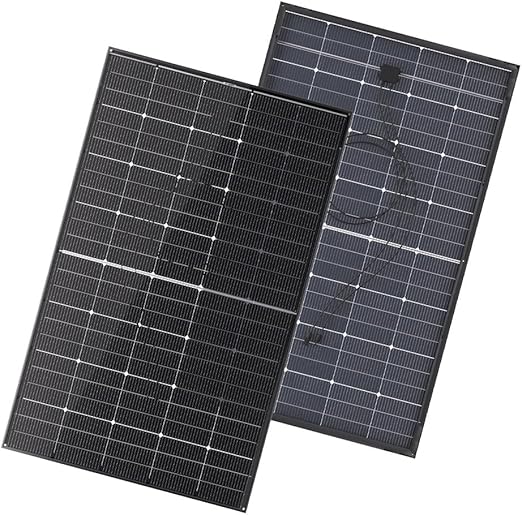
Stepping up to 300W gets you into the territory of medium-sized off-grid installations. A single 300W panel in good sun can generate 1200-1500Wh per day, which is enough to power most cabin loads without battery drain. This is Eco-worthy’s middle-ground option.
The panel is physically larger (about 64 x 39 inches) and heavier (around 60 pounds), so secure mounting and proper support are essential. The same monocrystalline technology applies, with a 22% efficiency rating and 25-year warranty. The bigger frame means more robust construction—the wind rating goes up to 2800 Pa, and snow load capacity increases proportionally.
This is a good choice if you’re planning to build an off-grid system for a small residential cabin, a larger RV with heavy power demands, or a hybrid grid-tie system where you want to offset daytime consumption. Two 300W panels in series would give you 600W of power, roughly equivalent to a typical home solar kit starter system.
One consideration: not all charge controllers and inverters are designed for 300W input. Check your system’s specifications before ordering—you may need a higher-capacity MPPT charge controller than what ships with basic packages.
Features
- 300W rated power, 24V nominal
- Monocrystalline, 22% efficiency
- Large aluminum frame, 60 lbs
- Higher wind/snow load ratings
- MC4 connectors
- 25-year warranty
- Strong daily output (1200-1500Wh)
- Good value per watt
- Robust frame for rough terrain
- Proven in cabin/RV builds
- Heavy—needs strong roof or ground mount
- May require upgraded charge controller
- Overkill for small RV or portable use
4. Eco-Worthy 400W 48V Monocrystalline Panel
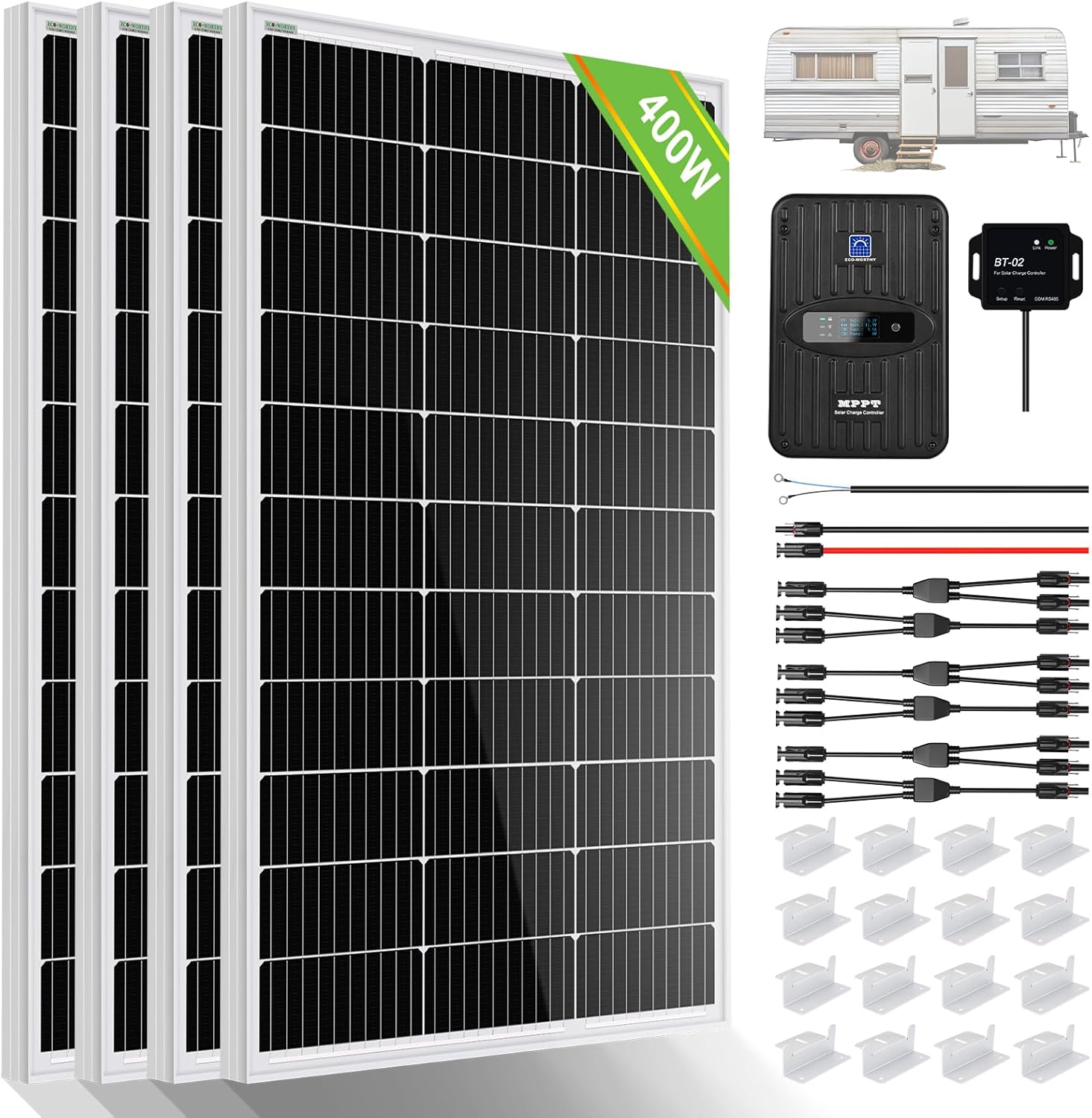
For serious off-grid installations, the 400W, 48V panel is Eco-worthy’s top offering. At 400W, you’re generating 1600-2000Wh per day in good sun. Two or three of these panels can power a full household or large RV without supplemental power.
The 48V configuration is standard for higher-power systems because it allows smaller wire gauges and lower current losses over long cable runs. If you’re building a system with lithium batteries and a 48V inverter, these panels integrate cleanly.
The panel is large (about 77 x 39 inches) and heavy (roughly 65 pounds), so you absolutely need secure, professional mounting. Wind and snow load ratings are the highest in the Eco-worthy lineup, making this suitable for snowy climates and windy locations.
Cost-per-watt is competitive, and the 25-year warranty covers long-term reliability. This is the panel to choose if you’re serious about energy independence and can justify the upfront investment.
Features
- 400W rated power, 48V nominal
- Monocrystalline, 22% efficiency
- Largest frame with enhanced durability
- Highest wind/snow load ratings
- MC4 connectors, 25-year warranty
- Highest daily output (1600-2000Wh)
- Excellent for 48V systems
- Professional-grade durability
- Best cost-per-watt at scale
- Heavy and large—professional installation recommended
- Overkill for small systems
- Requires 48V system setup
5. Eco-Worthy 150W 12V Monocrystalline Panel

The 150W, 12V panel sits between the 100W and 200W options, giving you roughly 600-750Wh daily output. This size makes sense if you have a two-person RV with moderate power needs or a small cabin that can get by on 150W generation.
Weight is around 30 pounds, still manageable for RV roof mounting. The monocrystalline technology, MC4 connectors, and 25-year warranty are standard across the Eco-worthy line. This is a flexible choice for systems that are growing gradually.
Pros: mid-range price, lighter than 200W, scalable. Cons: less output than 200W per panel, still requires quality mounting hardware.
Features
- 150W, 12V nominal
- Monocrystalline, 21% efficiency
- 30 lbs, RV-friendly
- 25-year warranty
- Good middle ground
- Lighter than 200W
- Affordable scaling
- Not much cheaper than 200W
- Less daily output
- Narrow use case
6. Eco-Worthy 250W 24V Monocrystalline Panel
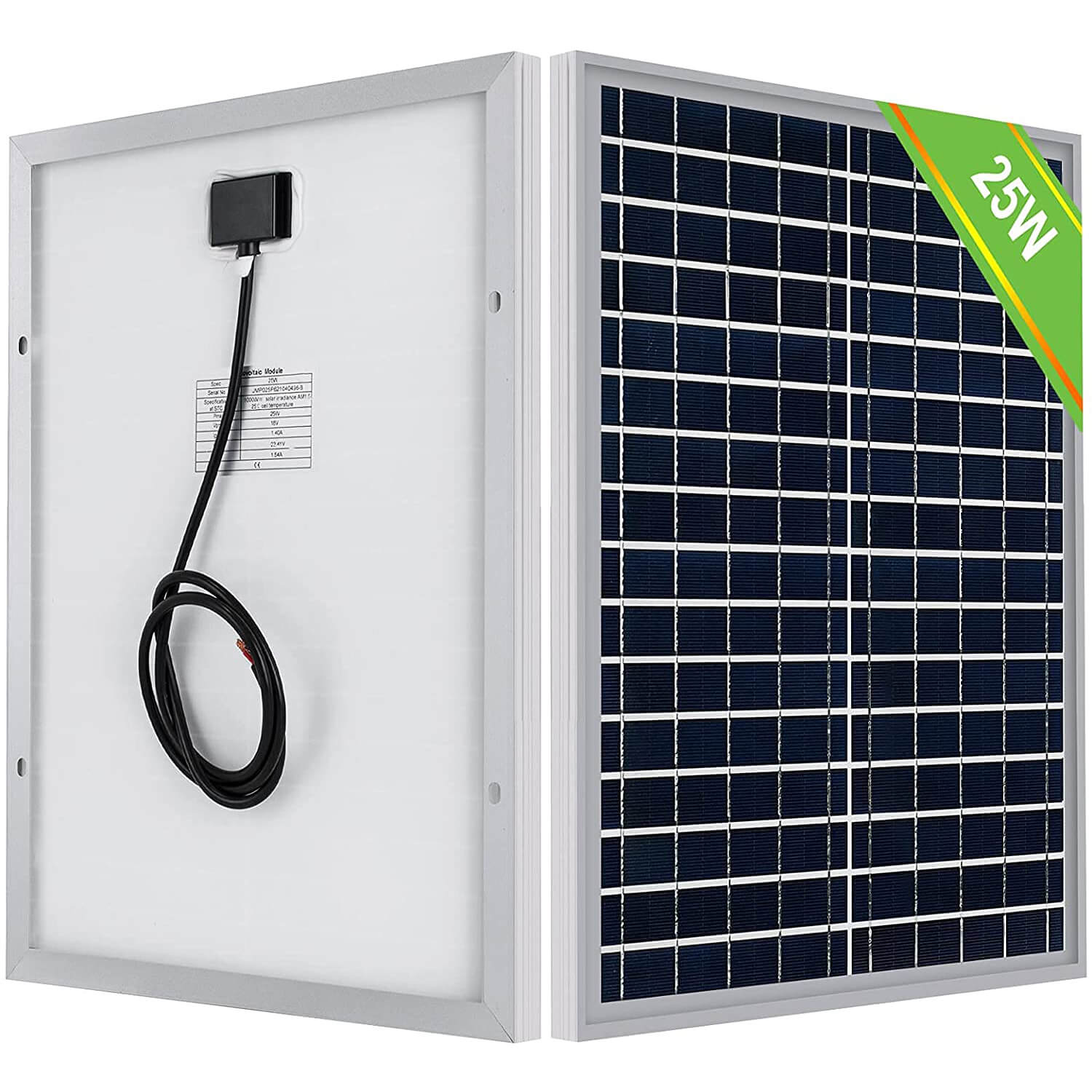
The 250W, 24V model fills a gap for systems that need more than 200W but not quite 300W. Output runs about 1000-1200Wh daily. This is a practical choice for a cabin system that’s somewhere between “minimal” and “comfortable.” Weight is around 50 pounds, so roof mounting is possible but needs proper support. The monocrystalline build and 25-year warranty apply.
Features
- 250W, 24V nominal
- Monocrystalline, 22% efficiency
- 50 lbs, medium size
- 25-year warranty
- Good intermediate size
- Solid daily output
- Mid-range price
- Medium weight still requires secure mount
- Niche sizing (many skip to 300W)
7. Eco-Worthy 200W 48V Monocrystalline Panel
If you’re building a 48V system but don’t need the full 400W yet, the 200W, 48V offers a way to start smaller and scale up. Output is around 800-1000Wh daily. This is less common than the 24V and 12V versions but available for users committed to the 48V architecture.
Features
- 200W, 48V nominal
- Monocrystalline, 22% efficiency
- 42 lbs, aluminum frame
- 25-year warranty
- Good for 48V starter systems
- Can stack with 400W for scaling
- Niche voltage—less common than 24V
- Fewer compatible charge controllers
8. Eco-Worthy 50W 12V Monocrystalline Panel
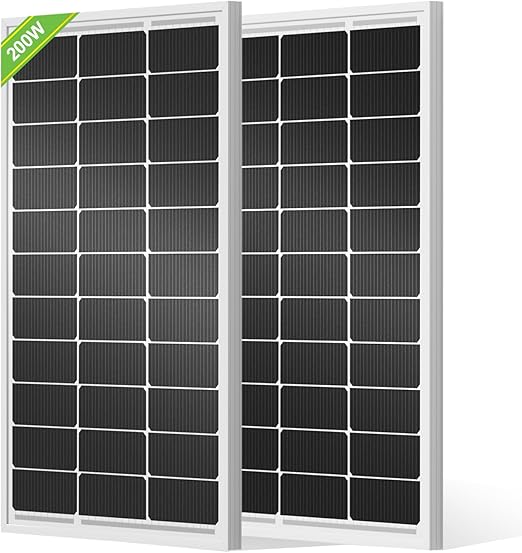
The 50W, 12V is Eco-worthy’s entry-level panel for small projects—portable solar chargers, tiny RVs, or hobby systems. At 50W, expect roughly 200-250Wh daily. It’s lightweight (about 10 pounds) and compact (roughly 22 x 20 inches). Not powerful, but great for learning or supplementing a larger system.
Features
- 50W, 12V nominal
- Monocrystalline, 20% efficiency
- 10 lbs, portable size
- 25-year warranty
- Lightweight and portable
- Very affordable
- Beginner-friendly
- Low output—not for real installations
- Limited practical use for cabins/RVs
Eco-Worthy Solar Panels Buying Guide
ECO-WORTHY Panel Cell Technology: What Mono, Poly, and LiFePO4 Kits Mean
ECO-WORTHY’s product lineup spans monocrystalline and polycrystalline solar panels alongside complete kits that bundle panels with batteries, inverters, and charge controllers. Monocrystalline panels — ECO-WORTHY’s primary product line — use single-crystal silicon cells that achieve 20–23% efficiency, outperforming polycrystalline by 3–5 efficiency points. ECO-WORTHY discontinued most of their polycrystalline lines in 2022–2023, aligning with industry-wide shifts away from the lower-efficiency technology. For kit buyers, understanding which battery chemistry the kit uses matters as much as panel wattage: ECO-WORTHY offers both sealed lead-acid and LiFePO4 battery kits at significant price differences. LiFePO4 chemistry provides 2,000+ cycle life (compared to 300–500 for lead-acid), performs in cold weather, requires no maintenance, and charges/discharges more efficiently — making it the superior choice for any off-grid application requiring daily cycling. Lead-acid kits cost less upfront but have substantially higher cost per cycle over their lifespan. For most buyers, the premium for LiFePO4 pays back within 3–4 years of regular use.
Wattage Selection: Matching Panel Size to Your Energy Needs
ECO-WORTHY offers panels and kits from 10W to 600W per unit, and selecting the right wattage requires calculating your actual daily energy consumption rather than guessing. The starting calculation: total the watt-hours consumed by each device per day (watts × hours of use). A 12V refrigerator running 24 hours at 50W average consumes 1,200Wh/day. A USB charging station using 10W for 4 hours consumes 40Wh. Add all devices, multiply by 1.25 (system efficiency losses), then divide by your average peak sun hours to get required panel watts. In a 5 peak-sun-hour location, a 1,500Wh daily consumption requires 1,500 × 1.25 ÷ 5 = 375W of panel capacity. This calculation gets you to the right order of magnitude; real-world energy audits often reveal consumption significantly higher than initial estimates once all devices are counted. ECO-WORTHY’s kit configurations are pre-sized for common applications (RV, cabin, boat) — but always verify the included kit wattage against your calculated consumption before purchasing, as the standard sizing assumptions may not match your actual usage.
Complete Kit vs. Panel-Only: Which Makes More Sense?
ECO-WORTHY sells panels standalone or as complete kits including charge controller, wiring, mounting hardware, and in some configurations, a battery and inverter. Complete kits offer component compatibility certainty — you know the charge controller is rated for the panel wattage, the wiring gauge is correct for the current, and the system has been designed as a unit. This is valuable for buyers without electrical background who might otherwise mismatch components. Panel-only purchases make sense for upgrading an existing system (adding capacity to a functioning installation), for experienced buyers who prefer to select their own charge controller and battery, or for grid-tied applications where panels connect to a grid-tie inverter rather than a standalone battery system. When comparing kit pricing to building the same system from individual components, kits often represent modest savings plus the convenience of single-source purchasing — but the savings are rarely dramatic, as the included components are standard market items.
MPPT vs. PWM Charge Controllers: Understanding the Difference
ECO-WORTHY bundles both MPPT (Maximum Power Point Tracking) and PWM (Pulse Width Modulation) charge controllers in different kit configurations, and the distinction significantly affects system efficiency. PWM controllers are simpler and cheaper, essentially functioning as a switch between the panel and battery. They work adequately in matched-voltage systems (12V panel into 12V battery, 24V panel into 24V battery) but cannot harvest energy from higher-voltage panels efficiently. MPPT controllers are sophisticated DC-DC converters that continuously adjust to extract maximum power from the panel regardless of battery state of charge. In practice, MPPT controllers improve energy harvest by 20–30% compared to PWM — a meaningful gain in off-grid applications where every watt-hour matters. For any ECO-WORTHY kit over 200W, or for systems where the panel voltage significantly exceeds the battery voltage, MPPT is strongly preferable. ECO-WORTHY’s MPPT controllers also provide more detailed monitoring data than PWM units, which helps with system troubleshooting and optimization.
Mounting and Structural Considerations for ECO-WORTHY Panels
ECO-WORTHY panels include a standard aluminum frame with pre-drilled mounting holes, compatible with most residential and RV racking systems. For roof installations, ensure the racking system is designed for the panel’s weight (typically 2–4 lbs per square foot) and your local wind and snow load requirements — ECO-WORTHY’s standard residential panels are rated to withstand 5,400 Pa wind load and 2,400 Pa snow load, adequate for most US regions but check against local building codes for high-wind or heavy-snow areas. For RV and van installations, a common ECO-WORTHY application, panels are typically mounted flat on the roof rather than tilted — this reduces aerodynamic drag at highway speeds but sacrifices production efficiency at low sun angles. Flexible ECO-WORTHY panels (where available) allow curved surface mounting on curved RV roofs, boats, or cargo trailers. Ground mount frames are available as separate ECO-WORTHY accessories and allow optimal tilt angle for your latitude — typically latitude +5° for year-round performance, or a steeper angle for winter-optimized operation.
Off-Grid System Design: Series vs. Parallel Panel Wiring
Connecting multiple ECO-WORTHY panels requires choosing between series wiring (which adds voltage while keeping current constant) or parallel wiring (which adds current while keeping voltage constant). The choice is determined by your charge controller’s input voltage range and optimal operating voltage. For MPPT controllers designed for 24V or 48V battery banks, wiring panels in series to reach 36–80V input allows the MPPT controller to efficiently step down voltage while maximizing current — an efficient configuration for larger systems. For PWM controllers and 12V systems, parallel wiring keeps panel voltage at the 12V level the PWM needs to function. Series-parallel combinations (some strings in series, connected in parallel) achieve both higher voltage and higher current, useful for large 48V systems. ECO-WORTHY’s product documentation includes wiring diagrams for their recommended configurations, but understanding the fundamentals prevents errors when adapting to non-standard setups or when adding panels to an existing ECO-WORTHY installation.
Warranty, Customer Support, and Long-Term Reliability
ECO-WORTHY offers a 5-year material warranty and 25-year power output warranty on their panels — the industry standard for residential-grade products. The 25-year performance warranty guarantees panels produce at least 80% of rated output after 25 years, with a linear degradation rate of about 0.7% per year from year 2 onward. As a China-based manufacturer with direct-to-consumer US sales through Amazon and their own website, ECO-WORTHY’s customer support is primarily email and chat — faster than typical overseas brands but slower than US-based manufacturers with call centers. Warranty claims for defective panels are generally handled via replacement shipment rather than on-site service. User reviews indicate that panel quality is consistent within batches, but occasional manufacturing defects (cell delamination, junction box sealing failures) do occur — monitor newly installed panels for the first few months and document any issues with photos to streamline warranty claims. For installations where system downtime is costly, keeping a spare panel on hand provides faster recovery than waiting for a warranty replacement to ship.
Eco-Worthy vs. Other Brands
- Eco-Worthy vs. Renogy: Both are popular for off-grid. Eco-worthy is cheaper; Renogy has slightly higher efficiency and better US support.
- Eco-Worthy vs. Newpowa: Similar price and specs. Newpowa may have better documentation; Eco-worthy has more model variety.
- Eco-Worthy vs. Premium Brands (SunPower, LG): Eco-worthy is half the price but 10-15% lower efficiency. For off-grid and DIY, the price difference justifies lower efficiency.
Frequently Asked Questions
How long do Eco-worthy panels last?
Eco-worthy panels are warrantied for 25 years and should last 30-40 years in good conditions. The main failure points are junction box sealing (can crack if panels are dropped) and connector corrosion in very humid climates. Proper mounting and ventilation extend lifespan.
Can I combine Eco-worthy panels with other brands?
Yes, as long as the voltages match. You can mix 24V panels from different manufacturers in series or parallel. Mix-and-match wattages work fine in parallel (with proper blocking diodes), but it’s not recommended because lower-wattage panels become bottlenecks in series configurations.
Do Eco-worthy panels come with mounting brackets?
No, they come with predrilled holes but no brackets. You need to source your own aluminum L-brackets or racking system. This is typical for panels in this price range.
What’s the best angle for Eco-worthy panels?
Mount at your latitude angle for year-round balance, or tilt steeper (latitude +15°) in winter and shallower (latitude -15°) in summer. For off-grid systems that prioritize winter, a steeper angle is usually better. Ground-mounted systems are easier to adjust seasonally than roof-mounted.
Are Eco-worthy panels good for cloudy climates?
Yes, monocrystalline panels work reasonably well in cloudy and overcast conditions. Output drops to 40-60% of rated in light cloud, but they still generate usable power. If you live in a very cloudy region, size your system larger (add more panels) to compensate.
Summing Up
Eco-worthy solar panels deliver solid performance for off-grid, RV, and cabin installations. Their range from 50W to 400W covers most DIY use cases, and the 24V and 48V options integrate well with standard off-grid components. The 25-year warranty and monocrystalline technology make them a reliable choice for long-term systems. If you’re budget-conscious and willing to handle your own installation, Eco-worthy panels are a smart buy. For professional roof installations or grid-tie systems, you’ll likely want to look at premium brands, but for off-grid independence, Eco-worthy is a proven workhorse.
If you’re also thinking about solar panels for your home, call (855) 427-0058 for a free quote — it takes just a few minutes to find out what installation would cost and save you in your area.
Updated