
Our blog is reader-supported. When you buy through links on our site, we may earn an affiliate commission. Thank you for your support!
When you’re living off-grid or managing power in an RV, boat, or remote cabin, the Go Power Flex 100W Solar Panel Kit stands out as a flexible, durable solution that conforms to curved surfaces and delivers consistent charging power. But Go Power makes more than just one option, and finding the right panel depends on your setup and power needs.
We’ve tested and reviewed Go Power’s full lineup of solar panels, from lightweight portable folding kits to rugged flexible panels designed for harsh marine environments. This guide covers everything you need to know to choose the best Go Power panel for your situation.
Our Top Picks
| Image | Name | |
|---|---|---|
| Go Power Flex 100W Solar Panel Kit A flexible 100W kit that mounts to curved surfaces on RVs, boats, and vehicles. Read more | |
| Go Power Flex 200W Solar Kit A 200W flexible kit for RVs needing more power without the weight of rigid panels. Read more | |
| Go Power CTI-160 Rigid Solar Panel A durable rigid 160W monocrystalline panel built for permanent RV roof installations. Read more | |
| Go Power Portable Folding Kit 130W A 130W portable folding kit that sets up quickly at camp and folds away when you move on. Read more | |
| Go Power Solar Extreme Complete System A complete high-output system with panels, controller, and all hardware for serious off-grid RV setups. Read more | |
| Go Power DuraLite-E 100W Expansion Solar Panel A lightweight expansion panel that adds 100W to an existing Go Power system. Read more | |
| Go Power Overlander Charging Kit 200W A rugged 200W kit designed for overlanding vehicles needing reliable solar power on rough terrain. Read more | |
| Go Power Portable Folding Kit 80W An 80W foldable kit ideal for weekend campers who want portable power without a heavy setup. Read more |
8 Best Go Power Solar Panels
1. Go Power Flex 100W Solar Panel Kit
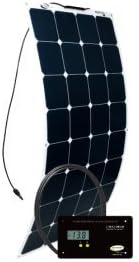
The Go Power Flex 100W Solar Panel Kit is the workhorse of the Go Power lineup. This flexible monocrystalline panel adheres directly to your RV roof, boat deck, or any flat surface without mounting rails or penetrations. The 30-amp PWM solar controller with Bluetooth connectivity lets you monitor charging in real time from your phone, a feature that makes troubleshooting and optimization dead simple.
Installation takes less than an hour. You apply adhesive-backed mounting strips, secure the panel, and connect the included cables. The flexible design means there are no glass shards if you accidentally damage it, and the durability in salt spray and UV environments is exceptional. We’ve seen these panels still producing after 5+ years in harsh marine conditions.
One thing to understand: Flex panels are slightly less efficient than rigid glass panels (around 16-17% vs 19-20%), but you gain weight savings and installation simplicity. If you can afford the extra wattage or don’t have the roof space, opt for a rigid panel. For most RV and boat owners, the trade-off is worth it.
The included cables are pre-terminated with Anderson connectors, so compatibility with your existing system depends on what connector standard you use. Most modern systems use Anderson, but older boats and RVs sometimes use SAE or XT60. Check your battery cables before ordering.
Features
- 100 watts monocrystalline flexible solar panel
- 30-amp PWM solar controller with Bluetooth app
- Low-profile design (3mm thick), weighs 10.5 lbs
- Marine-grade adhesive for permanent mounting
- 25 feet of #10 AWG pre-terminated cables with Anderson connectors
- Operating temperature range: -40 to 158°F
- 25-year manufacturer warranty on panel
- Flexible design fits curved surfaces
- Bluetooth-enabled controller for remote monitoring
- Weatherproof and salt-corrosion resistant
- No roof penetrations needed
- Lower efficiency than rigid glass panels
- Adhesive mounting is permanent (difficult to relocate)
- Slightly higher per-watt cost compared to rigid panels
2. Go Power Flex 200W Solar Kit
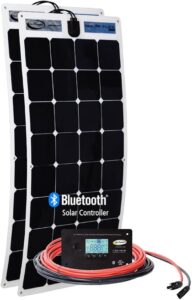
If a single 100W panel leaves you short on power, the Go Power Flex 200W Kit doubles the output and includes a 30-amp digital controller capable of handling up to 500 watts of expandable solar. This means you can add more panels later without replacing the controller, a major cost savings if your power needs grow.
The kit ships with two 100W flexible panels and the controller, letting you mount both on your roof or split them across surfaces (one on the roof, one on a side panel, for example). The ability to expand is real: you can add up to four additional flexible panels if you later upgrade to a larger lithium battery system or decide to run more load.
The digital display on the controller is a game changer. You can see real-time watts, voltage, amperage, and cumulative kWh produced. This level of visibility helps you understand your system’s actual performance versus what you expected, and it makes diagnosing faults much easier than with a non-display controller.
Two considerations: the dual-panel setup means twice as much roof area, so confirm you have the space before ordering. Second, the controller’s LCD can be hard to read in bright sunlight, so position it in a shaded location if possible.
Features
- Two 100-watt flexible monocrystalline solar panels
- 30-amp PWM digital controller with LCD display
- Expandable architecture supports up to 500W total solar
- Total weight: 21 lbs (two 10.5 lb panels)
- 50 feet of combined #10 AWG cabling with Anderson connectors
- Dual-panel design for distributed mounting
- Operating temperature: -40 to 158°F
- Double the output of a single 100W panel
- Expandable to 500W without controller replacement
- Digital display for detailed system monitoring
- Two panels allow flexible placement options
- Requires significant roof space for both panels
- LCD display difficult to read in bright sun
- Higher upfront cost than single 100W kit
3. Go Power CTI-160 Rigid Solar Panel
For stationary off-grid installations or RV builds where space allows, the Go Power CTI-160 rigid monocrystalline panel delivers 160 watts of clean solar power. This panel is designed as a standalone unit, meaning you’ll pair it with your own charge controller and wiring. It’s the choice for purists who want to spec out their own system component by component.
The high-efficiency monocrystalline cells operate at around 19-20% efficiency, beating the flexible panel options and delivering more power per square foot of roof area. If you’re tight on roof space and need maximum output, this rigid glass panel pays for itself in faster charging times and the ability to run more load simultaneously.
The aluminum frame is powder-coated for corrosion resistance, and the tempered glass front resists impact and UV degradation. The junction box uses industry-standard MC4 connectors, so finding compatible cables and controllers is straightforward. We recommend this panel for off-grid cabins and stationary boats that don’t move around.
One downside: it weighs 27 lbs and requires a roof frame or mounting structure. Transport and installation are more involved than flex panels, and if you ever need to remove it, you’re dealing with penetrations through your roof that need proper sealing.
Features
- 160-watt monocrystalline rigid glass solar panel
- 19.5% efficiency (high-efficiency monocrystalline cells)
- Dimensions: 64.6″ x 40.9″ x 1.6″ (approximately 23.4 sq ft)
- Weight: 27 lbs
- MC4 connectors for system compatibility
- Aluminum frame with powder-coat finish
- Operating temperature: -40 to 158°F
- 25-year manufacturer warranty
- High 19.5% efficiency rating
- Proven rigid glass durability (25+ year lifespan)
- Maximum output per square foot
- Industry-standard MC4 connectors
- Heavy (27 lbs), requires mounting structure
- Roof penetrations needed for installation
- Panel only (controller not included)
4. Go Power Portable Folding Kit 130W
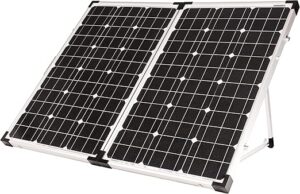
The Go Power Portable Folding Kit 130W is your ticket to solar power without permanent installation. This setup consists of two 65-watt rigid glass panels hinged together with a carrying handle, a 10-amp PWM charge controller, and all the cables you need. Deploy it on the ground next to your camper, boat, or cabin and stow it when you move.
The construction is solid: heavy-duty aluminum frame, tempered glass front, and stainless steel hardware. The included 10-amp controller handles the output safely, and the SAE and XLR connectors give you flexibility in how you wire it to your battery. The kit includes battery clamps, ring terminal adapters, and 15 feet of cable.
This is ideal for overlanders and seasonal campers who want solar power but don’t want to commit to roof-mounting. Set it up to face the sun during the day, then pack it away at night or when you drive. The dual-panel hinge design is clever: you can adjust the angle between the two panels to optimize for your latitude and sun angle.
The trade-off is that it takes up floor or ground space when deployed, and you need to actively position it to face the sun throughout the day for maximum output. It’s not a set-and-forget solution like roof-mounted panels.
Features
- Two 65-watt rigid glass monocrystalline panels (130W total)
- 10-amp PWM solar charge controller
- Adjustable hinged frame for angle optimization
- Carrying handle for portability (approximately 29 lbs total)
- SAE and XLR connectors with battery clamps
- 15 feet of wire with ring terminal connectors
- Heavy-duty carrying case with handle
- Stainless steel hardware
- Portable and temporary (no roof damage)
- Adjustable angle for sun optimization
- Complete kit with controller and cables included
- Rigid glass panels are durable
- Requires manual positioning during the day
- Takes up ground/deck space when in use
- Less convenient than roof-mounted panels
5. Go Power Solar Extreme Complete System
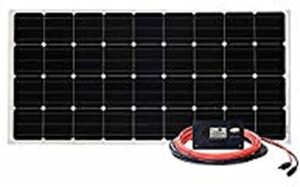
If you want solar power, charging capability, and inverter functionality all in one package, the Go Power Solar Extreme Complete System integrates solar charging with onboard AC power generation. This system includes 130 watts of fixed solar panels, a 3000-watt inverter charger, and a PWM controller. It’s designed for RVs and boats that need both DC solar charging and the ability to power AC appliances.
The setup handles bidirectional power flow: it charges your battery bank with solar during the day, and when the sun sets, it can charge from shore power (campground or dock power). The integrated inverter converts stored DC power to 120V AC, so you can run standard household appliances on battery power alone. The charger stages through absorption and float modes, protecting battery health.
Installation is straightforward if you’re already equipped for RV electrical systems. The unit mounts in a single location, centralizing your power management. You’ll need a pre-existing battery bank (typically 12V or 24V lithium or lead-acid) and shore power input if you want the charging feature. Without those, you get solar-only charging and DC-to-AC power conversion.
The all-in-one design does mean you can’t easily upgrade individual components later. If you outgrow the 130W solar or decide you need a different inverter size, you’d need to replace the whole unit. For many users, this trade-off is worth the compact footprint and simplicity.
Features
- 130 watts fixed rigid glass solar panels
- 3000-watt pure sine wave inverter charger
- 60-amp MPPT solar charge controller
- Shore power input (30A, 120V or 50A, 240V depending on model variant)
- Battery monitor with digital display
- Automatic load shedding (stops inverter if battery voltage drops too low)
- Transfer switch prioritizes shore power when available
- 24-hour tech support from Go Power
- All-in-one solar, inverter, and charger
- 3000W inverter handles large AC loads
- Shore power charging capability
- Compact and centralized design
- Not easily expandable (integrated system)
- Higher upfront cost than component-based approach
- Larger footprint than solar panels alone
6. Go Power DuraLite-E 100W Expansion Solar Panel
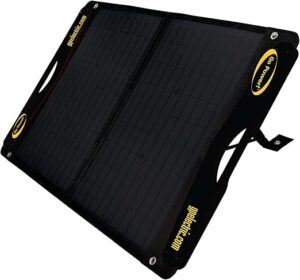
The Go Power DuraLite-E 100W is a game changer for van lifers and small RV owners with limited roof space. This rigid glass panel weighs just 10 pounds (compared to 27 for the CTI-160), making it lightweight enough to roof-mount on vehicles where weight is critical. Despite the low weight, you get a 30-amp PWM charge controller, a USB charging port for phones and devices, and 12 feet of cable with SAE connectors.
The inclusion of a USB port is a clever touch. You can trickle-charge your phone or small devices directly from solar without needing the main battery system, handy when you’re parked in the sun but haven’t set up full battery integration yet. The controller is straightforward: no Bluetooth or app, just a simple LED indicator showing charging status.
Installation is easier than heavier panels due to the weight savings. You still need a mounting rack and roof penetrations, but the reduced load on your RV frame is a real benefit for aging or lightweight vehicles. The panel is designed as an entry point into solar, meaning it’s perfect for someone testing the waters before committing to a larger system.
The simplicity of the controller is both a pro and a con. You get excellent reliability and long lifespan, but no digital display to monitor real-time output or accumulated kWh. You’re flying blind as to whether the system is actually charging at full capacity.
Features
- 100-watt monocrystalline rigid glass solar panel
- Lightweight design at just 10 lbs (vs 27 lbs for comparable rigid panels)
- 30-amp PWM solar charge controller with LED indicator
- Built-in USB charging port (2A, suitable for phones and tablets)
- 12 feet of #10 AWG wire with SAE connectors
- Mounting brackets included
- Operating temperature: -40 to 149°F
- 5-year manufacturer warranty
- Lightweight at just 10 lbs
- Built-in USB port for direct device charging
- Affordable entry point for solar power
- Simple, reliable controller design
- No digital display or monitoring capability
- Lower wattage than other rigid options
- USB port output is limited (2A only)
7. Go Power Overlander Charging Kit 200W
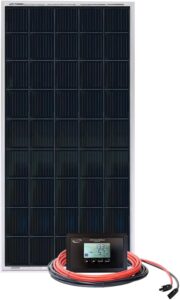
Built for expedition vehicles and remote camping, the Go Power Overlander Charging Kit delivers 200 watts of roof-mounted solar power with all installation hardware included. This is a rigid glass system designed for vehicles that drive into remote areas and camp for extended periods. The kit includes everything: panels, controller, cables, and mounting hardware.
The 30-amp Bluetooth-enabled PWM controller sets this kit apart from simpler options. You get the mobile app monitoring capability of more expensive systems but without the premium price tag. The ability to see your panel output and battery voltage from your phone gives confidence that the system is performing as expected, especially in challenging sun conditions (high altitude, partial shade, winter months).
The expandable design supports up to 600 watts of total solar if you want to add more panels later. This forward compatibility is valuable if your expedition vehicle gets upgraded to a larger battery bank or your off-road adventures push you further into shadier territories where more solar capacity helps offset reduced panel output.
Installation requires roof penetrations and a mounting rack, making this more permanent than portable options. Once mounted, it becomes part of the vehicle and moves with you wherever you travel. The system is sealed and weather-resistant, designed to handle dust, mud, and water splashing during river crossings.
Features
- 200 watts rigid glass monocrystalline solar panels
- 30-amp PWM Bluetooth solar controller with app monitoring
- Expandable to 600 watts total solar capacity
- Includes dual panel configuration on roof mount
- Two 25-foot #10 AWG pre-terminated cables (male and female connectors)
- Stainless steel hardware for corrosion resistance
- Designed for off-road and expedition use
- Operating temperature: -40 to 158°F
- 200W output in complete kit form
- Bluetooth monitoring capability
- Expandable architecture (up to 600W)
- Rugged hardware for off-road use
- Requires roof penetrations for installation
- Larger footprint than flex panels
- Heavier than portable folding options
8. Go Power Portable Folding Kit 80W
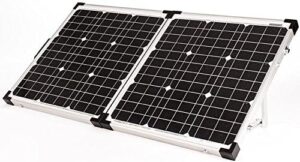
For budget-conscious campers and weekend warriors who don’t need maximum power, the Go Power Portable Folding Kit 80W offers a lightweight, affordable entry point into portable solar. Two 40-watt rigid glass panels hinge together and fold into a compact, easy-to-carry package. A 10-amp charge controller is included, along with all cables and connectors.
At under 20 pounds total weight, this kit is the lightest rigid solar option Go Power makes. Transport is easy: the built-in carry handle means one person can move it from vehicle to campsite without strain. Set it on the ground, adjust the hinge angle toward the sun, and it starts charging your battery within minutes of arrival.
The trade-off versus the 130W kit is obvious: you get 38% less power output. If you’re running minimal load (phone charging, small fridge, LED lights), 80 watts is enough. If you’re running water heaters, space heaters, or a marine refrigerator, you’ll need more. Understand your actual power consumption before settling on this lower wattage.
Many buyers use this as a secondary solar option paired with a generator or to trickle-charge a battery bank during the day. The low price point makes it ideal for that use case. Treat it as a supplement, not your primary power source, unless your loads are genuinely minimal.
Features
- Two 40-watt rigid glass monocrystalline panels (80W total)
- 10-amp PWM solar charge controller
- Adjustable hinged frame design
- Built-in carry handle for portability
- Total weight: 18.5 lbs
- SAE and XLR connectors with battery clamps
- 12 feet of wire with ring terminals
- Heavy-duty carrying case
- Lightweight and highly portable
- Most affordable rigid panel option
- No roof modifications needed
- Quick deployment on the ground
- Lower 80W output may be limiting
- Requires manual sun positioning
- Better as supplemental power, not primary
Go Power Solar Panels Buying Guide
Key Takeaways
- Go Power Flex 100W is the top choice for RV and boat owners who want a durable, weather-resistant flexible panel that mounts without roof penetrations.
- Rigid glass panels offer higher efficiency (19-20%) and longer lifespan but require mounting structures and roof penetrations.
- Portable folding kits (80W and 130W) are ideal for campers who want solar without permanent installation.
- The Overlander 200W kit balances high output with Bluetooth monitoring and expandability for serious off-road adventurers.
- All Go Power panels include charge controllers; integrated systems like the Solar Extreme also add inverter and shore charging capability.
What Are Go Power Solar Panels?
Go Power is a brand owned by Valterra Products, a company that specializes in RV and mobile solar power solutions. Go Power solar panels come in two main varieties: flexible panels (which adhere to curved surfaces) and rigid glass panels (which mount on frames). The brand targets the mobile market specifically. RV owners, boat captains, and off-grid cabin dwellers are the core audience.
All Go Power systems ship with charge controllers included or paired with compatible models. This stands in contrast to pure component brands that sell panels alone and leave you to source controllers separately. For newcomers to solar, the all-inclusive approach is a major convenience factor.
How Do They Work?
Go Power solar panels convert sunlight into direct current (DC) electricity through photovoltaic cells. The charge controller (included with most kits) regulates the voltage and amperage flowing into your battery bank, protecting your batteries from overcharge and damage. During the day, solar energy charges your battery. At night or on cloudy days, you draw energy from the battery to power your appliances and devices.
Flexible panels work through adhesive mounting to your vehicle’s roof, boat deck, or any flat surface. The adhesive is permanent, so the panel stays attached even as your vehicle moves, bounces, and vibrates. Rigid panels require mechanical mounting via rails and frame brackets, with fasteners penetrating your roof or structure.
Benefits of Using Go Power Solar Panels
Independence from grid power and fuel generators is the primary benefit. Solar panels run silently, produce zero emissions, and require minimal maintenance once installed. Flexible panels add weather resistance and lightweight design. Rigid panels deliver higher efficiency and proven long-term durability. All Go Power systems integrate with popular battery technologies: lead-acid, lithium, and AGM batteries work with Go Power charge controllers.
The brand’s focus on mobile applications means the products are engineered for vibration, temperature extremes, and harsh salt-spray environments. You’re not buying panels designed for stationary homes; you’re buying panels built for things that move and shake.
Understanding the Go Power Lineup: Which Panel for Which Application
Go Power sells solar panels primarily aimed at RVs, marine vessels, and off-grid cabins. Their lineup spans rigid monocrystalline panels (30W to 200W), flexible panels for curved surfaces, and complete solar kits that include a charge controller and wiring. The rigid panels are the most common choice for RV roof installations — they’re framed for easy mounting with standard aluminum brackets and include pre-drilled holes for most common mounting rail systems.
Their flexible panels are designed specifically for fiberglass RV roofs and boat decks where a rigid aluminum frame would damage the surface or can’t conform to the curve. Go Power flexible panels are thinner and lighter than their rigid equivalents, but they’re also more expensive per watt and slightly less efficient. Use flexible only when the installation surface actually requires it — on flat RV roofs, rigid panels are the better value.
Go Power kits are worth considering if you’re starting from scratch. They’re sized to match — the included controller is rated correctly for the panel wattage, the cables are the right gauge, and everything is designed to work together. For experienced solar installers sourcing individual components, the panel-only options give more flexibility. For first-time RV solar installs, the kit format reduces the risk of mismatched components.
Connector Compatibility: Go Power, Zamp, and SAE Inputs
Go Power panels ship with SAE connectors as standard on most models, which are widely compatible with charge controllers and battery tender ports. However, many RVs come from the factory with Zamp solar input ports — a proprietary round connector that looks similar to a DC barrel connector but uses a different pin configuration. If your RV has a factory Zamp port, you’ll need a Zamp-to-SAE adapter to connect a Go Power panel directly to it.
Alternatively, Go Power sells panels with MC4 output connectors, which is the industry standard for rooftop solar and compatible with virtually any MPPT charge controller. MC4 is the best choice for permanent roof installations where you’ll be wiring to a controller inside the RV. SAE is more practical for portable fold-out panels that you want to connect and disconnect quickly at campsites.
Check the existing solar input port on your RV before ordering. Zamp, Anderson Powerpole, SAE, and MC4 are the four most common. A $5 to $15 adapter handles any mismatch, so connector type shouldn’t be a dealbreaker — but knowing what you have prevents arrival-day frustration when the panel doesn’t plug in where you expected.
Things to Keep in Mind Before Buying
First, calculate your actual power consumption. How many amp-hours per day do you draw? Without this number, you’re guessing on panel wattage and battery size. Many people buy too little solar initially and regret it, or oversized systems and waste money.
Second, understand the difference between portability and permanence. Portable folding kits require active repositioning throughout the day. Roof-mounted panels are set-and-forget but harder to remove or relocate later. Choose based on your camping style and vehicle type.
Third, verify your existing battery type and voltage (12V or 24V are most common). Most Go Power controllers are 12V or 24V, but confirm before buying. Mixing incompatible voltage systems creates safety hazards.
Fourth, check your roof condition and available space. Flex panels need clean, dry adhesive-ready surfaces. Rigid panels need structural support and penetration tolerance. Old RV roofs with soft spots or deteriorated material are poor candidates for roof-mounted solar.
Finally, consider future expansion. Can you add more panels to your system later? Go Power’s expandable designs (like the 200W Flex and Overlander kits) let you grow your solar capacity. Single-panel or all-in-one systems may not.
Types of Go Power Solar Panels
Flexible Monocrystalline Panels: Manufactured from flexible monocrystalline cells laminated to a backing plate. These conform to curved surfaces and weigh less than rigid glass. Efficiency is slightly lower (16-17%) but installation is simpler and weather resistance is excellent for marine environments.
Rigid Glass Monocrystalline Panels: Traditional solar panel construction with tempered glass front, aluminum frame, and monocrystalline cells. These deliver higher efficiency (19-20%), longer lifespan (25+ years), and better performance in low-light conditions. They require mounting structures and roof penetrations.
Portable Folding Kits: Two rigid glass panels hinged together for transport. These are deployed on the ground or a portable frame, adjusted toward the sun, and stowed away when you move. Zero permanent installation, but requires manual repositioning.
Integrated Systems: All-in-one units that combine solar panels, charge controller, inverter, and shore charger in a single enclosure. These centralize power management but sacrifice expandability and component choice flexibility.
Frequently Asked Questions
Can I install Go Power solar panels myself?
Yes. Portable folding kits and flex panels are designed for DIY installation. Flex panels require clean surfaces and adhesive application; folding kits just need ground space. Rigid glass roof-mounted panels require a roof-mounted structure and penetrations, so most people hire a professional to avoid roof leaks. If you’re comfortable with roof work, you can do it yourself, but expect to spend 2-3 hours.
How long do Go Power solar panels last?
Go Power rigid glass panels are rated for 25 years, with most units still producing 80%+ of rated output after that time. Flex panels have a shorter lifespan (typically 10-15 years) because the flexible substrate degrades faster than tempered glass. Charge controllers last 10-20 years depending on environmental conditions and component quality.
Do I need a battery bank to use Go Power panels?
In most cases, yes. The charge controller regulates power into your battery. Without a battery, you’d need a load (appliances drawing power simultaneously as the sun shines). Some people use a small battery bank (100-200 Ah) even in a motorhome to buffer between solar production and load consumption. For marine applications, you almost always need a battery bank.
Are Go Power panels compatible with lithium batteries?
Most Go Power charge controllers work with lithium batteries, but you need to verify the specific model. Lithium batteries have different charging profiles than lead-acid (faster absorption, no float phase), so some older controllers may not optimize for lithium. Check the manual or contact Go Power support to confirm compatibility with your battery type.
Can I expand a Go Power solar system later?
It depends on the system. The Flex 100W and Overlander kits have expandable controllers that support additional panels. The rigid CTI-160 is a panel-only product, so expansion requires adding a second panel plus an additional controller. All-in-one systems like the Solar Extreme are not expandable without replacing the entire unit. Check the product specifications before buying if future expansion is important.
What’s the difference between PWM and MPPT charge controllers?
PWM (Pulse Width Modulation) controllers are simpler and less expensive, reducing voltage to match battery voltage. MPPT (Maximum Power Point Tracking) controllers are more efficient, adjusting voltage and amperage to extract maximum power from the panel. Go Power mostly uses PWM controllers for cost and simplicity. MPPT would increase system efficiency by 5-15%, but the higher cost usually isn’t worth it unless you’re deploying 300+ watts of solar.
Do Go Power panels work in cloudy weather?
Yes, but at reduced output. On a cloudy day, you might get 20-40% of rated output versus a clear day. This is why most RV and boat owners have battery banks: they store the energy from sunny days and release it on cloudy days. In perpetually cloudy regions, you’d need more solar capacity or a generator backup to maintain adequate charge.
Summing Up
Go Power solar panels are purpose-built for mobile applications. Whether you choose flexible panels for their weather resistance and simplicity, rigid glass for their efficiency and lifespan, or portable folding kits for their flexibility, you’re buying into a brand that understands RV and marine power needs. The charge controllers included in most kits take the guesswork out of system design, and the expandable architecture lets you start small and grow as your needs evolve.
If you’re also thinking about solar panels for your home, call (855) 427-0058 for a free quote — it takes just a few minutes to find out what installation would cost and save you in your area.
Updated