
Our blog is reader-supported. When you buy through links on our site, we may earn an affiliate commission. Thank you for your support!
If you’re looking for the best HQST solar panels, the HQST 100W 12V Monocrystalline Solar Panel is the one to beat. It delivers reliable off-grid power at a price that makes the big-name competitors look overpriced, and it’s the reason HQST has built such a loyal following among RV owners and boaters.
HQST (High Quality Solar Technology) keeps a tight product line. They don’t try to be everything to everyone. All three of their core panels use monocrystalline silicon, ship with MC4 connectors, and are built for 12V systems. Below, we break down each option so you can pick the right fit for your setup.
Our Top Picks
| Image | Name | |
|---|---|---|
| HQST 100W 12V Monocrystalline Solar Panel The best-value rigid solar panel in the HQST lineup, delivering 100W at 12V with MC4 connectors included. Amazon’s Choice with 1,294+ reviews. Read more | |
| HQST 100W 12V Monocrystalline Solar Panel 2-Pack Two matched 100W panels (200W total) at a bundle discount. The best choice for larger RV systems that need matched output and consistent specs. Read more | |
| HQST 100W Bifacial Solar Panel with PERC Cell Technology Premium 100W bifacial panel with PERC cells, IP68 waterproofing, and just 12 lbs. Captures light from both surfaces for up to 25% more output in the right conditions. Read more |
3 Best HQST Solar Panels
1. HQST 100W 12V Monocrystalline Solar Panel
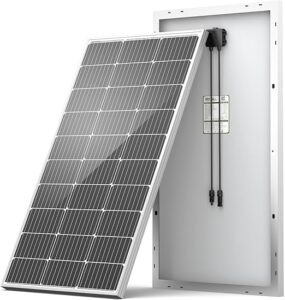 ” src=”https://us.solarpanelsnetwork.com/blog/wp-content/uploads/2026/04/hqst-100w-12v-monocrystalline-solar-panel-300×300.jpg” alt=”HQST 100W 12V Monocrystalline Solar Panel” width=”300″ height=”300″/>
This is the one that built HQST’s reputation. At around $44.99, the HQST 100W 12V Monocrystalline Solar Panel delivers roughly 20% cell efficiency in a rigid aluminum frame with tempered glass. It’s earned Amazon’s Choice status and regularly sells 300+ units per month, which tells you a lot about how well it actually works for people using it in the real world.
Setup is genuinely simple. The panel ships with MC4 solar connectors already attached, so you’re not hunting for adapters on day one. Just run your MC4 cable to a charge controller, connect your battery, and you’re charging. For someone setting up their first RV solar system, that plug-and-play approach saves a lot of frustration. The 77″ x 39″ x 1.5″ panel fits neatly on most RV roofs with standard Z-bracket mounts.
At 24 pounds, it’s on the heavier side compared to newer bifacial designs, but that weight comes from solid build quality. The aluminum frame handles expansion and contraction across temperature cycles well, and the pre-drilled mounting holes line up with standard brackets. Reviewers consistently mention that this panel holds up after years of exposure, which matters more than the initial price for something bolted to a roof.
The one real limitation is that it’s 12V only. If you’re building a 24V system, you’ll need to wire two panels in series. For a single-panel setup charging a 100Ah battery bank, this is the most cost-effective 100W panel you’ll find anywhere. The value-per-watt here is genuinely hard to beat.
Features
- 100W output, 12V system voltage
- Monocrystalline silicon cells at approximately 20% efficiency
- Rigid tempered glass front with aluminum frame
- Pre-attached MC4 solar connectors
- Pre-drilled mounting holes for Z-bracket installation
- IP65 weather resistance
- Dimensions: approximately 77″ x 39″ x 1.5″
- Weight: approximately 24 lbs
- Rating: 4.5/5 stars (1,294 reviews)
- Amazon’s Choice badge
- Best price-per-watt of any HQST panel at around $0.45/W
- MC4 connectors included for easy hookup
- Proven reliability with 1,294 reviews and 4.5 stars
- Amazon’s Choice and 300+ monthly sales confirm demand
- Heavier than newer bifacial designs (24 lbs)
- 12V only — needs series wiring for 24V systems
- Single panel may not be enough for larger power needs
2. HQST 100W 12V Monocrystalline Solar Panel 2-Pack
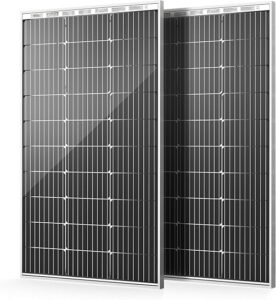 ” src=”https://us.solarpanelsnetwork.com/blog/wp-content/uploads/2026/04/hqst-100w-12v-2-pack-solar-panel-300×300.jpg” alt=”HQST 100W 12V Monocrystalline Solar Panel 2-Pack” width=”300″ height=”300″/>
The 2-pack bundles two of the standard 100W panels at a meaningful discount over buying them individually. At around $97.98 for 200W total, you’re getting the same proven monocrystalline cells with the same efficiency and build quality, but with better economies of scale. It holds the highest customer rating of any HQST product at 4.6 stars across 1,304 reviews.
The flexibility in wiring is what makes this bundle useful. Wire both panels in parallel and you get 200W at 12V, doubling your charging current into a 12V battery bank. Wire them in series and you get 24V at 100W, which opens up 24V inverter and controller options. Most people installing a 200Ah or larger battery bank will run them in parallel for maximum 12V amperage. Either way, MC4 connectors are included with both panels.
You do need the mounting space for two panels. A pair of 77″ x 39″ panels takes up meaningful roof real estate. For larger Class A or Class C motorhomes, a 5th wheel, or a roof rack on a cargo trailer, that’s not a problem. For a smaller van or compact RV, measure before ordering. The total shipping weight of 48 pounds also means delivery requires careful handling.
If you know you need more than 100W and want the convenience of a bundle with matching specs and manufacture dates, this is the smart buy. Buying two separate panels and hoping they’re from the same production run is less certain than getting a factory-paired set.
Features
- 200W total output (two 100W panels)
- Can be wired in parallel (12V/200W) or series (24V/100W)
- Monocrystalline silicon, approximately 20% efficiency per panel
- Matched specifications and production for consistent performance
- MC4 connectors included with both panels
- IP65 weather resistance
- Weight: approximately 24 lbs per panel (48 lbs total)
- Rating: 4.6/5 stars (1,304 reviews) — highest of any HQST product
- Amazon’s Choice badge
- Bundle discount over buying two panels separately
- Matched panels from same production batch
- Highest customer rating (4.6 stars) in HQST lineup
- Flexible wiring for 12V or 24V systems
- Requires mounting space for two full-size panels
- 48 lbs total weight adds to shipping complexity
- Overkill for simple trickle-charge applications
3. HQST 100W Bifacial PERC Solar Panel
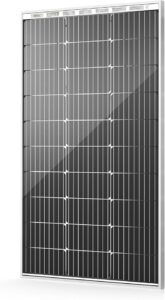 ” src=”https://us.solarpanelsnetwork.com/blog/wp-content/uploads/2026/04/hqst-100w-bifacial-perc-solar-panel-300×300.jpg” alt=”HQST 100W Bifacial PERC Solar Panel” width=”300″ height=”300″/>
This is HQST’s premium offering, and it’s genuinely a different kind of panel. The bifacial PERC design generates power from both the front and back surfaces, pulling in reflected light from whatever surface the panel sits above. In practice, you can see up to 25% more output compared to a standard 100W mono panel under the right conditions, which makes the $69.99 price tag much easier to justify.
The weight reduction is the most immediately noticeable upgrade over the standard model. At just 12 pounds, this panel is half the weight of the 24-pound standard 100W. For installations on boats, camping trailers, or any setup where every pound matters, that’s significant. The compact 22″ x 38″ footprint also makes placement more flexible than the full-size 77″ panels.
IP68 waterproof rating means this panel can be fully submerged in water up to one meter deep for 30 minutes and keep working. That’s a useful margin for marine installations where spray, humidity, and occasional flooding are realities. The aluminum frame and tempered glass meet the same standards as the standard model, but the backing uses a white reflective material specifically designed to maximize bifacial gain.
The catch with bifacial panels is that the back-surface gain only materializes with proper installation. You need ground clearance or a reflective surface below the panel to let light bounce up to the rear cells. On a dark roof with the panel flush-mounted, you’ll see very little bifacial benefit. On a boat deck, elevated ground mount, or portable stand with sand or concrete below, the gains are real. If your installation supports it, this is the highest-performing panel HQST makes.
Features
- 100W output with bifacial PERC cell technology
- Up to 25% additional output from rear surface light capture
- PERC cells improve low-light and diffuse light performance
- IP68 waterproof rating — fully submersible to 1 meter
- Ultra-lightweight at 12 lbs (half the weight of standard 100W)
- Compact footprint: 22″ x 1.2″ x 38″
- 12V system voltage
- Aluminum frame, monocrystalline silicon, tempered glass
- MC4 connector compatible
- Bifacial design captures up to 25% more output in ideal conditions
- Half the weight of standard 100W (12 lbs vs 24 lbs)
- IP68 waterproof for demanding marine environments
- PERC cells improve performance in low-light conditions
- 57% more expensive than the standard 100W ($69.99 vs $44.99)
- Bifacial gain requires elevated installation with reflective surface below
- Fewer reviews than standard model (less real-world feedback)
HQST Solar Panel Buying Guide
Key Takeaways
- HQST focuses on the 100W 12V monocrystalline segment — their product line is intentionally narrow but well-executed
- The standard 100W panel at $44.99 is one of the best-value rigid solar panels on Amazon
- The 2-pack bundle is the smart choice if you know you need 200W — matched panels and factory pricing beat buying two separately
- The bifacial PERC panel earns its premium for marine use, elevated mounts, and installations where weight savings matter
- All HQST panels require a compatible MPPT or PWM charge controller — no controller is included
- IP65 on standard models is sufficient for most rooftop and RV use; IP68 on the bifacial is worth the upgrade for marine environments
What Are HQST Solar Panels?
HQST (High Quality Solar Technology) is a solar panel manufacturer that sells primarily through Amazon. The brand built its following in the RV and off-grid market by offering monocrystalline rigid solar panels at prices that undercut major competitors like Renogy and ECO-WORTHY. Their approach is simple: focus on one thing, make it well, and price it aggressively. That strategy has made the HQST 100W 12V panel one of the most consistently popular solar panels on Amazon.
How Do HQST Solar Panels Work?
All HQST panels use monocrystalline silicon photovoltaic cells. When sunlight hits the cells, photons knock electrons loose from the silicon crystal structure, creating direct current (DC) electricity. The MC4 connectors route that current to a charge controller, which regulates the voltage and current before delivering power to your battery. On the bifacial PERC model, an additional layer of PERC (Passivated Emitter and Rear Cell) technology improves electron capture efficiency, and the transparent or white rear surface allows the back of the panel to capture reflected light — essentially running two panels worth of surface area in one unit.
Benefits of HQST Solar Panels
The primary benefit is straightforward economics. HQST gives you equivalent cell efficiency to premium brands at 20-30% less cost. The standard 100W panel at $44.99 competes with panels from Renogy ($54.99) and ECO-WORTHY ($59.99+) at a meaningfully lower price point. For RV owners or boaters adding solar for the first time, that price difference matters — you can buy a quality charge controller with the savings. The build quality is solid enough that the panels routinely last 5-10 years with normal exposure, and the pre-attached MC4 connectors make installation faster than panels that ship without connectors.
HQST’s Narrow Product Range: Understanding the 100W Variants
HQST focuses almost exclusively on the 100W monocrystalline segment, which makes their lineup unusually narrow compared to brands like Renogy or SunPower. This focus has an upside: HQST has refined their 100W panel through multiple iterations, and buyers benefit from a product that’s had more engineering attention at its specific wattage than a panel that’s just one of twenty sizes in a broad catalog. Their current 100W mono and 100W bifacial PERC panels represent genuine technological progression rather than a lineup padded with minor variations.
What this means practically is that HQST is most suitable when you know you want 100W panels and you’re buying multiples to build a larger array. The 100W size works well for most 12V battery charging applications — a pair gives you a 200W array, which is a common starting point for van builds and small off-grid setups. If you need a 50W or 200W panel specifically, HQST is the wrong brand — their catalog doesn’t cover those sizes well.
Availability is worth checking before committing to HQST. Their distribution is primarily through Amazon, with less presence in brick-and-mortar solar retailers and specialty RV stores. This means warranty claims and technical support go through Amazon’s return system rather than a dedicated dealer network. For most buyers this is fine, but if you’re building a large array and want ongoing technical support, a brand with a broader dealer presence may serve you better long-term.
HQST Bifacial PERC vs. Standard Mono: When the Upgrade Is Worth It
HQST’s bifacial PERC panel generates power from both front and rear surfaces. The rear side captures reflected light — albedo — from surfaces below and around the panel. In ideal conditions (highly reflective ground like white gravel, sand, or snow, with panels elevated at least 12 inches above the surface), rear-side gain can add 10% to 25% to total output. In typical ground-level deployments on dark soil or grass, rear-side gain drops to 3% to 8%. On rooftop installations where the back faces a dark roof surface, bifacial gain is negligible.
The practical recommendation is this: bifacial panels deliver meaningful additional output in ground-mount applications with elevated frames and reflective ground cover. If you’re mounting on a dark roof or a low-clearance ground frame over soil, the standard mono panel at the same price point gives you nearly identical real-world output without the bifacial premium. The bifacial advantage is real, but only in conditions that actually allow rear-side illumination.
PERC technology, regardless of bifacial or not, adds an efficiency boost by improving electron capture at the cell’s rear. HQST’s PERC panels are rated at 20% to 21% efficiency compared to their standard mono at 18% to 19%. This 1 to 2 percentage point difference in efficiency means slightly more watts per square inch, which is relevant if panel space is limited. For most outdoor applications with adequate space, the efficiency difference doesn’t justify a premium unless you’re genuinely space-constrained.
Things to Consider Before Buying
HQST panels are all 12V and all 100W. If you need a 200W single panel, or a 50W panel, or a 24V panel, HQST doesn’t have those options in their current Amazon lineup. For those needs, Renogy or ECO-WORTHY offer a wider range. Also, no charge controller is included with any HQST panel — you need to source an MPPT or PWM controller separately sized for your battery bank. Finally, confirm your mounting space before ordering. The standard 100W panels are nearly 6.5 feet long, which doesn’t fit every installation.
Types of HQST Solar Panels
HQST’s Amazon line breaks into three configurations. The standard 100W monocrystalline is their flagship, the option most buyers should start with. The 2-pack is the same panel in a bundle, priced for buyers who need 200W. The bifacial PERC is their technology-forward option for buyers who need lighter weight, IP68 waterproofing, or elevated mount installations where bifacial gain is possible. Beyond Amazon, HQST also sells foldable portable panels and higher-wattage panels direct through their website, but those aren’t readily available through Amazon US at this time.
Frequently Asked Questions
What charge controller do I need for an HQST 100W solar panel?
For a single 100W HQST panel charging a 12V battery bank, a 10A MPPT controller is the minimum. Most installers recommend a 20A MPPT controller to give headroom for adding a second panel later. MPPT is strongly preferred over PWM — an MPPT controller can recover 20-30% more of the panel’s output, especially in cooler temperatures and partial shade conditions. Budget around $25-50 for a reliable 20A MPPT unit.
Can I wire two HQST 100W panels in series for a 24V system?
Yes. Two HQST 100W 12V panels wired in series produce 24V at up to 100W, which is suitable for 24V battery banks and 24V MPPT controllers. When wiring in series, the voltages add while the current stays the same. Make sure your charge controller is rated for the combined open-circuit voltage (Voc) of both panels in series — typically around 44-46V for two HQST 100W panels. Most 24V MPPT controllers handle this comfortably.
Is the HQST bifacial panel worth the extra cost over the standard 100W?
It depends on your installation. If you’re mounting the panel flat on a dark roof where no light reaches the back surface, the bifacial advantage is minimal and the $25 premium isn’t justified. But if you’re mounting on a boat deck, a raised ground mount, or any situation where reflected light can reach the rear of the panel, the bifacial gain can add 15-25% more output. The IP68 rating and lighter weight (12 lbs vs 24 lbs) are also real advantages for marine and portable applications regardless of bifacial performance.
How many HQST 100W panels do I need to run a 12V refrigerator?
A 12V compressor refrigerator typically draws 30-60W on average (more during compressor cycles, less when holding temperature). In good sun, one 100W panel can generally keep up with a small 12V refrigerator during daylight hours. But to actually charge a battery bank and run the fridge overnight, most people need 200W of panels plus at least 100Ah of battery storage. The HQST 2-pack at 200W is a practical starting point for that kind of setup.
Does HQST offer a warranty on their solar panels?
HQST panels include a 30-day money-back guarantee through Amazon and a manufacturer warranty on the panels themselves. The standard industry warranty structure for solar panels covers product defects (typically 1-5 years) and power output guarantees (the panel maintains 80% of rated output for 25 years). Verify the current warranty terms directly with HQST or through the Amazon product listing at the time of purchase, as terms can change.
How does HQST compare to Renogy for RV solar panels?
Both make solid 100W 12V monocrystalline panels. The main differences: HQST is consistently $5-15 cheaper per panel, while Renogy has a wider product catalog (flexible panels, higher wattages, complete kits). Build quality is comparable at this price tier. If you want just the panels at the lowest cost, HQST wins. If you want a kit with a controller, mounting hardware, and cables in one purchase, or if you need a panel size HQST doesn’t offer, Renogy gives you more options.
Summing Up
HQST makes a narrow but well-executed product line. The standard 100W 12V monocrystalline panel is one of the strongest value propositions in the rigid solar panel market — proven by 1,294 reviews, Amazon’s Choice status, and consistent monthly sales. The 2-pack is the logical next step for anyone who needs 200W and wants matched panels at a bundle price. And the bifacial PERC model earns its place for marine use, weight-sensitive installs, and situations where elevated mounting makes the bifacial gain realistic.
If you’re also thinking about solar panels for your home, call (855) 427-0058 for a free quote — it takes just a few minutes to find out what installation would cost and save you in your area.
Updated