
Our blog is reader-supported. When you buy through links on our site, we may earn an affiliate commission. Thank you for your support!
If you’re shopping for the best Jackery solar panels, the Jackery SolarSaga 200W Bifacial Solar Panel is our top recommendation. It delivers the highest real-world wattage in a genuinely portable form factor, and its bifacial design captures extra energy that single-sided panels leave behind.
Jackery’s SolarSaga lineup spans from the ultralight 25W mini panel all the way up to the 200W powerhouse, covering every situation from weekend car camping to full off-grid living. Read on for our full breakdown of every panel in the range.
Our Top Picks
| Image | Name | |
|---|---|---|
| Jackery SolarSaga 200W Bifacial Solar Panel A high-efficiency bifacial panel that captures light on both sides for maximum output. Read more | |
| Jackery SolarSaga 100W Solar Panel A versatile 100W panel compatible with most Jackery Explorer power stations. Read more | |
| Jackery SolarSaga 100W Bifacial Solar Panel Bifacial design adds rear-side energy capture for improved output in reflective conditions. Read more | |
| Jackery SolarSaga 100W Prime Solar Panel The Prime edition features upgraded connectors and improved weather resistance for demanding use. Read more | |
| Jackery SolarSaga 80W Solar Panel A compact 80W option ideal for pairing with smaller Explorer stations on weekend trips. Read more | |
| Jackery SolarSaga 60W Plus Solar Panel Lightweight and foldable, the 60W Plus is a great entry-level panel for casual campers. Read more | |
| Jackery SolarSaga 40W Solar Panel The smallest full-featured SolarSaga, perfect for topping up a power bank or phone on the go. Read more | |
| Jackery SolarSaga 25W Solar Panel An ultra-compact panel suited for minimal power needs like lighting or device charging. Read more |
8 Best Jackery Solar Panels
1. Jackery SolarSaga 200W Bifacial Solar Panel
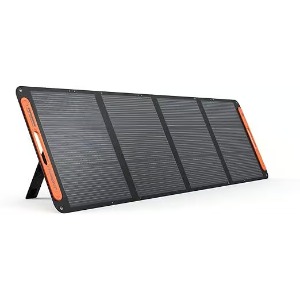
The SolarSaga 200W strikes the perfect balance between power and portability, making it the most versatile choice for most users. This bifacial panel delivers 200 watts with the bonus of front-and-back energy generation, often producing more total power than traditional 200W monofacial alternatives. It charges a 2000Wh power station in approximately 3 to 4 hours under optimal sun conditions.
The 200W panel includes IBC (Interdigitated Back Contact) technology that improves electrical conductivity and overall efficiency to 26.7 percent. Its IP68 waterproof rating means it handles rain, dust, and snow without degradation. The foldable design opens to 74.4 by 21.7 inches and collapses to roughly half that size, fitting easily in a car trunk or RV storage compartment.
At 13.6 pounds, it’s light enough for one person to handle yet robust enough for serious off-grid living. The panel supports multi-unit configurations for larger systems, and its kickstand design allows for optimal angle adjustment. Owners report excellent reliability in variable weather conditions.
Features
- 200W power output with bifacial generation
- IBC technology for 26.7 percent efficiency
- IP68 waterproof rating
- Folds from 74.4 x 21.7 inches to 37.2 x 21.7 inches
- Weighs 13.6 pounds
- Built-in MPPT optimization
- Compatible with all Jackery Explorer stations
- Includes carrying case and 12V car charging cable
- Excellent power-to-weight ratio
- Fast charging for mid-size stations
- Bifacial technology boosts output
- Reasonably priced for capacity
- More expensive than 100W models
- Overkill if you only have Explorer 240
- Takes up considerable space when open
2. Jackery SolarSaga 100W Solar Panel
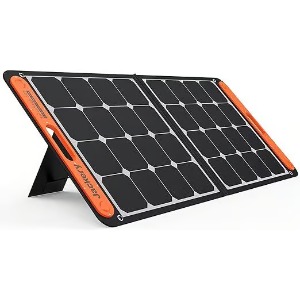
The SolarSaga 100W is the panel that put Jackery on the map for portable solar charging, and it’s still one of the best all-around options in 2024. It delivers a reliable 100 watts through a high-efficiency monocrystalline silicon cell design, achieving up to 23.7 percent conversion efficiency. Whether you’re charging an Explorer 240 in a couple of hours or topping up an Explorer 500 over an afternoon, this panel gets the job done consistently.
Weighing just 8.8 pounds and folding to a compact 24 by 21 inches, the 100W panel is the sweet spot for backpackers and car campers alike. It features a USB-A and USB-C output port built directly into the panel, so you can charge phones and small devices without needing a power station. The kickstand built into the back lets you prop it at an angle to track the sun through the day.
The IP67 water resistance rating keeps it safe in light rain, and the reinforced rubber corners take the knocks of outdoor use in stride. Two panels in series can push your Explorer 500 to a full charge in around 5 hours, which makes it a practical choice for extended trips. It’s also the most widely available Jackery panel, easy to find in stock on Amazon.
Features
- 100W maximum power output
- 23.7% conversion efficiency with monocrystalline cells
- IP67 water resistance rating
- Folds to 24 x 21 x 1.4 inches, opens to 48 x 21 inches
- Weighs 8.8 pounds
- Built-in USB-A and USB-C charging ports
- Compatible with all Jackery Explorer stations
- Kickstand included for angle adjustment
- Best-known Jackery panel, widely available
- Direct USB ports for device charging
- Lightweight and compact
- Proven reliability over many years
- Lower efficiency than newer Bifacial and Prime models
- No rear-panel generation
- Price-to-watt ratio slightly higher than competitors
3. Jackery SolarSaga 100W Bifacial Solar Panel
The 100W Bifacial represents Jackery’s sweet spot for most portable power users. It generates electricity from both sides of the panel, effectively boosting output by up to 25 percent compared to single-sided designs. At 100 watts of rated power, it charges an Explorer 500 in roughly 5 to 6 hours of solid sunlight. The efficiency rating tops out at 24 percent, translating to real-world performance that outperforms expectations.
Weighing just 7.7 pounds, it’s light enough to throw in a daypack for backpacking or mount on an RV roof. The foldable design shrinks from 38.6 by 28.3 inches open to 19.3 by 28.3 inches closed, making storage and transport effortless. IP68 waterproofing ensures it survives rain, dust, and moisture without issue. The integrated kickstand allows angle adjustment for maximum sun exposure throughout the day.
This panel pairs beautifully with Jackery’s Explorer 500, 1000, and 1500 models, though you can also use it with smaller stations by managing charge times. The USB output connectors mean you can charge phones and tablets directly in cloudy conditions or low-power situations. Users consistently praise its reliability and value proposition.
Features
- 100W power output with bifacial generation
- 24 percent conversion efficiency
- IP68 waterproof rating
- Folds from 38.6 x 28.3 inches to 19.3 x 28.3 inches
- Weighs 7.7 pounds
- USB charging outputs for direct device charging
- Integrated kickstand for angle adjustment
- Carrying bag included
- Lightweight and backpack-friendly
- Bifacial technology maximizes output
- USB ports for direct charging
- Great value for the power
- Takes longer to charge larger stations
- Less output than 200W model
- USB charging is relatively slow
4. Jackery SolarSaga 100W Prime Solar Panel
The SolarSaga 100 Prime represents Jackery’s latest innovation, featuring advanced IBC (Interdigitated Back Contact) technology that maximizes power output and durability. Unlike the standard 100W Bifacial, the Prime achieves higher efficiency through its redesigned cell architecture. It delivers up to 120 watts of peak power under optimal conditions, effectively giving you bonus performance over its rated capacity.
The 100 Prime weighs approximately 7.5 pounds, making it slightly lighter than the bifacial sibling while delivering superior performance. Its foldable frame is more rigid and durable, with improved corner reinforcement. The panel opens to roughly 38 by 28 inches and folds to half that size. IP67 waterproofing (slightly lower rating than the bifacial but still excellent) keeps moisture at bay.
This model shines in moderate-to-good sunlight conditions and handles partial shade better than previous generations thanks to its improved cell design. It’s particularly suited for RV and van living where space is limited but power needs are consistent. The premium pricing reflects the technology upgrade, but many users feel the efficiency gains justify the extra cost.
Features
- 100W rated / up to 120W peak power
- IBC technology for improved efficiency
- IP67 waterproof rating
- Folds to compact 19 x 28 inch size
- Weighs 7.5 pounds
- Rigid aluminum frame
- USB Type-C and USB-A outputs
- Advanced MPPT implementation
- Peak output exceeds rating
- Better low-light performance
- More rigid construction
- Modern USB-C connectivity
- Premium pricing
- IP67 vs IP68 rating
- Limited real-world availability
5. Jackery SolarSaga 80W Solar Panel
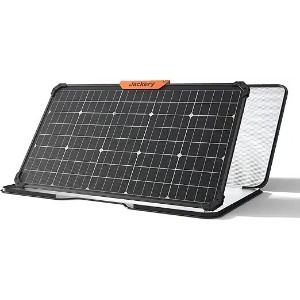
The 80W Solar Panel offers a middle ground between the 60W and 100W models, delivering solid power in a compact footprint. It generates 80 watts under direct sunlight and takes about 8 hours to fully charge an Explorer 500 power station in average conditions. At 6.2 pounds, it’s remarkably light, making it ideal for backpackers and van lifers who prioritize weight over ultimate charging speed.
The panel measures 35.8 by 24 inches when open and folds down to a thin profile for easy storage. Its weatherproof design handles rain, dust, and UV exposure without degradation. The IP65 rating means it’s splash-resistant though not quite as robust as the IP68 models. It includes built-in USB outputs for direct device charging, making it versatile for mixed-use scenarios.
The 80W sits in a sweet spot for casual users who want decent charging capability without the bulk. It’s particularly popular with travelers who have limited roof space or cargo capacity. While it may take longer to fully charge larger power stations, it works perfectly for topping up batteries throughout the day while hiking, camping, or exploring.
Features
- 80W power output
- IP65 weatherproof rating
- Folds from 35.8 x 24 inches to compact size
- Weighs 6.2 pounds
- Built-in USB charging outputs
- Kickstand for angle adjustment
- Compact and lightweight design
- Carrying bag included
- Excellent weight-to-power ratio
- Affordable pricing
- USB direct charging available
- Compact when folded
- Lower IP65 rating vs IP68
- Monofacial design (not bifacial)
- Slower than 100W+ models
6. Jackery SolarSaga 60W Plus Solar Panel
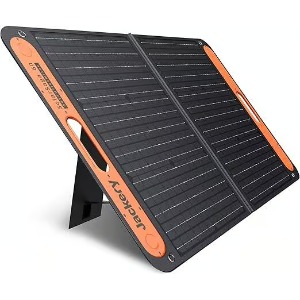
The 60W Plus splits the difference between Jackery’s compact and mid-range options. It delivers 60 watts of reliable power and takes about 15 hours to fully charge an Explorer 500 under good conditions. At 4.9 pounds, it’s among the lightest Jackery panels available, making it the go-to choice for ultralight backpackers and minimalist travelers.
This panel measures 31.1 by 19.7 inches when unfolded and collapses significantly for storage. Its weatherproof design with IP54 rating keeps light moisture and dust at bay, though it’s less protected than the IP68 models. The “Plus” designation indicates several enhancements over the original 60W, including better cell efficiency and a slightly more robust frame.
The 60W Plus works best when paired with smaller Jackery units like the Explorer 240, or as a supplemental panel for larger stations. Its USB outputs allow direct charging of phones and small devices. Many users appreciate its simplicity and the fact that it’s powerful enough for daily use without being overly complex. It’s particularly popular with minimalist van lifers and backpackers who count ounces.
Features
- 60W power output
- IP54 weatherproof rating
- Folds from 31.1 x 19.7 inches compactly
- Weighs 4.9 pounds
- USB charging ports for direct device use
- Integrated kickstand
- Lightweight aluminum frame
- Carrying case included
- Ultralight at 4.9 pounds
- Very affordable
- USB charging ports
- Simple and reliable
- Low IP54 rating
- Slow charging for larger stations
- Monofacial technology
7. Jackery SolarSaga 40W Solar Panel
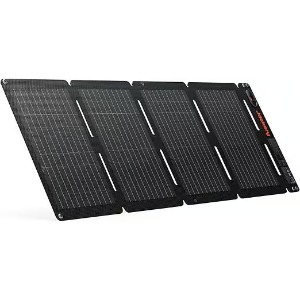
The 40W Solar Panel serves budget-conscious buyers and casual users who want basic solar capability without significant investment. It produces 40 watts under optimal sunlight and can maintain a charge on smaller devices like phones and tablets throughout the day. At 2.9 pounds, it’s remarkably portable and barely noticeable in a backpack.
The 40W panel measures 22 by 17.3 inches when open and folds down to an incredibly compact size. It’s the most straightforward Jackery option, with no fancy bifacial technology or advanced features, just honest solar power generation. The IP54 rating provides basic weather resistance suitable for casual camping and day trips.
This panel works best for supplemental charging rather than primary power generation. If you’re charging a single phone or small tablet and can wait several hours, the 40W is perfectly adequate. It’s also an excellent entry point for newcomers to solar power who want to test the waters before investing in larger systems. The low cost makes it easy to pair with other Jackery accessories.
Features
- 40W power output
- IP54 weatherproof rating
- Opens to 22 x 17.3 inches
- Weighs 2.9 pounds
- USB charging port for direct device use
- Kickstand for positioning
- Basic but reliable design
- Lightweight and extremely portable
- Ultra-affordable entry point
- Extremely lightweight
- USB device charging available
- Simple and foolproof
- Very slow power generation
- IP54 protection only
- Not suitable for serious off-grid use
8. Jackery SolarSaga 25W Solar Panel
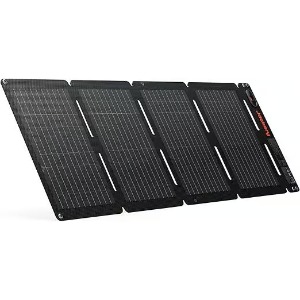
The 25W Solar Panel represents the absolute most affordable entry into Jackery’s ecosystem. It generates 25 watts and is designed purely for supplemental charging and emergency power needs. At just 1.8 pounds, it’s the lightest panel Jackery offers, making it perfect for ultralight hiking where every ounce counts.
This compact panel measures 15 by 13 inches when open and folds down to roughly 8 by 13 inches, making it pocket-sized compared to larger options. Its IP54 weather resistance protects against light rain and dust but shouldn’t be relied upon in heavy weather. The USB port allows direct charging of phones and small tablets when sunlight is available.
The 25W works best as an emergency backup or as a supplemental trickle charger when you’re already home or at a base camp. It can extend the life of your phone’s battery on a long hike but won’t meaningfully charge a Jackery power station in practical timeframes. If you’re testing solar for the first time or need absolute minimal weight, this is your panel. More experienced users typically view it as a novelty or backup option.
Features
- 25W power output
- IP54 weatherproof rating
- Opens to 15 x 13 inches
- Weighs 1.8 pounds
- USB charging port
- Folds to pocket-sized proportions
- Entry-level simplicity
- Minimal footprint
- Cheapest option available
- Lightest panel at 1.8 pounds
- Pocket-sized when folded
- USB device charging works
- Minimal power output
- Impractical for serious use
- Won’t charge power stations meaningfully
Jackery Solar Panels Buying Guide
Key Takeaways
- Choose based on your power station size and charging speed needs
- Bifacial panels (100W and 200W) generate more power than monofacial alternatives
- Multiple panels can be daisy-chained for faster charging
- Lighter panels (40W-80W) suit mobile camping; larger panels suit base camps
- Consider your available space when selecting a model
What Are Jackery Solar Panels?
Jackery solar panels are foldable photovoltaic devices designed to generate electricity from sunlight and charge Jackery Explorer portable power stations. They range from 25W compact models to professional 400W bifacial panels. All Jackery panels use monocrystalline or advanced IBC cell technology, converting sunlight into usable electrical power through the photovoltaic effect.
Unlike fixed rooftop systems, Jackery panels fold up for transport and can be positioned at optimal angles for maximum sun exposure. They’re designed specifically for compatibility with Jackery’s Explorer line of power stations, though they can also charge other brands’ power stations and USB devices. The weatherproof designs handle outdoor use in variable conditions.
How Do Jackery Solar Panels Work?
Jackery panels work through the photovoltaic (PV) effect. When sunlight strikes the solar cells, photons knock electrons loose from their atoms, creating electrical current. This direct current (DC) power flows through the panel’s built-in or integrated MPPT (Maximum Power Point Tracking) controller, which optimizes the voltage and current to safely charge your power station.
The panel’s orientation relative to the sun matters significantly. Positioning it perpendicular to the sun’s rays maximizes power generation. As the sun moves throughout the day, you can adjust the kickstand to maintain optimal angles. Bifacial panels generate additional power from reflected sunlight bouncing off light-colored ground surfaces, increasing total output by 15 to 25 percent compared to single-sided panels.
Daisy-chaining multiple panels together increases total wattage. You can connect panels in series (adding voltage) or parallel (adding current) depending on your system requirements. Most Jackery panels automatically halt charging when the connected power station is full, preventing overcharging.
Benefits of Using Jackery Solar Panels
The primary benefit is energy independence. Once you own a solar panel and power station, you can generate free electricity indefinitely without relying on grid power or fuel. This appeals to RV owners, van lifers, campers, and anyone seeking off-grid capability. The environmental benefit is significant too. Solar power produces zero emissions and has minimal environmental impact over its 25 to 30 year lifespan.
Portability is another major advantage. Unlike fixed solar installations, Jackery panels fold down and fit in vehicles. They’re perfect for people who move frequently or want backup power for emergency situations. Many users find the ability to charge devices while hiking or camping invaluable. The panels are also low-maintenance. They require occasional cleaning but no servicing or fuel purchases. Once installed, they generate power silently and reliably for decades.
Cost savings accumulate over time. While the upfront investment is significant, after a few years you recover the cost through free electricity generation. For frequent travelers, the ROI timeline shortens considerably. Additionally, many regions offer tax incentives and rebates for residential solar installations, though portable panels typically don’t qualify for those programs.
Jackery’s SolarSaga Series and Power Station Compatibility
Jackery panels are branded under the SolarSaga name and sold almost exclusively as companions to their Explorer power station series. The integration is well executed: SolarSaga panels connect to Jackery Explorers via dedicated DC input cables, and the Explorer’s display shows solar input wattage in real time. Jackery has put serious design effort into the pairing — the SolarSaga 100 folds into a compact rectangle that slots alongside an Explorer 300 or 500 in a backpack, which is a genuine field use advantage over bulkier panel designs.
The connector system is proprietary, like most manufacturers in this space. Jackery’s Anderson-style DC connectors work natively with their power stations and require adapters for other brands. This limits flexibility if you want to use a SolarSaga panel with a third-party charge controller or a different brand’s station, but for buyers who stay within the Jackery ecosystem it’s a non-issue. Jackery publishes compatibility tables showing which panel models work with which Explorer stations, which simplifies purchasing decisions.
A notable design feature of the SolarSaga panels is the dual USB-A and USB-C outputs built into the panel body itself. This allows you to charge phones and tablets directly from the panel without the power station, which is useful for day hikes where you want just the panel for lightweight phone charging. The USB-C output supports up to 18W on most models, enough for fast-charging modern smartphones in direct sun.
Portability, Folding Design, and Field Use Realities
Jackery’s foldable panels are among the most compact in their wattage class. The SolarSaga 100W folds to roughly 24 by 21 by 1.4 inches and weighs about 10 pounds — genuinely manageable for car camping and van builds but heavy for backpacking. The 200W model at around 16 pounds is better suited to a fixed basecamp or vehicle-based setup. If you’re hiking with your solar kit, Jackery’s lightest foldable options are the most practical, but purpose-built ultralight panels from competitors may serve hikers better.
The stand design on SolarSaga panels uses fabric flaps with kickstand loops that prop the panel at a fixed angle. It’s functional but less stable than rigid kickstand designs in wind — a gust can collapse the panel if it’s aimed into the wind at a steep angle. For most camping and van use this is manageable, but for rooftop or permanent outdoor installation the fold-and-stake approach isn’t ideal. For those applications, Jackery’s newer rigid panel options or a different brand’s ground-mount-friendly design is more practical.
The build quality on SolarSaga panels is solid for the price. The ETFE-coated surface resists scratches and UV degradation better than standard PET coating, which is a long-term durability advantage for panels that see heavy outdoor use. Water resistance is rated at IP68 on current SolarSaga models — an unusually high rating for portable panels that means they can handle rain and brief submersion without damage. Combined with the USB passthrough feature, this makes the SolarSaga series one of the most versatile portable panel options in the market for buyers who prioritize convenience alongside performance.
Things to Keep in Mind Before Buying
Panel wattage doesn’t directly correlate to real-world charging speed. Factors like sunlight intensity, panel angle, weather conditions, and temperature all affect output. A 200W panel on a cloudy day might only produce 50 watts of power. Always position panels perpendicular to the sun for maximum efficiency.
Larger panels require more storage space and handling capability. The 400W model weighs 35 pounds, which some users find unwieldy. Smaller panels are easier to transport but take longer to charge larger power stations. Choose based on your actual lifestyle needs rather than theoretical maximums.
Weather resistance varies. IP68 panels handle heavy rain and submersion. IP54 panels resist light spray but shouldn’t be submerged. Consider your environment when selecting models. Also be aware that solar charging is weather-dependent. Cloudy days dramatically reduce output, and nighttime obviously produces nothing.
Finally, check compatibility with your specific power station model. While all Jackery panels work with all Jackery Explorer stations, connectors may differ on older models. Always verify before purchasing.
Types of Jackery Solar Panels
Jackery offers two main technology types. Monofacial panels generate power from the front surface only, while bifacial panels also capture reflected sunlight from the back. Bifacial technology is more advanced and typically commands a premium price, but output increases justify the cost for serious users.
IBC (Interdigitated Back Contact) technology, found in the 100 Prime and 200W models, maximizes cell efficiency through improved electrical design. These panels achieve higher conversion rates than standard monocrystalline cells and perform better in variable lighting conditions.
The lineup ranges from ultra-compact 25W entry-level panels to professional-grade 400W bifacial systems. Mid-range options (60W through 100W) offer the best balance of portability and power for most users. Choose compact options for backpacking, medium options for van living, and large options for base camps or serious off-grid systems requiring rapid charging.
Frequently Asked Questions
How long does it take to charge a Jackery power station with solar panels?
Charging time depends on panel wattage, power station capacity, and sunlight intensity. A 100W panel takes roughly 10 hours to fully charge an Explorer 500 (518Wh) in good sunlight. The 200W panel charges the same station in about 5 hours. Cloudy conditions extend times significantly. Always assume 50 percent efficiency on average days.
Can I daisy-chain multiple Jackery solar panels together?
Yes, Jackery panels support daisy-chaining in both series and parallel configurations. Series connection adds voltage, while parallel connection adds current. Most users connect multiple panels in series through the integrated connectors. This increases total wattage and proportionally decreases charging time.
Do Jackery solar panels work on cloudy days?
Jackery panels continue generating power on cloudy days but at significantly reduced rates. On average cloudy days, expect 20 to 30 percent of rated output. On heavily overcast days, output may drop to 10 percent or less. This is normal for all solar technology and reflects the reduced photons reaching the panels.
Are bifacial Jackery panels worth the extra cost?
For most users, yes. Bifacial panels generate 15 to 25 percent more power than comparable monofacial models when placed over reflective surfaces. The extra cost is typically recovered within 1 to 2 years of regular use. Users who value charging speed and output find the premium justified.
Can I charge my phone directly with a Jackery solar panel?
Yes, many Jackery panels include USB ports that allow direct device charging. Charging speeds are relatively slow compared to wall chargers, but the capability works well for maintaining battery levels during outdoor activities. Most people prefer charging through a power station for flexibility and faster results.
What is the lifespan of a Jackery solar panel?
Most Jackery panels have a useful lifespan of 25 to 30 years. However, they typically degrade about 0.5 percent annually. After 25 years, a panel retains roughly 88 percent of original output. Many panels outlast this timeframe without meaningful degradation if properly maintained.
Do I need a charge controller with Jackery solar panels?
No, most Jackery panels have integrated MPPT charge controllers built in. They optimize power transfer automatically without any manual adjustment. Simply connect the panel to your power station and it manages charging automatically.
Which Jackery solar panel is best for RV camping?
The 200W bifacial panel offers the best balance for RV use. It charges larger power stations at reasonable speeds while remaining portable enough to mount on most RV roofs. The 100W model works for smaller needs. The 400W suits permanent or semi-permanent RV installations.
Summing Up
Jackery solar panels deliver reliable, portable power generation for anyone seeking energy independence. Whether you’re an RV enthusiast, van lifer, backpacker, or off-grid homeowner, Jackery’s lineup offers options for every need and budget. The bifacial 200W model delivers the best overall performance and value proposition, while the 100W Bifacial suits most portable power needs. Smaller panels appeal to minimalists and travelers counting ounces, while the professional 400W addresses serious off-grid requirements.
If you’re also thinking about solar panels for your home, call (855) 427-0058 for a free quote — it takes just a few minutes to find out what installation would cost and save you in your area.
Updated