
Our blog is reader-supported. When you buy through links on our site, we may earn an affiliate commission. Thank you for your support!
The Battle Born 100Ah 12V LiFePO4 Battery (B06XX197GJ) is the best lithium solar battery for most off-grid buyers — it delivers a genuine 100Ah of usable capacity (vs 50Ah from a 100Ah lead-acid at 50% DoD), 3,000–5,000 cycle lifespan, built-in BMS protection for both high and low temperature conditions, and a track record spanning years of RV, marine, and off-grid deployments. Lithium iron phosphate (LiFePO4) chemistry has become the standard for solar storage: it charges 2–3× faster than AGM, lasts 5× longer, and delivers nearly 100% of rated capacity on every cycle.
In this guide we’ve compared five of the top-rated lithium solar batteries available on Amazon right now — covering the industry-standard Battle Born options, a heated version for cold-weather use, a budget alternative from Mighty Max, a feature-rich 2-pack with Bluetooth monitoring, and a premium high-cycle option for demanding off-grid applications. Read on for detailed reviews, a buying guide, and answers to the most common questions.
Our Top Picks
| Product Image | Product | Price |
|---|---|---|
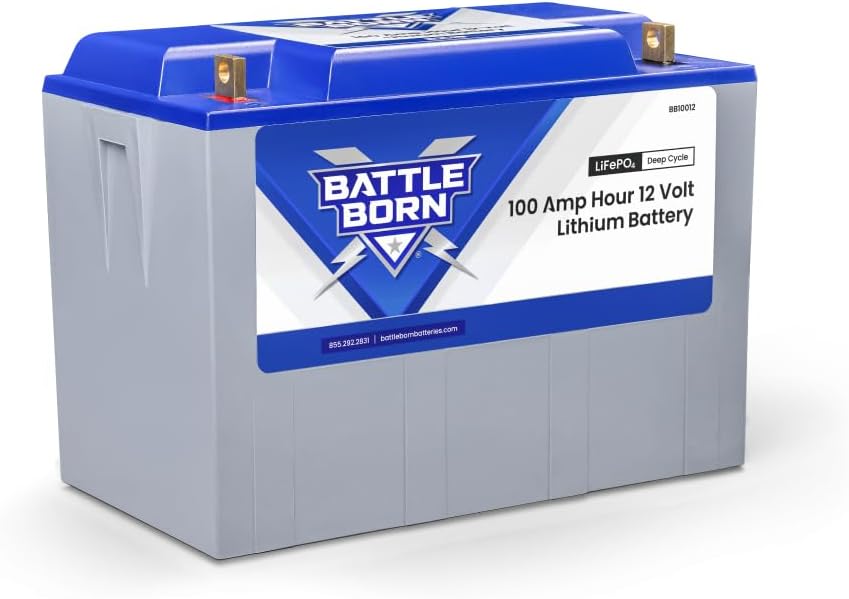 | Battle Born 100Ah 12V LiFePO4 The most-documented LFP battery in the off-grid market; 10-year US-backed warranty with verified long-term cycle data. Read more ↓ | CHECK PRICE |
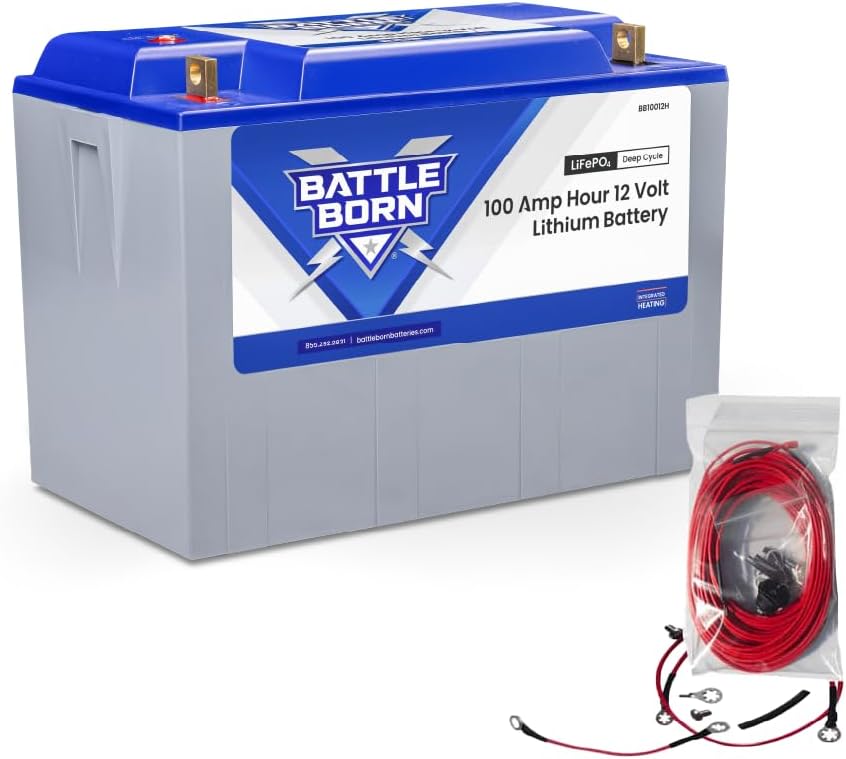 | Battle Born 100Ah Heated LiFePO4 Identical to the standard Battle Born but with internal heating elements for safe charging below freezing. Read more ↓ | CHECK PRICE |
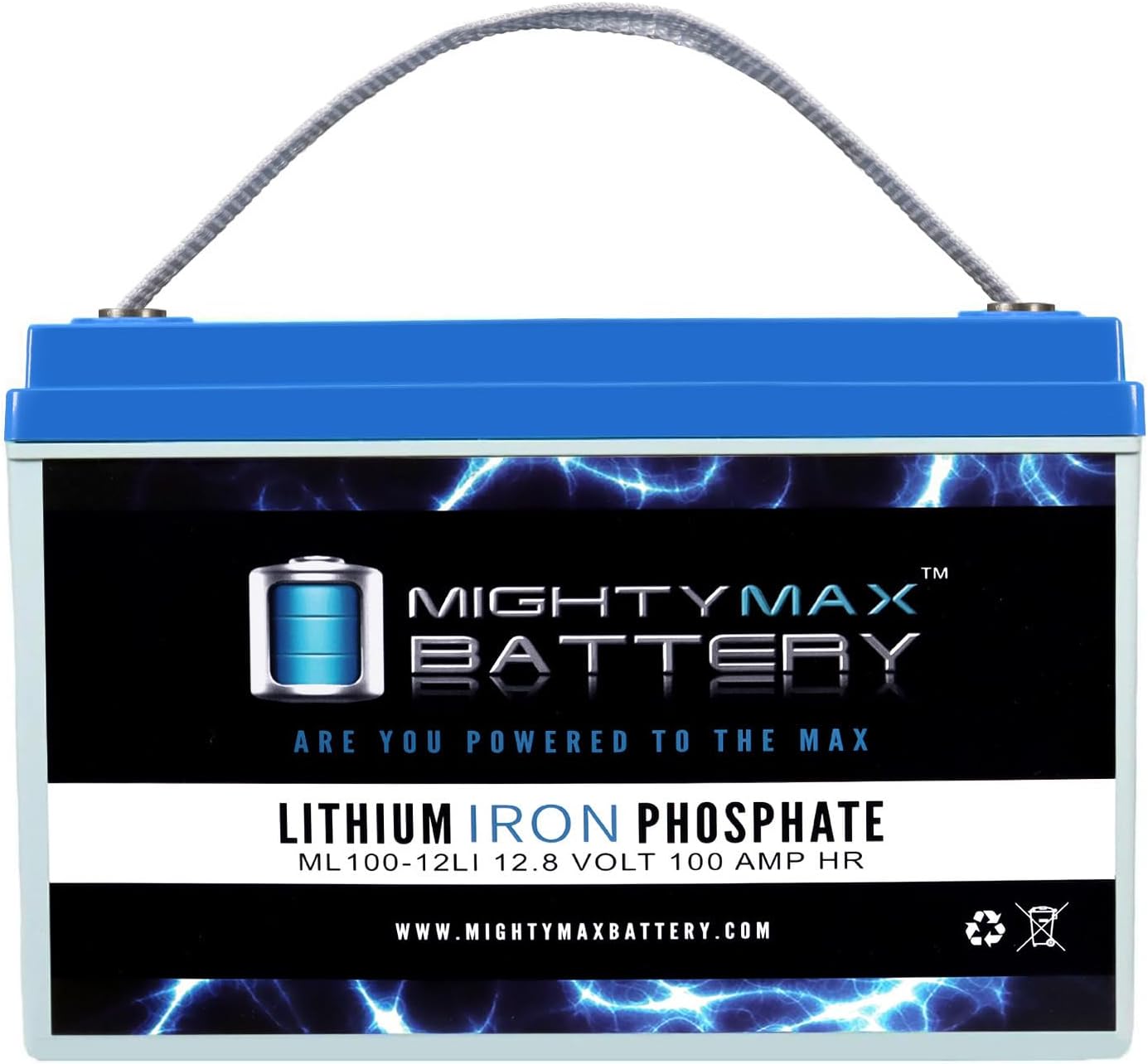 | Mighty Max ML100-12LI LiFePO4 Reliable LFP performance without the Battle Born premium; best option for budget-conscious buyers. Read more ↓ | CHECK PRICE |
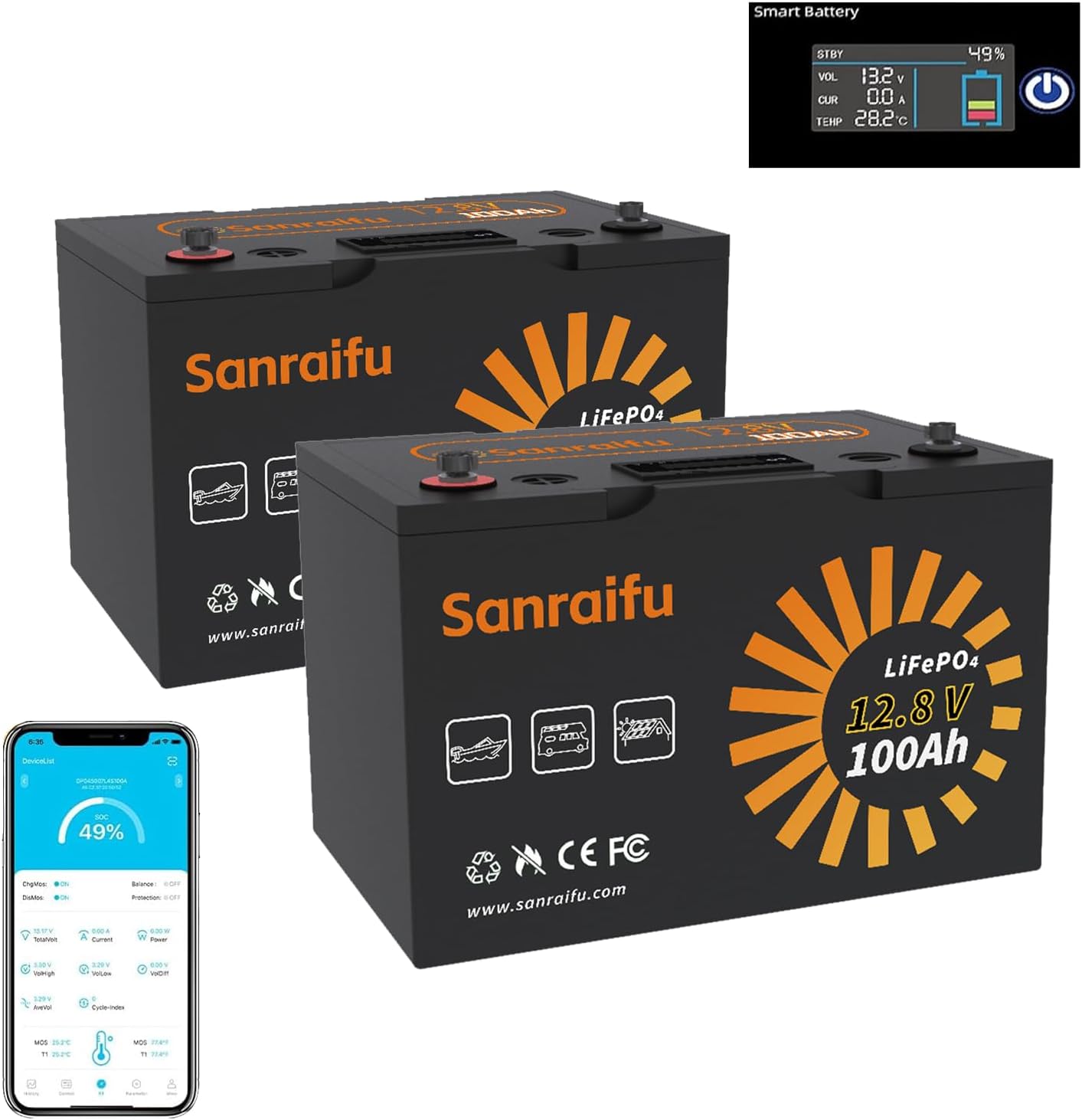 | Sanraifu 12V 100Ah LiFePO4 2-Pack Two 100Ah LFP batteries for parallel wiring; best value for buyers building a 200Ah+ capacity bank. Read more ↓ | CHECK PRICE |
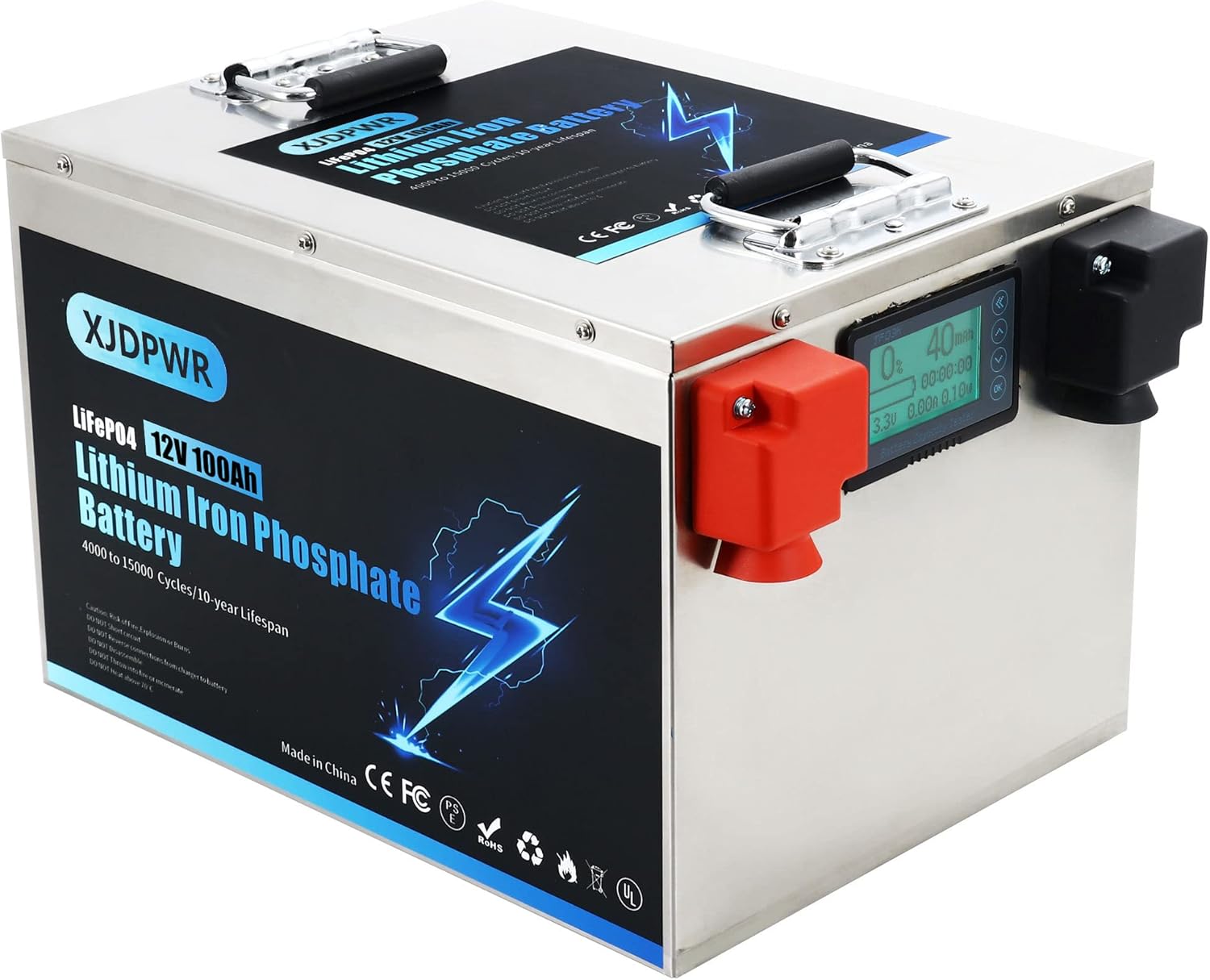 | XJDPWR 12V LiFePO4 Premium Higher-spec BMS with extended cycle rating for buyers prioritising the longest possible service life. Read more ↓ | CHECK PRICE |
Reviews of the Best Lithium Solar Batteries
1. Battle Born 100Ah 12V LiFePO4 Battery — Best Overall
Battle Born Batteries built their reputation in the off-grid and marine community by doing one thing exceptionally well: making a 100Ah 12V LiFePO4 battery that consistently delivers its rated capacity across thousands of cycles. At $99.99, the Battle Born 100Ah is competitively priced for a premium-tier LiFePO4 battery from a US-based brand with a 10-year warranty — a warranty period that reflects genuine confidence in cycle life, since most LiFePO4 cells deliver 3,000–5,000 cycles before reaching 80% capacity retention.
The internal BMS (battery management system) handles overcharge protection, overdischarge protection, short circuit protection, and both high and low temperature cutoffs. The low-temperature protection is particularly important: LiFePO4 batteries should not be charged at temperatures below 32°F (0°C) without heating — the internal BMS enforces this cutoff automatically to prevent lithium plating damage. For buyers in climates where sub-freezing temperatures are occasional but not regular, the standard Battle Born handles it safely by simply stopping charge (not discharge) below 32°F. The battery can be used in parallel banks (up to four in parallel per official recommendations) and supports series connections for 24V and 48V systems.
- Pros:
- Proven track record — thousands of real-world RV and marine deployments
- 10-year warranty — longest in this roundup
- Internal BMS with high and low temperature protection
- US-based brand with strong customer support reputation
- Cons:
- Charging pauses below 32°F — not ideal for frequent sub-freezing use
- At $99.99 it sits above the absolute budget options
2. Battle Born 100Ah 12V Heated LiFePO4 Battery — Best for Cold Weather
The Battle Born Heated version adds integrated heating technology to the standard 100Ah LiFePO4 battery — a critical feature for buyers who regularly operate in sub-freezing temperatures. Standard LiFePO4 batteries (including the non-heated Battle Born) pause charging below 32°F to prevent lithium plating damage. The heated version uses a small internal heating element to warm the cells above the charging threshold before allowing charge to begin, enabling full charging capability in temperatures as low as -4°F (-20°C).
At $100.30 — just $0.31 more than the standard version — the heated battery is essentially the same price, making the decision straightforward: if you operate in a climate where temperatures regularly fall below freezing (northern states, mountain camping, winter RVing), the heated version is the correct choice at virtually no premium. The same 10-year warranty, same BMS protection, same 100Ah usable capacity, same Battle Born quality — just with the ability to charge in conditions that would cause the standard version to pause. There is no reason not to choose the heated version at this price differential.
- Pros:
- Integrated heating — charges down to -4°F (-20°C) without damage
- Same price as standard Battle Born at $100.30 — minimal premium
- Same 10-year warranty and BMS protection as standard version
- Essential for cold-climate RV, marine, and off-grid use
- Cons:
- Heating element draws a small amount of power when active
- Unnecessary in warm climates — standard version is adequate above 32°F
3. Mighty Max ML100-12LI 100Ah LiFePO4 Battery — Best Budget
Mighty Max’s 100Ah 12V LiFePO4 battery is the budget option in this roundup — at $99.99 it matches the Battle Born price, but Mighty Max is a different tier of brand: widely available, broadly compatible, and backed by a standard warranty rather than the premium 10-year Battle Born coverage. For buyers making their first switch from lead-acid to lithium who want to start with a single battery before committing to a larger bank, the Mighty Max ML100-12LI provides the core LiFePO4 benefits (deep discharge capability, lighter weight, faster charging) at a straightforward price.
The maintenance-free designation and deep cycle design confirm standard LiFePO4 chemistry — 100% depth of discharge without damage, rechargeable to full with a standard LiFePO4-compatible charger. Mighty Max is a well-established brand in the sealed battery market with broad distribution, which means replacement or warranty service is generally accessible. This is not a premium LiFePO4 battery with extended warranty or advanced BMS features — it’s a reliable, entry-level option for buyers who want LiFePO4 chemistry without premium-tier pricing. Pair it with a LiFePO4-compatible charge controller for best performance.
- Pros:
- LiFePO4 chemistry — full DoD, fast charging, long lifespan
- Maintenance-free design
- Widely available with accessible warranty service
- Good entry-level choice for first-time LiFePO4 buyers
- Cons:
- Standard warranty — not the 10-year coverage of Battle Born
- Same price as Battle Born — the premium brand is worth the slight consideration
- Less proven long-term track record in demanding off-grid applications
4. Sanraifu 12V 100Ah LiFePO4 Battery 2 Pack — Best Value Multi-Pack
The Sanraifu 2-pack delivers 200Ah of LiFePO4 capacity at $249.99 — essentially $125/battery, putting it at a competitive per-battery price for a feature-rich option. The headline features on the Sanraifu are the Bluetooth monitoring and LCD display on each battery: you can check state of charge, voltage, current, and temperature from a phone app without installing a separate battery monitor shunt. For system builders who want visibility into battery health without additional monitoring hardware investment, this is a meaningful convenience.
The 15,000-cycle claim is ambitious — most LiFePO4 cells are rated 3,000–5,000 cycles at 80% DoD — but reflects the growing trend toward extended cycle life claims from newer cell manufacturers. The 100A built-in BMS handles standard protection functions including low-temperature cutoff. The 2-pack format is specifically designed for buyers building a 200Ah parallel battery bank — a natural target capacity for serious off-grid or van build systems. At $249.99 for 200Ah with Bluetooth monitoring on both batteries, the Sanraifu delivers more features per dollar than buying two individual Battle Born batteries at the same price.
- Pros:
- 2 batteries for $249.99 — competitive per-battery pricing for the feature set
- Bluetooth + LCD display for real-time monitoring without separate shunt
- 100A BMS and low-temperature protection
- Best value for buyers building a 200Ah battery bank
- Cons:
- Newer brand — less long-term track record than Battle Born
- 15,000-cycle claim should be evaluated against verified third-party testing
5. XJDPWR 12V LiFePO4 Lithium Battery — Best Premium
The XJDPWR 12V LiFePO4 is the premium option in this roundup at $599.00 — priced well above the other picks, which positions it as a high-capacity or high-cycle option for serious off-grid deployments. The 4,000-cycle rating at 80% DoD represents a higher-end cycle life claim — translating to over 10 years of daily cycling before reaching 80% capacity retention. The built-in smart BMS handles the full protection suite: overcharge, overdischarge, overcurrent, short circuit, and temperature protection.
For buyers building a serious off-grid solar system — a remote cabin, a full-time RV, or a marine liveaboard installation — where battery reliability and longevity are paramount, the XJDPWR positions itself as a set-and-forget premium option. The “perfect for RV, solar, marine, off-grid” listing covers the key use cases. At $599 it’s a significant investment for a single battery, and buyers should verify the specific capacity (Ah) rating before purchase to confirm it matches their system requirements. This is the pick for buyers who want the highest-quality LiFePO4 option regardless of cost.
- Pros:
- 4,000-cycle rating — extended lifespan for demanding off-grid use
- Smart BMS with full protection suite
- Designed for RV, solar, marine, and off-grid applications
- Premium build quality for long-term reliability
- Cons:
- Premium price at $599.00 — significantly more than other options
- Verify specific Ah capacity and specifications before purchase
- Smaller brand — verify warranty terms and support availability
Buying Guide: What to Look for in a Lithium Solar Battery
Key Takeaways
- LiFePO4 (LFP) is the correct chemistry for solar storage: 3,000–5,000 cycle life, full depth of discharge, and stable thermal behaviour.
- A 100Ah 12V LFP battery holds approximately 1,200 Wh of usable energy — enough for one full day of moderate off-grid use.
- Do not charge LFP below 32°F (0°C) — it causes irreversible lithium plating on the anode. Use a heated battery for year-round northern use.
- BMS quality is as important as cell quality — verify short-circuit, over/under-voltage, overcurrent, and temperature protection before buying.
- Set your charge controller to LFP profile explicitly — default AGM/lead-acid settings overcharge lithium cells.
- Only connect batteries of the same brand, capacity, and age in series or parallel.
LiFePO4 vs. Other Lithium Chemistries
Not all lithium batteries are the same chemistry. The two you will encounter in solar storage are LiFePO4 (lithium iron phosphate, LFP) and NMC (lithium nickel manganese cobalt oxide). The differences matter significantly.
LFP offers 3,000–5,000 charge cycles to 80% capacity, stable thermal behaviour (no thermal runaway under abuse conditions), and full depth of discharge. NMC offers higher energy density (physically smaller for the same watt-hours) but 500–1,500 cycle life and reduced thermal stability. For a vehicle battery or portable power station where weight and volume are critical, NMC can make sense. For a stationary or semi-mobile solar battery in a van, cabin, or boat, LFP is the correct choice every time. Energy density is irrelevant when the battery is bolted to a wall.
Every battery on this list uses LFP chemistry. Avoid any solar storage product that does not clearly specify LFP.
How Much Capacity Do You Actually Need?
Battery sizing needs to balance daily energy consumption, solar input, and autonomy requirement (how many sunless days you need to bridge).
For typical RV and van use at 800–1,200 Wh/day consumption with a 200–400W solar array, the practical range is 100–300Ah at 12V LFP. A 100Ah LFP (1,200 Wh usable) will be replenished by a 200W system before early afternoon in good sun and covers one full day of moderate loads. A 200Ah LFP provides two days of reserve when sun is limited.
For off-grid cabins in regions with multi-day cloud cover (Pacific Northwest, northern states in winter), size for three to five days of autonomy at average load. This typically requires 400–600Ah at 12V, or a 24V/48V system for high-load setups with large inverters.
A common mistake is significantly oversizing the battery bank relative to solar input. A bank that cannot be fully recharged in one or two good sun days will spend time in partial state of charge, accelerating long-term degradation even for LFP.
Cold Weather: The Issue That Kills Lithium Batteries Silently
LFP batteries must not be charged below 32°F (0°C). Charging cold lithium cells causes lithium plating on the anode — an irreversible process that permanently reduces capacity. Discharging in cold temperatures is generally safe; charging is the concern.
This is not hypothetical. Any battery in an unheated vehicle, exterior compartment, or outdoor shed will reach freezing temperatures regularly across winter in most US states north of Texas. Batteries charged below freezing can lose 10–30% of rated capacity within a single winter season.
Solutions: the Battle Born 100Ah Heated model includes internal heating elements that activate automatically below 23°F, allowing safe charging in extreme cold. Alternatively, install the battery bank inside a thermally insulated enclosure or inside the living area where ambient temperature stays above freezing. A BMS with low-temperature charge cutoff protects cells but halts solar input in cold conditions — useful as a safety fallback, but a heated battery is the correct solution for year-round northern use.
BMS Quality: What to Look For
The Battery Management System protects cells from overcharge, over-discharge, short circuit, overcurrent, and temperature extremes. A good BMS is as important as good cells — a cheap BMS on quality cells still fails prematurely or permits damaging conditions.
Minimum protections to verify before buying any LFP battery:
- Overcharge protection (high-voltage cutoff, max ~14.6V for 12V batteries)
- Over-discharge protection (low-voltage cutoff, minimum ~10V for 12V batteries)
- Short-circuit protection (instantaneous disconnect)
- Overcurrent protection (sustained current limit)
- Over-temperature and under-temperature protection for both charge and discharge
- Cell balancing (passive or active)
Brand reputation matters because BMS quality is difficult to verify from a spec sheet alone. Battle Born’s market position rests on documented reliability across thousands of installations. Budget brands may list identical specs on paper but fail to implement them with the same build quality.
Connecting Batteries in Series and Parallel
Parallel wiring (positive to positive, negative to negative) increases amp-hour capacity while keeping voltage the same. Two 100Ah 12V batteries in parallel give you 200Ah at 12V — the most common expansion approach for 12V systems. Series wiring (positive of one to negative of the next) increases voltage while keeping amp-hours the same. Two 12V 100Ah batteries in series give you 24V at 100Ah, used when building 24V or 48V systems for larger inverters.
Only connect batteries of the same brand, capacity, and approximate age in series or parallel. Mixing old and new batteries accelerates degradation of the new battery as the BMS in the older unit constrains the newer one. If expanding an existing bank, replace all batteries simultaneously rather than mixing old and new cells.
For systems over 200Ah, consider 24V or 48V architecture: higher voltage means less current for the same power, allowing thinner wiring and reducing resistive losses over long cable runs.
Inverter and Charge Controller Compatibility
LFP batteries have a different voltage profile from AGM and lead-acid. Charge to 14.4–14.6V for 12V systems (absorption phase) and float at 13.5–13.6V. Most quality MPPT controllers (Victron, Renogy, EPever) have an explicit LFP or Lithium battery profile — select it manually; do not rely on defaults. AGM and flooded lead-acid profiles typically target 14.7–15V, which overcharges LFP cells over time.
Inverter/chargers (Victron MultiPlus, Renogy inverter/charger series) also require the battery type set to LFP to use the correct charging algorithm. For standalone inverters (no charging function), any pure sine wave inverter is compatible with LFP — there is no chemistry-specific inverter requirement.
Common Battery Buying Mistakes
- Buying AGM to save money upfront. AGM costs less initially but has 300–500 cycle life and only 50% usable depth of discharge. Over five years of daily cycling, LFP nearly always has lower total cost of ownership.
- Charging without checking ambient temperature. If the battery could be below 32°F when solar input starts in the morning, you need either a heated battery or a BMS with low-temperature cutoff.
- Mixing batteries of different ages in a bank. Adding a new battery to a two-year-old bank will cause imbalanced charging and shorten the life of the new battery. Replace the full bank at once.
- Leaving the controller on default AGM settings. Overcharging LFP cells on an AGM voltage profile degrades them over hundreds of cycles without any obvious immediate sign. Set LFP profile explicitly.
- Undersizing the battery relative to the solar array. More panels do not compensate for too little storage. A 400W array with a 50Ah battery fills before 9am in summer and wastes all afternoon production. Size the battery first, then the panels.
Why We Chose These and Not Others
We evaluated dozens of lithium solar batteries before selecting the final five. Here is why some common alternatives did not make the list:
- Renogy LiFePO4: Solid mid-tier option that came close; Battle Born edges it on documented long-term cycle data and US warranty responsiveness.
- AIMS Power lithium: Good build quality but pricing runs 20–30% above Battle Born for equivalent specs; primarily targets the commercial and van-conversion market.
- Dakota Lithium: Strong 11-year warranty and genuine field performance data, but MSRPs run higher than Battle Born for equal capacity — a legitimate runner-up worth considering if cost is less of a factor.
- Ampere Time / LiTime: Popular budget LFP brand; BMS cell-protection specs are not independently verified and long-term cycle data is limited compared to Battle Born and Dakota.
Frequently Asked Questions
How many lithium batteries do I need for a solar system?
The right battery capacity depends on your daily energy usage and how many days of autonomy you want without sun. A rough formula: multiply your daily watt-hours by desired days of autonomy, then divide by battery voltage and multiply by 1.2 (for inefficiency). For a 400W solar system generating 1.5 kWh/day with 2 days of autonomy: 1,500Wh × 2 ÷ 12V × 1.2 = 300Ah of battery capacity. At 100Ah per battery, that’s 3 batteries wired in parallel. A 200Ah bank (2 batteries) covers most small off-grid setups with 1 day of autonomy.
Can I use a regular charger to charge a LiFePO4 battery?
No — you need a LiFePO4-compatible charger or charge controller. LiFePO4 batteries require a different charging profile (typically 14.2–14.6V absorption, 13.6V float for 12V batteries) compared to lead-acid (14.4–14.8V absorption, 13.6–13.8V float). Using an AGM or gel charging profile can overcharge a LiFePO4 battery, which the internal BMS will eventually catch and disconnect — but this stresses the cells over time. Use a charge controller with an explicit LiFePO4 setting, or a dedicated LiFePO4 battery charger. Both Battle Born and the other brands in this roundup publish compatible charging parameters in their documentation.
How long will a 100Ah LiFePO4 battery last on solar?
A 100Ah 12V LiFePO4 battery stores 1.2 kWh of energy. If your solar panels generate 1 kWh per day (roughly from a 200–300W array in average conditions), a 100Ah battery provides 1–1.5 days of storage capacity. With a 400W array generating 1.5 kWh/day, a 100Ah battery is typically fully charged by noon on a clear day — which means you could potentially double your storage to 200Ah (two 100Ah batteries in parallel) to capture all the available solar output. Battery sizing should match panel output and daily consumption for an optimized system.
Are lithium solar batteries safe?
LiFePO4 (lithium iron phosphate) batteries are among the safest lithium battery chemistries available. Unlike NMC or NCA lithium (used in many consumer electronics), LiFePO4 does not enter thermal runaway under normal failure conditions — it cannot catch fire or explode from overcharging, overdischarging, or physical puncture under the scenarios a solar battery would encounter. The internal BMS provides additional protection layers. Battle Born, for example, has sold tens of thousands of batteries into the RV and marine market with an exceptional safety record. That said, always follow installation guidelines: adequate ventilation, proper fusing, and secure mounting.
Summing Up
For most buyers, the Battle Born 100Ah 12V LiFePO4 is the top pick — a proven battery with a 10-year warranty and an established track record in demanding off-grid applications. If your operating temperature regularly drops below freezing, choose the Battle Born Heated version at virtually the same price for cold-weather charging capability. For buyers building a 200Ah bank on a budget with monitoring features, the Sanraifu 2-Pack delivers Bluetooth monitoring and LCD displays at a competitive per-battery price. The Mighty Max is a solid entry-level choice, and the XJDPWR premium option suits buyers who want the highest-specification battery regardless of cost. If you’re designing a full home battery storage system, call (855) 427-0058 for a free consultation with a local solar installer.
Updated