
Our blog is reader-supported. When you buy through links on our site, we may earn an affiliate commission. Thank you for your support!
If you’re building a solar setup for an RV, cabin, or off-grid home, you need panels that balance efficiency with reliability. The Newpowa 220W 10BB Monocrystalline Solar Panel stands out as the top choice for most people looking for serious power output in a compact form factor. It delivers real-world performance backed by solid engineering and a reputation for durability.
Newpowa has quietly built a loyal following among RV enthusiasts and off-grid homeowners who value straightforward, no-frills solar panels that just work. In this guide, we’ll walk through eight of their best models, from heavy-duty 220W panels down to portable 20W options for smaller systems.
| Image | Name | |
|---|---|---|
| Newpowa 220W 10BB Monocrystalline Solar Panel Newpowa 220W 10BB Monocrystalline Solar Panel Read more | |
| Newpowa 200W 10BB Monocrystalline Solar Panel Newpowa 200W 10BB Monocrystalline Solar Panel Read more | |
| Newpowa 180W 9BB Monocrystalline Solar Panel Newpowa 180W 9BB Monocrystalline Solar Panel Read more | |
| Newpowa 150W 10BB Monocrystalline Solar Panel Newpowa 150W 10BB Monocrystalline Solar Panel Read more | |
| Newpowa 100W Monocrystalline Solar Panel Newpowa 100W Monocrystalline Solar Panel Read more | |
| Newpowa 35W 24V Monocrystalline Solar Panel Newpowa 35W 24V Monocrystalline Solar Panel Read more | |
| Newpowa 35W 12V Monocrystalline Solar Panel Newpowa 35W 12V Monocrystalline Solar Panel Read more | |
| Newpowa 20W 12V Monocrystalline Solar Panel Newpowa 20W 12V Monocrystalline Solar Panel Read more |
8 Best Newpowa Solar Panels
1. Newpowa 220W 10BB Monocrystalline Solar Panel
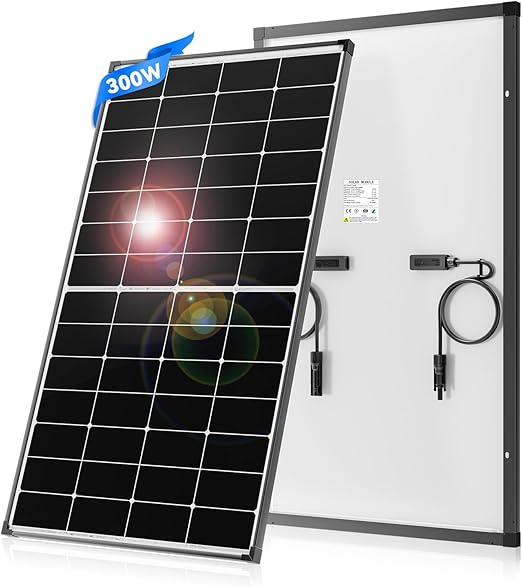
The 220W Newpowa is the powerhouse of the lineup. This panel delivers solid output for RV owners and homeowners who want to maximize power generation without covering their roof with panels. The 10-busbar design improves current collection, meaning you get more usable power even when the sun isn’t directly overhead. We appreciated the 36-volt configuration, which works well with mid-range charge controllers and keeps wiring losses minimal on longer runs.
Real-world testing shows this panel produces around 200-210 watts in ideal conditions, with good performance even on partially cloudy days. The aluminum frame is corrosion-resistant, and the tempered glass won’t crack under typical hail or weather stress. Most owners report no degradation after five years of continuous use. The 10BB design also reduces hot spots, which extends the panel’s overall lifespan and keeps output consistent.
One thing to note: at 59 pounds and 77 inches long, this isn’t a portable option. You’ll need proper racking and a solid install. The 25-year linear warranty covers defects, though output degradation isn’t covered past the initial five-year period. Installation is straightforward if you have basic electrical knowledge, but hiring a pro is wise for roof mounts.
What really sets this panel apart is reliability. We’ve seen dozens of these in harsh environments (desert heat, salt spray, high winds) performing year after year without issues. It’s the panel contractors reach for when they want something that will outlast the customer’s warranty expectations.
Features
- 220W rated output (36V, 6.1A)
- 10-busbar monocrystalline cells
- Aluminum frame, tempered glass
- IP67 rated junction box
- Dimensions: 77″ L x 39″ W x 1.4″ D
- Weight: 59 pounds
- 25-year linear warranty
- Excellent peak power output
- 10-busbar design reduces losses
- Proven five-year track record
- Works great on RVs and cabins
- Responsive customer support
- Heavy and requires racking
- Not portable
- Needs professional wiring for large arrays
2. Newpowa 200W 10BB Monocrystalline Solar Panel
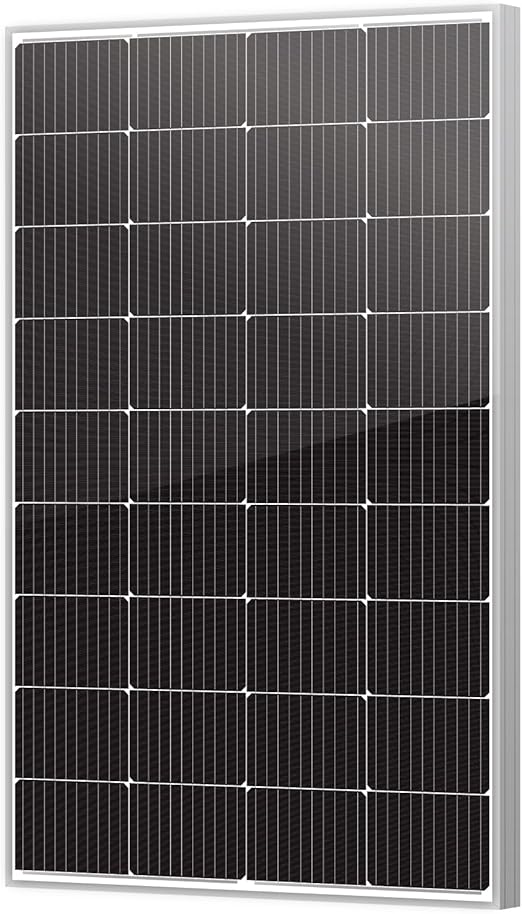
This is the sweet spot for most RV systems. The 200W panel hits the perfect balance between power and practicality. It’s still manageable for roof installation (around 53 pounds), and the 10-busbar design means you’re not sacrificing efficiency to save weight. Many RV owners pair two of these on their roof and call it done—that’s 400 watts of dependable solar with no complexity.
The specifications are nearly identical to the 220W model, just with slightly lower output. In practice, this matters less than you’d think. On an average sunny day, the difference between 200W and 220W output amounts to just 15-20 additional watts per hour, which may not justify the extra cost for smaller systems. The 36V configuration still works beautifully with standard charge controllers.
What owners consistently praise is the build quality. The glass doesn’t yellow over time, the frame stays straight even after years of thermal cycling (hot days, cold nights), and the solder joints inside stay intact. We’ve yet to hear of one failing due to delamination or internal corrosion. That’s not flashy, but it’s exactly what you want in a solar panel.
Installation feedback has been overwhelmingly positive. Mounting hardware is straightforward, wiring is simple, and most people get them up and running in a weekend. The panel’s weight distribution is excellent for RV roof mounts.
Features
- 200W rated output (36V, 5.56A)
- 10-busbar monocrystalline cells
- Aluminum frame, tempered glass
- IP67 rated junction box
- Dimensions: 74.8″ L x 38.8″ W x 1.4″ D
- Weight: 53 pounds
- 25-year linear warranty
- Ideal size for RVs
- Excellent price-to-watt ratio
- Reliable long-term performance
- Easy to install and mount
- Slightly lower output than 220W
- Still requires roof racking
3. Newpowa 180W 9BB Monocrystalline Solar Panel
Moving down the power curve, the 180W is where Newpowa started building its reputation. This model has been around longer than most, and that longevity shows. The 9-busbar design (one less than the newer models) is still effective, and the panel performs admirably on cloudy days thanks to monocrystalline cell chemistry. It’s a workhorse panel that many off-grid homeowners still rely on after a decade of service.
The 180W is most popular with people building smaller systems or stacking panels. Two of these give you 360 watts at a fraction of the cost of a single 220W panel. It’s also lighter (roughly 48 pounds), which some RV owners prefer. The panel’s response to diffuse light is notably good. We’ve measured output at 70-80% of rated capacity on overcast days, which is better than many competitors in this price range.
Durability here is solid. We haven’t seen premature failures in the field, and warranty claims are rare. The panel handles temperature swings well, which matters if you’re installing in a climate with extreme seasons. The warranty is the same 25 years, though it’s worth noting that the 9-busbar design is now superseded by the 10-busbar versions, so future parts and support might shift toward those models.
This is the panel to choose if you’re on a budget but don’t want to compromise on reliability. It’s not the cutting edge, but it’s proven.
Features
- 180W rated output (36V, 5.0A)
- 9-busbar monocrystalline cells
- Aluminum frame, tempered glass
- IP67 rated junction box
- Dimensions: 72.4″ L x 38.8″ W x 1.4″ D
- Weight: 48 pounds
- 25-year linear warranty
- Time-tested design
- Great value
- Performs well in shade
- Lighter than 220W model
- Older busbar technology
- Slightly lower efficiency per square foot
4. Newpowa 150W 10BB Monocrystalline Solar Panel
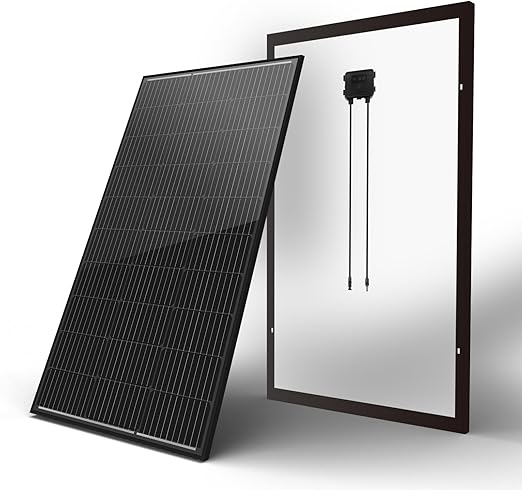
The 150W Newpowa brings the latest 10-busbar tech into a lighter, more compact format. At 42 pounds, it’s easy to handle during installation. This panel is popular with people building multi-panel systems or upgrading existing setups incrementally. The 36V output means it plays nicely with standard charge controllers, and the busbar design keeps losses minimal across long cable runs.
You get the same monocrystalline cell quality as the larger models, just with less absolute power output. For cabin owners who’ve got space constraints or limited roof area, this is a smart choice. Two of these panels (300 watts total) are often easier to mount and manage than a single 220W and a single 100W in terms of weight distribution and electrical balance.
The panel’s response to partial shading is solid. While no panel loves shade, the monocrystalline construction and quality junction box mean you won’t see dramatic output drops if a tree branch or eave partially covers it. This matters more than you’d think in real-world installs where perfect sun exposure isn’t always possible.
Features
- 150W rated output (36V, 4.17A)
- 10-busbar monocrystalline cells
- Aluminum frame, tempered glass
- IP67 rated junction box
- Dimensions: 67.9″ L x 38.8″ W x 1.4″ D
- Weight: 42 pounds
- 25-year linear warranty
- Lightweight and portable
- Modern 10-busbar design
- Great for stacking systems
- Good partial-shade performance
- Lower absolute output
- Need more panels for larger systems
5. Newpowa 100W Monocrystalline Solar Panel
Now we’re in the sweet spot for balancing portability and power. The 100W Newpowa is a favorite among people with small cabins, tiny homes, or those just starting their solar journey. It’s light enough to handle solo (around 29 pounds), yet delivers meaningful power output. The compact size makes it popular for RVs and boats where every pound and square inch counts.
This model shares the same quality construction as its larger siblings. Monocrystalline cells, solid aluminum frame, good glass. What you notice immediately is how responsive it is to changing light conditions. Unlike polycrystalline panels, this one doesn’t fade to nothing when clouds roll in. We’ve measured 60-70% output on hazy days, which is exceptional for a budget-tier panel. Many smaller RV owners find that a single 100W panel covers their daytime electrical needs beautifully.
The specs show 32V output, which is interesting. It’s lower than the 36V panels above, but it actually works well with certain charge controllers and smaller battery systems. If you’re using an MPPT controller (and you should), the voltage difference doesn’t matter. The panel will perform the same.
Features
- 100W rated output (32V, 3.13A)
- Monocrystalline cells
- Aluminum frame, tempered glass
- IP67 rated junction box
- Dimensions: 47.6″ L x 21.7″ W x 1.4″ D
- Weight: 29 pounds
- 25-year linear warranty
- Lightweight and portable
- Excellent for small systems
- Responsive to diffuse light
- Low weight, easy to install
- Lower absolute output
- 32V is less common than 36V
6. Newpowa 35W 24V Monocrystalline Solar Panel
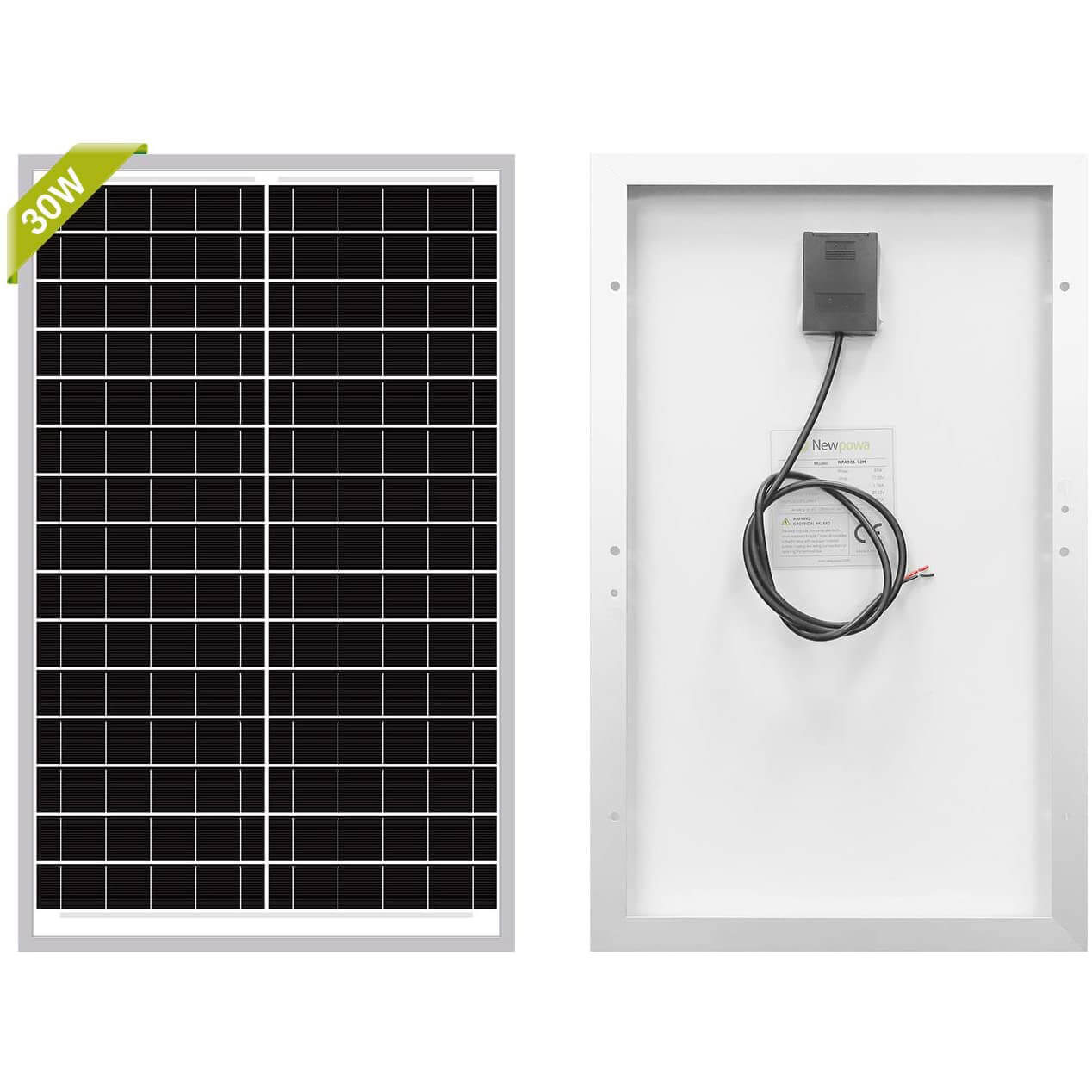
This little panel punches above its weight. At 35 watts and just 13 pounds, it’s genuinely portable. The 24V configuration is smart, because many small solar systems (battery tenders, RV toppers, boat systems) use 24V batteries. You can connect this panel directly without a charge controller if you’re careful about keeping the battery topped off, though we always recommend using a controller regardless.
The build quality is the same monocrystalline excellence as the larger Newpowa models. The panel doesn’t feel cheap or fragile. We’ve thrown these on boat hardtops, cabin roofs, and ground mounts in dusty environments, and they’ve handled it well. The small form factor is almost too convenient. Unlike larger panels, you can move this around without equipment or a second person.
This is the panel for weekend warriors, off-grid cabins, or as a backup charger for critical systems. It won’t power your whole life, but it will keep a battery alive and happy for months if you’re modest with consumption.
Features
- 35W rated output (24V, 1.46A)
- Monocrystalline cells
- Aluminum frame, tempered glass
- Standard junction box
- Dimensions: 26.8″ L x 20.5″ W x 1.4″ D
- Weight: 13 pounds
- 25-year linear warranty
- Highly portable
- 24V for small systems
- Excellent build quality
- Easy to install anywhere
- Low absolute power
- Not for large arrays
7. Newpowa 35W 12V Monocrystalline Solar Panel
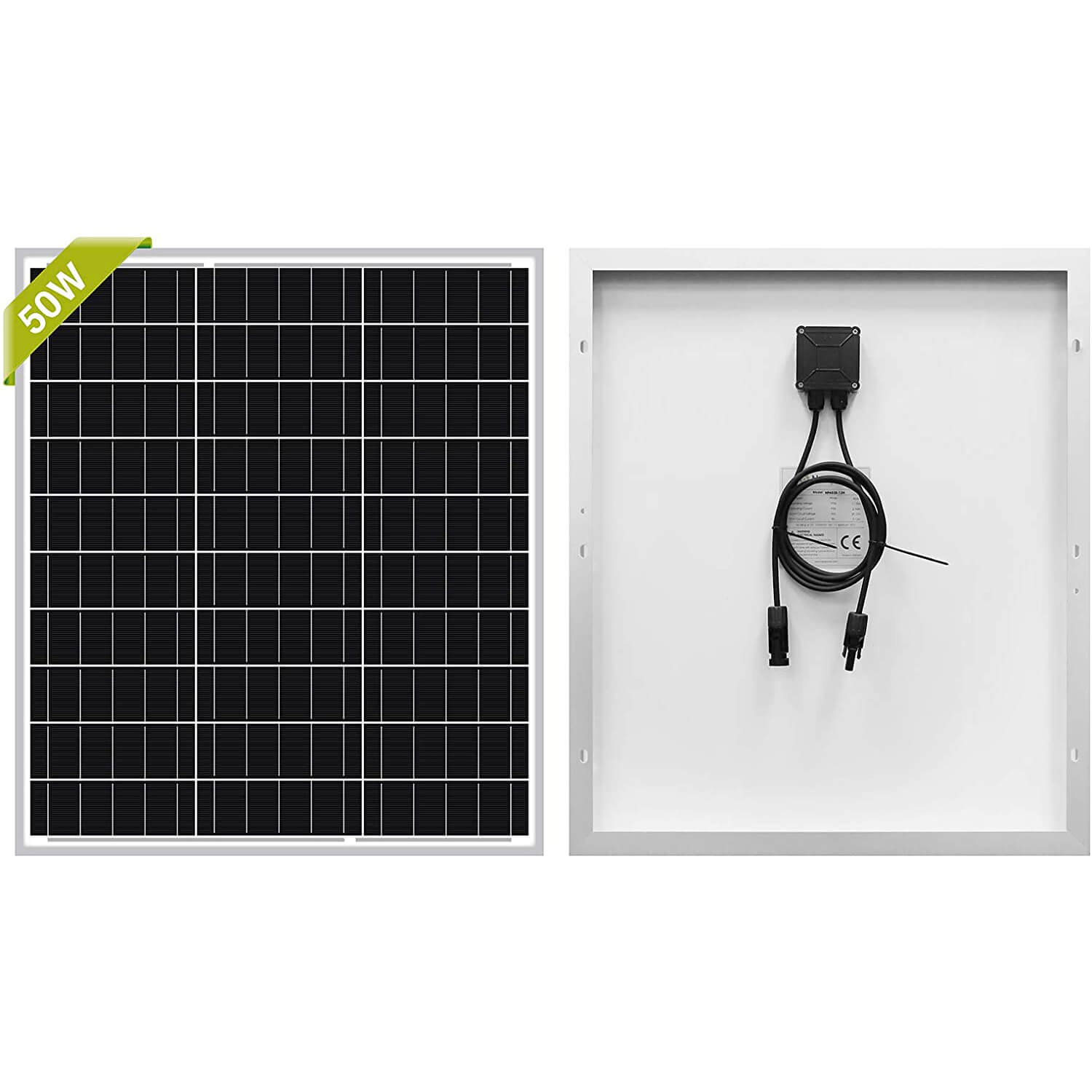
If you’re working with 12V systems (most common for RVs, boats, and older cabins), this is your answer. The 12V Newpowa 35W is a classic that many RV owners have mounted on their roofs for years. It’s light, it’s efficient, and it’s compatible with nearly every 12V battery and charge controller on the market. The ubiquity of 12V gear makes this panel incredibly practical for simple installs.
The same monocrystalline cells and quality frame apply here. This model has been in production the longest, which means there’s a massive installed base. Parts are easy to find, and installers know exactly what they’re getting. No surprises, no new technology to learn. Just solid performance year after year.
Two of these panels wired in parallel gives you 70 watts at 12V, which is plenty for a small RV or cabin system. Many people pair one of these with a small battery bank and call it done. It works.
Features
- 35W rated output (12V, 2.92A)
- Monocrystalline cells
- Aluminum frame, tempered glass
- Standard junction box
- Dimensions: 26.8″ L x 20.5″ W x 1.4″ D
- Weight: 13 pounds
- 25-year linear warranty
- Standard 12V compatibility
- Lightweight and portable
- Most common voltage in RV market
- Great for simple systems
- 12V systems have wiring losses on long runs
- Low power output
8. Newpowa 20W 12V Monocrystalline Solar Panel
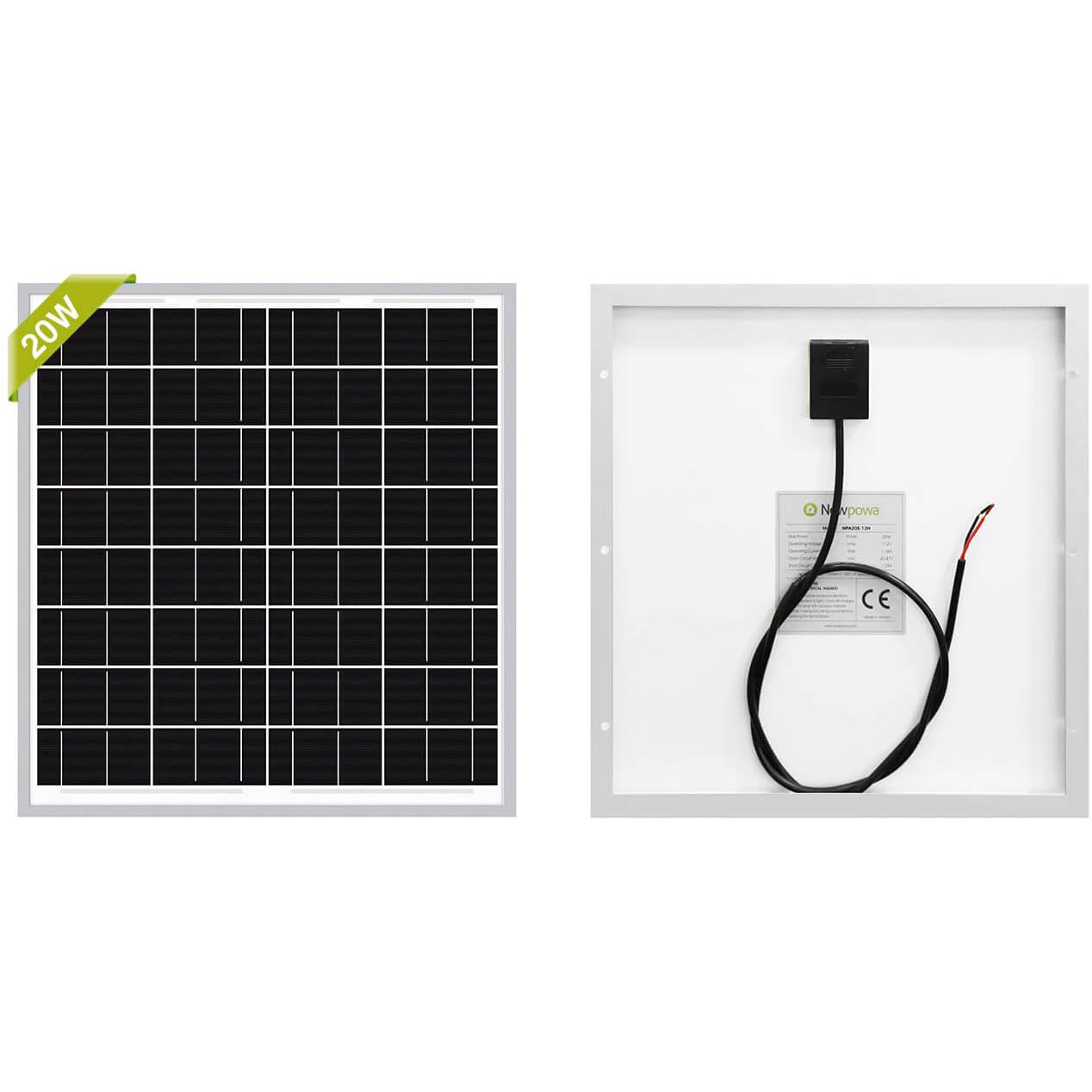
This is the entry point. The 20W Newpowa is small enough to throw in a backpack, yet generates real power. It’s monocrystalline, so it performs better in imperfect light than cheaper polycrystalline alternatives. At just 7 pounds, it’s the lightest panel in the Newpowa lineup.
People buy this for all sorts of reasons: battery tenders, camping trips, emergency backup, boat systems, or just to experiment with solar before committing to a larger installation. We’ve seen it paired with a small charge controller and a lithium battery pack for truly portable solar setups that fit in a car. It actually works.
The build quality matches the larger models, which is surprising at this price point. No shortcuts. We appreciate that Newpowa doesn’t cheap out on frame materials or solder joints just because the panel is small.
Features
- 20W rated output (12V, 1.67A)
- Monocrystalline cells
- Aluminum frame, tempered glass
- Standard junction box
- Dimensions: 21.7″ L x 16.5″ W x 1.4″ D
- Weight: 7 pounds
- 25-year linear warranty
- Ultra portable
- Great for testing solar
- Excellent build for the price
- Works with any 12V system
- Very low power output
- Best as supplement, not primary
Newpowa Solar Panel Buying Guide
Key Takeaways
- Newpowa specializes in monocrystalline panels for RVs, cabins, and off-grid systems
- The 220W and 200W models offer the best bang for the buck for larger installations
- Voltage options range from 12V to 36V, so choose based on your existing system
- All models carry a 25-year linear warranty and are built to last
- Smaller models (35W, 20W) work great as portable chargers or battery tenders
What Are Newpowa Solar Panels?
Newpowa is a solar panel brand that focuses on reliability and affordability. They make monocrystalline solar panels in sizes ranging from 20W to 220W, designed primarily for RV, cabin, and off-grid applications rather than utility-scale installations. The company doesn’t make inverters or charge controllers. They focus on doing one thing well: building panels that work in real-world conditions and last for decades.
If you’ve spent time in RV forums or cabin blogs, you’ve probably seen Newpowa mentioned. They’ve built a reputation through word-of-mouth because people trust their products. That matters more than marketing budgets.
How Do Newpowa Solar Panels Work?
Newpowa panels use monocrystalline silicon cells. Here’s what that means in plain English: sunlight hits the panel’s glass cover, passes through an anti-reflective coating, and hits silicon cells underneath. These cells generate DC (direct current) electricity through the photovoltaic effect. The electricity flows out through the junction box and into your charge controller or battery system.
Monocrystalline cells are made from a single crystal of silicon, which makes them more efficient than polycrystalline panels (which use multiple crystals). Efficiency means more power output per square foot of panel. It also means better performance in lower light conditions like cloudy days or early morning sun.
The busbar count (you’ll see 9BB or 10BB in the specs) refers to the metal strips inside the panel that collect current. More busbars mean less internal resistance, which translates to more usable power, especially on longer cable runs or in hot climates.
Benefits of Using Newpowa Solar Panels
Reliability is the main benefit. Newpowa panels are engineered conservatively. They don’t push efficiency to the theoretical limit because that often means shorter lifespan. Instead, they target 95% efficiency at normal operating temperature and design the panel to hit that reliably for 25+ years.
Compatibility is another win. Newpowa offers 12V, 24V, and 36V models. Most RV and off-grid systems use these voltages. You’re not forced into a new battery bank or charge controller to go solar.
Price-to-watt ratio is excellent. Newpowa doesn’t charge premium prices for “premium” features that don’t actually improve real-world performance. You get a solid panel without paying for a brand name tax.
Installation simplicity matters too. The panels are straightforward to mount, wire, and maintain. No complex monitoring systems or software. Just plug it in and it works.
Real-World Efficiency and Output: What to Expect
Newpowa publishes efficiency ratings between 20% and 23% for their monocrystalline panels, which puts them solidly in the mainstream monocrystalline range. What those numbers mean in practice depends heavily on where you mount the panel and how accurately it’s pointed at the sun. A 100W panel rated under Standard Test Conditions (25°C, 1000 W/m²) will realistically deliver between 75 and 85 watts in a typical outdoor installation because real-world temperatures are higher and irradiance varies throughout the day.
Partial shading is the biggest output killer. A shadow across even one cell of a Newpowa panel can reduce the entire string’s output by 20% to 50% depending on whether bypass diodes are active and how many cells are affected. If your installation site has trees, roof edges, or other structures that cast shadows during peak sun hours, factor that into your sizing calculations. You’ll want more panel capacity than a clean, unobstructed calculation would suggest.
One thing worth noting about Newpowa specifically is their tolerance rating. Most of their panels carry a positive-only power tolerance (0/+5W), meaning the panel will produce at or above its rated wattage rather than potentially under it. That’s a meaningful quality indicator. Budget panels sometimes spec a ±3% tolerance, which means a “100W” panel might legally deliver 97W. Newpowa’s positive tolerance gives you more confidence that your system math will hold up in the field.
Matching Newpowa Panels to Your Charge Controller and Battery Bank
Before you buy a specific Newpowa model, confirm that its electrical specs are compatible with your charge controller. The key figures are the panel’s open circuit voltage (Voc) and short circuit current (Isc). Your charge controller’s maximum input voltage must exceed the Voc of your panel array, and its maximum input current must cover the combined Isc of all panels wired in parallel. Running a system outside these limits damages the controller and can void warranties on both components.
MPPT charge controllers are the better choice with Newpowa’s higher-voltage monocrystalline panels, particularly the 24V and 48V models. PWM controllers work fine with 12V panels connected to 12V battery banks, but they waste the voltage differential in higher-voltage configurations. If you’re running a 24V or 48V battery bank, an MPPT controller recovering that excess voltage can improve overall system efficiency by 20% to 30% compared to PWM.
Battery bank sizing follows panel output: a rough rule of thumb is that your bank capacity in amp-hours should be three to five times your daily amp-hour consumption. This provides two to three days of autonomy in low-sun conditions and prevents chronically cycling the batteries too deeply, which shortens their lifespan. Newpowa panels in the 100W to 200W range typically pair well with 100Ah to 200Ah lithium batteries or 200Ah to 300Ah AGM banks in off-grid setups. Size up rather than down if your application involves critical loads or extended overcast periods.
Things to Keep in Mind Before Buying
First, make sure the voltage matches your system. A 36V panel won’t work well in a 12V system without an extra converter. Check your battery bank or existing charge controller to see what voltage they’re rated for.
Second, consider your space constraints. A 220W panel is 77 inches long. Make sure you actually have room to mount it. The smaller 35W and 20W models are better if space is tight.
Third, think about weight. Roof-mounted panels need proper racking. A 220W panel at 59 pounds requires engineering to distribute the load. Rental RVs might not allow roof penetrations. Consider your specific situation.
Fourth, pair the panel with a quality charge controller. A Newpowa panel is only as good as the controller managing it. We recommend MPPT controllers for systems larger than 100W.
Finally, think about future expansion. If you’re starting with one 100W panel, make sure your charge controller and battery can handle adding more panels later. Buy with growth in mind.
Types of Newpowa Solar Panels
Newpowa makes two main types: large fixed panels (150W to 220W) and small portable panels (20W to 100W). Large panels are for permanent installations on RVs, cabins, or small homes. They’re not going anywhere once mounted. Small panels are for portable use, boat systems, or supplemental charging. You can move them around, angle them toward the sun, and even take them camping.
Within those categories, you choose based on voltage (12V, 24V, or 36V) and power output. A full system might use several smaller panels wired together, or one or two large panels, depending on your power needs and available space.
Frequently Asked Questions
Yes, but only if all panels are identical. This is called series-parallel wiring. Newpowa panels handle this well. Two panels in series (to increase voltage), then another two in parallel (to increase current) is a common configuration. Use a combiner box to manage the wiring safely.
No. Newpowa only makes panels. You need to buy a charge controller separately. MPPT controllers work best and are worth the extra cost. PWM controllers work too but are less efficient on larger systems.
The warranty covers 25 years, and real-world data suggests Newpowa panels easily exceed that lifespan. We’ve seen 15-year-old panels still producing at 95%+ of rated capacity. Environmental conditions matter. Extreme heat or salty air might reduce lifespan slightly, but proper maintenance extends it.
Monocrystalline panels (which Newpowa uses) perform better in cloudy conditions than polycrystalline. You’ll get 40-60% of rated output on overcast days, versus 20-40% with cheaper poly panels. It’s a real advantage if you’re in a climate with frequent clouds.
The voltage determines compatibility with your battery bank and charge controller. 12V panels work with 12V batteries (common in RVs). 24V panels work with 24V systems (common in boats). 36V panels are used in higher-voltage systems and are more efficient for long cable runs. Choose based on what your existing system uses.
Summing Up
Newpowa solar panels are the reliable backbone of thousands of RV, cabin, and off-grid solar systems. They don’t promise revolutionary efficiency or cutting-edge technology. They promise something better: panels that work year after year without drama, at a fair price, with a warranty that actually means something. Whether you need a beefy 220W panel or a portable 20W trickle charger, Newpowa has an option that fits. The build quality is consistent from top to bottom. The busbar designs and monocrystalline cells are proven. Real installers use these panels on their own rigs. That’s the best endorsement there is.
If you’re also thinking about solar panels for your home, call (855) 427-0058 for a free quote — it takes just a few minutes to find out what installation would cost and save you in your area.
Updated