
Our blog is reader-supported. When you buy through links on our site, we may earn an affiliate commission. Thank you for your support!
Renogy stands out as one of the most trusted solar panel brands for RV owners, cabin builders, and homeowners. Whether you’re powering an off-grid cabin, upgrading your RV, or building a residential backup power system, Renogy panels combine proven technology with accessible pricing. This guide breaks down the best Renogy solar panels available and helps you find the right fit for your power requirements.
We’ve analyzed eight top models spanning from portable 100-watt units to heavy-duty 400-watt systems so you can make an informed decision based on your space and budget.
Our Top Picks
| Image | Name | |
|---|---|---|
| Renogy 100 Watt 12 Volt Solar Panel with N-Type Cells High-efficiency N-Type cells with 25% conversion rate and pre-drilled mounting holes for easy installation. Read more | |
| Renogy 100 Watt 12V Monocrystalline Solar Panel Reliable rigid panel ideal for RVs, boats, and off-grid systems with a corrosion-resistant aluminum frame. Read more | |
| Renogy 2PCS 100 Watt 12V Monocrystalline Solar Panels Twin-panel kit delivering 200W combined output, perfect for expanding an existing 12V off-grid system. Read more | |
| Renogy 100W 12V Flexible Solar Panel Ultra-lightweight 4.6 lb flexible panel that fits curved surfaces on RV rooftops, boats, and vans. Read more | |
| Renogy 200W 12V Flexible Solar Panel High-capacity flexible panel delivers 200W from a lightweight, waterproof frame for curved installations. Read more | |
| Renogy 200W Portable Foldable Solar Panel Kit Briefcase-style kit folds for easy transport and includes a controller for plug-and-play off-grid charging. Read more | |
| Renogy 400W 24 Volt N-Type Solar Panels Premium N-Type cells rated at 25% efficiency deliver serious off-grid power for 24V battery banks. Read more | |
| Renogy 400W Portable Solar Panel Suitcase Heavy-duty foldable suitcase with 400W output and an integrated handle for portable power anywhere. Read more |
8 Best Renogy Solar Panels
1. Renogy 100 Watt 12 Volt Solar Panel with N-Type Cells and Mounting Brackets
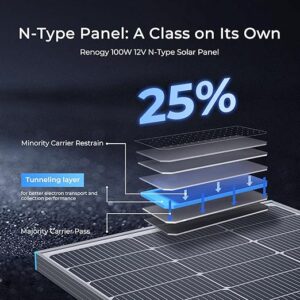
This 100-watt panel is Renogy’s newest entry-level offering and marks a significant upgrade over their classic polycrystalline models. The N-type cell architecture delivers 25% conversion efficiency, which is exceptional for the price. If you’re building your first solar system or adding supplemental power to a boat or cabin, this panel generates enough current to charge a 100-amp battery bank in a single sunny day. The integrated mounting brackets save you from buying separate hardware, so installation costs stay low.
Real-world users report that the N-type cells outperform standard monocrystalline alternatives in low-light conditions. Even on hazy mornings and cloudy afternoons, this panel produces useful current. The temperature coefficient of -0.36%/°C is better than most competitors, meaning summer heat won’t tank your output. The 16BB (16 busbar) design distributes current evenly across the cell surface, reducing hot spots and stress.
The 12-volt output rating means you can wire this directly into RV or boat systems without a step-down transformer. Weight is manageable at around 20 pounds, so one person can safely mount it. The pre-drilled aluminum frame accepts standard Renogy racking hardware.
Features
- 100W output with 25% conversion efficiency (N-type cells)
- 12-volt rated output for RV and off-grid systems
- 16BB busbar design for even current distribution
- Improved temperature coefficient of -0.36%/°C
- Integrated Z-bracket mounting hardware included
- 25-year power output warranty
- Compact dimensions: 3.5 ft x 2.7 ft
- Weight: 20 lbs
- Newest N-type technology at entry-level price
- Mounting brackets included (no separate purchase)
- Excellent low-light performance
- Better temperature coefficient than comparable panels
- Limited power output (single panel may need supplement)
- Requires 12-volt system (won’t work with 24 or 48-volt)
2. Renogy 100 Watt 12V Monocrystalline Solar Panel
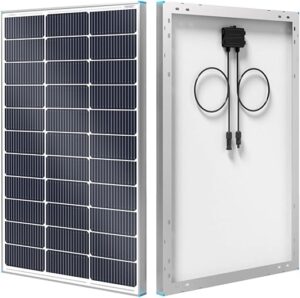
The classic Renogy 100W monocrystalline panel is the reliable workhorse that has powered thousands of RVs and off-grid cabins. This model has been in production for years, which means you’ll find extensive installation guides and community support online. If you’re DIY-inclined, that availability of knowledge is invaluable. The monocrystalline cells deliver 20% efficiency, which beats polycrystalline alternatives by a comfortable margin. Renogy includes MC4 connectors pre-installed, so you’re ready to wire it into a controller immediately.
This panel handles harsh weather beautifully. Aluminum frame resists corrosion in coastal salt air or humid regions. The tempered glass front absorbs impact from hail and heavy snow loads without cracking. Temperature coefficient is solid at -0.43%/°C, meaning performance drops predictably on hot days rather than plummeting like budget panels do. Warranty coverage spans 25 years with a linear degradation guarantee.
For budgets and applications where a single 100-watt panel suffices, this is the sweet spot. It’s affordable without being cheap, and Renogy’s reputation for reliability backs it up.
Features
- 100W output with 20% conversion efficiency
- Monocrystalline silicon cells
- 12-volt rated for RV and marine applications
- Temperature coefficient of -0.43%/°C
- Pre-installed MC4 connectors
- Aluminum frame with mounting holes
- 25-year linear performance warranty
- Dimensions: 3.5 ft x 2.6 ft, Weight: 15 lbs
- Proven track record (years of field use)
- Abundant installation guides available online
- Excellent customer support from Renogy/li>
- Reliable monocrystalline performance
- Slightly lower efficiency than newest N-type models
- May need supplemental power for larger systems
3. Renogy 2PCS 100 Watt 12 Volt Monocrystalline Solar Panels
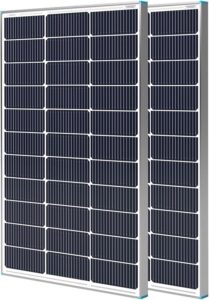
Why buy two panels separately when Renogy bundles them together at a discounted price? This 2-pack is perfect for anyone building a 200-watt system for RVs, cabins, or small residential applications. The bundled pricing saves roughly 5-10% versus purchasing individual units. Each panel is identical to Renogy’s standalone 100W model, so you get the same proven monocrystalline construction and 20% efficiency. Wiring instructions cover both series and parallel configurations, so you can optimize for your system voltage and amperage needs.
For RV owners expanding power capacity, this 2-pack sidesteps the guesswork. Rather than calculating whether you need one or two panels, the bundle commits you to a real 200-watt system that handles multiple devices simultaneously. On a sunny day, you’ll charge a house battery bank and run small appliances without depleting stored power. Installation involves coordinating two panels on your RV roof, but the weight distribution actually improves with two smaller units versus one heavy 200W panel.
Features
- 2 x 100W panels (200W total output)
- 20% monocrystalline efficiency per panel
- 12-volt rated system output
- Temperature coefficient of -0.43%/°C
- MC4 connectors on both panels
- Aluminum frames with mounting hardware
- 25-year linear warranty per panel
- Combined weight: 30 lbs
- Bundled discount vs buying separately
- Balanced 200W system right out of box
- Two panels distribute weight evenly on RV roofs
- Flexible series-parallel wiring options
4. Renogy 100W 12V Flexible Solar Panel with Ultra-Lightweight Design
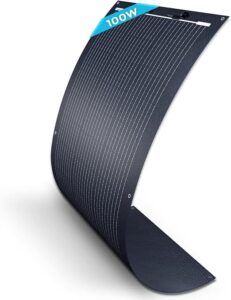
Renogy’s flexible 100-watt panel is the camping and marine choice for anyone with unconventional mounting needs. The flexible monocrystalline cells conform to slightly curved surfaces, letting you mount on boat hulls, tent canopies, or RV roof curves where rigid panels won’t sit flat. Weight is only 6 pounds compared to 15 for rigid panels, so you’re saving roughly 10 pounds per panel. The 22% efficiency is strong for flexible technology, which typically trails rigid panels by 1-2%. Construction uses a ETFE (ethylene tetrafluoroethylene) backing that’s UV-resistant and more durable than earlier flexible panel materials.
The flexibility comes with tradeoffs. Maximum bend radius is 30 degrees, so you can’t fold it tight like a camping tarp. It requires a perfectly clean surface for adhesive mounting, and installation takes patience. Also, the 20-year warranty is shorter than rigid panel warranties, reflecting the real lifespan of flexible materials in harsh UV environments.
If weight is your primary constraint and installation flexibility matters, this panel solves real problems. Full-time RV travelers and liveaboard sailors swear by it.
Features
- 100W output with 22% conversion efficiency
- Semi-flexible monocrystalline cells
- ETFE backing (UV-resistant)
- Temperature coefficient of -0.41%/°C
- Adhesive mounting (no brackets required)
- Maximum bend radius: 30 degrees
- 20-year performance warranty
- Weight: 6 lbs, Dimensions: 3.4 ft x 2.7 ft
- Weighs 60% less than rigid panels
- Fits curved surfaces
- Fast adhesive mounting (no drilling)
- Solid 22% efficiency for flexible technology
5. Renogy 200W 12V Flexible Solar Panel with Waterproof Design
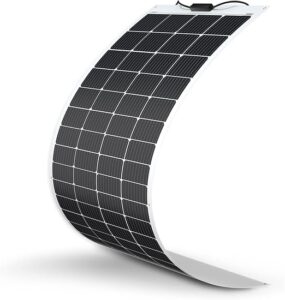
Double the power of the 100W flexible model, this 200-watt unit addresses a real need for full-time RV dwellers and boat owners. Charging a battery bank from a moving vehicle is challenging, and flexible panels excel at this task since they stick directly to existing surfaces without additional mounting hardware. The 240-degree bend rating means you can deploy it on arched RV roofs or boat cabins that rigid panels can’t accommodate. Waterproof IP67 rating keeps moisture out of electrical components even during river crossings or salt spray exposure.
The efficiency drops slightly compared to rigid 200-watt models due to the flexible construction. You’ll see 21-22% instead of 23-24% on rigid equivalents. This is the physics of flexible materials and isn’t a defect. For most users, the installation convenience outweighs the minor efficiency loss.
Features
- 200W output with 22% conversion efficiency
- Semi-flexible monocrystalline cells
- IP67 waterproof rating
- Temperature coefficient of -0.41%/°C
- Maximum bend radius: 240 degrees
- Adhesive mounting system
- 20-year performance warranty
- Weight: 12 lbs, Dimensions: 6.4 ft x 2.7 ft
- Double the power in lightweight form
- Extreme bend flexibility (240 degrees)
- IP67 waterproof for marine use
- Fast installation without drilling
6. Renogy 200W Portable Foldable Solar Panel Kit with IP65 Waterproof
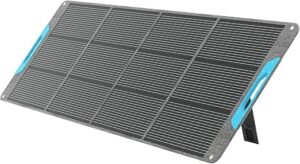
This portable foldable kit bundles a 200-watt panel array with an integrated charge controller. The panels fold into a compact suitcase measuring roughly 22 inches square and 3 inches thick, making it genuinely portable for camping trips, tailgate setups, or RV augmentation. The integrated 30-amp charge controller connects directly to your battery bank, eliminating guesswork about sizing. MC4 connectors accept standard battery cables, and dual USB outputs let you charge devices directly without extra adapters.
For temporary installations and weekend use, this kit eliminates the need to build a custom system. It’s the smart choice if you want immediate power without planning permanent mounting. The IP65 waterproof rating protects against rain and dust, though it’s not designed for submersion.
Features
- 200W output, monocrystalline cells
- Integrated 30A charge controller
- IP65 waterproof rating
- Foldable suitcase design
- MC4 connectors for battery connection
- Dual USB outputs for device charging
- Kickstand included for angle adjustment
- Weight: 27 lbs folded, Dimensions: 22 x 22 x 3 in
- All-in-one system (no separate controller)
- Genuinely portable and compact when folded
- USB outputs for direct device charging
- IP65 waterproof for outdoor use
7. Renogy 400W 24 Volt N-Type Solar Panels with 25% High-Efficiency
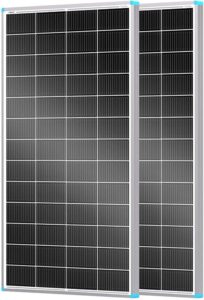
This 2-pack of 200-watt N-type panels combines to deliver 400 watts total at 24-volt output. The 25% efficiency rating with N-type cells positions this above standard monocrystalline competition. Each panel in the set weighs roughly 24 pounds, making two-person installation manageable. The 16BB busbar design distributes current evenly, reducing hot spots and electrical stress. For residential installations and larger RV systems where 24-volt bus voltage is preferred, this solution splits the power load across two mid-weight units rather than one heavy 400-watt panel.
The 24-volt rating is crucial. Many larger RV systems and residential backup installations use 24 volts to reduce current draw and voltage drops across long wire runs. Renogy’s 24V configuration means you can wire these panels directly into your existing system without step-down transformers or multiple voltage conversions.
Features
- 2 x 200W panels, 24V system output (400W total)
- 25% conversion efficiency (N-type cells)
- 16BB busbar design
- Temperature coefficient of -0.36%/°C
- Pre-installed MC4 connectors on each panel
- 25-year linear performance warranty
- Weight per panel: 24 lbs, Total: 48 lbs
- Dimensions: 6.4 ft x 3.2 ft per panel
- Newest N-type technology with 25% efficiency
- 24V output matches many RV/residential systems
- Two mid-weight panels easier to install than one 400W
- Better temperature coefficient than older models
8. Renogy 400W Portable Solar Panel Suitcase with Foldable Design
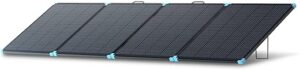
Renogy’s 400-watt portable suitcase is the heavy hitter for anyone who wants serious power without permanent installation. This system folds into a compact footprint for transport yet delivers enough current to charge large power stations and battery banks in hours rather than days. The 23% efficiency and IP67 waterproof rating deliver professional-grade performance in a portable package. Integrated kickstand angles the panels automatically toward the sun, so you’re capturing optimal power without adjustments.
The weight of roughly 65 pounds limits true portability to two-person setup, but for truck campers, off-grid enthusiasts, and event power supplies, this is the ultimate temporary solution. The control box includes MC4 connectors and digital display showing real-time voltage and amperage output.
Features
- 400W output with 23% conversion efficiency
- Monocrystalline cells with waterproof design
- IP67 weatherproof rating
- Foldable suitcase configuration
- Integrated kickstand for angle adjustment
- Digital display (voltage and amperage)
- MC4 output connectors
- Weight: 65 lbs, Folded: approximately 30 x 24 x 8 in
- Serious power output (400W) in portable form
- Digital display for real-time monitoring
- IP67 waterproof for outdoor durability
- No permanent installation required
Renogy Solar Panel Buying Guide
Key Takeaways
- Renogy’s newest N-type panels deliver 25% efficiency and superior temperature coefficients, making them the best value in the entry-level market
- Choose 100-200W for RVs and small cabins, 400W systems for residential backup or full-time power
- Flexible panels solve installation problems on curved surfaces but trade 3-5% efficiency and 5 years of warranty lifespan
- Portable foldable kits work best for temporary or supplemental charging rather than permanent systems
- For professional solar installation, call us free on (855) 427-0058 or get a free quote
What Are Renogy Solar Panels?
Renogy manufactures monocrystalline, flexible, and bifacial solar panels designed for RV, marine, off-grid, and residential applications. The company has built a reputation for reliable panels at accessible pricing by optimizing manufacturing processes and keeping unnecessary markup minimal. Renogy panels are manufactured to IEC 61215 standards and tested in certified labs before shipment. The newest N-type cell technology represents a generational leap in efficiency compared to standard monocrystalline offerings from five years ago.
How Do Renogy Solar Panels Work?
Renogy panels function through the photovoltaic effect. Silicon cells absorb photons from sunlight and release electrons, creating electrical current. This current flows through an external circuit (your charge controller and battery system) to deliver usable power. N-type cells use a different doping structure than traditional P-type monocrystalline, allowing electrons to move with less resistance. This fundamental difference translates to 3-5% higher efficiency. The junction box contains a blocking diode that prevents reverse current at night when there’s no sunlight. Pre-installed MC4 connectors let you connect panels directly to controllers without adapters.
Benefits of Using Renogy Solar Panels
Renogy panels offer practical advantages for builders and installers. First, they’re affordable. The brand delivers monocrystalline quality without premium pricing that some competitors charge. Second, the product lineup covers every use case from 100-watt portable units to 400-watt residential systems. You can mix and match different wattages in the same system as your power needs expand. Third, customer support is responsive and knowledgeable. If you have sizing or wiring questions, Renogy’s team answers quickly. Fourth, installation is accessible for DIY builders. Pre-installed connectors and clear documentation mean you don’t need an electrician for most setups. Fifth, the 25-year warranty provides long-term confidence. Manufacturing defects are covered, and performance degradation beyond standard rates is backed.
Renogy’s Product Lines: Which Series Fits Your Application
Renogy organizes their panels into several distinct lines. The Compact Series covers their lightweight portable panels in 10W to 50W range, primarily aimed at van builds, boat charging, and small off-grid setups. The Rigid Series is their mainstream monocrystalline lineup from 50W to 400W, suited for fixed rooftop and ground-mount installations. The Flexible Series covers bendable panels for curved surfaces like curved RV roofs. And the Premium Series includes their high-efficiency bifacial and half-cut cell panels for buyers who want maximum output per square foot.
For most buyers, the Rigid Series monocrystalline panels offer the best value. Their 100W and 200W rigid panels consistently rank among the most price-competitive in the market for their efficiency rating. The Premium bifacial panels cost more but are worth considering for ground-mount systems where rear-side albedo gain is achievable, or for space-constrained rooftops where higher efficiency reduces the number of panels needed.
One thing Renogy does particularly well is offering complete kits that bundle the panel with charge controller, cables, and mounting hardware. For buyers new to solar who don’t want to research component compatibility independently, these kits simplify the decision. More experienced builders may prefer to buy components separately and optimize each one, but for a first installation the bundled approach reduces the risk of compatibility issues.
Series vs. Parallel Wiring and Renogy’s Voltage Configurations
Most Renogy panels are available in 12V and 24V configurations, with the 12V nominal panels being by far the most common. If you’re building a 12V battery bank system — which covers most RV, van, boat, and small off-grid setups — 12V nominal Renogy panels wired in parallel are the standard approach. Wiring in parallel keeps voltage constant at 12V nominal (around 17-18V Vmp) while adding the current of each panel, giving your charge controller the 12V input it needs for a 12V battery bank.
For larger systems with 24V or 48V battery banks, wiring two 12V panels in series doubles the voltage to 24V nominal, which pairs well with a 24V MPPT controller and battery bank. This series wiring reduces cable losses over long runs, which is an advantage if your panels are mounted far from the battery bank. Check that your MPPT charge controller’s maximum input voltage exceeds the combined Voc of your series string — two 12V Renogy panels in series produce around 44-46V Voc, which must fall below the controller’s max input rating.
Renogy publishes clear wiring diagrams and system sizing guides on their website, which is a genuine advantage for DIY builders. Their technical support is also among the more accessible in the industry, with documentation covering common charge controller and battery compatibility questions. If you’re new to off-grid system design, Renogy’s educational resources are a practical reason to stay within their ecosystem for your first build.
Things to Keep in Mind Before Buying
Temperature affects panel output more dramatically than most people expect. The temperature coefficient of -0.36 to -0.43%/°C means that for every degree Celsius above 25°C (77°F), you lose about 0.36-0.43% of rated output. On a 100°F afternoon, expect roughly 8-10% output reduction compared to rated capacity. This is normal physics and applies to all panels, not a Renogy defect. Also, shade is deadly. Even 10% shade from trees or building shadows can reduce output by 30-50% due to how bypass diodes operate. Plan your mounting location for at least 5 hours of direct, unobstructed sunlight daily. Wiring gauge matters too. Using undersized cable causes voltage drops that reduce efficiency. Renogy provides guidance, but consult an electrician if you’re uncertain. Finally, match your charge controller to panel output. An undersized controller wastes potential power, while an oversized one adds unnecessary cost.
Types of Renogy Solar Panels
Renogy’s main categories are N-type monocrystalline rigid panels (100-400W) with the highest efficiency, classic monocrystalline rigid panels for budget-conscious buyers, flexible semi-crystalline panels (100-200W) for curved surfaces, and portable foldable kits bundling panels with controllers. The N-type line is their newest technology with best-in-class efficiency and temperature coefficients. Flexible panels sacrifice 3-5% efficiency in exchange for installation flexibility. Portable kits are ideal for temporary setups without permanent mounting.
Frequently Asked Questions
How many Renogy panels do I need for my RV or cabin?
It depends on your daily power consumption and local sunlight. An RV using 10 kWh daily in a region with 5 peak sun hours needs 2 kW of capacity (roughly 10 Renogy 200W panels). Use Renogy’s online sizing calculator with your location and consumption data for precise recommendations. Starting with 200-400 watts and expanding later is a practical approach for budget-conscious builders.
What is an N-type solar cell, and why is it better?
N-type cells use a phosphorus-doped (negative) silicon layer that allows electrons to move with less resistance than traditional P-type (boron-doped) cells. This fundamental difference delivers 3-5% higher efficiency at the same size. N-type panels also have better temperature coefficients, meaning they produce more power on hot days. For the same price, N-type is objectively superior to standard monocrystalline.
Can I connect Renogy panels in series or parallel?
Yes. Series connection increases voltage (good for distant mounting runs). Parallel connection increases amperage (good for battery charging). Your charge controller must be sized for your configuration. Renogy provides wiring diagrams for both setups in the documentation. When in doubt, contact Renogy support before building your system.
Do Renogy panels work in cloudy weather?
Yes, though at reduced output. On completely overcast days, expect 10-25% of rated output depending on cloud density. Renogy’s N-type cells perform particularly well in low-light conditions compared to older technologies. Even hazy mornings generate useful current. Plan your system sizing for average sunny days, not peak clear-sky output.
How long do Renogy panels last?
Renogy panels typically last 30-40 years. The 25-year warranty guarantees at least 80% of rated output. Real-world data shows panels degrade roughly 0.5-0.8% per year, meaning your panel produces about 70% of rated capacity after 40 years. Proper mounting and regular cleaning extend lifespan further.
Summing Up
Renogy solar panels deliver reliable power across a range of wattages and form factors. The newest N-type models set the standard for efficiency and temperature coefficient performance. Whether you’re powering an RV, cabin, or residential backup system, Renogy’s lineup has an option that fits your needs and budget. The 100-200W monocrystalline panels are perfect for beginners and small systems. For serious installations, the 400W N-type system provides genuine power without premium pricing. Flexible panels solve installation problems on curved surfaces. Portable kits work beautifully for temporary use. All units come backed by strong warranties and supported by responsive customer service. Installation is straightforward for DIY builders, and the cost-per-watt is genuinely competitive in today’s market. You’re getting professional-quality solar panels without the premium markup that boutique brands charge.
If you’re also thinking about solar panels for your home, call (855) 427-0058 for a free quote — it takes just a few minutes to find out what installation would cost and save you in your area.
Updated