
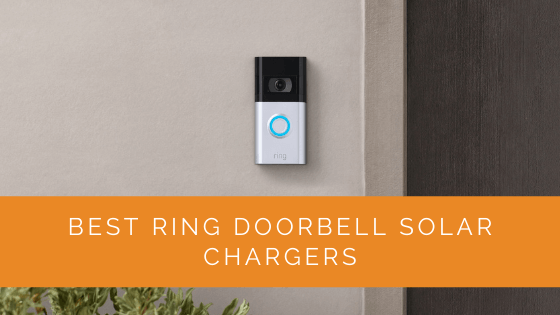
Our blog is reader-supported. When you buy through links on our site, we may earn an affiliate commission. Thank you for your support!
The best Ring doorbell solar charger in 2026 is the Ring Solar Charger for Battery Doorbells (2nd Gen) — the official Ring-made accessory that clicks directly onto compatible Ring doorbells, requires no tools, and needs just 3–4 hours of daily sun to keep your doorbell battery topped up indefinitely. But the right charger depends entirely on which Ring doorbell you own: different models use different connectors, and using the wrong charger risks a poor fit or no charging at all.
We’ve reviewed the best Ring doorbell solar chargers — official Ring accessories and the top-rated third-party alternatives — covering every current Ring battery doorbell model. Whether you have a Ring Video Doorbell 3, 4, Battery Doorbell Plus, or Battery Doorbell Pro, there’s a solar charger that fits without adapters or workarounds.
Our Top Picks
| PRODUCT IMAGE | PRODUCT | PRICE |
|---|---|---|
 | Ring Solar Charger for Battery Doorbells — Official Official Ring solar charger designed specifically for Ring Battery Doorbell and Ring Doorbell (2nd Gen). Mounts to any wall or eave, trickle charges the battery whenever sunlight is available. | CHECK PRICE |
 | Ring Solar Charger for Battery Doorbell — 2024 Models Updated official Ring solar charger compatible with newer 2024 Battery Doorbell models. Same simple clip-and-mount install with a weatherproof build rated for year-round outdoor use. | CHECK PRICE |
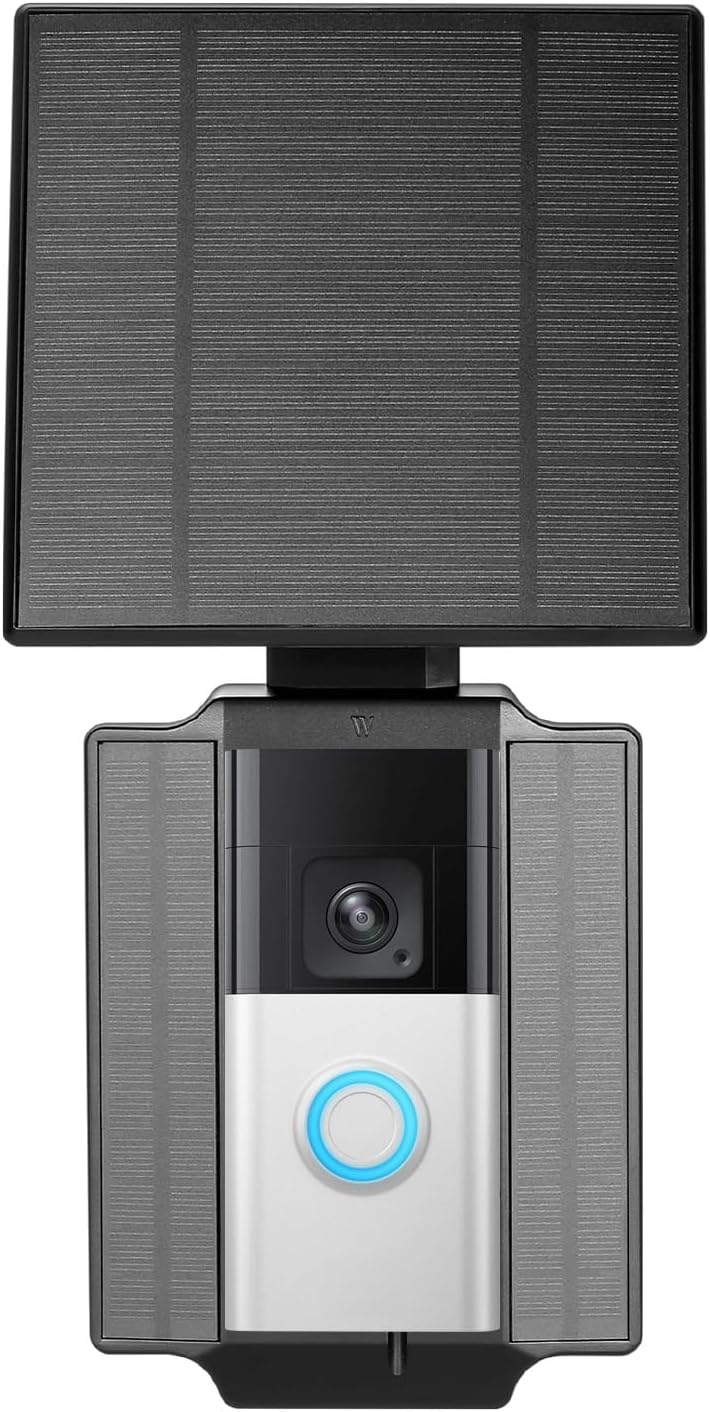 | Wasserstein Universal Solar Charger for Ring Third-party solar charger with a wider compatibility range than the official Ring unit. Works with Ring Battery Doorbells and several Video Doorbells — includes adjustable mounting bracket. | CHECK PRICE |
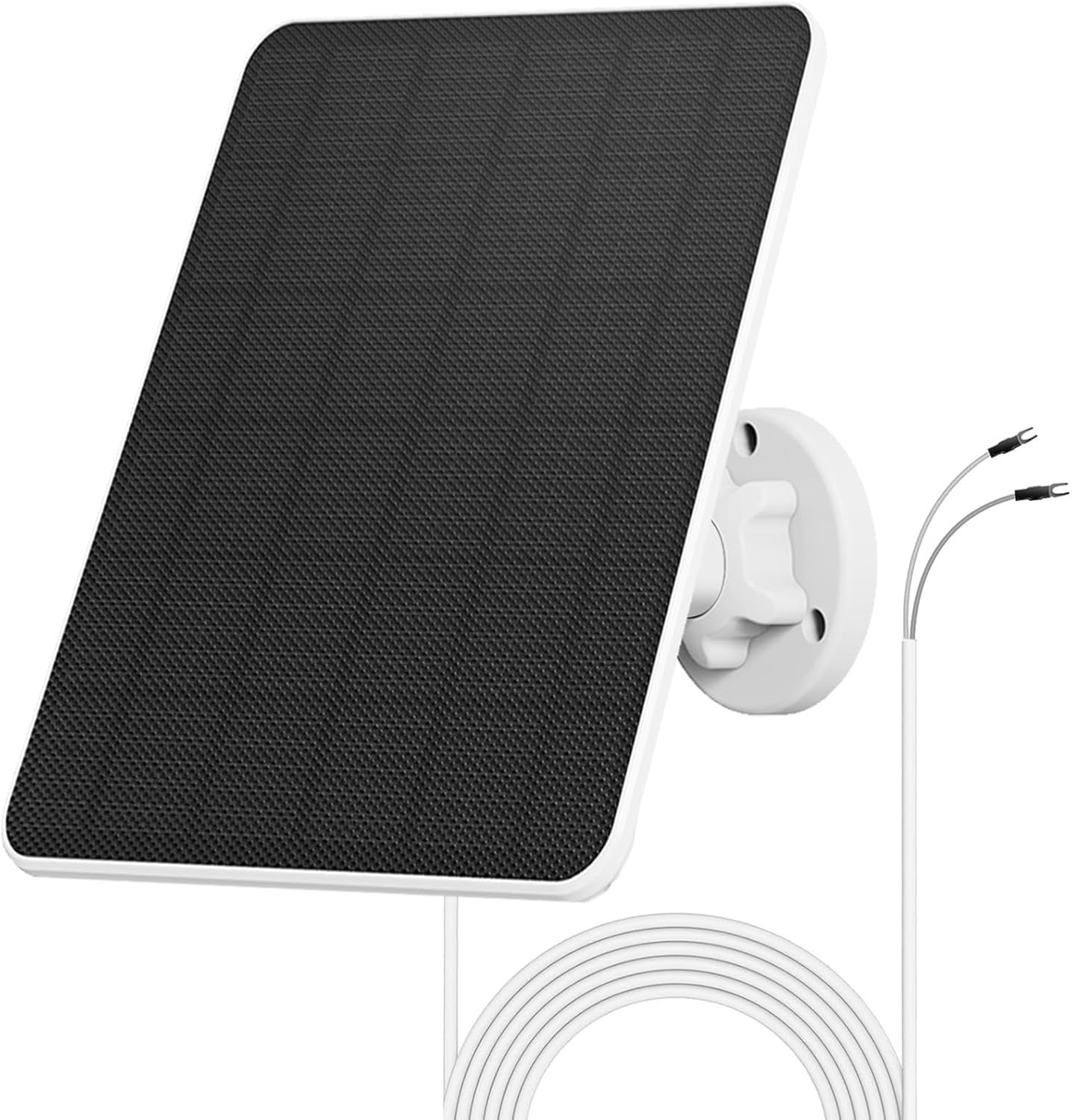 | 6W High-Output Solar Panel for Ring Doorbell Higher-wattage 6W panel delivers faster trickle charging — ideal for shaded north-facing doors that get limited direct sun. Charges Ring doorbells and security cameras via USB. | CHECK PRICE |
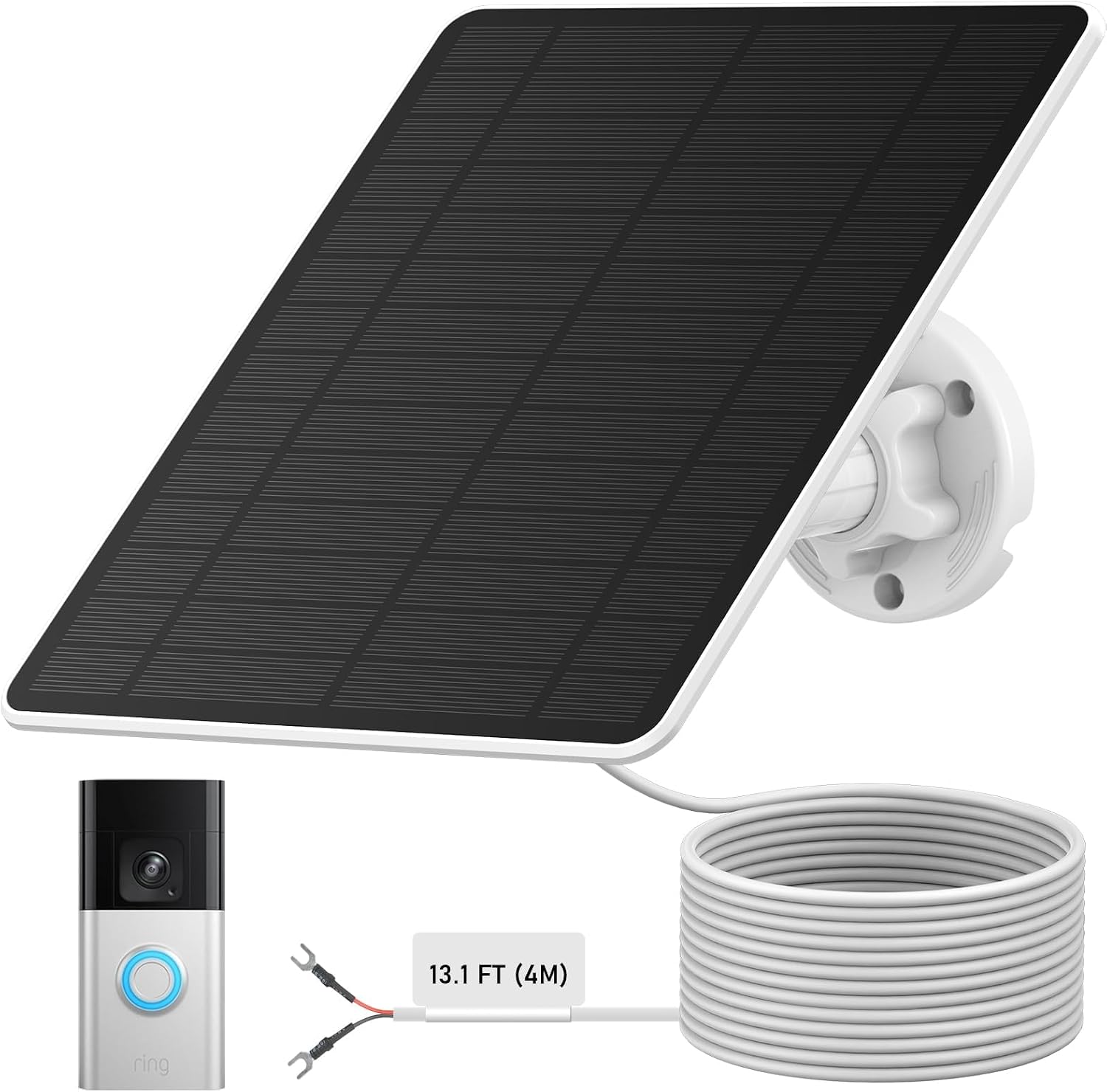 | 360° Adjustable Solar Charger for Ring (Fast Charging Cable) Fully adjustable 360° swivel mount lets you angle the panel to face the sun regardless of doorbell position. Includes fast-charge cable for compatible Ring models. | CHECK PRICE |
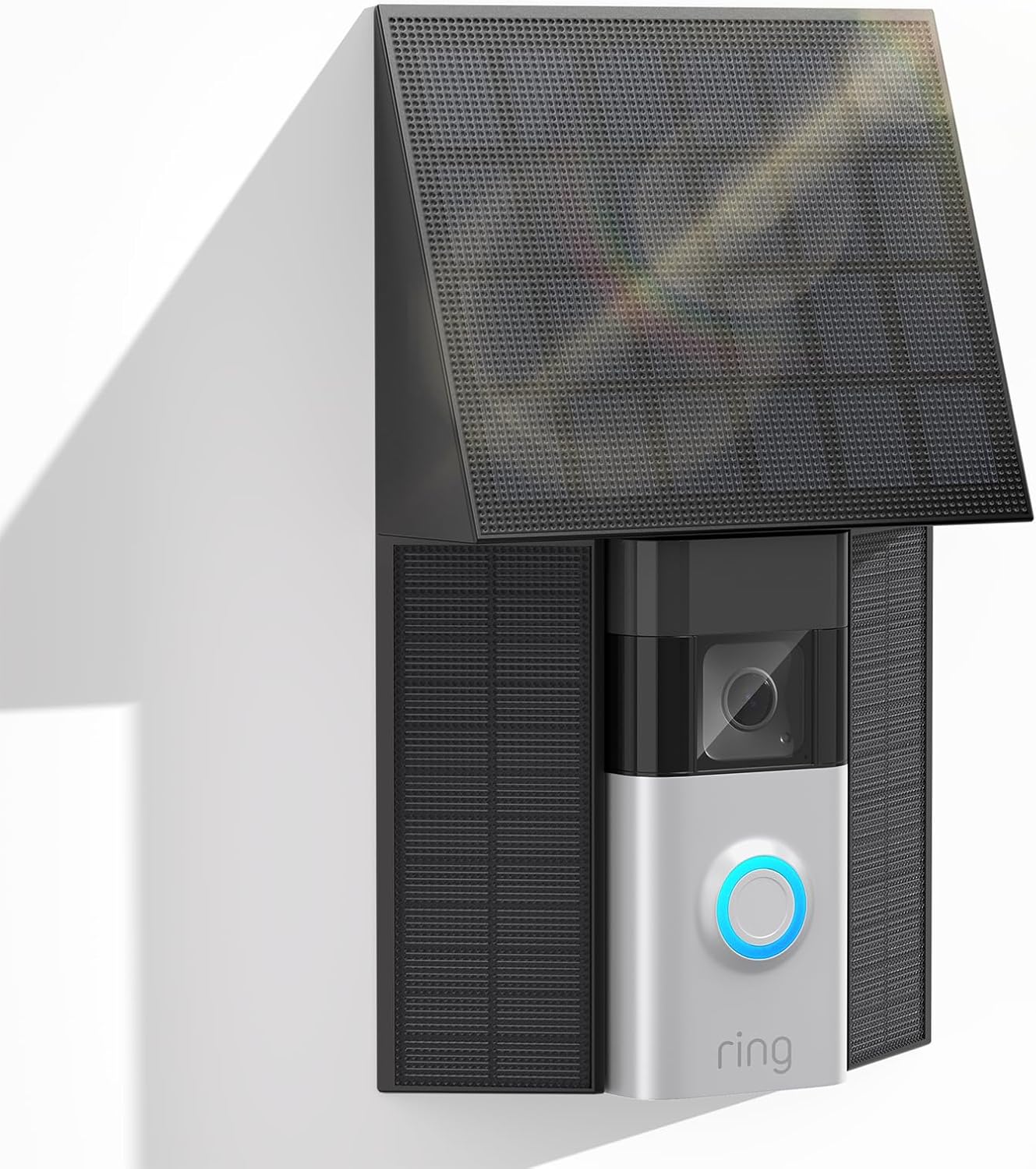 | Solar Charger for Ring Battery Doorbells (2-Prong) Budget-friendly 2-prong solar charger for Ring Battery Doorbells. Simple clip attachment installs in under a minute — keeps the battery topped up year-round in sunny locations. | CHECK PRICE |
1. Ring Solar Charger for Battery Doorbells — Best Official Ring Charger
The official Ring Solar Charger is the cleanest solution for most Ring doorbell owners. It uses a proprietary quick-connect bracket that snaps directly to your Ring doorbell mount — no tools, no drilling, no separate cable routing. The micro-USB connector slides into the charging port on the back of compatible Ring doorbells (Video Doorbell 3, 3 Plus, 4, Battery Doorbell Plus, Battery Doorbell Pro) with a waterproof seal. Ring engineered this specifically to their doorbells, so fit and finish are seamless compared to third-party brackets.
Ring’s 2nd Gen Solar Charger improves on the original with 35% more power output, which makes a practical difference on partly cloudy days and in winter when sun angles are lower. With 3–4 hours of direct daily sun, most users report their doorbell battery staying between 90–100% year-round without manual recharging. Comes in both black and satin nickel to match Ring’s standard colorways.
Compatible with: Ring Video Doorbell 3, 3 Plus, 4, Battery Doorbell Plus, Battery Doorbell Pro.
Not compatible with: Ring Video Doorbell 1st gen, Doorbell 2, Doorbell Wired, any hardwired Ring models.
Pros: Perfect fit, no tools, official Ring build quality, 35% more output than original, weatherproof seal, two color options.
Cons: Only works with specific Ring models, pricier than third-party alternatives.
2. Ring Solar Charger for Battery Doorbell — For Newer 2024 Models
Ring’s newer Battery Doorbell (2024 release) uses a different connector than the Ring Video Doorbell 3/4 lineup — specifically a 4-pin port rather than micro-USB. If you bought a Ring Battery Doorbell (the base model, not Plus or Pro) after 2023, this is the correct solar charger. Using the older 2nd Gen charger won’t connect properly to newer models.
The charger design is nearly identical to the 2nd Gen — same snap-on bracket, same weatherproof build, same 3–4 hour sun requirement — but with the correct connector for the current Battery Doorbell generation. If you’re unsure which Ring model you have, check the back of the unit: a round port is micro-USB, a rectangular 4-pin port indicates the newer connector that this charger fits.
Compatible with: Ring Battery Doorbell (2023/2024 model).
Not compatible with: Ring Video Doorbell 3/4, Battery Doorbell Plus/Pro, or older Ring models.
Pros: Official Ring, correct connector for newest Battery Doorbell, seamless installation.
Cons: Narrow compatibility — only for the current base Battery Doorbell.
3. Wasserstein Universal Solar Charger — Best Third-Party Pick
Wasserstein is the most trusted third-party Ring accessory brand and their Universal Solar Charger earns that reputation. The 2.5W monocrystalline panel delivers more power than Ring’s official charger (Ring’s charges at approximately 0.6–0.9W peak), which means faster top-ups on partially sunny days and more reliable charging in northern latitudes or shaded installations. The universal compatibility is the standout: it works with Ring Video Doorbell 2nd Gen (2020), 3, 3 Plus, 4, Battery Doorbell Plus, Battery Doorbell Pro, and even Wyze Video Doorbell Pro.
The adjustable panel tilts up to 120 degrees, which matters more than it sounds — being able to angle the panel toward the sun at your door’s specific orientation (south-facing vs east/west-facing) makes a meaningful difference in daily charging yield. The bracket replaces your existing doorbell mounting plate and requires removing your doorbell to swap the mount, but installation is straightforward with the included instructions.
Compatible with: Ring Video Doorbell 2nd Gen (2020), 3, 3 Plus, 4, Battery Doorbell Plus, Battery Doorbell Pro, Wyze Video Doorbell Pro.
Not compatible with: Ring Battery Doorbell (2023/2024 newest model).
Pros: 2.5W output (more than official Ring charger), adjustable 120° panel angle, broad Ring compatibility, trusted brand.
Cons: Third-party fit (slightly less seamless than official), doesn’t support the newest 2024 Battery Doorbell.
4. 6W High-Output Solar Panel for Ring Doorbell — Best for Low-Sun Locations
Most Ring solar chargers output 0.6–2.5W. This 6W panel is more than double the wattage of any competitor here, designed specifically for doors that face north, are heavily shaded, or are in overcast climates where standard 0.6W chargers simply can’t keep up with the doorbell’s power consumption. If you’ve tried a Ring solar charger and found it couldn’t maintain battery level in your location, the 6W is the upgrade to try before giving up on solar entirely.
The 360° adjustable mount lets you angle the panel to maximize light capture in difficult orientations. IP65 waterproofing handles rain and condensation reliably. The longer connecting cable (compared to official Ring brackets) gives more flexibility in positioning the panel away from the doorbell body for better sun exposure. Compatible with Ring Video Doorbell 3, 3 Plus, 4, Battery Doorbell Plus, and 2nd Gen (2020 release).
Pros: 6W output — the highest-wattage Ring solar charger available, 360° mount, IP65 waterproof, good for shaded/north-facing doors.
Cons: Larger panel (more visible), higher price point, third-party fit.
5. 360° Adjustable Solar Charger for Ring (Fast Charging Cable) — Best Flexibility
This charger stands out for its fully rotating 360° mount, which gives maximum flexibility when installing on non-standard door frames, siding, or brick facings where a fixed-angle bracket won’t aim the panel at the sun. The fast charging cable (rated higher amperage than standard Ring cables) speeds up recovery when the battery does occasionally drain during high-traffic periods or extended cloudy stretches. Suitable for Ring Video Doorbell Plus, 3, 3 Plus, and 4.
The compact panel size makes it less visually intrusive on the front of your home than larger 6W panels, while still delivering reliable charging in typical sun conditions. A good middle ground between the official Ring charger (aesthetically clean but limited) and the high-output 6W option (powerful but visually bulky).
Pros: Full 360° rotation, fast charging cable, compact panel, waterproof, clean aesthetic.
Cons: Lower output than 6W option, may not keep pace with heavy-use doorbells in shaded locations.
6. Solar Charger for Ring Battery Doorbells (2-Prong) — Budget-Friendly Option
If you need a Ring solar charger at the lowest cost possible, this 2-prong connector model handles Ring Video Doorbell 3, 3 Plus, 4, Battery Doorbell Plus, and Battery Doorbell Pro. Output is modest (~0.6W, similar to the original Ring official charger), which means it works well on south-facing doors with 4+ hours of daily direct sun but may not keep pace with doorbells on east or west-facing installations where sun exposure is limited.
The compact panel mounts directly to the existing doorbell bracket without replacing the mount, making installation faster than Wasserstein-style replacements. A reasonable choice if your door gets good sun and you want to spend as little as possible on the charger.
Pros: Lowest price, compact installation, works with major Ring models.
Cons: Modest ~0.6W output, not recommended for shaded or north-facing installations.
Ring Doorbell Solar Charger Buying Guide
How Ring Doorbell Solar Chargers Work: Continuous Trickle Charging
Ring doorbell solar chargers work differently from conventional solar panel installations. Rather than storing energy in a large battery bank for later use, they deliver a continuous low-level trickle charge directly to the Ring device’s internal battery — typically 1–2 watts of power that, in adequate sun, offsets the Ring’s daily energy consumption and keeps the battery perpetually topped up. The Ring Video Doorbell’s internal battery drains at a rate that varies dramatically by usage: a doorbell with frequent motion events, live view sessions, and two-way audio may consume 100–200mAh per day; a quieter installation might use 30–50mAh. A well-positioned solar charger producing its rated output in adequate sun can fully offset the consumption of a lightly-used Ring. For high-activity installations or inadequately-positioned solar chargers, the charger slows discharge rather than eliminating it — you charge quarterly instead of monthly. Understanding this distinction prevents the common disappointment of buyers who expect a solar charger to make battery top-up completely unnecessary in all conditions.
Ring Solar Charger vs. Ring Solar Panel: What Each Product Does
Ring sells two distinct solar accessories that are frequently confused. The Ring Solar Charger connects to the Ring doorbell’s charging port via a cable and delivers power from a small panel — simple to install, works with most Ring models, no permanent wiring required. The Ring Solar Panel (for Ring Spotlight Cam and Stick Up Cam) uses a purpose-built mount that integrates the panel with the camera housing — not interchangeable with doorbell models. Third-party solar chargers offer compatibility with a broader range of Ring models at lower prices, but quality varies significantly. Compatibility is the first thing to verify before purchasing any Ring solar charger: check the specific Ring model you own (Video Doorbell, Video Doorbell 2, 3, 3 Plus, 4, Pro, Pro 2, Wired, Elite) and confirm the charger lists explicit compatibility with that model. Ring’s own solar charger uses a proprietary connector that matches Ring doorbell charging ports; third-party alternatives use the same connector format but vary in cable quality and weatherproofing. Official Ring solar accessories carry a 1-year warranty and guaranteed firmware compatibility; third-party options typically offer longer physical warranties but may encounter firmware update complications.
Panel Size, Wattage, and Real-World Output
Ring solar chargers use small panels — Ring’s own charger is rated at 1.9W; third-party alternatives range from 1.5W to 3.5W. The difference matters more in practice than it appears on paper. In ideal conditions (direct full sun, panel angled toward the sun), a 1.9W panel delivers 1.9W. In the real-world conditions where most Ring doorbells are installed — facing the street on a porch, possibly under a roof overhang, at a fixed angle that isn’t optimized for sun — actual output is often 40–70% of rated output. A 1.9W charger producing 1.2W in practice delivers approximately 6Wh over a 5-hour “peak sun” day, which offsets moderate Ring battery drain adequately. A 2.4W or 3W third-party charger delivering the same 60% real-world efficiency produces 7.2–9Wh per day, providing a meaningful buffer for high-activity installations or less-than-ideal sun exposure. For installations on north-facing porches where direct sun is minimal, any small solar charger will produce insufficient output to maintain battery charge — a hardwired or frequent manual charging approach is more practical than expecting solar to solve a fundamental positioning problem.
Installation Requirements: Cable Routing and Panel Positioning
Ring solar charger installation is straightforward in concept but requires careful execution for reliable results. The charger connects to the Ring doorbell’s micro-USB or proprietary charging port via a 10–13 foot cable, which must be routed from the panel mounting position to the doorbell position. Routing options: along the wall surface under a weather cap (clean, professional appearance), through a small drilled hole if passing through a wall or soffit (requires caulking for weatherproofing), or surface-routed with cable clips (quickest, least clean). The panel mounting position must receive adequate direct sun — typically requiring a south, east, or west-facing wall section that isn’t shadowed by the porch overhang during midday hours. The Ring Solar Charger mounts with two screws; include a bubble level when mounting to ensure the panel face is square and the bracket doesn’t stress the cable connection. Route the cable with a drip loop — a low point in the cable that prevents water from running along the cable into the charging port during rain. Seal any wall penetrations with silicone caulk rated for exterior use.
Weather Resistance and Year-Round Reliability
Ring solar chargers are designed for outdoor installation and carry IP65 weather resistance ratings — protection against direct water spray from any angle. The panel housing and cable junction are sealed against rain. The charging port connection at the Ring doorbell is the most vulnerable point: ensure the cable connector seats fully and the rubber seal around the port is intact. In climates with extended periods of overcast weather (Pacific Northwest, upper Midwest in winter), solar chargers may fail to keep pace with Ring battery drain through stretches of 3–7 consecutive overcast days. Ring’s own app shows battery level and solar charging status — use this data over a few weeks to assess whether your charger is adequately maintaining battery level. In severe cold (below 0°F), lithium battery charging is restricted by the Ring device itself to prevent cold-weather battery damage — the solar charger continues producing power, but the Ring’s BMS suspends acceptance of charge below the threshold temperature. This is expected behavior, not charger failure.
Third-Party vs. Official Ring Solar Chargers: The Real Trade-offs
Ring’s official solar charger costs $20–$30 and carries Ring’s brand assurance of compatibility and firmware integration — it appears in the Ring app as a recognized solar charging device, showing charging status clearly. Third-party solar chargers from Wasserstein, SOLIOM, and others cost $15–$40 and offer higher panel wattages (up to 3.5W), longer cables (up to 16 feet), and compatibility claims across a wider Ring model range. The practical differences: Ring’s official charger is guaranteed to show correct solar status in the Ring app; some third-party chargers are detected as a charging source but don’t populate the solar-specific charging indicator. Third-party chargers with larger panels genuinely produce more power — a 3.5W third-party charger in a marginal-sun installation can make the difference between maintaining battery charge and not. Cable length matters for installations where the optimal panel position is far from the doorbell — Ring’s 10-foot cable is adequate for most porch installations; 13–16 foot third-party cables provide more routing flexibility. Verify third-party claims of specific Ring model compatibility in user reviews, not just the product listing.
Maximizing Performance: Angle, Direction, and Seasonal Adjustment
Solar charger performance varies significantly with panel orientation. South-facing walls capture the most total annual sun in North American locations; east-facing walls capture morning sun; west-facing walls capture afternoon sun. A panel that can be tilted toward the optimal sun angle rather than mounted flat against a vertical wall produces 20–35% more energy annually. Ring’s solar charger mounts at a fixed angle — the angle is determined by the bracket design and the wall surface. Some third-party chargers include an adjustable tilt mount that allows angling the panel toward the sun at your specific latitude (ideally 25–35° tilt from vertical for most US locations). Seasonal variation affects output significantly: in December at 40° north latitude, a south-facing vertical panel receives roughly 50% of the peak-summer-day solar energy. If your installation just barely maintains battery charge in summer, it will likely fall behind in winter. Positioning the panel where it receives maximum direct midday sun — even if this requires a slightly longer cable run — has the largest single impact on year-round reliability.
Troubleshooting: When the Solar Charger Isn’t Keeping Up
The most common complaint about Ring solar chargers is “the battery still drains even with solar.” Diagnosing the root cause determines the right solution. First, check the Ring app’s Device Health page — it shows current battery level, charging status (solar or not), and signal strength. If the app shows “Not Charging” on sunny days, check that the cable connection is fully seated, the cable isn’t damaged, and the panel is receiving direct sun (not shaded by the overhang or nearby plants). If the app shows charging but the battery still drops, consumption exceeds solar production — the most common scenario for high-activity installations. Solutions: reduce motion sensitivity to decrease recording frequency, disable certain motion zones that trigger on street traffic, reduce video quality (lower resolution recordings are shorter and use less battery), or upgrade to a larger-panel third-party charger. If none of these changes maintain battery level, the installation location may genuinely not receive adequate sun for solar to be viable — a wired Ring installation or frequent manual charging is the more reliable long-term solution for deeply shaded locations.
Compatibility Quick Reference and Buying Checklist
Before purchasing any Ring solar charger, verify these five points. First, confirm your Ring model number (printed on the back of the device or in the Ring app under Device Health). Second, verify the charger lists explicit compatibility with your model — “works with Ring” is insufficient; look for your specific model version (Video Doorbell 3 Plus is different from Video Doorbell 3). Third, measure the distance from the ideal panel mounting location to the Ring doorbell charging port to verify the cable length is adequate — add 20% for routing curves and drip loops. Fourth, assess the sun exposure at the planned panel position: count the hours of direct unshaded sun on a clear day at that specific spot, not nearby. Fifth, check Ring’s own compatibility tool at ring.com to confirm official solar accessories for your model, then compare third-party alternatives in the same wattage range. For most standard Ring Video Doorbell installations on covered porches in regions with 4+ hours of daily sun, a 2W+ solar charger maintains battery charge adequately with moderate Ring activity settings.
Frequently Asked Questions
Will a Ring solar charger keep my doorbell fully charged?
In good conditions, yes. With 3–4 hours of daily direct sunlight, Ring’s official solar charger and third-party equivalents can maintain a Ring doorbell battery indefinitely without manual recharging. However, in shaded locations, north-facing doors, or during winter months with shorter daylight hours, the standard charger may not fully offset consumption. In those cases, the 6W high-output panel or Wasserstein 2.5W charger perform better. Most users report checking their battery level dropping from weekly to monthly after installing a solar charger in adequate sun conditions.
Can I use a third-party solar charger with my Ring doorbell?
Yes, with caveats. Third-party chargers like Wasserstein are specifically engineered for Ring doorbell compatibility and work reliably. Generic solar chargers with micro-USB outputs may also connect physically, but poor weatherproofing around the port can allow moisture ingress over time. Stick to Ring-specific models (official or Wasserstein) for long-term reliability.
Does a Ring solar charger work in winter?
Yes, but with reduced output. Winter sun is lower on the horizon and daily sunlight hours are shorter, which reduces how much power the panel generates each day. Users in northern states (above 40° latitude) often find their solar charger can’t fully maintain battery level between November and February without occasional manual recharging. An adjustable-angle panel (like the Wasserstein’s 120° tilt) helps by letting you optimize panel angle for the lower winter sun position.
How do I know which Ring doorbell I have?
Open the Ring app → tap the three lines → Devices → select your doorbell → tap Device Health → scroll down to “Device Details.” The model name appears there. You can also check the back of the physical doorbell where a model number is often printed on a sticker.
Does the Ring solar charger void my Ring warranty?
Using Ring’s official solar charger definitely does not void the warranty — it’s Ring’s own product. Third-party chargers like Wasserstein also should not void your Ring warranty for normal use, as they connect via the standard charging port. However, using non-IP-rated generic chargers that allow moisture into the port could potentially create issues if corrosion occurs. Stick to weatherproof models from reputable brands.
Summing Up
For most Ring doorbell owners, the official Ring Solar Charger is the right pick — it’s designed specifically for Ring’s battery system and installs in minutes. If your door faces north or gets limited sun, step up to the 6W high-output panel for faster charging. Third-party options like the Wasserstein charger offer broader compatibility if you run a mix of Ring models. Once a solar charger is fitted, you can largely forget about manually recharging your doorbell.
If you’re also interested in solar panels for your home, call (855) 427-0058 for a free installation quote — find out what a full system would cost and save in your area.
Updated