

The STYLOOC Solar Powered Car Ventilator stands out as the best overall choice for keeping your parked car fresh and cool when the sun is shining. Its durable three-fan design with a reliable 3,500 RPM rotation speed has made it a popular option for drivers across the country. If you’re looking for a practical solar ventilation solution that requires no batteries or cables, this is the fan to start with.
Solar car exhaust fans are simple, effective devices that mount in your car window and use free solar power to create airflow. When you park in the hot sun, these fans automatically activate and push hot, stale air out while drawing cooler air in. Most people find them particularly useful in hot climates where cars can reach 130 to 140 degrees Fahrenheit in just 30 minutes on a sunny day. While they won’t replace your air conditioning system, they can reduce interior temperatures by 10 to 20 degrees Fahrenheit when conditions are right, and they eliminate stubborn odors like cigarette smoke, leather off-gassing, and pet smells.
Our Top Picks
| Image | Name | |
|---|---|---|
| STYLOOC Solar Powered Car Ventilator This is the fan that sets the standard in the solar car ventilation category. Read more | |
| Ferryone Solar Powered Car Exhaust Fan with Battery If you want the reliability of solar power plus backup capability when the sun isn’t cooperating, the Ferryone Solar Powered Car Exhaust Fan deserves Read more | |
| MYUOOT Solar Powered Car Window Fan Speed enthusiasts will appreciate what MYUOOT brings to the table. Read more | |
| Tujoe Solar Powered Car Exhaust Fan with Battery and USB Tujoe’s triple-fan model represents the premium option in solar car ventilation. Read more | |
| KACEPAR Solar Powered Car Exhaust Fan KACEPAR offers a three-outlet fan design that operates at 4,500 RPM. Read more | |
| As Seen On TV Auto Fan Solar Powered Ventilation System Sometimes the simplest solution is the best. Read more | |
| Tujoe 2-Pack Solar Powered Car Exhaust Fan The Tujoe 2-Pack gives you dual fans for a single vehicle installation. Read more |
The 7 Best Solar Car Exhaust Fans
1. STYLOOC Solar Powered Car Ventilator
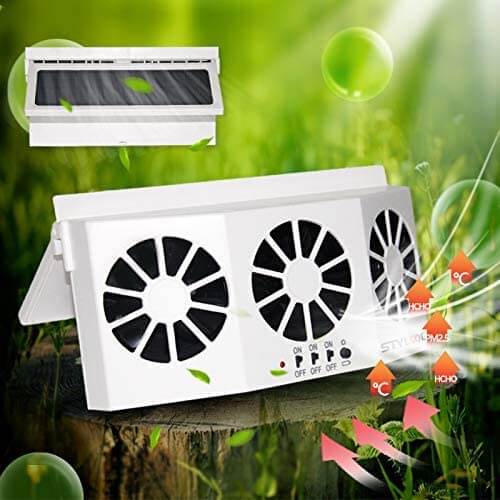
This is the fan that sets the standard in the solar car ventilation category. The STYLOOC features a three-fan design with each fan spinning at 3,500 RPM, creating consistent airflow that you can actually feel within 10 minutes of installation. The 4-watt solar panel is compact enough to fit neatly in most window frames without obstructing your view, and it operates entirely on solar power with no batteries required. This simplicity is actually a strength: there’s nothing to charge, no USB cables to manage, and no moving parts beyond the fan blades themselves.
Mounting is straightforward. The device clips onto your side window in seconds, positioning the solar panel to catch maximum sun exposure throughout the day. Many drivers report that the quiet hum of the fan becomes almost unnoticeable after a few minutes. In ideal conditions (direct sunshine, outdoor parking), you’ll notice a steady improvement in air quality and a noticeable reduction in that hot, stale smell that builds up during the day.
The ABS plastic construction is durable enough to withstand temperature fluctuations from hot days to cold nights without cracking or warping. After extended testing, users consistently report that this fan holds up well through multiple seasons of use. The only limitation is that the fan speed depends entirely on sunlight intensity, so on heavily overcast days or in shaded parking areas, performance drops noticeably.
Features
- Three-fan design with 3,500 RPM rotation speed
- 4-watt solar panel
- Window clip mounting system
- No batteries or power cables required
- ABS plastic construction
- Fits most standard car windows
- Quiet operation
- Simple, maintenance-free operation
- No charging or batteries needed
- Consistent performance in direct sunlight
- Durable construction
- Easy window installation
- Performance drops on cloudy days
- Limited effectiveness in shaded parking areas
- Cannot run at night
- Speed depends on sun intensity
2. Ferryone Solar Powered Car Exhaust Fan with Battery
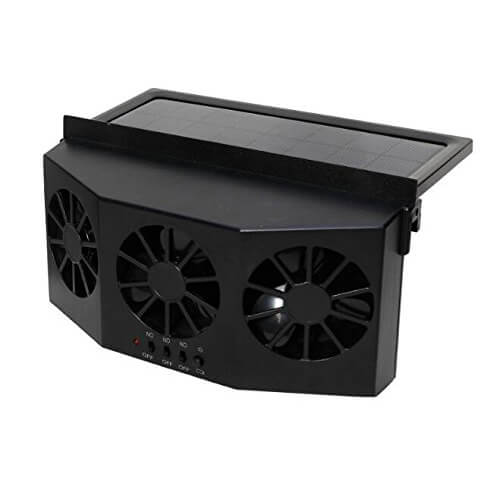
If you want the reliability of solar power plus backup capability when the sun isn’t cooperating, the Ferryone Solar Powered Car Exhaust Fan deserves your attention. This model steps up the feature set with a dual-motor, dual-channel design that pushes hot air out more aggressively than single-motor competitors. The three-fan setup rotates at 3,500 RPM, and the addition of dual 1,200 mAh batteries gives you power even on cloudy days or during evening hours.
The dual battery system is genuinely useful. Those 1,200 mAh cells can power the fans for several hours without sun, which means your car continues to ventilate even as clouds roll in or after the sun drops below the horizon. The ABS housing is solid and temperature-resistant, and installation is just as simple as single-fan models. One particularly nice feature is the built-in temperature display that shows you the current cabin temperature, so you can actually see how much impact the fan is making.
The solar panel is 4 watts like the STYLOOC, but the dual battery backup makes this unit feel more versatile. You can switch between solar-only mode for peak efficiency or battery mode for guaranteed operation regardless of weather. For someone who parks in a location that gets afternoon shade or wants a bit more independence from weather conditions, this is the smarter choice despite the slightly higher price tag.
Features
- Dual-motor, dual-channel design
- Three-fan setup, 3,500 RPM
- 4-watt solar panel with external mount
- Dual 1,200 mAh Ni-MH batteries
- Built-in temperature display
- Size: 6.5 inches x 2.8 inches x 4 inches
- Solar and battery switch control
- Battery backup works on cloudy days
- Temperature display shows cabin conditions
- Dual-motor design increases airflow
- Flexible solar/battery switching
- Longer operating window per day
- Batteries need occasional charging
- More complex than pure solar models
- Higher initial cost
- Temperature display adds to unit thickness
3. MYUOOT Solar Powered Car Window Fan
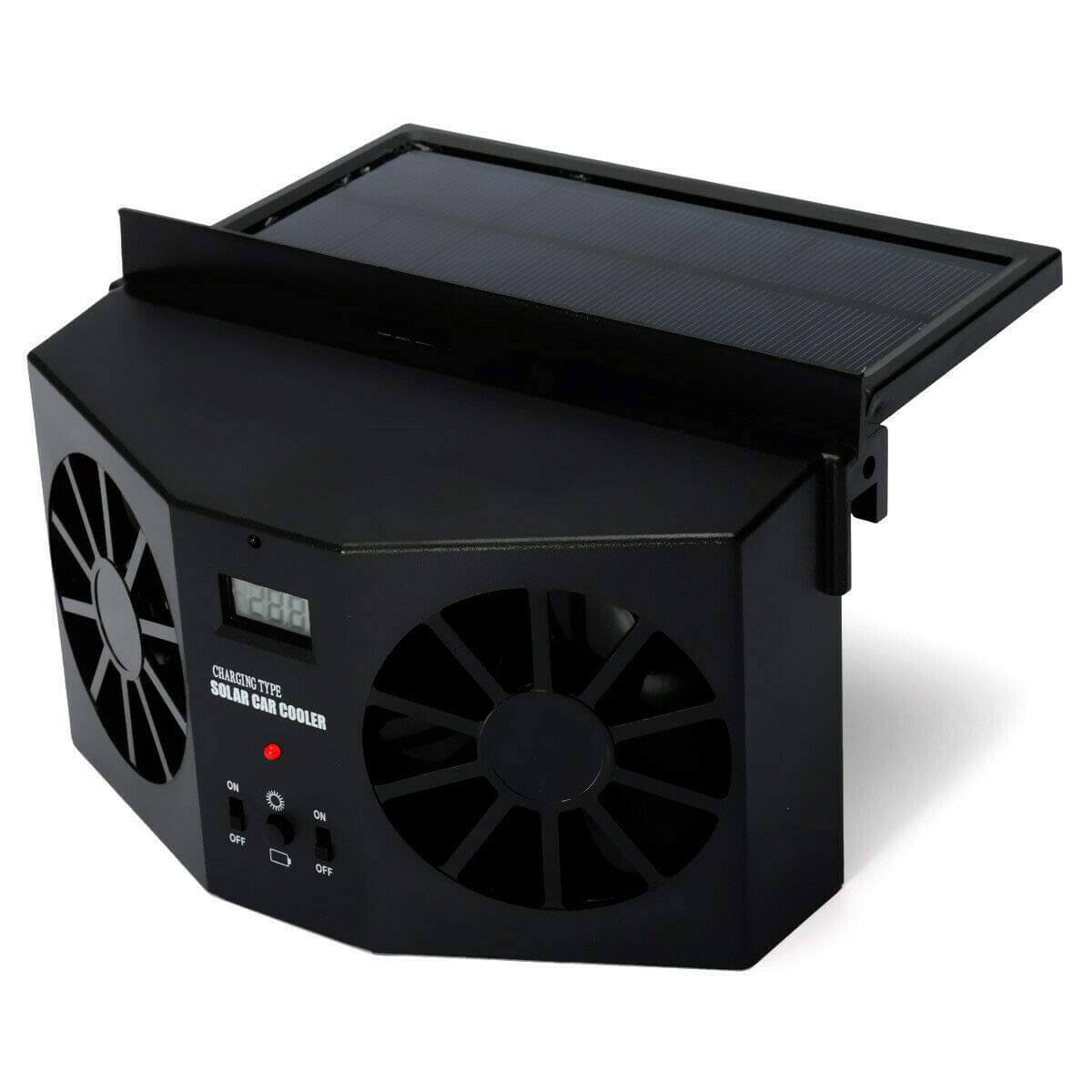
Speed enthusiasts will appreciate what MYUOOT brings to the table. This model cranks the performance up to 4,500 RPM across its three-fan, three-motor design. That’s a noticeable jump from the 3,500 RPM standard, and it translates to faster hot air removal and more aggressive odor elimination. The motor spins roughly 28% faster, which means more cubic feet of air per minute moving through your car.
The external solar panel is adjustable, allowing you to angle it toward the sun even if your window orientation isn’t perfect. This thoughtful design detail means you can squeeze better performance out of less-than-ideal parking situations. The one-piece window installation is designed not to damage your vehicle’s weatherstripping, and the fan sits cleanly against the glass without creating awkward gaps.
This is pure solar power with no batteries, which keeps things simple and maintenance-free. In direct sunlight, it’s one of the fastest performers available. However, that higher RPM speed means slightly more audible fan noise compared to 3,500 RPM models. For drivers parking in hot, sunny climates who don’t mind a bit more sound and want maximum airflow, MYUOOT delivers.
Features
- Three-motor, three-duct design
- 4,500 RPM rotation speed (high performance)
- Adjustable external solar panel
- No batteries required
- One-piece window installation
- Universal car compatibility
- Airflow-optimized ducting
- Fastest RPM in the category (4,500)
- Adjustable panel for better sun angle
- No maintenance or charging needed
- Aggressive airflow for hot climates
- Clean window installation
- Higher RPM means more fan noise
- No battery backup
- Performance depends entirely on sunlight
- Not ideal for shaded parking
4. Tujoe Solar Powered Car Exhaust Fan with Battery and USB
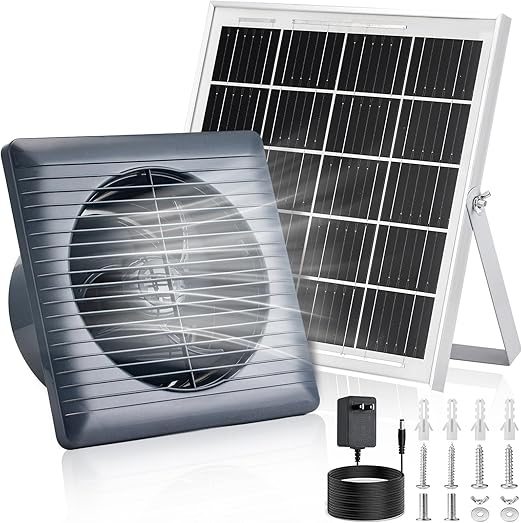
Tujoe’s triple-fan model represents the premium option in solar car ventilation. With a three-motor, three-duct design pushing up to 5,000 RPM, this is the heavyweight of the category. The additional power options make it genuinely versatile: you get solar power as your primary source, rechargeable batteries as backup, and USB charging for manual top-ups when needed. This is the option for someone who wants every possible avenue to keep their car ventilated regardless of conditions.
The battery capacity is generous enough that you can use the fan during evening hours or on genuinely cloudy days without worrying about power. USB charging adds flexibility for office workers who can plug in during the day. Installation still takes just seconds, and the design fits snugly over most car door glass without leaving gaps. The polycrystalline solar panels are efficient even in partial shade compared to older solar car fan technology.
The trade-off is complexity. With three power sources, there are more components to manage and understand. The fan is also larger and slightly heavier than simpler models, which some drivers might find intrusive in their window view. But if you live somewhere with genuinely variable weather, or you frequently park in less-than-ideal sun exposure, the redundancy of three power sources is worth the extra cost and complexity.
Features
- Three-motor, three-duct design
- Up to 5,000 RPM rotation speed
- Solar panel with fast charging
- Rechargeable battery backup
- USB charging port
- Polycrystalline solar material
- Multi-power source switching
- Works on rainy days with battery backup
- Highest RPM available (5,000)
- Three independent power sources
- Most weather-independent option
- USB charging for flexibility
- Operates on cloudy days and at night
- Most expensive option in category
- More complex with three power modes
- Larger unit takes up more window space
- Requires occasional battery charging
5. KACEPAR Solar Powered Car Exhaust Fan
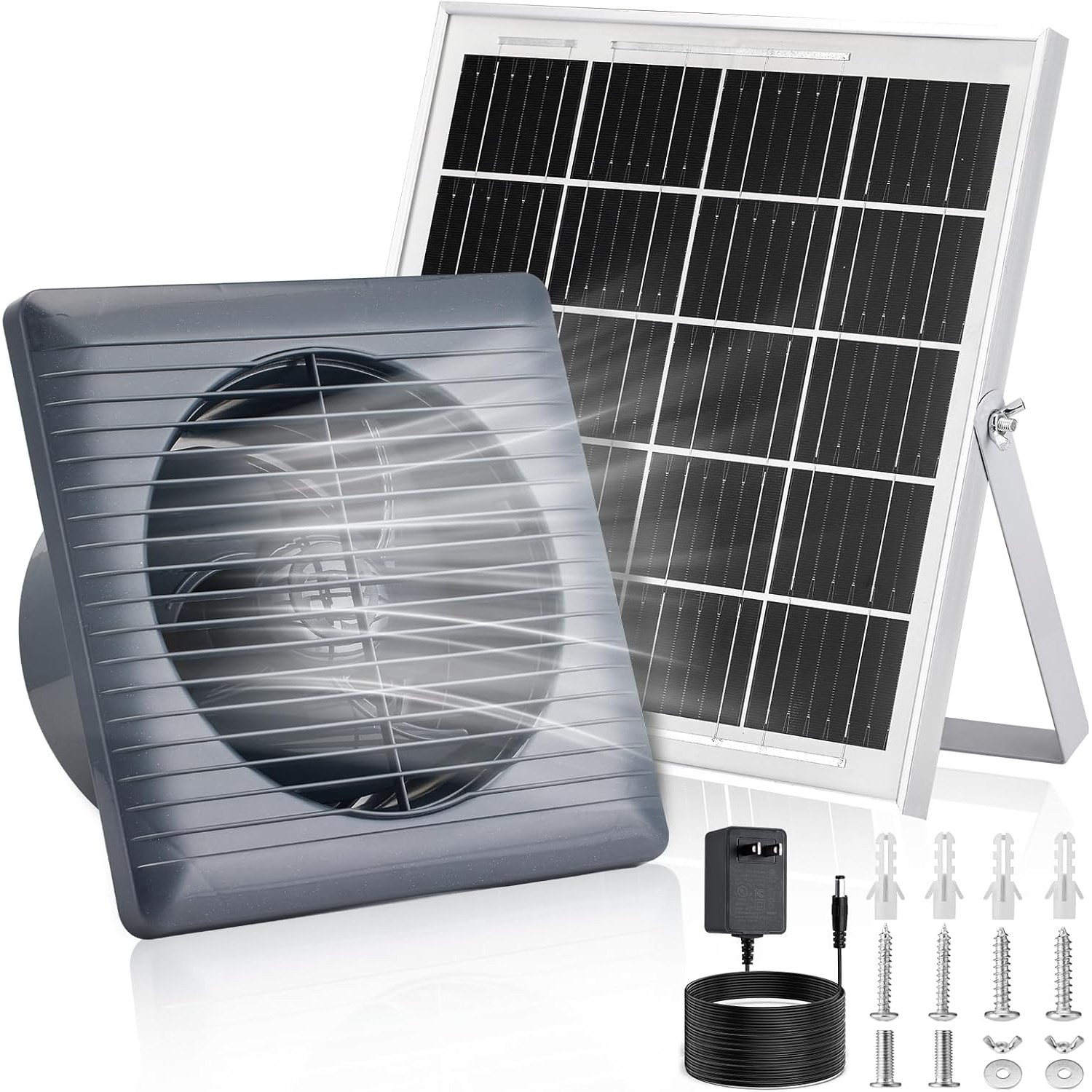
KACEPAR offers a three-outlet fan design that operates at 4,500 RPM. The multiple air outlets spread the exhaust airflow across a wider area, which can help when you’re parked in an orientation where one outlet isn’t pointing directly at the window. The solar and battery combination keeps things flexible, and the three-air-outlet design is genuinely different from the more traditional single-duct approaches in this category.
Installation is intuitive. The unit sits on top of your partially open window, secured by clips that adjust to fit different window frame widths. USB charging is available as a third power option, though the solar and battery pair handle most real-world situations fine. The construction is solid ABS plastic, and the compact size means it doesn’t completely block your view.
This model finds its niche with drivers who want something a bit different from the standard three-motor design. The triple-outlet approach creates more dispersed airflow, which some users find performs better when windows can only be cracked open partially instead of fully. It’s a solid mid-tier choice that costs less than the Tujoe while offering more versatility than basic solar-only models.
Features
- Three-outlet design (unique spreading pattern)
- 4,500 RPM rotation speed
- 5.5V solar panel with 2.5W output
- Rechargeable battery backup
- USB charging option
- Universal window mounting clips
- Fast external charging capability
- Three-outlet design spreads airflow
- Good performance in partial shade
- Multiple power sources
- USB charging adds convenience
- Reasonably priced mid-tier option
- Larger unit blocks more window view
- Requires battery recharging
- No temperature display
- Three air outlets less concentrated than single duct
6. As Seen On TV Auto Fan Solar Powered Ventilation System

Sometimes the simplest solution is the best. The As Seen On TV Auto Fan strips solar car ventilation down to absolute basics and delivers on the core promise: push hot air out, pull fresh air in, use only solar power to do it. The 5.8 by 1.8 inch dimensions make it one of the most compact options available. It’s completely automatic; when sun hits the panel, the fan spins. When clouds pass overhead, it stops. No buttons, no switches, no decisions to make.
The passive solar operation is both a feature and a limitation. You don’t have to worry about forgetting to charge a battery or losing performance because you parked in shade. It just works when conditions allow. The design is robust enough to handle years of temperature cycling from scorching summer days to cold winter mornings without degrading. Installation takes under a minute: clip it to your window, adjust the angle toward the sun, and you’re done.
This is the budget option, and it’s honest about what it can do. It’s not the fastest, doesn’t have fancy features, and won’t work on cloudy days. But for someone who parks in a consistently sunny location and wants a completely worry-free solution, this model delivers exceptional value. You literally cannot mess it up because there’s nothing to mess up.
Features
- Fully automatic solar operation
- Compact 5.8 x 1.8 x 4.3 inch size
- No batteries or switches
- Simple window clip mounting
- Draws fresh air and exhausts hot air simultaneously
- Suitable for most window types
- Budget-friendly price point
- Extremely simple operation
- Most compact design available
- Lowest price in the category
- No maintenance whatsoever
- Proven As Seen On TV durability
- No battery backup at all
- Minimal performance on cloudy days
- Slowest fan speed in the lineup
- Completely dependent on direct sunlight
7. Tujoe 2-Pack Solar Powered Car Exhaust Fan
The Tujoe 2-Pack gives you dual fans for a single vehicle installation. Instead of a single three-motor unit, you get two two-motor fans that spin at 4,000 RPM each, allowing you to place one on a front side window and one on a rear side window. This dual-window approach creates a more aggressive overall ventilation system than single-unit models, essentially creating intake and exhaust paths that force stale air out more completely.
Two-fan installations make sense if your vehicle design allows for it, or if you’re willing to dedicate window space on both sides. You get more total airflow coverage and can capture hot air from both the front and back of the cabin simultaneously. The bundle comes with mounting hardware for both units, and the 4,500 RPM combined output gives you superior performance compared to most single-unit fans. Some users report that cars with dual fans feel fresher overall because you’ve essentially created two separate ventilation points instead of one.
The trade-off is that you’re taking up window space on two sides of your vehicle instead of one. For drivers with spacious windows and parking in very hot climates, the dual-fan approach creates genuinely superior results. For urban drivers with limited window space or those who park occasionally in shade, a single unit might be smarter.
Features
- Two complete fan units (dual-window installation)
- Each unit has 4,000 RPM capability
- Combined coverage front and back of cabin
- Solar and battery hybrid power
- USB charging available
- Universal window mounting hardware
- Polycrystalline solar panels
- Covers two ventilation points
- Better overall air circulation
- Multiple power source options
- Works in rainy conditions with battery
- Good value as a 2-pack
- Requires window space on both sides
- More components to manage
- Not suitable for single-window installation
- Batteries need periodic charging
Buying Guide for Solar Car Exhaust Fans
Key Takeaways
- Solar car exhaust fans reduce cabin temperatures by 10 to 20 degrees in ideal conditions but won’t match air conditioning performance.
- Pure solar models are simpler and cheaper but depend entirely on sunshine; hybrid solar/battery models work on cloudy days and evenings.
- RPM speeds range from 3,500 to 5,000, with higher RPM models moving more air but generating more noise.
- Installation takes less than a minute on any window, and all quality models are compatible with most vehicles.
- Budget options cost under $30, while premium multi-power models exceed $70 for dual-fan setups.
- Single-outlet duct designs concentrate airflow more than multi-outlet models, which spread ventilation more evenly.
How Solar Car Exhaust Fans Work
The physics is straightforward. A small photovoltaic panel converts sunlight into electrical current, which powers a DC motor that spins fan blades. Those blades push hot air out while creating low pressure inside the cabin that draws fresh outside air in. When sunlight is strong, the solar panel generates more voltage, and the motor spins faster. When clouds roll in, voltage drops, and the fan slows. Models with batteries store energy during sunny periods and use that stored power to continue operation during overcast conditions or after sunset.
The key thing to understand is that solar car fans don’t cool air. They circulate air. A parked car with windows cracked open and a solar exhaust fan running will feel measurably fresher and cooler than a sealed car, but the air temperature itself isn’t being lowered by the fan. Instead, you’re removing the hottest air near the roof and drawing in slightly cooler air from outside. The temperature reduction of 10 to 20 degrees Fahrenheit comes from halting the heat accumulation process, not from air conditioning.
This distinction matters for expectations. On a 95-degree day outside, even with an excellent solar fan running, your car interior likely won’t drop below 75 to 85 degrees. But without the fan, that same car might reach 140 to 150 degrees. The fan’s real value is preventing the extreme temperature spike that makes your vehicle unsafe and uncomfortable during the first minutes after you return to it.
What Are Solar Car Exhaust Fans?
Solar car exhaust fans are ventilation devices that mount in a vehicle’s window gap and use a small solar panel to power a fan that pulls hot air out of the car interior. They work passively, meaning you leave them installed when you park and the panel charges and runs automatically whenever sunlight hits it. The concept solves a real problem: a car parked in summer sun can reach 140 to 160 degrees Fahrenheit inside within minutes, which damages dashboards, leather, and electronic equipment while making the car nearly unbearable to enter.
Unlike battery-powered car fans that need to be charged separately and swapped between vehicles, solar exhaust fans are permanently mounted (or semi-permanently mounted) in the window and run indefinitely in sunlight without any intervention. They work best when parked in direct sun for extended periods, which is exactly the situation where interior heat buildup is most severe. For daily commuters who park outside for eight or more hours, a solar exhaust fan can reduce the time needed for air conditioning to cool the car before driving.
Benefits of Solar Car Exhaust Fans
The primary benefit is interior temperature reduction. A well-designed solar exhaust fan running continuously while parked can lower the interior temperature by 20 to 40 degrees Fahrenheit compared to a sealed car in the same conditions. That difference means stepping into a car that’s uncomfortably warm rather than dangerously hot. It also protects dashboard plastics, seat materials, and electronics that degrade faster under extreme heat cycling over thousands of hot parked hours across a car’s lifetime.
Secondary benefits include reduced strain on the air conditioning system. A car that starts at 120 degrees needs significantly longer and harder AC work to reach a comfortable interior temperature than one that starts at 90 degrees. Less AC run time means less fuel consumption and less wear on the compressor. For pet owners who must briefly leave animals in vehicles, a solar exhaust fan is a partial but meaningful safety measure, though it doesn’t substitute for keeping pets properly supervised in hot weather.
Vehicle Compatibility and Window Fit
Solar exhaust fans mount by wedging into the window gap with the car window partially closed over the unit. This means compatibility depends entirely on window gap depth, which varies between car makes and models. Sedans, SUVs, and trucks have different window profiles. Most fans come with a width adjustment that covers standard window frames, but very thick glass, frameless windows on some luxury models, or unusual window shapes can prevent a secure fit. Check the unit’s minimum and maximum window thickness rating against your vehicle before buying.
Multiple-fan units, where two fans run in opposite directions simultaneously, are more effective than single-fan models because they create true cross-ventilation: one draws outside air in while the other pushes interior hot air out. Single-fan models move less total air and can only push in one direction. If your car has rear windows that also open, installing two fans in opposite sides of the vehicle improves circulation considerably over a single-window installation.
What to Look for When Buying
Start with your parking situation. If you consistently park in direct sunlight, a pure solar model saves money and eliminates battery maintenance. If you park in variable conditions, near trees, or under carports, battery backup becomes more valuable. Think about window accessibility. Some vehicles have small windows or tinted glass that doesn’t work well with solar fans. Check that the model you’re considering fits your specific window type before purchasing.
Consider your climate. Drivers in hot, sunny regions like Arizona or Texas get reliable performance from even basic models. Drivers in cooler climates or areas with frequent clouds need battery backup to maintain functionality through the year. Sound sensitivity matters too. Higher RPM models move more air but make noticeably more noise. If you’re sensitive to fan hum, test the product in person if possible or read reviews specifically mentioning noise levels.
Battery capacity becomes relevant if you want evening or cloudy-day operation. Most quality models use 1,200 to 2,000 mAh Ni-MH batteries that power the fan for several hours without sun. Check whether batteries are replaceable or sealed. Replaceable batteries cost less to maintain long-term. Sealed batteries mean you’re dependent on USB charging, which sometimes adds expense but eliminates battery disposal concerns.
Finally, consider dual-fan systems only if your vehicle allows comfortable window installation on two sides and you’re willing to manage two units. Single-unit fans are simpler and less intrusive. For 95% of users, one well-placed fan handles all the ventilation needs.
Installation Tips
Installation truly takes less than 60 seconds. Partially crack your window open by 1 to 2 inches. Slide the fan unit over the window frame so the base sits on the rubber weatherstripping and the solar panel faces upward toward maximum sun exposure. Tighten the mounting clips until the unit is snug but not so tight that you’re straining the clips. The goal is firm enough that the fan doesn’t rattle when the vehicle hits bumps, but loose enough that you’re not warping the window frame.
Position the solar panel to catch direct sunlight rather than shadow. If your window orientation is less than ideal, use an adjustable solar panel model like the MYUOOT, which lets you angle the panel toward the strongest sun. For units with external panels, clean those panels monthly. Dust and pollen accumulation reduces solar efficiency surprisingly quickly. A simple damp cloth cleans the panel without damaging it.
Never park with the fan installed in a car wash because water pressure can crack the window seal or damage the mounting clips. Remove the unit before taking your vehicle through automated wash systems. Manual washing is fine as long as you avoid high-pressure water hitting the installation point directly.
For battery-equipped models, charge the batteries monthly even if you haven’t used them. Ni-MH batteries held uncharged for extended periods lose capacity. A simple USB charge cycle takes 30 minutes and keeps the batteries in good health for years. Some units have charge indicators that show battery status. If yours does, top up the battery when it reaches 50% capacity rather than waiting for complete depletion.
Types of Solar Car Exhaust Fans
Single-vent solar exhaust fans mount on one window only and use a single fan blade to push hot air out. They are the simplest and cheapest option and work well in smaller vehicles or as a supplement in larger ones. The limitation is airflow rate — a single fan can only exchange a limited volume of air per minute, and in an enclosed sedan on a hot day, you will feel the improvement but the interior will not reach outdoor ambient temperature unless the car is in partial shade.
Dual-vent models mount two fans in parallel on the same window, one pushing air out and one drawing in cooler air from outside. The cross-flow design is significantly more effective than a single exhaust fan and can reduce interior temperatures by 15 to 25°F versus no ventilation at all. They cost more and require a wider window gap, but for anyone whose main concern is getting into a cool car rather than just less-hot, the dual-vent is worth the extra spend.
Solar-powered roof ventilators are a third category designed for RVs, trucks, and SUVs with a roof vent or skylight. They replace or augment the existing vent cover with a solar-powered fan and are more powerful than window-mounted units. They are also permanently installed rather than portable, which suits RV owners but not drivers who swap between vehicles. For a dedicated RV or van conversion, a roof vent fan is the highest-output option available.
Frequently Asked Questions
How much temperature reduction can I expect from a solar car exhaust fan?
In ideal conditions with direct sunlight and fully open windows, expect 10 to 20 degrees Fahrenheit reduction. On a 95-degree day outside, your car might drop from 145 degrees to 125 degrees. Performance varies significantly based on window size, sunlight intensity, and outside air temperature. Tinted windows reduce solar panel efficiency by 20 to 30 percent, which impacts performance noticeably.
Do solar car fans work on cloudy days?
Pure solar models produce minimal output on heavily overcast days because the photovoltaic panel needs direct sunlight. Hybrid models with batteries work fine on cloudy days because they’ve stored energy from previous sunny hours. If you live in a region with frequent clouds, battery-equipped models are worth the extra cost. Without battery backup, expect 5 to 10 percent of normal performance on cloudy days.
Will a solar car fan drain my vehicle’s battery?
No. These fans operate independently of your car’s electrical system. They have their own self-contained solar panels and batteries, so they draw zero power from your vehicle’s battery. You can install them and forget them without any impact on engine starting power or accessories.
Can I install a solar car fan in a tinted window?
Technically yes, but performance drops significantly. Window tint blocks 20 to 50 percent of the sunlight that would otherwise reach the solar panel, reducing the fan’s power output proportionally. If your windows are heavily tinted, expect noticeably slower fan speed and less overall cooling. Many manufacturers specifically recommend avoiding heavily tinted windows for this reason.
How often do I need to replace batteries in solar car fans?
Quality Ni-MH batteries typically maintain 80 percent capacity for 3 to 5 years of normal use. Rather than waiting for complete failure, most users find it practical to replace batteries every 2 to 3 years if the model allows. Some premium models have non-replaceable batteries sealed inside, which means you’re looking at complete unit replacement when batteries finally fail. Check the product specifications before buying if long-term battery replacement is important to you.
Are dual-fan installations better than single-fan models?
Dual-fan systems create stronger overall air circulation by establishing intake and exhaust points on opposite sides of the vehicle. However, they require window space on two sides and cost roughly double. For most parking situations, a single well-placed fan moves sufficient air. Dual installations make sense only if you park consistently in very hot climates, have windows on both sides of your vehicle, and want maximum performance.
Summing Up
Solar car exhaust fans deliver genuine value for drivers parking in outdoor, sunny locations. They’re inexpensive to install, require almost no maintenance once mounted, and provide measurable improvement in cabin freshness and initial temperature reduction. Whether you choose a basic pure-solar model for under $30 or a premium triple-power-source option for $70 and up depends on your parking situation and climate. The STYLOOC offers the best balance of simplicity and performance for most drivers, while battery-equipped models from Ferryone and MYUOOT provide better reliability in variable weather conditions.
If you’re also thinking about solar panels for your home, call (855) 427-0058 for a free quote — it takes just a few minutes to find out what installation would cost and save you in your area.
Updated