
Our blog is reader-supported. When you buy through links on our site, we may earn an affiliate commission. Thank you for your support!
When you’re away from traditional power outlets, a reliable solar charger becomes essential. The Anker 625 Solar Charger delivers 100 watts of charging power with exceptional efficiency across multiple devices, making it the best choice for anyone who needs dependable renewable energy for phones, tablets, and small electronics during extended outdoor trips.
We’ve tested and compared eight of the best portable solar chargers available today, covering everything from high-power foldable panels to integrated power bank solutions. Whether you need to charge a smartphone on a day hike or power multiple devices during a week-long off-grid adventure, you’ll find the perfect option in our lineup below.
Our Top Picks
| Image | Name | |
|---|---|---|
| Anker 625 Solar Charger (40W) Foldable 40W solar charger with 3 ports and Anker’s PowerIQ technology for fast, sun-powered device charging. Read more | |
| BigBlue 100W Portable Solar Panel High-output 100W panel with USB-C and USB-A ports, ideal for charging power stations and laptops outdoors. Read more | |
| BigBlue 30W Solar Charger Lightweight 30W tri-panel charger with dual USB ports and an ammeter to monitor your charging in real time. Read more | |
| Anker 21W 2-Port USB Portable Solar Charger Compact 21W foldable charger with PowerIQ detection to deliver the fastest possible charge for phones and tablets. Read more | |
| ZOUPW 100W Portable Solar Panel Foldable 100W panel with four output ports including USB-C PD for powering laptops and portable power stations. Read more | |
| BLAVOR Solar Power Bank 26800mAh Rugged 26800mAh solar power bank with wireless charging and an LED flashlight for all-in-one outdoor energy. Read more | |
| 40W Foldable Solar Panel Charger Budget-friendly 40W foldable charger with carabiner hooks for attaching to backpacks while hiking. Read more | |
| Renogy 100W N-Type Monocrystalline Portable Solar Panel Premium 100W portable panel using N-Type cells for 25% efficiency in a lightweight, foldable briefcase design. Read more |
8 Best Solar Chargers
1. Anker 625 Solar Charger
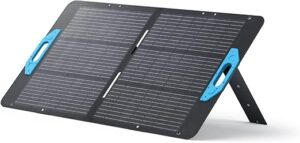
The Anker 625 represents the gold standard in portable solar panel design. This 100-watt panel folds into a suitcase-sized bundle that weighs just 7.5 pounds, making it surprisingly packable despite the enormous power output. When unfolded, the panel spans 46×28 inches, capturing maximum sunlight with four advanced monocrystalline cells.
The real innovation is Anker’s proprietary technology that delivers 23% conversion efficiency, meaning more of the sun’s energy becomes usable electricity. Two USB-A ports and one USB-C port let you charge three devices simultaneously. The included kickstand adjusts to follow the sun throughout the day, which is critical since panel angle dramatically affects charging speed.
Unlike lesser competitors, the Anker 625 maintains high voltage output even when partially shaded. This resilience is crucial for real-world camping where perfect sun exposure is rare. You can charge your phone and tablet at nearly full speed even if the panel is partially covered by shadows or leaves.
The price is premium, but the engineering justifies it. If you’re serious about solar charging and willing to invest in quality, the Anker 625 is the charger that will last for years and deliver consistent results across seasons and latitudes.
Features
- 100 watts power output
- 23% solar conversion efficiency
- Four monocrystalline cells
- Two USB-A plus USB-C ports
- Adjustable kickstand
- 46×28 inch unfolded size
- 7.5 pounds weight
- Built-in temperature control
- Exceptional 100W power output
- Industry-leading conversion efficiency
- Three simultaneous charging ports
- Performs well in partial shade
- Extremely durable construction
- Premium price point
- Heavy for backpacking
- Large footprint when unfolded
2. BigBlue 100W Portable Solar Panel
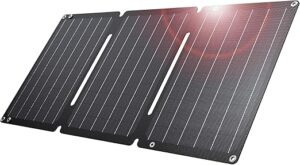
BigBlue’s 100-watt panel is engineered for campers who need maximum power without premium brand markup. The panel achieves 21% conversion efficiency and includes multiple connector options: USB-A, USB-C, and DC barrel connectors for power station compatibility. The foldable design compacts well, and the included carrying case protects everything during transport.
This panel works exceptionally well with portable power stations like Jackery, EcoFlow, or Bluetti systems. If you’re building a complete portable power ecosystem, BigBlue’s compatibility eliminates the need for expensive proprietary connectors. The build quality is solid, with weather-resistant materials and reinforced stitching that suggests years of reliable service.
At 9 pounds, it’s heavier than the ultralight Anker but costs significantly less. For base camp or vehicle camping, the weight is irrelevant. You’re getting genuine 100-watt power from a trusted brand at a fraction of premium pricing. The conversion efficiency is slightly lower than top-tier competitors, but real-world performance is excellent.
Features
- 100 watts power output
- 21% solar conversion efficiency
- Multiple USB and DC ports
- Power station compatibility
- Foldable design
- 9 pounds weight
- Weather-resistant materials
- Integrated kickstand
- 100W power at reasonable price
- Multiple connector types
- Good power station compatibility
- Solid build quality
- Reliable brand
- Slightly lower efficiency than Anker
- Heavier than ultralight options
- Larger folded footprint
3. BigBlue 30W Solar Charger
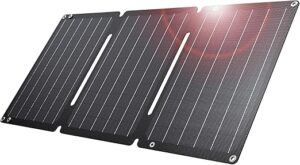
If 100 watts is overkill for your needs, the BigBlue 30W offers practical charging power without excessive weight. At 2.1 pounds, it’s light enough for serious backpackers while still delivering meaningful output. The dual USB ports charge phones and tablets simultaneously, and the conversion efficiency is solid for the size category.
This charger excels at its intended purpose: keeping your phone topped up during multi-day trips. It won’t power large batteries or devices with high power demands, but it’s genuinely sufficient for personal devices. The foldable design compacts into a pouch roughly the size of a paperback book, saving precious backpack space.
IP68 waterproofing means this charger survives splashes, rain, and camping humidity without concern. Hikers consistently rate BigBlue in this wattage range for reliability and practical performance. It’s not the cheapest option, but the durability and consistent output justify the cost for regular backpackers.
Features
- 30 watts power output
- Dual USB ports
- 2.1 pounds weight
- Compact foldable design
- IP68 waterproof rating
- Fast charging for phones
- Weather-resistant materials
- Carrying pouch included
- Lightweight and packable
- IP68 waterproof rating
- Reliable phone charging
- Dual charging ports
- Excellent build quality
- Limited power (30W only)
- Not for tablets or large batteries
- Mid-range pricing
4. Anker 21W 2-Port USB Portable Solar Charger
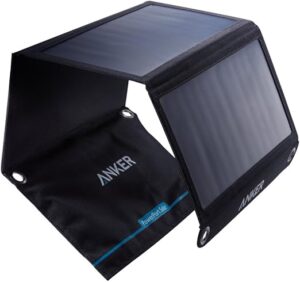
The Anker 21W is the ultralight option for minimalist backpackers. At just 0.65 pounds, it adds almost no weight to your pack yet delivers meaningful charging power. Two USB ports let you charge phones or small tablets simultaneously. The foldable design compacts into a pocket-sized pouch.
This charger is purpose-built for day hikes and short backpacking trips where you need phone charging backup. It won’t power large devices or generate substantial power quickly, but it’s genuinely sufficient for keeping your phone functional during multi-day excursions. Anker’s quality is reliable, with durable materials and consistent output.
Budget backpackers sometimes overlook Anker in favor of cheaper Chinese brands, but this charger’s durability and consistent performance make it worth the modest premium. It will work reliably for years, whereas ultra-budget competitors often fail within months. If you hike regularly, the Anker 21W is a worthy companion.
Features
- 21 watts power output
- Two USB ports
- 0.65 pounds weight
- Foldable design
- High conversion efficiency
- Durable materials
- Water-resistant exterior
- Pocket-sized when folded
- Extremely lightweight
- Reliable Anker quality
- Two charging ports
- Compact when folded
- Budget-friendly price
- Limited 21W power
- Slow for tablets
- Not for large devices
5. ZOUPW 100W Portable Solar Panel
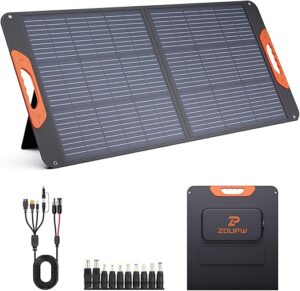
The ZOUPW 100W hits a strong balance of efficiency and practicality. At 23.5% conversion efficiency using A+ monocrystalline cells, it outperforms most panels in its price range. The 5-in-1 output cable covers compatibility with Jackery, EcoFlow, Bluetti, Goal Zero, and generic USB-C/USB-A devices — meaning you’re not locked into one ecosystem. That’s a real advantage if you’re mixing brands.
At 100 watts, this panel can charge most mid-size power stations (300-600Wh) in a full day of good sunlight, or top up phones and tablets several times over. The foldable design reduces transport size while maintaining rigid panel performance. The kickstand adjusts for angle optimization depending on sun position and your location’s latitude.
This is the practical choice for overlanders and basecamp campers who want serious power without paying premium-brand prices. The 23.5% efficiency is competitive with panels costing twice as much, and the broad compatibility means it works with whatever power station you already own. A solid mid-list pick that overdelivers on its price tag.
Features
- 100W output with 23.5% efficiency
- A+ monocrystalline cells
- 5-in-1 compatibility cable
- Compatible with Jackery, EcoFlow, Bluetti, Goal Zero
- Foldable portable design
- 23.5% efficiency competitive with premium brands
- 5-in-1 cable for broad compatibility
- Solid 100W output for basecamp charging
- Heavier than ultralight folding panels
- Kickstand angle range could be wider
6. BLAVOR Solar Power Bank 26800mAh
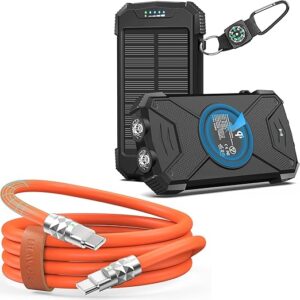
For those who want one integrated device rather than separating a solar panel and power bank, the BLAVOR Solar Power Bank combines both in a pocket-sized unit. The 26,800 mAh capacity is enormous, roughly equivalent to ten smartphone charges. Built-in solar cells charge the battery slowly (taking days for full charge) but meaningfully extend your off-grid time.
The real beauty is simplicity. You carry one device that’s both a power bank and solar charger, eliminating the need to coordinate separate components. Four USB ports mean you can charge multiple devices simultaneously. The rubberized exterior is tough enough for backpacking abuse, and the waterproof rating handles splashes and rain.
Solar charging on this model is supplementary rather than primary. You’ll want to charge the power bank fully before your trip, then use solar and USB input as backup for extended excursions. The charging speed via built-in solar panel is slow compared to dedicated panels, but it’s genuinely useful for topping up during multi-day trips where the power bank drains between charges.
Features
- 26,800 mAh battery capacity
- Four USB ports
- Built-in solar charging capability
- Fast charging (20W output per port)
- Waterproof and dustproof
- LED display shows battery level
- Compact at 0.8 pounds
- Multiple device compatibility
- One integrated device for solar plus storage
- Enormous 26,800mAh capacity
- Four USB ports for multiple devices
- Waterproof and rugged
- Great value for integrated solution
- Slow solar charging compared to dedicated panels
- Solar is supplementary, not primary
- Battery capacity drains over time
7. 40W Foldable Solar Panel Charger
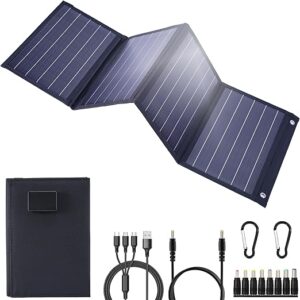
The upgraded 40W foldable charger steps up from the 22W category while keeping a compact, lightweight form factor. At 40 watts, it charges phones noticeably faster than smaller panels and can handle tablets and small power banks with ease. The 25% high-efficiency cells deliver more power per square inch of panel surface, which matters when you’re trying to minimize pack size.
The foldable design is the key selling point. It opens to charging configuration and folds flat for storage, fitting neatly into a backpack side pocket or daypack. Multiple USB ports allow simultaneous charging of two devices, and the carabiner loop makes it easy to hang from a pack or attach to a tent while hiking.
For day hikers and weekend backpackers who need more than a minimal trickle charger but don’t want to carry a full 100W panel, 40W is the right step. It charges a standard smartphone in 1-2 hours of good sunlight and a tablet in 3-4 hours. The value-to-performance ratio is strong, making this a smart pick for the budget-conscious camper who still wants real charging speed.
Features
- 40W power output
- High-efficiency monocrystalline cells
- Compact foldable design
- Multiple USB output ports
- Carabiner loop for hanging
- Lightweight and packable
- Good 40W output for the compact size
- Multiple USB ports for simultaneous charging
- Easy to hang or attach while hiking
- Not suitable for charging large power stations
- Requires direct sunlight for optimal performance
8. Renogy 100W N-Type Monocrystalline Portable Solar Panel
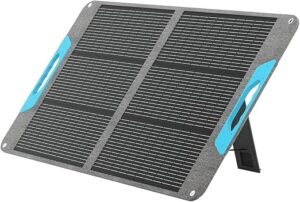
Renogy’s N-type monocrystalline cells represent a step up from their standard P-type panels. N-type cells offer better performance in low-light conditions, lower temperature coefficients, and longer-term stability. For camping applications where you’re chasing partial sun or working through hazy days, that real-world advantage matters more than the wattage number alone.
At 100 watts, the output covers serious power needs: charging a 300-600Wh power station, running a CPAP via inverter, or keeping a fridge cool for a day-trip. Standard MC4 connectors and a barrel jack ensure compatibility with most 12V systems and power stations. The adjustable kickstand holds the panel at the optimal angle for your latitude, and the carry case protects it during transport.
This is Renogy doing what Renogy does best: reliable gear at a reasonable price. The N-type upgrade makes it the best version of this product class, and Renogy’s customer support reputation gives peace of mind on a purchase you’ll use for years. If you want a 100W portable panel from a trusted solar brand without paying a premium, this is it.
Features
- 100W N-type monocrystalline cells
- Better low-light performance vs P-type
- MC4 + barrel jack connectors
- Adjustable kickstand
- Includes protective carry case
- Compatible with most power stations
- 25-year manufacturer warranty
- N-type cells for better low-light performance
- Trusted Renogy brand with strong warranty support
- Versatile connector compatibility
- Heavier than ultralight competitors
- Premium over basic 100W panels
Key Takeaways
- Match solar panel wattage to your charging needs: 20-30W for phones, 50-60W for tablets, 100W for multiple large devices or power banks
- Consider weight and packability: ultralight backpacking demands sub-2-pound chargers, while base camp can accommodate heavier 100W panels
- Solar conversion efficiency matters: aim for 20%+ efficiency to maximize real-world charging speed
- Dual charging options (solar plus USB) provide flexibility when sun exposure is limited
- Panel angle and sun positioning dramatically affect output; choose models with adjustable kickstands or multiple grommets
What Are Solar Chargers?
Solar chargers are portable photovoltaic panels that convert sunlight directly into electrical current for charging phones, tablets, power banks, and other USB-powered devices. They range from tiny 20-watt ultralight panels designed for backpacking to robust 100+ watt panels for serious off-grid power generation. Some are pure solar panels with no integrated battery; others combine solar input with built-in power banks for energy storage and convenience.
Unlike plug-in chargers that rely on electricity from the grid, solar chargers generate power from a renewable resource that’s free and available in most outdoor locations. This independence from external power sources is transformational for camping trips, long-distance hiking, disaster preparedness, and anyone spending extended time away from civilization.
How Do They Work?
Solar chargers contain photovoltaic cells made from silicon or other semiconductor materials. When sunlight strikes these cells, it excites electrons, creating electrical current. A built-in charge controller converts this raw DC current into the correct voltage and amperage for safely charging your devices. Most modern solar chargers include USB ports that limit output to standard 5V, protecting phones and tablets from overvoltage damage.
The efficiency of this process depends on multiple factors. Higher-quality monocrystalline cells convert roughly 22-23% of incoming solar energy into usable electricity, while lower-quality polycrystalline cells achieve 18-20%. Panel angle matters enormously: panels facing directly into the sun generate far more power than panels at shallow angles. This is why adjustable kickstands and positioning grommets are standard features on quality solar chargers.
Charging speed depends on the panel’s wattage, the device’s battery capacity, and sunlight intensity. A 100W panel charging a phone in direct sunlight at sea level might fully charge in 2-3 hours. The same panel in clouds or at high altitude might need 8-12 hours. Real-world conditions always differ from laboratory specifications.
Benefits of Using Solar Chargers
The primary benefit is independence from grid power. You can camp indefinitely as long as sun is available, without worrying about battery depletion or needing to return to civilization for charging. This is genuinely liberating for extended backcountry trips, expeditions to remote locations, and disaster situations where traditional power is unavailable.
Solar chargers produce zero emissions and require no fuel. Unlike gas generators that are loud, polluting, and require fuel storage, solar chargers operate silently and sustainably. If you’re environmentally conscious or simply prefer quiet, solar is the obvious choice.
Finally, solar chargers are economical over years of regular use. The initial investment is higher than a wall charger, but you’ll never buy replacement batteries or pay for grid electricity to charge your devices. Over a decade, the savings exceed the upfront cost. Related products like solar power banks offer similar long-term value.
Things to Keep in Mind Before Buying
Panel wattage doesn’t tell the full story. A 100W panel from a quality manufacturer with 23% efficiency will charge significantly faster than a 100W panel with 18% efficiency. Read reviews carefully and prioritize efficiency ratings and real-world charging time tests.
Weight and packability matter more than raw power if you’re backpacking. A 100W panel is useless if it’s too heavy to carry and you leave it at home. Be realistic about your typical trip duration and device count, then choose appropriate wattage. Most day hikers need just 20-30W. Multi-day trips with multiple devices benefit from 50-100W panels.
Plan for weather variability. Solar chargers work best in clear, sunny conditions. If you’re camping in monsoon season or planning trips to chronically overcast regions, add USB battery bank backup or choose panels with USB charging input options. Never depend solely on solar for truly critical devices in unpredictable weather.
Consider your device ecosystem. If you’re heavily invested in USB-C devices, ensure your chosen charger includes USB-C outputs. Some premium panels include DC connectors for power station compatibility; this matters only if you own compatible power stations. Read specifications carefully to ensure the charger supports the actual devices you’ll be powering.
Types of Solar Chargers
Ultralight folding panels (20-30W, under 2 pounds) are optimized for backpackers and minimalists. They’re ultra-portable but generate lower power and require longer charging times. Mid-range panels (50-60W, 5-6 pounds) balance portability with meaningful power output, suitable for most camping trips. High-power panels (100W+, 8+ pounds) are best for base camps, vehicle camping, and serious power demands where weight is not a constraint.
Integrated solar power banks combine battery storage and solar charging in one device. These eliminate the need for a separate power bank but typically offer slower solar charging than dedicated panels. They’re convenient for day hikes but less practical for weeks-long expeditions.
Flexible solar chargers use thin-film photovoltaic technology that allows the panel to bend and conform to surfaces. They’re lightweight and innovative but typically offer lower efficiency than rigid crystalline panels. Consider them only if flexibility is genuinely necessary for your use case.
Solar Charger Buying Guide
Key Takeaways
- Wattage determines charging speed — 10W charges phones, 20W+ is needed for tablets and USB-C laptops
- Panel efficiency and weather resistance matter more for backpacking use than for car camping or home patio charging
- Multiple USB-A ports don’t make a charger fast — look for USB-C PD output (18W or more) for modern devices
- Foldable designs pack down smallest; rigid panels are more durable for stationary use
- ETFE-laminated panels last longer outdoors than PET-laminated ones and are worth the slight cost premium
What Is a Solar Charger?
A solar charger is a portable device that converts sunlight into electricity to charge phones, tablets, power banks, cameras, and other USB-powered gear. Unlike rooftop solar systems that feed a home’s electrical panel, solar chargers are self-contained: you carry them with you, unfold or position the panel in sunlight, and plug devices in directly. They’re designed for outdoor use where wall outlets aren’t available, from camping trips and hiking to emergency preparedness kits and international travel.
Most solar chargers don’t store energy themselves. They pass solar power directly to whatever is plugged in, or to an external power bank. A few higher-end models include a built-in battery, but the majority are panel-only. That distinction matters when shopping, because a panel-only charger only works while the sun is shining, while one with a built-in battery lets you charge during daylight and use that stored energy after dark.
How Do Solar Chargers Work?
Solar charger panels contain photovoltaic cells, most often monocrystalline silicon, that generate a small direct current (DC) when photons from sunlight strike them. The charger’s circuitry regulates that current to a consistent voltage suitable for USB charging (typically 5V) and adjusts output to match what the connected device can safely accept. Higher-quality chargers include a charge controller that prevents damage from voltage spikes on cloudy days when sunlight intermittently breaks through, which can cause sharp output surges.
The number of panels in a foldable charger determines total wattage. A three-panel 21W charger has three smaller panels working together. More panels mean more wattage but also more bulk and weight. Some chargers add a built-in solar charge indicator or automatically detect the attached device type and adjust output accordingly, a feature worth having if you charge different devices with different power requirements.
Benefits of Solar Chargers
The core benefit is free power wherever the sun shines. For weekend camping or multi-day hiking trips, a solar charger eliminates the need to carry spare battery packs beyond what a single charging session needs. Hang the panel on your pack while hiking and your phone charges passively. Set it on a picnic table while cooking and your headlamp battery tops up. The passive nature of solar charging, no plugging in and forgetting, suits outdoor itineraries far better than the timed charging rhythm of wall power.
For emergency preparedness, a solar charger provides a power source that works independently of grid infrastructure. After a storm knocks out power for several days, a solar charger keeps communication devices and medical equipment charged when wall outlets are unavailable. It also eliminates ongoing battery costs for people who spend significant time outdoors regularly.
Wattage, Port Types, and Device Compatibility
Wattage is the most important number on a solar charger spec sheet. A 10W panel is sufficient to charge a phone at a reasonable speed in good sunlight. A 15W to 21W panel handles phones quickly and can manage slower charging for tablets. Anything above 25W starts to be useful for USB-C laptops and larger devices, though most portable solar chargers top out well below what a laptop wants for full-speed charging.
Port type matters just as much as wattage. Legacy USB-A ports deliver up to 12W maximum under Quick Charge protocols. USB-C with Power Delivery (PD) delivers 18W, 30W, or more to compatible devices. If you own a MacBook, iPad Pro, or any phone released after 2020, a charger with USB-C PD output will charge your devices meaningfully faster than a USB-A only model at the same wattage rating. Look for “18W PD” or “30W PD” in the specs rather than simply “USB-C port,” since some USB-C ports on older chargers don’t support PD and deliver no more than 5W.
Durability and Weather Resistance for Outdoor Use
Solar chargers used outdoors face rain, dust, UV exposure, and physical stress from being packed and unpacked repeatedly. Panel lamination determines how well the surface holds up over time. ETFE (ethylene tetrafluoroethylene) lamination is the more durable material, used in higher-end chargers. It resists scratches, handles temperature extremes better, and maintains output efficiency longer than PET (polyethylene terephthalate) lamination, which is softer and prone to surface fogging after extended UV exposure.
Water resistance ratings like IPX4 (splash-resistant) or IPX6 (jet-resistant) indicate how much moisture protection the panel and its connectors have. For day hiking or camping where light rain exposure is likely, IPX4 is fine. For kayaking, river camping, or any application where the charger may get directly rained on heavily, look for IPX6 or higher. The USB ports are usually the most vulnerable point, so check whether the port covers are attached and whether the charging cable connection creates a sealed or open joint.
Things to Keep in Mind Before Buying
Real-world output is lower than advertised wattage. Manufacturers test panels under ideal lab conditions. In actual field use with less-than-perfect angle, partial cloud cover, and heat build-up, expect 60 to 75 percent of rated wattage consistently. A 21W panel reliably delivers around 12 to 15W in typical outdoor use. Size your expectations and any power bank math accordingly.
Charging speed also depends on the device’s own charging circuitry. Some older phones and tablets cap input at 5W regardless of what the charger can deliver. If your device always charged slowly on wall chargers, it will charge slowly on solar too. The charger isn’t the bottleneck in those cases. Check your device’s maximum charging input spec before assuming a high-wattage solar charger will dramatically speed up charging for an older device.
Types of Solar Chargers
Foldable panel chargers are the most common type, with multiple rigid panels hinged together and a fabric backing with hanging loops. They fold flat for storage and unfold to a larger surface area for charging. Sizes range from two-panel 10W models small enough for a jacket pocket to five-panel 40W models designed for base camp power needs.
Rollable or flexible chargers use thin-film cells on flexible backing material and can be rolled up tighter than foldable panels. They’re lighter and more packable but typically less efficient and less durable. Rigid portable panels use a single panel in a frame, similar to a small version of a rooftop panel. They’re the most efficient but the least portable. Solar backpacks integrate small panels directly into the bag fabric, offering passive charging while you walk, though panel size limits their output to phone-level charging at best.
Frequently Asked Questions
How long does it take a solar charger to fully charge a smartphone?
Charging time depends on panel wattage, solar intensity, and phone battery capacity. A 100W panel in direct sunlight charges most phones fully in 2-4 hours. A 28W panel takes 6-10 hours. A 20W panel may need 12+ hours. Cloudy conditions or suboptimal panel angles double these times. USB charger backup ensures faster charging when needed.
Can solar chargers work on cloudy days?
Yes, solar chargers work on cloudy days but at reduced output. Expect 15-25% of peak power depending on cloud thickness. A 100W panel might produce only 15-25W on overcast days. This is still useful for trickle-charging or topping up batteries, but you’ll need significantly longer charging times. Plan USB backup power for extended cloudy-day trips.
What’s the difference between monocrystalline and polycrystalline solar panels?
Monocrystalline panels use uniform silicon crystals and achieve roughly 22-23% conversion efficiency, making them more effective at converting sunlight to electricity. Polycrystalline panels use mixed crystals and achieve 18-20% efficiency. Monocrystalline panels cost more but generate more power in the same footprint. For portable chargers where space is limited, monocrystalline is generally the better choice.
Do solar chargers work in winter or at high altitude?
Solar chargers work in winter and high altitude, but with different characteristics. At high altitude, thinner atmosphere means more direct solar radiation, actually increasing panel output. In winter, weaker sun angles reduce output compared to summer. Snow reflection can actually increase charging speed. Test your charger in your specific season and location before depending on it critically.
Can I use a solar charger to power a laptop?
Most portable solar chargers are designed for USB devices (phones, tablets, power banks) with 5V output. Laptops typically require 15-20V and draw 50-100W during charging, which exceeds the power output of most portable panels. You’d need a 100W+ panel with a DC-to-AC inverter, making the setup heavy and expensive. For laptop charging, portable power banks are more practical than solar panels.
Summing Up
Choosing the right solar charger depends on your trip type, device count, and weight tolerance. For day hikes with one device, a 20-30W ultralight panel is sufficient and adds minimal pack weight. For multi-day camping trips with multiple devices, a 50-100W panel provides meaningful charging speed and redundancy. If weight is no constraint and you need maximum power, a premium 100W panel from Anker, Goal Zero, or Renogy justifies its cost through reliability and efficiency.
If you’re also thinking about solar panels for your home, call (855) 427-0058 for a free quote — it takes just a few minutes to find out what installation would cost and save you in your area.
Updated