
Our blog is reader-supported. When you buy through links on our site, we may earn an affiliate commission. Thank you for your support!
If you run livestock on fenced pastures without reliable grid power nearby, a solar fence charger is one of the smartest investments you can make. The Gallagher S30 Solar Electric Fence Charger is our top pick for most farms. It delivers serious containment power with a lithium battery that keeps working even through stretches of cloudy weather.
The right solar fence charger can keep cattle in, predators out, and your electric bill where it belongs. Below we’ve reviewed eight of the best options on the market right now, ranging from compact units for small homesteads to heavy-duty energizers covering 30 miles of fence line.
Our Top Picks
| PRODUCT IMAGE | PRODUCT | PRICE |
|---|---|---|
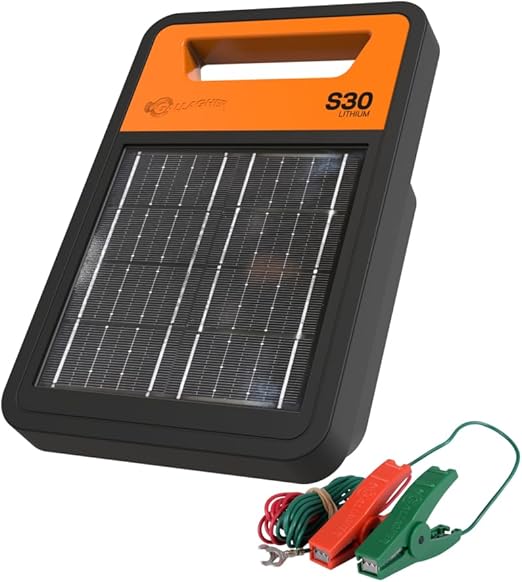 | Gallagher S30 Solar Electric Fence Charger 0.3 Joule output, powers up to 30 miles of fence, built-in battery, LED fence-fault indicator, ideal for medium livestock operations. | CHECK PRICE |
| Gallagher S12 Solar Electric Fence Charger 0.12 Joule, up to 12 miles of fence, compact solar panel, integrated battery, good for small paddocks and pets. | CHECK PRICE |
| Zareba ESP5M-Z Solar Powered Electric Fence Charger Powers up to 5 miles, 0.05 Joule, suitable for small animals and garden perimeters, low-impedance output. | CHECK PRICE |
| Gallagher S20 Solar Electric Fence Charger 0.2 Joule, 20 miles of fence capacity, upgraded solar panel and battery over S12, ideal for horses and cattle. | CHECK PRICE |
| Zareba ESP10M-Z Solar Electric Fence Charger 10-mile range, 0.1 Joule, weatherproof ABS housing, suitable for cattle, horses, and larger perimeter control. | CHECK PRICE |
| DfuGift Solar Electric Fence Charger 0.5 Joule 0.5 Joule high output, up to 30 miles of fence, 30-day battery backup, LED fault indicator, dual-power (solar+AC). | CHECK PRICE |
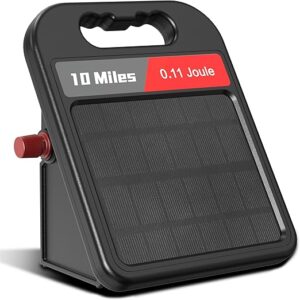 | Solar Electric Fence Charger 10 Mile with 30-Day Backup 10-mile coverage, 30-day battery backup reserves, weatherproof housing, suitable for horses, cattle and deer control. | CHECK PRICE |
| Parmak Magnum Solar-Pak 12 Electric Fence Charger 6V system, up to 30 miles on good ground, built-in 6V battery, proven design trusted by farmers for decades. | CHECK PRICE |
8 Best Solar Fence Chargers
1. Gallagher S30 Solar Electric Fence Charger
For farms running cattle, horses, or dealing with serious predator pressure, the Gallagher S30 is the one to buy. It covers a typical 4-mile range in real-world use (not ideal lab conditions) with a 20-mile ideal range that means you’ve got headroom to spare even when weeds load the fence.
What sets the S30 apart is its lithium battery technology. Lead-acid batteries, which you find in older solar chargers, degrade in cold weather and take longer to recover after a run of cloudy days. The lithium pack here charges faster and holds its capacity far better through winter, which matters if you’re in a state that sees hard freezes.
The unit handles electric poultry netting and sheep netting across 2 to 3 connected 164-foot sections without breaking a sweat. For rotational grazing setups where you’re regularly moving the charger between paddocks, the carry handle and compact form factor make that genuinely easy. The rugged weather-resistant case and UV protection mean it’s built to live outside year-round.
At 4.7 stars across 52 reviews, the S30 has earned strong marks from farmers actually running it in demanding conditions. It’s not the cheapest option on this list, but when animal containment is the job, you want something that doesn’t compromise.
Features
- 4-mile typical range / 20-mile ideal range
- Lithium battery charges faster and holds charge longer than lead-acid
- Handles 2 to 3 sections of electric poultry or sheep/goat netting
- Weather-resistant case with UV protection and impact-resistant design
- Built-in carry handle for portable, rotational use
- Suitable for cattle, horses, goats, and large predator deterrence
- Real-world 4-mile range holds up in livestock conditions
- Lithium battery performs well in cold weather
- Portable carry handle makes rotational grazing practical
- Tough enough to live outdoors year-round
- Premium price point compared to Zareba models
- Fewer reviews than budget options yet
2. Gallagher S12 Solar Electric Fence Charger
This is the entry point to the Gallagher solar lineup, and it’s a smart choice for anyone running a small homestead, protecting a garden plot, or containing chickens and goats on limited acreage. Rated for up to 4 miles and 18 acres, it’s scaled to the kind of fencing jobs most hobby farmers actually deal with day to day.
The S12 mounts directly to a grounding rod rather than a post. This unusual approach that doubles as the physical mount and electrical ground connection. Drive the rod at least 18 inches into soil and you’re set. It’s a clever, compact design that means you don’t need additional hardware to get it standing.
With 620 reviews at 4.4 stars, this is one of theolar chargers on Amazon. The lithium battery technology carries over from the larger S30 and S20, which means better cold-weather performance than older lead-acid units at similar price points.
Features
- Powers up to 4 miles / 18 acres of fence line
- 0.12 stored joule energizer with lithium battery technology
- Mounts to grounding rod, which serves as mount and ground connection
- Built-in earthing for simplified installation
- Portable and suitable for garden protection, chickens, goats, small livestock
- Charge before first use for best performance (2 to 3 days in direct sun)
- 620+ verified reviews at 4.4 stars, genuinely proven
- Lithium battery handles cold weather better than lead-acid
- Ground rod mount simplifies installation
- Compact size makes it easy to move between plots
- Needs 2 to 3 days of sun before first use
- Output joules too low for heavy weed conditions
- Ground rod not included
3. Zareba ESP5M-Z Solar Powered Electric Fence Charger
If you want the most battle-tested solar fence charger on Amazon, this is it. Over 1,400 reviews at 4.4 stars is a number that takes years of real-world use to accumulate, and the Zareba ESP5M-Z has earned every one of them. It’s a workhorse for anyone containing cattle, horses, goats, or keeping predators out of poultry runs on 5-mile-range setups.
The 360-degree rotating mount lets you orient the solar panel toward the sun’s position regardless of which direction the fence post faces, and that makes a real difference in how consistently the battery charges through the day. And the 2-week reserve capacity means a run of overcast weather won’t leave you with a dead fence.
Built in the USA and backed by a 1-year warranty that includes lightning damage, the Zareba has a reliability reputation that matches its review count. It’s the one to buy when you need something proven to work and don’t want to gamble on a newer brand.
Features
- 5-mile rating (2.5 miles in light weeds)
- Patented 360-degree rotating mount for optimal sun angle
- Up to 2 weeks of operation without sun
- Compatible with T-posts, Y-posts, and round-wood posts
- Built in the USA with 1-year warranty including lightning damage
- Low impedance design for better performance through weeds
- 1,400+ reviews, the most proven solar fence charger available
- 360-degree rotating panel gets maximum sun exposure
- 2-week battery reserve handles cloudy stretches
- Made in the USA with lightning warranty
- Only 5-mile range, not enough for large operations
- Older design compared to lithium-equipped Gallagher models
4. Gallagher S20 Solar Electric Fence Charger
The S20 is Gallagher’s mid-range solar unit, sitting between the compact S12 and the more powerful S30. At 0.2 joules and a 2-mile real-world range, it’s designed for portable strip grazing and rotational pasture management where you’re picking the charger up and moving it regularly. The lightweight design and integrated carry handle make that genuinely easy.
Like the rest of the Gallagher solar lineup, the S20 runs on lithium battery technology. The smart adaptive electronics constantly monitor solar energy being stored and adjust output accordingly, keeping your fence hot even on days when cloud cover cuts panel production.
It currently holds a perfect 5.0-star average across 28 reviews, which is impressive. With fewer reviews than the S12 or Zareba units, it’s worth noting this rating is still relatively early, but the consistent praise tracks with the quality seen across the Gallagher range.
Features
- 0.2 joule output, 2-mile real-world range
- Lithium battery with high-efficiency solar panel
- Intelligent adaptive energy control monitors and adjusts output
- Lightweight and portable with integrated carry handle
- Ideal for strip grazing and rotational pasture management
- Suitable for poultry, livestock, gardens, and pets
- Perfect 5.0-star rating from current reviews
- Smart adaptive electronics prevent battery drain
- Lithium battery recharges faster than lead-acid
- Lightweight and easy to move between paddocks
- Only 2-mile range limits use on larger properties
- Fewer reviews than comparable Zareba models
- Premium Gallagher pricing
5. Zareba ESP10M-Z Solar Electric Fence Charger
Step up from the 5-mile ESP5M-Z and you get the 10-mile version with the same proven Zareba build, double the coverage. It’s the right pick for medium-sized operations that have outgrown a 5-mile charger but don’t need to run 30 miles of wire. At 597 reviews and 4.3 stars, it’s well validated.
The 0.15 output joules handles cattle, horses, bulls, and goats through standard conditions, and the 2-week backup reserve carries over from the smaller model. Mount it on a T-post, Y-post, or round-wood post using the built-in bracket, orient the panel toward peak sun, and you’re done.
Where it falls short is weed load. At 0.15 joules, a heavily vegetated fence line will bleed enough power to reduce effective range significantly. If your pastures run thick with grass against the wire, look at the Parmak Magnum below instead.
Features
- 10-mile rating (5 miles in light weeds)
- 0.15 output joules for cattle, horses, bulls, goats
- Up to 2 weeks of operation without sun
- Built-in mounting bracket for T-posts, Y-posts, round-wood posts
- Low impedance design
- Built in the USA
- 10-mile coverage at a reasonable price
- Well-proven with 597 reviews
- 2-week reserve keeps fence live through bad weather
- Low joule output suffers in heavy weed conditions
- Older lead-acid-era design, not lithium
- 4.3 stars, a step below the top Gallagher models
6. DfuGift Solar Electric Fence Charger 0.5 Joule
The DfuGift stands out from the pack with a built-in light sensor that actually adjusts pulse intervals depending on time of day. During daylight it pulses every second; at night it slows to 1.5 seconds between pulses, reducing battery draw while still maintaining an effective deterrent. It’s a small feature that adds up to meaningful battery life extension over time.
At 0.5 joules and 8,000V peak output across a 5-mile range, it’s notably more powerful than the Zareba ESP5M-Z on a joule-per-dollar basis, and the IP55 weatherproofing holds up well in rain and humidity. Rated 4.7 stars from 54 reviews, it’s earning solid marks from users who want more than a basic charger.
Features
- 0.5 joule output, 8,000V peak pulse voltage
- 5-mile fence line coverage
- Integrated light sensor: 1-second day / 1.5-second night pulse intervals
- IP55 weatherproof construction
- LED status indicator for at-a-glance monitoring
- High-voltage, low-current design safe for humans and livestock
- Smart day/night pulse sensor extends battery life
- 0.5 joule output is strong for a 5-mile unit
- IP55 weatherproofing handles wet conditions well
- Lesser-known brand compared to Gallagher or Zareba
- Only 54 reviews and less long-term track record
- 5-mile maximum won’t serve large operations
7. Solar Electric Fence Charger 10 Mile with 30-Day Backup
The headline feature here is the 30-day backup capacity: six sunny days to fully recharge, and then up to a month of operation without additional sun. If your property goes through extended overcast stretches or your fence is in a shaded spot, that buffer is genuinely useful. The 5W monocrystalline panel charges efficiently when the sun cooperates.
At 8,100V output and 10 miles of coverage, it competes directly with the Zareba 10-mile model on range and beats it on output voltage. Setup is tool-free and the design is lightweight enough to move around for strip grazing or portable paddock applications. IP-rated waterproof construction handles outdoor exposure.
This is the most divisive pick on the list. A no-name brand with 55 reviews doesn’t give you the same confidence as 600-plus Zareba reviews, and the 0.11 joule output is notably low for a 10-mile claim. But at 4.7 stars from the reviews it does have, it’s performing better than you’d expect from the price point.
Features
- 10-mile fence line coverage, 8,100V maximum output voltage
- 0.11 joule output with 5W monocrystalline solar panel
- 30-day battery backup (6 sunny days to fully recharge)
- Portable, tool-free setup
- Waterproof construction for outdoor year-round use
- Adjustable pulse output voltage
- 30-day backup reserve is best on the list
- 10-mile range at budget pricing
- 0.11 joules is very low for 10-mile claims
- No-name brand with limited review history
- Unlikely to handle heavy weed conditions at full range
8. Parmak Magnum Solar-Pak 12 Electric Fence Charger
Push the stake in, point the panel south, and the Parmak Magnum Solar-Pak 12 gets to work. This is the heavy-hitter on the list: 30 miles of coverage, 3.1-plus joules of output, powered by a 12-volt sealed rechargeable battery that’s included in the box. The solar panel charges it by day; the battery runs the fence at night. It’s a time-tested formula that’s been working for large livestock operations for decades.
At 743 reviews, the Parmak has the long review history that proves real-world reliability over time. The 3.9-star average is the lowest on this list, which reflects one consistent complaint: it’s an older design, and the lower impedance technology doesn’t perform as well in heavy weed conditions as newer competitors claim. If your fence runs clean and clear, it delivers excellent results.
Features
- 30-mile coverage, 3.1+ joules output
- 12-volt sealed rechargeable battery included
- Solar charges battery by day; battery powers fence at night
- Low impedance for maximum power and longer life
- Weatherproof portable outdoor model
- Ideal for large pastures with significant livestock
- 30-mile range and 3.1+ joules, the most powerful on this list
- 12V battery included, no extra purchase required
- 3.9-star rating is the lowest here. The older design shows
- Heavier and less portable than compact models
- Performance drops more than competitors in weed conditions
Solar Fence Charger Buying Guide
Key Takeaways
- Match the joule output to your fence conditions. Low joules fail fast in heavy weed loads
- Lithium batteries outperform lead-acid in cold weather and charging speed
- Ideal range ratings are marketing figures; real-world range is typically 20 to 30 percent of ideal
- Look for at least 2 weeks of battery reserve to handle cloudy weather stretches
- Well-known brands (Gallagher, Zareba) have long track records and available support parts
What Is a Solar Fence Charger?
A solar fence charger (also called a solar fence energizer) converts sunlight into electrical pulses that run through your fence wire, creating a deterrent shock for animals that contact it. The shock is high voltage but low current, enough to be memorable and conditioning without causing harm. During the day, the solar panel charges an onboard battery. At night, that battery continues powering the fence. The result is continuous, off-grid electric fencing wherever you can get sunlight.
How Do Solar Fence Chargers Work?
The solar panel on a fence charger feeds a small battery, either a sealed lead-acid unit or a modern lithium pack. A controller inside the unit regulates charging and fires pulses through the fence wire at regular intervals, typically once per second. When an animal contacts the wire and completes a circuit through the ground, it receives a short, sharp shock. The ground circuit is critical. Poor grounding is the most common reason a fence charger seems to underperform. Most units need multiple grounding rods driven at least 18 inches into soil, connected to the charger’s earth terminal.
Benefits of Using a Solar Fence Charger
The biggest benefit is location freedom. Corded AC chargers need to be within reach of a power outlet, which limits where your fencing can go. A solar charger goes anywhere with sunlight: remote pastures, wooded edges, temporary strip grazing setups. There’s no wiring to run, no extension cord to manage, and no electricity bill to run it. Many solar units are also designed to be portable, so you can pick them up and reposition them as your rotational grazing plan changes through the season.
Joule Output: The Only Spec That Matters for Effective Fencing
When shopping for a solar fence charger, ignore wattage and panel size. The only number that tells you whether a charger will actually work is stored joule output. One joule is the minimum for controlling cattle on a well-maintained fence. Two joules handles horses and pigs reliably. Four joules or more is needed for predator control or for long fence runs with significant weed contact.
Many budget chargers advertise impressive-sounding coverage figures (“covers up to 25 miles of fence!”) while listing only 0.1 or 0.15 joules of output. That is barely enough to deter chickens from a clean, short fence run. Real-world fence lines have weeds, multiple wire strands, dry soil, and mixed animal types. Buy the joule rating you need for your actual application, not the coverage claim, which is always measured under ideal conditions that rarely match a working farm.
Low-Impedance vs. Standard Output and Why It Matters for Weedy Fence Lines
Standard fence chargers lose significant voltage when weeds or wet vegetation touch the wire. A weed-shorted section can drop fence voltage from 5,000 to under 1,000 volts, which is not enough to deter most animals. Low-impedance energizers push power through vegetation contact without the same voltage drop, maintaining an effective shock even on poorly maintained fence lines.
If you maintain your fence line meticulously and mow or spray under the wire regularly, a standard output charger works fine. If your fence runs through pasture, brush, or tall grass that touches the wire seasonally, a low-impedance energizer is worth the extra cost. It will also give you a much longer effective range in real conditions versus the rated maximum, since the rating always assumes a clean fence.
Battery Backup and What Happens During Cloudy Periods
Solar fence chargers include an internal battery that keeps the fence energized at night and during cloudy days. Most models use a sealed lead-acid battery sized to run the charger for 5 to 21 days without sun, depending on the joule output. Higher-output chargers drain the battery faster, so a 4-joule energizer needs a larger battery or more panel wattage than a 1-joule unit to maintain the same reserve days.
In overcast climates or wooded pastures where the panel gets partial shade, battery reserve matters more than in open sunny fields. Check the manufacturer’s claimed days of reserve under no-sun conditions. Anything below 5 days is marginal for regions with extended winter cloud cover. And make sure the panel can be repositioned or angled — most solar fence chargers mount the panel directly to the unit, but some allow a remote panel installation if your ideal fence post location is shaded.
Things to Keep in Mind Before Buying
Joule output matters more than mileage ratings. Manufacturers rate fence chargers in ideal conditions, meaning no weeds touching the wire, good dry soil, well-driven ground rods. In real pasture use with grass growth, moisture variation, and possibly degraded connections, effective range shrinks fast. A charger rated 0.15 joules at 10 miles might realistically cover 3 to 4 miles in typical conditions. If you have weed pressure, budget for higher joule output than you think you need.
Battery chemistry is the second thing to look at. Lead-acid batteries work fine in moderate climates but lose capacity in cold weather and take longer to recover from deep discharge. Lithium batteries hold their charge better through winter, recharge faster from partial sun, and have a longer overall lifespan. They cost more upfront but often pay back over a few seasons.
Types of Solar Fence Chargers
Panel-integrated units like the Gallagher and Zareba models on this list combine the solar panel and energizer in one box. They mount directly to a fence post or grounding rod. Easy to set up and move, they suit most small to medium operations.
Separate panel systems use a standalone solar panel mounted on a separate pole or bracket, wired to an energizer box. These allow the panel to be positioned for maximum sun exposure independently of where the energizer needs to be. They’re more setup work but useful where shade or post position limits panel performance on an integrated unit.
Plug-in slash solar combination units can run from either AC mains power or solar, switching between sources as available. These are practical for barns or shelters where grid power is sometimes available but outdoor fencing extends beyond it.
Frequently Asked Questions
How many joules do I need for a solar fence charger?
For small animals in clean conditions, 0.1 to 0.3 joules is usually enough. For cattle, horses, or any setup with weed contact, you want at least 0.5 joules, and more if you have dense vegetation against the wire. The Parmak Magnum’s 3.1 joules handles heavy weed loads that would kill a low-output charger’s effective range entirely.
How long will a solar fence charger run without sun?
Most quality units are designed for at least 2 weeks of reserve. The Zareba models explicitly rate 2-week backup. The 30-day model on this list claims a full month. In practice, cold temperatures reduce battery capacity, so expect somewhat shorter runtimes in winter than the listed specs suggest.
Why is my solar fence charger clicking but the fence has no power?
The clicking pulse is normal and means the energizer is firing. If there’s no power on the wire, the problem is almost always grounding. Check that your ground rods are driven deep into moist soil, that ground connections are tight and corrosion-free, and that there’s no break in the fence wire between the charger and where you’re testing. A fault (vegetation contact or wire touching a post bracket) can also drain output to near zero.
Do solar fence chargers work in winter or cloudy climates?
Yes, but battery chemistry matters a lot in cold weather. Lithium units like the Gallagher S12, S20, and S30 hold up significantly better than lead-acid models when temperatures drop. All solar chargers need some direct sun to maintain charge over time. If your location goes weeks without meaningful sun, consider a plug-in backup option or a unit with a larger battery reserve.
Can I use a solar fence charger for deer, bears, or predators?
Yes. Solar fence chargers work well for wildlife exclusion and predator control, but the setup matters. Bait wires (smeared with attractant at nose height) are often used for bear fencing to ensure the animal makes contact with the wire. For deer, multiple strand heights are necessary. Higher joule output of 0.5 joules and up is recommended for wildlife exclusion versus livestock containment.
Summing Up
Solar fence chargers remove the headache of running power to remote pastures and eliminate ongoing electricity costs for livestock operations. Gallagher’s S-series dominates for reliability and build quality; Zareba offers solid budget options for lighter-duty applications. Match the Joule output to your fence length and vegetation load — overpowering a short fence wastes money, while underpowering a long or weedy fence means it won’t hold animals reliably.
If you’re also thinking about solar panels for your home or farm buildings, call (855) 427-0058 for a free quote — it takes just a few minutes to find out what installation would cost and save you in your area.
Updated