
Our blog is reader-supported. When you buy through links on our site, we may earn an affiliate commission. Thank you for your support!
The Ciwuzxs Solar Rechargeable Flat Flashlight is our top pick for the best solar flashlight. It pumps out 900 lumens of bright white light, charges via USB or its built-in solar panel, and folds flat when not in use. Whether you keep one in a kitchen drawer or a bug-out bag, it’s the most versatile solar flashlight available right now.
Solar flashlights have come a long way. The best ones now charge two ways, last hours on a single charge, and cost less than a tank of gas. We’ve rounded up the six best options available on Amazon, covering everything from high-output rechargeable models to hand-crank emergency torches.
Our Top Picks
| Image | Name | |
|---|---|---|
| Ciwuzxs Solar Rechargeable Flat Flashlight 900 Lumens Flat-profile solar rechargeable flashlight delivering 900 lumens with a built-in solar panel for off-grid charging. Read more | |
| Hilngav 2 Pack Solar Flashlight Rechargeable Zoomable LED 2-pack zoomable solar flashlights with rechargeable batteries and multiple brightness modes. Read more | |
| Solar Rechargeable LED Emergency Flashlight Emergency solar flashlight with rechargeable battery and durable waterproof construction. Read more | |
| Oudain 4 Pack Hand Crank Solar Powered Flashlight 4-pack hand crank and solar powered flashlights ideal for emergency kits and outdoor use. Read more | |
| Simpeak Hand Cranking Solar Powered Flashlight with Carabiner Compact solar flashlight with carabiner clip and hand crank for emergency charging anywhere. Read more | |
| Mudder 4 Pack Hand Crank Solar Powered Flashlight Value 4-pack solar hand crank flashlights with COB LED technology for bright emergency lighting. Read more |
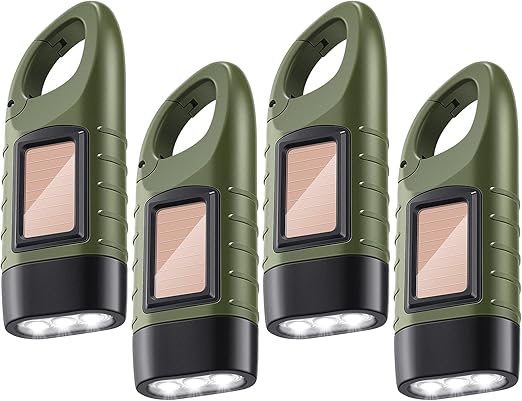
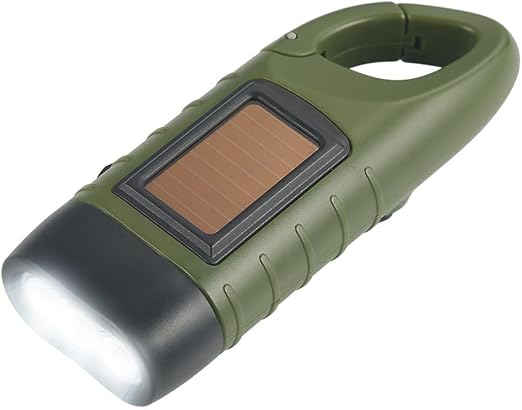
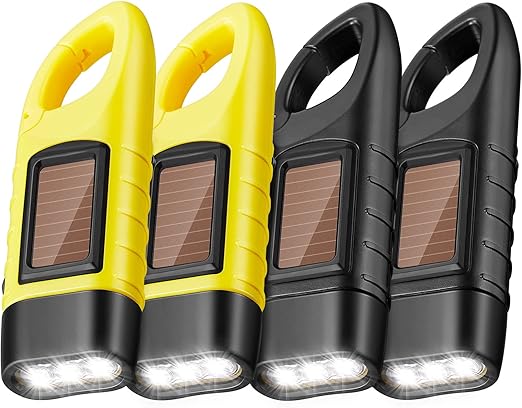
6 Best Solar Flashlights
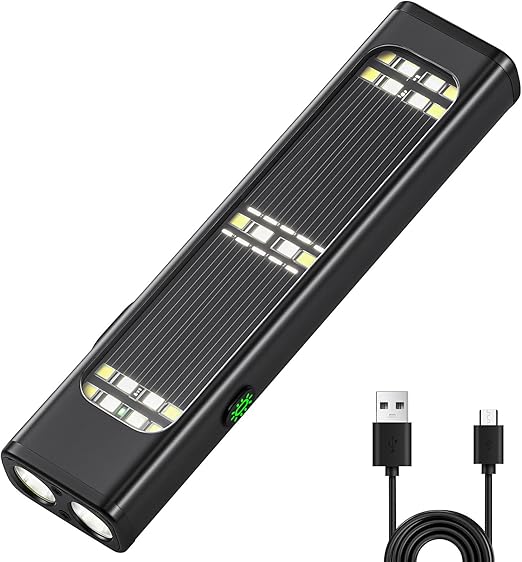
1. Ciwuzxs Solar Rechargeable Flat Flashlight 900 Lumens
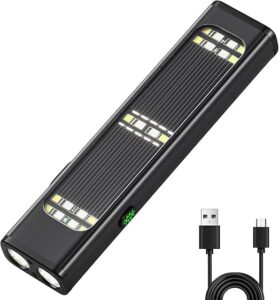
Of all the solar flashlights out there, this one packs the most light into the thinnest profile. The Ciwuzxs folds flat to about the thickness of a paperback book, which makes it easy to slip into a glovebox, first aid kit, or camping pack without taking up any real space. Open it up and you’ve got a bright 900-lumen beam that holds for hours on a full charge.
Charging is handled two ways. The built-in solar panel on the back face tops the battery up in sunlight, and a USB port lets you charge it from any power bank or wall adapter. That dual-charging setup is what separates this model from cheaper solar-only options that can leave you in the dark after a cloudy week.
The beam has multiple modes including high, low, and strobe. Build quality feels solid rather than flimsy, and the flat design means it won’t roll off a surface when you set it down. Good for home emergency kits, power outages, and camping trips alike.
For a solar flashlight you can count on, the Ciwuzxs earns its spot at the top of this list. The combination of serious output, compact form factor, and dual charging is hard to beat at this price point.
Features
- 900 lumens output on high mode
- Folds flat for compact storage
- Charges via built-in solar panel or USB
- Multiple brightness modes including strobe
- Durable lightweight construction
- Excellent 900-lumen brightness
- Ultra-compact flat profile
- Dual charging (solar + USB)
- Multiple light modes
- Solar charging is slow compared to USB
- Flat design can feel unfamiliar at first
2. Hilngav 2 Pack Solar Flashlight Rechargeable Zoomable LED
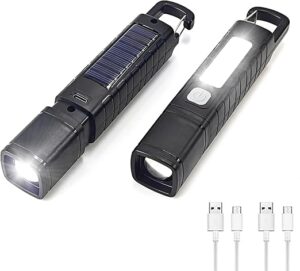
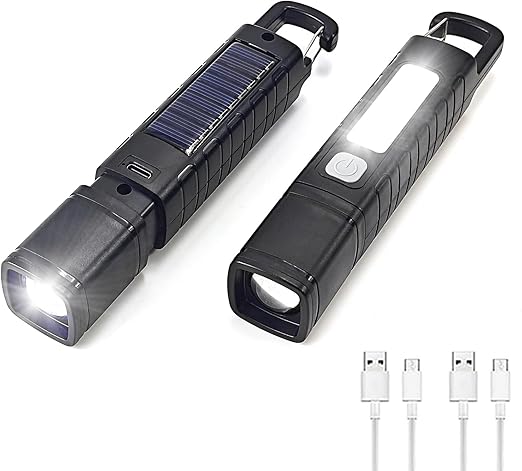
If you want to get two flashlights without doubling your budget, the Hilngav 2-pack is the smart choice. Both units are zoomable, letting you switch between a tight focused beam for distance and a wide flood for close-up area lighting. That flexibility makes them useful beyond just “point and shine.”
Like the Ciwuzxs, these charge via solar panel or USB. The solar panels are positioned on the head of each flashlight, facing forward, so they charge when you leave them on a windowsill or dashboard. Runtime is solid, and the zoom function is smooth and easy to operate with one hand.
Getting two flashlights at this price point is genuinely useful. Keep one in the house and one in the car, or give one to a family member. The build quality is on par with what you’d expect at this price, nothing fancy, but reliable for everyday emergency use.
Features
- Zoomable beam — flood to spotlight
- Comes as a 2-pack
- Solar + USB dual charging
- LED head for long bulb life
- Compact cylindrical design
- Two flashlights for the price of one
- Useful zoom function
- Dual charging capability
- Lower output than the Ciwuzxs
- Build feels lightweight
- Solar charging area is small
3. Solar Rechargeable LED Emergency Flashlight
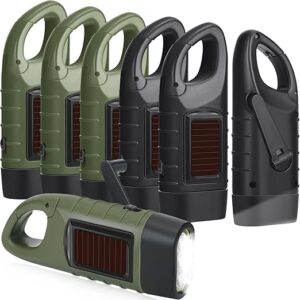
This solar rechargeable model is a solid mid-range option for anyone who wants a dependable torch for power outages and camping without overthinking the purchase. It charges via solar and USB, puts out consistent white light, and has a conventional cylindrical grip that feels natural in the hand.
The LED output is respectable for this category, bright enough to navigate a dark room or find your way along a trail without causing eye fatigue. The solar panel size is proportional to the flashlight body, which means charging in direct sun takes a reasonable amount of time rather than forever.
It’s a practical, no-fuss option. Not the brightest on this list, not the most feature-packed, but a reliable tool that does exactly what it promises. Good for households that want an emergency flashlight stashed in a drawer without spending much thought on it.
Features
- Built-in solar panel charging
- USB backup charging port
- LED light source for efficiency
- Standard cylindrical grip
- Multiple light modes
- Simple, reliable design
- Dual charging modes
- Good value for the price
- Not the brightest option here
- Limited additional features
- Solar charging is slow
4. Oudain 4 Pack Hand Crank Solar Powered Flashlight
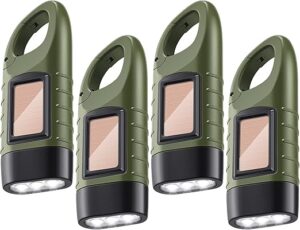
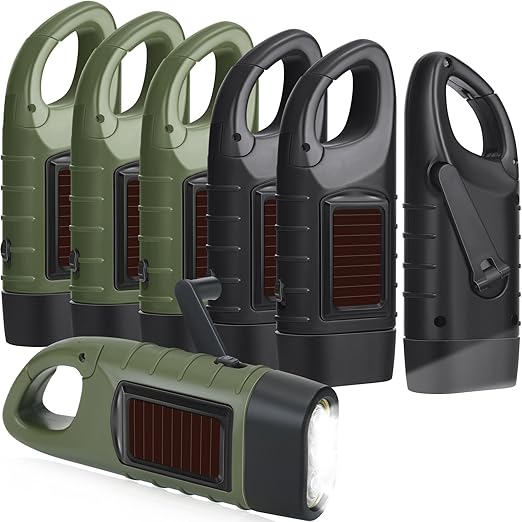
The Oudain 4-pack is built for one thing above all: working when nothing else will. Hand-crank flashlights need no batteries, no USB cable, and no sun. You turn the crank and you get light. That makes them the ultimate backup when you’ve been without power for days and every charged device in the house is dead.
Getting four in a pack is smart thinking. Stash one in each car, one in the kitchen, and one in the garage. At this price per unit, it’s cheaper than buying individual flashlights, and having multiples spread around the house means you’re never hunting in the dark for the one flashlight you can’t find.
The solar panel on each unit adds passive charging capability when you leave them on a windowsill, which means they may arrive topped up after a sunny few days. Runtime from a full hand-crank charge is modest, better suited for emergency use than extended camping trips, but that’s exactly what this type of flashlight is designed for.
Features
- Hand crank generates power without any source
- Solar panel for passive charging
- Comes in a 4-pack
- LED light output
- Compact and lightweight
- Works with zero power available
- Excellent value for 4-pack
- Great for emergency preparedness
- Solar + crank dual charging
- Cranking is tiring for extended use
- Output lower than rechargeable models
5. Simpeak Hand Cranking Solar Powered Flashlight with Carabiner
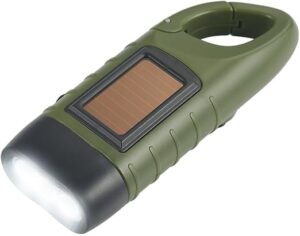
The Simpeak stands out from the other hand-crank options because of one practical addition: a built-in carabiner clip. That lets you clip it to a backpack strap, tent guy line, or belt loop so it’s always within reach on a hike or at a campsite. Small detail, genuinely useful in practice.
Like the Oudain, it uses both hand-crank and solar charging, so you’re covered in any situation. The form factor is compact enough to carry without noticing the weight, and the carabiner is rated for regular light-duty use rather than being a decorative clip that bends on first use.
This is the best pick among the hand-crank options if you’re primarily interested in outdoor and camping use rather than home emergency prep. The clip adds real everyday utility that the other crank models don’t offer. Output is modest but sufficient for trail navigation and campsite use.
Features
- Built-in carabiner for attachment
- Hand crank + solar dual charging
- Compact lightweight body
- LED bulb
- Suitable for outdoor use
- Carabiner clip for convenient carry
- Good for camping and hiking
- Works without any power source
- Lower lumen output than rechargeable models
- Single unit (no multipack)
- Carabiner not rated for climbing
6. Mudder 4 Pack Hand Crank Solar Powered Flashlight
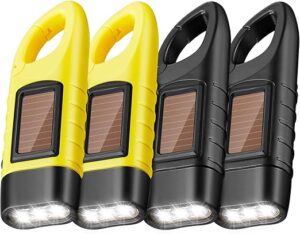
Another strong 4-pack option, the Mudder set covers the same core use case as the Oudain. Hand-crank power generation, solar top-up, and a compact form factor that works for emergency kits, gloveboxes, and anywhere else you stash a backup flashlight.
Comparing the two 4-packs: Mudder and Oudain are closely matched on features and price. The Mudder set’s build is slightly different in hand feel, so if you’ve had the Oudain and found the grip uncomfortable, this is worth trying as an alternative. Both are solid emergency flashlights that work when everything else has died.
Features
- 4-pack value set
- Hand crank power generation
- Solar panel charging
- LED output
- Compact design for storage
- Good value for 4-pack
- Works without batteries or power
- Similar to Oudain — little differentiation
- Modest output
- Cranking effort adds up quickly
Solar Flashlight Buying Guide
How Solar Charging Works in Flashlights: Timing and Practicality
Solar flashlights integrate a small photovoltaic panel into the flashlight body — typically on a flat surface of the handle or housing — that charges an internal battery during daylight. Understanding the practical charging dynamics sets appropriate expectations. A typical solar flashlight panel is 3–10 square centimeters; in peak sun, this produces 30–100mW. A 1,000mAh battery (common in mid-range solar flashlights) stores approximately 3.7Wh — charging from empty to full at 100mW takes 37 hours of peak sun, which in practice means 2–4 full sunny days of outdoor exposure. This calculation reveals why solar charging is best understood as a supplement to other charging methods rather than a primary charging source. Solar flashlights are most practical as emergency and preparedness tools that trickle-charge via the solar panel during normal storage, maintaining readiness without requiring battery removal or AC charging. In genuine off-grid or disaster scenarios, setting a solar flashlight in a sunny window for 4–8 hours provides meaningful top-up charge that extends runtime. Most quality solar flashlights also include USB charging, which is the practical primary charging method, with solar as the backup.
Light Output Categories: Lumens and Runtime by Use Case
Solar flashlight output ranges from 50 to 1,000+ lumens across different product categories, and the appropriate output level depends entirely on the intended use. Emergency and preparedness flashlights need enough output to navigate a home during a power outage, read a map, or signal for help — 100–300 lumens is more than adequate and significantly extends runtime compared to maximum-output operation. Task flashlights for camping, hiking, and trail use need 150–400 lumens for trail navigation and camp setup; close-range tasks like cooking or tent setup need only 30–100 lumens. High-power flashlights for tactical, search, or professional applications deliver 500–1,000+ lumens but consume battery proportionally faster. Runtime is the inverse of output: a 300mAh battery running a 100-lumen LED (approximately 1W) delivers approximately 1 hour of runtime at that output. Multiple output modes — high, medium, low, SOS — allow users to match consumption to need, dramatically extending runtime by using lower output when maximum brightness isn’t required. A flashlight that delivers 4 hours at high and 24 hours at low gives the user meaningful choice that a single-output flashlight doesn’t.
Primary Battery vs. Rechargeable: Chemistry and Capacity
Solar flashlight battery design falls into two categories. Fixed internal rechargeable batteries (lithium-ion or LiFePO4) charge via the integrated solar panel and USB port — they’re built into the flashlight and not user-replaceable without disassembly. This design is appropriate for regular-use flashlights that will be routinely charged and used. The second category uses standard AA or AAA NiMH rechargeable batteries that can be solar-charged in place, removed for external charging, or replaced with fresh cells in an emergency when solar and USB charging aren’t available. The removable battery design has a meaningful advantage for emergency preparedness: in an extended power outage where USB charging is unavailable and solar charging is limited by weather, you can swap in fresh alkaline AA batteries from a store — something you cannot do with a sealed lithium pack. For everyday and recreational use, sealed lithium packs are more convenient. For emergency preparedness where absolute reliability in worst-case scenarios matters most, removable-battery designs offer the redundancy that sealed designs cannot provide. LiFePO4 chemistry in sealed packs offers the best combination of cycle life (2,000+ cycles), temperature range, and safety of any rechargeable lithium chemistry.
Durability: Drop Rating, Water Resistance, and Build Quality
Flashlights encounter rough handling — they’re dropped, knocked off tables, carried in tool bags with other equipment, used in rain and wet conditions. For a flashlight to be genuinely useful as an emergency or outdoor tool, it must survive these conditions. Drop resistance is specified as drop height survived without failure — a 1-meter drop rating (the standard for many quality flashlights) represents falling from table height to a hard floor. A 2-meter drop rating provides more confidence for belt-carry use where drops from standing height are possible. Anodized aircraft-grade aluminum bodies provide the highest strength-to-weight ratio and excellent heat dissipation from the LED; high-impact polymer bodies are lighter and less prone to denting but can crack in the coldest temperatures. IP68 waterproofing (submersible to 1 meter for 30 minutes) is appropriate for any flashlight that might be used in rain or dropped near water — the marginal cost of higher waterproofing over IP44 is minimal and the protection is meaningfully better. For solar panels integrated into the flashlight body, check that the panel’s mounting is flush and sealed, not raised or gasketed in a way that creates a catch point for knocks and drops.
Multiple Charging Methods: Why USB + Solar + Dynamo Matters for Preparedness
The most capable solar flashlights for emergency and preparedness use include multiple charging inputs. USB-C (increasingly common, faster than micro-USB) provides fast primary charging when power is available. The integrated solar panel provides maintenance charging and emergency top-up. A hand-crank dynamo generator (found on combination preparedness lights, sometimes paired with a radio) provides power generation that requires no external source at all — critical for true grid-down scenarios lasting weeks. Some designs add a battery terminal bay for standard alkaline batteries as a fourth option. The practical hierarchy in a disaster scenario: charge via USB before and during any storm warning period (building up full battery reserve); after power loss, use USB power bank reserves if available; use solar charging during daylight hours to extend reserve; use hand crank for communication device charging in low-light periods. For a household emergency preparedness kit, a multi-source flashlight that includes at least solar plus USB, and ideally adds hand crank, is significantly more resilient than a single-source design. The hand crank feature adds cost but eliminates the last dependency — no battery, no grid, no sun — on obtaining power from an external source.
Solar Flashlight for Camping and Outdoor Recreation
For recreational outdoor use — camping, backpacking, hiking — solar flashlights occupy a specific niche. The primary advantage over non-solar LED flashlights is the ability to trickle-charge during the day while clipped to a pack or left in a sunny campsite spot, reducing dependence on carrying spare batteries. On a multi-day camping trip, a solar flashlight set in the sun for 4–6 hours per day during hiking can maintain a meaningful charge level even with nightly use, potentially eliminating the need for spare batteries entirely in good weather. The limitation: in heavily forested camping environments, cloud cover, or short-daylight shoulder seasons, solar top-up may be minimal. Backpackers counting grams of pack weight note that small high-output flashlights with lithium primary batteries are lighter than solar flashlights with integrated panels and rechargeable batteries — the weight penalty of the solar design is real, typically 30–60 grams heavier than equivalent-output designs without solar. For car camping where weight is not a constraint, this tradeoff is immaterial. For ultralight backpacking where every gram is optimized, a standard lithium-powered headlamp plus USB power bank is typically more weight-efficient than a solar flashlight for multi-day trips.
SOS and Emergency Signaling Functions
Many solar flashlights include an SOS strobe mode — a rapid flashing pattern that follows the international distress signal (three short, three long, three short flashes) and is visible at much greater distances than continuous illumination at equivalent power consumption. The SOS function is activated by a specific button sequence (to prevent accidental activation) and typically operates at reduced power draw compared to continuous high-output modes, extending the period the light can continue signaling. At 300 lumens in clear night conditions, a flashlight SOS strobe can be seen 3–5 miles distant from a ground observer and further from aircraft. Rescue personnel looking for a ground signal use the SOS pattern as a confirmation marker — a steady light might be a house or vehicle; an SOS strobe is an unambiguous call for help. For hikers, boaters, and anyone venturing into areas with limited communication infrastructure, the SOS function is a genuine safety feature worth verifying in any emergency preparedness flashlight. Test the SOS function before relying on it — a few solar flashlights have menu systems complex enough that activating SOS under stress is non-obvious.
Price Tiers and Right-Sizing to Use Case
Solar flashlights span from under $10 to over $80, with each tier delivering different capabilities. Under $15: basic single-mode output (100–200 lumens), small battery (200–500mAh), solar charging as the primary or only charge method, NiMH or small lithium cell — adequate as a backup room light or basic emergency kit item, not suitable as a primary flashlight. $15–$35: dual or triple output modes, USB charging plus solar, 500–1,000mAh battery, 200–500 lumens high mode, adequate waterproofing — appropriate as a quality everyday carry or camping flashlight. $35–$60: higher output (500–1,000 lumens), quality aluminum body, IP68 waterproofing, larger battery (2,000+ mAh), LiFePO4 chemistry in some models, longer warranty — appropriate for serious outdoor use and comprehensive emergency preparedness kits. $60–$100+: commercial or tactical grade construction, maximum output, multi-source charging including dynamo, radio integration on some combination devices, extended warranties — appropriate for professional emergency responders, serious outdoor travelers, and preparedness-focused buyers who treat the flashlight as critical safety equipment. For most households, the $20–$40 range provides a reliable tool that covers emergency, camping, and everyday utility without overspending on professional-grade features.
Frequently Asked Questions
How long does it take to charge a solar flashlight?
It depends on the solar panel size and sunlight intensity. In direct summer sunlight, most solar flashlights reach a usable charge in 4 to 8 hours. Charging through a window typically takes two to three times longer because glass blocks some of the UV spectrum. USB charging is much faster, usually 1 to 3 hours for a full charge. Hand-crank models generate around 1 minute of light per minute of cranking at moderate effort.
How long do solar flashlights last on a full charge?
Most modern solar flashlights run 3 to 8 hours on a full charge at medium brightness. High mode drains the battery faster, often cutting runtime to 1 to 3 hours. Lower brightness modes can stretch runtime to 10+ hours for some models. Hand-crank models provide shorter runtime per charge because the battery capacity is typically smaller.
Are solar flashlights as bright as regular flashlights?
Good ones are, yes. The Ciwuzxs delivers 900 lumens, which is comparable to a mid-range conventional LED flashlight. Budget solar flashlights can be dim, so check the lumen spec before buying. For reference: 100 lumens is enough to find your way around a dark room, 300 lumens is solid for outdoor use, and 600+ lumens is genuinely bright for most purposes.
Can I charge a solar flashlight through a window?
Yes, but expect slow results. Standard glass filters out UV and some visible spectrum light, which reduces solar panel efficiency by 30 to 50%. It works for top-up maintenance charging rather than fast charging. For a quicker charge, take the flashlight outside or charge it via USB.
Which is better — solar or hand-crank flashlights?
For emergency preparedness, hand-crank wins because it works in absolute zero-power situations. For everyday use and camping, solar rechargeable models are more convenient since they charge passively and USB charging is fast. The best option is a dual-mode flashlight that offers both.
How many lumens do I need in a solar flashlight?
300 lumens is the practical minimum for outdoor use. 500 to 900 lumens gives you a genuinely useful beam for most tasks. If you only need it for around-the-house use during power outages, 200 lumens is workable. Look for a model with multiple brightness modes so you can extend battery life when full power isn’t needed.
Summing Up
The best solar flashlight depends on what you need it for. If you want maximum brightness and portability, the Ciwuzxs 900 Lumen is the standout choice. Its flat design, dual charging, and high output make it the most capable option here. For value-focused buyers who want multiple flashlights, the Oudain 4-pack or Mudder 4-pack hand-crank models are excellent emergency kit choices that work with zero power. The Hilngav 2-pack hits a nice middle ground for households that want two capable solar rechargeable flashlights without spending much. Whatever you pick, having a solar flashlight — or a few — stashed around your home is one of the simplest and most practical ways to prepare for power outages.
If you’re also thinking about solar panels for your home, call (855) 427-0058 for a free quote — it takes just a few minutes to find out what installation would cost and save you in your area.
Updated