
Our blog is reader-supported. When you buy through links on our site, we may earn an affiliate commission. Thank you for your support!
Solar garden lights transform outdoor spaces into enchanting nighttime retreats while adding security and functionality to your yard. The GIGALUMI Solar Garden Lights with 120 LEDs stand out as our top choice because they deliver bright, steady illumination with flexible copper wire construction that lets you create custom shapes and arrangements. Each light features an upgraded solar panel and high-capacity 600mAh battery, providing 8-10 hours of continuous lighting after just 4-6 hours of sunlight.
Whether you’re looking to highlight pathways, create ambient patio lighting, or accentuate garden features, solar garden lights offer versatile solutions without electrical wiring or maintenance. This guide reviews eight of the best solar garden lights available, evaluated for brightness, battery performance, design versatility, and durability in real-world outdoor conditions.
Our Top Picks
| Image | Name | |
|---|---|---|
| GIGALUMI Solar Garden Lights Bright, reliable solar garden lights from a top-rated brand, perfect for lawns and flower beds. Read more | |
| TONULAX Solar Garden Lights Warm-white solar garden lights with an elegant design that blends into any outdoor setting. Read more | |
| GIGALUMI Pathway Lights 12-Pack Multi-pack solar pathway lights ideal for lining driveways, walkways, and garden beds. Read more | |
| GIGALUMI Lily Solar Flower Lights Beautiful lily-shaped solar flowers that add a charming glow to garden borders and pathways. Read more | |
| ASMAD Solar Garden Lights Durable solar garden spotlights with adjustable heads for highlighting plants and features. Read more | |
| Aloftsun Solar Garden Lights Energy-efficient solar garden lights with wide illumination coverage and an IP65 waterproof rating. Read more | |
| T-SUN Solar Garden Spotlights Adjustable solar spotlights ideal for illuminating garden beds, pathways, and architectural features. Read more | |
| Newhouse Lighting Solar String Lights Solar string lights that add decorative ambiance to patios, pergolas, and garden spaces. Read more |
8 Best Solar Garden Lights
1. GIGALUMI Solar Garden Lights
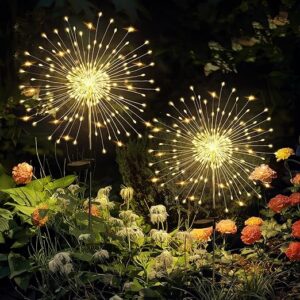
GIGALUMI’s 120 LED solar garden lights deliver impressive brightness at 800+ lumens with an innovative design that’s more flexible than traditional fixed lights. The copper wire construction allows you to bend and shape the lights into virtually any configuration, from a simple stake to elaborate spirals, stars, or custom patterns. This versatility makes these lights a favorite for creative homeowners.
The upgraded solar panel charges quickly even in partial sunlight. The high-capacity 600mAh battery stores enough energy for 8-10 hours of continuous operation after 4-6 hours of sun exposure. During peak summer months, you might get 10+ hours of runtime.
Installation is simple: unwrap the copper wire, position it where you want it, stake the base into soil, and you’re done. No digging, no wiring, no mounting hardware required. The lights activate automatically at dusk and turn off at dawn thanks to the built-in light sensor.
The warm white light creates inviting ambiance in gardens, around patios, and along pathways. The two-pack ensures you can cover multiple areas or create a more dramatic display with combined lights.
Features
- 120 LED chips per light
- 800+ lumens brightness
- Flexible copper wire construction
- Bendable into custom shapes
- Upgraded solar panel
- 600mAh high-capacity battery
- 8-10 hour runtime
- 4-6 hour charge time
- Warm white light
- Automatic dusk-to-dawn operation
- Two units per pack
- Flexible design allows customization
- Bright 800+ lumen output
- Long 8-10 hour runtime
- Wire requires careful positioning
- May need support stakes for elaborate shapes
- Higher price than basic stake lights
2. TONULAX Solar Garden Lights
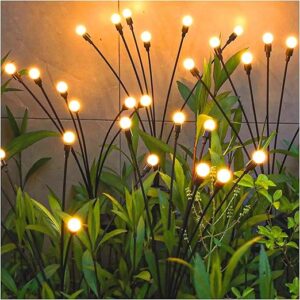
TONULAX brings a unique feature to solar garden lights: swaying motion. The lights are designed to move gently with the wind, creating dynamic lighting effects rather than static illumination. This swaying design makes gardens come alive at night with subtle, captivating movement.
The heavy bulb base keeps the light stable even when wind moves the fixture, preventing the light from tipping over. The high-flexibility iron wire allows graceful swaying without stress or breakage. The warm white light combined with gentle motion creates an almost magical nighttime atmosphere.
These lights work beautifully around patios, gardens, and flower beds. They’re excellent for creating focal points that draw attention to specific landscape features. The two-pack lets you create paired installations or cover wider areas.
Battery performance is solid at 8-9 hours on a sunny day. The automatic sensor means you never have to manually control when these lights operate.
Features
- Swaying motion feature
- Heavy bulb base for stability
- Flexible iron wire construction
- Warm white light
- Automatic dusk-to-dawn sensor
- 8-9 hour battery runtime
- Two units per pack
- Durable materials
- Easy installation
- Unique swaying motion feature
- Attractive design aesthetic
- Stable construction
- Motion may not appeal to all
- May move too much in strong winds
- Higher price point
3. GIGALUMI Pathway Lights 12-Pack
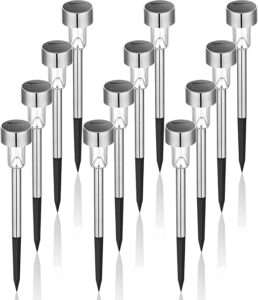
The GIGALUMI 12-pack pathway lights provide comprehensive coverage for gardens and walkways at an economical price. These lights use stainless steel construction that resists rust and corrosion from moisture and weather exposure.
With twelve units, you can line entire pathways, define garden beds, or create comprehensive lighting throughout your outdoor space. The stake design makes installation quick and straightforward. No digging trenches, no wiring, no mounting hardware needed.
The cold white light provides excellent visibility for safety along pathways. Each light operates independently, so if one fails, the others continue functioning. The solar panel on each unit charges individually, adapting to local sun exposure.
These lights are the practical choice if you value functionality and comprehensive coverage over creative customization.
Features
- 12 lights per pack
- Stainless steel construction
- Rust-resistant materials
- Cold white light
- Stake-mounted design
- Automatic operation
- Individual solar charging
- Pathway-optimized design
- Long lifespan
- 12-pack provides complete coverage
- Rust-resistant stainless steel
- Affordable per-unit cost
- Cold white light (not warm)
- Basic design lacks customization
- May not stand out visually
4. GIGALUMI Lily Solar Flower Lights
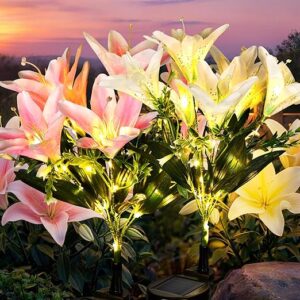
GIGALUMI’s lily flower lights bring artistic flair to garden design. Each light is shaped to resemble an open lily flower, creating beautiful visual interest during the day and casting a soft, warm glow at night.
The two-pack comes in mixed colors (one white, one pink) or you can select matching pairs. The flowers automatically light at dusk, creating enchanting nighttime garden displays. These lights work beautifully in flower beds, around garden features, and as accent lighting.
The automatic operation means no manual switching. Install them once and enjoy reliable, maintenance-free lighting throughout the season. The soft warm light creates inviting ambiance that white lights can’t achieve.
These lights are perfect if you want garden lighting that’s also a decorative element. They attract positive attention from neighbors and visitors.
Features
- Lily flower-shaped design
- Decorative function
- Available in multiple colors
- Two units per pack
- Warm white light
- Automatic dusk-to-dawn operation
- Weather-resistant materials
- Stake-mounted installation
- 8-10 hour runtime
- Beautiful flower design
- Decorative and functional
- Available color options
- Higher price for aesthetic appeal
- Fragile flower petals need care
- May not suit modern landscapes
5. ASMAD Solar Garden Lights
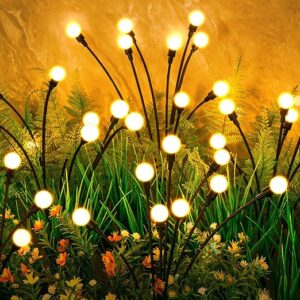
ASMAD’s solar garden lights create a firefly effect with varying wire lengths that produce natural, swaying motion. The eight LED bulbs per light deliver gentle illumination perfect for ambient garden lighting.
The design philosophy focuses on creating natural-looking lighting that mimics fireflies dancing through your garden. This creates magical nighttime ambiance without harsh brightness. The longer wire lengths mean installation flexibility, allowing customization of light height and position.
These lights run 10-12 hours after 6-8 hours of solar charging. The automatic sensor activates them at dusk. They’re ideal for creating atmospheric lighting in gardens, around patios, and near seating areas where ambiance matters more than bright illumination.
Features
- Eight LED bulbs per light
- Firefly effect design
- Varying wire lengths
- Swaying motion capability
- Warm white light
- 10-12 hour battery runtime
- Automatic dusk-to-dawn sensor
- Easy customization
- Maintenance-free operation
- Unique firefly aesthetic
- Natural swaying motion
- Long runtime
- Lower brightness than other options
- Wire positioning requires care
- Not ideal for pathway lighting
6. Aloftsun Solar Garden Lights
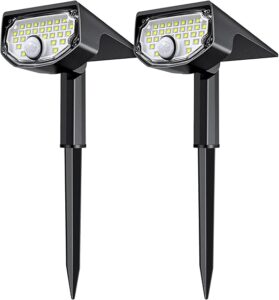
Aloftsun brings functional versatility with 30 LED bulbs and three operating modes. Mode one provides motion-sensor activation with ambient light. Mode two offers continuous medium brightness. Mode three delivers full brightness motion detection.
The 800 lumen output makes these lights suitable for larger gardens and areas requiring brighter illumination. The solar panels are integrated into the light head, providing compact installation that doesn’t require separate panel positioning.
The three-mode flexibility means you can adapt lighting based on the season and your needs. In summer, ambient lighting might suffice. In winter, brighter security-focused modes provide better nighttime visibility.
Features
- 30 bright LED bulbs
- 800 lumens brightness
- Three operating modes
- Motion sensor option
- Integrated solar panel
- Automatic dusk-to-dawn operation
- IP65 waterproof rating
- 8-10 hour battery runtime
- Adjustable mounting
- Three flexible operating modes
- Bright 800 lumen output
- Integrated solar panel
- More complex setup
- Higher price than basic lights
- Motion detection may cause false triggers
7. T-SUN Solar Garden Spotlights
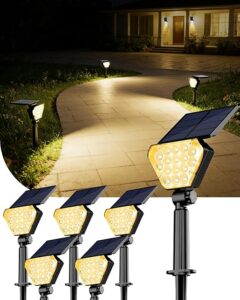
T-SUN solar spotlights offer focused illumination for highlighting specific garden features. Unlike ambient lights that spread light everywhere, spotlights concentrate light on targeted areas like sculptures, water features, or architectural elements.
The adjustable mounting lets you angle spotlights precisely where needed. You can mount them at ground level with included spikes or attach them to walls and structures. The focused beam is ideal for creating dramatic nighttime garden displays.
These lights work well in combination with ambient lights. Use spotlights to highlight focal points while ambient lights provide overall illumination. This layered approach creates depth and visual interest in garden design.
Features
- Spotlight design
- Focused beam
- Adjustable mounting
- Ground spike option
- Wall-mount capability
- Automatic operation
- Weather-resistant
- Long battery life
- Multiple brightness levels
- Focused illumination
- Flexible mounting
- Highlights garden features
- Not ideal for overall illumination
- Requires thoughtful positioning
- Beam may be too narrow for pathways
8. Newhouse Lighting Solar String Lights
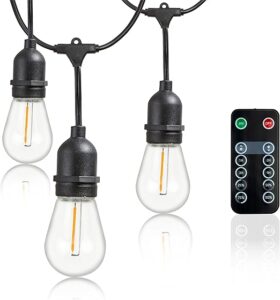
Newhouse brings the charm of traditional string lights to solar garden lighting. The connected string design creates continuous illumination across patios, pergolas, and garden areas. Each light in the string operates independently so you maintain ambiance even if individual bulbs fail.
The warm white light creates inviting ambiance for outdoor entertaining and relaxation. String lights can transform a simple patio into an enchanting nighttime entertainment space. Hang them overhead, wrap them around trees, or drape them along fences.
Installation is flexible since the string format accommodates various mounting scenarios. No mounting brackets needed, just find anchor points for the main cable.
Features
- String light design
- Connected light segments
- Warm white light
- Multiple length options
- Weather-resistant materials
- Flexible installation
- Long battery life
- Automatic dusk-to-dawn operation
- Creates enchanting ambiance
- Flexible hanging options
- Multiple mounting possibilities
- Requires overhead installation
- Heavy when wet
- May need frequent cleaning
Solar Garden Lights Buying Guide
Garden Light Styles: Pathway, Spotlight, String, Lantern, and Decorative
The solar garden light category encompasses several distinct product types that are often grouped together but serve fundamentally different purposes. Pathway lights are stake-mounted fixtures that direct light downward onto walking surfaces, defining garden paths, driveway edges, and border outlines. They’re functional first, decorative second. Spotlights are directional fixtures on adjustable stakes or wall brackets, focusing a beam on a specific plant, tree, sculpture, or garden feature — they create dramatic accent lighting and visual hierarchy in the garden. String lights hang between posts, trees, or along pergola edges, creating ambient overhead illumination for seating areas. Lanterns sit on the ground or hang from hooks, providing omnidirectional soft light for atmosphere without directional intent. Decorative or novelty lights (gnomes, mushrooms, animals, flowers) are purely whimsical — atmosphere and personality rather than functional illumination. Effective garden lighting typically layers multiple types: pathway lights for navigation, spotlights for feature emphasis, and ambient types for overall atmosphere. Understanding which types your garden needs before shopping prevents buying all of one type that doesn’t quite serve the various zones.
Lumen Output by Garden Zone and Purpose
Matching lumen output to the garden zone prevents the two most common mistakes: pathway lights too dim to safely guide nighttime traffic, or feature lights so bright they wash out the garden’s nighttime character. For safe nighttime navigation, pathways need at minimum 30–50 lumens per fixture at 6-foot spacing, or 60–100 lumens at 8-foot spacing. Seating areas benefit from 200–500 lumens total ambient illumination from multiple lower-output sources rather than one bright spot — the distributed approach eliminates harsh shadows and glare that make outdoor seating uncomfortable. Accent spotlights for specimen plants or structures should produce 200–500 lumens focused on the target; for large trees (15+ feet) or building facades, 1,000–2,000 lumens creates dramatic uplighting visible from a distance. Border and bed decorative lights operate at 5–20 lumens — their purpose is visual interest and atmosphere, not illumination, and higher output from these fixtures creates glare that actually diminishes the garden’s nighttime appeal. Plan your garden lighting scheme zone by zone before purchasing, noting the purpose and appropriate lumen range for each area.
Color Temperature: Creating the Right Garden Atmosphere
Color temperature (measured in Kelvin) profoundly affects how garden lighting feels at night. Warm white light (2,700–3,000K) closely mimics candlelight and incandescent bulbs — it renders foliage in golden tones, makes wooden structures feel inviting, and creates an intimate, cozy atmosphere most suited to seating areas and dining terraces. Neutral white (4,000–4,500K) provides better color rendering — plants look more natural, stone and concrete read clearly, and the overall effect is crisp without being harsh. Cool white (5,000–6,500K) is bright and clinical — excellent for security and task applications, poor for garden atmosphere where you want relaxation rather than alertness. Most garden lighting recommendations favor warm white (3,000K or below) for pathways, seating areas, and water features; neutral white works well for driveways and entry paths where seeing clearly matters more than ambiance. A common mistake is buying cool white lights for a garden seating area — the result feels like an interrogation room rather than a relaxing outdoor space.
Solar Performance in Partially Shaded Gardens
Most residential gardens are partially shaded — by fences, buildings, mature trees, or neighboring structures — during some or all of the day. Solar garden lights are tested in full sun and their runtime claims reflect ideal conditions that may never exist in your garden. Before purchasing, map your garden’s sun pattern over a full summer day: note which areas receive 4+ hours of direct sun (suitable for any solar light), which receive 2–4 hours of direct sun (marginal — use high-efficiency monocrystalline panels), and which receive less than 2 hours (use hardwired lighting instead). For beds beneath tree canopy, consider remote-panel solar lights where the panel is placed in a sunnier spot while the light fixture can be positioned in shade. For heavily shaded gardens — under dense evergreen canopy, against north-facing fences — solar lighting is often impractical and low-voltage hardwired systems are more reliable. Don’t fall for vague “works in shade” marketing claims; they typically mean the light will function (dimly, briefly) rather than perform at rated output and runtime.
Automatic Controls: Dusk-to-Dawn, Timer, and Motion Modes
Most solar garden lights include a light sensor (photocell) that automatically activates at dusk and deactivates at dawn, requiring no manual operation. This dusk-to-dawn mode is the standard operating mode for pathway and ambient lights. Timer modes that run the light for a set period (4, 6, or 8 hours after dusk) conserve battery, enabling brighter operation for the early-night hours when the garden is actually used, then shutting off for the remainder of the night when no one is outside. This is particularly useful in winter when nights are long and charge days are short — running at 50% brightness for 12 hours uses more battery than running at full brightness for 5 hours. Motion-activated modes add security functionality, turning the light to full brightness when movement is detected and returning to dim standby (or off) after the detection period. For garden party or event lighting, some premium string and lantern lights offer color-changing modes or dimming capability controllable via app. Simpler is often better for maintenance: lights with more modes have more control electronics that can fail, and most users use only one mode anyway.
Design Cohesion: Mixing and Matching in the Garden
A garden lit by lights from a dozen different brands, in different finishes, at different heights, is visually chaotic even if each individual fixture is attractive. Design cohesion comes from establishing 2–3 consistent lighting families in defined zones: one style for the front garden, a complementary style for the backyard, and coordinated transition elements at boundaries. Within each zone, use consistent height, finish, and light output. Mixing warm and cool white within the same view is particularly jarring — decide on one temperature for each zone and stick to it. A useful technique is selecting one “anchor” fixture style (a stake spotlight or lantern) and building the rest of the lighting scheme to complement it. When purchasing in stages (common for garden lighting that evolves over seasons), save the product links for each fixture and note the brand/model, so additions match existing fixtures accurately. Color rendering inconsistency between manufacturing batches is more common in solar lights than in premium hardwired fixtures — ordering all fixtures for a zone at the same time from the same supplier minimizes this risk.
Maintenance Schedule for Year-Round Performance
Solar garden lights require light but consistent maintenance to perform well over multiple seasons. Panel cleaning is the highest-impact maintenance task: a dusty or pollen-covered panel charges at 60–80% of its clean-panel efficiency. Wiping panels with a damp cloth every 4–6 weeks during spring, summer, and autumn maintains peak performance. After autumn leaf fall, check that stake-mounted lights haven’t been pushed sideways by foot traffic or ground frost heave, and reposition as needed. Battery replacement — typically every 2–3 years for NiMH units — is straightforward: use identical capacity and chemistry cells, not alkaline substitutes. In cold climates (zones 6 and below), bringing stake lights indoors for winter storage prevents battery damage from deep freezing, cracked housings from frost heave, and panel damage from ice storms. Mark the storage bags with the installation location so you replace lights in exactly the same positions in spring. Lights left out through harsh winters typically fail within 2–3 seasons; lights brought in seasonally often last 7–10+ years.
Frequently Asked Questions
How long do solar garden light batteries last?
Most solar garden light batteries last 2-4 years before losing capacity. Higher-end models with premium batteries may reach 5-7 years. Many lights use replaceable AA batteries, making battery swaps easy and inexpensive.
Will solar garden lights work in winter?
Solar garden lights work in winter with reduced performance. Shorter days and lower sun angles mean less charging and shorter runtime. In far northern climates, some lights may not activate at all on cloudy winter days.
How many hours should solar garden lights run?
Quality solar garden lights run 8-12 hours after a full day of direct sunlight. Budget models may only run 6-8 hours. Location and season affect actual runtime significantly.
Do solar garden lights need maintenance?
Minimal maintenance is required. Occasionally wipe solar panels clean of dust and debris. In winter, clear snow off panels. Most lights require nothing else for years of reliable operation.
Can I leave solar lights outside year-round?
Yes, quality solar garden lights are designed for year-round outdoor use. They handle rain, snow, temperature extremes, and UV exposure without degradation. Budget lights may lose brightness over time with extended UV exposure.
What brightness level is best for gardens?
For ambient garden lighting, 100-300 lumens is ideal. For pathway safety, choose 400+ lumens. For decorative accent lighting, any brightness level works if you like the aesthetic effect.
Are solar garden lights waterproof?
Quality solar garden lights are IP65 waterproof, meaning they handle rain without issues. Most aren’t designed to be submerged, but they easily withstand outdoor weather exposure.
Can I move solar lights around my garden?
Yes, solar lights are completely portable. Simply pull them up and reposition them wherever needed. No installation equipment means complete flexibility to rearrange seasonally or as your garden evolves.
Summing Up
Solar garden lights provide affordable, maintenance-free solutions for enhancing your outdoor space. The GIGALUMI Solar Garden Lights with flexible wire construction offer creative customization options and excellent brightness. For a decorative approach, TONULAX swaying lights create magical movement while the GIGALUMI Lily lights bring artistic flair. For comprehensive pathway coverage, the GIGALUMI 12-pack pathway lights provide practical, budget-friendly solutions.
If you’re also thinking about solar panels for your home, call (855) 427-0058 for a free quote — it takes just a few minutes to find out what installation would cost and save you in your area.
Updated