
Our blog is reader-supported. When you buy through links on our site, we may earn an affiliate commission. Thank you for your support!
Solar garden stake lights are the easiest way to add light and ambiance to your yard without running electrical wiring. Whether you want to outline a pathway, highlight garden beds, or simply add a welcoming glow to your outdoor space, these stakes deliver on both form and function. The Sparkblaze 16 Pack leads our list with the highest rating of any solar pathway light we reviewed, at 4.6 stars from a strong verified buyer count.
We compared eight of the best-selling options on Amazon side by side. This guide breaks down each model’s strengths, helps you pick the right count for your yard size, and shows you how to get the longest battery life from your lights.
Our Top Picks
| Image | Name | |
|---|---|---|
| Sparkblaze 16 Pack Solar Pathway Lights Outdoor | |
| Eyrosa Solar Lights Outdoor 12 Pack Waterproof | |
| DenicMic Solar Lights Outdoor 10 Pack 6000K | |
| Mancra 10 Pack Metal & Glass Solar Pathway Lights | |
| ASMAD Solar Lights Outdoor 4 Pack (32 LEDs) | |
| BITPOTT Bright Solar Pathway Lights Outdoor 6 Pack | |
| Tadyreal Solar Spot Lights Outdoor 10 Pack | |
| GIGALUMI 16 Pack Solar Lights Outdoor Waterproof |
8 Best Solar Garden Stake Lights
1. Sparkblaze 16 Pack Solar Pathway Lights Outdoor
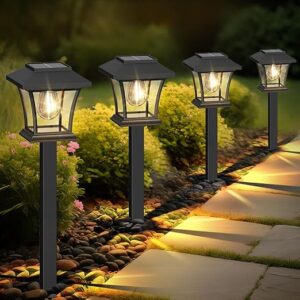
At 4.6 stars, Sparkblaze sits at the top of our list and it earns it. The 16-pack gives you enough coverage for a full driveway entrance or a long garden pathway without needing to order two separate packs. Each light uses a bright LED with a warm-white tone that works well against grass, mulch, and stone borders alike. The waterproof housing is well-rated for outdoor exposure year-round, and the dusk-to-dawn sensor kicks in reliably from the first night.
What buyers consistently praise is the consistent quality across the full pack. Budget solar lights often ship with two or three dead units in a 16-pack. Sparkblaze buyers report that all 16 arrive functional and hold charge well through the first season. The stakes push into most soil types without bending, and the solar panel on top is positioned to catch direct sun without needing special angling.
Runtime after a full charge is around 8 hours, which covers dusk to around midnight or 1 AM for most of the year. In summer, longer daylight hours push runtime even further. For buyers who want to set up a lit path and not think about it again, Sparkblaze is the most hands-off option on this list.
The only real limitation is that 16 units is more than some buyers need for a small garden. If you’re lighting just a front step or a short border, a smaller pack is the better value. But for anyone with a real driveway or a long garden edge, 16 lights at this price is a strong deal.
Features
- 16-pack, LED solar pathway lights
- Warm white, dusk-to-dawn auto sensor
- Waterproof construction
- 8-hour runtime on full charge
- Easy push-in stake installation
- Highest-rated solar pathway light on this list (4.6 stars)
- Full 16-pack covers long pathways in one order
- Consistent performance across all units in the pack
- Reliable 8-hour runtime after a sunny day
- 16 units is overkill for small gardens
- Warm white only, no color options
2. Eyrosa Solar Lights Outdoor 12 Pack Waterproof
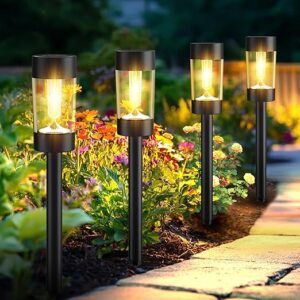
Eyrosa’s 12-pack hits the sweet spot for mid-sized yards. Twelve lights is enough for a standard residential pathway or a garden bed perimeter without going overboard. The waterproof rating holds up to direct rain and sprinkler contact, which matters for lights that go in garden beds where they’ll get wet regularly. At 4.5 stars, this is a well-reviewed product with a large verified buyer base.
The brightness is solid for pathway-marking duty. These lights don’t try to floodlight your yard. They provide the ambient glow that guides you down a path safely at night without washing out the garden’s natural nighttime appearance. The LED color is warm white, which suits most residential landscapes better than cool white.
Installation is straightforward: push the stake in, pull the battery tab, and they’re working by dusk. The dusk-to-dawn sensor is accurate and doesn’t false-trigger on ambient light from streetlights or porch lights. After a full sunny-day charge, expect 6 to 8 hours of runtime.
Features
- 12-pack, LED solar landscape lights
- Warm white, waterproof housing
- Dusk-to-dawn auto on/off
- 6-8 hour runtime on full charge
- Right pack size for most residential yards
- Strong waterproof rating for garden bed use
- Accurate dusk-to-dawn sensor
- Warm white only
- Shorter runtime than some competitors
- Slightly higher per-unit cost than 16-packs
3. DenicMic Solar Lights Outdoor 10 Pack 6000K Cold White
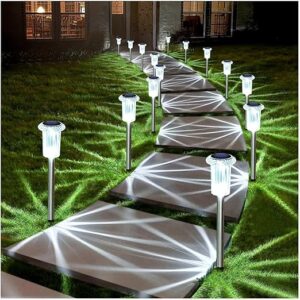
DenicMic is the cold white option on this list. The 6000K color temperature produces a crisp, bluish-white light that looks more modern than warm white and tends to provide better visibility contrast against dark pavement or mulch. If you’re using these for safety-oriented pathway lighting rather than aesthetic ambiance, the cold white color makes it easier to see the path at night.
The 10-pack is a practical count for most entrance pathways. At 4.5 stars, DenicMic’s quality control keeps most units functional out of the box. Runtime is 8 to 10 hours after a full charge, which is on the longer end for this category and means they’ll still be lit when you get home late.
One thing to know going in: cold white is very much a stylistic choice. Some buyers find it too bright or clinical for a garden setting. If you’re lighting a path through flower beds or decorative planting, warm white integrates better. But for a utility driveway or walkway where function matters more than atmosphere, cold white is actually the more useful option.
Features
- 10-pack, 6000K cold white LED
- Waterproof, dusk-to-dawn sensor
- 8-10 hour runtime
- Push-in stake, no tools needed
- Cold white is better for visibility on dark paths
- Longer runtime (8-10 hours) than most competitors
- 10-pack is practical for most pathway lengths
- Cold white can feel clinical in garden settings
- Single color option only
4. Mancra 10 Pack Metal and Glass Solar Pathway Lights
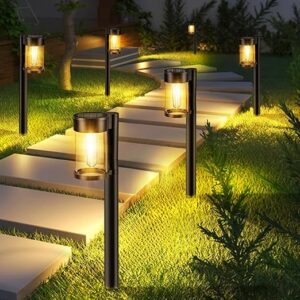
Mancra builds these out of metal and glass rather than the plastic most pathway lights use, which means they hold up better to physical wear and look noticeably more upscale in a landscaped yard. The warm white 3000K output is softer than standard LEDs and suits formal or traditional garden styles well. At 4.5 stars, they’re well-reviewed by buyers who specifically wanted something that didn’t look cheap next to quality landscaping.
The 10-pack covers a standard entrance or garden border without waste. The metal stake holds firmer in soft or sandy soil than plastic alternatives, and the glass lens diffuses light more evenly than a plain plastic dome. These aren’t the brightest lights on this list, but brightness isn’t their selling point. They’re for buyers who want a premium look alongside the solar convenience.
Price per unit is higher than plastic options, which is expected for metal and glass construction. But if you’re putting these in front of a well-maintained entrance where appearance matters, the extra cost is worth it. Mancra’s quality control is good, with very few reports of DOA units in the 10-pack.
Features
- 10-pack, metal and glass construction
- Warm white 3000K LED
- Waterproof, dusk-to-dawn sensor
- Metal stake for firm soil grip
- Metal and glass looks premium next to quality landscaping
- 3000K warm white is softer and more flattering than standard
- Metal stake holds firm in loose soil
- Higher per-unit cost than plastic alternatives
- Not the brightest option on this list
- Glass lens could crack if struck
5. ASMAD Solar Lights Outdoor 4 Pack (32 LEDs)
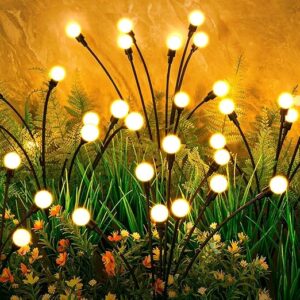
ASMAD takes a different approach by packing 32 LEDs into each unit. That’s a much higher LED count than most pathway lights in this price range, and the result is noticeably brighter output per stake. If you’re using these to light a patio edge or a spot where you want real visibility rather than just ambient glow, the 32 LEDs make a practical difference.
The 4-pack is for buyers who only need a few lights, not a full pathway run. At 4.5 stars, ASMAD’s quality is well-regarded, and the higher LED count doesn’t seem to compromise battery runtime. Expect 6 to 8 hours per night after a full charge.
Features
- 4-pack, 32 LEDs per unit
- Bright warm white output
- Waterproof, dusk-to-dawn sensor
- Easy stake installation
- 32 LEDs per unit means noticeably brighter than competitors
- Good for spots needing real visibility, not just ambiance
- 4-pack suits small spaces without excess
- Only 4 per pack — expensive to cover a full pathway
- Brighter output may look harsh in delicate garden settings
6. BITPOTT Bright Solar Pathway Lights Outdoor 6 Pack
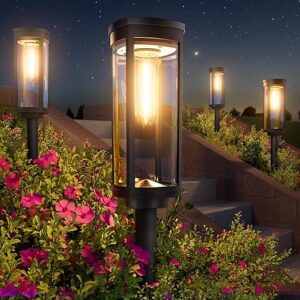
BITPOTT positions their lights as “bright” in the product name, and they mostly deliver on that. The 6-pack sits between the 4-packs and the larger 10 to 16 packs. If you need more than four lights but don’t need a full driveway run, six is a practical count for a short walkway or a patio border. At 4.4 stars, these are solidly mid-tier.
The brightness is good for the price, and the waterproof housing holds up to regular rain. One thing to note: the solar panel on BITPOTT units is slightly smaller than on some competitors, which can mean slower charging on partially cloudy days. If your pathway gets consistent direct sun, this is a non-issue. If you’re in a cloudier climate or have partial shade on the stake location, a model with a larger panel is a better choice.
Features
- 6-pack, bright LED output
- Waterproof, dusk-to-dawn sensor
- Warm white, auto on/off
- Easy stake installation
- 6-pack is practical for short walkways and patios
- Bright output for the price point
- Solid waterproofing for regular rain exposure
- Smaller solar panel means slower charging on cloudy days
- 4.4 stars — a notch below the top picks
- Higher per-unit cost than larger packs
7. Tadyreal Solar Spot Lights Outdoor 10 Pack (46 LED)
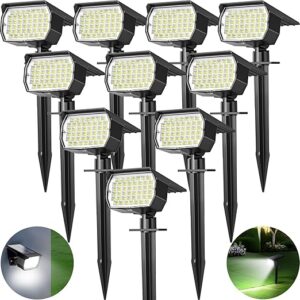
Tadyreal’s 46-LED solar spotlights are a different category from the other lights on this list. Where pathway stakes spread light low and wide, spotlights project a focused beam upward or outward. These suit buyers who want to illuminate a shrub, a garden ornament, or the base of a tree rather than mark a walking path. The 46-LED count means the beam has real presence at night.
At 4.3 stars, Tadyreal is a step below the top options on this list and some buyers report brightness inconsistency across the 10-pack. These work well enough in direct sun locations but underperform in partial shade. The adjustable head lets you angle the beam at specific targets rather than lighting straight up, which is useful for accent lighting.
Features
- 10-pack, 46 LEDs per unit
- Adjustable spotlight head
- Waterproof, dusk-to-dawn sensor
- Warm white focused beam
- 46-LED count produces a bright focused beam
- Adjustable head for accent lighting specific targets
- 10-pack covers a garden with multiple accent points
- Spotlight style, not suitable for pathway marking
- Brightness inconsistency reported across units
- Lower 4.3-star rating vs top picks
8. GIGALUMI 16 Pack Solar Lights Outdoor Waterproof Stainless Steel
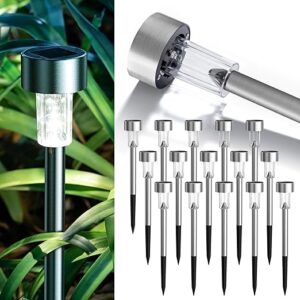
GIGALUMI is one of the best-known names in solar garden lighting, so their 16-pack earns a spot on this list by reputation and sales volume. The stainless steel stake construction is more rust-resistant than plastic alternatives, and the 16-pack gives you enough units for a full driveway run or a long garden border without ordering a second pack. At 4.0 stars, these are not the highest-rated option here, but they’re a known quantity with millions of units sold.
The brightness is modest, which is the main reason they sit at the bottom of this list. For buyers who just need to mark where a path is, modest is fine. If you want actual usable light output, the Sparkblaze or DenicMic are better choices. What GIGALUMI has going for it is brand recognition and a robust return policy if units arrive faulty.
Features
- 16-pack, stainless steel construction
- Warm white LED, dusk-to-dawn sensor
- Waterproof rating
- Auto on/off, no wiring needed
- Well-known brand with strong returns support
- Stainless steel is more rust-resistant than plastic
- 16-pack covers long pathways in one order
- Modest brightness — 4.0 stars, lowest on this list
- Brighter options available at similar prices
- Brightness degrades faster than some competitors
Solar Garden Stake Light Buying Guide
Lumen Output and Light Spread: Decorative vs. Pathway vs. Spotlight
Solar garden stake lights range from purely decorative (under 10 lumens, diffused in all directions through colored glass or resin) to functional pathway lights (50–150 lumens, directed downward to illuminate walking surfaces) to focused spotlights (200–400 lumens, narrow beam for plant or statue accent lighting). Understanding which category serves your garden is essential before comparing products. Decorative lights are about visual effect at night — a glowing orb or flower shape contributing to garden atmosphere rather than task lighting. Pathway lights create a lit corridor that defines edges and prevents tripping without creating glare. Spotlights emphasize specific garden features — a specimen tree, ornamental grass, sculpture, or garden structure — with a focused beam from stake level upward. Mixing categories thoughtfully creates layered garden lighting: pathway stakes along a walk, spots on key plants, and decorative lights filling in beds. Using only one type produces a flat effect; using the wrong type for the job (decorative lights trying to serve as pathway lights, for example) creates inadequate or unattractive results.
Solar Panel Efficiency and Placement in Garden Conditions
Garden stake lights are the most installation-dependent solar product category because garden environments are inherently variable in sun exposure. A stake light that works perfectly in a sunny border fails entirely in a bed beneath tree canopy. Panel placement relative to available sun is critical — and often limited by where the stake needs to be for visual effect. Most stake lights have integrated top-mounted panels (the most compact design), fixed-angle panels tilted toward the sun, or remote panels on a short cable that can be positioned separately from the light. For shaded gardens, remote-panel designs give you the flexibility to position the panel in a sunnier spot while the light stake sits in the shade. Monocrystalline silicon panels perform significantly better than polycrystalline in diffuse and partial-shade conditions, collecting useful energy from overcast skies rather than requiring direct sunlight. If the majority of your garden is in partial shade for most of the day, expect battery-powered solar lights to have shorter runtimes than packaging claims, which are tested in full-sun conditions.
Battery Type and Runtime Expectations
Most solar garden stake lights use rechargeable AA or AAA NiMH batteries (typically 600–1200mAh), which are adequate for warm-climate installations but lose significant capacity below freezing. Higher-quality units use LiFePO4 cells that maintain performance through winter, important for year-round garden lighting. Runtime claims — “8 hours,” “10 hours” — are measured under controlled conditions with full charge and standard operating temperatures. Real-world runtimes depend on how many hours of sun the panel received that day, the temperature, and whether the light was on continuously or in flicker mode. A light claiming “8 hours” after a full sun charge in summer may provide only 4–5 hours after a short winter charge day. For critical pathway lighting that must operate reliably, choose lights with battery capacity rated for your longest winter nights at your latitude, and check user reviews specifically from northern states or similar latitudes. The replaceable-battery format is a significant advantage: when capacity drops after 2–3 years (as NiMH inevitably does), swapping AA batteries at $2–$3 extends the light’s life rather than requiring full replacement.
Construction Materials and Weather Durability
Garden stake lights are exposed to ground moisture, direct rain, sprinkler spray, UV radiation, frost, and the mechanical stress of ground movement from freeze-thaw cycles. IP44 is the minimum waterproofing for outdoor garden lights; IP65 provides substantially better protection against dirt and water intrusion and should be the standard for lights in direct sprinkler zones. Material quality affects longevity significantly at the lower price points: thin ABS plastic stakes crack when pushed into hard soil; plastic panels fade and yellow within two seasons of direct sun; cheap brass fittings corrode to the point of permanent staining. Stainless steel stakes and hardware, UV-stabilized resin housings, and tempered glass lenses represent the premium tier that realistically survives 5+ years in a functioning garden. For mass planting (20–50+ lights in a large garden), the value proposition shifts: buying inexpensive lights and replacing them every 2–3 years may be economically equivalent to buying premium lights, particularly when garden layouts change with planting redesigns.
Design Aesthetic: Matching Lights to Garden Style
Solar garden stake lights are sold in dozens of styles — from naturalistic (mushroom, flower, dragonfly, stone) to contemporary (geometric, frosted glass globe, brushed stainless cylinder) to traditional (lantern, coach lamp, pagoda). Style selection is personal, but a few principles improve results. Consistency within a view: mixing too many styles in one visible area creates visual clutter. A consistent design in a given bed — all mushroom lights, or all globe lights — creates a cohesive look that reads as intentional. Transition between styles at natural boundaries: a different style in the backyard versus the front garden is fine; mixing five styles in the same front border is not. Scaling to plant height: lights that stand 8 inches tall disappear in a mature perennial border with plants growing to 24+ inches; scale stake height to garden height so lights remain visible through the growing season. Night-only appeal vs. daytime appearance: during the day, solar stake lights are visible as objects in the garden. Choose designs that are attractive (or at least inoffensive) in daylight rather than purely optimizing for their nighttime illumination effect.
Installation Density and Multi-Pack Planning
Effective garden path lighting requires lights spaced 6–8 feet apart to create a continuous, comfortable luminous corridor. A 40-foot path needs 5–7 lights; a U-shaped entry path with 80 feet total coverage needs 10–13 lights. Purchasing multi-packs is almost always more economical than buying singles: the cost per light typically drops 20–40% when buying 6-packs or 10-packs compared to individual units. For large garden installations, buying from the same batch helps ensure color temperature consistency — lights from different manufacturing runs can vary in tint, producing noticeable mismatches when installed side by side. Installation technique affects longevity: pushing stakes into very hard clay soil risks cracking the stake housing; loosening the soil with a hand fork before inserting the stake prevents this. Keep stakes plumb (vertically straight) so the panel faces the sky directly rather than at an angle — even a 15-degree tilt can reduce daily charging by 5–10% over a season.
Maintenance and Long-Term Performance
Solar garden stake lights are low-maintenance but not no-maintenance. Panel cleaning is the most important task: panels accumulate dust, pollen, bird droppings, and leaf debris that can reduce charging efficiency by 15–25%. A quick wipe with a damp cloth every 2–3 months during the growing season maintains optimal performance. Battery replacement — the other key maintenance task — is straightforward for NiMH units: remove the battery cover (usually a small screw on the base), swap the AA or AAA cells for fresh rechargeable batteries of the same capacity, and reinstall. Do not use alkaline batteries in solar lights — they’re not designed for the charge-discharge cycle and will leak, potentially damaging the electronics. Season-end storage in cold climates extends battery and fixture life: removing lights before the ground freezes hard, cleaning them, and storing indoors prevents cracked housings, dead batteries, and rust on metal components that accumulate when lights are left out through hard winter weather.
Frequently Asked Questions
Summing Up
Solar garden stake lights are one of the easiest ways to add ambiance and visibility to a garden path or flower bed — no wiring, no running costs, and they charge themselves each day. The picks above range from budget multi-packs that flood a large garden with light to premium metal and glass stakes that hold up season after season.
If you’re also thinking about solar panels for your home, call (855) 427-0058 for a free quote — it takes just a few minutes to find out what installation would cost and save you in your area.
SHOP SOLAR GARDEN STAKE LIGHTS
Updated