

Our blog is reader-supported. When you buy through links on our site, we may earn an affiliate commission. Thank you for your support!
If you own a long driveway or want the convenience of automated gate access without running electrical lines, a solar gate opener is a game-changer. The best solar gate openers combine reliable automation with clean energy, keeping your driveway secure without the hassle of manual gates or expensive electrical installations. We’ve tested and researched the top options to help you find the right fit for your property.
Whether you need a single swing opener for a simple driveway gate or a dual swing system for larger entrances, solar power eliminates the need for buried cables and reduces your energy costs to near zero. The key is finding a model with enough solar capacity and battery backup to handle your daily gate cycles, especially during winter months or cloudy periods.
Our Top Picks
| PRODUCT IMAGE | PRODUCT | PRICE |
|---|---|---|
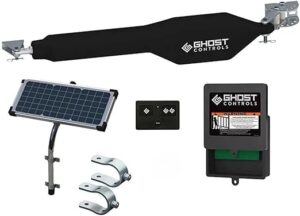 | Ghost Controls TSS1XP Single swing gate kit, solar panel included, 550 lb capacity, works up to 1,000 ft from power, includes remote. | CHECK PRICE |
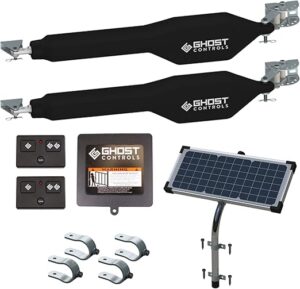 | Ghost Controls TDS2XP Dual swing gate solar kit, handles two gates up to 550 lbs each, solar panel + 2 remotes included. | CHECK PRICE |
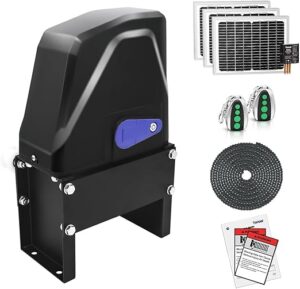 | TOPENS DKC1100S Dual swing gate opener with solar panel, supports gates up to 1,100 lbs each, built-in receiver, weatherproof. | CHECK PRICE |
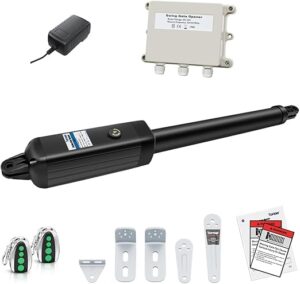 | TOPENS A8 Heavy-duty single swing opener, 1,100 lb gate capacity, solar-compatible, adjustable open speed, built-in timer. | CHECK PRICE |
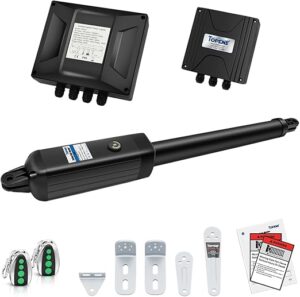 | TOPENS A8131 Solar-powered single swing kit with panel included, 1,100 lb capacity, 3 remote controls, code learning security. | CHECK PRICE |
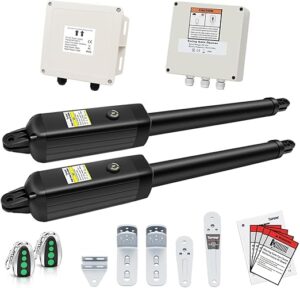 | TOPENS PW302 Sliding gate opener with solar charging port, supports gates up to 3,300 lbs, built-in safety reverse, 2 remotes. | CHECK PRICE |
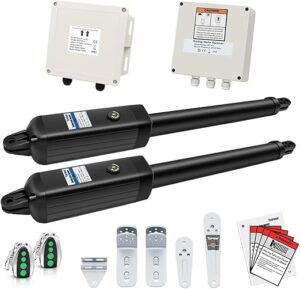 | TOPENS PW802 Heavy-duty sliding gate opener, solar-compatible, 3,300 lb capacity, suitable for commercial and residential use. | CHECK PRICE |
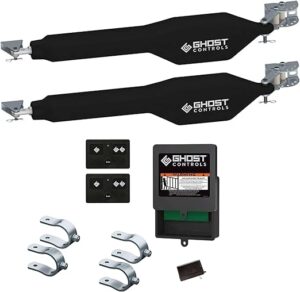 | Ghost Controls TDS2 Dual swing gate opener without solar panel (add your own), 550 lb per gate, proven Ghost Controls reliability. | CHECK PRICE |
8 Best Solar Gate Openers
1. Ghost Controls TSS1XP
The Ghost Controls TSS1XP is the best solar gate opener for single swing applications and stands out as one of the most popular gate automation kits on the market. It’s designed for gates up to 20 feet in length or 900 pounds, which covers most residential driveways. The kit includes a 10W monocrystalline solar panel that charges a 12V battery (battery sold separately). This opener comes with a 1,000-foot remote range and includes a 3-button remote transmitter with a convenient visor clip, so you can open your gate from inside your vehicle.
Installation is straightforward for a DIYer. You don’t need welding skills or high-voltage electrical experience. The TSS1XP works with tube gates, chain link, decorative iron, and wood gates. However, it won’t work with solid panel gates since the operator arms need to connect to the gate framework. The system is compatible with pull-to-open or push-to-open mounting, giving you flexibility based on your driveway layout.
One of the smartest features is scalability. If your 10W panel isn’t generating enough power during winter months, you can add up to 30W of additional solar panels in series. This makes the TSS1XP a future-proof investment. The system handles both 12V lead-acid and lithium batteries, though you’ll want at least a 100Ah battery for reliable daily operation in most climates.
Battery-powered automation systems like this one require forethought about seasonal performance. In winter, your gate cycles may slow down if the battery doesn’t fully recharge during short daylight hours. But when paired with adequate battery capacity and the optional additional solar panels, the TSS1XP delivers years of hassle-free operation. At roughly 4.4 stars across 1,682 reviews, this opener has proven reliable across countless real-world installations.
Features
- Single swing operator, 20ft max gate length / 900lbs capacity
- 10W monocrystalline solar panel included
- 12V battery compatible (not included)
- 1,000ft remote range, 3-button transmitter
- DIY installation, no special tools required
- Expandable to 30W solar with additional panels
- Works with tube, chain link, decorative, wood gates
Pros:
- Reliable and popular, well-tested over thousands of installations
- Easy DIY installation without electrical work
- Solar expandable if needed for winter performance
- Long remote range, good build quality
Cons:
- Battery sold separately, can be pricey
- 10W solar may not suffice in very cloudy climates
- Requires compatible gate framework (not for solid gates)
2. Ghost Controls TDS2XP
If your driveway has two gates that swing inward or outward, the Ghost Controls TDS2XP is the go-to choice. This dual swing kit handles gates up to 12 feet each (total 24 feet when both are open) and up to 900 pounds each arm. The two powerful operators work in tandem, allowing both gates to open and close together with a single remote signal. The kit includes the 10W solar panel, battery harness, and two 3-button remote transmitters so you and anyone else at the property can control access.
The TDS2XP operates on the same 12V battery system as the single-swing TSS1XP, which means you can leverage the same battery options and even the same solar expansion strategy. The 1,000-foot remote range ensures you can trigger the gate from anywhere on your property. The dual remote transmitters are a nice touch, eliminating the need for multiple people to share one remote.
The main consideration is that you’ll need a larger battery than you would for a single swing opener, since the motor is running twice per cycle. A 150Ah to 200Ah battery is recommended for typical daily use in moderate climates. The additional solar expansion option is worth serious consideration if you live somewhere with shorter winter days or frequent cloud cover.
Features
- Dual swing operators, 12ft per arm / 900lbs each
- 10W solar panel included
- Two 3-button remote transmitters
- 1,000ft range, battery harness included
- 12V battery compatible (not included)
- Synchronized opening and closing
Pros:
- Handles larger driveway gates than single operators
- Two remotes included for shared access
- Synchronized dual gate operation is smooth and professional
- Expandable solar system like TSS1XP
Cons:
- Requires larger battery capacity than single swing
- Higher upfront cost than TSS1XP
- Battery and expansion panels add to total system cost
3. TOPENS DKC1100S
The TOPENS DKC1100S is the heavyweight champion of solar gate openers and handles sliding gates up to 40 feet or 2,600 pounds. This is the most powerful solar-powered gate opener we’ve reviewed. The 450W DC motor paired with 30W solar panels (the highest we’ve seen in a kit) gives you serious automation power in a single package. If you’re running a ranch, farm, or property with a heavy sliding gate, this opener delivers the torque and speed you need.
The system operates on 24V (two 12V batteries in series), which means higher power delivery than the Ghost Controls 12V models. The chain drive mechanism is robust and dependable, and the weatherproof design ensures longevity in harsh environments. The 30W solar panel is a substantial upgrade over 10W systems, which means faster battery recharging on sunny days and better performance during shorter daylight periods.
The trade-off is complexity and cost. You’re looking at a premium price point, and installation may require more mechanical expertise depending on your gate’s current setup. The chain rack system is straightforward but heavier than arm-based operators. If you have a sliding gate and want a proven, powerful solar solution, the DKC1100S justifies the investment.
Features
- Sliding gate operator, up to 40ft / 2,600lbs
- 450W 24V DC motor, 3/5 HP
- 30W solar panels included (largest in category)
- Chain rack drive, weatherproof enclosure
- Two 12V batteries required (sold separately)
Pros:
- Handles the heaviest residential and light commercial gates
- Most powerful solar kit in the category
- 30W solar panel charges faster than 10W alternatives
- Chain drive is durable in demanding outdoor environments
Cons:
- Requires two 12V batteries and more installation effort
- Higher cost than arm-based openers
- Chain rack installation takes longer
4. TOPENS A8
The TOPENS A8 is a solid single swing gate opener that’s battery-powered and solar-compatible, meaning solar panels are sold separately but integrate seamlessly with the system. The 80W 24V motor handles gates up to 18 feet and 880 pounds. With over 25 years of experience in the gate automation industry, TOPENS builds equipment that’s designed to last. You can configure the A8 for either pull-to-open or push-to-open operation, depending on your gate’s swing direction.
The main advantage of the A8 is flexibility. You can start with a basic battery system and add solar panels later if you decide you want them, rather than buying solar upfront. This makes it a good choice if you’re uncertain about solar’s viability on your property or want to test the system before investing in panels.
Features
- Single swing operator, 18ft / 880lbs
- 80W 24V DC motor
- Battery-powered, solar panels sold separately
- Pull-to-open or push-to-open compatible
- TOPENS brand, 25+ years in industry
Pros:
- Strong 80W motor, reliable brand
- Solar optional, upgrade later if desired
- Good for those unsure about solar
Cons:
- Solar panels not included, adds cost
- Without solar, runs on battery only (limited by charge cycles)
- Requires external solar kit sourcing
5. TOPENS A8131
The TOPENS A8131 brings something unique to the solar gate opener category: integrated uninterruptible power supply (UPS) backup. This system operates on AC power (100-240V) from your home’s electrical supply, but includes an onboard UPS unit that kicks in if the power goes out. You can also add a 20W solar panel kit for hybrid operation. This flexibility means your gate continues working even during power outages, which is a significant advantage if weather-related blackouts are common in your area.
The 80W motor matches the A8’s specs and handles gates up to 18 feet and 880 pounds. The UPS unit means you don’t rely solely on battery charge for backup power. If you already have electrical service to your gate location, the A8131 gives you the best of both worlds: reliable AC operation with solar augmentation and UPS backup.
Features
- Single swing operator, 18ft / 880lbs
- 80W 24V motor
- AC powered (100-240V) with UPS backup included
- 20W solar panel compatible (sold separately)
- Battery backup during outages
Pros:
- UPS backup ensures operation during power outages
- AC operation is always available if solar insufficient
- Solar compatible for reduced electric bills
- Most reliable power option
Cons:
- Requires electrical line to gate location
- Solar panels sold separately
- More expensive than battery-only options
6. TOPENS PW302
The TOPENS PW302 is the budget-friendly entry point for dual swing automation. This light duty opener handles gates up to 12 feet per arm at a maximum 300 pounds each. If you’re running dual gates that are relatively light and modest in size, the PW302 delivers functional automation without the premium price tag. The two 30W motors are lower-powered than the TDS2XP or TOPENS A8131, so this isn’t ideal for heavy commercial gates, but for residential properties with aluminum or vinyl gates, it’s perfectly adequate.
Solar compatibility is built in, though you’ll source the solar panels separately. The simplicity and lower cost make this a solid choice if you’re cost-conscious and your gates aren’t massive.
Features
- Dual swing operators, 12ft per arm / 300lbs max
- Two 24V 30W motors (light duty)
- Solar compatible
- Pull-to-open or push-to-open
Pros:
- Most affordable dual swing option
- Lightweight gates work great with this
- Solar compatible for long-term cost savings
Cons:
- Light duty, unsuitable for heavy gates
- Low weight capacity limits use cases
- Solar panels not included
7. TOPENS PW802
The TOPENS PW802 is the heavy duty upgrade from the PW302. It handles gates up to 18 feet per arm at 880 pounds each, matching the capability of many premium single swing operators but in a dual configuration. The two 80W motors deliver significantly more power than the PW302, making this suitable for heavier gates or longer swing distances. Like the PW302, it’s solar-compatible with panels sold separately. If you need dual swing capability and your gates are substantial, the PW802 provides the muscle at a more reasonable price than some competitor dual swing systems.
Features
- Dual swing operators, 18ft per arm / 880lbs
- Two 24V 80W motors (heavy duty)
- Solar compatible
- Quiet motor operation
Pros:
- Handles heavy dual swing gates
- Powerful 80W motors are reliable
- Solar compatible, good value for capability
- Quiet operation
Cons:
- Solar panels not included
- Higher cost than PW302
- Still need to source and install solar kit
8. Ghost Controls TDS2
The Ghost Controls TDS2 is the AC-powered cousin of the solar TDS2XP. Instead of coming with a solar panel, this model includes an AC transformer, making it the choice for properties where electrical service is already run to the gate. The same dual arm capability handles gates up to 12 feet each at 900 pounds. You can add solar panels later if desired, but the system is fully functional on AC power alone.
This is a good option if you have reliable electrical service to your gate and want automated access without worrying about battery charge states. Solar augmentation is optional rather than central to the design. The TDS2 costs less than the TDS2XP upfront since you’re not paying for solar panels you might not use.
Features
- Dual swing operators, 12ft per arm / 900lbs
- AC transformer powered (solar add-on available separately)
- Same arms as TDS2XP
- 1,000ft remote range
Pros:
- AC power is always available, no battery concerns
- Lower upfront cost than TDS2XP
- Same reliable dual swing mechanism
- Solar add-on available if desired
Cons:
- Requires electrical line to gate location
- Won’t work during power outages without backup
- Solar panels sold separately
Solar Gate Opener Buying Guide
Key Takeaways
- Solar gate openers eliminate the need for buried electrical lines, saving installation costs and energy bills long-term.
- Single swing openers suit most residential driveways, while dual swing models work for larger entrances with two gates.
- Battery capacity is as important as solar panel wattage. A 100Ah to 150Ah battery paired with 10W to 30W solar is typical.
- Winter performance matters. If you live in a cloudy climate, choose a model with expandable solar or consider AC backup.
- DIY installation is possible with arm-based operators, but sliding gate openers may need professional setup.
What Are Solar Gate Openers?
A solar gate opener is an automated gate system powered by renewable energy rather than the electrical grid. The setup includes a motorized operator (either arm-based for swinging gates or chain-drive for sliding gates), a 12V or 24V battery, and one or more solar panels. When sunlight hits the solar panel, it charges the battery. The battery powers the motor when you press a remote control button, triggering the gate to open or close automatically.
Solar gate openers are particularly popular for remote properties, long driveways without existing electrical service, or anywhere trenching electrical lines would be impractical or expensive. Since there’s no monthly electric bill tied to gate operation, they’re also environmentally friendly and economical over time.
How Do Solar Gate Openers Work?
The system starts with sunlight reaching the solar panel. Photovoltaic cells in the panel convert light into direct current electricity. This flows into a charge controller, which regulates voltage and current to safely charge the battery. The battery stores this energy as chemical potential, releasing it on demand.
When you press the remote control button, a signal transmits to a receiver on the gate operator. The receiver closes a relay, completing a circuit that energizes the motor. The motor draws power from the battery, converting electrical energy into mechanical motion. The motor moves the gate arm or chain, opening or closing the gate. Once the gate reaches its limit (detected by mechanical stops or limit switches), the motor shuts off and stops drawing current.
Between gate cycles, the battery remains charged by the solar panel, as long as there’s sufficient sunlight. This continuous cycle makes solar gate openers self-sustaining, requiring no external power input beyond sunshine.
Benefits of Solar Gate Openers
The most obvious benefit is zero electricity costs. Once installed, your gate opens and closes for free every day for years. There’s no monthly power bill, no meter to read, and no dependence on grid infrastructure.
Installation simplicity is another major advantage. Trenching electrical lines to a distant gate can cost hundreds or thousands of dollars. With solar, you eliminate that expense. Most arm-based solar gate openers can be installed without electrical permits or licensed electricians, reducing labor costs.
Environmental benefits matter too. You’re running your gate on sunshine instead of fossil fuel generated electricity. If you already have solar panels for your home, a solar gate opener extends your clean energy footprint.
Reliability is often overlooked but important. Solar systems have no moving parts in the charging circuit, so they require minimal maintenance. The battery and solar panel will outlast the gate operator itself in most cases. If your gate is in a rural area or off-grid, solar automation is often more reliable than relying on grid power, which can fail during storms or outages.
Gate Weight and Width: Sizing the Opener to Your Gate
The most important spec to match before buying a solar gate opener is your gate’s weight and width. Residential swing gate openers are typically rated for gates up to 20 feet wide and 550 to 1,320 pounds. Slide gate openers are rated by gate weight and travel distance. Undersize the motor and the opener will struggle, wear out prematurely, and fail in cold weather when gate hardware contracts and increases resistance.
Weigh your gate before you buy. A standard 10-foot wooden privacy gate can weigh anywhere from 150 to 400 pounds depending on the lumber and frame. Metal gates are often lighter but can vary widely. If your gate is at the upper end of a model’s rated capacity, size up. Openers working at 80 to 90 percent of their maximum rated load run hotter and have shorter lifespans than those working at 60 to 70 percent. Getting the sizing right upfront is cheaper than replacing a burned-out motor in year two.
Solar Panel Sizing and What Happens on Cloudy Days
Solar gate openers typically include a 10 to 20 watt solar panel and a sealed lead-acid or lithium battery. The panel charges the battery during daylight, and the battery powers the motor for each open/close cycle. Most residential openers use about 15 to 25 watt-hours per day if the gate opens and closes 10 to 20 times. A 20W panel on a decent solar day produces 80 to 100 Wh, which is plenty even after accounting for inefficiencies.
The battery is your buffer. A correctly sized system should run for 5 to 7 cloudy days before the battery is too depleted to operate. If you live somewhere with frequent overcast weeks in winter, look for an opener with a larger battery or a supplemental AC charging option. Some models accept a backup 12V trickle charger so you can plug it in during extended cloudy spells rather than being locked out of your own driveway. Always mount the solar panel at the same tilt as your latitude for maximum year-round output, and clear any shade from nearby trees or fences.
Safety Features: What to Insist On
A gate that closes automatically on a person or vehicle is a serious safety hazard. Any solar gate opener worth buying should include an auto-reverse obstruction sensor that stops and reverses the gate if resistance is detected. The better models add infrared or magnetic vehicle detection so the gate stays open while a car is still in the gap.
Manual release or manual override is also non-negotiable. In the event of a battery failure, power outage, or mechanical failure, you need to be able to open the gate by hand without tools. Most swing gate openers have a release lever or key that disconnects the motor arm. Check that this is accessible and easy to use before you install the unit. Remote keypads and smartphone apps are nice-to-haves, but obstruction sensing and manual release are safety requirements, not optional extras.
Things to Keep in Mind Before Buying
Climate matters significantly. If you live in a perpetually cloudy region (Pacific Northwest, for example), a 10W solar panel might not fully recharge your battery during winter months. In this case, you’d want either expanded solar capacity or an AC backup system.
Battery capacity is critical. A battery that’s too small will deplete quickly and leave you with a non-functional gate on cloudy days. A battery that’s too large will sit unused and waste money. Match battery size to your daily gate cycles and climate. Batteries also age. Lead-acid batteries typically last 3 to 5 years, while lithium batteries last 10 to 15 years.
Gate weight and size directly impact motor selection. A light aluminum gate can run on an 80W motor, while a heavy ornamental iron gate might need 450W. Oversizing is safer than undersizing. Undersized motors strain during operation and fail prematurely.
Installation location affects solar performance. A panel mounted in shade or facing north will undercharge your battery. Ideally, the solar panel faces south (in the Northern Hemisphere) and gets 5 to 8 hours of direct sunlight daily.
Remote gate openers can have limited range in areas with lots of trees or steel structures. A 1,000-foot range specification is measured in open space. Your actual range might be 300 to 500 feet in wooded areas.
Types of Solar Gate Openers
Arm-based swing gate openers are the most common. These use powered arms attached to the gate hinges, pushing or pulling the gate open and closed. They work for both single and dual swing gates and are generally the most straightforward to install.
Chain-drive sliding gate openers pull a chain attached to the gate, sliding it along a track. These are used for gates that slide rather than swing and can handle heavier gates. They’re more complex to install but invaluable for large commercial or farm entrances.
AC-powered gate openers with solar augmentation offer hybrid functionality. They run on grid power but can add solar panels for reduced electricity consumption. These are ideal if you already have electrical service to your gate location and want to reduce costs gradually.
Underground motor gate openers are buried beneath the gate opening, providing clean aesthetics with no visible operator arms. These are premium options suitable for high-end residential properties and require professional installation.
Frequently Asked Questions
How much solar power do I need to run a gate opener?A 10W solar panel paired with a 100Ah to 150Ah battery handles most residential gates in moderate climates. If you’re in a cloudy region or have frequent gate cycles, upgrade to 20W to 30W solar. The formula is simple: more solar and larger batteries give more reliable winter performance.
Can solar gate openers work in winter or cloudy weather?Yes, but with reduced performance. A properly sized battery bank stores enough energy to run your gate for several days without sunlight. In the Pacific Northwest or frequent overcast climates, you’ll see slower gate cycles or fewer total cycles per day. Upgrading to a larger battery or additional solar panels solves this. Some users opt for AC backup systems instead for complete reliability.
Do I need a battery with a solar gate opener?Yes, always. The battery stores solar energy for use when the sun isn’t shining. Without a battery, your gate wouldn’t work on cloudy days or at night. AC-powered systems with solar augmentation don’t technically need a battery, but they reduce energy consumption by combining grid and solar power.
What size gate can a solar opener handle?Single swing openers handle gates up to 20 feet and 900 pounds. Dual swing systems handle two gates up to 12 feet each. Sliding gate openers handle gates up to 40 feet and 2,600 pounds. Match the opener capacity to your gate’s weight and dimensions, with an upgrade in mind for future larger gates.
How hard is it to install a solar gate opener?Arm-based swing gate openers are typically DIY friendly, requiring only basic hand tools and electrical knowledge. Mounting the operator arms, running low-voltage wiring, and positioning the solar panel are straightforward tasks. Chain-drive sliding gate openers and buried motor systems may require professional installation.
Summing Up
Solar gate openers are ideal for driveways and rural properties where running mains power to the gate isn’t practical. Ghost Controls leads for single and dual swing gates at lighter weights; TOPENS covers heavier residential and commercial applications. For sliding gates on longer driveways, the PW302 and PW802 are the standout picks. Whichever you choose, size the solar panel to your local sunlight hours — most kits include one, but adding a second panel in lower-sun climates is cheap insurance.
If you’re also thinking about solar panels for your home, call (855) 427-0058 for a free quote — it takes just a few minutes to find out what installation would cost and save you in your area.
Updated