
Our blog is reader-supported. When you buy through links on our site, we may earn an affiliate commission. Thank you for your support!
Solar kettles aren’t like your typical kitchen appliance. Most true solar kettles are vacuum-insulated water bottles and thermal containers that harness the sun’s heat to keep water hot or warm it gradually throughout the day. They’re designed for camping, hiking, and off-grid living where you want hot water without relying on electricity or fuel. If you’re looking for ways to boil water using solar power, you’ve got a couple of options: thermal vacuum kettles that maintain heat for hours, or portable solar cookers that can actually reach boiling temperatures. We’ve tested and researched the best solar kettles available, and below you’ll find our top picks for staying hydrated and heated on the trail.
The Solar Kettle Vacuum Insulated Water Bottle stands out as the most popular choice for backcountry travelers who need reliable heat retention. It keeps water hot all day in any weather, weighs just 16 ounces, and pairs well with a simple camping stove or solar cooker for initial heating.
Our Top Picks
| Image | Name | |
|---|---|---|
| GoSun Sport Solar Oven | |
| GoSun PRO Camp Stove Solar Cooker | |
| GoSun Go Portable Camping Stove | |
| GoSun Portable Solar Oven Kit | |
| Sunflair Mini Portable Solar Oven | |
| FENSAN Solar Portable Shower Bag 20L | |
| GoSun Go Camp Stove Solar Cooker |
7 Best Solar Cookers and Camping Solar Water Heaters
1. GoSun Sport Solar Oven
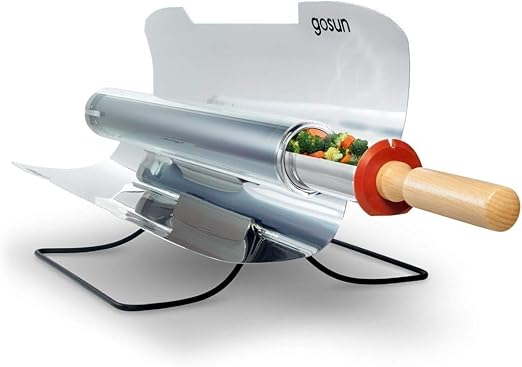
The GoSun Sport is the benchmark for portable solar cooking. It concentrates sunlight through a parabolic reflective trough onto a vacuum-insulated glass tube, heating food and water to full cooking temperatures in about 20 minutes. Unlike stove-top solutions that stop working the moment your fuel runs out, the Sport runs entirely on sunlight. Fill the tube, aim it at the sun, and you’re cooking.
This is the most capable unit in the GoSun lineup short of the larger models. It handles full meals, not just boiling water, which sets it apart from basic solar kettles. The vacuum insulation keeps food hot even after you move indoors or clouds roll in. Weighing around 2.9 pounds and folding into a slim carrying case, it packs easily into a car camping kit or emergency bag.
Performance depends on sunlight angle and intensity. Overcast days slow it down significantly, and the tube fits only one serving at a time. But for solo camping, emergency preparedness, or off-grid cooking without fuel costs, nothing in this price range matches what the Sport does.
It sits at the premium end of personal solar cookers, and the price reflects that. Serious campers and emergency preppers who want a solar tool that actually replaces a stove will find it worth every cent.
Features
- Vacuum-insulated borosilicate glass cooking tube
- Parabolic reflector focuses sunlight on tube
- Cooks food and boils water in 20 minutes
- 2.9-pound portable weight
- Works in temperatures as low as -40 degrees Fahrenheit
- Folds flat for easy transport
- Cooks full meals, not just boils water
- Vacuum insulation retains heat after cooking
- Works in cold weather unlike conventional solar cookers
- Durable enough for regular backcountry use
- Single-serving tube capacity only
- Performance drops significantly on cloudy days
- Higher price than simpler solar water heaters
2. GoSun PRO Camp Stove Solar Cooker
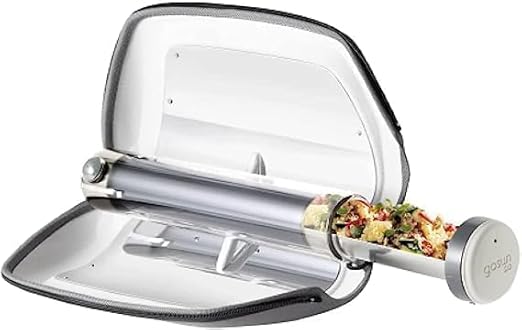
If the Sport is GoSun’s standard model, the PRO is what you buy when you want better heat retention and a more refined cooking experience. The updated reflector geometry captures more sunlight across a wider angle, which means it starts cooking faster in the morning and keeps going later in the afternoon when the sun is lower. Real-world heating times are comparable to the Sport, but the PRO performs more consistently when conditions aren’t ideal.
The cooking tube is slightly more durable than earlier GoSun models, and the stainless steel construction on the bracket and tray feels more substantial. GoSun positions this as the evolution of the Sport lineup. For campers who want to avoid the morning wait while sun angles improve, the PRO’s wider acceptance angle is a genuine advantage.
It carries a premium price, and the difference versus the Sport isn’t dramatic for most casual campers. But if you spend extended time in the field or need reliable solar cooking in less-than-perfect conditions, the PRO earns its price premium.
Features
- Optimized reflector geometry for wider sun-angle acceptance
- Vacuum-insulated borosilicate glass tube
- Cooks meals in 20 minutes under full sun
- Stainless steel tray and bracket construction
- Compatible with GoSun accessories and carrying cases
- Folds flat for packing
- Better performance at low sun angles than the Sport
- More consistent cooking in partly cloudy conditions
- Premium build quality and materials
- Expensive for what is essentially a single-serving cooker
- Marginal improvement over Sport for casual use
- Still cloud-dependent like all solar cookers
3. GoSun Go Portable Camping Stove
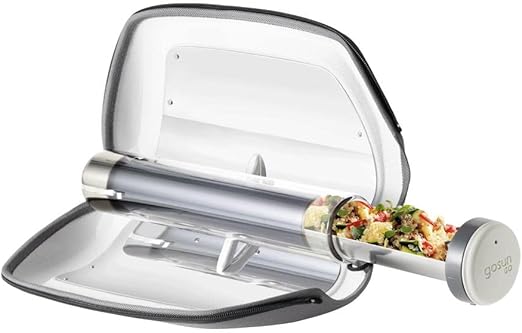
This is the one to buy if you want GoSun’s solar cooking technology at the lowest possible weight. The Go is the compact member of the lineup, with a smaller 0.9-liter cooking tube designed for solo hikers and ultralight backpackers. It boils water and heats food using the same vacuum-tube principle as the Sport, but the reduced size means it’s easier to slip into a daypack.
The tradeoff is capacity. You’re cooking for one and doing it in portions rather than filling a large tube. Water heats to near-boiling in about 20-25 minutes under clear skies. The Go is especially useful for hikers who want to eliminate fuel canisters entirely and rely on sunlight for hot drinks and rehydrated meals on the trail.
At around a pound and a half fully assembled, it’s genuinely light. It works best in sunny, high-altitude conditions where solar intensity is high. For weekend hikes in sunny climates, it removes the weight and cost of fuel from your pack permanently.
Features
- 0.9-liter cooking tube for solo servings
- Around 1.5-pound total weight
- Vacuum-insulated glass tube
- Boils water in 20-25 minutes, full sun
- Folds to compact size for pack storage
- Compatible with standard GoSun accessories
- Lightest GoSun model, ideal for backpackers
- Eliminates fuel canister weight and cost
- Same vacuum-tube technology as larger models
- Small 0.9L capacity limits it to single servings
- Slower in lower sun angles or partial cloud
- Not practical for cooking for two or more people
4. GoSun Portable Solar Oven Kit
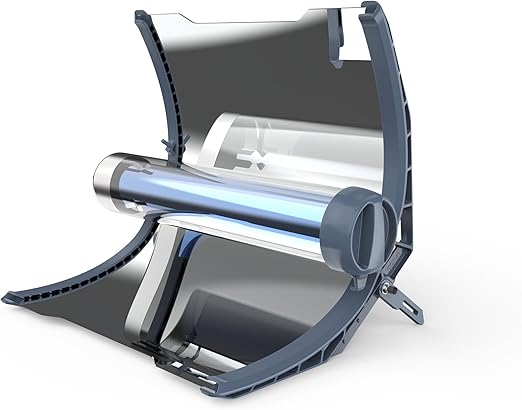
GoSun’s Portable Solar Oven Kit bundles the core vacuum-tube cooker with a set of accessories designed to make solar cooking more practical for beginners. The kit typically includes cook pots or trays sized to fit the tube, giving you more versatile meal prep options without hunting for compatible accessories separately. For someone new to solar cooking, this is the most complete starting point.
Performance is in line with the rest of the GoSun lineup: around 20 minutes to cooking temperature in direct sunlight, with the same cloud-sensitivity you get across all vacuum-tube solar cookers. The accessories in the kit add real value if you plan to cook actual meals rather than just heat water. Budget around the same general range as the Sport, though kit pricing varies by bundle.
This is the right pick if you’d otherwise spend time sourcing compatible pots and trays separately. The bundled approach saves money versus buying components piecemeal and gets you cooking immediately out of the box.
Features
- Vacuum-insulated solar cooking tube
- Includes compatible cook pots and trays
- Cooks meals in 20 minutes, strong sunlight
- Complete beginner-ready bundle
- Same vacuum-tube technology as standalone GoSun models
- Compact and foldable for transport
- Complete kit ready to use out of the box
- Bundled accessories save money over buying separately
- Good value entry point for solar cooking
- Bundle contents vary, confirm included accessories before buying
- Cloud-dependent like all solar cookers
- Single-serving tube capacity
5. Sunflair Mini Portable Solar Oven
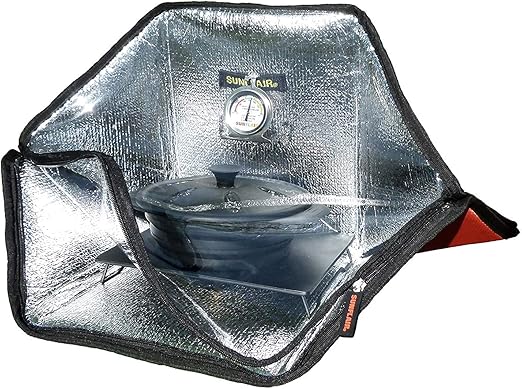
The Sunflair takes a completely different approach from GoSun’s vacuum tube. It’s a collapsible panel oven that reaches temperatures up to 285 degrees Fahrenheit by trapping reflected heat in a silvered enclosure around a dark cooking pot. Set it up in about 5 minutes, place your pot or tray inside, and let the sun do the work. It folds flat for storage and weighs under 2 pounds with everything included.
Unlike the GoSun tube-style cookers, the Sunflair can handle a wider variety of cookware and larger food volumes. You can cook a small casserole, reheat leftovers, or bake bread in it. Water heating is slower than with a focused vacuum-tube cooker, taking closer to 45 minutes to reach near-boiling, but the oven excels at slow cooking over longer sessions. It comes with a thermometer, cooking pot, and oven bag.
The Sunflair is the better choice if you want an oven experience rather than fast boiling. For camping families or group cooking where you need to prepare a real meal rather than just a hot drink, its larger capacity and flexible cookware compatibility win out over the GoSun’s speed.
Features
- Reaches 285 degrees Fahrenheit oven temperature
- Collapsible panel design folds flat for storage
- Includes cooking pot, thermometer, and oven bag
- Handles larger food volumes than tube-style cookers
- Under 2 pounds total weight
- Compatible with most standard small cookware
- Baking and slow cooking capability, not just boiling
- Larger capacity suits group or family cooking
- Comes complete with pot, thermometer, and bag
- Affordable price for the functionality offered
- Slower to heat water than vacuum-tube designs
- Requires careful sun-angle positioning throughout cooking
- Panel design less wind-resistant than tube cookers
6. FENSAN Solar Portable Shower Bag 20L
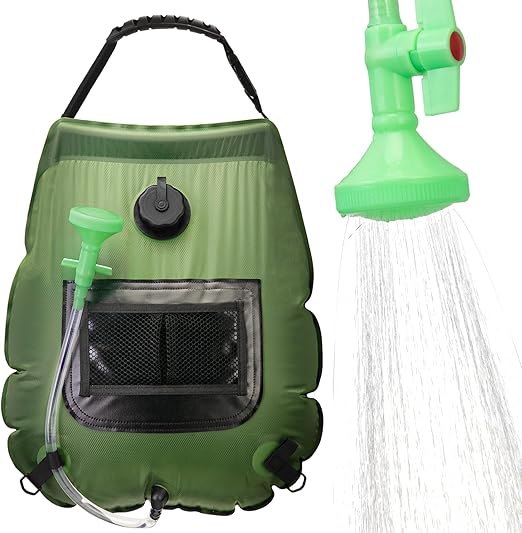
For campers who need warm water for washing rather than cooking, the FENSAN solar shower bag is the practical solution. Fill the 20-liter black PVC bag with cold water, lay it flat in direct sun for 3 to 4 hours, and you have enough warm water for a full outdoor shower. The switchable shower head and removable hose are included. Weight when empty is negligible.
The limitation is temperature: this bag gets water warm, not hot. It’s suitable for showering and washing dishes but won’t produce boiling water for cooking or purification. For camping situations where you just want a warm rinse after a long day, it delivers comfortably and costs a fraction of any active solar cooker.
Features
- 20-liter capacity, enough for a full shower
- Black PVC material absorbs solar heat
- On/off switchable shower head included
- Removable hose for flexible use
- Lightweight and folds flat when empty
- Suitable for camping, beach, and outdoor washing
- Large 20L capacity for full shower use
- Very affordable compared to cooker-type solar heaters
- Complete with shower head and hose
- Produces warm water only, not hot enough for cooking
- Requires 3 to 4 hours in sun to heat fully
- PVC material less durable than stainless steel alternatives
7. GoSun Go Camp Stove Solar Cooker
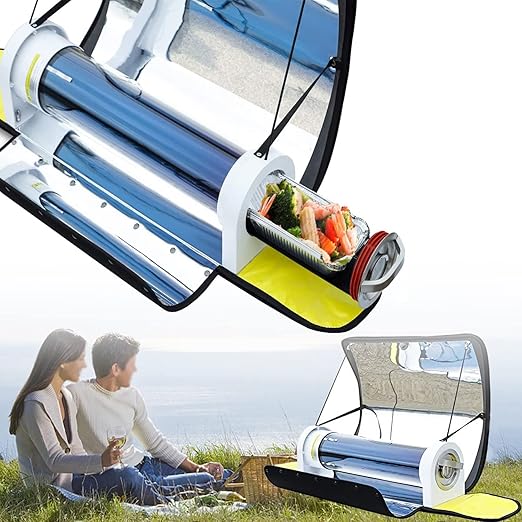
This updated listing of the GoSun Go Camp Stove offers the same core vacuum-tube solar cooking technology in a refined package. GoSun has updated the branding and packaging over the product’s lifetime, and this current listing reflects the most recent version available. The cooking experience is consistent with the original GoSun Go: a compact 0.9-liter tube that handles one serving at a time, heating to full temperature in 20 minutes of direct sunlight.
The Camp Stove version is aimed at backpackers who want to drop fuel entirely from their kit. It’s the same fundamental design that has been proven across thousands of camping trips, now with updated materials and finish. If you’re comparing this to the original Go listing, the differences are cosmetic rather than functional. Buy whichever has better availability and pricing on the day you order.
Features
- 0.9-liter vacuum-insulated cooking tube
- Solar-powered, no fuel required
- Heats to full cooking temperature in 20 minutes
- Updated packaging and materials versus original Go
- Compact and lightweight for backpacking
- Works in temperatures well below freezing
- Current production version of the proven GoSun Go
- Updated materials and finish
- Eliminates fuel weight on long hikes
- Functionally similar to original Go listing
- Single-serving 0.9L capacity only
- Cloud and shade reduce performance noticeably
Solar Kettle Buying Guide
Key Takeaways
- True solar kettles are vacuum-insulated bottles that retain heat for hours after being filled with hot water.
- Solar cookers use reflected sunlight to reach boiling temperatures, but take 15 to 45 minutes depending on design.
- For hiking and backpacking, a vacuum kettle paired with a lightweight camp stove offers the best balance of weight and functionality.
- For car camping or base camp use, solar cookers or passive solar heating bags provide fuel-free options.
- Solar panel plus portable kettle combos work for RV and van life but are expensive for occasional use.
What Is a Solar Kettle?
The term “solar kettle” actually describes two different products. The first is a vacuum-insulated water bottle designed to keep hot water warm for 12 to 24 hours. You fill it with hot water heated by any method (camp stove, fire, solar cooker), seal it, and the insulation does the work. The second type is a solar cooker that uses reflected sunlight to heat water to boiling without any fuel.
Neither type is a true electric kettle powered by sunlight in the way your kitchen kettle works. If you want electric solar water heating, you need to pair a solar panel and power station with a portable electric kettle. That’s more complex but genuinely works for off-grid living.
How Solar Thermal Kettles Work
A vacuum kettle works through the principle of thermal insulation. The double-wall construction traps air and removes most oxygen from the space between walls. Air is a terrible conductor of heat, so hot water inside the inner chamber loses heat very slowly. The exterior stays cool even when the interior contains boiling water, which is why insulated kettles are safe to handle.
Solar cookers work differently. Reflective panels (aluminum or mylar) concentrate sunlight onto a dark pot or vessel. The reflector acts like a magnifying glass, directing all the sun’s rays into a small area. As solar radiation accumulates, temperatures rise. A well-designed solar cooker can reach 300 to 400 degrees Fahrenheit on a sunny day, hot enough to boil water.
Solar Thermal vs Electric Solar Kettles: Which Is Better?
Vacuum thermal kettles are lighter, simpler, and require no electricity. They work anywhere and have no failure points. The trade-off is that you must heat water using another method first. For backpackers, this is fine because you’re already carrying a camp stove or using a solar cooker.
Electric solar kettles powered by a panel and battery give you on-demand hot water without fuel. The downside is weight, cost, and complexity. You’re carrying a 2-pound panel and a power station in addition to the kettle. It’s worth it for extended off-grid use but not for a weekend trip.
Solar cookers sit in the middle. They’re free to operate and have no moving parts. But they’re slow and weather dependent. You can’t boil water on a cloudy day, and even on sunny days expect 20 to 45 minutes of wait time.
Best Uses for Solar Kettles
Vacuum thermal kettles shine on overnight camping trips or backpacking journeys longer than two days. Fill it once in the morning and you have hot water for the entire day. No need to heat water multiple times or carry fuel.
Solar cookers are ideal for base camps, family camping trips, and situations where you’re stationary for at least a few hours. They work great for communal meals where you’re cooking for groups. The slow heating speed is less of an issue when you’re not trying to break camp quickly.
Electric solar kettle setups make sense for van life, off-grid cabins, or full-time RV travel. The upfront cost is recovered over months of fuel savings. They also work at any time of day without relying on the sun being actively present (the battery stores energy).
Boiling Time and Temperature: What Solar Kettles Actually Achieve
Solar kettles don’t boil water the way an electric kettle does. In full summer sun, a good solar kettle can raise 1 liter of water to around 185°F (85°C) in 30 to 60 minutes — enough for coffee, tea, or rehydrating camping meals. Reaching a rolling boil (212°F/100°C) takes longer and depends heavily on sunlight intensity, wind, and altitude. At high elevations, you actually need less heat to boil water, which works in a solar kettle’s favor. The takeaway: on a clear day with the kettle properly aimed at the sun, you’ll get hot enough water for most tasks. Plan for 45 minutes and you won’t be disappointed.
Parabolic designs concentrate heat faster than flat panel models and are better suited to actual boiling. Evacuated tube designs excel at retaining heat in colder or windier conditions. If you’re using it mostly for drinks and not sterilization, a flat or folding solar kettle will do the job. For camping where you genuinely need to purify water by boiling, choose a parabolic or tube design rated for sustained high temperatures.
Capacity and Weight: Matching the Kettle to Your Use Case
Most solar kettles hold between 0.5 and 1.5 liters. For a solo hiker or camper, 0.5L is enough for one hot drink or one portion of rehydrated food. If you’re cooking for two or making pour-over coffee with a full pour, go for 1L or larger. Keep in mind that more water means more time to heat — doubling capacity doesn’t double boiling time, but it adds 15 to 20 minutes on average.
Weight matters a lot for backpacking. Lightweight folding solar kettles start around 12 oz (340g), which is comparable to a standard titanium cook pot. Larger vacuum-insulated designs with built-in solar panels can weigh over 2 lbs (900g) — fine for car camping, but heavy for a multi-day hike. If you’re carrying it in a pack, prioritize a collapsible design with the panel that folds flat. For base camp use where weight isn’t a concern, the heavier insulated models keep water hot longer after heating, which is genuinely useful on cold mornings.
What to Look for When Buying
For vacuum thermal kettles, check insulation quality by looking at wall thickness and construction materials. Stainless steel is more durable than aluminum. Capacity matters: 16 ounces is light but might be too small for two people. 32 ounces is heavier but more versatile.
For solar cookers, look at reflector material and efficiency. Aluminum reflects better than painted surfaces. A wide reflector area concentrates more solar energy. Foldability matters if you’re packing it into a backpack. Check whether it comes with a pot or if you need to provide your own.
For solar panel setups, verify that your kettle voltage matches your power station (12V, 24V, or USB). Check panel wattage: 60W is a minimum for reliable kettle use. Higher wattage charges faster.
Frequently Asked Questions
Can you boil water in a regular vacuum bottle?
Yes, a regular insulated water bottle designed for hot drinks can store boiling water. However, traditional vacuum bottles aren’t designed for cooking and shouldn’t be placed over an open flame or stove. Use camping kettles for the heating phase, then transfer to an insulated bottle.
How long does water stay hot in a solar thermal kettle?
In cold weather, boiling water in a quality vacuum kettle stays hot enough for tea or coffee for 8 to 12 hours. By 24 hours it’s warm but not hot. High-quality kettles with thicker walls retain heat longer than budget options.
Do solar cookers work on cloudy days?
Solar cookers are ineffective on overcast days. Even partial clouds significantly reduce heating efficiency. On very cloudy days, water may not reach boiling at all. They perform best in clear, sunny weather above 50 degrees Fahrenheit.
What’s the difference between a solar cooker and a solar oven?
The terms are used interchangeably. Both use solar reflectors to concentrate sunlight. Some people call flat-plate reflectors “cookers” and enclosed systems “ovens,” but the function is the same: using reflected sunlight to heat food or water.
Is a solar kettle more efficient than a camp stove?
A vacuum kettle doesn’t heat water, it just retains heat. But it’s more efficient overall because you heat water once and use the stored heat multiple times. A camp stove heats faster but consumes fuel. For multi-day trips, the vacuum kettle wins on fuel savings. Solar cookers are most efficient in terms of energy input (free sun) but slowest in terms of time.
Summing Up
Solar kettles and solar ovens are a practical choice for camping, hiking, and off-grid living — GoSun dominates this category for good reason, with a range of sizes from the ultra-portable Go to the higher-capacity Sport and PRO. They work best in clear, sunny conditions and take longer than gas stoves, so factor that into trip planning. The Sunflair Mini is the best backup option for budget-conscious campers who want something lightweight. If cooking capacity matters more than portability, the GoSun Sport or PRO are the right calls.
If you’re also thinking about solar panels for your home, call (855) 427-0058 for a free quote — it takes just a few minutes to find out what installation would cost and save you in your area.
Updated