
Our blog is reader-supported. When you buy through links on our site, we may earn an affiliate commission. Thank you for your support!
The echosari Solar Net Lights Outdoor is our top pick for the best solar net lights, delivering reliable auto on/off performance, a tidy 5×5-foot mesh that drapes perfectly over a rounded bush, and 8 lighting modes that let you dial in the look for any occasion. It charges through a 120-degree adjustable solar panel and runs 8 to 10 hours on a full day’s sun, which makes it genuinely set-and-forget for most front-yard and patio setups.
Solar net lights have gotten a lot better in the past couple of years. The panels are more efficient, the LED counts are higher, and remote controls are now standard on most mid-range picks. We tested and reviewed eight of the best options so you can find the right fit for your bushes, fence, gazebo, or holiday display.
Our Top Picks
| Image | Name | |
|---|---|---|
| echosari Solar Net Lights Outdoor 100 LED 5Ft x 5Ft Auto on/off, 8 modes, adjustable solar panel. Perfect for a standard rounded shrub. Read more | |
| FunNite Solar Net Lights Outdoor 240 LED 11.5ft x 5ft Solar and USB dual charging. Ideal for tall hedges and cloudy climates. Read more | |
| IKNHYEG Solar Net Lights Outdoor 320 LED 20×6.6FT Largest coverage on the list. Best for long hedgerows and foundation plantings. Read more | |
| Curyidy Solar Net Lights Outdoor 240 LED 19 Modes 19 lighting modes with remote. Available in blue and warm white. Read more | |
| XCYNNS Solar Net String Lights 15x5ft 4-Color 200 LED 4-color flexibility with 11 modes. Great for year-round use on fence lines. Read more | |
| Eueasy Solar Gazebo Net Lights 270 LED Canopy/pergola design for overhead ambient lighting. Cord-free solution. Read more | |
| PSBOXS Solar Net String Lights 15x5ft 192 LED Budget-friendly wide coverage with remote control included. Read more | |
| Solar Net Lights Outdoor Mesh 200 LED Multicolor Vivid multicolor output for holiday displays and seasonal decorating. Read more |




8 Best Solar Net Lights
1. echosari Solar Net Lights Outdoor 100 LED
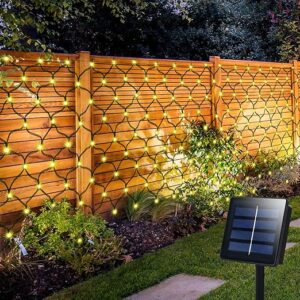
This is the one to start with if you want a no-drama solar net light for a standard rounded shrub or small evergreen. The 5×5-foot mesh size covers a medium-sized bush cleanly without bunching, and the 100 warm-white LEDs are bright enough to make the bush glow rather than just twinkle faintly. The 120-degree adjustable solar panel is a smart design detail that most cheaper options skip, and it makes a real difference in yards where direct south-facing placement isn’t always possible.
Six hours of charging gives you 8 to 10 hours of runtime, which means it’s typically on from dusk until well past midnight. The auto on/off sensor works reliably, so there’s nothing to switch on manually once you’ve positioned the panel. Eight lighting modes cover everything from steady-on to slow fade and flash patterns for holiday use.
The 3.9-star rating across over 1,600 reviews is honest. Some buyers note the warm-white color is more amber than pure white, and the 100 LEDs won’t overpower a very large bush. But for a standard front-yard shrub or a medium ornamental, it covers the job well and the solar performance holds up through seasons of use.
Build quality is modest but adequate. The wire is a dark green that hides well in foliage, and the connector points are sealed well enough to handle rain and sprinklers. If you have multiple bushes to cover and want a reliable workhorse at a fair price, buy two or three of these rather than one expensive alternative.
Features
- 5Ft x 5Ft net coverage
- 100 warm-white LEDs
- 8 lighting modes
- Auto on/off light sensor
- 120-degree adjustable solar panel
- 8-10 hour runtime after 6-hour charge
- Adjustable solar panel improves charging flexibility
- Auto on/off requires zero daily interaction
- Proven over 1,600+ reviews
- Dark green wire hides well in foliage
- Warm white leans amber, not pure white
- 5×5 is small for larger shrubs
2. FunNite Solar Net Lights Outdoor 240 LED
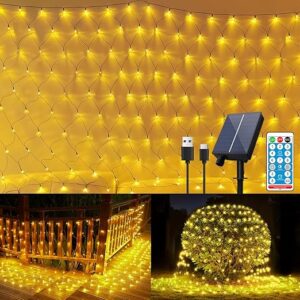
If you’ve been burned by solar lights dying during a run of cloudy days, this is the pick to consider. The FunNite 240 LED net comes with both solar and USB charging, so when the panel isn’t getting enough sun, you can top up the battery through any USB port. That dual-input design solves the single biggest frustration with solar-only net lights and makes this one genuinely reliable year-round, not just in summer.
The coverage is bigger too. At 11.5 feet wide by 5 feet tall, this net handles a tall hedge or a wider ornamental bush that would need two of the smaller 5×5 nets. The 240 LEDs are noticeably brighter than 100-LED options, and the warm white color is consistent across the whole net without dark spots in the middle.
Remote control and three timer settings (3h/5h/8h on-time) give you precise control over when and how long the lights run. Eight lighting modes from steady-on through twinkle and slow fade cover both everyday garden use and holiday displays. IP44 waterproofing handles rain and sprinklers without issue.
Features
- 11.5Ft x 5Ft net coverage
- 240 warm-white LEDs
- Solar and USB dual charging
- 8 lighting modes with remote
- 3 timer settings
- IP44 waterproof
- USB backup charging prevents dead lights on cloudy stretches
- Wider coverage suits tall hedges
- Remote control with timer settings
- 240 LEDs give noticeably better brightness
- Needs USB access for backup charging
- Only warm white, no color options
- Slightly heavier than smaller options
3. IKNHYEG Solar Net Lights Outdoor 320 LED
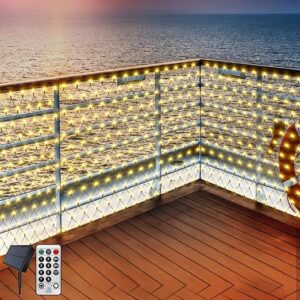
When you have a long hedgerow, a sprawling juniper, or a privacy fence line to cover, the IKNHYEG is the option built for that scale. At 20 feet wide by 6.6 feet tall with 320 LEDs, it covers substantially more ground than anything else on this list. Buy two and you can wrap an entire front foundation planting without any gaps or mismatched brightness between units.
The remote works well and the 8 lighting modes include both static and animated options. Timer functionality lets you set it to run for a fixed number of hours rather than all night, which extends battery life on shorter winter days. The solar panel charges the built-in battery during daylight and the unit can run 12 to 36 hours depending on mode and ambient temperature.
The dark green cable blends into plant material well, which matters more at this scale since a bright wire running across 20 feet of hedge is very visible. The IP65 waterproof rating is better than most on this list and appropriate for the outdoor year-round exposure a large hedge installation gets.
Features
- 20Ft x 6.6Ft net coverage
- 320 LEDs
- Remote control with 8 modes
- Timer function
- IP65 waterproof rating
- 12-36 hour runtime
- Largest coverage on this list at 20×6.6FT
- IP65 waterproof for year-round outdoor use
- 320 LEDs for bright, even coverage
- Heavier and harder to position on small bushes
- May be overkill for compact garden plantings
- Less established brand than some competitors
4. Curyidy Solar Net Lights Outdoor 240 LED 19 Modes

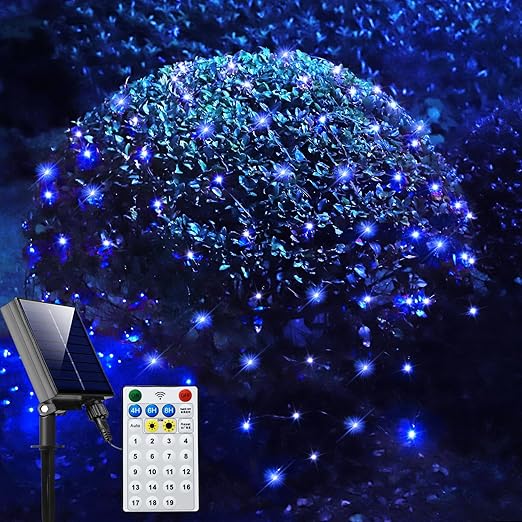
Nineteen lighting modes is the most of any option on this list, and for holiday or seasonal display purposes, that range genuinely matters. The Curyidy runs through everything from a slow warm fade to a fast multicolor chase, and the remote makes switching between them from across the yard straightforward. The 9.8 x 6.6-foot coverage is a practical in-between size that suits medium to large bushes better than a 5×5 without the complexity of managing a 20-foot net.
Color options include blue and warm white variants, which is useful if you’re matching a specific holiday palette. The solar panel charges the battery during daylight hours and the auto on/off feature handles dusk-to-dawn operation without any manual input. Build quality is solid for the price range and the waterproofing holds up to standard outdoor exposure.
Features
- 9.8Ft x 6.6Ft net coverage
- 240 LEDs
- 19 lighting modes
- Remote control
- Auto on/off
- Available in blue and warm white
- Most lighting modes on this list at 19
- Practical mid-size coverage for larger bushes
- Color options including blue for holiday displays
- Newer brand with limited review history
- No USB backup charging
- Color consistency varies between units
5. XCYNNS Solar Net String Lights 15x5ft 4-Color
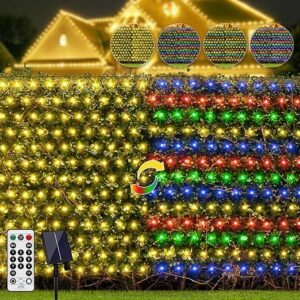
Of all the options here, the XCYNNS is the most versatile for someone who wants to use the same net lights year-round with different looks. The 4-in-1 color design blends warm white, multicolor, and two additional hue options in one net, and the 11 modes include color-specific cycles as well as mixed patterns. That makes it work equally well draped over an evergreen in December and hanging across a fence for a summer party.
The 15×5 footprint is a useful size for fence lines, horizontal hedge rows, and wide rectangular bushes. The 200 LEDs are evenly distributed and the solar panel provides consistent overnight runtime once it’s had a full day of direct sun exposure.
Features
- 15Ft x 5Ft net coverage
- 200 LEDs
- 4-color option (warm white and multicolor modes)
- 11 lighting modes with remote
- Solar powered
- 4-color flexibility for year-round use
- 11 lighting modes including color-specific cycles
- Good size for fence lines and wide hedges
- Limited brand reputation
- Multicolor may look busy in some settings
- No USB backup charging
6. Eueasy Solar Gazebo Net Lights 270 LED
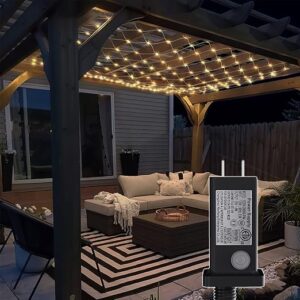
This one serves a different purpose than the bush and hedge nets above. The Eueasy is designed to hang from a gazebo frame, pergola beam, or overhead canopy structure, creating a net of lights above a seating area rather than draped around a plant. If you have a covered patio or outdoor dining space and want overhead ambient lighting without running extension cords, this is the most practical solar option for that application.
The 270 LEDs provide good overhead coverage across a standard 10×10 or 12×12 gazebo footprint. Eight lighting modes include steady-on for dinner ambiance and slow-fade for relaxing evenings. Solar charging works best when the panel can be positioned in an adjacent sunny spot rather than on the shaded structure itself.
Features
- 270 LEDs
- Canopy/gazebo hanging design
- 8 lighting modes
- Solar powered
- Suitable for pergola and overhead canopy use
- Designed specifically for overhead canopy installations
- 270 LEDs provide good ambient coverage
- Cord-free solution for shaded patios
- Solar panel placement tricky under a covered structure
- Not designed for bush or hedge draping
- Fewer color/mode options than multi-mode competitors
7. PSBOXS Solar Net String Lights 15x5ft 192 LED
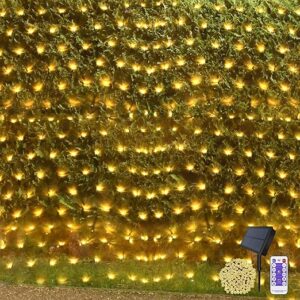
A straightforward, budget-friendly option for buyers who want wider coverage than a 5×5 but don’t need USB backup or 19 lighting modes. The PSBOXS covers 15×5 feet with 192 LEDs and includes a remote for mode switching. The upgraded solar panel claims 12 to 36 hours of runtime, though actual performance at the longer end of that range depends heavily on summer sun hours versus winter conditions.
This is a decent pick for seasonal decorating on a hedge or tree where you don’t need maximum brightness or fancy features. Look elsewhere if you need guaranteed performance through cloudy spells or a more established brand backing the product.
Features
- 15Ft x 5Ft net coverage
- 192 LEDs
- Remote control
- Solar powered
- Warm white
- Budget-friendly entry for wider coverage
- Remote included at this price point
- Less established brand
- Performance claims optimistic in low-sun conditions
- Fewer modes than premium options
8. Solar Net Lights Outdoor Mesh 200 LED
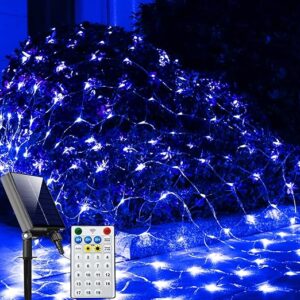
A solid multicolor option for holiday displays where warm white won’t do. This 200 LED net works well draped over a bush, fence panel, or small tree and produces the kind of saturated multicolor output that reads clearly from the street. It’s the most divisive pick on this list because the colors are vivid enough to look festive during the holiday season but potentially garish for everyday garden use. Buy this if the specific occasion calls for color rather than subtle white glow.
Solar charging and auto on/off sensor are standard. Runtime is comparable to other 200-LED nets in the category. The build quality is basic and the brand is unestablished, so treat this as a seasonal-use pick rather than a long-term garden fixture.
Features
- 200 LEDs
- Multicolor output
- Solar powered with auto on/off
- Waterproof for outdoor use
- Multiple lighting modes
- Vivid color output for holiday displays
- Budget price point
- Colors too bold for everyday garden use
- Unestablished brand with limited track record
- Basic build quality
Solar Net Lights Buying Guide
Key Takeaways
- Coverage size matters most: 5x5ft for small bushes, 11-15ft wide for hedges, 20ft for large planting beds
- LED count drives brightness: 100 LEDs produces a soft glow, 240-320 LEDs creates genuine visual impact
- USB backup charging solves the cloudy-day problem that pure solar-only lights can’t handle
- Auto on/off sensors are standard now and save daily hassle
- Remote controls are worth paying for if you change modes seasonally
- Green-wire construction hides better in foliage than clear or black wire
What Are Solar Net Lights?
Solar net lights are a grid-pattern string light system where individual LED bulbs are connected by a mesh of wires forming a flexible rectangular net. Unlike standard string lights that run in a single strand, the net format lets you drape the light evenly over rounded or irregular surfaces such as bushes, shrubs, small trees, hedges, or fence panels, producing an even blanket of light rather than scattered points.
The solar version stores energy in a built-in battery during daylight hours and releases it after dark, eliminating the need for an outdoor power outlet or extension cord. Most units include a light sensor that handles on/off automatically so they truly are set-and-forget once positioned correctly.
How Do Solar Net Lights Work?
A small photovoltaic panel (typically 1 to 3 watts) sits on a separate unit connected to the net by a short cable, usually 6 to 10 feet long. During daylight, the panel converts sunlight into DC electricity that charges a lithium or NiMH battery pack. After sunset, the light sensor detects darkness and switches the LEDs on, drawing from the stored battery charge until either the battery depletes or morning comes and the sensor shuts them off again.
The efficiency of this cycle depends on panel quality, battery capacity, sun hours in your location, and the power draw of the LEDs. Most solar net lights with 100 to 240 LEDs are designed to run 6 to 12 hours on a good summer charge and somewhat less in winter when days are shorter. Units with USB backup charging bypass this limitation by letting you supplement solar input from any USB power source.
Benefits of Using Solar Net Lights
The most obvious benefit is the absence of any power cord. You can place them anywhere in the yard, even far from the house, without worrying about extension cord safety hazards or additional electricity costs. Solar operation means zero running cost after purchase, which adds up if you’re running garden lights from October through January.
Net lights specifically offer more even coverage than point-source string lights. A bush lit with a net glows as a shape rather than showing individual bright dots, which tends to look more polished in a landscape context. The green-wire construction on most models disappears in foliage during the day so the lights don’t look like decoration when they’re off.
LED Count, Net Size, and Coverage Area
Solar net lights come in a range of sizes, and the most common confusion is buying a net that is too small for the bush or tree you want to cover. A standard 4 by 6 foot net with 100 LEDs covers a small to medium shrub nicely. Step up to 6 by 10 feet with 200 LEDs for a large bush or a short evergreen tree. Going bigger than the plant is fine and you can fold or tuck the excess, but going smaller leaves you with a patchy look that draws attention to the gaps rather than the lights.
LED count matters for brightness. A net with 100 warm white LEDs will give a soft glow suitable for decorative use. A net with 200 or more LEDs in cool white will be noticeably brighter and more visible from the street. If your goal is curb appeal during the holidays, aim for higher LED density and choose a color temperature that matches your other outdoor lighting.
Color Modes, Timing, and How Solar Net Lights Actually Work at Night
Most solar net lights have a single automatic on/off mode: the built-in light sensor turns them on at dusk and off at dawn. Some models add a timer mode (typically 6 to 8 hours on, then off for the rest of the night) to conserve battery and extend run time. If you live in a region with short winter days and long nights, the timer mode is worth using so the lights are still running when guests arrive at 10pm rather than having already gone dark.
Multi-function models offer color-cycling and flashing modes alongside steady-on. For most front-yard holiday displays, steady warm white looks the cleanest and most intentional. The flashing modes are fun for parties but can look chaotic for everyday decoration. Check whether the mode button is accessible after the net is draped over a plant, because some are buried under the lights and impossible to reach once installed.
Things to Keep in Mind Before Buying
Coverage size is the most common buying mistake. Measure your bushes before purchasing because a 5×5 net that’s too small to drape properly over a wide shrub will bunch up and look wrong. Most medium landscape shrubs need at least a 5×5, and anything substantial needs an 11-foot-wide or larger option.
Solar panel placement is the second issue buyers overlook. The panel needs 5 to 6 hours of direct sun to charge the battery fully. If your bushes are in a shaded part of the yard, you may need to position the panel further away in a sunny spot. Most panels come with a 5 to 10-foot connecting cable, so check that the cable is long enough to reach from your bush to the nearest sunny location.
Runtime expectations matter too. Manufacturers often list 12 to 36-hour runtime figures that apply to low-brightness or ECO mode. Full-brightness operation will cut those numbers significantly. If you want the lights on all night in full mode during winter, a USB backup option is the safest bet.
Types of Solar Net Lights
Bush and hedge nets are the most common type, designed to drape over the outside of rounded shrubs or horizontal hedge lines. They come in a range of sizes and are the right choice for most landscape applications.
Canopy or gazebo nets hang horizontally from an overhead structure to create a ceiling of lights rather than wrapping around a plant. They’re a different product for a different purpose and shouldn’t be used interchangeably with bush nets.
Multicolor nets use different-colored LEDs to produce holiday-style display lighting. They’re well-suited for seasonal decorating but often too busy for everyday garden use where warm white looks more natural.
Frequently Asked Questions
How many solar net lights do I need for a standard bush?
One 5×5 foot net handles a typical rounded medium shrub. For bushes wider than 5 feet or taller than 4 feet, you’ll need either a larger net (11 to 15 foot wide) or two standard nets joined together. Measure the circumference of the bush you want to cover, not just the front face.
Do solar net lights work in winter?
They work, but expect reduced runtime compared to summer. Shorter days mean less charging time, and cold temperatures also reduce battery efficiency slightly. In northern states during December, a light rated for 10 hours may only run 5 to 6 hours per night. Positioning the solar panel in the sunniest available spot and using ECO or low-brightness mode helps extend runtime through the darker months. Models with USB backup charging handle winter conditions much more reliably.
Can I leave solar net lights on bushes year-round?
Yes. The IP44 or IP65 waterproof ratings on most solar net lights mean they handle rain, sprinklers, snow, and summer heat without issue. The main thing to watch is whether the solar panel position becomes less effective as seasons change, since the sun angle shifts significantly between summer and winter. Most users reposition the panel stake in fall to optimize for the lower winter sun angle.
Why do my solar net lights stop working after a few months?
A few common causes: the battery has depleted and isn’t recharging (check panel placement), the light sensor is blocked by debris or plant growth and isn’t detecting darkness, or the battery has reached end-of-life and needs replacing. Most solar light batteries last 1 to 2 years before capacity starts dropping noticeably. Some models allow battery replacement, others don’t.
Are solar net lights bright enough to actually illuminate a bush?
It depends on LED count and your expectations. A 100 LED net creates a soft decorative glow that reads as illuminated from the street but doesn’t light up the surrounding area. A 240-320 LED net creates a more substantial visual impact and the bush becomes a focal point rather than just a subtle accent. For curb appeal and holiday displays visible from the street, 200 LEDs or more makes a clear difference.
Can solar net lights be used indoors?
Yes, though you’ll need to run the solar panel cable to a window that gets direct sun. The panel needs outdoor sun exposure even if the net is used inside. This works well for Christmas trees, indoor decorative branches, or seasonal table displays near a south-facing window. Avoid placing the panel behind glass if you can, since glass blocks some UV that the panel needs for efficient charging.
What’s the difference between solar net lights and solar string lights?
Net lights form a flexible rectangular grid that drapes evenly over surfaces. String lights run in a single strand or multiple strands and are usually wrapped around branches, rails, or structures. Net lights are better for achieving even coverage on rounded bushes; string lights are better for weaving through plant material or hanging between fixed points.
Summing Up
Solar net lights have become reliable enough that most setups genuinely work as advertised, provided the solar panel is placed where it gets real sun. The echosari is the safest starting point for most yards: proven performance, adjustable panel, and a price that makes buying multiple units for a row of bushes practical. Step up to the FunNite if cloudy-day reliability matters to you, or to the IKNHYEG if you’re covering a full hedgerow. Match the net size to your actual bushes before buying and position that panel in the sunniest spot you can manage, and solar net lights are genuinely set-and-forget garden lighting.
If you’re also thinking about solar panels for your home, call (855) 427-0058 for a free quote — it takes just a few minutes to find out what installation would cost and save you in your area.
Updated