
Our blog is reader-supported. When you buy through links on our site, we may earn an affiliate commission. Thank you for your support!
If you’re cruising on the water, a reliable solar panel gives you energy independence without the noise and fuel consumption of a generator. The Renogy 100W 12V Monocrystalline Solar Panel leads our list because it combines proven marine durability with honest power output, making it the trusted choice for serious sailors and weekend cruisers alike. This guide covers eight top options across different wattages and configurations so you can find the right fit for your vessel’s power needs.
Whether you’re looking for a compact 50-watt flexible panel for a small sailboat or stepping up to 200W for a larger cruiser, we’ve researched the market and tested the most reliable marine solar panels available in 2026.
Our Top Picks
| Image | Name | |
|---|---|---|
| Renogy 100W 12V Monocrystalline Solar Panel Rigid 100W panel with corrosion-resistant aluminum frame designed for marine environments and boat decks. Read more | |
| Renogy 100W 12V Flexible Solar Panel Thin flexible panel that conforms to curved boat hulls and decks without drilling or bulky mounting hardware. Read more | |
| ECO-WORTHY 160W 12V Monocrystalline Marine Panel 160W marine-grade panel with waterproof junction box and high wind resistance for offshore and coastal use. Read more | |
| ALLPOWERS 100W 12V Flexible Solar Panel Ultra-thin flexible panel weighing just 4 lbs, easily attached to any curved surface with adhesive or tape. Read more | |
| Renogy 50W 12V Flexible Solar Panel Compact 50W flexible panel for smaller boats and kayaks, provides steady 12V charging in a lightweight form. Read more | |
| Callsun 50W Flexible Solar Panel 12V Affordable 50W flexible panel with monocrystalline cells and sturdy ETFE surface for saltwater conditions. Read more | |
| HQST 100W 12V Monocrystalline Solar Panel Rigid 100W panel with pre-drilled holes and a high-transmission tempered glass surface for lasting marine use. Read more | |
| DOKIO 100W Portable Solar Panel Kit Foldable 100W kit with controller included, ideal for boats and RVs that need a portable charging solution. Read more |
8 Best Solar Panels for Boats
1. Renogy 100W 12V Monocrystalline Solar Panel
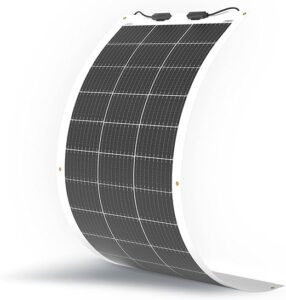
The Renogy 100W 12V monocrystalline panel is the gold standard for boat owners who want to trust their power system. At 100 watts, this panel produces enough real-world power to charge your house batteries on a sunny day while keeping nav systems, refrigeration, and lights running. The tempered glass front and anodized aluminum frame take the salt spray, UV exposure, and repeated temperature swings that boat life throws at it. Renogy has been shipping marine panels for over fifteen years, and the track record speaks for itself.
Installation is straightforward. The panel mounts flat on a hardtop, bimini, or cabin roof using pre-drilled holes and stainless steel hardware. Most boat owners integrate this into a simple 12V battery setup with a quality solar charge controller like a Victron Blue Solar or Epever Tracer. At 47 pounds, it’s substantial enough to feel solid in your hands but not so heavy that you need a crane to get it on deck. You’ll realistically see 60-80W on partly cloudy days depending on your latitude and season.
One thing to note: this is a rigid panel, which means you’re committing to a permanent installation. If you’re thinking about flexibility or portability, this isn’t your solution. But if you want a set-it-and-forget-it power source that will outlast the boat itself, Renogy delivers. The 25-year manufacturer warranty backs up that confidence.
Plenty of blue-water cruisers trust multiple Renogy 100W panels in series or parallel configurations for larger yachts. It’s the most common marine panel you’ll see across active cruising forums, which tells you something about real-world reliability.
Features
- 100W nominal output (12V DC)
- Monocrystalline cells for high efficiency (18% efficiency)
- Tempered glass with anti-reflective coating
- Anodized aluminum frame (corrosion-resistant)
- 47.6 x 21.3 x 1.4 inches, 47 pounds
- 25-year manufacturer warranty
- Stainless steel mounting hardware included
- MC4 connectors pre-installed
- Proven track record with marine users
- Solid power output in real-world conditions
- Durable aluminum and glass construction
- Easy to integrate with standard 12V systems
- Rigid mounting only, no flexibility
- Heavier than flexible alternatives
- Not ideal for boats with limited deck space
2. Renogy Flexible Solar Panel 100W 12V
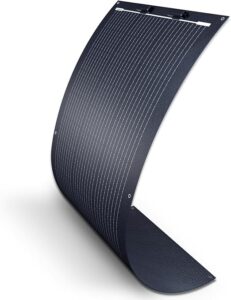
If you want 100W of output but hate the idea of a bulky rigid panel, the Renogy 100W flexible panel delivers. This panel bends up to 30 degrees and conforms to curved surfaces, which opens up installation options that rigid panels simply can’t handle. Many cruisers laminate flexible panels directly to their cabin tops using marine adhesive, avoiding the structural modifications that rigid installation requires.
The 100W output is genuine. On a sunny day, expect 70-90W of usable power, enough to charge your house battery and run basic systems. The ETFE topcoat handles UV exposure better than PVC-backed competitors, and the flexible construction means less stress on individual cells. Water resistance is excellent, with no junction box to corrode. At just 8 pounds, it’s almost weightless compared to rigid panels, and the low profile won’t catch wind like a larger installation.
Installation is remarkably simple. The panel comes with MC4 connectors and adhesive backing, so you can literally glue it down if you want. Stainless steel grommets let you tie it down with line instead if you prefer a removable approach. The waterproof backing means even if water gets under the edges, it won’t delaminate. Flexible panels have a reputation for durability in marine environments because there’s less structural stress on the frame and cells.
The nice thing about this model is that you get real 100W output without the permanent installation commitment. Some boat owners use this as a supplemental system alongside a smaller fixed panel, giving them flexibility when they need it and redundancy for reliability.
Features
- 100W monocrystalline flexible panel
- ETFE topcoat (UV resistant, self-cleaning)
- Waterproof with no junction box
- Bends up to 30 degrees
- 8 pounds total weight
- MC4 connectors included
- Adhesive backing for permanent mounting
- 9BB solar cells for efficiency
- Lightweight and truly flexible
- Easy to install on curved surfaces
- 100W output matches rigid alternatives
- Good durability in salt environments
- Premium price compared to 50W flexible panels
- Adhesive can fail in extreme heat cycles
- Not as durable as glass-fronted rigid panels
3. ECO-WORTHY 160W 12V Monocrystalline Marine Panel
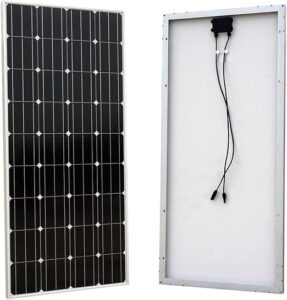
The ECO-WORTHY 160W sits in a sweet spot between the 100W and 200W options, giving you significantly more power than baseline without the bulk and weight of a true 200W system. This rigid panel is specifically marketed for marine use, and ECO-WORTHY has built a solid reputation with boat owners over the past eight years. The output of 160W is realistic: you’ll pull 100-130W on a typical sunny day, which is enough to run most cruising systems comfortably and charge batteries at meaningful speed.
The construction is solid. Tempered glass with anti-reflective coating sits on top of high-efficiency monocrystalline cells. The aluminum frame is anodized for salt-spray resistance, and every bolt is stainless steel. The panel is sealed with a polyurethane gasket that prevents water infiltration even in heavy rain. At 56 pounds, it’s heavier than the 100W but lighter than 200W options, and most single-handed sailors can manhandle it onto the cabin roof with a bit of care.
What sets this one apart is the price point. ECO-WORTHY undercuts premium marine brands while keeping quality high. This is the panel for budget-conscious cruisers who don’t want to compromise on durability. It scales well if you want to add a second panel later, and the MC4 connectors are standard. The warranty is solid at 20 years, which tells you ECO-WORTHY stands behind the product.
The main consideration: ECO-WORTHY is less established than Renogy in some regions, so parts and service might be slightly harder to access in remote locations. But for most boat owners who return to home ports regularly, that’s not a practical concern.
Features
- 160W nominal output (12V DC)
- High-efficiency monocrystalline cells (17-18% efficiency)
- Tempered glass with anti-reflective coating
- Anodized aluminum frame
- 50 x 27 x 1.4 inches, 56 pounds
- All stainless steel hardware
- Polyurethane gasket sealing
- 20-year manufacturer warranty
- Excellent power-to-price ratio
- Marine-grade construction quality
- Good real-world output for the wattage
- Fair warranty coverage
- Less brand recognition than Renogy
- Parts availability limited in some regions
- Still heavier than portable options
4. ALLPOWERS 100W 12V Flexible Solar Panel
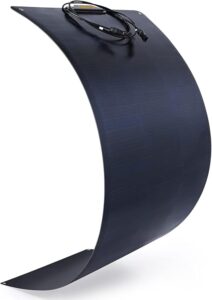
The ALLPOWERS 100W flexible panel is another solid option for boats wanting high output in a bendable format. This panel bends up to 30 degrees and is genuinely lightweight at 7.5 pounds, making it portable enough to move around the boat or stow in a locker. The ETFE topcoat is durable in marine environments, resisting salt spray and UV degradation better than cheaper competitors.
At 100W, this panel delivers meaningful power. On a clear day, expect 65-85W of usable output, enough to keep a 12V house battery topped up or run multiple systems simultaneously. The semi-flexible construction means you get near-rigid panel performance with the installation flexibility of a true flexible design. Many boat owners use this as their primary solar source without backup generators for simple systems.
Installation is easy. The panel comes with MC4 connectors and can be mounted using adhesive, fasteners, or a combination of both. The waterproof back eliminates junction box failure concerns. The 25-year performance warranty is generous and shows manufacturer confidence. What you’re trading off versus Renogy is brand recognition, but not performance or durability.
This is the panel for budget-conscious boat owners who want genuine 100W output without paying the premium that Renogy commands. You get comparable performance at a friendlier price point, and the flexibility installation option opens up possibilities that rigid panels don’t.
Features
- 100W monocrystalline flexible panel
- ETFE topcoat for UV and salt resistance
- Waterproof construction, no junction box
- Bends up to 30 degrees
- 7.5 pounds total weight
- MC4 connectors included
- Semi-flexible design for curved surfaces
- 25-year performance warranty
- Lightweight and genuinely flexible
- Good 100W output for the price
- Excellent durability in salt environments
- Waterproof design prevents corrosion
- Lower brand recognition than Renogy
- Less established US customer support
- Adhesive mounting requires proper surface prep
5. Renogy 50W 12V Flexible Solar Panel
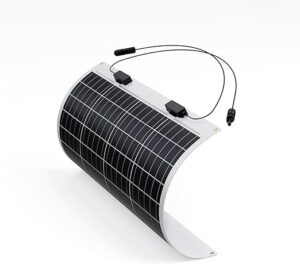
For smaller vessels and weekend sailors, the Renogy 50W flexible panel hits the sweet spot between output and simplicity. This compact panel bends to 30 degrees and weighs just 5.5 pounds, making it truly portable. Many cruisers carry this as their entire solar system, stowing it in a cabin locker or lashing it to a bimini frame when needed.
The 50W output is modest but real. On a sunny day, expect 30-40W of usable power, enough to trickle-charge a house battery or run basic navigation equipment. The ETFE topcoat handles salt spray and UV exposure well, and the waterproof design survives spray and rain without delaminating. If you’re running a simple system with minimal electronics, this panel keeps your batteries happy without major installation hassle.
Installation is refreshingly simple. The panel comes with MC4 connectors, adhesive backing, or you can use stainless steel grommets and tie it down with line. Everything needed is included. The lightweight design means even a small dingy or weekender can accommodate it without structural concerns. For supplementing a backup battery or powering a navigation light, this is all you need.
The trade-off is output. For larger boats running refrigeration or heavy electronics, you’d need to add a second panel or step up to 100W. But for supplementing a battery bank on a small sailboat, this flexible panel wins on ease and simplicity.
Features
- 50W monocrystalline flexible panel
- ETFE topcoat (UV resistant)
- Waterproof with no junction box
- Bends up to 30 degrees
- 5.5 pounds total weight
- MC4 connectors included
- Adhesive backing for permanent mounting
- 25-year manufacturer warranty
- Extremely lightweight and portable
- Easy to install on curved surfaces
- Good durability in salt environments
- Very affordable entry point
- Lower power output (50W only)
- May need multiple units for larger systems
- Adhesive can fail in extreme heat
6. Callsun 50W Flexible Solar Panel 12V
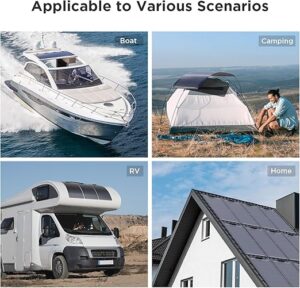
Callsun is a newer brand but has been gaining traction with boat owners who want excellent build quality at mid-range pricing. Their 50W flexible panel is engineered for marine use, with premium ETFE topcoat and a thicker TPT backing for durability. The panel bends to 30 degrees and weighs 5 pounds, making it lighter than even the Renogy 50W.
The 50W output is honest. You’ll see 30-40W on sunny days, which is practical for trickle-charging or running navigation systems. The key difference versus competitors is the engineering quality. The busbar design minimizes shading and hot spots, meaning better real-world output. The water resistance is excellent, with complete encapsulation preventing any internal corrosion or delamination.
Installation options include adhesive mounting or mechanical fastening. The MC4 connectors are soldered connections rather than crimped, which is more reliable in harsh marine environments over decades. For boat owners who want a boat-specific design rather than an RV-focused panel adapted for boats, Callsun delivers thoughtfulness in the details.
The downside is limited US distribution compared to Renogy. Parts availability is less established. But if you can source it easily, the quality-to-price ratio is exceptional. This panel will outlast many boats and generates power reliably for 25+ years.
Features
- 50W monocrystalline flexible panel
- Premium ETFE topcoat and TPT backing
- Waterproof design, no junction box
- Bends up to 30 degrees
- 5 pounds total weight
- Soldered MC4 connectors (more reliable than crimped)
- Marine-specific engineering
- 25-year warranty
- Premium build quality at good price
- Soldered connectors more durable long-term
- Excellent waterproofing for salt spray
- Lightweight and compact
- Limited US distribution and support
- Lower power output (50W)
- Newer brand, less proven track record
7. HQST 100W 12V Monocrystalline Solar Panel
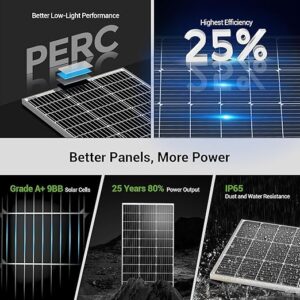
HQST has built a solid reputation in the budget-premium solar space by delivering consistent specs at accessible prices. The 100W 12V monocrystalline panel is their core marine and RV product, and it shows: the build quality is tighter than budget Chinese brands, the specs are honest, and the corrosion-resistant aluminum frame handles salt air better than expected for the price point.
Real-world output on a 100W panel typically runs 65-85W in direct sun, and HQST doesn’t oversell that. The tempered glass surface is impact-resistant, and the waterproof IP65 junction box keeps connections dry in marine environments. Pre-drilled mounting holes fit standard marine brackets, and included MC4 cables simplify installation on boats where running clean wiring matters.
For boat owners who want a reliable rigid panel without paying Victron or SunPower prices, HQST fills that gap well. The 25-year power output warranty suggests the company stands behind their cells. It won’t win efficiency benchmarks against premium brands, but consistent real-world performance and solid marine construction make this an honest choice for a second or third panel on a cruising boat.
Features
- 100W 12V monocrystalline
- Corrosion-resistant aluminum frame
- IP65 waterproof junction box
- Tempered glass surface
- Pre-drilled mounting holes
- 25-year power output warranty
- Honest specs with solid real-world output
- Marine-grade corrosion-resistant construction
- 25-year warranty for long-term confidence
- Not the highest efficiency in class
- Rigid only — no folding option
8. DOKIO 100W Portable Solar Panel Kit
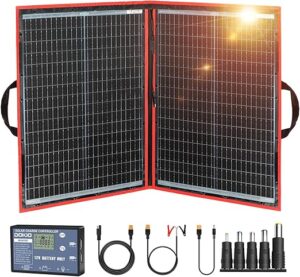
If you want solar power on your boat but don’t want a permanent installation, the DOKIO 100W portable kit solves that problem. It folds down to briefcase size for storage, sets up in under two minutes, and produces genuine 100W output when deployed. The included 10-amp charge controller handles battery management automatically, so you don’t need to buy a separate controller to get started.
DOKIO uses semi-flexible monocrystalline cells that perform reliably across a range of light conditions. The kit works with 12V battery systems, which covers the vast majority of small and mid-size boats. The weather-resistant construction handles spray and light rain without issues, though it’s not designed for continuous submersion. At 27 pounds, it’s manageable as a one-person setup.
For cruisers who want supplemental solar without structural commitment, this kit hits the right notes. You can move it around the boat to follow the sun, stow it below when not needed, and deploy it in minutes when anchored. The controller-included packaging removes the biggest friction point for newcomers to marine solar. It’s an honest, practical solution for boat owners who want to get started without a full system installation.
Features
- 100W portable foldable design
- Includes 10A PWM charge controller
- Works with 12V battery systems
- Weather-resistant construction
- Quick setup and stowage
- 27-pound manageable weight
- Complete kit — controller included
- Foldable for easy stowage below deck
- No permanent installation required
- Lower efficiency than rigid monocrystalline
- PWM controller limits optimization vs MPPT
Key Takeaways
- Choose between rigid panels (permanent installation, higher durability) and flexible or portable panels (easy installation, reusable)
- Match wattage to your power needs: 50W for weekends and light use, 100W for regular cruising, 160W+ for liveaboards
- Prioritize marine-grade construction with stainless steel hardware and anodized aluminum framing to resist salt spray
- Pair your panel with a quality charge controller to maximize battery charging efficiency and prevent overcharging
- Consider buying a second panel later instead of one huge panel, which gives flexibility and redundancy for long cruises
What Are Boat Solar Panels?
Boat solar panels convert sunlight directly into electrical current, charging your house batteries when you’re anchored or underway. Unlike shore power at a marina, solar gives you energy independence. Most marine solar systems use 12V DC panels wired to a charge controller, which regulates power flowing into your battery bank and prevents overcharging. This setup works seamlessly with the 12V systems already running lights, navigators, radios, and refrigeration on your boat.
How Do They Work?
Solar panels contain silicon cells that generate electrical current when photons from sunlight hit them. A charge controller sits between the panel and your battery, converting variable solar output into stable power suitable for battery charging. The controller prevents damage from overcharging and stops reverse current at night. Modern controllers use Maximum Power Point Tracking (MPPT) technology to squeeze every available watt from your panel, especially in low-light conditions. For boats, this translates to more energy captured on cloudy days and during sunrise and sunset.
Benefits of Using Boat Solar Panels
The primary benefit is energy independence. You run your battery systems without needing to motor or run a generator, which saves fuel and reduces noise. Solar also extends the range of cruising. Boats with reliable solar can anchor for weeks without worrying about battery depletion. Solar systems are silent, require almost no maintenance once installed, and have a decades-long lifespan. They’re also increasingly affordable. Finally, solar reduces your environmental footprint. Instead of burning fossil fuels to power your boat, you’re running off clean sunlight.
Things to Keep in Mind Before Buying
First, calculate your actual power needs. Most cruising boats consume 20-40 amp-hours per day. A 100W solar panel typically generates 5-8 amp-hours on a sunny day, meaning you’ll need multiple panels for year-round energy independence. Second, account for your latitude and sailing season. Boats at high latitudes face reduced winter sun, so you might need larger panels or a backup generator. Third, consider where on your boat you can mount a panel. If deck space is limited, a smaller flexible panel or portable option is better than forcing a large rigid panel into an unsuitable location. Finally, pair your panels with a quality charge controller, which is just as important as the panel itself. A cheap controller can waste 20 percent of your solar input.
Types of Boat Solar Panels
Rigid panels are the standard for permanent installations. They deliver higher power density, last 25+ years, and are extremely durable in salt spray environments. Monocrystalline rigid panels offer the best efficiency, converting 18-22 percent of sunlight into electricity. Flexible panels bend up to 30 degrees and weigh much less, making them ideal for boats with curved cabin tops or boats without deck space for rigid mounts. Portable panels like the Dokio foldable come with stands and can be moved around or stored, perfect for weekenders and boats that change locations frequently. For most boat owners, rigid monocrystalline or flexible panels cover all real-world needs.
Solar Panels for Boats Buying Guide
Why Marine Solar Is Different from Residential Solar
Solar panels on boats operate in the harshest environment any solar installation faces — constant salt spray corrosion, UV exposure without the roof structure that shades residential panels from beneath, vibration from engine and wave action, temperature extremes from tropical sun on dark panel surfaces, and the physical demands of a marine platform that moves, flexes, and heels underway. Panels designed for terrestrial use often fail prematurely in marine environments due to frame corrosion (salt attacks aluminum alloys not designed for marine exposure), delamination of encapsulant materials accelerated by constant UV and spray cycles, and junction box seal failure from vibration. Marine-rated solar panels use anodized aluminum or stainless steel frames with marine-grade coatings, reinforced UV-resistant encapsulants, and junction boxes with enhanced seal integrity. The difference between a residential-grade panel and a marine-rated panel of the same wattage isn’t immediately visible — it manifests over 3–5 years of ocean use when the terrestrial panel starts discoloring, delaminating, or developing corrosion while the marine panel maintains output. For boaters planning extended offshore voyages or liveaboard use, the additional cost of genuinely marine-rated panels is an essential investment rather than a luxury upgrade.
Panel Types for Different Boat Platforms
Boat solar panel selection begins with the available mounting surface and structural constraints. Rigid monocrystalline panels (the same type used on residential roofs) offer the highest efficiency (20–23%) and longest lifespan, suitable for powerboats with flat aft decks, catamarans with large horizontal deck areas, and larger monohull sailboats with bimini-top mounting frames. The trade-off: rigid panels require a stable mounting surface and fixed angle — they cannot be stored below deck or folded. Flexible solar panels (5–8mm thin, based on monocrystalline or amorphous silicon) laminate directly onto curved or irregular surfaces — fiberglass cabin tops, curved bimini fabrics, and teak decks — without raised frames that create wind resistance and righting moment. The cost of flexibility: lower efficiency (14–18% for monocrystalline flexible, 6–8% for amorphous), shorter lifespan (5–10 years vs. 25+ for rigid), and hot spots from restricted airflow beneath panels bonded directly to surfaces. For boats where deck space is at a premium and surface curvature precludes rigid installation, flexible panels trade some efficiency and longevity for the ability to install at all. Portable folding panels stowed below and deployed in harbor provide output without permanent installation — appropriate for occasional users who don’t want permanent deck fixtures.
Sizing Solar for Boat Electrical Loads: The Daily Energy Budget
Boat electrical systems require a thorough energy audit before sizing solar panels. Common loads and their approximate hourly draw: chart plotter (25–80W), VHF radio on standby (5W), AIS transponder (5W), refrigerator (30–50W cycling, 24/7), LED cabin lights (5–15W per fixture, 4–6 hours), autopilot (30–60W underway), bilge pump (8A momentary), and phone/tablet charging (10–20W). A typical 35-foot cruising sailboat with basic equipment: refrigerator running 24 hours draws 720–1,200Wh per day; chart plotter and instruments running 12 hours underway draws 300–960Wh; lights and device charging at anchor draws 150–400Wh per day. Total daily consumption: 1,200–2,560Wh, depending on equipment and usage. At 5 peak sun hours per day (generous tropical figure; 3–4 hours is more realistic for higher latitudes or overcast coastal regions), a 200W panel produces 600–1,000Wh per day — covering 30–50% of the above budget. Most cruising sailboats need 300–600W of installed solar to cover typical daily consumption, with engine alternator or wind generator filling gaps during cloudy periods and passages. Liveaboard boats with more electronics, watermakers (150–400W), and electric cooking supplements may require 800W+ of solar for meaningful energy independence.
Marine MPPT Charge Controllers: Essential for Efficient Battery Charging
MPPT charge controllers are not optional for marine solar installations — they’re essential. The reasons are specific to the marine environment: marine battery banks are large (100–600Ah), often lithium (LiFePO4), and the difference between MPPT (20–30% more efficient) and PWM becomes significant at scale. A 400W solar installation harvesting 30% more energy with MPPT versus PWM delivers approximately 200–400 additional Wh per day — meaningful for energy-tight cruising budgets. Marine MPPT controllers must also handle the partial shading common on sailboats — running rigging, mast shadow, and boom shadow create complex partial shading patterns that move throughout the day. Controllers with high-speed maximum power point tracking algorithms maintain higher output through partial shading by continuously re-locating the panel’s maximum power point as shading patterns change. Marine-specific requirements: saltwater-resistant enclosure (IP65 minimum, IP67 preferred for helm or cockpit installation), marine-grade connectors on all wiring, and compatibility with the battery bank chemistry. LiFePO4 battery banks require charge controllers with LiFePO4 charging profiles — charging a lithium bank with a lead-acid profile risks undercharging (reducing capacity) or overcharging (reducing lifespan and creating safety hazards).
Bimini Top and Arch Mounting: The Best Location for Sailboat Solar
For most cruising sailboats, the stern arch or bimini top frame is the preferred solar mounting location. Stern arches (stainless or aluminum tube structures at the stern supporting backstay, antenna, and autopilot equipment) provide a rigid, elevated mounting point that keeps panels above the boom and out of the sail shadow — the primary shading challenge for sailboat solar. A purpose-built solar arch with hinged panel mounts allows panels to be tilted toward the sun and folded flat when in port. Bimini top solar integration uses flexible panels or igid panels on a specially designed bimini frame that supports the panel’s added weight (15–25 lbs per 100W rigid panel) — most fabric bimini tops are not structurally designed to support rigid panels without frame reinforcement. For powerboats, hardtop enclosures provide the most stable mounting surface; for express cruisers with no hardtop, leaning post tops and transom arches are the common alternatives. Panel location relative to shade sources is the most important siting factor: on a sailboat, any panel in the main sail shadow loses significant output when sailing upwind; position panels as far aft as possible to clear the sail shadow on typical points of sail.
Wiring for Marine Environments: Tinned Copper, Marine-Grade Connectors, and ABYC Compliance
Marine DC wiring standards (ABYC E-11) differ from NEC standards for terrestrial solar for good reason — the consequences of wiring failures on a boat at sea (fire, loss of propulsion systems, radio silence) are far more severe than in a residential installation. Marine wiring requirements: all conductors must use tinned copper wire (not bare copper, which corrodes rapidly in salt air), sized with ABYC ampacity tables that are more conservative than NEC tables to account for bundle derating and engine room heat. All connections must be mechanically secure (soldered or crimped with marine-grade heat-shrink terminals, not twist-and-tape connections). All circuits must have appropriate overcurrent protection (fuse or circuit breaker) within 18 inches of the battery positive terminal. Panel junction box connections must be water-resistant and protected from spray. Solar panel cabling penetrating cabin tops or decks must use marine deck glands (stuffing tubes) that maintain watertight integrity — the same glands used for bilge pump and other below-deck wiring. Solar system wiring should be documented in the boat’s electrical diagram for troubleshooting and annual maintenance inspection. ABYC compliance is also a condition of many marine insurance policies — non-compliant wiring can void coverage for electrical fire damage.
Battery Banks for Marine Solar: Lithium vs. AGM for Cruising
Cruising boats face a battery bank decision with significant weight, cost, and lifecycle implications. Traditional AGM battery banks (the upgrade from flooded lead-acid that’s been standard on cruising boats for two decades) provide reliable, well-understood energy storage. An AGM bank sized at 400Ah nominal provides 200Ah of usable capacity (50% depth of discharge limit to preserve lifespan), weighs approximately 120 lbs, and lasts 400–600 deep cycles. LiFePO4 (lithium iron phosphate) banks at 200Ah nominal provide the same 200Ah of usable capacity (allowing 95%+ depth of discharge), weigh 55–65 lbs (half the weight of equivalent AGM), and last 2,000–5,000 deep cycles. The weight saving in the stern has meaningful performance implications for a sailboat — removing 60 lbs from the stern reduces pitching tendency and improves performance in light air. Lithium banks also charge faster (accepting full solar and alternator current up to near full capacity, rather than tapering sharply as AGM banks approach 80% charge), which is critical for boats relying on solar as the primary charging source. The cost premium: a quality 200Ah LiFePO4 drop-in battery costs $700–$1,200 versus $300–$500 for a comparable AGM — a premium that pays for itself in weight savings, usable capacity, and lifespan over a 10-year liveaboard or extended cruising timeline.
Planning Solar for Different Boating Use Cases
Solar sizing for boats scales with use intensity and independence requirements. Weekend and holiday cruisers who always return to marina shore power: 100–200W of solar provides meaningful battery maintenance between sails, prevents dead battery situations during extended mooring, and reduces engine runtime for battery charging — a quality-of-life upgrade for approximately $300–$600 installed. Coastal cruisers who anchor out for 3–5 day stretches: 200–400W of solar provides genuine energy independence for refrigeration, electronics, and lighting without daily motoring to charge — the threshold that transforms anchor-out cruising from battery-anxiety-management to relaxed self-sufficiency. Offshore passage-makers and liveaboards in tropical cruising grounds: 400–800W of solar combined with wind generation and efficient appliances (LED lighting, efficient refrigeration compressors, low-draw watermakers) enables full energy independence for extended periods without shore power or engine charging. For offshore passages, redundancy matters: two separate solar charging systems with independent controllers ensures that one system failure doesn’t leave the boat uncharged on a multi-week passage. Size for your actual use case — a coastal cruiser who anchors out occasionally doesn’t need the system complexity of an offshore passage-maker, and oversizing solar creates weight and windage penalties that are real costs on a sailboat.
Frequently Asked Questions
Can a solar panel power a boat engine starter?
No. Engine starters draw hundreds of amps in a split second, far more than a solar panel can deliver. Solar panels charge house batteries, which power lights, electronics, and refrigeration. Your engine alternator handles starting and charging via the main engine battery. The two systems are separate and both necessary.
What size charge controller do I need for my boat panel?
Your controller amperage should be 125 percent of your panel’s maximum short-circuit current. A 100W 12V panel outputs roughly 5-6 amps, so a 10A controller is safe. For 160W panels, a 15-20A controller is appropriate. MPPT controllers are more efficient than PWM and worth the extra cost for larger systems.
Do boat solar panels work in rain or cloudy conditions?
Yes, though output drops significantly. On a cloudy day, you’ll generate 10-20 percent of rated output. In light rain, maybe 5-10 percent. This is why most boat owners still use a backup fuel generator for extended cloudy periods. But even modest cloudy-day output helps keep batteries stable and extends generator run time.
Can I add a second panel later to my boat solar system?
Absolutely. You can wire panels in series (higher voltage) or parallel (same voltage, combined amperage) depending on your needs. If you’ve already installed a 100W panel, adding a second 100W panel in parallel creates a 200W system. Make sure your charge controller can handle the combined amperage.
How long do boat solar panels last?
Quality marine panels last 25-30 years. Most manufacturers warrant panels for 25 years with minimal degradation clauses. In practice, panels lose about 0.5 percent efficiency per year. A panel installed today will still produce 85-90 percent of its original power in 25 years, which is excellent longevity.
Summing Up
Adding solar power to your boat is one of the best investments you can make for long-term cruising independence. Start with a realistic assessment of your power needs, then choose panels that match your space and budget. The Renogy 100W offers proven reliability, while the Dokio foldable provides flexibility for boats that move frequently. For larger systems, stepping up to 160W or combining multiple panels gives you the power for liveaboard life. Whatever you choose, pair your panel with a quality charge controller and ensure all hardware is stainless steel for lasting durability in the marine environment.
If you’re also thinking about solar panels for your home, call (855) 427-0058 for a free quote — it takes just a few minutes to find out what installation would cost and save you in your area.
Updated