
Our blog is reader-supported. When you buy through links on our site, we may earn an affiliate commission. Thank you for your support!
Finding the right solar panels can feel like a lot. Wattage, efficiency ratings, mono vs. poly, rigid vs. flexible, grid-tied vs. off-grid. The Renogy 100W 2-Pack Monocrystalline earns our top spot with a 4.7-star rating from over 1,700 buyers and consistent real-world performance across a huge range of setups.
We reviewed eight of the best-selling solar panels on Amazon, covering everything from compact 50W panels for small battery charging to 400W suitcase-style portable rigs. Whether you’re powering an RV, a boat, a cabin, or preparing to go grid-tied at home, this guide covers the options worth your money.
Our Top Picks
| PRODUCT IMAGE | PRODUCT | PRICE |
|---|---|---|
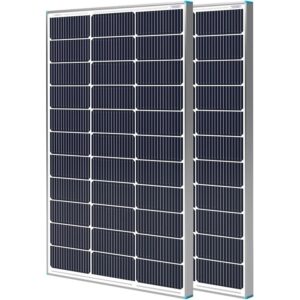 | Renogy 100W 2-Pack Monocrystalline Solar Panel Two 100W monocrystalline panels, 21% efficiency, pre-drilled holes for easy mounting, compatible with 12V/24V systems. | CHECK PRICE |
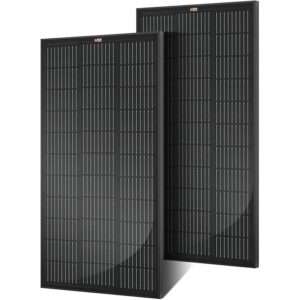 | RICH SOLAR 100W All Black 2-Pack All-black monocrystalline design, 2×100W, IP67 junction box, ideal for rooftop and off-grid RV installs. | CHECK PRICE |
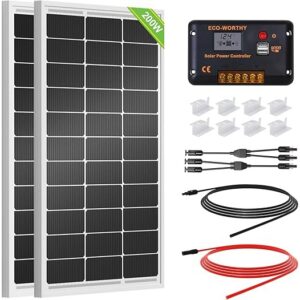 | ECO-WORTHY 200W Solar Panel Kit with Controller 200W kit with 30A PWM charge controller, SAE connectors, and mounting Z-brackets — complete off-grid starter kit. | CHECK PRICE |
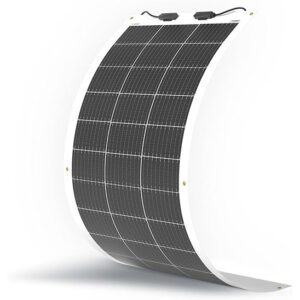 | Renogy Flexible 100W Solar Panel Ultra-thin 2.5mm flexible panel, bends up to 248°, ETFE surface, ideal for curved RV roofs and boats. | CHECK PRICE |
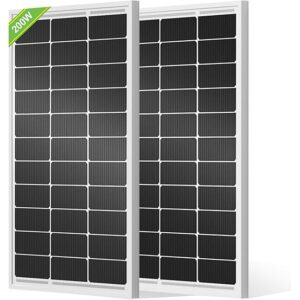 | ECO-WORTHY 100W 2-Pack Monocrystalline 2×100W mono panels, 22.8% efficiency, reinforced frame, suited for cabins, caravans, and backup power. | CHECK PRICE |
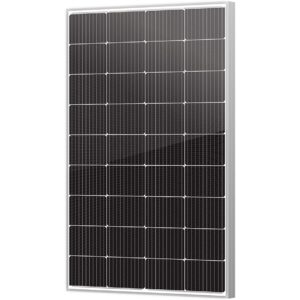 | Newpowa 200W Monocrystalline Solar Panel Single 200W mono panel, 17.65% efficiency, compact design, ideal where higher wattage in small footprint is needed. | CHECK PRICE |
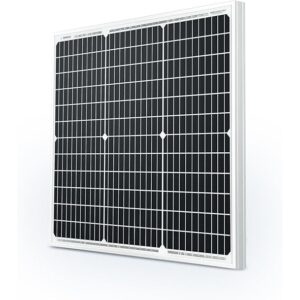 | Renogy 50W Monocrystalline Solar Panel Compact 50W panel, IP67 junction box, built-in diode, suitable for small battery maintenance and portable setups. | CHECK PRICE |
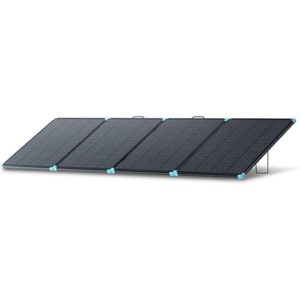 | Renogy 400W Portable Foldable Suitcase Solar Panel 400W foldable suitcase, built-in 40A MPPT controller, kickstand, waterproof — ready to use out of the box. | CHECK PRICE |
8 Best Solar Panels
1. Renogy 100W 2-Pack Monocrystalline Solar Panel
Renogy is probably the most trusted name in consumer solar panels, and this 100W 2-pack is the product that keeps that reputation intact. With a 4.7-star rating from more than 1,700 verified buyers, it’s one of the most reviewed solar panels in its class on Amazon. The two-panel format gives you 200 watts of capacity for the price of one premium panel elsewhere, which is a compelling starting point for most off-grid and backup power builds.
Each panel delivers up to 500Wh per day in good sun. The monocrystalline cells hit roughly 21% efficiency, which is competitive for panels in this price range. The aluminum frame is corrosion-resistant and built to handle wind loads and snow pressure that would flex or crack cheaper units. Renogy’s pre-drilled mounting holes accept most standard mounting hardware without modification.
Buyers consistently highlight the panel’s easy compatibility with Renogy’s own charge controllers and inverters, but these also pair fine with Victron, EPEver, and other brands. Output is stable and predictable. You’re not buying surprises with Renogy, and for most buyers that consistency is exactly what they’re after.
The 2-pack format does mean you need enough mounting real estate for two panels. For tight RV rooftop installs or small boat decks, a single higher-wattage panel might actually take up less space. But for anyone with room, 200W from two Renogy panels is a solid starting point and easy to expand from.
Features
- 100W per panel, 2-pack (200W total)
- Monocrystalline cells, ~21% efficiency
- Corrosion-resistant aluminum frame
- Pre-drilled mounting holes
- Waterproof junction box
- 4.7 stars from 1,700+ buyers — one of the most trusted panels on the market
- 200W for the price of a single premium panel
- Consistent output, predictable performance
- Easy compatibility with most charge controllers
- Two-panel format needs more mounting space than a single larger panel
- Doesn’t include controller or cables
2. RICH SOLAR 100W All Black 2-Pack
The RICH SOLAR 100W all-black 2-pack is the pick for buyers who want the visual clean of a full black panel without paying premium brand prices. All-black panels with black frames and black backsheets have become the standard for residential roof installs where aesthetics matter, and RICH SOLAR delivers this look at a price that makes it accessible for off-grid and RV builds too. The 4.7-star rating from over 1,300 buyers backs up the performance claims.
Output per panel sits at 100W, and the high-efficiency monocrystalline PERC cells push actual efficiency to around 22%. PERC cells (Passivated Emitter Rear Contact) collect reflected light from the rear of the cell, giving these a small but real efficiency advantage over standard mono panels in the same wattage class. In partial shade conditions, this matters more than the spec sheet suggests.
The aluminum frame is IP65-rated and built for outdoor long-term exposure. RICH SOLAR backs these with a 25-year power output warranty, which is industry standard but worth confirming on any panel you’re buying. The 2-pack ships with MC4 connectors and includes enough cable to make your first connection without a separate cable order.
The all-black aesthetic won’t matter for most hidden off-grid installations, but if you’re mounting on a visible roof or anywhere you’d normally care about curb appeal, these look noticeably cleaner than panels with silver frames and white backsheets. For buyers who want function and form, RICH SOLAR is a serious contender at this price.
Features
- 100W per panel, 2-pack (200W total)
- All-black monocrystalline PERC cells, ~22% efficiency
- IP65-rated aluminum frame
- MC4 connectors included
- 25-year power output warranty
- All-black design looks premium on roof installs
- PERC cells offer slightly better efficiency in partial shade
- 4.7 stars from 1,300+ verified buyers
- Comes with MC4 connectors
- All-black absorbs slightly more heat (minor output effect in very hot climates)
- Premium aesthetic adds cost over silver-framed alternatives
3. ECO-WORTHY 200W Solar Panel Kit with Controller
This is the one to buy if you want to get a complete solar charging system running without sourcing components separately. The ECO-WORTHY 200W kit bundles two 100W monocrystalline panels with a charge controller, cables, and connectors, so most buyers can go from box to functioning system in an afternoon. At 4.6 stars from more than 1,000 reviews, it’s one of the most purchased starter kits on Amazon for a reason.
The included charge controller is a basic PWM unit rated for the kit’s output. For most small to mid-size battery banks in straightforward 12V or 24V setups, PWM is fine. If you’re planning a larger system or want maximum battery efficiency, upgrading to an MPPT controller is worth the extra cost, but the included unit does what it needs to do for the panel count in this kit.
What makes this kit stand out is the reduction in friction for first-time buyers. Sourcing a controller, cables, and connectors separately adds cost and risk if you get the specs wrong. ECO-WORTHY bundles everything at a price that competes favorably with buying panels alone from other brands. The panels themselves perform well, with consistent output and solid waterproofing for outdoor installation.
Features
- 2 x 100W monocrystalline panels (200W total)
- PWM charge controller included
- MC4 cables and connectors included
- 4.6 stars, 1,000+ reviews
- Complete kit with controller, cables, and connectors
- Great value for first-time buyers setting up a system from scratch
- 1,000+ verified reviews, strong track record
- Included PWM controller is basic (MPPT would be more efficient for larger setups)
- Kit format means you’re paying for components you may already own
4. Renogy Flexible 100W Solar Panel
The Renogy Flexible 100W is for the install that a rigid panel simply can’t fit. Curved RV roofs, boat decks, van builds, and any surface that’s not flat enough for an aluminum-framed panel — this is where flexible panels earn their place. At 4.4 stars from nearly 950 reviews, it’s the most popular flexible option in Renogy’s lineup and consistently recommended in van life and overlanding communities.
The panel flexes up to 248 degrees, which sounds extreme but reflects how much freedom this gives you compared to a rigid unit. It’s about 70% lighter than a comparable rigid panel, which matters if you’re weight-sensitive on an RV or marine build. The ETFE surface is more durable than PET coating (PET yellows and degrades faster), giving these panels a longer outdoor lifespan. Efficiency sits at around 20%, slightly below rigid panels at the same wattage.
Flexible panels are a tradeoff, and buyers should understand it going in. They cost more per watt than rigid panels, they’re harder to cool because they sit flush against surfaces rather than elevated on frames, and they’re more susceptible to physical damage from foot traffic or point pressure. But for curved surfaces or weight-critical builds, they’re the only practical option. Renogy’s version is among the most reliable in this category.
Features
- 100W flexible monocrystalline panel
- Bends up to 248 degrees
- ETFE surface coating
- 70% lighter than rigid equivalent
- ~20% efficiency
- Works on curved surfaces — RV roofs, boat decks, van builds
- Much lighter than rigid panels
- ETFE coating lasts longer than PET alternatives
- More expensive per watt than rigid panels
- Harder to cool (flush mount limits airflow)
- Vulnerable to point pressure damage
5. ECO-WORTHY 100W 2-Pack Monocrystalline
ECO-WORTHY’s 100W 2-pack is the budget-friendly path to 200W of panel capacity. At 4.6 stars from nearly 750 reviews, it competes directly with the Renogy 2-pack but typically comes in at a lower price point. For buyers who want to maximize wattage per dollar and aren’t brand-loyal, this is a viable route.
The monocrystalline cells perform well in full sun, with output consistency that holds up through the first season of use. The panels are IP65 waterproofed and built for year-round outdoor exposure. They don’t include a controller, so you’ll need to factor that cost in if you’re starting from scratch. But if you already have a charge controller rated for 200W input, these drop straight in.
ECO-WORTHY isn’t the most prestigious brand on this list, but the review count at this rating suggests real buyers are getting real results. The value proposition here is simple: more watts for less money, with quality that satisfies the majority of buyers in typical off-grid and RV applications.
Features
- 100W per panel, 2-pack (200W total)
- Monocrystalline cells
- IP65 waterproof rating
- Pre-drilled mounting holes
- Best value for 200W capacity on this list
- 4.6 stars from solid buyer count
- IP65 weatherproofing for year-round use
- No controller included
- ECO-WORTHY brand has less prestige than Renogy or RICH SOLAR
- Limited color and frame options
6. Newpowa 200W Monocrystalline Solar Panel
If you want 200W in a single panel rather than two 100W units, the Newpowa 200W is the right direction. One larger panel simplifies wiring, reduces connection points where failures can occur, and takes less space on the mounting surface than two separate units. At 4.6 stars from 700+ reviews, Newpowa has earned solid credibility in the mid-market solar space.
The single-panel format comes with a tradeoff: it’s larger and heavier, which can make mounting more awkward solo. You’ll want a second person for rooftop installs. But for ground-mounted systems, pole mounts, or flat barn roofs where panel size isn’t the constraint, one 200W unit is cleaner than two 100W panels every time.
Efficiency is competitive with other monocrystalline options in this class, and the build quality reflects Newpowa’s focus on the higher end of the DIY solar market. The junction box is IP65-rated, the frame handles typical weather loads, and the panel ships ready to connect with MC4 leads.
Features
- 200W single monocrystalline panel
- IP65 junction box
- MC4 leads included
- 4.6 stars, 700+ reviews
- 200W in a single panel simplifies wiring
- Fewer connection points than a 2-panel setup
- Strong reviews for a mid-market brand
- Larger and heavier — harder to mount solo
- Less flexibility in positioning than two smaller panels
7. Renogy 50W Monocrystalline Solar Panel
Not every solar build needs 200W. The Renogy 50W monocrystalline panel covers the smaller end of the spectrum, suited for trickle-charging a single battery bank, powering trail cameras, maintaining an RV battery during storage, or running a small 12V lighting setup in a shed. At 4.7 stars from over 650 reviews, it carries Renogy’s usual quality at the entry-level wattage.
The compact footprint makes it the easiest panel on this list to handle solo. At this size, one person can carry, position, and secure it without a helper. The aluminum frame and IP67 junction box hold up to outdoor exposure year-round, and Renogy’s 25-year power output warranty gives you long-term confidence. For small, focused applications, this 50W panel does the job cleanly.
Features
- 50W monocrystalline panel
- IP67 junction box
- 25-year power output warranty
- Compact form factor
- Right-sized for small battery charging and maintenance applications
- Easy to handle solo thanks to compact size
- 4.7 stars at entry-level wattage
- 50W is underpowered for most full-system builds
- Higher cost-per-watt than larger panels
- Sold as single panel only
8. Renogy 400W Portable Foldable Suitcase Solar Panel
Push the stand open, angle toward the sun, done. That’s the promise of the Renogy 400W portable suitcase panel, and it mostly delivers. The suitcase format folds open to deploy 400 watts of monocrystalline capacity without mounting hardware, roof penetrations, or permanent installation. It’s the pick for buyers who move their power source between locations, camp with a large battery bank, or want solar without committing to a fixed install. At 4.4 stars from around 280 reviews, it’s newer and has fewer reviews than the other Renogy products here, but the ratings are solid.
At 400W, this is the highest-capacity portable option on this list. Paired with a quality MPPT charge controller and a large lithium battery bank, it can realistically power a weekend camp setup, recharge a portable power station, or run essential loads during an extended off-grid stay. The integrated kickstand deploys in seconds and holds the panel at an angle to maximize sun exposure. The handle and latching clasps make it genuinely portable in a way that two loose panels with cables never quite are.
The suitcase format is heavier than a single rigid panel of the same wattage because of the housing, hinges, and protective casing. It’s a tradeoff in favor of portability and durability during transport. If you’re doing a fixed rooftop install, a standard rigid panel setup will cost less and perform just as well. But for buyers who need real wattage they can take anywhere, this 400W suitcase is the most capable option on this list.
Features
- 400W foldable suitcase, two 200W panels
- Integrated kickstand for positioning
- Built-in carry handle with latching clasps
- Monocrystalline cells
- MC4 output leads
- 400W portable with no mounting hardware needed
- Integrated kickstand for easy positioning
- Practical for camping, overlanding, and temporary power setups
- Heavier than equivalent rigid panels due to housing
- Higher cost per watt than fixed-mount options
- Fewer reviews than other Renogy products on this list
Solar Panel Buying Guide
Key Takeaways
- Monocrystalline panels offer higher efficiency (19-22%) than polycrystalline — worth the premium for most residential and off-grid buyers.
- PERC cells improve performance in partial shade and low-light conditions compared to standard mono cells.
- Flexible panels cost more per watt and run hotter, but they’re the only option for curved surfaces and weight-sensitive builds.
- 2-pack formats often give better value per watt than single panels, but a larger single panel simplifies wiring.
- Always pair your panels with a properly sized charge controller — PWM for basic setups, MPPT for better efficiency and larger battery banks.
- Sun hours in your location matter more than panel efficiency. A 20% efficient panel in Arizona outperforms a 22% panel in Seattle.
What Are Solar Panels?
Solar panels, also called photovoltaic (PV) panels, convert sunlight directly into electricity using semiconductor cells. When photons from sunlight hit the cells, they knock electrons loose, creating a flow of direct current (DC) electricity. That current travels through wiring to a charge controller, which regulates the voltage going into your battery. An inverter converts DC to the AC power used by household appliances.
Modern consumer solar panels are almost universally monocrystalline. Monocrystalline cells are cut from a single silicon crystal, giving them higher efficiency than polycrystalline (multi-crystal) cells. Polycrystalline panels have largely disappeared from the market because the efficiency gap has closed to the point where monocrystalline is the default at nearly every price point.
How Do Solar Panels Work?
The photovoltaic effect is the process at the core of every solar panel. Silicon is a semiconductor — it conducts electricity under certain conditions. When sunlight hits a silicon cell, photons excite electrons and give them enough energy to move through the cell. The cell is structured so that these electrons flow in one direction, creating usable DC current.
A standard residential or off-grid panel contains 60 to 72 individual cells connected in series. Series connections increase voltage. A single cell produces about 0.5V. Sixty cells in series produce roughly 30V, which is the standard open-circuit voltage for a 12V-nominal panel. The charge controller takes that voltage and steps it down or regulates it to safely charge your battery at the correct voltage for your bank.
Benefits of Solar Panels
The most immediate benefit is reduced electricity costs. Panels generate free power from sunlight. For off-grid systems, they eliminate the need for grid connections entirely. For grid-tied homes, they offset utility consumption and, in states with net metering, allow homeowners to sell excess power back to the grid.
Solar panels require almost no maintenance. There are no moving parts. The main maintenance task is keeping the panel surface clean so sunlight can reach the cells without obstruction. In most climates, rain handles most of this. In dusty or pollen-heavy environments, a quarterly rinse with a garden hose is enough.
Panels also add home value. Studies consistently show that homes with solar installations sell faster and at a premium compared to equivalent homes without panels. And with federal tax credits still available, the upfront cost for a residential system is meaningfully lower than it was five years ago.
Solar Panel Efficiency and Wattage: What the Numbers Mean
Efficiency and wattage are related but different. Wattage is the raw output under standard test conditions (STC) — 1,000 watts of sunlight per square meter at 77 degrees Fahrenheit. A 400W panel will produce up to 400 watts under those conditions. Efficiency is how much of the available sunlight gets converted to electricity, expressed as a percentage. Higher efficiency means you need less roof space for the same output.
Monocrystalline panels run 20 to 23% efficiency. Polycrystalline runs 15 to 17%. Thin-film is 10 to 13%. For a home with limited roof space, efficiency matters a lot. For a large installation where space isn’t the constraint, the cheaper polycrystalline option at the same total wattage is a reasonable choice. Don’t assume the highest-wattage panel is always best — a 400W panel at 20% efficiency takes more roof space than a 400W panel at 22%.
How Many Solar Panels Does a Typical Home Need?
The answer depends entirely on how much electricity you use. The average American home uses about 10,500 kWh per year, or roughly 875 kWh per month. With modern 400W panels and around 4 to 5 peak sun hours per day (which covers most of the continental US), each panel produces about 50 to 60 kWh per month. That means a typical home needs 14 to 18 panels to cover most of its electricity use.
But your situation may differ significantly. A smaller home or an energy-efficient household might need only 8 to 10 panels. A larger home with electric heating or an EV charging in the garage might need 24 or more. The right approach is to pull your last 12 months of electricity bills, find your annual kWh total, and work backwards from there. A professional installer will do this calculation as part of a free site assessment. For a quick quote based on your actual address and usage, call (855) 427-0058 or get a free installation quote.
Understanding Solar Panel Warranties and Certifications
Solar panels carry two separate warranty types. The product warranty (also called the materials or workmanship warranty) covers defects in the panel itself — typically 10 to 15 years for quality brands. The performance warranty guarantees the panel will still produce a minimum percentage of its rated output after a set number of years — typically 80% at 25 years for monocrystalline panels, 85% or more for premium brands.
Certification matters for grid-tied installations. Look for UL 1703 or UL 61730 certification for US grid connection. IEC 61215 and IEC 61730 are the international equivalents, and most quality panels carry both. If you’re installing off-grid, certification is less legally required but still signals quality construction and testing. Brands with Tier 1 Bloomberg NEF classification have demonstrated bankability — they’ve been independently verified to have the manufacturing scale and financial stability to honor long-term warranties.
Types of Solar Panels
Monocrystalline panels are cut from a single silicon crystal and are the most efficient and longest-lasting type available. They’re the standard choice for residential rooftop installations where space is at a premium. Polycrystalline panels are made from multiple silicon fragments and are slightly less efficient but cost less per watt — they remain competitive in large commercial or ground-mounted installations where space isn’t constrained. Thin-film panels use layers of photovoltaic material on a glass, plastic, or metal substrate. They’re lighter and more flexible than crystalline panels, perform better in low-light and high-heat conditions, and degrade more slowly at high temperatures. They’re best suited for commercial flat roofs, ground arrays with space to spare, and specialty applications like building-integrated photovoltaics (BIPV). Bifacial panels, a newer category, capture light on both sides — useful in ground-mounted installations with reflective surfaces below the array.
Things to Keep in Mind Before Buying
Match your panel wattage to your actual load. Calculate what you need to power, how many hours per day you run it, and work backward to find the watt-hours required per day. Divide that by your location’s average peak sun hours to find the panel wattage needed. Oversizing is fine. Undersizing creates frustration.
Your charge controller must be compatible with your panels. The controller’s input voltage rating must exceed your panel’s open-circuit voltage (Voc). For a 100W panel with a 21V Voc, a 12V controller rated for at least 25V input works. If you wire two panels in series, the voltage doubles, and your controller must handle that higher input.
Mounting matters more than buyers expect. Poor mounting — panels blocked by shadows for part of the day, panels not angled toward the sun, panels with inadequate airflow underneath — can cut actual output by 20-40% compared to what the spec sheet suggests. Take time to plan the mount before you buy the panels.
Types of Solar Panels
Rigid monocrystalline panels are the standard choice for most applications. They’re the most efficient, the most durable, and the best value per watt when you have a flat surface to mount them on. Most panels on this list are rigid mono panels.
Flexible panels are for curved or irregular surfaces. They sacrifice some efficiency and run hotter due to flush mounting, but they make solar possible on surfaces where rigid panels simply don’t fit. They cost more per watt and need more care to avoid physical damage.
Portable suitcase panels are rigid panels in a folding carry case with a built-in stand. They’re for buyers who need high-wattage solar they can deploy and pack away. They cost more than equivalent fixed panels due to the housing, but they require no permanent installation and can move with you.
Frequently Asked Questions
It depends on your electricity consumption and your location’s sun hours. The average US home uses about 30 kWh per day. With 5 peak sun hours and 20% system efficiency losses, you’d need roughly 6 kW of panels — that’s around 20 to 24 standard 300W panels. A solar installer can give you an accurate estimate based on your actual utility bills and roof assessment. Call (855) 427-0058 for a free quote.
Monocrystalline panels use cells cut from a single silicon crystal. They’re more efficient (19-22%) and perform better in low-light conditions. Polycrystalline panels use multiple silicon fragments melted together — slightly less efficient but historically cheaper. In practice, monocrystalline has become the standard at most price points, and polycrystalline panels are increasingly rare in consumer products.
No. Don’t do it. A charge controller regulates the voltage coming from the panels so it doesn’t overcharge your battery. Without a controller, even a small 50W panel can damage or destroy a battery in a matter of hours on a sunny day. The controller also prevents reverse current flow from the battery back through the panel at night. Always use a charge controller sized for your panel output.
Yes, but at reduced output. A panel that produces 100W in full sun might produce 10-25W under heavy overcast. Diffuse light still reaches the cells — clouds just filter and scatter it. Panels with PERC cells handle diffuse light better than standard mono cells. Plan your system around your location’s average sun hours, not just full-sun days.
Most quality panels are warrantied for 25 years of power output, typically guaranteeing at least 80% of original output at the end of that period. Real-world degradation runs around 0.5% per year for quality monocrystalline panels. That means a panel rated at 100W in year 1 should still produce around 87W in year 25. Panels can function well beyond their warranty period — it’s not uncommon to see 30-year-old panels still generating power.
PWM (Pulse Width Modulation) controllers are simpler and cheaper. They work by directly connecting the panel to the battery and modulating the connection to prevent overcharge. Fine for small 12V systems. MPPT (Maximum Power Point Tracking) controllers convert excess panel voltage into additional current, typically capturing 15-30% more energy from the same panels. For larger systems and lithium battery banks, MPPT is worth the extra cost.
Summing Up
The best solar panels for most buyers are monocrystalline, rated between 100W and 400W depending on your needs. Renogy, ECO-WORTHY, RICH SOLAR, and Newpowa consistently deliver reliable performance at competitive prices. Match wattage to your actual load, check compatibility with your charge controller or inverter, and prioritize panels with at least a 10-year product warranty.
If you’re thinking about a full home solar installation, call (855) 427-0058 for a free quote — it takes just a few minutes to find out what a system would cost and save you in your area.
Updated