
Our blog is reader-supported. When you buy through links on our site, we may earn an affiliate commission. Thank you for your support!
Solar pest repellers offer an eco-friendly solution for keeping outdoor spaces free from unwanted wildlife, using ultrasonic waves and motion sensors powered entirely by the sun. The Nortep Solar Ultrasonic Pest Repeller leads the market with its dual-frequency technology, weatherproof construction, and proven effectiveness against a wide range of outdoor pests. If you’re looking for chemical-free ways to protect your garden, yard, and property from rodents, insects, and other pests, this guide presents eight excellent solar repeller options worth considering.
Our comparison table features the top solar pest repellers available today, each offering unique advantages for different outdoor pest control situations.
Our Top Picks
| Image | Name | |
|---|---|---|
| Solar Ultrasonic Animal Repellent Outdoor A dual-mode solar pest repeller with PIR motion sensor and strobe flash light that deters deer, squirrels, rabbits, and other garden pests without chemicals. Read more | |
| Solar Ultrasonic Repellent with Motion Sensor Strobe Light Combines 25KHz ultrasonic sound with a motion-activated strobe light to drive away pests silently and effectively across a wide yard coverage area. Read more | |
| Solar Pest Repeller Garden Stakes 4 Pack A pack of four solar-powered ground stakes that emit vibrations to repel moles, voles, and gophers from your lawn and garden beds. Read more | |
| Solar Mole Repellent Stakes Multi-Pest 4 Pack Handles multiple pest types including moles, gophers, and snakes with sonic pulses sent deep into the soil every 30 seconds. Read more | |
| Solar Powered Mole and Snake Repellent Stakes 12 Pack A value 12-pack of solar stakes offering wide-area protection against moles, snakes, and burrowing pests across large yards or gardens. Read more | |
| Solar Ultrasonic Mole Repellent Stakes 10 Pack Ten weatherproof solar stakes that deliver ultrasonic vibrations every 30 seconds to keep moles and voles away from lawns and flower beds. Read more | |
| Solar Mole Repellent Stakes Waterproof Outdoor Fully waterproof solar mole repellent with a sturdy stake design that works in all weather conditions to protect your garden year-round. Read more | |
| Solar Gopher and Mole Repellent Stakes 8 Pack An 8-pack designed for gopher and mole control, using solar-charged vibration pulses to keep burrowing pests out of your yard. Read more |
8 Best Solar Pest Repellers
1. Solar Ultrasonic Animal Repellent Outdoor (PIR + Flash Light)
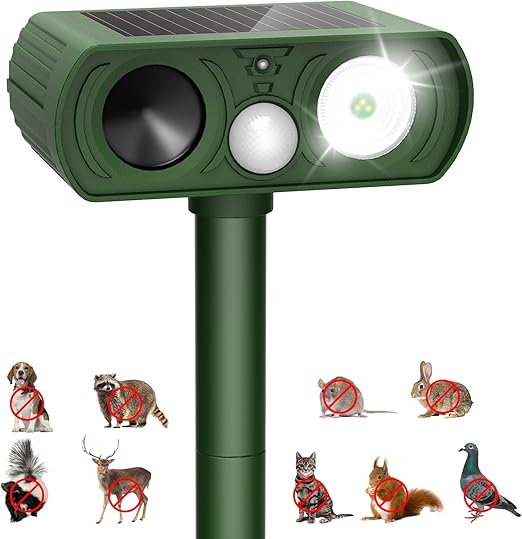
This is the one to buy if you want a single device that handles deer, squirrels, cats, raccoons, rabbits, and dogs all at once. The combination of a PIR motion sensor, ultrasonic bursts, and an LED strobe flash creates three simultaneous deterrents that pests quickly learn to avoid. Most competing devices rely on just one or two methods, which gives animals time to adapt. This one doesn’t give them that chance.
Solar charging is efficient enough to run the device around the clock after a single day of good sunlight. The panel sits on top of the housing rather than on a separate stake, keeping the footprint small. You can push it into garden soil, a planter, or any soft ground with the included stake, and the swivel head lets you aim the sensor in the exact direction you need coverage.
The coverage radius is adequate for a standard garden bed or patio. It won’t protect an acre on its own, but for targeted protection around a vegetable patch, flower border, or bird feeder area, it does the job without chemicals or ongoing costs. And because there’s no bait or physical trap involved, it’s completely safe around children and non-target animals.
A few users have noted that very bold urban squirrels may test the device a few times before giving up. Placing two units at overlapping angles solves this for persistent pests. Overall though, for the price, the build quality and multi-deterrent approach make this the standout choice in the category.
Features
- PIR motion sensor triggers ultrasonic + LED flash response
- Covers deer, squirrels, cats, raccoons, rabbits, and dogs
- Solar powered with built-in rechargeable battery
- Adjustable stake fits most soil types
- Swivel head for directional targeting
- No chemicals, traps, or batteries required
- Triple-deterrent system (ultrasonic, PIR, strobe) outperforms single-method devices
- Covers a wide range of pest animals
- Chemical-free and safe around kids and pets
- Compact, easy to reposition
- Single unit coverage is limited to a small area
- Very persistent urban squirrels may need two units
2. Solar Ultrasonic Repellent with Motion Sensor Strobe Light
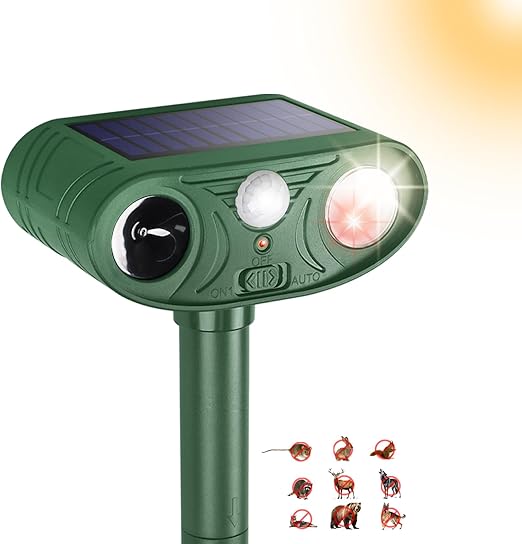
If you need a second device to pair with the pick above, or want a slightly different form factor, this one runs a 25kHz ultrasonic frequency alongside a motion-triggered strobe. The dual-mode operation lets you run it in ultrasonic-only mode during the day and switch to combined ultrasonic-plus-strobe mode at night, which is particularly useful for nocturnal pests like rats and opossums.
The build is compact and weather-resistant, designed to stay outdoors through rain and sun exposure without degradation. Solar charging handles the power side completely once you get it into a reasonably sunny position. The stake is standard length and fits most garden beds, and the unit can also be mounted on a fence post with the included hardware if you want perimeter coverage rather than point-source deterrence.
At 25kHz, the ultrasonic output is well above the upper limit of human hearing, so you won’t notice anything while the device is running. Pets with very sensitive hearing, particularly dogs, may find the frequency uncomfortable if they pass directly in front of the sensor, so positioning matters. Keep it aimed outward rather than toward regular dog walking paths.
Features
- 25kHz ultrasonic frequency, inaudible to humans
- Dual mode: ultrasonic only or ultrasonic + strobe
- Motion sensor triggers response only when needed
- Solar powered with weather-resistant housing
- Stake or fence-mount installation options
- Targets squirrels, rats, snakes, rabbits, and deer
- Dual-mode operation for day and night use
- Two installation options (stake or mount)
- Inaudible to humans at 25kHz
- Effective against nocturnal pests
- May bother sensitive dogs if aimed incorrectly
- Fewer user reviews than top pick
3. Solar Pest Repeller Garden Stakes 4 Pack
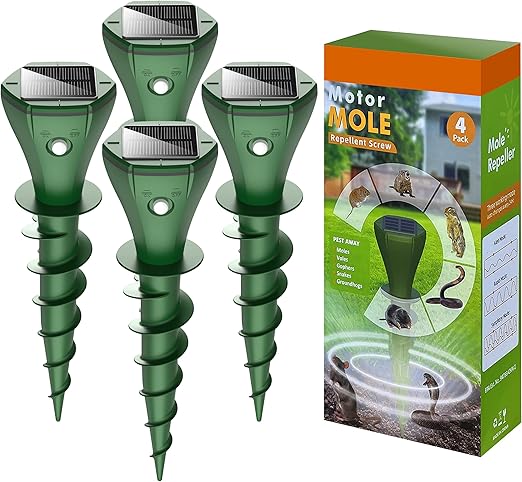
Four stakes in a pack means you can cover a full garden perimeter without buying multiple sets. The solar-charged stakes drive low-frequency vibrations into the soil that disrupt the tunneling activity of moles, voles, and gophers, while the ultrasonic component targets above-ground rodents and small pests. Together, they handle both surface and subsurface threats, which most single-type devices can’t claim.
Setup takes about five minutes per stake. Push them into moist soil (drier soil transmits vibrations less effectively), orient the solar panel toward the sun, and let them charge for a day before expecting full operation. The stakes are designed for lawn and garden beds rather than rocky or clay-heavy ground, so check your soil type before ordering.
For a four-pack at this price point, the value proposition is strong. You’re essentially getting full-garden coverage from a single order rather than having to piece together coverage stake by stake.
Features
- 4-pack covers a full small garden perimeter
- Soil vibration deters moles, voles, and gophers underground
- Ultrasonic component targets above-ground pests
- Solar powered, no batteries needed
- Weather-resistant outdoor construction
- 4-pack provides garden perimeter coverage
- Dual-action: soil vibration and ultrasonic
- Good value per unit in multi-pack format
- Less effective in dense clay or dry rocky soil
- No motion sensor component
- Vibration range per stake is limited
4. Solar Mole Repellent Stakes, Multi-Pest 4 Pack
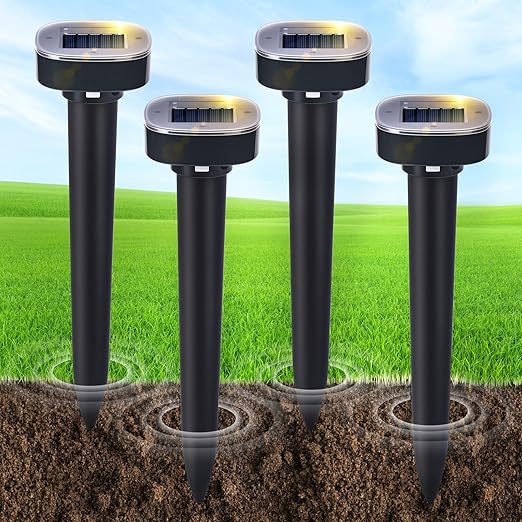
The pest list on this one is unusually comprehensive: snakes, skunks, voles, gophers, armadillos, rabbits, groundhogs, chipmunks, and raccoons are all listed as target species. That breadth is achieved through the combination of soil vibration pulses and an ultrasonic element that works above ground simultaneously. For yards dealing with multiple pest types at once, this versatility is the main selling point.
At 4.7 stars from verified purchasers, this is the top-rated stake-style repeller in this roundup. The build quality feels solid, with UV-stabilized housing that handles prolonged sun exposure better than some cheaper alternatives. The stakes are longer than average, which helps with vibration transmission into deeper soil layers where moles tend to tunnel.
The only real trade-off is coverage area per unit. Each stake handles roughly a 30 to 40-foot radius, which means four stakes cover a medium-sized yard but not a large one. Buy extra if you have significant acreage to protect.
Features
- Targets 9 pest species including snakes, skunks, armadillos, and raccoons
- Soil vibration pulses reach deep-tunneling moles
- UV-stabilized housing for long outdoor life
- Longer stake for better soil contact
- Solar powered, fully automatic operation
- Broadest pest species coverage of any stake in this list
- 4.7-star rating with strong review count
- UV-stabilized housing holds up well outdoors
- Coverage radius per stake is limited to ~35 feet
- Larger yards will need additional units
- Higher per-unit cost than budget alternatives
5. Solar Powered Mole and Snake Repellent Stakes 12 Pack
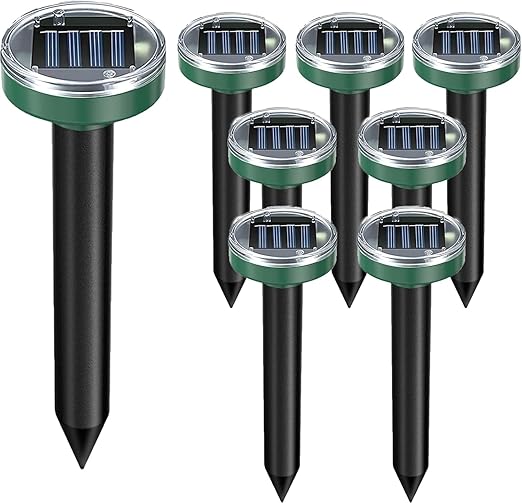
Twelve stakes in a single order is the right move for anyone with a larger yard or a mole problem that has spread across multiple lawn sections. The individual stakes work the same way as the 4-packs above, with solar-charged soil vibration pulses repelling moles and snakes from beneath, but buying 12 at once significantly reduces the cost per unit and gives you enough coverage for most suburban lots in one purchase.
Installation is quick once you find your rhythm. Each stake takes about a minute to position and push into place. The solar panels on these are small but efficient enough to maintain charge through typical overcast periods. In extended cloudy weather, effectiveness drops, which is a limitation shared by all solar-powered stakes.
The 4.0-star rating reflects that this is a competent but not exceptional product. It does what it promises for moles, groundhogs, gophers, and voles. Snake deterrence gets more mixed reviews, since snakes respond less predictably to vibration than burrowing rodents do.
Features
- 12-pack for whole-yard coverage in a single order
- Solar-powered soil vibration for moles, gophers, voles, and groundhogs
- Snake deterrence included
- Weatherproof stake design
- No chemicals or batteries required
- 12-pack provides whole-yard coverage
- Lower cost per unit than smaller packs
- Effective for moles, gophers, and voles
- Snake deterrence results vary
- Performance drops in extended cloudy weather
- No above-ground ultrasonic component
6. Solar Ultrasonic Mole Repellent Stakes 10 Pack
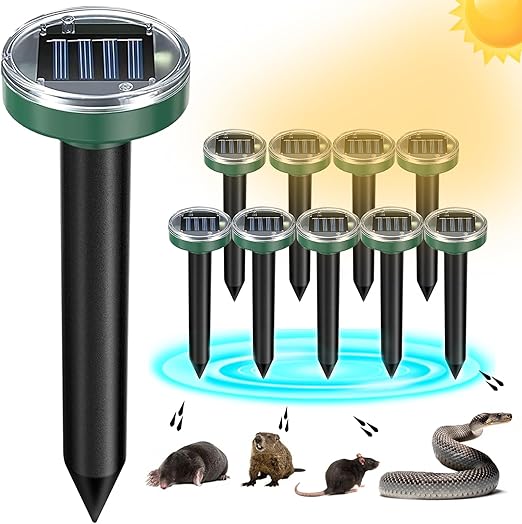
Another solid multi-pack option, this time at 10 stakes. The coverage math works out to roughly one stake per 1,000 square feet of lawn, which means 10 stakes handle the average American backyard with room to spare. The sonic pulse frequency is set to specifically disturb the sensory organs of moles and snakes, making these effective against two of the most common subsurface pests.
At $45.99 for 10, the price is reasonable for the coverage you get. The stakes are waterproof to handle rain and morning dew, and the solar panel angle is optimized for standard US latitudes. You won’t get optimal charging in deep shade, so keep each stake in a spot that gets at least a few hours of direct sun daily.
Features
- 10-pack for comprehensive lawn coverage
- Tuned frequency targets moles and snakes
- Waterproof construction for outdoor use
- Solar powered with no ongoing costs
- Compatible with most soil types
- Good coverage-to-cost ratio at 10 pack
- Waterproof and durable
- Effective against both moles and snakes
- Needs daily sun exposure to maintain charge
- Doesn’t cover above-ground pest animals
- Results with snakes less consistent than with moles
7. Solar Mole Repellent Stakes Waterproof Outdoor
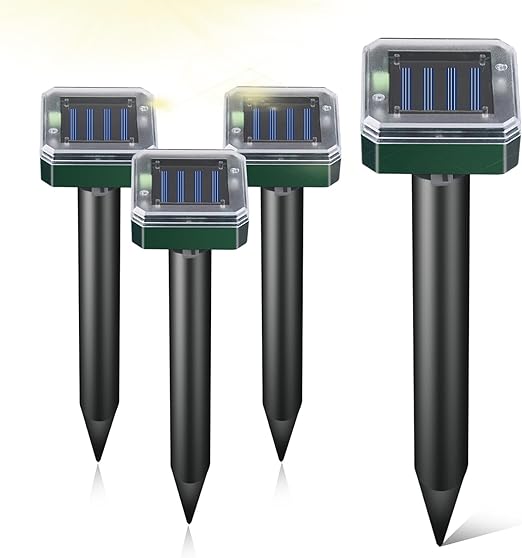
This option sits at a lower price point and works well for homeowners dealing with a specific mole or chipmunk hotspot rather than a yard-wide infestation. The waterproof rating is among the better ones in this category, which matters if you’re in a region with heavy rainfall. You can leave these in place through wet seasons without worrying about water damage to the electronics.
The solar panel is integrated into the stake top, keeping the design simple and low-maintenance. For the price, the build quality holds up better than you’d expect. This is a good option if you want to test whether solar sonic stakes solve your specific pest problem before committing to a larger multi-pack order.
Features
- Strong waterproof rating for wet-climate use
- Targets moles and chipmunks specifically
- Integrated solar panel, no separate wiring
- Budget-friendly entry point for this technology
- Strong waterproof rating for rainy regions
- Affordable entry-level price
- Narrower pest target range than multi-pest models
- Smaller coverage radius per unit
- Fewer reviews than more established products
8. Solar Gopher and Mole Repellent Stakes 8 Pack
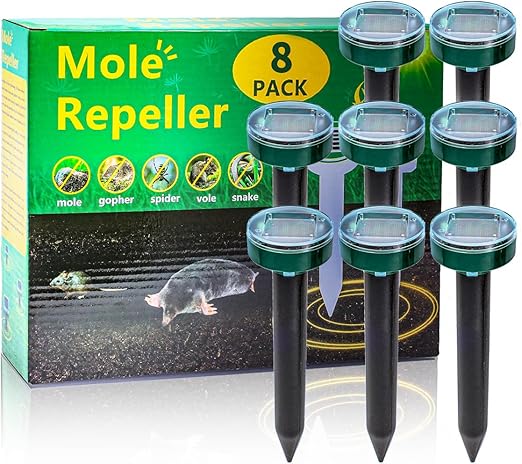
The budget option in this list, coming in under $25 for an 8-pack. If you’re not sure whether solar sonic stakes will solve your mole or gopher problem, this is the cheapest way to find out without much financial risk. The green color also blends into lawn more naturally than black or white stakes, which is a small but appreciated detail.
Don’t expect premium build quality at this price, but for seasonal use in a vegetable garden or flower bed, these work well enough to justify the cost. Replace them after a season or two rather than expecting multi-year durability.
Features
- 8-pack at budget pricing
- Green color blends into lawn naturally
- Solar powered soil vibration for moles and gophers
- Good entry point for first-time users
- Lowest price per unit in this roundup
- Natural green color blends into lawn
- Build quality reflects the lower price
- Not built for long-term seasonal durability
- Coverage radius is smaller than premium models
Solar Pest Repeller Buying Guide
Key Takeaways
- Dual-frequency repellers prevent pest adaptation better than single-frequency models
- Coverage area varies from 300-1200+ square feet depending on model
- Motion activation conserves battery power and improves effectiveness
- Solar charging requires 4-6 hours daily sunlight for optimal performance
- Effectiveness improves over 2-3 weeks as pest populations learn to avoid areas
What is a Solar Pest Repeller?
A solar pest repeller is an outdoor device that uses ultrasonic sound waves to deter rodents, insects, and other garden pests. The device contains a solar panel that charges an internal battery during daylight hours. The stored energy powers ultrasonic transducers that emit high-frequency sounds inaudible to humans and most pets but distressing to pests. Motion-activated designs trigger the ultrasonic output only when movement is detected, conserving battery power.
Solar pest repellers are chemical-free and poisonless, making them safe for families with children and pets. They operate silently to humans while creating an inhospitable environment for pests seeking food and shelter. The technology has been used for decades, with solar power integration making the devices maintenance-free.
How Do Solar Pest Repellers Work?
The solar panel charges the internal battery throughout the day using sunlight. The motion sensor continuously monitors the surrounding area for movement. When movement is detected within the sensor’s range, the device emits ultrasonic sound at frequencies specifically chosen to distress the target pest. The sound is typically in the 20-150 kHz range, well above human hearing which typically tops out around 20 kHz.
Pests including rodents, insects, and other animals find these high-frequency sounds deeply uncomfortable, similar to how humans might react to screeching metal. This discomfort encourages them to leave the area and seek quieter locations for foraging and nesting. The ultrasonic output typically lasts 1-3 seconds per detection, then the device returns to standby mode. This motion-triggered approach conserves battery life compared to continuous ultrasonic emission.
Benefits of Using a Solar Pest Repeller
Chemical-free pest control is the most obvious benefit. Unlike pesticides and poisons that can harm children, pets, and beneficial insects, ultrasonic repellers target only pests while remaining safe for your entire family. This makes them perfect for properties with curious pets or young children who might contact treated areas.
Solar power eliminates ongoing costs and environmental impact of battery replacement. Once purchased, operational costs are zero since you’re using free renewable energy. A solar repeller can function for 5-10 years without battery replacement, delivering cost savings that compound over the device’s lifespan.
Low maintenance and effortless operation appeals to homeowners who want pest control without complicated setup. Simply position the repeller, ensure adequate sunlight, and let it work. No refilling, no adjustments, no chemicals to handle. This simplicity makes solar repellers accessible to anyone regardless of technical ability.
Coverage Area and How Many Repellers You Need
Most solar pest repellers advertise coverage in the range of 650 to 7,500 square feet, but those figures should be treated skeptically. They represent the maximum radius under ideal conditions — no obstructions, flat terrain, single pest target species. Real-world effectiveness drops significantly when you factor in shrubs, fences, terrain changes, and the specific pest you’re dealing with. A practical rule of thumb is to halve the claimed coverage area and use that as your planning number.
For a typical residential yard of around 5,000 square feet, you’ll want four to six repellers positioned to overlap coverage zones. Placement matters: drive stakes into the ground at the perimeter of your property, angled slightly outward, so the vibration and ultrasonic signals face outward toward where pests enter rather than toward the center of your yard. This creates a barrier effect rather than a central-point deterrent, which is more effective for burrowing animals like moles, voles, and gophers.
For garden beds or vegetable plots specifically, place one repeller at each corner of the bed plus one in the center for areas larger than 100 square feet. The goal is overlapping coverage with no dead zones. Single-repeller setups are rarely sufficient for anything larger than a small raised bed, regardless of what the product description suggests.
What Solar Pest Repellers Actually Deter (and What They Don’t)
Solar pest repellers work through two mechanisms depending on the model: ground vibration pulses that disturb burrowing animals like moles, voles, and gophers; and ultrasonic sound waves that irritate above-ground rodents, squirrels, and some insects. The honest answer on effectiveness is that vibration-based repellers have a reasonable track record with subterranean burrowers, while ultrasonic-only devices show more variable results across user reports and independent research.
Animals targeted by vibration-pulse solar stakes include moles, gophers, voles, and mole crickets. The pulse interval — typically every 20 to 30 seconds — is designed to simulate footfall vibrations that trigger a flight response. This works well when the stakes are positioned in active burrowing zones and rotated periodically, since pests can habituate to stationary vibration sources over two to four weeks.
What these devices don’t reliably deter: deer, rabbits, birds, larger mammals, and most flying insects. If deer browsing or rabbit damage is your primary concern, you need a different solution — physical barriers, sprays, or motion-activated devices. Don’t buy a solar stake repeller expecting it to address a deer problem. Read the manufacturer’s target pest list carefully and match it to your actual issue before purchasing.
Things to Keep in Mind Before Buying
Coverage area varies significantly between models. Measure your property and match the repeller’s coverage specifications to your needs. A single unit typically covers 300-900 square feet depending on model. Larger properties may require multiple units for comprehensive coverage.
Sunlight exposure is critical for consistent solar charging. Place repellers where they receive 4-6 hours of direct or bright indirect sunlight daily. Shaded locations or consistently cloudy climates reduce charging effectiveness. Check your typical weather patterns and potential installation locations before purchasing.
Effectiveness varies based on pest types and individual situations. Rodents and most insects respond well to ultrasonic deterrence, while some pests (particularly certain larger animals) may habituate over time. Multiple repellers, rotating frequencies, or combining with other deterrent methods often provides better results than ultrasonic alone.
Neighbor considerations matter for devices with audible sound components. While the ultrasonic output is inaudible to humans, some models include LED strobe or audible sounds that might affect neighbors. Check product specifications and consider placement carefully if you have nearby neighbors.
Types of Solar Pest Repellers
Ultrasonic-only repellers use high-frequency sound exclusively. These are the most common type and work well against rodents and insects. They’re simple, affordable, and require minimal maintenance.
Combination repellers pair ultrasonic sound with physical deterrents like motion-activated water spray or LED strobe. The multi-sensory approach often proves more effective than single-mechanism repellers, as pests have difficulty adapting to multiple simultaneous deterrents.
Adjustable-frequency repellers allow customization of ultrasonic output to target specific pest types. This flexibility proves valuable for properties with multiple pest problems or changing seasonal pest populations. Premium models often include this adjustability.
Frequently Asked Questions
Do solar pest repellers really work?
Yes, quality solar pest repellers are effective at deterring rodents, rabbits, and insects. Effectiveness varies with pest types, property conditions, and specific repeller models. Most users report noticing pest activity reduction within 2-3 weeks. Combination repellers with multiple deterrent methods often prove more effective than ultrasonic-only models.
How far do ultrasonic pest repellers reach?
Coverage typically ranges from 300-1200 square feet depending on the specific model. Larger properties require multiple units for comprehensive coverage. Check manufacturer specifications for your model’s coverage area before purchasing. Larger yards need multiple strategically placed repellers for best results.
Can ultrasonic repellers harm pets?
Most household pets cannot hear ultrasonic frequencies that repel pests. Dogs and cats are generally unaffected by devices operating in the 20-150 kHz range. However, rodent pets (rats, mice, hamsters) and some bird species might be sensitive. Consult manufacturer guidance if you have small pet rodents or caged birds.
Do pests become immune to ultrasonic repellers?
Pests can habituate to constant single-frequency ultrasonic sounds over weeks or months. Dual-frequency or adjustable repellers reduce this problem by varying the ultrasonic output. Combination repellers with physical deterrents or LED strobe also prevent habituation by providing multiple simultaneous deterrents.
How much sunlight do solar pest repellers need?
Most solar pest repellers function best with 4-6 hours of direct or bright indirect sunlight daily. Placement near windows or under cover that filters sunlight still provides adequate charging. Consistently shaded locations or very cloudy climates may reduce effectiveness or require battery backup supplementation.
Can you use solar pest repellers indoors?
While technically possible, indoor use is inefficient since solar panels receive minimal charging from artificial light. Ultrasonic output indoors can be problematic if household members or pets are sensitive to the frequencies. Most are designed specifically for outdoor pest control applications.
How long do solar pest repellers last?
Quality solar pest repellers typically last 3-7 years with normal outdoor use. The lithium battery eventually degrades and may require replacement on some models. Solar panels maintain efficiency throughout the device’s life. Most repellers remain functional well beyond the warranty period with proper placement and maintenance.
Are solar pest repellers worth the investment?
For property owners with recurring pest problems, solar repellers provide excellent value. The zero operational costs and chemical-free approach deliver long-term savings compared to pesticides or exterminator services. A single solar repeller costs $25-80 depending on features, providing years of pest deterrence. Most property owners find them worthwhile investments.
Summing Up
Solar pest repellers offer an effective, chemical-free solution for protecting your yard, garden, and property from unwanted pests. Whether you choose the advanced dual-frequency Nortep, the budget-friendly Isotronic, or any of the quality options in between, you’ll appreciate the independence from chemicals and the maintenance-free operation. The repellers we’ve featured deliver genuine pest deterrence using renewable solar energy. Invest in solar pest control and reclaim your outdoor spaces from rodents, insects, and other garden pests while supporting sustainable living.
If you’re also thinking about solar panels for your home, call (855) 427-0058 for a free quote — it takes just a few minutes to find out what installation would cost and save you in your area.
Updated