
Our blog is reader-supported. When you buy through links on our site, we may earn an affiliate commission. Thank you for your support!
Solar porch lights are one of the simplest ways to upgrade your home’s exterior without running new wiring or paying higher electricity bills. The right solar porch light keeps your entryway bright and welcoming every night, runs completely free after installation, and looks good doing it. But with dozens of options on the market, figuring out which ones actually deliver is the hard part. We’ve done that research for you.
Whether you want a classic lantern style, a sleek modern fixture, or a motion-sensing security light, there’s a solar porch light that fits your home. Here are the eight best options available right now.
Our Top Picks
| Image | Name | |
|---|---|---|
| AOOTEK 182 LED Solar Porch Light | |
| Otdair Solar Porch Light Outdoor | |
| LITOM 120 LED Solar Porch Light | |
| Govee Solar Lantern Porch Light | |
| Jackyled Solar Porch Ceiling Light | |
| BAXIA TECHNOLOGY Solar Porch Light | |
| Davinci Solar Porch Wall Lantern | |
| URPOWER Solar Porch Light |
8 Best Solar Porch Lights
1. AOOTEK 182 LED Solar Porch Light
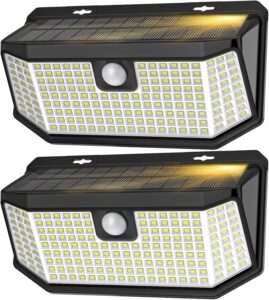
Of all the solar porch lights on this list, the AOOTEK 182 LED stands out for pure brightness. With 182 LED chips packed into a wide-angle panel head, this light floods a large porch or front walkway with more light than most competitors can match. It’s a motion-activated security light at heart, and it does that job extremely well.
The three-mode design gives you options: constant low light, motion-triggered bright light, or motion-triggered bright light with gradual dimming. Most homeowners use mode 3, which keeps the area subtly lit and bursts to full brightness when someone approaches. The motion sensor has a 120-degree detection angle and triggers from up to 26 feet away.
Installation is straightforward. One mounting bracket goes into the wall and the solar panel clips onto the bracket with a built-in swivel so you can angle it toward the sun independently from the light head. Charging takes about 6 to 8 hours of direct sun and provides 8 to 12 hours of illumination.
The IP65 weatherproof rating means rain, snow, and humidity won’t cause problems. This is a working light, not a decorative one, and it performs its security function night after night without requiring any attention.
Features
- 182 LED chips, 1200 lumens output
- 120-degree motion detection, 26-foot range
- Three lighting modes
- IP65 weatherproof rating
- Built-in rechargeable lithium battery
Pros:
- Exceptional brightness for the price
- Wide motion detection angle
- Easy independent panel angle adjustment
- Long detection range
Cons:
- Industrial look won’t suit all home styles
- No decorative appeal
2. Otdair Solar Porch Light Outdoor
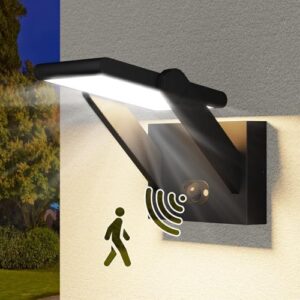
If you want something that looks like a traditional porch light but runs on solar power, the Otdair is one of the better-looking options in the category. The matte black finish and clean rectangular housing blend with modern and transitional home styles without looking out of place.
It runs in two modes: always-on dim mode all night, or motion-activated bright mode. The dim setting provides gentle ambient light, which is useful if you like to keep your porch visible without blinding passing neighbors. When the sensor detects motion, it ramps to full brightness for 30 seconds before returning to the dim setting.
The solar panel is integrated into the top of the fixture, so installation is just two screws into the wall. There’s no separate panel to mount and angle, which simplifies things considerably. This does mean the panel needs to be in a location that gets adequate direct sun, so it’s best suited for south or west-facing porches.
Battery performance is solid in most climates, holding enough charge through a full night of operation after a decent sunny day. In regions with limited winter sun, the dim mode helps stretch battery life.
Features
- Integrated top-mounted solar panel
- Two lighting modes (dim always-on, motion bright)
- Matte black weatherproof housing
- Simple two-screw wall installation
- Motion sensor with 30-second activation
Pros:
- Attractive traditional porch light appearance
- Simple no-separate-panel installation
- Dim always-on mode keeps area visible all night
Cons:
- Panel direction is fixed to wall orientation
- Less bright than standalone panel lights
- Best on south/west-facing walls only
3. LITOM 120 LED Solar Porch Light
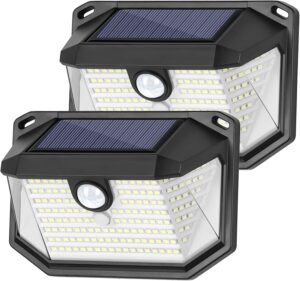
The LITOM 120 LED is a strong mid-range performer with a slightly smaller footprint than the AOOTEK but nearly as much brightness. It uses an upgraded PIR motion sensor that reduces false triggers from small animals while still catching human movement reliably at up to 26 feet.
Three modes cover most needs: motion-sensor only, dim-always-on with motion burst, or constant full brightness. The constant mode drains battery faster, but it’s useful if you’re hosting an outdoor gathering and don’t want the light clicking on and off all evening.
Build quality feels solid. The housing is ABS plastic with a polycarbonate lens, and it’s rated IP65. The mounting bracket allows the light head to pivot independently of the solar panel, which is genuinely useful if your optimal mounting position isn’t directly facing south.
At this price point, the LITOM represents solid value. It won’t impress anyone with its looks, but it’s reliable, bright enough for a standard porch, and holds up well through seasonal weather changes.
Features
- 120 LED chips
- IP65 weatherproof
- Three modes including constant brightness
- Upgraded PIR sensor, 26-foot range
- Adjustable solar panel angle
Pros:
- Good brightness at mid-range price
- Constant brightness mode for gatherings
- Reduced false triggers
Cons:
- Functional rather than attractive
- Constant mode uses battery quickly
4. Govee Solar Lantern Porch Light
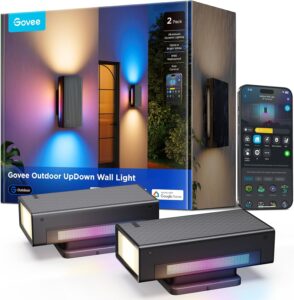
This is the one to buy if you want genuine decorative appeal without giving up function. Govee’s solar lantern-style porch light looks like a quality electric fixture from the curb, with a classic black lantern housing and warm amber LEDs that cast a welcoming glow rather than the harsh blue-white light of security-focused options.
It’s designed for decorative ambiance more than motion-triggered security. The light runs at a warm dim level throughout the night, automatically turning on at dusk and off at dawn. There’s no motion activation in this model, so it’s best paired with a separate security light if you need detection capability.
The integrated top-panel design means installation is just two screws into the wall. The warm 3000K color temperature works beautifully on covered porches and near entryways where you want to create atmosphere rather than floodlight the approach.
Battery life is genuinely good for a decorative light because the always-on dim setting uses relatively little power. Even in overcast conditions, most users report 8 or more hours of operation from a partial charge.
Features
- Classic lantern design, matte black finish
- Warm 3000K LED color temperature
- Dusk-to-dawn automatic operation
- Integrated top-mounted solar panel
- IP65 weatherproof
Pros:
- Beautiful decorative appearance
- Warm amber light creates welcoming atmosphere
- Reliable dusk-to-dawn operation
- Good battery life at dim setting
Cons:
- No motion sensing
- Not bright enough for security use
5. Jackyled Solar Porch Ceiling Light
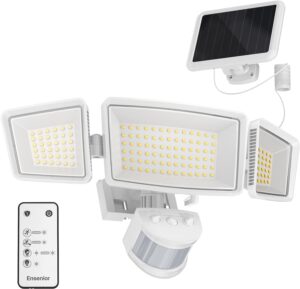
Most solar porch lights mount on walls, but the Jackyled is designed for ceilings, which makes it ideal for covered porches, carports, and pergolas where overhead lighting works better than wall-mounted fixtures. If you have a covered front porch and want to light it from above, this fills that niche.
It mounts flat against the ceiling and includes a separate solar panel on a 16-foot cable so the panel can be positioned in direct sun while the light hangs in the shade of your covered porch. This is exactly the right design for covered spaces where wall-mount panels would be in shadow.
The motion sensor detects movement within a 120-degree arc below the fixture, making it practical as both a safety light and a convenience light that turns on when you approach your door. Brightness is adequate for a porch ceiling application, roughly equivalent to a 40-watt incandescent in distributed coverage.
Build quality is decent for the price. The housing is plastic, but the remote solar panel is glass-covered and holds up well outdoors. This is a specialty product that solves a specific problem well.
Features
- Ceiling-mount design for covered porches
- 16-foot cable for remote solar panel placement
- 120-degree downward motion detection
- IP65 weatherproof housing
- Dusk-to-dawn auto on/off
Pros:
- Designed for covered porch ceilings
- Remote panel reaches sunny spots
- Good for carports and pergolas
Cons:
- Limited to ceiling-mount applications
- Plastic housing feels budget
6. BAXIA TECHNOLOGY Solar Porch Light
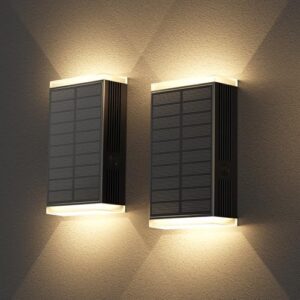
The BAXIA TECHNOLOGY solar light is the budget pick on this list, and for straightforward porch or pathway illumination, it gets the job done without costing much. You get a compact motion-sensing light with 28 LED chips, adequate for a small porch or side entrance.
Installation is tool-free, using an adhesive backing strip or two small screws. The light is light enough to stay put with adhesive on smooth painted surfaces, though screw mounting is more reliable long-term. Setup takes about two minutes.
Motion detection range is shorter than premium options, around 10 to 16 feet, and the 90-degree arc isn’t as wide as higher-end sensors. For a small, enclosed porch where you’re directly in front of the light, that’s fine. For a wide open entry area, you’d want something with wider detection.
It won’t impress anyone, but at this price, you can buy two or three and cover multiple spots around your home’s exterior for less than the cost of one mid-range fixture. That’s the appeal.
Features
- 28 LED chips
- Adhesive or screw mount
- Motion detection, 10-16 foot range
- IP65 weatherproof
- Automatic dusk-to-dawn sensor
Pros:
- Very affordable
- Tool-free adhesive installation
- Good for multiple small spots
Cons:
- Shorter detection range
- Less bright than premium options
- No aesthetic appeal
7. Davinci Solar Porch Wall Lantern
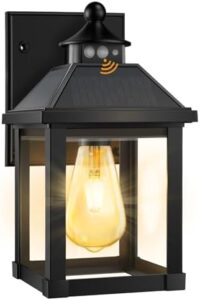
The Davinci is a premium decorative option for homeowners who want a solar porch light that genuinely looks like a quality electric fixture. The die-cast aluminum housing with seeded glass panels is a significant step up in material quality from plastic-bodied competitors, and it shows.
This is a dusk-to-dawn ambient light rather than a motion-triggered security fixture. The warm LED inside casts a soft, even glow through the seeded glass that looks excellent on brick, stone, or painted exteriors. It’s the kind of fixture that improves your home’s curb appeal rather than just adding function.
The solar panel is concealed in the top of the lantern, keeping the aesthetic clean. Battery life is strong because the warm LED runs at low wattage all night, and most users report consistent operation through multiple consecutive cloudy days before performance drops.
The price is higher than most options on this list, but the build quality and appearance justify it for homeowners who care about how their home looks after dark.
Features
- Die-cast aluminum housing with seeded glass
- Warm white LED, dusk-to-dawn operation
- Concealed integrated solar panel
- Weather-resistant metal construction
- Classic lantern design
Pros:
- Premium metal and glass construction
- Genuinely attractive curb appeal
- Strong battery life with low-power LED
- Looks like an electric fixture
Cons:
- Higher price point
- No motion sensing
8. URPOWER Solar Porch Light
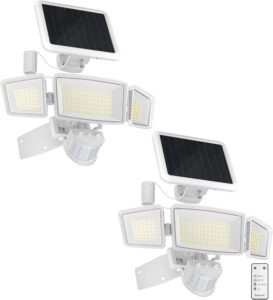
The URPOWER solar light is the most divisive pick on this list. It’s a capable motion-sensing light with reasonable brightness and solid weather resistance, but it’s been on the market long enough that newer designs have caught up with or surpassed it on most specs. Still, it has a loyal following because it’s consistently reliable and available at a fair price.
The 4-panel design (four small solar panels on a single head) absorbs sun from multiple angles, which gives it slightly better performance on partially shaded walls than single-panel designs. The motion sensor triggers from about 20 feet and stays on for around 30 seconds per activation.
Installation uses a single mounting bolt, making it one of the easiest to put up. The rotating head means you can aim the light precisely after mounting. For basic porch and pathway illumination, it delivers consistent results without fuss.
If you want something simple and proven, the URPOWER is a reasonable choice. Just know that newer options on this list offer more brightness and better features at similar prices.
Features
- Four-panel solar absorption design
- Motion sensor, 20-foot range
- Single-bolt mounting with rotating head
- IP64 weatherproof rating
- 30-second motion activation hold
Pros:
- Multi-panel design improves shaded charging
- Easy single-bolt installation
- Proven reliable over time
Cons:
- Newer options offer better specs
- IP64 vs IP65 on most competitors
- Dated design
Solar Porch Light Buying Guide
Porch Light Mounting Configurations: Wall, Ceiling, Post, and Pillar
Solar porch lights are sold in multiple mounting formats, and the right choice depends entirely on your porch architecture. Wall-mount lanterns attach directly to the exterior wall surface beside the door — the most common residential format, typically installed at eye level (6–7 feet) flanking the entry. Flush-mount or semi-flush ceiling lights hang from porch ceilings in covered entry areas, appropriate where the overhead space is enclosed. Post-top lights mount on freestanding or existing structural posts at porch corners. Pier or pillar lights attach to brick or stone entry columns using surface-mount brackets. For solar specifically, mounting position has an additional constraint: the solar panel must receive adequate sun, and the panel is usually integrated into or mounted near the light fixture. A covered porch that blocks direct sun from above — the most common scenario — often prevents sufficient panel charging for integrated-panel wall mounts. The workaround is to choose lights with a separate panel on a cable, mounted in a sunnier location, connected to the light on the covered porch. Understanding your porch’s sun exposure is the most critical step before selecting any solar porch light.
The Sun Problem: Why Most Covered Porches Challenge Solar Charging
The fundamental tension in solar porch lighting is architectural: most porches are covered, which is what makes them comfortable to use, but the roof overhang that provides shade also blocks direct sun from reaching a solar panel mounted on or near the light. A north-facing porch may receive less than 1 hour of direct sun daily on the panel, far below the 4–6 hours needed for reliable all-night operation. Before purchasing, assess your specific porch sun exposure: stand at the planned installation point at noon on a clear day and observe how much sky is visible. South-facing porches with a minimal overhang can work well with integrated panels. North-facing covered porches often cannot support solar lighting without a separately positioned panel. Remote panel designs — where the panel mounts on a south-facing roof section, fence post, or garden stake in full sun, connected to the porch light by a 10–20 foot cable — solve this problem at the cost of installation complexity. Lights marketed for “shaded” conditions typically compensate with larger batteries (providing buffer through low-charge days) rather than truly solving the charging problem, and they fail in extended cloudy periods.
Lumen Output for Porch and Entry Lighting
Porch lighting serves two simultaneous purposes: welcoming guests aesthetically and providing sufficient light for safe entry. These requirements translate to different lumen targets. For decorative ambiance in a covered porch seating area, 100–300 lumens per fixture creates pleasant illumination without glare. For functional entry lighting — seeing a door lock clearly, identifying visitors, safely navigating steps — 400–800 lumens is the practical minimum. Security-oriented porch lighting (motion-activated, designed to deter and illuminate intruders) needs 1,000–2,000 lumens. Porch size and ceiling height affect how light distributes: a 10-foot ceiling over a 6×8 foot entry benefits from a single centered 400-lumen ceiling fixture; a 9×12 foot wraparound porch needs two to four fixtures totaling 800–1,500 lumens for even coverage. A common mistake is buying decorative lanterns for a large porch and finding the coverage inadequate — pair decorative lanterns (100–200 lumens each) with brighter motion-activated flood lights for full-coverage security, letting the decorative fixtures handle ambiance and the security lights handle threat deterrence.
Motion Detection for Porch Applications
PIR motion detection on porch lights serves a different role than perimeter security lighting: on a covered porch, the detection zone is typically small (the immediate entry path) and activation should happen reliably when someone approaches the door. Detection range of 15–20 feet is appropriate — enough to activate as a visitor walks up the path, not so far that passing pedestrians trigger it constantly. Detection angle of 90–120 degrees captures movement from the front approach without excessive false triggers from side traffic. Adjustable sensitivity eliminates most small-animal activations while remaining reliably triggered by an approaching adult. The dim-standby-to-bright-on-motion mode works well for porch applications: the light stays on at low output (providing ambient illumination for the seating area), then jumps to full brightness when motion is detected. Timeout settings of 30–90 seconds are appropriate for porch use — long enough to unlock the door and enter, short enough to avoid leaving the light at full brightness all night on a busy street. For porches used frequently for outdoor dining and seating, the option to disable the motion sensor and run in continuous mode is useful.
Design Styles: Matching Your Porch Architecture
Porch lights are among the most visible exterior fixtures on a home — they’re at eye level at the main entry point, viewed daily by occupants and visitors. Design compatibility with the home’s architecture matters more here than almost anywhere else in solar outdoor lighting. Traditional colonial and craftsman homes pair naturally with lantern styles featuring clear or seeded glass panels, oil-rubbed bronze or matte black finishes, and visible frame construction. Contemporary and modern homes suit clean-lined cylindrical or rectangular fixtures with frosted glass diffusers and brushed nickel or matte black finishes. Farmhouse and rustic styles work with aged bronze, barn-light pendants, and Edison-style bulb aesthetics. Mediterranean and Spanish Colonial homes pair with wrought-iron lanterns with amber glass. Beyond style, scale matters: a small lantern (8-inch height) looks lost beside a standard 8-foot door; a fixture scaled to the door height (12–16 inch height) reads as properly proportioned. For paired flanking lights, both fixtures should be identical — mismatched pairs look accidental rather than designed. Check the fixture dimensions in product listings carefully; photos often make fixtures appear larger than they are.
Battery Capacity and All-Night Winter Runtime
Porch lights used for security or ambiance need to operate from dusk to dawn — potentially 14–15 hours on winter nights at northern latitudes. Battery capacity must cover this duration even after a short winter charging day. For continuous-on operation at 200 lumens (a typical porch ambiance level), a light consuming roughly 2W needs 30Wh of battery for a 15-hour winter night. A 3,000mAh LiFePO4 battery at 12V stores 36Wh — marginally adequate in full sun, inadequate if the panel is shaded. Quality porch lights designed for year-round operation include battery reserves for 2–3 nights of operation — meaning 60–90Wh of battery storage — paired with a panel large enough to recharge that bank from a typical winter day’s sun exposure. NiMH batteries (common in entry-level fixtures) lose 30–40% capacity in freezing temperatures, meaning a light rated for 12-hour runtime at 70°F may only run 7–8 hours at 20°F. For northern installations, LiFePO4 chemistry and generous battery-to-panel ratio are the specifications to prioritize over lumen output.
Weatherproofing for the Porch Environment
Covered porches protect fixtures from direct rain but not from humidity, wind-driven moisture, temperature cycling, insects, and UV radiation from morning and afternoon sun angles. IP44 is the minimum waterproof rating for covered porch use (splash-resistant from any direction). IP65 adds dust-tight construction and protection against low-pressure water jets — better for porches with wide eave openings that get direct rain in windstorms. In coastal environments, salt-air corrosion is the main durability concern: fixtures within 5 miles of saltwater need marine-grade stainless hardware and powder-coat finishes resistant to salt exposure. Insect intrusion into light housings is a consistent problem in warm climates — fixtures with tight glass seals and quality gaskets exclude insects that would otherwise nest in the housing and degrade the electronics. Check reviews for reports of insect intrusion, water infiltration, and lens fogging — these are the most common long-term failure modes for porch lights in high-humidity environments.
Price Tiers and What Each Level Buys
Solar porch lights range from $25 to $200+ per fixture, with distinct capability differences at each tier. Under $40 per fixture: basic wall lanterns with small integrated panels, NiMH batteries, limited runtime in winter, adequate for mild-climate secondary porches or decorative use on south-facing covered entries. $40–$80 per fixture: improved battery capacity, better IP ratings, motion sensor integration, longer warranties, and more design options — the sweet spot for most front-door applications in standard climates. $80–$120 per fixture: premium construction (cast aluminum or brass), larger separate panels, LiFePO4 batteries, reliable year-round operation including northern winters, multiple operating modes. $120–$200+ per fixture: architectural-grade fixtures matching hardwired quality, designer styles, smart home integration, maximum brightness and runtime — appropriate for high-visibility entry statements or properties where curb appeal is a priority. For most homes, the $50–$80 range delivers reliable performance and attractive design without the premium cost of architectural fixtures. Buy in matched pairs for flanking installations.
Frequently Asked Questions
It depends on mode and battery capacity. Motion-sensing lights (which stay off until triggered) can provide 8 to 12 hours of coverage on a full charge. Dusk-to-dawn always-on lights typically last 6 to 10 hours. In winter with shorter days and less sun, expect somewhat reduced performance.
They can, but performance depends entirely on how much sunlight the solar panel receives. Lights with integrated top-mounted panels need the wall itself to be in direct sun. Lights with separate adjustable panels can have the panel positioned in a sunny spot even if the light head is in shade. For covered porches, ceiling-mount models with remote panel cables are often the best solution.
IP64 means the fixture is protected against water splashing from any direction. IP65 adds protection against direct water jets. Both are suitable for typical porch use, but IP65 provides an extra margin of protection and is worth prioritizing for exposed locations that receive direct rain.
Yes, though performance drops in winter for two reasons: shorter days mean less charging time, and cold temperatures reduce lithium battery capacity slightly. Most solar porch lights still function in cold climates, they just may not run as long on cloudy winter nights. Motion-sensing mode helps because it conserves power by only activating when needed.
Minimal. Wiping the solar panel clean a few times per year removes dust and pollen that reduce charging efficiency. In areas with heavy tree coverage, panels may accumulate debris more quickly. The batteries in most models are sealed and non-replaceable, lasting 2 to 3 years before capacity noticeably degrades.
Warm white (2700-3500K) creates an inviting, atmospheric glow that most people prefer for a front porch. It looks more like traditional incandescent lighting. Cool white (5000-6500K) is brighter and better for security purposes but can feel harsh and clinical near an entryway. If you’re choosing just one light, warm white is generally more welcoming.
Summing Up
Solar porch lights work best when the panel gets unobstructed afternoon sun — a shaded porch ceiling often means the light will only perform well if the panel mounts separately on a nearby wall or eave. AOOTEK’s 182 LED model delivers the most light for the price and handles most porch installations well. If you want a more traditional aesthetic, the Govee lantern and Davinci metal lantern both look at home on craftsman and colonial-style porches.
If you’re also thinking about solar panels for your home, call (855) 427-0058 for a free quote — it takes just a few minutes to find out what installation would cost and save you in your area.
Updated