
Our blog is reader-supported. When you buy through links on our site, we may earn an affiliate commission. Thank you for your support!
A solar power bank lets you recharge your phone, tablet, or other devices anywhere the sun shines, with no outlet required. The best ones charge fast, hold a meaningful amount of power, and survive the bumps and weather of outdoor use. But solar panels add bulk and cost, and a cheap solar panel on an otherwise good power bank can make the whole product frustrating to use. Knowing which ones are worth buying takes some research.
We’ve looked at what’s currently available and selected eight solar power banks that deliver genuine value, from ultra-compact everyday options to high-capacity units for extended backcountry trips.
Our Top Picks
| Image | Name | |
|---|---|---|
| Anker PowerCore Solar 20000 | |
| BLAVOR Solar Power Bank 20000mAh | |
| Hiluckey Solar Charger 25000mAh | |
| ADDTOP Solar Power Bank 26800mAh | |
| BigBlue 3 USB Ports Solar Charger | |
| Feeke Solar Power Bank 10000mAh | |
| Dizaul Solar Charger 5000mAh | |
| iWALK Small Solar Power Bank 9000mAh |
8 Best Solar Power Banks
1. Anker PowerCore Solar 20000
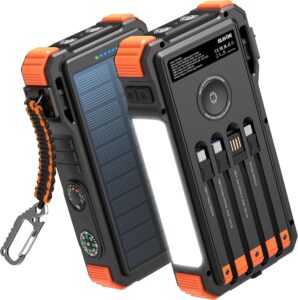
Anker’s reputation for build quality and battery reliability is well established, and the PowerCore Solar 20000 backs that reputation with a 20,000mAh capacity, fast charging output, and a solar panel that actually contributes meaningfully to charging rather than just existing as a marketing feature. The solar input reaches up to 700mAh under ideal conditions, which translates to roughly 50 hours of full sun to charge from empty via solar alone. That sounds long, but for topping off a unit that’s already mostly charged from a wall outlet, it works well on a daypack or roof of a tent.
The 18W USB-C Power Delivery output charges modern laptops and tablets at a useful rate, and the 12W USB-A port handles everything else. A built-in flashlight is a nice addition for camping use.
Build quality is excellent. The rubberized outer shell absorbs impacts and the whole unit has an IPX5 water resistance rating, which is sufficient for rain and splashes though not submersion. This is the power bank to buy if you want Anker’s quality assurance behind the solar panel branding.
For multi-day hiking or camping where you want to partially solar-supplement grid-charged capacity, it’s an excellent choice. Don’t expect solar to be your only charging source unless you have a lot of direct sun and patience.
Features
- 20,000mAh capacity
- 18W USB-C Power Delivery output
- Solar input up to 700mAh
- IPX5 water resistant
- Built-in LED flashlight
- Dual USB-A + USB-C output ports
Pros:
- Anker build quality and reliability
- Fast 18W USB-C output
- Decent solar contribution for supplemental use
- IPX5 water resistance
Cons:
- Solar charging alone takes a very long time
- Heavier than non-solar power banks at same capacity
2. BLAVOR Solar Power Bank 20000mAh
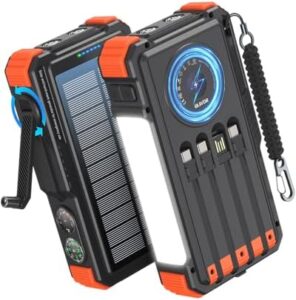
The BLAVOR is a feature-packed solar power bank that consistently ranks highly for the combination of wireless charging, high capacity, and decent solar panel performance. The 20,000mAh lithium polymer battery can charge a typical smartphone 4 to 5 times, and the wireless charging pad on the back charges Qi-compatible devices without cables, which is a convenience feature that few competitors at this price offer.
The two solar panels (front and back) produce better solar input than single-panel designs, and the micro-suction surface allows you to stick it to a smooth surface like a tent window for hands-free solar charging. The IP66 waterproof rating is genuinely impressive for the price, making it one of the more water-resistant options on this list.
Output includes USB-C PD, two standard USB-A ports, and the wireless pad simultaneously if needed. An SOS flashlight mode with strobe is a practical safety addition. The only trade-off is that all this capability adds weight and bulk, making it less ideal for ultralight travel.
If you want maximum features in a solar power bank and don’t mind the size, the BLAVOR is hard to beat for the money.
Features
- 20,000mAh capacity
- Wireless Qi charging output
- Dual solar panels (front and back)
- USB-C PD + dual USB-A outputs
- IP66 waterproof
- SOS flashlight with strobe mode
Pros:
- Wireless charging on top of wired outputs
- Dual solar panels improve charging
- IP66 waterproof rating
- SOS flashlight for emergency use
Cons:
- Bulkier and heavier than single-panel designs
- Wireless charging is slow
3. Hiluckey Solar Charger 25000mAh
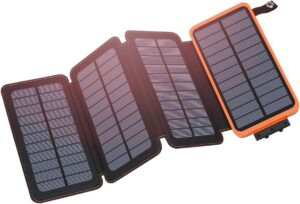
The Hiluckey Solar Charger earns its spot with the highest capacity on this list, 25,000mAh, and four solar panels that provide the best solar input of any consumer-grade power bank we’ve seen. Under good conditions, the quad-panel design can push 1.5 to 2W of solar input, which meaningfully reduces dependence on wall-outlet top-ups during multi-day outdoor trips.
The 25,000mAh capacity is enough to charge most smartphones 6 to 7 times. It has three USB-A outputs and one USB-C input, though the lack of USB-C output is a limitation for users with newer devices that expect fast USB-C charging. Most phones still charge fine via USB-A, but it’s worth knowing before buying.
The IPX5 water resistance and rubberized frame make it outdoor-durable. The four-panel array is larger than single-panel units but the extra solar surface area is functional, not decorative. If solar supplementation matters to you on extended trips, the quad panels make a real difference compared to single-panel competitors.
The trade-off is size and weight. This is one of the heavier options on the list. It lives comfortably in a pack but isn’t something you’d carry in a pocket.
Features
- 25,000mAh capacity
- Four solar panels for maximum input
- Three USB-A + one USB-C input
- IPX5 water resistant
- LED flashlight
- Carabiner clip included
Pros:
- Highest capacity on this list
- Four panels provide real solar input
- Three simultaneous USB-A outputs
Cons:
- No USB-C output
- Large and heavy
4. ADDTOP Solar Power Bank 26800mAh
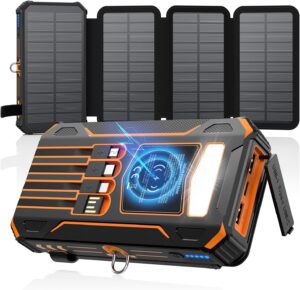
The ADDTOP pushes capacity even further, to 26,800mAh, which is about as high as you’ll find in consumer solar power bank designs without crossing into generator territory. For a group of campers sharing one power bank, or for charging a tablet multiple times, the capacity gives you real headroom.
It charges via solar, micro-USB, or USB-C, which gives you input flexibility in different situations. Two USB-A outputs and one USB-C output cover most device types. The solar input is a single panel and produces around 800mAh under ideal conditions, so it’s best used as a supplement to wall charging rather than a primary source.
The drop-resistant rubber housing and IP65 waterproofing give it solid outdoor credentials. An integrated LED flashlight rounds out the feature set. At this capacity, the ADDTOP is a solid pick for base camp use where weight is less of a concern than having enough power to keep multiple devices going over several days.
It’s a chunky unit. Don’t buy this for day hiking where you want to travel light. It’s a camp-stay and car-camping power bank, not a trail power bank.
Features
- 26,800mAh capacity
- Tri-input: solar, micro-USB, USB-C
- USB-A x2 and USB-C output
- IP65 waterproof
- Drop-resistant rubber housing
Pros:
- Very high capacity for groups or extended trips
- Multiple input options including USB-C
- IP65 waterproof and drop resistant
Cons:
- Single solar panel limits solar input
- Heavy for hiking use
5. BigBlue 3 USB Ports Solar Charger
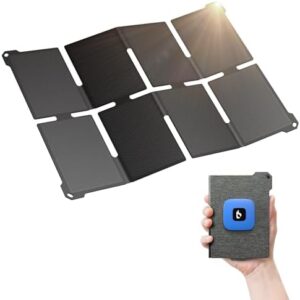
The BigBlue is different from the others on this list. It’s not a power bank. It’s a direct solar panel charger with no internal battery, designed to charge your devices directly from the sun while you’re stationary. You hook your phone to it, set it in the sun, and it charges as fast as the sun allows.
The advantage of this design is weight and simplicity. At 21 watts of solar output, it charges phones fast on a sunny day, comparable to a standard wall outlet. There’s no heavy battery to carry, which makes it the ultralight choice for activities where you can stay in the sun while charging.
It folds into a compact panel sleeve and clips to a pack with the included carabiner. Three USB ports charge multiple devices simultaneously. A built-in ammeter shows you actual charging current so you can optimize panel angle.
The limitation is obvious: no battery means no charge stored. If you need power after dark or during overcast stretches, you need a separate battery. It’s a companion product for solar storage, not a standalone solution.
Features
- 21W direct solar output (no internal battery)
- Three USB-A ports
- Foldable panel design, carabiner clip
- Built-in ammeter for panel optimization
- Lightweight at 21 ounces
Pros:
- Fast direct solar charging (no battery inefficiency)
- Lightest option on this list
- Three simultaneous charging ports
Cons:
- No internal battery — can’t charge after dark
- Only works in direct sun
6. Feeke Solar Power Bank 10000mAh
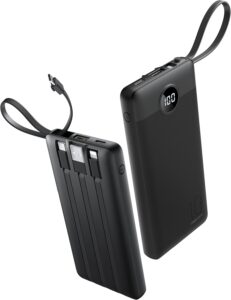
The Feeke is the compact choice on this list. At 10,000mAh, it’s half the capacity of most other options here, but it’s also significantly lighter and easier to carry in a jacket pocket or small bag. For a day hike or weekend trip where you mostly need to top off one phone, the 10,000mAh capacity is often plenty.
The single solar panel is appropriately sized for the smaller unit, and the IP67 waterproof rating is actually higher than many larger competitors. The USB-C output charges modern phones at a reasonable rate, and the standard USB-A handles everything else.
It’s honestly better looking than most solar power banks, with a compact rectangular form factor that doesn’t look conspicuously outdoor-gear. Battery LED indicators show remaining charge clearly. For everyday carry with occasional solar supplementation, this size class makes more practical sense than lugging a 20,000mAh unit.
For week-long trips where you need to charge multiple devices repeatedly, step up to a larger capacity. But for most day-to-day outdoor use, the Feeke hits a nice balance of portability and capability.
Features
- 10,000mAh capacity
- IP67 waterproof
- USB-C + USB-A outputs
- Compact pocket-friendly size
- LED battery indicator
Pros:
- Compact and lightweight
- IP67 waterproof (higher than many competitors)
- Good for everyday carry
Cons:
- Lower capacity than most on this list
- Single solar panel limits supplemental charging
7. Dizaul Solar Charger 5000mAh
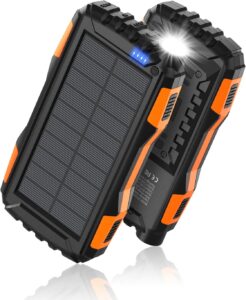
The Dizaul is the ultra-compact option, a 5,000mAh solar power bank small enough to fit in a shirt pocket. It charges one smartphone once, which sounds limiting until you realize most people’s biggest fear is losing their last 20 percent of battery, not needing five full charges. As an emergency backup that clips to a keyring or bag, the Dizaul is genuinely useful.
The solar panel charges the battery slowly, but that’s the trade-off for the small form factor. Clip it to the outside of a bag on a sunny day and you’ll pick up enough charge for an emergency top-off. It’s not designed for serious power needs, but it earns its place as a lightweight emergency device.
The IP65 rating and rugged outer casing make it more weather-resistant than its diminutive size might suggest. For hikers who want an absolute minimum weight emergency option, the Dizaul makes sense.
Features
- 5,000mAh capacity
- Ultra-compact pocket size
- IP65 weatherproof
- Single USB-A output
- Carabiner attachment point
Pros:
- Ultra-compact and lightweight
- Good emergency backup option
- IP65 weatherproof
Cons:
- Only one full phone charge
- Very slow solar charging
- Single USB-A only
8. iWALK Small Solar Power Bank 9000mAh
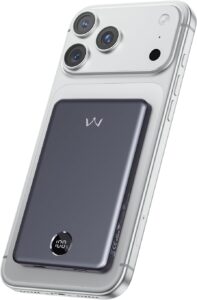
The iWALK fills a niche: a compact solar power bank with a built-in lightning connector for iPhone users, eliminating the cable entirely for Apple device charging. If you exclusively use iPhones and want the most convenient possible solution, plugging your phone directly into the power bank without any cable is genuinely useful.
The 9000mAh capacity is enough for two to three phone charges. Solar input is modest, typical for this size class, but the integrated lightning plug is the actual selling point. Android users have no reason to choose this over other options, but iPhone users who forget cables regularly will appreciate it.
Build quality is decent. The compact form factor is similar to the Feeke but with the added value of the built-in connector. If the built-in plug doesn’t apply to your devices, look elsewhere on this list.
Features
- 9,000mAh capacity
- Built-in lightning connector for iPhone
- USB-A output port
- Solar charging panel
- Compact form factor
Pros:
- Built-in lightning plug eliminates cables for iPhone users
- Compact size
- Simple operation
Cons:
- Only useful for iPhone users
- No USB-C output
- Modest capacity
Solar Power Bank Buying Guide
Solar Panel vs. Built-In Battery: How Solar Power Banks Actually Work
Solar power banks are fundamentally battery packs — the battery inside does the real work of storing and delivering power to your devices. The solar panel supplements the battery by adding charge during daylight hours, but it does not directly power your phone in real time. This distinction matters for accurate expectations: a 10,000mAh solar power bank in bright sun with a 2W panel generates roughly 0.4–0.6W of usable charging current — enough to add about 200–300mAh per hour to the battery in full sun. That same battery, charged via USB-C from a wall adapter at 18W, fills in 2–3 hours. Solar charging is a long-term trickle, not a rapid charge — it takes a full sunny day to add 2,000–3,000mAh to the battery from solar input. The practical value of the solar panel is extending your charge between wall-outlet top-ups during multi-day outdoor adventures, not replacing wall charging entirely. Anyone expecting the solar panel to rapidly charge a fully depleted battery will be disappointed. The solar input is a meaningful supplement during extended off-grid use; for occasional outdoor day trips, the battery capacity matters far more than the solar panel wattage.
Battery Capacity: How Many Charges You Get per Fill
Battery capacity (mAh) is the primary specification for a power bank, determining how many device charges the bank provides per fill. A typical iPhone 15 battery holds 3,279mAh; a Samsung Galaxy S24 holds 4,000mAh. A 10,000mAh power bank delivers approximately 2.5–3 phone charges after accounting for 20–25% energy losses from conversion, heat, and wiring. A 20,000mAh bank provides 5–6 phone charges. For capacity selection: day hikers who want one emergency charge for their phone need 5,000–10,000mAh; backpackers spending multiple days without electricity typically need 20,000–30,000mAh. Charging tablets requires proportionally more capacity — an iPad Air battery holds approximately 7,600mAh, so a 10,000mAh bank provides only one tablet charge. For powering cameras, GPS devices, and multiple phones simultaneously over 3–5 days of backcountry use, 20,000–30,000mAh is the practical minimum. Heavier, larger batteries trade portability for capacity — the right balance depends on the specific trip profile.
Solar Panel Wattage and Realistic Daily Solar Input
Solar power bank panels range from 1W to 10W+, and the difference in real-world charging performance is significant. A 1.5W panel in full sun charges at approximately 0.5W actual (panels rarely achieve rated output in real conditions due to temperature, angle, and irradiance variation), adding roughly 100–150mAh per hour. Over an 8-hour hiking day, that’s 800–1,200mAh — meaningful for extending the bank’s life but not game-changing on its own. A 5W panel at similar efficiency adds 300–400mAh per hour and 2,400–3,200mAh per hiking day — substantially more useful. Ten-watt panels on multi-panel foldable banks can realistically add 4,000–6,000mAh per day in excellent conditions, which begins to offset daily smartphone usage. The practical takeaway: single-panel power banks (1–3W) slow depletion meaningfully over multi-day trips; multi-panel foldable banks (5W+) can approach energy-neutral balance for smartphone users on long expeditions. For tablet and laptop charging, no portable solar bank has a large enough panel to offset those devices’ consumption.
Output Ports and Charging Speed for Your Devices
Modern power banks must charge multiple device types at appropriate speeds. USB-A ports at 5V/2.4A (12W) charge older Android phones and accessories at standard speed. USB-C ports with Power Delivery (PD) support are essential for fast-charging modern iPhones, Android phones, tablets, and laptops — PD at 18W charges most phones in 1.5–2 hours versus 3+ hours at standard 5W. PD at 45W or 65W is required for laptop charging. Wireless charging (Qi) is a convenience feature available on premium models — it’s slower than wired but eliminates cable management at camp. For multi-device households or groups, look for banks with simultaneous multi-port charging at rated speeds: some banks throttle all ports when multiple devices are connected, reducing the charging speed for each device. Verify that your specific fast-charging protocol is supported: Apple Fast Charge, Samsung Super Fast Charge, and Qualcomm Quick Charge all have different implementation requirements — check that your phone’s protocol is listed in the power bank specifications.
Durability: IP Rating, Drop Resistance, and Outdoor Construction
A solar power bank used outdoors faces rain, dust, mechanical shock from drops and pack compression, and temperature extremes. The minimum IP rating for outdoor use is IP64 (dust-tight, splash-resistant); IP67 or IP68 provides meaningful waterproofing for kayaking, beach use, or heavy rain. Drop-resistance ratings (typically 4–6 feet onto concrete) indicate whether the housing and internal components survive the most common outdoor failure event. Rubberized housing or corner bumpers provide drop protection without adding significant weight. Temperature range matters for battery performance: lithium batteries lose 20–30% capacity below 32°F — a 10,000mAh bank in freezing conditions may deliver only 7,000–8,000mAh. Keep the power bank in an inner pocket close to body heat when temperatures drop significantly to maintain capacity. For extreme cold (below 14°F/-10°C), consider power banks using LiFePO4 chemistry, which maintains better low-temperature performance than standard lithium-ion. Sand and dust ingress into USB ports is a common failure mode — port covers (silicone plugs) protect against this during active outdoor use.
Weight and Portability Tradeoffs
Solar power bank weight varies from 8 oz (227g) for a compact 10,000mAh single-panel unit to 24+ oz (680g) for a 25,000mAh multi-panel unit. For backpacking, where every ounce matters, the weight cost of a solar power bank versus a standard power bank of the same capacity is the weight of the solar panel and ruggedized housing — typically 2–5 oz (57–142g). This is a reasonable tradeoff for trips of 3+ days without power access. For car camping and day hiking, weight is less critical and higher capacity is more practical. The physical size also matters: bulky multi-panel banks don’t fit conveniently in hip belt pockets or small daypacks. Before purchasing, check the dimensions alongside the capacity and weight to verify the bank fits your carry system. Clip-on loops or carabiner attachment points allow hanging the bank on a pack exterior for solar charging while hiking — verify the attachment point can support the bank’s weight (important for heavier units).
Charging Time: Wall vs. Solar Input
Charging the power bank itself — not just using it — is a key consideration for frequent users. Wall charging via USB-C PD is by far the fastest method: a 20,000mAh bank charges in 4–6 hours via a 45W USB-C PD adapter, ready for the next trip. Solar-only charging of the same bank takes 30–50 hours in good sun conditions with a 2W panel — not practical for anyone who needs the bank topped off between trips. This confirms that solar power banks are best used with a baseline full charge from the wall, with solar extending that charge during the trip. Banks that support pass-through charging (using the bank to charge a device while simultaneously charging the bank from solar or wall) are more versatile — you can keep devices topped up during the day from solar input even as the bank’s own reserve is being drawn down. Confirm whether pass-through charging is supported and whether it causes battery degradation over time, as some designs discourage pass-through to protect battery longevity.
Budget Tiers and What Each Level Offers
Solar power banks span a price range from under $20 to over $120, with the tiers representing genuine quality differences. Under $25: 5,000–10,000mAh capacity, 1–2W single panel, standard USB-A output, basic waterproofing, NiMH or standard Li-ion cells — adequate for occasional day hike use where the solar feature is a nice-to-have rather than relied-upon. $25–$50: 10,000–20,000mAh, 3–5W panels, USB-C output (often with basic fast charging), IP65+ waterproofing, drop-resistant housing — the best value tier for regular outdoor use with genuine dependence on solar top-up. $50–$80: 20,000–30,000mAh, 5–10W multi-panel foldable design, USB-C PD fast charging at 18W+, IP67+ waterproofing, robust construction — appropriate for multi-day backpacking and extended off-grid expeditions. Over $80: maximum capacity, dual USB-C PD, wireless charging, LCD displays, multi-panel designs with higher solar wattage — premium features for dedicated outdoor users and travelers. The $25–$50 range offers the best performance-per-dollar for the majority of hiking and travel use cases.
Frequently Asked Questions
Much longer than most buyers expect. A 20,000mAh solar power bank with a single small panel takes 50 to 100 hours of direct sunlight to charge from empty. In practice, solar panels on power banks are best used to slow discharge during outdoor activities, not to fully charge a dead battery. Always charge from a wall outlet before heading out.
Only if the power bank has USB-C Power Delivery (PD) output and sufficient capacity. Most laptops require 45 to 65 watts for charging, but a 20,000mAh power bank with 18W PD can still provide a meaningful top-up to a partially depleted laptop. Don’t expect to run a laptop on a power bank continuously, but a partial charge during a work session is achievable.
Plan for about 15 percent of capacity per phone per day, accounting for conversion losses. For one phone over 7 days, a 15,000 to 20,000mAh bank is a comfortable margin. For two phones or if you also charge earbuds, headlamps, or other devices, 25,000mAh or two separate banks is safer. Solar supplementation helps but shouldn’t be factored into your capacity planning.
Prolonged exposure to very high heat can degrade lithium battery performance over time. In moderate outdoor temperatures, solar charging is fine. Avoid leaving the power bank in direct sun inside a closed car on a hot day, where temperatures can reach 140°F or more. Clip it to the outside of your pack in the open air rather than sealing it in a hot tent.
For the battery and electronics, yes. The difference between a reputable brand like Anker and an unbranded alternative is meaningful in terms of actual battery capacity (some cheap units understate specs significantly), charging speed, and longevity. For the solar panel itself, the differences are smaller because all consumer-grade solar panels are limited in size. Spend on a quality battery from a known brand.
Summing Up
Solar power banks are best used as emergency backup and supplemental charging on the go — the solar panel tops up the internal battery over a day of outdoor activity, adding 15–30% charge in a full day of sun. They’re not a replacement for wall charging. The Anker PowerCore Solar and Hiluckey 25000mAh are the most reliable picks for capacity and panel quality. If ultralight portability matters more, the iWALK 9000mAh slips into a jacket pocket while still giving you a full phone charge.
If you’re also thinking about solar panels for your home, call (855) 427-0058 for a free quote — it takes just a few minutes to find out what installation would cost and save you in your area.
Updated