

Our blog is reader-supported. When you buy through links on our site, we may earn an affiliate commission. Thank you for your support!
The best solar powered fan in 2026 is the DBF 18″ Solar Powered Fan — a high-output floor fan with a 40W solar panel and 30,000mAh battery that delivers all-day cooling without ever touching the grid. But “solar powered fan” actually covers two very different products: personal cooling fans (for patios, camping, and workspaces) and ventilation fans (for sheds, greenhouses, chicken coops, and attics). Choosing the wrong type is the most common mistake we see. This guide covers both, so you can match the right fan to your actual situation.
We’ve reviewed eight solar fans across both categories — four portable models for personal cooling and four ventilation fans for enclosed spaces. Whether you need to cool yourself on a hot patio or keep your greenhouse from cooking in July, one of these picks will handle it.
Our Top Picks
| PRODUCT IMAGE | PRODUCT | PRICE |
|---|---|---|
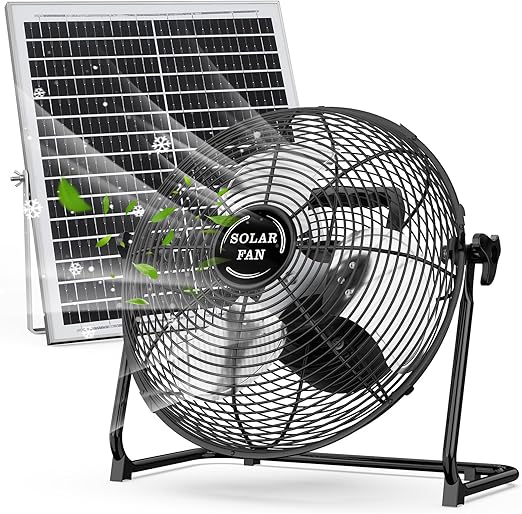 | DBF 18" Solar Powered Fan Large 18-inch solar floor fan for all-day outdoor cooling. Runs directly off a solar panel — no battery needed in full sun. Three-speed, tilt-adjustable head, IP44 splash-resistant. | CHECK PRICE |
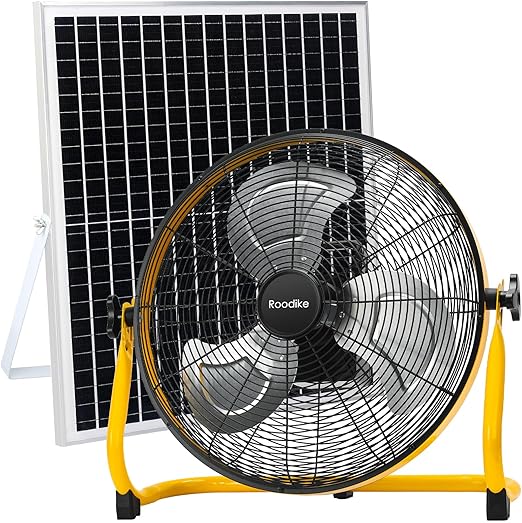 | Roodike 16" Solar Rechargeable Floor Fan Mid-size 16-inch fan with built-in LiFePO4 battery bank — run on solar, battery, or USB-C. 3 speeds, oscillation, 12+ hr runtime on a full charge. Ideal for patios and workshops. | CHECK PRICE |
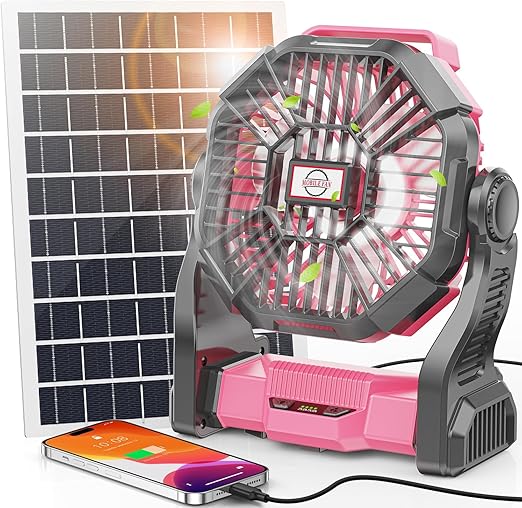 | 30,000mAh Solar Fan with LED Lantern Dual-purpose camping fan and lantern with 30,000mAh built-in battery. Charges via solar or USB-C. 360° rotation, 3 speeds, 4 LED brightness modes. Great for tents and off-grid use. | CHECK PRICE |
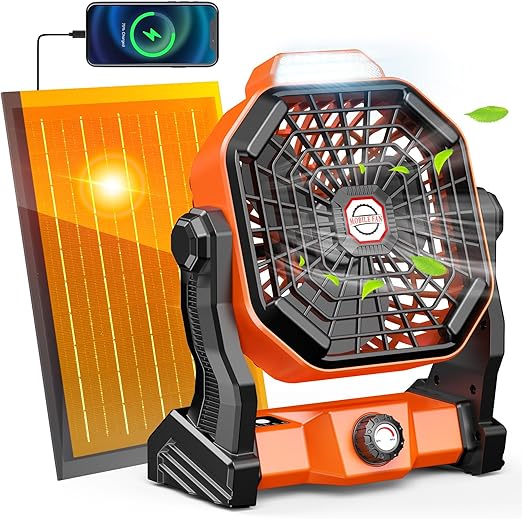 | Rechargeable Solar Camping Fan 8" Compact 8-inch portable fan with integrated solar panel on the handle. Lightweight at under 1 lb. Clip or stand mount. Runs 4–8 hours per charge, charges fully in 4–6 hours of direct sun. | CHECK PRICE |
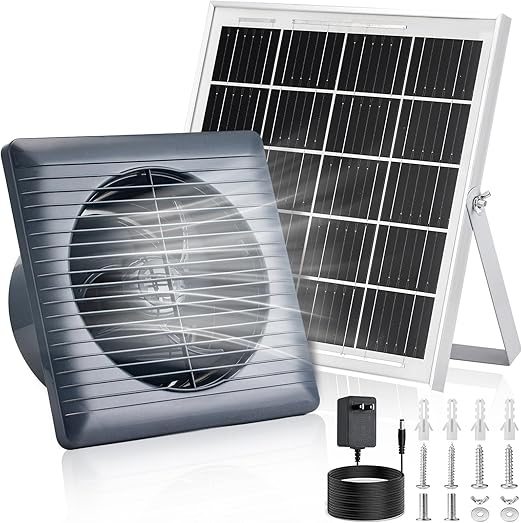 | Prozilon Solar Exhaust Fan Ventilation exhaust fan designed for sheds, attics, and crawl spaces. Mounts in a wall or roof vent. Runs whenever sun hits the panel — no wiring or switch needed. 10-year panel warranty. | CHECK PRICE |
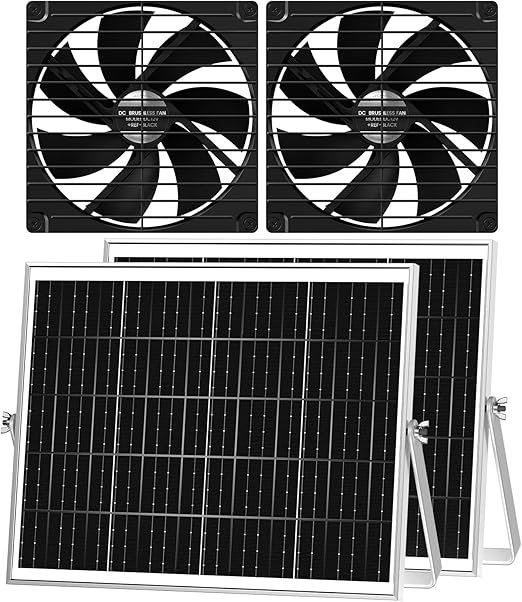 | PQINS Solar Greenhouse Fan 2-Pack Set of two solar intake/exhaust fans sized for greenhouses and cold frames. Dual thermostat control: runs automatically when temperature rises. No wiring required, IP54 weatherproof. | CHECK PRICE |
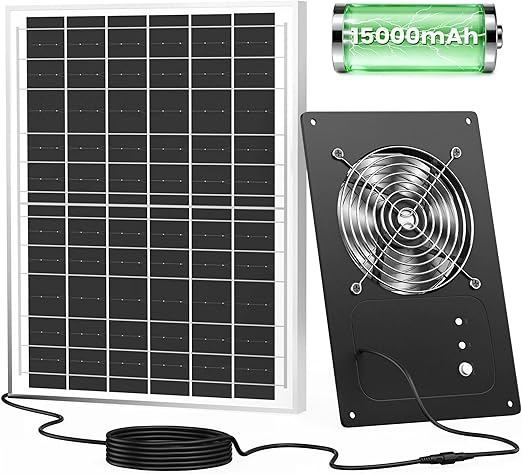 | Dstana Solar Coop Fan with Battery Solar fan built for chicken coops — mounts inside or outside, battery backup keeps it running through cloudy days. Adjustable thermostat triggers fan at user-set temperature. | CHECK PRICE |
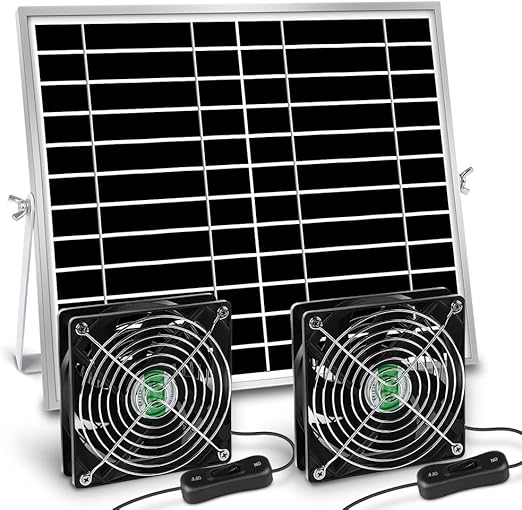 | Erifyng Solar Powered Fan for Sheds & Garages Versatile wall-mount solar ventilation fan for sheds, garages, RV compartments, and outbuildings. Direct solar power, no battery. 10W panel included, 12V DC motor, easy install. | CHECK PRICE |
8 Best Solar Powered Fans for 2026
Best Personal & Portable Solar Fans
1. DBF 18″ Solar Powered Fan — Best All-Day Outdoor Cooling
The DBF 18″ is the solar fan to buy if you need serious, all-day outdoor cooling. The 40-watt monocrystalline panel — larger than anything else on this list — charges a 30,000mAh battery that keeps the 18-inch blade spinning from morning through evening without a top-up. At full charge, expect 12–16 hours at low speed or 6–8 hours at high speed, which is enough to run through a full outdoor work shift or a weekend camping stay without babysitting a charge level.
The 18-inch blade diameter moves noticeably more air than 12–16 inch competitors — if you’ve stood in front of a box fan versus a large floor fan, you’ll understand the difference immediately. Multiple speed settings and an oscillation mode distribute airflow across a patio or covered workspace rather than concentrating it in one direction. The handle-and-wheel design makes it genuinely portable without being awkward to move.
The honest trade-off is size and weight. This is not a fan you’ll toss in a daypack. But for anywhere you can drive or carry it — patio, jobsite, garage, campsite — nothing else on this list moves as much air as long as the DBF 18″.
Pros: 30,000mAh battery covers all-day use, 18″ blade for maximum airflow, 40W panel charges faster than smaller panels.
Cons: Heavier than compact models, not ideal for backpacking.
2. Roodike 16″ Solar Rechargeable Floor Fan — Best Mid-Size Pick
The Roodike 16″ hits the sweet spot between portability and power. Its 16-inch blade and mid-capacity battery deliver strong airflow for a 200–300 sq ft patio or covered porch, and the lighter build makes it easier to move between a backyard and a campsite than the larger DBF. Remote control and multiple speed modes give you convenient adjustment without walking over to the unit.
The detachable solar panel with a long cable lets you mount the panel in the sunniest spot while keeping the fan positioned where you actually need airflow — a practical advantage in shaded patios where the seating area doesn’t get direct sun. Charge time from the solar panel is 8–10 hours of full sun for a complete charge, which is typical for this power class.
Pros: More portable than 18″ models, remote control included, detachable panel with long cable, good mid-range airflow.
Cons: Smaller battery than DBF 18″, less airflow than larger models.
3. 30,000mAh Solar Fan with LED Lantern — Best for Camping
This is the camping-optimized pick — a battery-backed solar fan that doubles as an LED lantern, solving two problems at once for tent campers and RV users. The 30,000mAh battery runs the fan overnight on a single day’s solar charge, and the built-in LED ring light (adjustable brightness) replaces a separate camp lantern. For backpackers and family campers, eliminating one device from the gear list matters.
The compact, foldable design packs more efficiently than floor-standing models, and the hanging hook lets you suspend it from a tent ridgeline or RV ceiling rather than needing floor space. Runtime at low fan speed averages 20+ hours, with the LED running simultaneously extending that to a more moderate 10–14 hours depending on brightness.
Pros: Fan + lantern combo, 30,000mAh for overnight use, hanging hook, compact foldable design.
Cons: Lower CFM than floor fans, not suited for large open spaces.
4. Rechargeable Solar Camping Fan 8″ — Best Compact Portable
When portability is the priority, the 8-inch camping fan is the right tool. Its compact size fits in a backpack side pocket, the integrated solar panel folds flat for packing, and it weighs less than most water bottles when empty. Runtime from the smaller battery is more modest — typically 4–8 hours depending on speed — but for personal cooling in a tent or on a beach chair, it’s exactly what you need.
Multiple mounting options (desk stand, hanging hook, belt clip on some models) give you flexibility in how you position it. The USB-C charging port lets you top it up from a power bank on cloudless days when the small integrated panel isn’t sufficient. Best used for personal cooling in close proximity rather than circulating air through a large space.
Pros: Ultraportable, fits in a backpack, multiple mounting positions, USB-C charging backup.
Cons: Limited airflow by design, shorter battery life than larger models.
Best Solar Ventilation Fans (Sheds, Coops, Greenhouses & Attics)
Ventilation fans solve a different problem: moving stale, hot air out of an enclosed space — not cooling a person directly. These are the right choice for sheds, workshops, greenhouses, chicken coops, and attic spaces where heat buildup damages equipment, kills plants, or harms animals. They run whenever the sun shines, which is exactly when enclosed spaces get dangerously hot.
5. Prozilon Solar Exhaust Fan — Best for Sheds & Small Attics
The Prozilon Solar Exhaust Fan is a direct-drive unit powered by a 25W solar panel — meaning it runs automatically whenever sunlight hits the panel, with no battery to maintain or charge. For shed and small attic ventilation, this is ideal: the fan runs hardest on hot, sunny days when it’s needed most and shuts off at night when temperatures naturally drop.
Designed for wall or gable-end mounting, it pulls hot air out of the space while cooler air enters through vents or gaps. Adequate ventilation rate for sheds up to 400–600 sq ft depending on ceiling height. The waterproof housing and panel make it fully outdoor-installable without additional weatherproofing. Installation is straightforward: mount the fan, mount the panel, connect the cable.
Pros: Direct-drive (runs automatically in sun), no battery to replace, weatherproof, easy installation, low maintenance.
Cons: No operation after dark, output varies with cloud cover.
6. PQINS Solar Greenhouse Fan 2-Pack — Best for Greenhouses
Greenhouses need airflow from two directions — intake and exhaust — to properly regulate temperature and CO₂. The PQINS 2-pack is designed exactly for this: mount one fan near the base as an intake and one near the peak as an exhaust, and you get genuine air exchange rather than just recirculation. Most single-fan units miss this entirely.
Each 7.1-inch fan is direct-drive from the shared 15W solar panel, giving you automatic operation that peaks exactly when greenhouse temperatures peak. Fits standard greenhouse mounting holes and connects easily to the included panel. Effective for greenhouses up to 200–250 sq ft or as supplemental airflow in larger spaces.
Pros: 2-pack enables proper intake/exhaust airflow, automatic solar operation, fits standard greenhouse mounts.
Cons: No battery backup, limited to daytime operation, smaller than professional ventilation systems.
7. Dstana Solar Coop Fan with Battery — Best for Chicken Coops
Chicken coops need ventilation after dark as well as during the day — birds rest at night but still produce heat and moisture that ammonia from droppings worsens without airflow. The Dstana sets itself apart from basic direct-drive ventilation fans by including a battery, so it continues operating overnight even after the solar panel stops generating power.
The adjustable bracket lets you position the fan at the optimal height for coop ventilation, and the durable build handles the humidity and dust typical of poultry environments. Works equally well for rabbit hutches, dog kennels, and other small animal shelters where 24-hour air movement matters for animal health.
Pros: Battery-backed for nighttime operation, adjustable mounting, humidity-resistant, good for animals that need 24-hr airflow.
Cons: Battery capacity limited vs large portable fans, small coverage area.
8. Erifyng Solar Powered Fan for Sheds & Garages — Most Versatile
The Erifyng is the most versatile ventilation pick: flexible enough for shed exhaust, garage walls, RV vents, or coop airflow, with a mounting system that fits most standard vent openings. The fan comes with a thermostat-controlled mode on select configurations, so it only runs when temperature exceeds your set threshold — useful for automated shed protection without wasting battery.
Multiple airflow modes (intake or exhaust) let you reverse the fan direction based on your ventilation strategy. The low noise profile makes it less disruptive near animal shelters or home garages where people spend time. A solid all-around pick if you’re unsure exactly which ventilation product fits your specific space.
Pros: Reversible intake/exhaust, fits multiple space types, quiet operation, thermostat-compatible.
Cons: Jack of all trades — dedicated greenhouse or coop fans may perform better in those specific environments.
Solar Powered Fan Buying Guide
Fan Types and Their Applications: Attic, Portable, and Gable
Solar-powered fans serve distinctly different purposes depending on the installation context, and the product categories are not interchangeable. Attic fans — mounted on the roof deck or gable end — exhaust hot air from the attic space, typically reducing attic temperatures by 20–40°F and reducing the load on air conditioning in the living space below. They’re fixed installations with high airflow requirements (1,000–1,600+ CFM) and benefit from solar power because they’re most needed when the sun is strongest. Gable fans mount in the existing gable vent opening, avoiding any roof penetration, and are simpler to install than roof deck units. Portable solar fans are smaller table-top or clip-on units designed for personal cooling in outdoor spaces — patios, workshops, boat cockpits, camping — with airflow in the 200–500 CFM range. They’re not substitutes for attic ventilation; they’re personal comfort devices. Whole-house solar exhaust fans are a hybrid category: large-capacity fans that ventilate an entire home via a ceiling-mounted unit, best suited for mild climates where mechanical air conditioning isn’t required. Clarifying which application you need before shopping prevents buying a product optimized for the wrong use case.
CFM Rating: How to Calculate the Right Ventilation Capacity
Cubic feet per minute (CFM) is the primary sizing metric for solar attic and ventilation fans. The standard recommendation for attic ventilation is 1 CFM per square foot of attic floor space, assuming typical pitch and insulation. A 1,500 square foot attic requires 1,500 CFM of ventilation — achieved by one high-capacity unit (1,500–1,750 CFM) or two medium units (750–900 CFM each). For steeper roofs (above 6:12 pitch) or dark roofing materials that absorb more heat, increase the CFM calculation by 15–20%. Natural ventilation through ridge and soffit vents works alongside powered attic ventilators; the fan supplements passive airflow rather than replacing it. For portable personal cooling fans, CFM matters less than airflow direction and oscillation — higher CFM in a wide oscillating pattern covers more outdoor space effectively. Always check measured CFM in independent reviews rather than relying on manufacturer specs, which often test at zero static pressure (no restriction) — real-world performance through vent openings is lower.
Solar Panel Wattage and Thermostat Integration
Solar attic fans typically include panels ranging from 10W to 35W. Panel size determines maximum airflow capacity and charging reserve in low-sun conditions. A well-designed unit with a 25W panel and 1,500 CFM motor operates effectively with 4+ peak sun hours per day — sufficient for most US locations during summer months when attic cooling is most needed. Thermostat and humidistat integration is a significant upgrade: thermostats activate the fan only when attic temperature exceeds a set threshold (typically 80°F/27°C), preventing the fan from drawing conditioned air from the living space during cool nights or on cold days. Humidistats protect against winter moisture accumulation in the attic — moisture from cooking and bathing migrates upward and can cause mold and structural damage without adequate ventilation. Units with both thermostat and humidistat control are the correct choice for four-season climates; thermostat-only is adequate in dry climates with mild winters.
Installation Requirements: Roof Type Compatibility and Weatherproofing
Solar attic fan installation varies significantly in complexity depending on roof material. Asphalt shingle roofs are the easiest installation surface — the fan curb mounts over a cut hole in the decking, with shingles woven around the flashing for a weathertight seal. Metal roofs require specialized mounting hardware and sealants compatible with the metal profile; improper installation causes leaks that may not appear until months later. Tile (clay or concrete) roofs require removing tiles, mounting on the substrate, and reseating tiles around the unit — a job better left to experienced roofers. Flat roofs use curb mounts with waterproof membrane around the base. Gable fans avoid roof penetration entirely, inserting into the existing gable vent frame — the simplest installation approach. Regardless of fan type, all roof penetrations should use butyl tape or roofing sealant, not silicone alone, to remain weathertight through thermal cycling. Check that the product includes all required flashing and mounting hardware; some budget units ship without flashing or with hardware not appropriate for your roofing material.
Noise Levels: Motor and Blade Design
Attic fans run during peak daytime hours and must not create disruptive noise inside the home. Noise generated by solar attic fans has two sources: motor hum and aerodynamic blade noise. Brushless DC motors (standard on quality units) operate significantly quieter than older brushed designs and require no maintenance over their 15–20 year service life. Blade design also matters: a larger diameter blade spinning slower moves the same volume of air as a smaller blade spinning faster, but with significantly less noise. Most quality residential units operate between 35–45 dB at the fan location — roughly equivalent to a quiet conversation — which translates to barely perceptible noise inside a well-insulated home. Read reviews specifically noting noise levels from inside the house rather than at the fan itself. Units where reviewers note motor rattles, vibration noise, or humming heard through the ceiling are worth avoiding regardless of how good their airflow specs look.
Warranty, Energy Savings, and Return on Investment
Solar attic fans in the $150–$500 range typically carry 5-year to 25-year warranties. The federal Investment Tax Credit (ITC) at 30% applies to solar attic fans installed as part of a solar system but not to standalone solar ventilation units — check with a tax professional for your specific situation. Energy savings from solar attic fans are real but often overstated in marketing. In hot climates with inefficient duct systems running through an attic (common in houses built before 1990), a properly sized attic fan can reduce cooling energy consumption by 5–15%. In homes with well-insulated attic floors and ducts inside conditioned space, the savings are smaller. Simple payback calculation: if the fan costs $300 installed and saves $30–$50 annually in cooling costs, the payback period is 6–10 years. The best return on investment comes from homes with dark roofing in hot climates, large unconditioned attic spaces, and existing AC systems that struggle during summer months.
Smart Features and Remote Monitoring
Premium solar attic fans now include WiFi connectivity and smartphone app control, allowing remote thermostat adjustment, run-time tracking, and performance monitoring without climbing into the attic. These features are genuinely useful for diagnosing whether the fan is activating at the right temperature, confirming that it’s running during peak heat hours, and checking accumulated run time over a season. Some units integrate with smart home platforms (Alexa, Google Home) for voice control of thermostat setpoints. For portable solar fans, smart features are less important — manual speed control and oscillation are the relevant adjustments. Battery management is a feature to look for in portable units: low-battery indicators prevent the frustration of the fan unexpectedly stopping when you need it. USB charging outputs that let the solar fan panel also charge phones or small devices add meaningful versatility to portable units used in off-grid scenarios.
Frequently Asked Questions
Do solar powered fans work on cloudy days?
Yes, but with reduced output. Battery-powered models (DBF 18″, Roodike, camping fans, Dstana Coop Fan) draw from stored battery power and continue running normally regardless of cloud cover. Direct-drive ventilation fans (Prozilon, PQINS Greenhouse) spin slower or stop on overcast days since they convert sunlight directly to motor power. For reliable cloudy-day performance, choose battery-backed models. For ventilation fans where daytime operation is all that’s needed, direct-drive is fine — cloudy days are also cooler, reducing the ventilation demand.
How long do solar fan batteries last?
The solar panel itself lasts 20–25 years and rarely fails. The rechargeable battery is the wear component — most lithium-ion packs in solar fans last 2–4 years (500–1,000 full charge cycles) before capacity noticeably degrades. LiFePO4 batteries last significantly longer (1,500–3,000 cycles). After the battery degrades, most units can accept replacement packs. To extend battery life, avoid storing the fan fully depleted for extended periods and keep it out of extreme heat when not in use.
What size solar powered fan do I need for a shed?
For a typical garden shed (8×10 ft to 10×12 ft), a single ventilation fan with 150–300 CFM is adequate. The Prozilon Solar Exhaust Fan or Erifyng cover this range well. For larger workshops (16×24 ft or bigger), you’ll need either a fan with 600+ CFM or two smaller fans — one intake low on a wall and one exhaust near the peak. Position the exhaust fan as high as possible on the hottest wall (usually the south or west wall), since hot air rises and exits most efficiently near the roofline.
Can a solar fan replace an air conditioner?
No. Solar fans move air (convective cooling) but cannot lower air temperature below the outdoor ambient. On a 95°F day, the best solar floor fan will make you feel cooler through evaporative cooling on your skin and air movement, but the air temperature in your space remains close to 95°F. Air conditioners actively remove heat from air. If your goal is to cool a room below outdoor temperature, you need an air conditioner. If your goal is to reduce heat buildup in an unoccupied shed or keep airflow moving across your skin outdoors, a solar fan handles that perfectly.
Can I charge my phone with a solar powered fan?
Some models yes, some no. The DBF 18″ and the 30,000mAh Solar Fan with LED Lantern both include USB-A or USB-C output ports that let you charge phones and small devices from the fan’s battery. Ventilation fans (Prozilon, PQINS) are purpose-built for airflow and don’t include USB charging. Check the product specs for USB output before buying if this feature matters to you.
Summing Up
Solar powered fans have matured into genuinely useful tools — whether you’re cooling a shed, ventilating a greenhouse, or staying comfortable at a campsite without access to shore power. The DBF 18″ Solar Fan is our top pick for raw cooling performance in direct sun. For versatility — running on solar, a built-in battery, or USB-C — the Roodike 16″ is hard to beat. And for outbuilding ventilation where you never want to run wiring, the Prozilon exhaust fan and Erifyng shed fan both earn their place.
If you’re also thinking about a full home solar system, call (855) 427-0058 for a free quote. Local vetted installers can size a system for your home and walk you through the 30% federal tax credit available through 2032.
Updated