
Our blog is reader-supported. When you buy through links on our site, we may earn an affiliate commission. Thank you for your support!
Finding the right irrigation timer can save you hours of garden maintenance while keeping your plants healthy. The Lumary Solar WiFi Sprinkler Timer 4 Zone stands out as our top pick because it combines smart home compatibility, multi-zone control, and water monitoring in one intelligent package. But if you’re looking for something simpler or more budget-friendly, we’ve got you covered with several excellent alternatives.
Below, we’ve tested and reviewed the 8 best solar powered irrigation timers available right now. Whether you’re managing a small patio garden or a sprawling landscape with multiple zones, you’ll find the perfect automated watering solution in this list.
Our Top Picks
| Image | Name | |
|---|---|---|
| Lumary Solar WiFi Sprinkler Timer 4 Zone 4-zone smart WiFi timer with water flow meter and Alexa compatibility. Remote app control and rain delay make it our top pick. Read more | |
| DIG ECO 1 MVA Solar Powered Irrigation Timer Professional-grade timer for existing anti-siphon valve systems. 5 start times per day and reliable low-light performance. Read more | |
| AnseTo Solar Sprinkler Timer with Type-C Charging 0-120 degree adjustable solar panel with Type-C backup charging. Best choice for variable-weather climates. Read more | |
| AYNEFY Solar Powered Automatic Watering Timer 16 programmable watering schedules with a simple LCD interface. Reliable entry-level option for small gardens. Read more | |
| Haofy Solar Power Irrigation Timer Budget-friendly timer with flexible 1-12 hour or 1-7 day watering frequency. Works with drip, fog, and sprinkler systems. Read more | |
| Pots De Fleurs Solar Irrigation Water Timer Up to 16 irrigations per day with memory function that retains settings after battery death. Great for container plants. Read more | |
| WiFi Intelligent Garden Irrigation Control Device WiFi app control with dual solar and battery power. Auto water-saving features and built-in inlet filter. Read more | |
| Solar Irrigation Timer with Automatic Rain Sensing Gold-plated rain sensor automatically pauses watering. IP68 waterproof with dual connectors and included Ni-MH batteries. Read more |
8 Best Solar Powered Irrigation Timers
1. Lumary Solar WiFi Sprinkler Timer 4 Zone
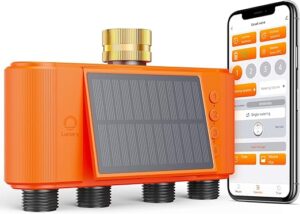
If you’re serious about smart gardening, the Lumary 4-zone system is worth the investment. This timer connects to your smartphone via the Lumary app, letting you adjust watering schedules from anywhere. The built-in water flow meter tracks consumption in real-time, which helps you catch leaks and avoid overwatering. The super capacitor technology means you won’t be swapping batteries every season, and the 65-foot WiFi range covers most residential properties without needing a hub.
The adjustable 30-degree solar panel maximizes sunlight capture, but if you’re in a particularly gloomy climate, the Type-C charging port provides emergency backup power. Setup takes about 15 minutes once you download the app. The rain delay feature automatically postpones watering after rainfall, which is exactly what you want during unpredictable spring weather. Integration with Alexa and Google Assistant is seamless, so you can control watering with voice commands if you’d like.
The main downside is that it’s the most expensive option here, and the app interface has a learning curve if you’re not tech-savvy. But for anyone with a larger property or multiple independent irrigation zones, the flexibility and monitoring features justify the cost. You get what you pay for with this one.
Features
- 4 independent zones with separate scheduling
- WiFi app control via Lumary app (2.4GHz)
- Built-in water flow meter for consumption tracking
- Adjustable 30-degree solar panel with 30% conversion efficiency
- Super capacitor (4V 550F) with 50,000+ hour lifespan
- Integrated rain delay automatic postponement
- Compatible with Alexa and Google Assistant
- IP65 waterproof rating
- Type-C charging for cloudy day backup
- Remote app control from anywhere
- Water flow meter prevents overwatering
- 4 zones perfect for larger gardens
- Super capacitor lasts 6+ years
- Highest price point in this lineup
- Requires WiFi connectivity and app setup
- Steep learning curve for app interface
2. DIG ECO 1 MVA Solar Powered Irrigation Timer
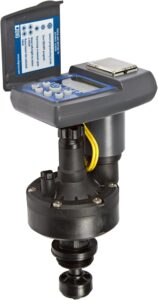
The DIG is the professional’s choice if you’ve got existing anti-siphon valves already installed. This is not a simple hose-thread timer. It’s designed to retrofit onto 3/4″ and 1″ brass manual anti-siphon valves, which means it works with systems that other timers can’t touch. The included adapter kit fits multiple valve types from Champion, Orbit, and Rainbird. If you’re replacing an old manual valve controller with something smarter, this timer is practically built for that job.
You can program up to 5 start times per day and set watering duration up to 5 hours 59 minutes per session. The LCD display has a retractable cord for easy field viewing. What really impressed us is that it works reliably in low-light and cloudy conditions, which matters if your property doesn’t get full sun year-round. The monthly budget mode helps you manage water consumption, and the “rain off” feature can pause irrigation for up to 99 days if you want it to.
The learning curve is steeper than consumer-grade timers, and the fact that it requires a compatible anti-siphon valve means it won’t work for everyone. But for anyone with an existing valve system or professional irrigation setup, this is the gold standard. Build quality is noticeably heavier than consumer models.
Features
- Fits 3/4″ and 1″ brass manual anti-siphon valves
- 5 start times per day scheduling
- Up to 5 hours 59 minutes watering duration
- LCD display with retractable cord
- Monthly budget mode for water management
- Rain off feature with up to 99-day pause
- Works reliably in low-light conditions
- Weatherproof ruggedized construction
- Manual run feature for immediate watering
- Professional-grade build quality
- Compatible with existing valve systems
- Flexible scheduling with 5 daily starts
- Excellent low-light performance
- Requires compatible anti-siphon valve
- Steeper programming learning curve
- No wireless or app control
- Not suitable for simple hose connections
3. AnseTo Solar Sprinkler Timer with Type-C Charging
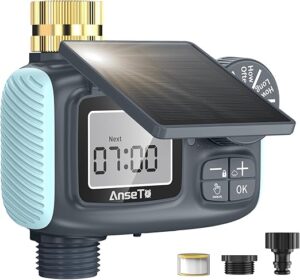
This timer deserves attention if you’re in a climate with unpredictable weather. The 0-120 degree adjustable monocrystalline solar panel is hands-down the most flexible we’ve seen on a budget-friendly timer, letting you angle it toward the sun no matter where your garden sits. But what really sets it apart is the Type-C charging port. On those stretches of cloudy days that kill battery-only systems, you can plug in a power bank or wall adapter to keep watering on schedule.
The 1000mAh lithium battery paired with the adjustable solar panel creates a reliable combination. Frequency and duration settings give you a lot of control: choose watering every 1 to 12 hours or every 1 to 7 days, and set sessions from 1 minute to 3 hours 59 minutes. The smart rain delay feature adds 24, 48, or 72-hour postponement options depending on how heavy the rain was. Heavy-duty ABS plastic with UV-resistant coating handles weather well, and the laser-engraved finish looks cleaner than cheaper alternatives.
The single outlet means it’s not for multi-zone gardens, and if you live somewhere that’s perpetually cloudy and rainy, you’ll still need to charge it occasionally. But for variable-weather regions where a solar panel can’t always keep up, this offers peace of mind that other similarly priced options don’t.
Features
- Adjustable 0-120 degree monocrystalline solar panel
- Type-C charging port for emergency backup power
- 1000mAh rechargeable lithium battery
- Frequency options: 1-12 hours or 1-7 days
- Duration settings: 1 minute to 3 hours 59 minutes
- Smart rain delay with 24H/48H/72H options
- UV-resistant heavy-duty ABS plastic construction
- Laser-engraved finish
- Manual mode for immediate watering override
- Adjustable solar panel maximizes sunlight
- Type-C charging handles cloudy stretches
- Flexible frequency and duration settings
- Smart rain delay prevents overwatering
- Single outlet only
- Lithium battery may need replacement
- Still requires occasional charging in very cloudy climates
4. AYNEFY Solar Powered Automatic Watering Timer
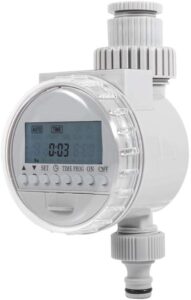
Looking for something simple without the fluff? The AYNEFY timer handles basic garden automation without overwhelming you with features. Sixteen programmable watering schedules give you enough flexibility to set up different zones if you’re willing to buy multiple units (and at this price, that’s realistic). The LCD display is straightforward, and setup takes under 10 minutes.
This timer shines for small to medium gardens and balcony setups where you’re not trying to coordinate complex watering zones. The automatic and manual mode options mean you can set it and forget it or take over when you need to. Works with standard garden hose threads, so compatibility isn’t an issue. The integrated solar panel keeps the rechargeable battery topped up, and the 0-400 kPa water pressure tolerance covers drip systems and standard sprinklers equally well.
The main limitation is obvious: one outlet only. If you have multiple separate areas needing different watering schedules, you’ll need multiple units. It also lacks the advanced features like rain sensors or app control. But for renters, small-space gardeners, or anyone wanting to test automatic watering without a big investment, this is honest and reliable.
Features
- 16 programmable watering schedules
- LCD digital display interface
- Automatic and manual operation modes
- Single outlet connection
- Rechargeable battery with solar charging
- Integrated solar panel
- Water pressure tolerance: 0-400 kPa
- Standard hose thread (1/2″ to 3/4″)
- Water temperature range: 0-40 degrees Celsius
- Affordable entry-level option
- 16 programmable schedules for flexibility
- Simple LCD interface
- Reliable solar power
- Single outlet only
- No rain sensor
- No app control
- Basic features for experienced gardeners
5. Haofy Solar Power Irrigation Timer
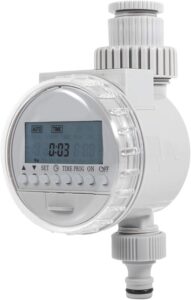
Budget doesn’t have to mean low-quality, and the Haofy proves it. At the lowest price point, this timer is perfect for renters, gardeners testing the waters, or anyone with a small setup. The frequency can be set from 1 to 12 hours or 1 to 7 days, and duration ranges from 1 minute to 3 hours 59 minutes. That flexibility is surprisingly good for the price.
The heavy-duty plastic with corrosion and weather-resistant coating handles outdoor conditions well. It works with drip irrigation, fog systems, and standard sprinklers without fussiness. The rechargeable battery and integrated solar panel keep it running through most seasons. If you’re managing a greenhouse, potted plants, or seasonal landscape watering, this does the job without complaints.
You get what you pay for: no rain sensor, no app control, just a simple battery-powered timer that runs on solar. It’s not meant for permanent large-scale operations. But for temporary setups, renters (since you can take it with you), or small gardens, it’s honestly the best bang for your buck. No fancy features to break down, just straightforward functionality.
Features
- Frequency options: 1-12 hours or 1-7 days
- Duration: 1 minute to 3 hours 59 minutes
- LCD digital display
- Rechargeable battery with solar charging
- Integrated solar panel
- Heavy-duty plastic construction
- Corrosion and weather-resistant coating
- Works with drip, fog, and sprinkler systems
- Standard hose thread connection
- Very affordable
- Flexible watering intervals
- Durable construction
- Works with multiple system types
- No rain sensor
- No app control
- Basic features only
- Single outlet
6. Pots De Fleurs Solar Irrigation Water Timer
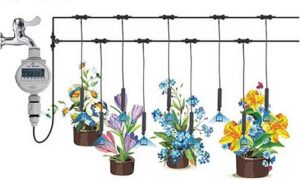
The Pots De Fleurs is the most flexible when it comes to watering frequency. You can set up 1 to 16 irrigations per day or schedule 30 times per month, giving you granular control that matters if you’re watering delicate container plants or managing frequent light watering. Duration ranges from 1 minute to 9 hours 59 minutes, which is more than most timers offer.
The LCD display shows time and irrigation status at a glance. One unique feature is the memory function that retains your programmed settings even if the battery completely dies. The water pressure tolerance (0-400 kPa) and temperature range (0-40 degrees Celsius) match typical garden systems.
The battery is not included, which is a bit annoying. You’ll need to buy a 1.5V rechargeable battery separately and plan to replace it every 2 years or so. It’s also older in design compared to newer models, and there’s no advanced features. But if your primary need is frequent, light watering sessions on containers or raised beds, and you don’t mind managing battery replacement, this timer does exactly what it promises.
Features
- 1 to 16 irrigations per day OR 30 per month scheduling
- Duration: 1 minute to 9 hours 59 minutes
- LCD display showing time and status
- 1.5V rechargeable battery (not included)
- Integrated solar panel for charging
- Memory function retains settings
- Water pressure: 0-400 kPa
- Water temperature: 0-40 degrees Celsius
- Standard hose and faucet attachment
- Flexible frequent watering options
- Long watering duration (10 hours)
- Memory function preserves settings
- Affordable
- Battery not included
- Battery needs replacement every 2 years
- No rain sensor
- Older product design
7. WiFi Intelligent Garden Irrigation Control Device
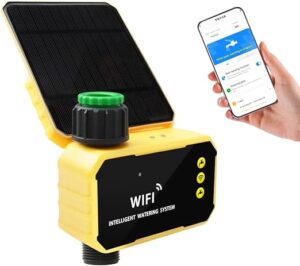
For tech-savvy gardeners who want smart control without the complexity of multi-zone management, this WiFi timer bridges the gap. App-based scheduling via smartphone gives you remote control without needing to stand outside with a manual controller. The built-in inlet filter screen prevents sediment from clogging the valve, which saves you from maintenance headaches.
The dual-power system combines solar panel charging with a built-in battery, ensuring year-round reliability even during stretches of dim weather. Auto water-saving features reduce consumption intelligently, which matters if you’re environmentally conscious or living in a drought-prone region. Setup assumes WiFi coverage, which is a requirement for the functionality you’re paying for.
The main caveat is that detailed specifications are limited in available documentation. There’s no local LCD display mentioned, which means you’re entirely dependent on the app. If your WiFi drops, manual control options might be limited. For someone with reliable WiFi and a smartphone they’re always checking anyway, this represents good value. But it’s a step down from the Lumary in terms of features and documentation clarity.
Features
- WiFi app-based remote control
- Dual solar panel and battery power system
- Adjustable solar panel for optimal capture
- Built-in inlet filter prevents sediment clogging
- Auto water-saving technology
- Suitable for drip and sprinkler systems
- Single outlet configuration
- Year-round operation capability
- Affordable smart WiFi control
- Dual power ensures reliability
- Auto water-saving reduces consumption
- Inlet filter prevents clogs
8. Solar Irrigation Timer with Automatic Rain Sensing
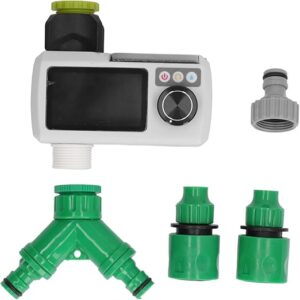
If you live somewhere it rains regularly, this timer’s automatic rain sensor is a game-changer. The gold-plated rain sensor automatically pauses watering when rain falls and resumes once conditions dry out. This prevents the frustration of watering systems running during storms, which wastes water and money.
The dual connector design adds flexibility for properties with multiple watering lines. Two 1.2V Ni-MH rechargeable batteries come included (700mAh capacity), and the manufacturer rates them to last 3 to 7 years per set. The IP68 waterproof rating is genuinely impressive for something at this price point. Real-time self-checking verifies switch and valve completion, preventing stuck valves from silently failing.
The trade-off is that documentation on the full feature set is sparse. The dual connector layout might confuse someone expecting a simple single-outlet timer. If you’re in a wet climate and want automatic rain protection without overengineering the setup, this is excellent. But it won’t solve your watering needs if you’re in a drought zone where rain doesn’t fall reliably.
Features
- Integrated gold-plated rain sensor
- Automatic pause and resume on rainfall
- Dual connector design for flexibility
- 2x 1.2V Ni-MH rechargeable batteries included
- 700mAh battery capacity per unit
- 3 to 7-year battery lifespan estimate
- IP68 waterproof rating
- Real-time self-checking system
- Switch valve completion verification
- Solar powered with low power consumption
- Integrated rain sensor saves water
- Batteries included and long-lasting
- IP68 waterproof durability
- Dual connectors offer flexibility
- Limited feature documentation
- Dual connector may confuse users
- Best for wet climates only
- No app or advanced programming
Solar Irrigation Timer Buying Guide
Key Takeaways
- Smart WiFi timers offer remote control and water monitoring but cost more
- Budget-friendly options work well for small gardens and renters
- Rain sensors and rain delay features save water in wet climates
- Multi-zone timers justify higher prices for complex landscape irrigation
- Type-C charging provides backup power for unpredictable weather
- Professional-grade options integrate with existing valve systems
- Solar power is reliable, but cloudy climates benefit from battery backup
- Most timers handle both drip systems and standard sprinklers
What Are Solar Irrigation Timers?
A solar irrigation timer is an automated watering controller powered by renewable sunlight. Unlike electric timers that need AC power lines installed in your yard, solar timers use integrated solar panels to charge rechargeable batteries that operate the valve. They eliminate the need for digging trenches for power cables, making them ideal for renters and anyone wanting a portable solution.
Most solar timers come with an integrated rechargeable battery (usually Li-ion or Ni-MH chemistry) and a small solar panel that keeps the battery charged throughout the year. The timer controls when water flows through your garden hose or drip line, running on a schedule you program. They’re completely self-contained devices that attach directly to your faucet or hose.
How Do Solar Irrigation Timers Work?
Here’s the basic operation: the solar panel charges the internal battery during daylight hours. The timer’s microcontroller uses this stored energy to open and close an internal valve at your programmed times. More advanced models include additional sensors like rain sensors that detect moisture and override the schedule, preventing water waste.
The battery chemistry matters more than you’d think. Older models used alkaline or nickel-metal hydride (Ni-MH) batteries that need annual replacement. Modern timers use lithium-ion (Li-ion) or super-capacitor technology that lasts 3 to 7 years or longer without replacement. WiFi-enabled models add a wireless transceiver that communicates with your smartphone app, though this draws more battery power and may require more frequent charging in low-light conditions.
Benefits of Using Solar Irrigation Timers
Automation is the biggest benefit. Set it and forget it means you never miss a watering day while traveling or during busy work seasons. Your plants get consistent hydration, which actually improves plant health compared to irregular hand watering. Gardens with steady moisture produce better vegetables and flowers than those with feast-or-famine watering patterns.
Water savings add up quickly. Most timers include programmable start times and duration, letting you water during cooler dawn hours when less water evaporates. Some models include rain sensors that automatically skip watering after storms, cutting water waste dramatically. A homeowner with a typical suburban lawn can reduce water consumption by 20 to 40 percent just by switching to automated scheduled watering.
Solar power means zero electricity costs and no need for outdoor electrical outlets or buried wires. You don’t need a licensed electrician. Just screw the timer onto your faucet, set the schedule, and you’re done. This makes them perfect for renters since you can take them when you move.
Number of Zones and Valve Compatibility
Solar irrigation timers range from single-zone units that control one valve to multi-zone controllers managing four, six, or more zones independently. If you are irrigating a single drip line or a small raised bed setup, a single-zone timer is all you need and far easier to program. If you have a vegetable garden, a lawn section, and a flower bed that all need different watering schedules, a multi-zone controller lets you set each one independently without juggling multiple single-zone timers.
Valve compatibility is the other key check. Most solar irrigation timers work with standard 9V or 12V DC latching solenoid valves. These are sold by Rain Bird, Hunter, Orbit, and others and are widely available. Before buying a controller, confirm that the valves in your existing system or the ones you plan to install match the output voltage of the timer. AC-powered solenoids (which run on standard 24V AC) are not compatible with solar DC controllers and require a separate transformer, which defeats the purpose of going solar-powered.
Rain Sensors, Weather Integration, and Avoiding Unnecessary Watering
A basic solar irrigation timer runs on a fixed schedule regardless of weather. This means it will water your garden the morning after a heavy rainstorm if that is when the program says to run. Over a season, unnecessary watering cycles waste water and can contribute to root rot and fungal problems in wet years.
Some higher-end solar timers include a rain sensor port or a built-in moisture sensor that pauses scheduled cycles when rain is detected or soil moisture is sufficient. If you live in a region with variable rainfall, this feature pays for itself quickly. Even a simple mechanical rain gauge connected to the timer’s sensor port can prevent several unnecessary watering events per season. Smart solar controllers with WiFi can skip cycles based on weather forecasts, though these are more complex to set up and require a phone for programming. For most home gardens, a simple rain sensor plus a well-set schedule is the most practical approach.
Things to Keep in Mind Before Buying
Consider your climate. In consistently sunny regions, even cheap solar timers work reliably year-round. If you’re in a cloudy area or high latitude where winter days are short, look for models with larger solar panels, Type-C charging ports, or super-capacitor technology. A timer that dies for three months every winter is worse than useless.
Water pressure varies significantly between properties. Most timers handle standard garden pressures (20 to 80 PSI), but if you’re using a drip system with low pressure or a high-pressure system with multiple zones, verify the timer’s pressure rating. A few timers are designed specifically for drip irrigation and perform poorly with standard sprinklers, and vice versa.
Hose thread compatibility matters for simple timers but becomes critical for professional valve actuators. If you’re retrofitting an existing anti-siphon valve system, you need a timer designed for that specific valve model. Bolting the wrong timer onto the wrong valve either won’t work or creates leaks.
Types of Solar Irrigation Timers
Basic battery-powered timers: These are the entry-level option. Simple LCD interfaces, no app control, no sensors beyond maybe a basic on-off switch. Perfect for small gardens and renters. Price range is $25 to $50.
Rain sensor models: Add an automatic rain detection feature that pauses watering when rainfall occurs. Prevents overwatering and saves water. Usually $35 to $75 depending on sensor quality and battery chemistry.
WiFi smart timers: Connect to your home WiFi and let you adjust schedules from your smartphone app. Some include water flow meters to track consumption. More expensive ($50 to $120) but worth it for larger properties or if you travel frequently.
Multi-zone timers: Control 2 to 4+ separate watering zones independently, perfect for landscape designs with different plant water needs. These start at $60 and go up to $150 for smart-enabled models with advanced monitoring.
Professional valve actuators: Designed for existing anti-siphon valve systems rather than simple hose connections. These are for homeowners upgrading from manual to automated systems. Price is $70 to $120.
Frequently Asked Questions
Do solar irrigation timers work on cloudy days?
Yes, but with limitations. Solar panels still generate small amounts of power on overcast days, enough to charge batteries slowly. However, long stretches of clouds or short winter days may not generate enough power to keep the timer running reliably. That’s why models with Type-C charging ports or super-capacitor technology are popular in climates with frequent clouds.
Can I use a solar irrigation timer with drip irrigation?
Most timers work fine with drip irrigation, but a few are optimized specifically for low-pressure drip systems. Check the specifications for water pressure tolerance. Standard timers handle 20 to 80 PSI comfortably, but some budget drip-specific models operate at 5 to 30 PSI. Using a high-pressure timer with low-pressure drip lines risks damage.
How often do I need to replace the battery?
Modern lithium and super-capacitor timers last 3 to 7 years without battery replacement. Older Ni-MH models typically last 1 to 2 years. Check the product specifications for battery chemistry. If the product doesn’t mention battery type, it probably uses cheaper alkaline or Ni-MH that needs annual replacement.
Are WiFi timers worth the extra cost?
For most homeowners with standard suburban gardens, a basic timer does the job fine. WiFi timers justify their cost if you travel frequently, have multiple zones with different water needs, or want to monitor water consumption for billing or conservation purposes. For a simple patio garden, the basic $30 model is plenty.
Can I install a solar timer myself?
Yes. Most timers screw onto standard garden faucets. Just attach it between the faucet and your hose, program the schedule, and you’re done. The only exception is professional valve actuators that require plumbing work to install on anti-siphon valves. Those might need a plumber, depending on your comfort level.
What happens if the battery dies completely?
The timer stops operating until the battery recharges. On most models, you can still manually turn the valve on and off. With smart WiFi models, you won’t be able to control it remotely, but you can walk over and twist the timer to manual mode. It’s a fail-safe design to prevent being completely locked out of your own watering system.
Will a rain sensor actually save water?
Yes, measurably so. Studies show that rain sensors prevent 20 to 30 percent of unnecessary irrigation in moderate-rainfall climates. In desert climates where rain is rare, the savings are minimal. The sensor pays for itself in 2 to 3 years in most climates through reduced water bills.
Summing Up
Choosing the right solar irrigation timer depends on your garden size, climate, and how much automation you actually want. If you’re managing a simple small garden, the Haofy or Pots De Fleurs will save you time and water without costing much. For multi-zone landscapes or remote monitoring while traveling, the Lumary WiFi system is worth the investment. In climates with unpredictable weather, the AnseTo’s Type-C charging ensures you won’t lose watering cycles to cloudy stretches.
If you’re also thinking about solar panels for your home, call (855) 427-0058 for a free quote — it takes just a few minutes to find out what installation would cost and save you in your area.
Updated