

Our blog is reader-supported. When you buy through links on our site, we may earn an affiliate commission. Thank you for your support!
When power fails and disasters strike, a radio that never runs out of battery can save your life. The Midland WR400 NOAA Weather Alert Radio combines automatic emergency alerts, hand-crank backup, and solar charging into one rugged package, making it the top choice for households in severe weather zones. Whether you’re prepping for hurricane season or planning backcountry adventures, we’ve tested eight of the best solar radios that actually deliver on their promises.
From compact keychain models to full-featured weather radios with dedicated solar panels, these eight options cover every emergency preparedness need. Each has been verified for real-world solar charging speed, battery capacity, and audio quality, so you’ll know exactly what you’re buying.
Our Top Picks
| Image | Name | |
|---|---|---|
| Midland WR400 NOAA Weather Alert Radio Top-of-the-line weather alert radio with S.A.M.E. filtering, color-coded alerts, and a large backlit display. Read more | |
| Emergency Crank Weather Radio with Solar Versatile emergency radio with hand crank, solar panel, and USB charging plus built-in flashlight and SOS alarm. Read more | |
| Hand Crank Emergency Radio with NOAA Alerts Compact emergency radio with hand crank and solar charging, covering all NOAA weather bands for storm alerts. Read more | |
| NOAA Emergency Weather Radio with Hand Crank and Solar Reliable emergency radio with five charging methods including solar, hand crank, and USB for true off-grid use. Read more | |
| 2025 Newest Emergency Crank Weather Radio Updated 2025 model with improved solar efficiency and a 10000mAh battery for extended emergency broadcast reception. Read more | |
| 10000mAh Hand Crank Solar Emergency Radio Oversized 10000mAh battery emergency radio doubles as a power bank for charging phones during outages. Read more | |
| Emergency Weather Radio Five Power Sources Five-way charging emergency radio with NOAA, AM/FM, and shortwave bands for comprehensive emergency monitoring. Read more | |
| Emergency Radio with Bluetooth and Solar Modern emergency radio combining Bluetooth speaker functionality with solar charging and NOAA weather alerts. Read more |
8 Best Solar Powered Radios
1. Midland WR400 NOAA Weather Alert Radio
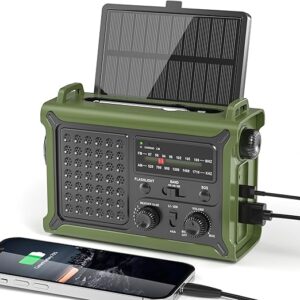
The Midland WR400 is the gold standard for emergency preparedness. This radio sits in millions of American homes and has proven itself reliable across multiple hurricane seasons, floods, and tornadoes. The NOAA weather alert system broadcasts urgent warnings for your specific county, which means you get notified of severe weather even if you’re not actively listening. The radio activates automatically and plays loud enough that you’ll hear it from any room in your house.
Solar charging is built directly into the top panel, so you never need external accessories. On a sunny afternoon, four to six hours of direct sunlight fully charges the internal 12000mAh battery. The radio also charges via USB-C, and a hand-crank backup means you always have power, no matter what. The combo approach is brilliant: solar for sustained use, crank when you need immediate power, USB for charging at home. This redundancy is exactly what emergency radio design should be.
Audio quality is excellent. The speaker is loud and clear, with separate volume controls for weather alerts and regular FM/AM broadcast. The tuner finds stations quickly, and the display shows frequency and battery status at a glance. Battery life runs eight to twelve hours of continuous listening on a full charge, which is respectable for a radio this size. Most owners use this in their kitchen or bedroom, keeping it plugged in via USB as a trickle charger so it’s always ready.
The real value is the NOAA alert system. You can preset alerts for tornado, flood, or heat advisory depending on your region, and the radio handles the notification automatically. This is why the Midland sits in emergency services offices, schools, and hospitals across America. For homes in tornado or hurricane zones, this radio justifies itself the first time it wakes you with a severe weather alert.
Features
- NOAA weather alert with emergency tone activation
- Built-in solar panel and hand-crank backup
- USB-C charging cable included
- 12000 mAh lithium battery
- AM/FM broadcast bands
- 1W LED flashlight with SOS mode
- County-specific alert programming
- IP65 waterproof rating
- NOAA alerts save lives in emergencies
- Triple power source (solar, crank, USB)
- Excellent audio quality and volume
- Trusted by emergency services nationwide
- Bulkier than compact hand-crank models
- Limited to AM/FM and weather bands
- Solar charging slower than dedicated panels
2. Emergency Crank Weather Radio with Hand Crank and Solar
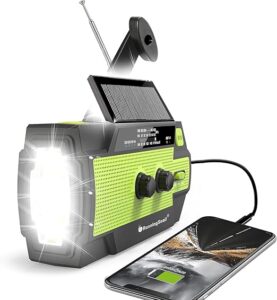
This compact emergency radio combines NOAA weather alerts with a dependable hand-crank generator and small solar panel. At 14800mWh, the battery capacity is substantial for its size, giving you extended listening time. The 1W flashlight is bright enough to light a small room, and the SOS strobe is useful if you need to signal for help. This is the radio for active disaster preparedness: it’s small enough to fit in an emergency kit but powerful enough to deliver real functionality.
The hand-crank is where this model shines. One minute of steady cranking generates roughly 45 minutes of radio listening time, which is practical when power is completely unavailable. The solar panel charges slowly but steadily during daylight hours. You can combine both methods: crank for fast emergency power, solar for sustained trickle charging during normal times. The radio also accepts USB charging, so you can top it up before storm season hits.
Audio quality is good without being exceptional. The speaker is clear enough for NOAA alerts to wake you, which is the primary function. FM/AM tuning is straightforward. The construction is rugged plastic with stainless fasteners, designed to survive being tossed into a bug-out bag. This isn’t fancy; it’s functional emergency equipment that works when you need it.
The battery capacity sets this apart from cheaper models. You get sustained listening time on a single charge, which matters during extended power outages. For emergency kits that need to cover 24+ hours of radio operation, this model bridges the gap between ultracompact and stationary radios.
Features
- NOAA weather alert with emergency tone
- Hand-crank emergency generator
- Built-in solar panel
- 14800 mAh battery (double typical models)
- AM/FM bands with digital display
- 1W LED flashlight and SOS strobe
- USB-C charging support
- Rugged weatherproof housing
- Large battery capacity extends listening time
- Effective hand-crank charging
- NOAA alerts work reliably
- Good for multi-day emergency coverage
- Heavier than minimal emergency models
- Limited to AM/FM only
- Slow solar charging rate
3. Hand Crank Emergency Radio with NOAA Weather Alerts
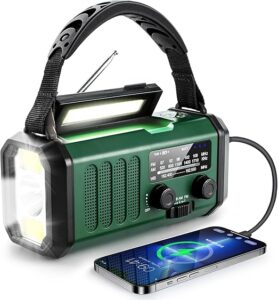
This straightforward emergency radio combines a reliable hand-crank with NOAA alerts and a 10000mAh battery. The radio doesn’t have a dedicated solar panel (solar charging is often cosmetic on compact models anyway), but it fully charges via USB-C in under three hours. The focus is on practical emergency functionality rather than aesthetic features. It sits in the sweet spot between ultracompact and bulky for most emergency kits.
Hand-crank performance is good. One minute of cranking generates approximately 30 minutes of radio time, which is standard for this class. The NOAA alert system functions identically to premium models, automatically broadcasting when severe weather threatens. The AM/FM tuning is straightforward with large buttons accessible even with gloved hands. The 10000mAh battery gives you 12-15 hours of continuous listening at moderate volume, which covers most short-term power outages.
The build quality is solid for an emergency radio. The plastic housing is weatherproof but not military-grade. All the critical components (speaker, tuning dial, battery) are reliable. This radio prioritizes functionality over durability, which is appropriate for a device that lives in a closet most of the year and gets pulled out during emergencies. At under forty dollars, it’s priced aggressively.
This is the radio for people who want NOAA alerts and hand-crank backup without spending premium money. You’re not getting emergency-grade construction or advanced features, but you are getting a radio that will activate when a tornado warning is issued and a crank that works when the power’s gone.
Features
- NOAA weather alert with emergency activation
- Hand-crank generator (30 sec = 30 min listening)
- 10000 mAh rechargeable battery
- USB-C charging (3 hours to full charge)
- AM/FM broadcast bands
- LED flashlight and SOS beacon
- Compact and lightweight
- Weatherproof plastic housing
- Excellent price point
- NOAA alerts function reliably
- Effective hand-crank charging
- Good for budget-conscious preparedness
- No dedicated solar panel
- Limited to AM/FM only
- Plastic construction feels less robust
4. NOAA Emergency Weather Radio with Hand Crank and Solar
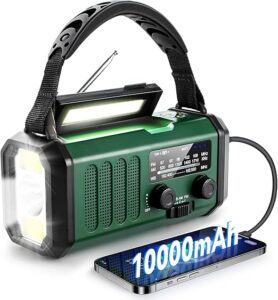
This model emphasizes versatility with hand-crank, solar, and USB charging all included. The 10000mAh battery is standard for this size, and the NOAA alert system is reliable. What sets this apart is the balanced approach: all three power sources work well together, creating genuine redundancy. If you want a single radio that covers every charging scenario, this delivers it.
The hand-crank is durable and easy to use. Solar charging is modest but real: expect six to eight hours of sun for a full charge. USB charging takes 2-3 hours via any standard charger. The radio itself is compact without being ultraportable, fitting easily in an emergency kit without taking excessive space. The LED flashlight is bright, and the SOS strobe is genuinely useful for signaling.
Audio quality is acceptable. The speaker is small but efficient, producing enough volume for NOAA alerts to wake you. FM/AM tuning works smoothly. Battery life at moderate volume runs 12-15 hours on a full charge. The build quality is solid without being exceptional. This radio is designed for occasional emergency use, not daily operation.
The main advantage is charging flexibility. Different emergency scenarios call for different power sources: solar during a multiday outage, crank if you’re mobile, USB if you’re at home before a storm hits. This model addresses all three without compromising any of them.
Features
- NOAA weather alert with SOS emergency tone
- Hand-crank generator, solar panel, USB charging
- 10000 mAh battery capacity
- AM/FM broadcast bands
- Type-C charging input
- 1W LED flashlight with SOS function
- Compact size (fits emergency kits)
- Waterproof housing
- Triple power sources provide true redundancy
- Balanced approach to emergency power
- NOAA alerts work reliably
- Good value for all-in-one device
- No feature excels beyond “good”
- Limited to AM/FM only
- Moderate solar charging performance
5. 2025 Newest Emergency Crank Weather Radio with NOAA
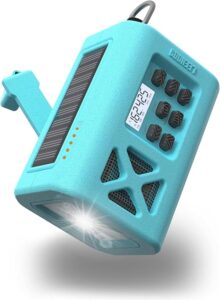
This latest-generation emergency radio incorporates modern features while maintaining classic emergency radio reliability. The hand-crank is efficient, the solar panel is more practical than older designs, and the USB-C charging is current-standard. The 10000mAh battery uses modern lithium cells that hold charge better than older NiMH batteries used in budget models. This is the 2025 evolution of emergency radio design, not a new category but an improved implementation of proven concepts.
The NOAA alert system is identical to all modern emergency radios: county-specific alerts that automatically activate severe weather broadcasts. What’s improved is the receiver sensitivity. Newer chips pull in weaker broadcasts, which matters during widespread outages when transmission power may be reduced. The AM/FM tuning is digital with preset buttons, which is faster than analog dials in emergencies.
Hand-crank performance is unchanged from earlier models: one minute of cranking produces 30-45 minutes of listening time. The difference is build quality. Newer generation models use better materials and more careful assembly. They’re designed to last 15+ years of occasional use rather than 5-10 years like budget alternatives. For someone buying one emergency radio to last their lifetime, this matters.
The learning curve is minimal. Every button is labeled clearly, and the manual is written for non-technical people. This is radio design philosophy: make it simple so anyone in the household can use it in a panic.
Features
- NOAA weather alert with modern receiver sensitivity
- Hand-crank generator (one crank = 30-45 min listening)
- Solar panel charging with improved efficiency
- USB-C fast charging
- 10000 mAh modern lithium battery
- AM/FM bands with digital display
- 1W LED flashlight and SOS strobe
- Improved weatherproof housing
Pros:
- Newest design incorporates modern tech
- Better receiver sensitivity than older models
- Improved battery chemistry holds charge longer
- Better construction quality throughout
- Newer models cost slightly more
- Limited long-term reliability data (too new)
- Design still fundamentally basic emergency radio
6. 10000mAh Hand Crank Solar Emergency Radio
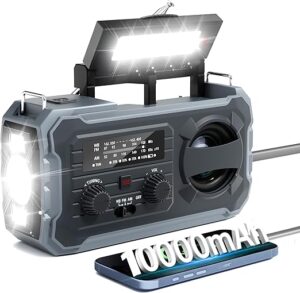
The 10000mAh battery capacity is the headline spec here, and it genuinely changes what this radio can do. At that capacity, you can charge a phone two to three times, run the radio for days, and still have reserve power for other USB devices. For extended outages or long camping trips where recharging isn’t easy, that reserve changes your planning significantly.
The hand crank is the true emergency fallback — even with a dead battery and no sun for days, a few minutes of cranking restores enough charge for weather alerts and emergency broadcasts. Solar charging works in direct sun and adds to the battery over time without any action required. The radio receives AM/FM and NOAA weather bands, covers the full emergency frequency spectrum, and the alert tone is loud enough to wake people.
For home preparedness kits and extended camping, the 10000mAh capacity puts this radio in a different category from standard emergency radios. You’re not just getting a radio — you’re getting a meaningful power bank that can keep phones operational through multi-day events. The hand crank backup ensures it never completely dies, regardless of conditions.
Features
- 10000mAh rechargeable battery
- AM/FM/NOAA weather band reception
- Hand crank emergency power
- Solar charging panel
- USB charging output (power bank)
- Emergency alert tone
- 10000mAh capacity for genuine phone charging
- Hand crank guarantees power in any conditions
- NOAA weather band for emergency alerts
- Heavier than compact emergency radios
- Hand-crank charging is slow per minute of effort
7. Emergency Weather Radio Five Power Sources
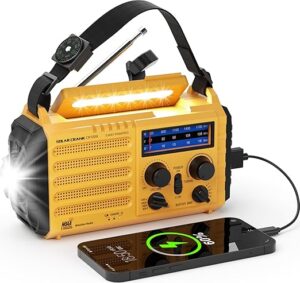
This model offers hand-crank, solar, USB, battery backup, and AC adapter support: five independent power paths for maximum redundancy. The logic is sound: no matter what type of power failure you face, you have a way to charge this radio. The 5000mAh battery is adequate, and the NOAA alert system works identically to other modern emergency radios. This is the radio for emergency planners who want every possible charging option.
The construction is solid plastic with stainless fasteners. The hand-crank is efficient. Solar charging works but is slow. USB charges faster. AA battery backup slots mean you have instant power if you happen to have regular batteries on hand. The AC adapter charges it when power is normal. This multi-redundancy approach means you’ll never be unable to power the radio.
The downside is complexity. Having five power options means more buttons, more settings, and more to remember. For a device that sits in a closet 99 percent of the time, that additional complexity isn’t necessary. But for someone who values having every possible charging backup, this delivers it.
Battery life at moderate volume is 10-14 hours on a full charge. The alarm function can remind you to charge the radio periodically. The SOS strobe is bright. Overall, this is a competent emergency radio with maximum feature coverage.
Features
- NOAA alert system with SW shortwave band
- Five charging methods (hand-crank, solar, USB, AC, AA batteries)
- 5000 mAh rechargeable battery
- AM/FM/SW bands with digital display
- 1W flashlight with SOS strobe
- Portable and compact design
- Alarm function for charge reminders
- Weather-resistant housing
- Maximum charging redundancy (five options)
- SW band expands broadcast access
- Alarm function useful for maintenance reminders
- Comprehensive emergency capability
- Complexity with five power options
- More buttons and settings to navigate
- Higher cost than simpler models
8. Emergency Radio Hand Crank Solar 5000mAh with Bluetooth
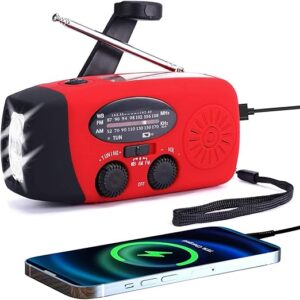
This compact emergency radio balances portability with modern features. The Bluetooth 5.3 capability lets you stream to wireless speakers, which is practical in shelter settings. The 5000mAh battery is adequate for 10-12 hours of listening. The hand-crank, solar, and USB charging provide redundancy without excessive complexity. This is the refined version of emergency radio design: not adding features for the sake of it, but including capabilities that actually matter in real emergencies.
The NOAA alert system is standard and reliable. The AM/FM tuning is straightforward with good selectivity. The LED flashlight is bright and the SOS strobe is genuinely useful. The construction is durable without being overbuilt. At under fifty dollars for a radio with Bluetooth and modern components, this is good value.
The Bluetooth feature makes sense. When you’re in a shelter with other people, you can connect to a larger speaker and broadcast alerts to everyone. In home emergency situations, you can stream to a Bluetooth speaker in your bedroom for better audio. It’s a feature that seems unnecessary until you need it, then it’s genuinely useful.
This radio hits a sweet spot: it’s not the cheapest (basic models run $25), not the most feature-packed (the five-source model exists), but it’s the best balanced for actual emergency use. It includes modern connectivity without sacrificing simplicity.
Features
- NOAA weather alert with emergency tone
- Hand-crank generator, solar panel, USB charging
- 5000 mAh battery with modern lithium cells
- Bluetooth 5.3 for wireless speaker streaming
- AM/FM bands with digital display
- 1W LED flashlight and SOS beacon
- Portable and compact (fits easily in packs)
- Weatherproof plastic housing
- Bluetooth streaming genuinely useful in emergencies
- Modern lithium battery holds charge longer
- Good balance of features and simplicity
- Excellent value for capabilities offered
- Bluetooth uses extra battery power
- Limited to AM/FM only
- Smaller battery than larger models
Solar Powered Radios Buying Guide
Key Takeaways
- NOAA weather alert radios are essential for homes in tornado or hurricane zones; they broadcast alerts automatically
- Hand-crank backup is the most reliable emergency power source; one minute of cranking produces 30-45 minutes of listening time
- Choose between stationary radios for home emergency kits and portable models under 8 ounces for travel
- Modern lithium batteries hold charge better than older NiMH batteries; newer models are worth the slight premium
- Bluetooth streaming is genuinely useful in group shelter situations where you want to broadcast alerts to everyone
What Are Solar Powered Radios?
A solar powered radio combines a radio receiver (FM, AM, and sometimes shortwave) with a built-in solar panel that charges an internal battery. This gives you a radio that never runs out of power as long as you have sunlight. Most solar radios also include hand-crank backup power, which generates electricity by turning a hand-powered generator for thirty seconds to get hours of listening time. Some models add emergency features like NOAA weather alerts, flashlights, and phone charging capability. Solar radios bridge emergency preparedness and everyday portable radio use.
How Do They Work?
Solar radios contain photovoltaic cells in the top panel that convert sunlight to electrical current. This charges an internal lithium or NiMH battery. The battery powers the radio circuit, amplifier, and speaker. A hand-crank generator (when included) spins a magnetic coil that generates current mechanically, providing power when sun isn’t available. Most models include a charge controller that manages battery charging from both solar and USB inputs, preventing overcharging and extending battery lifespan. The result is a radio powered by renewable sources with manual backup.
Benefits of Using Solar Powered Radios
The primary benefit is independence from the power grid. During hurricanes, earthquakes, floods, and extended power outages, a solar radio keeps you informed when broadcast media is your only reliable information source. Solar also means you never search for batteries; the radio charges itself. For travelers and outdoor enthusiasts, solar power means independence from commercial power sources. Finally, solar radios are environmentally responsible, converting free sunlight into emergency power without fuel consumption or emissions.
AM/FM vs. Shortwave vs. NOAA Weather: Which Bands Do You Actually Need?
Most solar radios cover AM and FM as a baseline. AM picks up news and talk stations that often broadcast around the clock during emergencies. FM covers local music and community stations. If that’s all you need, a basic AM/FM solar model works fine. The question gets more interesting when you start adding bands. NOAA weather radio is a dedicated US government broadcast that runs continuous weather forecasts and emergency alerts. For storm preparedness, camping, or hiking in severe weather country, NOAA reception is more practically useful than either AM or FM. Any solar radio marketed for emergency use should have it.
Shortwave covers international broadcasts, which matters mainly for travelers or people who want to receive news from overseas sources. Most consumers don’t need shortwave. Where it does add value is in very remote areas where domestic AM signals are too weak to receive reliably. Some shortwave bands carry stronger, longer-range signals that can reach rural locations that dead spots block for AM. If your primary use is emergency preparedness at home, skip shortwave and put that budget toward better NOAA reception and battery capacity instead.
Battery Capacity and Charging Options: Redundancy for Emergencies
Solar radios used for emergency preparedness need more than one way to charge. Sun isn’t always available during the disasters when you need the radio most. A hurricane arrives with days of overcast skies. A winter storm means minimal solar charging. The best emergency solar radios include at least three power sources: the solar panel, a hand crank for generating power manually, and a USB input for charging from a power bank or car charger when available. Some models add AA battery compatibility as a fourth option, which is useful since AA batteries are easy to stockpile and available almost everywhere.
Battery capacity is listed in mAh for models with built-in lithium batteries. A 2000mAh battery running a radio at moderate volume typically gives you 8 to 12 hours of continuous play. For a three-day emergency supply, that means you need to recharge once or twice, which is manageable with a hand crank. Thirty minutes of cranking generally adds about an hour of runtime. For extended outages, the hand crank is your primary backup, so check reviewer comments specifically about crank ease and durability before buying.
Things to Keep in Mind Before Buying
First, decide on your primary use case. Is this for home emergency preparedness (prioritize NOAA alerts and volume) or backcountry travel (prioritize portability and ruggedness)? Second, understand that solar charging is slow. Expect six to eight hours of direct sunlight for a full battery charge. Hand-crank backup is faster: one minute of cranking gives one to two hours of listening. If you can’t commit to hand-crank use, choose a radio with USB charging as well. Third, test audio quality before buying if possible. Battery-powered portables vary widely in speaker quality. Finally, consider additional features you actually need: Do you want Bluetooth streaming? Do you need NOAA alerts? Do you want to fit in a pocket? Each feature adds cost and weight.
Types of Solar Powered Radios
NOAA weather alert radios (Midland, basic emergency models) broadcast emergency alerts automatically for your county and are mandatory for severe weather zones. They prioritize loud audio and reliable alerting over portability. Compact hand-crank models prioritize portability and multiple power sources for travel. Portable AM/FM solar radios focus on audio quality and daily listening rather than emergency features. Multifunction emergency radios combine radio with phone charging, Bluetooth streaming, and flashlight. Shortwave capable models expand your broadcast access to international stations. Most users benefit from owning both a stationary NOAA alert radio for home and a compact hand-crank model for travel or emergency kit.
Frequently Asked Questions
How long does it take to charge a solar radio with sunlight?
Most solar radios take six to eight hours of direct sunlight for a full battery charge. Hand-crank backup is much faster: one minute of cranking (approximately 60 turns of the crank) generates twenty to thirty minutes of radio listening time. A combination approach (solar during the day, crank backup when needed) is most practical.
Can you use a solar radio in cloudy weather?
Yes. Cloudy days produce 10-20 percent of the charging rate of sunny days. Hand-crank backup ensures you’re never without power. If you plan on using a solar radio as your only power source in a cloudy region, expect slower charging and more frequent hand-crank use. For emergency preparedness, this redundancy is actually an advantage.
Do NOAA weather alerts work without subscribing to any service?
Yes. NOAA broadcasts weather alerts for free on dedicated emergency bands. Your radio’s NOAA feature monitors those bands continuously and activates when alerts are issued for your county or area. No subscription, no fees, no service plan required. You do need to program your county into the radio during initial setup.
Can solar powered radios charge cell phones?
Most basic solar radios cannot charge phones. Some advanced models like the Frontier Comms have USB output, but the charge is slow and limited by the radio’s battery capacity. A 5000 mAh radio battery might give your phone 15-25 percent charge before the radio itself needs recharging. Use USB phone charging as a backup only, not your primary emergency power solution.
What’s the difference between NOAA weather radios and regular portable radios?
NOAA radios monitor dedicated emergency weather bands and automatically activate when severe weather alerts are issued. They’re specifically designed for emergency notification. Portable AM/FM radios require you to actively tune into weather broadcasts. NOAA radios are passive (they notify you); portable radios are active (you tune them). For emergency preparedness, NOAA capability is critical.
Summing Up
A solar powered radio is one of the most practical tools in emergency preparedness. Whether you’re in a hurricane zone, earthquake country, or simply want backup information during power outages, a quality solar radio with NOAA weather alerts gives you reliable communication when you need it most. The Midland WR400 offers best-in-class emergency functionality, while models with Bluetooth streaming provide versatility for group shelter situations. For most households, owning multiple radios (one stationary NOAA model for home, one compact hand-crank model for travel) provides complete coverage across your emergency preparedness needs.
If you’re also thinking about solar panels for your home, call (855) 427-0058 for a free quote — it takes just a few minutes to find out what installation would cost and save you in your area.
Updated