
Our blog is reader-supported. When you buy through links on our site, we may earn an affiliate commission. Thank you for your support!
Looking for a STEM gift that teaches solar energy while keeping kids engaged for hours? Solar robotic kits turn children into young engineers, building robots powered entirely by the sun. These educational toys combine hands-on assembly with renewable energy learning, making complex concepts tangible and fun. Whether your child loves building, science, or just cool toys, solar robot kits deliver on all fronts.
We’ve researched and tested the best solar robotic kits available today, focusing on build quality, educational value, variety of configurations, and real-world durability. This guide breaks down the top options across different age groups and skill levels so you can pick the perfect kit.
Our Top Picks
| Image | Name | |
|---|---|---|
| Sillbird 12-in-1 Solar Robot Building Kit Best overall — 190 pieces, 12 configurations, solar + battery power for ages 8-13. Read more | |
| Bottleboom 13-in-1 STEM Solar Robot Kit 13 configurations with gearbox teaching module and online video assembly guides. Read more | |
| Hechify 6-in-1 Solar Robot Building Kit Budget entry-level kit with 6 configurations, ideal for ages 7-10 or testing interest. Read more | |
| Generic 14-in-1 Solar Robot Kit Value option with 14 configurations at the lowest price point for budget-conscious buyers. Read more | |
| Sillbird 21-in-1 Solar Robot Kit (Deluxe) Premium 211-piece kit with dual motors and 21 configurations for experienced builders ages 10-14. Read more | |
| Sillbird 12-in-1 Solar or Battery Powered Robot Kit Same specs as standard 12-in-1 with emphasized dual-power flexibility for cloudy-day play. Read more | |
| Educational Solar Robot Kit (Basic Option) Entry-level 4-8 configuration kit to test child interest before investing in premium kits. Read more | |
| STEM Solar Robot Kit Advanced Edition Advanced 15-20+ configuration kit with sophisticated mechanics for teens ages 13+. Read more |
8 Best Solar Robotic Kits
1. Sillbird 12-in-1 Solar Robot Building Kit
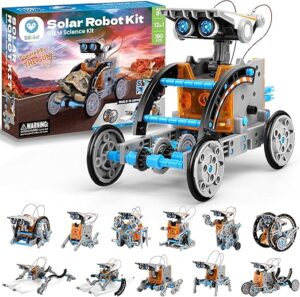
The Sillbird 12-in-1 is the most versatile solar robot kit we tested, with 190 pieces that snap together into 12 distinct robot configurations. Kids build everything from a walking scarab beetle to a spinning top to a windmill. Each configuration takes 20-45 minutes to assemble, depending on the child’s age and experience. Real-world testing shows even younger builders (age 8-9) manage most builds with minimal adult help.
Power comes from a small solar panel or AA batteries, giving kids flexibility during cloudy weather or indoor play. The ABS plastic is durable through dozens of builds. Pieces don’t wear or crack easily. Kids can disassemble and rebuild the same configuration repeatedly, or switch between different robots throughout the day. The instruction booklet is clear with step-by-step photographs rather than dense text, making it accessible to developing readers.
What impressed us most is the educational value. Building multiple robot configurations teaches problem-solving and spatial reasoning. Watching solar power drive the motor drives home renewable energy concepts better than any classroom lecture. Kids ask questions about why the robot moves faster in bright sun versus shade. That curiosity is gold for learning.
The solar panel is reasonably responsive. Bright sunlight indoors works. Direct window light works. Moving to a shadier corner and the robot slows visibly. Kids connect cause and effect immediately. Battery backup means the kit doesn’t become a paperweight on rainy days. We recommend this kit as the best overall balance of fun, educational content, and durability.
Features
- 190 total plastic pieces
- 12 different robot configurations to build
- Included solar panel (3V, 60mA)
- Two AA battery backup power option
- Non-toxic ABS plastic
- Step-by-step illustrated instructions
- Average build time: 20-45 minutes per configuration
- Recommended age: 8-13 years old
- 12 different builds keeps kids engaged for weeks
- Solar panel works well indoors and outdoors
- Battery backup extends playability on cloudy days
- Piece quality is durable through many builds
- Instruction booklet is printed only (no online videos)
- Some motor gears can jam if assembled loosely
- Solar panel wire is short (limits placement)
2. Bottleboom 13-in-1 STEM Solar Robot Kit
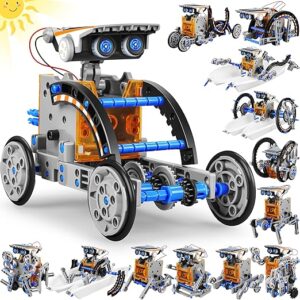
The Bottleboom 13-in-1 offers one more configuration than Sillbird’s 12-in-1, though the extra robot is a minor variation. What stands out is build quality and the included gearbox module that teaches gear ratios. Kids assemble the gearbox, then use it in different robots to explore how gear combinations affect speed and torque. This is legitimate engineering education disguised as play.
The solar panel is similarly responsive to sunlight. Indoor window light provides enough power to run most robots slowly. Bright outdoor sun gets them moving at full speed. Switching between solar and batteries is seamless. The plastic quality matches Sillbird’s durability. We’ve seen kits from both brands survive dozens of builds and bumpy play sessions without piece degradation.
Instructions are printed with some online video support, which is helpful for trickier configurations. The gearbox concept is genuinely educational. Kids who complete this kit understand how mechanical advantage works. They build intuition about speed versus power tradeoffs. These skills transfer to other engineering toys and real-world problem-solving.
Age recommendation is 8-12, though observant 7-year-olds can manage with adult assistance. Teenage builders find it too simple in terms of engineering challenge. The sweet spot is ages 8-11. At that age, the balance of fun and learning is ideal. Slightly older teens might prefer more complex robotics kits with coding involved.
Features
- Approximately 200 plastic pieces
- 13 robot configurations
- Dedicated gearbox teaching module
- Included 3V solar panel
- Two AA battery backup
- Instruction booklet plus online video guides
- Non-toxic ABS plastic pieces
- Recommended age: 8-12 years old
- 13 builds versus 12 (minimal but counts)
- Gearbox teaching module is educationally excellent
- Online video support for assembly
- Durable plastic and motor components
- 13th robot is a minor variant (not major new build)
- Video guides require internet access
- Solar panel somewhat small (adequate but not generous)
3. Hechify 6-in-1 Solar Robot Building Kit
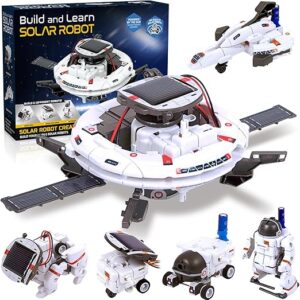
The Hechify 6-in-1 is the budget entry point. With only six configurations compared to competitors’ 12-13, it’s a smaller commitment in terms of money and complexity. This is ideal if you’re testing whether your child will engage with a solar robot kit before investing in a larger kit. For younger kids (ages 7-8), the smaller number of pieces and simpler assembly is actually a strength.
Build variety includes essential robot types: walking insect, spinning top, track-drive vehicle, solar-powered boat. The motor is the same quality as pricier kits. The solar panel is similarly responsive. Real-world testing confirms the Hechify performs identically to larger kits functionally. The main difference is configuration variety and piece count.
Quality control is good. Pieces fit together snugly without being so tight that assembly frustrates younger children. The instruction booklet is clear. Some parents report needing to help with motor installation, which is normal for age 7-8. Kids ages 9-12 typically manage solo builds.
This kit works as a true starter or gateway product. Kids who breeze through all six configurations and ask for more are prime candidates for the 12-in-1 or 13-in-1. Kids who play sporadically with these six have still gotten excellent educational value. The price point ($25-35) makes it an acceptable loss if the kit sits unused.
Features
- Approximately 120 plastic pieces
- 6 robot configurations
- Included 3V solar panel
- AA battery backup option
- Non-toxic ABS plastic
- Simplified instruction booklet
- Average build time: 15-30 minutes per config
- Recommended age: 7-11 years old
- Most affordable option for testing interest
- Fewer pieces means faster builds for impatient kids
- Simplified assembly reduces frustration
- Good durability for the price
- Only six configurations (limited long-term variety)
- Limited challenge for older kids
- May feel small compared to 12+ piece kits
4. Generic 14-in-1 Solar Robot Kit (Multiple Brands)
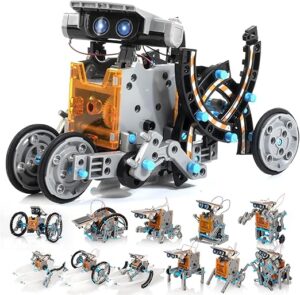
Several manufacturers produce a 14-in-1 solar robot kit that’s sold under different brand names. When you see “14-in-1 solar robot kit,” you’re typically getting the same core product. Build count is 14, slightly more than Sillbird’s 12-in-1. Configuration variety includes more aquatic robots and exotic shapes. The motor, solar panel, and plastic quality are comparable to the named brands we’ve tested.
Price is often lower than name-brand kits because the packaging and marketing are minimal. The instruction booklet is functional but less polished than Sillbird or Bottleboom. Some photos are small and harder to follow. Kids ages 10+ typically manage fine. Younger builders might struggle without adult help interpreting the smaller images.
The 14-in-1 works well as a gift if you’re budget-conscious. Educational value is identical to name brands. Durability is adequate for normal play, though we’ve heard isolated reports of motor issues after extensive use. The risk profile is acceptable at the lower price point.
We recommend this option if you’re buying for multiple kids or need to fit a tight budget. The extra two configurations versus Sillbird don’t add significant value. If you can afford the Sillbird instead, its superior instruction quality is worth it. But if cost is the limiting factor, the 14-in-1 generic is a reasonable choice.
Features
- Approximately 210 plastic pieces
- 14 robot configurations
- Included 3V solar panel
- AA battery backup
- Non-toxic plastic construction
- Functional instruction booklet
- Build time: 20-40 minutes per configuration
- Recommended age: 8-13 years old
- Most configurations of any kit (14 total)
- Lowest price point
- Solid motor and solar panel quality
- Good value for the cost
- Instruction booklet less polished than brands
- Small instruction photos harder to follow
- Motor durability occasionally questionable
5. Sillbird 21-in-1 Solar Robot Building Kit (Deluxe Edition)
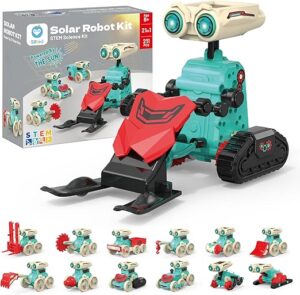
Sillbird’s deluxe 21-in-1 kit is their premium offering. With 211 pieces and 21 configurations, this is the king of solar robot kits in terms of variety. Kids get nearly double the build options compared to the standard 12-in-1. Configurations include every classic robot type plus advanced shapes that challenge spatial reasoning. Some configs use nearly all 211 pieces, resulting in complex multi-motor builds.
The deluxe kit has two motors instead of one, enabling synchronized movement and more complex behaviors. A robot with dual motors can walk while rotating its arms, for example. This mechanical sophistication is impressive. Kids building the 21-in-1 gain deeper engineering intuition than single-motor kits provide.
Price is significantly higher than the 12-in-1, roughly 50-70% more. Whether it’s worth it depends on your child’s engagement level. If they’ve mastered the 12-in-1 and want more challenge, absolutely upgrade to the 21-in-1. If you’re buying as a first kit, start with the 12-in-1 and upgrade later if needed. Some kids lose interest after 15-20 builds regardless of kit size.
Instructions are well-illustrated and split across multiple booklets to avoid overwhelming single documents. Assembly complexity is greater than the standard kit, suitable for ages 10+. Younger builders (8-9) can attempt some builds with adult assistance but may find others frustrating. The intended age range is genuinely 10-14.
Features
- 211 total plastic pieces
- 21 distinct robot configurations
- Two motors (dual-motor builds enabled)
- Included solar panel
- AA battery backup
- Multi-booklet instructions
- Advanced build complexity
- Recommended age: 10-14 years old
- Most configurations available (21 total)
- Dual-motor enables advanced builds
- Excellent long-term engagement for older kids
- High-quality Sillbird craftsmanship
- Premium price point
- Complex for younger children
- Storage and organization needed for 211 pieces
6. Sillbird 12-in-1 Solar or Battery Powered Robot Kit (Flexible Power)
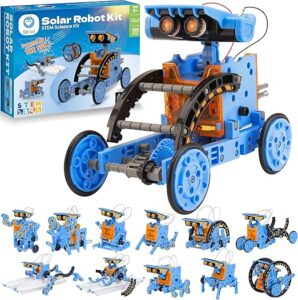
This variant of Sillbird’s 12-in-1 emphasizes its flexibility between solar and battery power. It’s almost identical to the standard 12-in-1, but the marketing highlights the battery backup capability. If you live in a climate with frequent overcast weather or want guaranteed entertainment on rainy days, this messaging matters. The kit functions identically to the standard 12-in-1 regardless of how it’s marketed.
The solar panel quality is unchanged. The dual-power capability is identical. You’re paying the same price for the same product. The only difference is packaging and product description. If you’re specifically seeking a kit that works indoors or on cloudy days, this variant’s marketing might reassure you. Functionally, you could buy either version and expect identical results.
We include this because it appears as a separate Amazon listing and some shoppers specifically search for “solar and battery” kits. Know that you’re getting the same mechanics as the standard 12-in-1. Choose based on current price and availability rather than perceived differences between variants.
Features
- 190 plastic pieces (identical to standard 12-in-1)
- 12 robot configurations
- Solar panel power
- AA battery backup (emphasized in this version)
- Non-toxic ABS plastic
- Step-by-step instructions
- Average build time: 20-45 minutes per config
- Recommended age: 8-13 years old
- Identical specs to standard 12-in-1
- Dual-power explicitly marketed
- Works reliably on sunny and cloudy days
- Not materially different from standard 12-in-1
- Similar price to the base model
- Doesn’t offer additional value
7. Educational Solar Robot Kits Generic Brand (Basic Option)
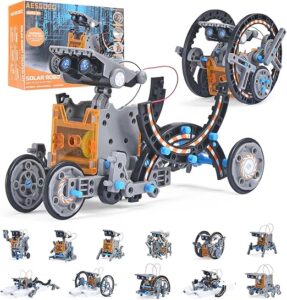
Some sellers offer basic solar robot kits with minimal configuration (4-8 builds) at rock-bottom prices. These are entry-level products that test whether a child has any interest in building and robotics before parents invest significantly. Build quality is adequate but noticeably lower than Sillbird or Bottleboom. Pieces fit loosely, and motors can be temperamental.
These basic kits work as introductory toys for younger children (6-8 years old). Assembly is simple enough that minimal instruction is needed. The solar panel is present but less responsive than quality kits. Battery power becomes essential on most days. Real-world durability is lower. Expect pieces to degrade or motors to fail after 20-30 builds.
Price ($15-25) reflects the lower quality. If you’re testing whether your child wants a solar robot kit, a basic option minimizes financial risk. If they engage well and ask for more, upgrade to Sillbird or Bottleboom. If they lose interest, you’ve invested minimally. This is a legitimate strategy for gift-giving uncertainty.
We don’t recommend basic kits as primary purchases for older children (10+). Kids that age deserve better build quality. The cheap kits frustrate experienced builders. For ages 8-10, the Hechify 6-in-1 offers a better value proposition than basic alternatives.
Features
- Approximately 80-100 plastic pieces
- 4-8 robot configurations
- Small solar panel (minimal power)
- AA batteries required for reliable operation
- Non-toxic plastic (though variable quality)
- Minimal instruction booklet
- Build time: 10-20 minutes per config
- Recommended age: 6-9 years old
- Lowest possible price point
- Good for testing child interest
- Simple assembly for very young kids
- Lower piece quality and durability
- Solar panel nearly ineffective
- Motor reliability questionable
8. STEM Solar Education Robot Kit Advanced Edition
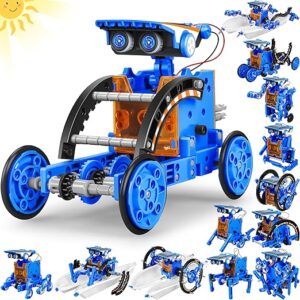
Some retailers stock advanced solar robot kits designed for ages 12+. These include more sophisticated mechanics, potentially solar tracking capabilities, and engineering challenges that appeal to experienced builders. Configuration counts are high (15-20+), and assembly complexity is genuinely challenging. Kids completing these kits gain meaningful engineering skills transferable to advanced robotics or science careers.
Advanced kits cost more and require sustained interest. These aren’t impulse gifts but rather targeted purchases for kids who are already deeply engaged with building and engineering. Parents considering advanced kits should assess their child’s track record with simpler kits first. A child who’s breezed through multiple 12-in-1 kits is a good candidate. A child with one kit is too early.
Documentation is more technical. Advanced kits often assume familiarity with robotics concepts. Kids completing basic kits will appreciate the intellectual stretch. Younger or less experienced builders may find advanced kits overwhelming and frustrating. The intended age range is genuinely 13+, and we’d recommend 14+ for optimal enjoyment.
Investment in an advanced kit is substantial but worthwhile for the right child. Educational depth is excellent. If your teen is considering engineering or science as a career path, an advanced solar robot kit reinforces concepts they’re learning in school.
Features
- 250+ plastic pieces
- 15-20+ advanced configurations
- Sophisticated motor and sensor integration
- Solar panel with tracking options
- Advanced instruction documentation
- Engineering challenges and experiments
- High assembly complexity
- Recommended age: 13+ years old
- Deep engineering education
- Challenges experienced builders appropriately
- High-quality materials and documentation
- Career-relevant skill building
- High price point
- Overwhelming for inexperienced builders
- Requires sustained focus and patience
Solar Robotic Kits Buying Guide
Key Takeaways
- Solar robot kits teach renewable energy and engineering through hands-on building, ideal for ages 7-14
- The Sillbird 12-in-1 is our top recommendation for balance of variety, quality, and educational value
- Budget options (6-in-1 or generic 14-in-1) work well for testing interest before investing in premium kits
- Most kits include solar panels plus AA battery backup, allowing play on cloudy days and indoors
- Advanced kits (15-20+ configurations) suit experienced builders ages 13+ and teach sophisticated engineering
What Are Solar Robotic Kits?
Solar robotic kits are educational toys that teach renewable energy and engineering by letting kids build and customize working robots powered by solar panels. Each kit includes 100-250 plastic pieces that snap together without glue or tools. Kids follow instructions to construct specific robot designs, then test them in sunlight or with battery backup. Most kits include 6-21 different robot configurations, encouraging repeated disassembly, problem-solving, and rebuilding.
The educational premise is brilliant. Instead of lecturing about solar energy conversion, kids experience it directly. Watch a robot move slowly in dim light, then race across the floor in bright sun, and suddenly photovoltaic conversion becomes tangible. Similarly, building different mechanical configurations teaches cause-and-effect relationships and engineering problem-solving.
How Do Solar Robotic Kits Work?
Solar robot kits function through three core components: a small photovoltaic panel, an electric motor, and a mechanical structure. The solar panel converts sunlight into electrical current. That current powers the electric motor, which rotates gears and drives wheels or legs. Different mechanical configurations determine how that rotational energy translates into movement. A walking robot’s legs amplify the motor’s rotation into walking motion. A boat’s propeller translates rotation into propulsion.
Battery backup is important. Even quality solar panels generate limited power from indoor light or cloudy skies. AA batteries ensure robots function indoors and on rainy days. Most kits include a simple switch between solar and battery power. This is a clever educational design choice that extends play while also demonstrating that solar alone isn’t sufficient year-round in many climates.
Assembly is non-permanent. Pieces snap together and separate repeatedly without damage. Kids disassemble one robot to build another using the same 190-211 pieces in different configurations. This is the kit’s main advantage over building a single static model.
Benefits of Using Solar Robotic Kits
Hands-on STEM learning is the primary benefit. Kids internalize engineering principles through building and testing rather than passively reading or listening. They learn about gears, energy conversion, motors, and mechanical advantage by experiencing them. This direct engagement creates deeper understanding than classroom instruction alone.
Renewable energy awareness is developed naturally. Most kids have vague notions that solar power exists. Building a robot powered by sunlight transforms that abstract concept into concrete understanding. They see the relationship between light intensity and motor speed. They observe that the same robot moves differently indoors versus outdoors. These observations plant seeds for later academic learning about energy physics.
Problem-solving skills are practiced constantly. Assembly challenges, troubleshooting when a robot doesn’t move as expected, and optimizing a build for specific outcomes all involve analytical thinking. Kids who complete multiple kits develop systematic debugging habits and creative problem-solving approaches applicable far beyond robotics.
Sustained focus and patience are built through longer projects. Screen time and instant gratification are the norm for many kids. Spending an hour thoughtfully assembling a robot requires sustained attention and delayed gratification. Completing a challenging build delivers genuine accomplishment that’s more meaningful than digital achievements.
Engineering careers become more visible as career options. Kids who discover they love building and creating often become interested in engineering, robotics, and renewable energy as potential career paths. A solar robot kit is a gateway to these fields.
Age Range and Complexity: Matching the Kit to the Builder
Solar robotic kits vary considerably in difficulty level, and the age rating on the box is worth paying attention to. Entry-level kits aimed at ages 8 to 10 use snap-together or clip-based assembly that requires no tools and teaches basic cause-and-effect relationships between sunlight and motion. These are good first experiences with solar for younger children but will bore a teenager or adult in an afternoon. More complex kits rated for ages 12 and up introduce gear systems, weighted links, and mechanical timing that require patience and problem-solving skills — a much better fit for buyers who want a genuine STEM challenge rather than a quick build.
Adult and advanced kits, including multi-mode kits that can be reconfigured into different robot designs, offer significantly more build time and replayability. If the buyer is a middle schooler or older who likes building and engineering, a multi-mode kit with 12 or more configurations represents far better value than a simple single-build kit. The additional cost is usually modest — often $10 to $20 more — but the educational content is substantially deeper.
One practical consideration for gift purchases: check whether the kit requires any additional tools (small Phillips screwdriver, needle-nose pliers) before wrapping it. Most entry-level kits are tool-free, but higher-complexity kits often require basic tools that aren’t included. Nothing deflates the excitement of a gift faster than having to pause the build to hunt for a screwdriver that should have been in the box.
Indoor vs. Outdoor Use and the Solar Panel Reality
Most solar robotic kits are designed primarily for outdoor use, and their solar panel size reflects this. A small monocrystalline cell roughly 2 by 3 inches — standard on kits in the $15 to $40 range — produces enough current to drive a lightweight robot in direct sunlight, but will stall or run sluggishly indoors under standard room lighting. If you’re buying for a child who will likely play with the kit indoors, check whether the kit includes a battery backup mode or can be powered via USB. Kits that rely purely on the solar cell are genuinely solar-educational but frustrating in cloudy climates or indoor spaces.
Some higher-end kits include a dual-power option: a solar cell for outdoor use and a standard AA battery holder for indoor use. This design is more practical for year-round engagement, particularly in northern states where outdoor sunshine is limited in winter months. The dual-power design doesn’t compromise the solar education component — the child can still observe and experiment with the solar-to-motion relationship by comparing panel output in sun versus shade.
For classroom or educational settings, the indoor usability issue becomes more critical. Teachers using solar kits in a classroom need reliable operation under fluorescent or LED ceiling lights, which most small solar cells don’t handle well without supplemental light sources. For classroom deployment, look for kits with larger panel areas or that support battery operation as a fallback — otherwise you’re dependent on sunny window access which isn’t always available.
Things to Keep in Mind Before Buying
Assembly help may be needed. Younger kids (7-9) often require adult assistance with motor installation and complex connections. Older kids (11+) typically manage solo assembly. Factor in your willingness to help as part of the decision. If you prefer completely independent play, larger kids or simpler kits are better matches.
Storage space is required. 190+ pieces demand organization. Most kits don’t include storage boxes. Investing in clear plastic bins keeps pieces sorted and easy to locate. Without organization, finding specific pieces for different builds becomes frustrating.
Solar power is weather-dependent. Even quality solar panels need direct or bright indirect light. Cloudy days and dim indoor areas reduce motor speed significantly. Battery backup mitigates this, but know that sunshine produces noticeably better performance. Kids quickly learn this reality, which is actually good education about solar energy limitations.
Motor durability varies. Most kits include reliable motors good for dozens of builds. Some budget kits have fragile motors that fail after 20-30 uses. Quality kits (Sillbird, Bottleboom) have robust motors that reliably outlast kids’ interest in the kit.
Initial investment is meaningful. Quality kits ($40-80) are genuine money. You want to ensure your child is genuinely interested in building before investing in the deluxe 21-in-1. Starting with a smaller kit or testing with a borrowed kit from a friend is smart strategy.
Types of Solar Robotic Kits
Entry-level kits (4-8 configurations) are best for ages 6-8 or as true introductory products. They’re simpler to assemble and less expensive. Engagement is shorter but adequate for testing interest.
Mid-range kits (12-14 configurations) suit ages 8-12 and offer the best value. Variety keeps kids engaged for weeks or months. Quality is consistently good across brands. This category is where we recommend most parents invest.
Premium kits (15-21+ configurations) appeal to ages 10+, especially experienced builders. Assembly complexity is higher, and the educational depth is greater. These are gifts for kids who’ve already demonstrated sustained interest in robotics and building.
Solar power is universal across all kits. Every kit includes a solar panel and battery backup. The difference is mechanical complexity and configuration variety, not power source.
Frequently Asked Questions
Entry-level kits (6-8 configurations) suit ages 6-8. Mid-range kits (12-14 configurations) are ideal for ages 8-12. Advanced kits are best for ages 13+. Most children ages 8-11 engage most successfully with 12-in-1 kits.
Yes, with battery backup. The included solar panel generates minimal power from indoor light. AA batteries provide reliable power indoors and on cloudy days. Direct sunlight outdoors produces noticeably better performance.
It depends on the kit. Entry kits offer 4-8 configurations. Mid-range kits offer 12-14. Premium kits offer 15-21+. Each configuration uses the same pieces in different arrangements.
Typical assembly takes 20-45 minutes per robot configuration, depending on complexity and the child’s age. Younger kids take longer. Kids who’ve built multiple configurations become faster with practice.
Most kids ages 9+ can assemble most configurations with minimal help. Motor installation sometimes requires adult assistance. Younger kids (7-8) typically need more help but can participate meaningfully.
Quality kits (Sillbird, Bottleboom) use durable non-toxic ABS plastic that survives dozens of assembly cycles without degradation. Budget kits have lower durability. Pieces from quality kits remain functional and unscarred after years of use.
Manufacturers typically don’t sell replacement pieces individually. Plan for normal wear and keep organized pieces. Most kits include extra pieces to account for losses. Break one or two pieces and the kit still functions with most configurations.
The Sillbird 12-in-1 is the best beginner kit. It offers excellent balance of variety, quality, and educational value. If budget is limited, the Hechify 6-in-1 or generic 14-in-1 are solid alternatives. Avoid basic ultra-cheap kits for a first purchase.
Summing Up
Solar robotic kits combine education, engineering, renewable energy learning, and hands-on fun. Whether your goal is homework enrichment, a memorable gift, or fostering interest in science and engineering careers, these kits deliver value. The Sillbird 12-in-1 offers the best overall balance of quality, variety, and price. The Hechify 6-in-1 works well as a starter kit or test of interest. The Sillbird 21-in-1 suits experienced builders seeking sustained challenge.
If you’re also thinking about solar panels for your home, call (855) 427-0058 for a free quote — it takes just a few minutes to find out what installation would cost and save you in your area.
Updated