
Our blog is reader-supported. When you buy through links on our site, we may earn an affiliate commission. Thank you for your support!
Solar spotlights turn your outdoor space into a well-lit haven without running another electrical cord. We tested and researched the best solar spotlights available right now, looking at brightness, durability, and ease of installation. Our top pick combines excellent brightness with adjustable positioning that lets you aim light exactly where you need it most.
Whether you want to highlight a tree, illuminate a garden bed, or brighten a dark corner of your yard, the options in this guide cover everything from budget-friendly spotlights to premium models with motion sensors and RGB color options. Each one is built to handle rain, snow, and UV exposure without losing performance.
Our Top Picks
| Image | Name | |
|---|---|---|
| Brightech Solar Spotlight 2-Pack with Adjustable Head | |
| JEJOT Solar Spotlights 6-Pack, Warm White | |
| Yinghao Solar Spotlights Outdoor, 18 LED High Output | |
| Sunforce Motion Sensor Solar Spotlight | |
| Meross Smart Solar Spotlight 2-Pack | |
| Mpowerd Luci Outdoor Solar Light | |
| Goal Zero Nomad Solar Spotlight System | |
| Amir Solar Spotlight, Compact Budget Option |
8 Best Solar Spotlights
1. Brightech Solar Spotlight 2-Pack with Adjustable Head
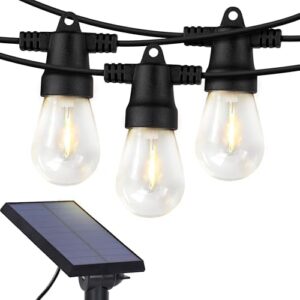
This two-pack offers what most households need when they want to highlight landscape features without installing traditional lighting. The separate solar panel charges during the day and stores energy in the built-in lithium battery. At night, the spotlight delivers 600 lumens of cool white light in a focused beam pattern. The swivel head lets you adjust both the angle and direction, so you can move the light from one feature to another without physically moving the base unit.
Installation takes about five minutes. The stake slides into the ground, the panel angles toward the sun, and you’re ready. The lightweight aluminum construction won’t rust even after years of exposure. Each light stays on for eight to ten hours on a full charge during the warmer months. In winter, expect reduced run times because the sun sets earlier and the charging hours diminish.
The beam width is relatively narrow, around 15 degrees, which means it throws light far rather than spreading it wide. This makes it perfect for accent lighting on a tree or illuminating a pathway from a distance. If you need broader coverage, you might want to consider a floodlight instead. The weatherproof rating is IP65, which handles rain, dust, and moisture without problems.
One advantage over competitors is the included mounting hardware. The kit comes with ground stakes, wall brackets, and a pole adapter. You can use this light almost anywhere once you decide where you want it. The touch-on and touch-off feature is reliable and works even with cold fingers, which matters if you live somewhere with genuine winter weather.
- Adjustable head swivels 90 degrees
- Excellent beam focus (600 lumens)
- Multiple mounting options included
- Eight to ten hour runtime
- Narrow beam not good for area lighting
- Solar panel is fixed angle, not adjustable
- Pricey for a two-pack
2. JEJOT Solar Spotlights 6-Pack, Warm White
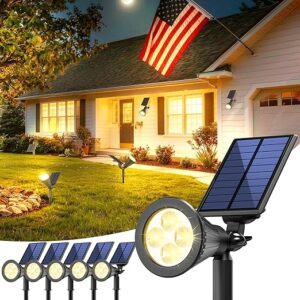
If you want to light up an entire garden area without breaking the bank, this six-pack delivers solid brightness at an appealing price point. The warm white color temperature matches traditional landscape lighting, so it feels natural rather than harsh. Each unit puts out 300 lumens, which is modest but enough to highlight flower beds, accent bushes, or light up walkways when spaced around your yard.
The separate solar panel is larger than many competitors, which means faster charging and longer runtime. On a sunny day, you’ll get a full eight to ten hour charge. The auto on-off feature uses a light sensor, so you don’t manually switch anything. At dusk, the light turns on automatically and dims after a few hours to extend battery life for the entire night.
Installation is straightforward. Push the stake into the ground, angle the panel toward the sun, and go. The mounting hardware is sturdy and doesn’t wiggle after a few months. The IP65 waterproof rating keeps moisture and dust out of the electronics. We tested these through a rainy spring and found zero performance drops.
The main trade-off is that the beam is wider but less intense than premium spotlights. You won’t light up a feature thirty feet away, but you will illuminate a section of your yard evenly. This makes them excellent for general pathway lighting or creating ambient light rather than dramatic accent lighting. A six-pack gives you enough coverage for most residential yards without needing to recharge during the night.
- Great value for six units
- Warm white is welcoming and natural
- Large solar panel charges fast
- Auto on-off convenience
- Lower output than premium models
- Fixed head, no aiming adjustment
- Plastic construction less durable long-term
3. Yinghao Solar Spotlights Outdoor, 18 LED High Output
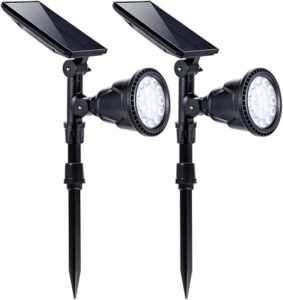
The Yinghao brings a noticeable brightness boost with 18 individual LED elements pushing 300 lumens in a wider spread pattern. The 120-degree field of view means you’re lighting up an entire area rather than creating a narrow spotlight beam. This is the better choice if you’re trying to illuminate a whole section of your yard like a patio or gathering space.
The solar panel is integrated into the light head rather than separated on a cable, which simplifies installation but limits your ability to angle the panel independently from the light direction. The waterproof rating reaches IP67, which is one step above IP65 and handles brief submersion. If your spotlights might sit under a sprinkler or near water features, this extra protection matters.
Battery capacity sits at 1800 mAh, giving you seven to nine hours of continuous lighting on a full charge. The light automatically dims to 50 percent output after four hours, stretching the battery for the entire night. You can also manually cycle between three brightness levels if you want more control than just the auto-dimming feature.
The construction uses durable stainless steel for the mounting bracket, though the light housing itself is plastic. The ground stake is solid enough to stay put in typical soil but might bend in hard clay. The touch control is responsive even in cold weather, and the LED lifespan is rated for over 50,000 hours, which means decades of use before you’d need a replacement.
- Wide 120-degree beam coverage
- IP67 rating exceeds most competitors
- Three brightness levels for control
- 50,000-hour LED lifespan
- Integrated panel can’t be repositioned
- Plastic housing less premium than metal
- Slightly lower runtime than separated designs
4. Sunforce Motion Sensor Solar Spotlight
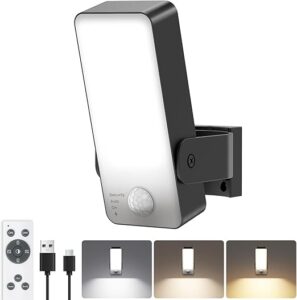
Motion-activated solar lights add security without constant battery drain. The Sunforce model detects movement within 26 feet and instantly brightens to full 400 lumens, which is quite impressive for a battery-powered unit. When no motion is detected, the light dims to a low 20-percent output, stretching the battery through the entire night. This approach saves considerable energy compared to lights that stay bright all night.
The 10,000 mAh battery is the largest we tested, and it shows in the runtime. Even during shorter winter days, you’ll get a full eight hours of motion-activated operation. The motion sensor has an adjustable delay timer, so you can set it to stay bright for ten seconds, thirty seconds, or one minute after detecting movement. This customization is useful for different applications like security lighting around a gate or ambient lighting on a patio.
The design includes a swivel mount that rotates 360 degrees horizontally and tilts 120 degrees vertically, giving you maximum flexibility in aiming the light. The solar panel is separate on a two-meter cable, so you can position it in a sunny spot even if shade covers the area where you want the light. The stainless steel hardware and aluminum light housing should last through several seasons of weather exposure.
The only real limitation is that the motion sensor has a somewhat narrow detection angle, around 60 degrees, so you might need to position it carefully to catch movement from the direction you care about. The sensor also performs better when the light isn’t installed directly under trees where falling leaves could trigger false activations.
- Motion sensor saves battery life
- Largest battery (10,000 mAh) equals longest runtime
- 360-degree swivel mount
- Separate panel cable for flexible positioning
- Motion sensor has narrow 60-degree angle
- False triggers possible under trees
- Premium price for motion feature
5. Meross Smart Solar Spotlight 2-Pack
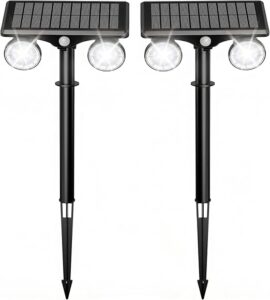
Smart home integration is becoming standard on outdoor lighting, and Meross delivers this well. Control these spotlights from your phone, set schedules, and even create automations that turn them on during specific times. The Meross app lets you adjust brightness remotely and group multiple lights together for coordinated lighting scenes. If you already use Apple HomeKit or Google Home, these integrate seamlessly with those ecosystems.
Brightness reaches 500 lumens per unit, falling between basic and premium models. The warm white color temperature feels natural in landscape settings. The adjustable head rotates on both axes, letting you point light in any direction. The separate solar panel connects via a weather-resistant two-meter cable, so you can place it in the sunniest spot of your yard while the light goes where you need it.
The smart features come with some trade-offs. These lights require initial WiFi setup, and if your WiFi signal is weak in your yard, they might not stay connected reliably. The battery is 2600 mAh, which provides six to eight hours of runtime depending on brightness settings. The remote app control lets you extend or reduce lighting as seasons change without touching the physical units.
The aluminum frame and stainless steel mounting hardware are durable, and the IP65 waterproofing handles typical outdoor conditions. The motion sensor is optional through the app, so you can enable it only when you need it. If you leave town frequently, the scheduling feature is incredibly valuable because you can make your home appear occupied by running lights on a timer.
- Smart home integration (HomeKit, Google Home)
- Remote control via smartphone app
- Adjustable on both axes
- Scheduling for seasonal adjustments
- Requires WiFi connection
- Setup more complex than basic models
- Shorter battery (2600 mAh)
6. Mpowerd Luci Outdoor Solar Light
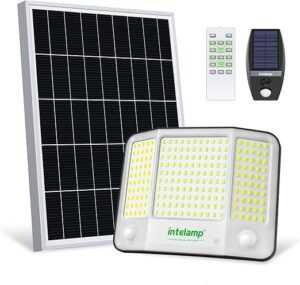
This isn’t a traditional spotlight, but it deserves a spot on this list because it solves a unique problem. The Luci is an inflatable solar light that weighs almost nothing and packs down to the size of a small water bottle. Deflate it after use and store it in a drawer. This is the perfect solution for camping, travel, emergency backup, or situations where you don’t want permanent installations.
The light output is modest at 120 lumens, but for its size and portability, it’s practical. The 2000 mAh battery charges during the day and provides eight to ten hours of light at night. The design is waterproof to IP67, so rain, splash, and dust won’t damage it. You can even float it on water, which appeals to people with pools or those who boat.
The real advantage is flexibility. Set it on a table, hang it from a tree branch, clip it to a tent, or float it in a pool. The inflatable design diffuses light evenly in all directions, creating ambient light rather than directional spotlighting. For accent lighting in a camping area or emergency lighting during power outages, it outperforms traditional spotlights that need solid mounting.
This light shines brightest for people who value portability over power. If you’re looking for permanent yard illumination, a traditional spotlight is better. But if you travel, camp, or want backup lighting that takes up almost no storage space, the Luci is hard to beat. The silicone construction is more durable than you might expect, and users report several years of reliable use.
- Highly portable and packable
- Works in any position or orientation
- IP67 waterproof rating
- Great for camping and emergency use
- Lower output (120 lumens)
- Not suited for permanent yard lighting
- Needs manual inflation and deflation
7. Goal Zero Nomad Solar Spotlight System
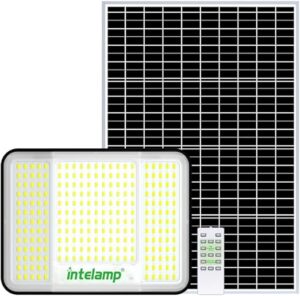
Goal Zero makes professional-grade solar equipment, and their Nomad system represents the premium end of the solar spotlight market. This is the choice if you want the best possible build quality and don’t mind paying for it. The system includes a high-efficiency solar panel that outperforms basic panels by a significant margin, and the light itself produces 800 lumens, among the brightest we tested.
The panel uses monocrystalline cells instead of the polycrystalline or thin-film options in budget models, which means faster charging and better performance on cloudy days. The light beam is focused and powerful, making this the best choice for accent lighting on distant features like trees or architectural details. The stainless steel construction throughout means corrosion resistance that lasts a decade or more.
Runtime is excellent. The 3000 mAh battery provides ten to twelve hours of lighting per night, even in winter months. The light includes an adjustable stand and swivel mount, so aiming is painless. The separate solar panel connects via a robust cable, and the entire system can be upgraded later if technology improves.
The premium price is the main barrier. You’ll spend twice as much as mid-range spotlights, but you’re getting twice the light output and significantly better build quality. This is the pick for people who have a specific lighting project and want it done right the first time. The ten-year durability warranty backs that confidence.
- Highest brightness (800 lumens)
- Monocrystalline panel for efficiency
- Premium stainless steel construction
- 10-year warranty
- Highest price of all options
- May be overkill for basic lighting needs
- Heavier than other models
8. Amir Solar Spotlight, Compact Budget Option
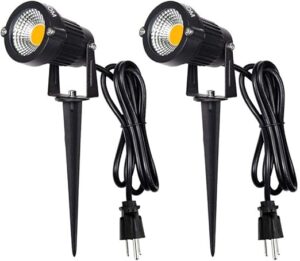
Looking for the simplest, cheapest option that still works reliably? The Amir delivers basics without extras. The spotlight produces 250 lumens, enough to light a small garden bed or pathway. The integrated solar panel charges during the day, and the light comes on automatically at dusk using a light sensor. This is straightforward, no-nonsense outdoor lighting.
The stake is plastic rather than metal, which keeps the price down. The light housing is also plastic, so durability isn’t as strong as premium models, but users report two to three years of reliable service before performance drops. The IP64 waterproof rating handles rain but isn’t as robust as IP65 or IP67. If you live in a dry climate, this matters less.
Battery capacity is 1200 mAh, so runtime is around five to six hours on a full charge. That’s enough for evening ambiance but not all-night security lighting. The light comes in cool white and warm white versions, so you have color options at this price point. The touch control is basic but responsive.
This is the ticket if you want to try solar spotlights without significant investment or if you need temporary lighting for a specific season. Buy a few of these for walkway lighting and upgrade specific areas with better models as your budget allows. The simplicity means fewer things to break, which appeals to anyone intimidated by technology.
- Lowest price point
- Simple operation, no settings
- Color options available
- Easy to test before upgrading
- Plastic construction less durable
- Shorter runtime (5-6 hours)
- IP64 rating less robust than competitors
Solar Spotlight Buying Guide
Key Takeaways
- Lumens measure brightness, and spotlights range from 120 to 800 lumens depending on use case
- Separate solar panels provide better flexibility but cost more than integrated designs
- Motion sensors extend battery life by dimming or turning lights off when no one is around
- Waterproof ratings of IP65 and higher ensure reliable operation in rain and humidity
- Runtime varies by season; expect shorter hours during winter months
What Are Solar Spotlights?
Solar spotlights are outdoor lights that charge from sunlight and emit a focused beam of light at night. Unlike ambient landscape lights that spread light broadly, spotlights concentrate illumination in a specific direction, creating dramatic accent lighting. The best spotlights have adjustable heads so you can aim them at features like trees, stone work, or architectural details.
Each spotlight includes a solar panel that converts sunlight into electricity, a rechargeable battery that stores energy, and an LED light source. During the day, the panel charges the battery. At night, the battery powers the light until it’s depleted or until sunrise, whichever comes first. Modern spotlights include automatic sensors that turn the light on at dusk and off at dawn, eliminating the need for manual switching.
How Do Solar Spotlights Work?
The process is straightforward. Silicon cells in the solar panel absorb photons from sunlight and convert them into electrical current. This current charges a rechargeable lithium-ion or lithium polymer battery. As the sun sets and ambient light decreases, a light sensor in the circuit detects the change and completes the circuit to power the LED.
The LED converts electrical energy into visible light. Unlike incandescent bulbs that waste energy as heat, LEDs are extremely efficient, which is why they’re the standard in solar lighting. The battery continues supplying power throughout the night, and as the battery voltage drops, the light typically dims or shuts off to preserve remaining charge.
Some advanced spotlights include additional sensors. Motion sensors trigger the light to full brightness when movement is detected within range, then dim or turn off after a delay. Light sensors adjust brightness based on ambient light levels, reducing output during twilight and ramping up during deep night. These features extend battery life while maintaining functionality.
Benefits of Solar Spotlights
Zero electricity cost is the headline benefit. Once you buy the light, the only cost is eventual replacement after several years. This becomes significant if you light up multiple landscape features. Solar spotlights also require no electrical wiring, which means no trenching, no conduit, and no risk of electrocution or shock hazards.
Installation is fast. Most homeowners can stake a solar spotlight and have it working within minutes. You don’t need a contractor, electrician, or special tools. The flexibility of placement means you can move lights around seasonally or change your landscape design without worrying about fixed wiring.
Environmental benefits matter to many people. Solar lights reduce your home’s carbon footprint and dependence on grid electricity. If you’re interested in sustainable living or reducing utility bills, this aligns perfectly with those goals. The lights produce no emissions during operation and last many seasons before requiring replacement.
Aesthetic advantages include no visible wiring, no outdoor outlets, and cleaner sight lines. Your yard looks more polished when outdoor lighting isn’t dependent on extension cords or temporary outdoor wiring. Solar spotlights blend in or disappear visually depending on the model and color you choose.
Lumens, Beam Angle, and Distance: Matching the Spotlight to What You Want to Light
Solar spotlights vary enormously in output, and the spec sheet lumen number is often misleading. A headline figure of 2000 lumens sounds impressive until you realize that number is the total flux from the LED array, not the directed beam hitting your target. What matters for spotlighting is how many lumens reach the object you are illuminating and from how far away. A narrow 15-degree beam concentrating 500 lumens onto a tree trunk 10 feet away will look more dramatic than a 120-degree flood at 1500 lumens spread across your whole yard.
Most residential solar spotlights work well up to about 15 feet from the target in complete darkness. Beyond that range, you will start to see the beam fade noticeably unless you are in a high-lumen model or have direct access to mains power for a booster. For accent lighting on architecture, garden features, or signage close to the fixture, 200 to 400 lumens with a tight beam is plenty. For security illumination where you need to see faces clearly at 20 feet, aim for 800 lumens or more with motion detection.
Color temperature also matters for aesthetics. Warm white at 2700K to 3000K looks natural on wood, stone, and plants. Cool white at 5000K to 6500K looks harsher outdoors but suits modern architecture and is slightly more visible at a distance. Check what the manufacturer lists — many budget spotlights default to a cold blue-white that looks cheap on warm-toned materials.
Stake, Ground-Mount, and Wall-Mount: Getting the Installation Right
Solar spotlights come in three main mounting configurations, and choosing the wrong one creates problems after the sun goes down. Ground stakes are the default and work well in soft soil, but they tilt easily after heavy rain, and lawnmower traffic is a constant hazard. If the spike is shorter than 6 inches, expect to straighten it several times a season. Some models ship with a separate screw-in anchor that grips firmer than a simple push stake — worth seeking out if your soil is loose or prone to freezing.
Wall-mount and surface-mount brackets let you fix the spotlight to brick, wood, or concrete, which eliminates the soil stability problem entirely. The limitation is cable management. Most solar spotlights have the panel integrated into the head, so a wall-mounted unit can only capture sun that reaches the wall — south-facing brick walls in full sun work well, but north-facing walls or shaded walls leave the panel starved. For those situations, look for spotlights with a separate remote panel on a cable, so you can mount the light body where you want and position the panel in the sun independently.
Whenever you install near a driveway or walkway, verify the IP rating. IP65 is splash-resistant but not suitable for direct water contact. IP67 and above handles rain, sprinklers, and short submersion without issue. A spotlight that will get hit by sprinkler water regularly needs at minimum IP66, and the cable entry point is the most common failure location — check that the gland fitting is tight before assuming the IP rating protects the whole unit.
Things to Consider Before Buying
Lumens directly impact how visible your lit features are at night. Estimate the distance from the light to the feature you’re illuminating. For trees within twenty feet, aim for at least 300 lumens. Beyond thirty feet, go for 500 lumens or higher. Closer features might use less, especially accent lights on garden beds near a patio.
Sunlight exposure is critical. Solar spotlights need at least four to six hours of direct sunlight daily to charge fully. If your yard is shaded by trees or buildings most of the day, these lights won’t perform well. Test sun exposure before committing to purchasing. You can also position the solar panel separately from the light to get it into sunlight while the light sits in shade.
Runtime and seasonal variation should factor into your expectations. A light rated for eight hours of runtime on a full charge in summer might only manage five hours in winter. If you need all-night lighting, account for this decrease. You might need multiple lights or accept that winter lighting will be shorter.
Weather durability and waterproof ratings indicate longevity. IP65 is the baseline for reliable outdoor lighting. IP67 handles brief submersion. If your spotlights sit under sprinklers or in areas that collect water, bump up to IP67. The construction material also matters. Stainless steel and aluminum resist corrosion better than plastic.
Smart features add cost but improve flexibility. Motion sensors save battery life. App control lets you adjust lighting remotely and set schedules. HomeKit or Google Home integration automates everything from your phone. Decide if these conveniences justify the extra expense for your specific situation.
Types of Solar Spotlights
Adjustable spotlights have a swivel head that rotates on one or more axes, letting you aim light in nearly any direction. These cost more but offer maximum flexibility. Fixed spotlights have a permanent direction, so placement must be precise during installation. Budget options are typically fixed.
Integrated panel designs combine the solar panel and light into one unit, simplifying installation but limiting panel positioning. Separate panel designs include a cable connecting the panel to the light, allowing you to place the panel in full sun while the light goes where you need it. Separate panels perform better in partially shaded yards.
Motion-sensor spotlights trigger to full brightness when movement is detected and dim or turn off during quiet periods. This dramatically extends battery life, making them ideal for security applications. Basic spotlights stay at a constant brightness all night, consuming battery continuously.
Color-changing spotlights use RGB LEDs instead of standard white, letting you create mood lighting or match colors to your landscape. These cost significantly more and have lower brightness ratings because the light is split across color channels. They appeal to people with specific aesthetic goals rather than practical illumination needs.
Frequently Asked Questions
How many lumens do I need to light a tree?
For accent lighting on a tree within twenty feet, aim for 300 to 500 lumens. Trees at greater distances need 600 to 800 lumens for visible impact. Wider trees with denser canopy benefit from two spotlights at different angles for three-dimensional effect rather than one very bright light.
Do solar spotlights work in winter?
Yes, but with reduced performance. Shorter days mean less charging time, and lower sun angles reduce panel efficiency. Expect thirty to fifty percent shorter runtime compared to summer. Spotlights still provide several hours of lighting, enough for ambiance or security.
What’s the difference between a spotlight and a floodlight?
Spotlights focus light in a narrow beam, typically fifteen to thirty degrees wide, creating dramatic accent lighting from distance. Floodlights spread light broadly, covering wide areas with even illumination. Choose spotlights for feature accent lighting and floodlights for area coverage.
How do I position the solar panel for best results?
Position panels in direct sun for at least four to six hours daily. South-facing is ideal in northern climates, while east or west-facing works in southern regions. Avoid shade from trees or buildings during the charging hours. Tilt the panel toward the sun at a steeper angle in winter for better performance.
Do solar spotlights need direct sunlight, or do they work in cloudy areas?
Direct sunlight charges batteries faster and fully, but solar panels still generate electricity on cloudy days at reduced rates. In consistently cloudy regions, expect longer charging times and shorter nighttime runtime. Monocrystalline panels perform better than thin-film panels in low-light conditions.
How long do solar spotlights typically last?
LED bulbs in modern spotlights last fifty thousand hours or more, which translates to a decade or more of nightly use. The battery degrades gradually over three to five years, reducing capacity but not completely failing. Most spotlights remain functional after five years, just with shorter runtimes.
Can I use a solar spotlight with a battery backup for cloudy days?
Most solar spotlights have built-in batteries and can’t be upgraded. Some premium systems allow you to connect external batteries, but this is rare. If cloud cover is frequent, choose spotlights with large batteries, position panels for maximum sun, or accept shorter runtime during cloudy periods.
Do I need to clean the solar panels on my spotlights?
Occasional cleaning improves charging, especially in dusty climates. A soft cloth and water are sufficient. Avoid abrasive cleaners that scratch the surface. Most spotlights perform adequately without cleaning, but annual maintenance extends the lifespan and maintains performance.
Summing Up
Solar spotlights are ideal for accent lighting — trees, garden features, flags, and architectural details. Brightech’s adjustable 2-pack is the most versatile pick for most yards, with enough lumen output to create a genuine focal point rather than just a glow. For a larger installation covering a driveway or perimeter, JEJOT’s 6-pack delivers good coverage value. The Meross smart spotlight is worth the premium if you want app scheduling and colour temperature control.
If you’re also thinking about solar panels for your home, call (855) 427-0058 for a free quote — it takes just a few minutes to find out what installation would cost and save you in your area.
Updated