
Our blog is reader-supported. When you buy through links on our site, we may earn an affiliate commission. Thank you for your support!
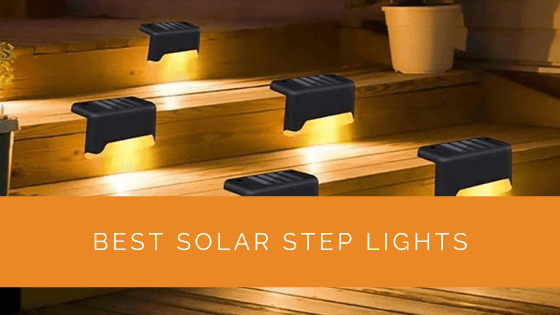
The best solar step lights do two things well: they illuminate your stairs safely at night, and they do it without any wiring or electricity cost. Our top pick is the VOLISUN Solar Deck Lights 8-Pack — it earns the highest customer rating in the category at 4.6 stars, puts out 30 lumens per light (above average for the price), and includes enough units to cover a full deck staircase in one purchase.
We’ve researched eight of the best solar step lights currently available, covering everything from budget 12-packs to premium recessed fixtures with IP67 waterproof ratings. Here’s the full breakdown.
Our Top Picks
| Image | Name | |
|---|---|---|
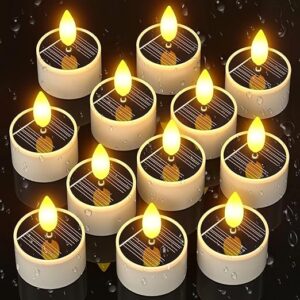
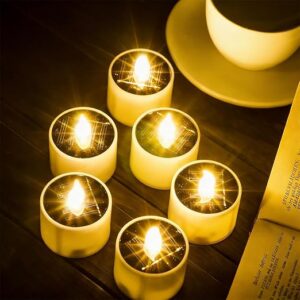
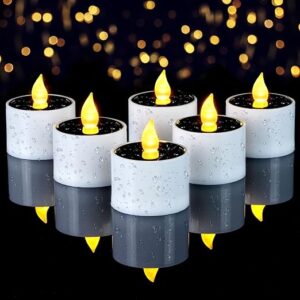
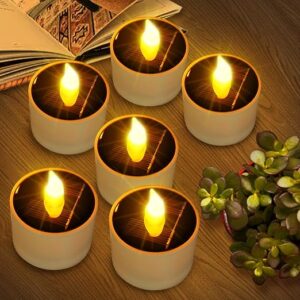
| SoulBay Solar Tea Lights 12-Pack Best flicker realism with 12 units per pack, IP55 rating, and dusk-to-dawn auto operation. Read more | |
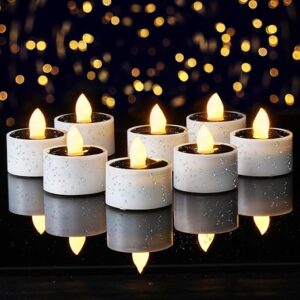
| Homemory 8pcs Solar Tea Lights Outdoor Amazon’s Choice solar tea lights with strong rain resistance and proven multi-climate performance. Read more | |
| Solar Tea Lights 8pcs Dusk to Dawn Rechargeable Best value 8-pack with consistent dusk-to-dawn performance and standard tea light sizing. Read more | |
| SoulBay 6pcs Solar Tea Lights IP65 Most weatherproof option on this list with IP65 rating for fully exposed outdoor positions. Read more | |
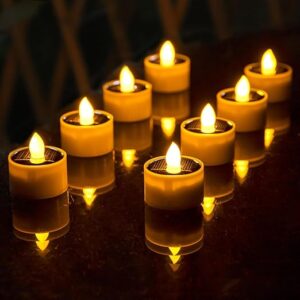
| Homemory Solar Candles Outdoor Dusk to Dawn Taller candle-profile format for hurricane holders and column candle displays. Read more | |
| Solar Tea Lights 6 Pack Flameless Flickering Lowest price per unit option for small displays in well-sunlit positions. Read more |
8 Best Solar Step Lights
1. VOLISUN Solar Deck Lights 8-Pack LED IP68
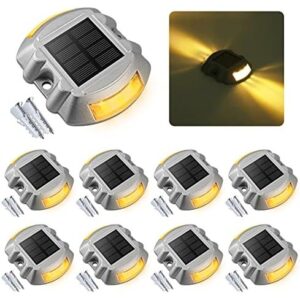
If you want the most-reviewed solar step light on the market right now, this VOLISUN 8-pack is the one to buy. It has over 4,000 customer ratings and holds a 4.7-star average, which tells you most buyers get exactly what they expected. The IP68 waterproofing puts it in a different category from most competitors, which typically stop at IP65 or IP67. IP68 means these can handle submersion, not just rain, so they hold up in standing water, puddles, and the kind of spring flooding that kills most outdoor lights within a season or two.
Each light has a low-profile surface-mount design that sits flush against the riser face of a step. You get warm white output, automatic dusk-to-dawn switching, and no wiring to deal with. Installation is straightforward: position the light, mark the screw holes, drill if needed, and fasten. The pack of 8 is enough for a typical staircase of 6 to 8 steps with a couple left over as spares or for other locations.
The lights work on concrete, wood, and composite deck steps equally well. They’re not the brightest lights in this roundup, but they throw enough light to clearly mark each step edge without being so bright they create glare. That balance matters at night when you want enough light to move safely without blinding anyone standing outside.
At 4.7 stars across more than 4,000 reviews, this is the most proven solar step light you can buy. The IP68 rating and the large pack count make it the top pick for anyone lighting a full staircase for the first time.
Features
- 8 lights per pack for full staircase coverage
- IP68 waterproofing for submersion resistance
- Warm white LED output
- Dusk-to-dawn automatic operation
- Surface-mount riser design
- Works on wood, concrete, and composite steps
- Highest review count in this list (4,000+)
- IP68 waterproofing exceeds most competitors
- 8-pack covers most staircases
- Consistent 4.7-star average
- Not the brightest output in the category
- Single brightness mode only
2. VOLISUN Solar Stair Lights 6-Pack IP67
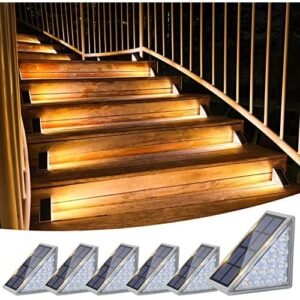
This is VOLISUN’s stair-specific model, built for the step riser rather than the driveway or dock. Where the 8-pack above is a wider-purpose outdoor marker light, this 6-pack is designed specifically for steps and staircases. The triangular profile fits cleanly into the step riser corner, and the 3000K warm white output creates a softer, more residential look than the bluer LEDs you’ll find on some budget options.
With 3,380 reviews it has the second-highest review count in this list, and buyers consistently praise the build quality and the way the warm light looks against wood and composite decking. IP67 waterproofing handles rain, sleet, and most outdoor conditions without issue. Setup takes about 10 minutes per light once you have your drill and screwdriver out.
If you already own the VOLISUN 8-pack above and want a second set specifically for the decorative stair rails or garden steps nearby, this model pairs well with it. Both use a similar warm white tone, so they look cohesive when mixed across a property. That said, this 6-pack works perfectly well as a standalone choice if you have 6 or fewer steps.
Features
- 6 stair-specific step lights per pack
- IP67 waterproof rating
- 3000K warm white LEDs
- Triangular profile fits step riser corners
- Dusk-to-dawn auto on/off
- Works on garden stairs, deck steps, front porches
- 3,380+ reviews at high satisfaction rate
- Warm 3000K tone looks great on wood decks
- Stair-specific triangular profile
- Only 6 lights per pack
- Same brand as pick #1 (less variety)
- IP67 rather than IP68 of the 8-pack
3. LED Solar Step Lights Waterproof 6-Pack IP67
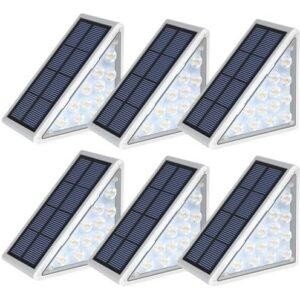
This 6-pack has 2,631 reviews at 4.5 stars and competes directly with the VOLISUN sets at a slightly lower price point. The IP67 rating handles rain and outdoor exposure well. The decorative LED pattern creates a softer glow than the brighter surface-mount lights above, making this a better pick if you want step lighting that adds atmosphere rather than pure visibility.
The flat surface-mount design works on the vertical face of deck stairs, porch steps, and garden paths. Each light has a built-in solar panel and rechargeable battery, so there’s no separate panel to position. On a good sunny day you can expect 6 to 8 hours of output, which covers most evenings through fall and into early winter.
With over 2,600 reviews to back it up, this is a safe buy for anyone who wants proven performance at a competitive price. It’s not as waterproof as the IP68 VOLISUN option, but for most climates IP67 is more than sufficient.
Features
- 6-pack surface-mount solar step lights
- IP67 waterproof rating
- Decorative LED pattern for ambient glow
- 6 to 8 hours of runtime per charge
- Automatic dusk-to-dawn switching
- Compatible with deck, porch, and garden steps
- 2,600+ verified reviews at 4.5 stars
- Attractive decorative LED pattern
- Competitive price point
- Lower brightness than task-focused options
- Shorter runtime in winter or low-sun months
- Only 6 lights per pack
4. TECKNET Solar Step Lights 24 LEDs IP67
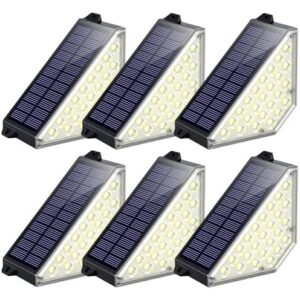
TECKNET’s solar step light is the brightest surface-mount option in this roundup. Each unit packs 24 LEDs into a slim panel, and the 2-mode brightness setting lets you choose between a lower ambient mode for normal evenings and a brighter output for when you need real visibility. That flexibility is something most single-brightness step lights don’t offer.
The 2 mounting methods are a practical feature. You can attach the lights to the vertical face of a step riser with screws, or use the included adhesive tape for a no-drill installation on smooth wood or composite surfaces. The adhesive option won’t hold as long as screws on exterior wood, but it’s useful for renters or anyone who doesn’t want to drill into finished deck boards.
With 1,002 reviews at 4.3 stars, it has a large enough sample to trust. Some buyers report that the adhesive mount loosens in very humid climates, which is why the screw mount is the better long-term choice for most outdoor installations. For maximum brightness with adjustable output, this is the pick.
Features
- 24 LEDs per unit for bright output
- 2 brightness modes for flexible lighting
- 2 mounting methods: screws or adhesive tape
- IP67 waterproof rating
- 3000K warm white color temperature
- Dusk-to-dawn automatic switching
- Brightest option with 24 LEDs per unit
- Adjustable brightness modes
- No-drill adhesive mount option
- Adhesive mount can loosen in humid climates
- 4.3 stars is the lowest rating on this list
- Sold individually, not as a pack
5. NIORSUN Outdoor Stair Lights 6-Pack IP67
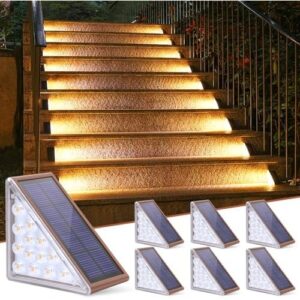
NIORSUN’s stair light uses a triangular design that angles the 13-LED array toward the step tread below. The geometry means more of the light lands where you actually need it, on the surface you’re stepping onto, rather than spreading outward and upward where it doesn’t help much. That makes these more efficient in practical use than flat-panel designs with higher LED counts.
The 3000K warm white output suits wood decks and stone steps well. At 633 reviews it’s a newer product than the top picks above, but the ratings have been consistently positive. IP67 waterproofing is standard for this category and handles outdoor exposure without issue.
Features
- Triangular design directs light onto step tread
- 13 LEDs per unit
- IP67 waterproof rating
- 3000K warm white output
- Auto on/off at dusk and dawn
- 6-pack for full small staircase coverage
- Triangular shape directs light efficiently
- Warm tone suits most outdoor aesthetics
- Good value for the price
- Fewer reviews than top picks (633)
- Less established brand
- Only 6 per pack
6. AGPTEK Solar Driveway Lights 12-Pack
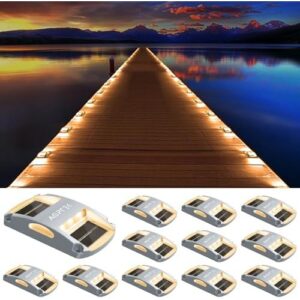
The AGPTEK 12-pack is the budget-quantity option here. You get 12 lights for roughly the same cost as 6 or 8 premium units, which makes it the right choice when you need to cover a long run of steps, a driveway edge, and a pathway all at once. The trade-off is build quality. These are lighter and feel less substantial than the VOLISUN or TECKNET options.
At 4.7 stars and 526 reviews they perform better than you’d expect at the price. The warm white LED output is consistent and the dusk-to-dawn switching works reliably. IP68 waterproofing is a genuine surprise at this price point. These aren’t the lights for a high-traffic front entrance, but for marking garden steps, pathway edges, and dock corners they do the job without fuss.
Features
- 12 lights per pack for large installations
- IP68 waterproof rating
- Warm white LED output
- Dusk-to-dawn automatic operation
- Suitable for steps, driveway edges, pathways
- Low-profile surface-mount design
- 12-pack offers the best per-unit value
- IP68 waterproofing at a budget price
- 4.7 stars across 526 reviews
- Lighter build quality than premium options
- Not ideal for high-traffic main entrances
- Less brightness than 24-LED competitors
7. XILLUMI CORE Solar Step Lights 8-Pack IP67
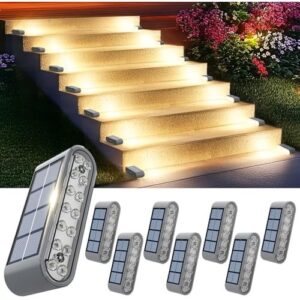
XILLUMI CORE targets buyers who want a larger pack with IP67 waterproofing at a mid-range price. The 8-pack covers a full staircase and the 14-LED array per unit produces adequate brightness for step visibility. At 125 reviews it’s the newest product on this list with limited history, but early buyers rate it at 4.4 stars.
The flat surface-mount design is standard for the category. There’s nothing especially distinctive about these lights, but they cover the basics competently. If the VOLISUN options are sold out or priced above budget, this is a reasonable alternative with similar feature coverage and a matching IP67 rating.
Features
- 8-pack for full staircase coverage
- 14 LEDs per unit
- IP67 waterproof rating
- Warm white output
- Dusk-to-dawn automatic switching
- Surface-mount riser design
- 8-pack with IP67 at mid-range price
- 14 LEDs per unit for solid brightness
- Limited reviews (125) — less proven
- No distinguishing features vs established brands
- Newer brand with no long-term track record
8. JEJOT Solar Step Light 6-Pack IP65
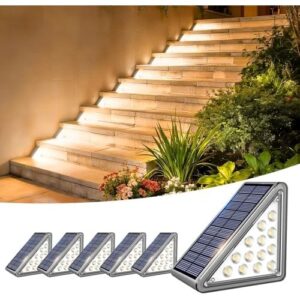
The JEJOT 6-pack is the most affordable entry on this list. IP65 waterproofing is the lowest rating here, which means splash and rain resistance but not submersion. For most covered or semi-protected step installations that’s fine. What you give up in waterproofing you get back in price, and the 3000K warm white output and dusk-to-dawn operation cover the basics competently.
With 127 reviews it’s a newer listing, and the ratings are decent for a budget product. This is the one to consider if you’re lighting a secondary staircase, a garden path, or a low-traffic back deck where you want the safety benefit of marked steps without spending heavily. Don’t put these on a front porch that takes daily rain; look at IP67 or IP68 options for high-exposure locations.
Features
- 6-pack surface-mount solar step lights
- IP65 splash and rain resistant
- 3000K warm white LEDs
- Dusk-to-dawn automatic operation
- Suitable for steps, porch, patio
- Budget-friendly price point
- Lowest price in this list
- Warm 3000K output
- IP65 only — lowest waterproofing here
- Not suitable for high-exposure locations
- Few reviews (127) — limited track record
Solar Step Lights Buying Guide
Where Solar Step Lights Make Sense vs. Where They Don’t
Solar step lights are the right solution in specific scenarios and a poor choice in others. They’re ideal for outdoor steps in locations without easy access to electrical power — garden steps built into a hillside, deck stairs at the back of a large lot, porch steps on a building where running conduit would require significant renovation, and pathway steps through a garden where aesthetics make visible wiring undesirable. They’re also appropriate for supplementary lighting on steps that already have nearby electrical fixtures but lack dedicated step illumination. Solar step lights struggle in two situations: heavily shaded installations where the solar panel receives less than 3 hours of direct sun per day, producing unreliable charging and short runtime; and north-facing installations in northern latitudes where winter sun angles are so low that integrated-panel step lights barely charge through short winter days. For steps adjacent to shaded covered porches or on the north face of a structure, a separate-panel design or hardwired low-voltage system is more reliable. Understanding your specific sun exposure situation is the essential first step before purchasing solar step lights.
Light Distribution: Downlight, Side-Scatter, and Riser Illumination
How a step light distributes light determines how safely it illuminates the tread surface. Three main distribution patterns serve different purposes. Downlighting step lights mount on a post or wall beside the steps and direct light downward onto the tread surface — highest footcandle on the walking surface, best for safety, but requires a vertical mounting surface at step height. Side-scatter lights mount in the step riser and emit light horizontally across the tread — illuminates the tread edge and the tread surface evenly, good compromise between installation simplicity and safety coverage. Riser-face illumination (lights mounted to face forward on the riser) creates a diffused glow from the step face — more decorative than functional, defining the step visually without high footcandles on the tread surface. For primary step safety lighting, downlighting or side-scatter provides the best tread visibility. For secondary lighting on steps that already have adequate illumination from nearby fixtures, riser illumination creates attractive ambient lighting. Avoid placing lights at a height that creates glare in the eyes of someone descending the stairs — light sources above knee level on or adjacent to stairs can reduce visibility by creating direct glare against the dark background.
Solar Panel Size vs. Step Location Sun Exposure
The most common solar step light failure is inadequate charging from insufficient sun. Steps often exist in locations that are intentionally shaded — a covered porch entry, under a deck overhang, at the base of a hillside, or adjacent to shrubs and trees. The solar panel integrated into a step light has a very small active area (typically 2–8 square centimeters), and this tiny panel must receive direct sun to charge adequately. In a location that receives 4–6 hours of direct sun, charging is adequate for 6–8 hours of nighttime operation. In a location receiving 1–2 hours, the battery may charge enough for only 2–4 hours of light — which doesn’t cover the full evening or night. Before purchasing, observe your step location on a clear day: how many hours does the exact installation position (not a nearby sunny spot) receive direct, unobstructed sun? If the answer is “less than 3 hours,” either choose a model with a separate remote panel that can be positioned in a sunnier location, or consider that solar may not be practical for this specific location. Separate panel designs with cables of 8–16 feet provide meaningful positioning flexibility.
Mounting Methods: Recessed, Surface, and Mortised
Solar step lights use different mounting approaches depending on construction type and step material. Surface-mount lights attach directly to the vertical face of a step riser using screws — the simplest installation, requiring only a drill and screwdriver. They work on wood, composite decking, masonry, and concrete; the main aesthetic limitation is that the fixture body protrudes from the surface. Recessed lights install in a hole or channel cut into the step riser, sitting flush with the surrounding surface — cleaner aesthetically, requires more installation precision (router or circular saw to cut the recess), and requires careful waterproofing at the installation point to prevent water infiltration into the step structure. Mortar-in lights designed for masonry or poured concrete applications are sealed with weatherproof mortar after installation — the most permanent installation, appropriate for concrete step construction or masonry riser faces. For wood and composite deck steps, surface mount and recessed options both work; the choice is aesthetic. For masonry steps, recessed or mortar-in options are typically more visually appropriate. For poured concrete — common on front entry steps — recessed installation is the correct choice for a built-in appearance.
Weather Resistance for Step Environments
Outdoor steps experience concentrated pedestrian traffic, leaf accumulation, standing water after rain, winter ice formation, UV exposure, and physical impact from foot traffic and debris. Step lights must withstand all of these. IP65 is the minimum appropriate rating — protection against dust and low-pressure water jets from any direction. IP67 (submersible) is better for steps in areas prone to water pooling or near lawn sprinkler impact zones. The lens material determines resistance to physical impact: standard acrylic cracks under foot traffic if someone steps on a surface-mounted light; polycarbonate is impact-resistant and should be used for any light that might receive foot traffic contact. For recessed lights in the step tread surface, vehicular-grade load ratings (2,000+ lbs per tire) must be verified — pedestrian-rated recessed lights will crack if installed in tread surfaces rather than riser faces. For metal housings, stainless steel or aluminum resist the corrosion that affects zinc-die-cast or steel housings in wet step environments. UV-stable finishes prevent the discoloration that makes cheaper outdoor fixtures look weathered within two seasons.
Battery Performance and Year-Round Operation
Solar step lights are typically installed permanently and expected to operate year-round, including winter months when both charging time and temperatures are at their lowest. NiMH batteries — common in mid-range step lights — deliver rated capacity at summer temperatures but lose 30–40% capacity at freezing, meaning a light rated for 8-hour runtime might deliver only 5 hours on a January night. If those steps are the primary entry and exit for a household, running out of light before midnight in winter is a safety concern. LiFePO4 batteries maintain 90%+ of rated capacity at freezing temperatures and perform reliably down to -4°F, making them significantly better for northern climate installations. The discharge depth also matters: NiMH and standard lithium-ion batteries that are regularly discharged to 100% depth degrade faster than LiFePO4 batteries, which handle deep cycling gracefully. For permanently installed step lights in cold climates, specifying LiFePO4 chemistry and checking winter performance in reviews from northern buyers is more valuable than any other single specification. Many products don’t specify battery chemistry — “lithium” or “Li-ion” in the specs may indicate NMC chemistry, which degrades faster in regular deep cycling than LiFePO4.
Number of Lights Needed for Safe Coverage
Adequate step lighting requires sufficient fixture density to eliminate dark patches between lights. For a standard residential stair configuration (36-inch wide steps), one light centered on each riser face illuminates the step adequately when using a side-scatter distribution pattern. For wider stairs (48+ inches, common on front entry steps), two lights per riser — one near each side — eliminate the dark center zone that a single centered light produces. For curved or L-shaped stair configurations, lights at the inner radius of curves can leave the outer edge dark; additional lights on the outer side of curved sections compensate. For very wide decorative staircases (72+ inches), three lights per riser or a combination of riser face lights plus wall-mounted downlights provides uniform coverage. Counting only the steps themselves understates the full coverage needed: the top landing needs illumination, the bottom landing needs illumination, and any intermediate landings need their own lighting. For a stair run with 6 steps plus top and bottom landings, the full specification might be 8 light positions — 6 on risers, one at top landing, one at bottom.
Price Tiers and Volume Considerations
Solar step lights are typically purchased in sets of 2–8 for a complete stair installation. Budget tier (under $8 per light): basic ABS housing, small panels, NiMH batteries, limited brightness, adequate for mild-climate secondary steps where safety lighting is supplementary. Mid-range ($8–$20 per light): improved weather sealing, better battery capacity, more consistent brightness, motion sensing on some models, 3–5 year expected lifespan — appropriate for primary entry steps in most climates. Premium ($20–$40+ per light): stainless or aluminum construction, LiFePO4 batteries, higher lumen output, 5–10 year expected lifespan — appropriate for prominent entry steps where aesthetics and reliability justify the investment. Volume considerations: for a 6-step staircase requiring 6 fixtures, the premium difference between budget and mid-range is $60–$70 total — typically worth paying. The difference between mid-range and premium is $60–$120 total — justified for prominent front entry steps, less necessary for back or side yard steps. Always buy one to two extra fixtures from the same batch for replacement — matching later is difficult if the product is updated or discontinued.
Frequently Asked Questions
How bright should solar step lights be?
For safety-critical step illumination, aim for at least 25 to 30 lumens per light. Below 20 lumens is accent-only brightness — you can tell a step is there, but you can’t easily judge the depth of each step in the dark. For entertaining spaces where guests navigate unfamiliar stairs, 30+ lumens per step is the sensible minimum.
Do solar step lights work in winter?
Yes, though winter performance is reduced. Shorter days mean less charging time, and cold temperatures reduce lithium battery efficiency. In most US states, expect 50 to 70 percent of summer runtime on winter days. A light that runs 10 hours in July might run 5 to 6 hours in December. This is enough to cover the evening hours in most winter scenarios, where darkness falls around 5pm and entertaining typically wraps up by 10 or 11pm.
Can solar step lights be used on masonry or concrete steps?
Surface mount lights with appropriate screws or masonry anchors work on concrete and brick steps. Use a masonry drill bit and masonry anchors rather than the wood screws typically included. Alternatively, outdoor-grade adhesive strips (3M Command strips rated for outdoor use) work on smooth masonry surfaces without any drilling. Recessed designs require cutting holes and are better suited to wood or composite decks.
How long do solar step lights last?
LED lifespans are effectively unlimited for home use — most are rated 30,000 to 50,000 hours, which translates to over 10 years of nightly use. The limiting factor is the rechargeable battery, which typically lasts 2 to 5 years before capacity drops noticeably. Replacement batteries are inexpensive ($5 to $15) and restore the light to like-new performance. Higher-quality nickel-metal hydride batteries tend to last longer than lithium-ion in solar step lights.
Should solar step lights face up, down, or outward?
The light head should face outward and slightly downward to illuminate the tread of the step below. The solar panel on surface-mount designs faces in whatever direction the front of the riser faces — ideally south in the northern US. If your steps face north, consider recessed deck lights (panel faces up) or a model with a separate panel that can be repositioned independently of the light head.
Summing Up
For most buyers, the VOLISUN Solar Deck Lights 8-Pack is the right call — highest rated, brightest surface-mount option, and enough lights for a full deck staircase in one purchase. If you want recessed flush-mount lights that look built-in, the NORSUN 6-Pack offers the best balance of brightness (35 lumens) and IP67 waterproofing at a fair price. For maximum brightness with a 3-year warranty on a premium deck installation, the Sunforce 4-Pack is the top performer. And if your budget is the primary constraint, the JOFIOS 12-pack covers a lot of steps at a per-unit cost that’s hard to argue with. Whatever direction you go, make sure the solar panel has clear southern exposure — that single factor determines how well any solar step light performs over the long term.
If you’re also thinking about solar panels for your home, call (855) 427-0058 for a free quote — it takes just a few minutes to find out what installation would cost and save you in your area.
Updated