
Our blog is reader-supported. When you buy through links on our site, we may earn an affiliate commission. Thank you for your support!
A solar water pump runs entirely on sunlight, making it perfect for remote locations without grid power, off-grid homesteads, irrigation systems, livestock watering, and pond aeration. With no electricity bills and minimal maintenance, the right solar pump can pay for itself within a season. Here are the best options available today.
Our Top Picks
| Image | Name | |
|---|---|---|
| VEVOR Solar Submersible Well Pump | |
| ECO-WORTHY 12V Solar Water Pump Kit | |
| Sunnydaze Solar Pump Kit with Battery Backup | |
| LEWISIA Solar Fountain Pump | |
| SUNFERRY Solar Birdbath Fountain Pump | |
| Duda Diesel Solar Pump System for Irrigation | |
| Anself Solar Powered Pond Pump | |
| AISITIN Solar Fountain Pump |
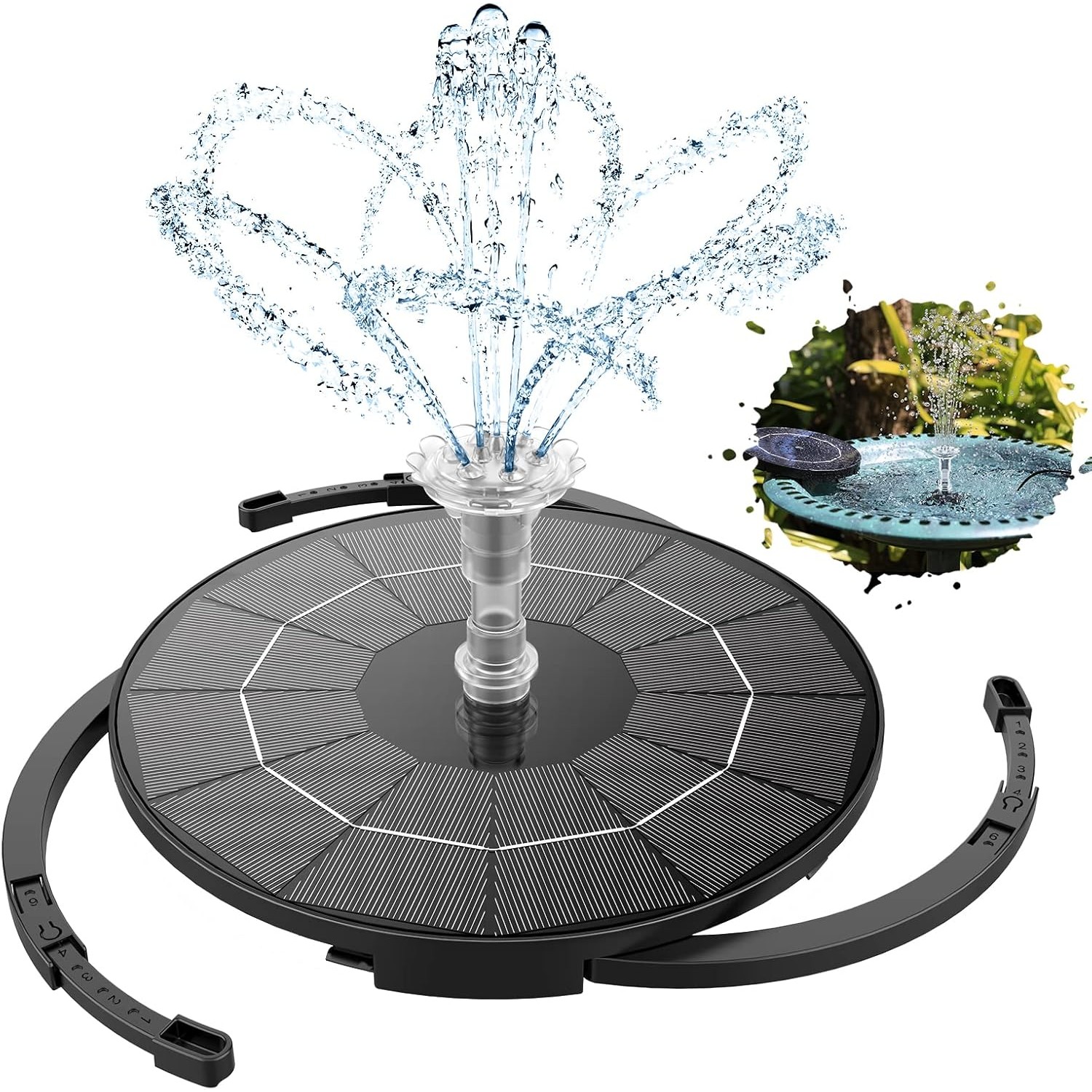
8 Best Solar Water Pumps
1. VEVOR Solar Submersible Well Pump
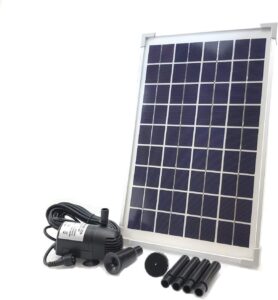
The VEVOR solar submersible pump leads this list because it handles real-world deep-well applications that most solar pumps can’t touch. Rated for wells up to 230 feet deep, it delivers up to 1.6 gallons per minute at max depth, which is enough for small household water supply, livestock tanks, or drip irrigation systems.
The 400W solar panel included in the kit is a genuine advantage. You’re not hunting for compatible panels or guessing about wiring. The brushless DC motor draws about 400W at peak and the built-in MPPT controller extracts maximum power even in partial cloud cover. A dry-run protection sensor shuts the pump off automatically if water level drops too low, protecting the motor from burnout.
Installation is straightforward for anyone comfortable with basic wiring and well work. Drop the pump into your well casing, connect the wiring, aim the panel south, and you’re pumping. Output varies with sunlight, so flow is highest midday and tapers off in morning and evening hours.
Features
- 400W solar input, brushless DC motor
- Max head: 230 feet
- Flow rate: up to 1.6 GPM
- Includes 400W solar panel and controller
- Dry-run auto shutoff protection
- Stainless steel pump body
Pros:
- Includes solar panel in kit
- Deep well capability
- Automatic dry-run protection
- Brushless motor for longevity
Cons:
- Higher price point
- Flow rate varies with sunlight
2. ECO-WORTHY 12V Solar Water Pump Kit
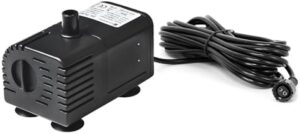
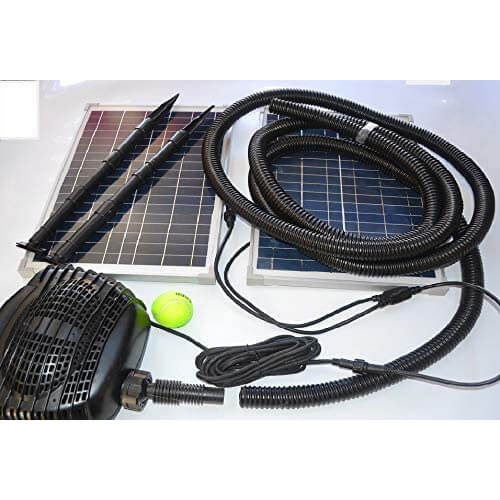
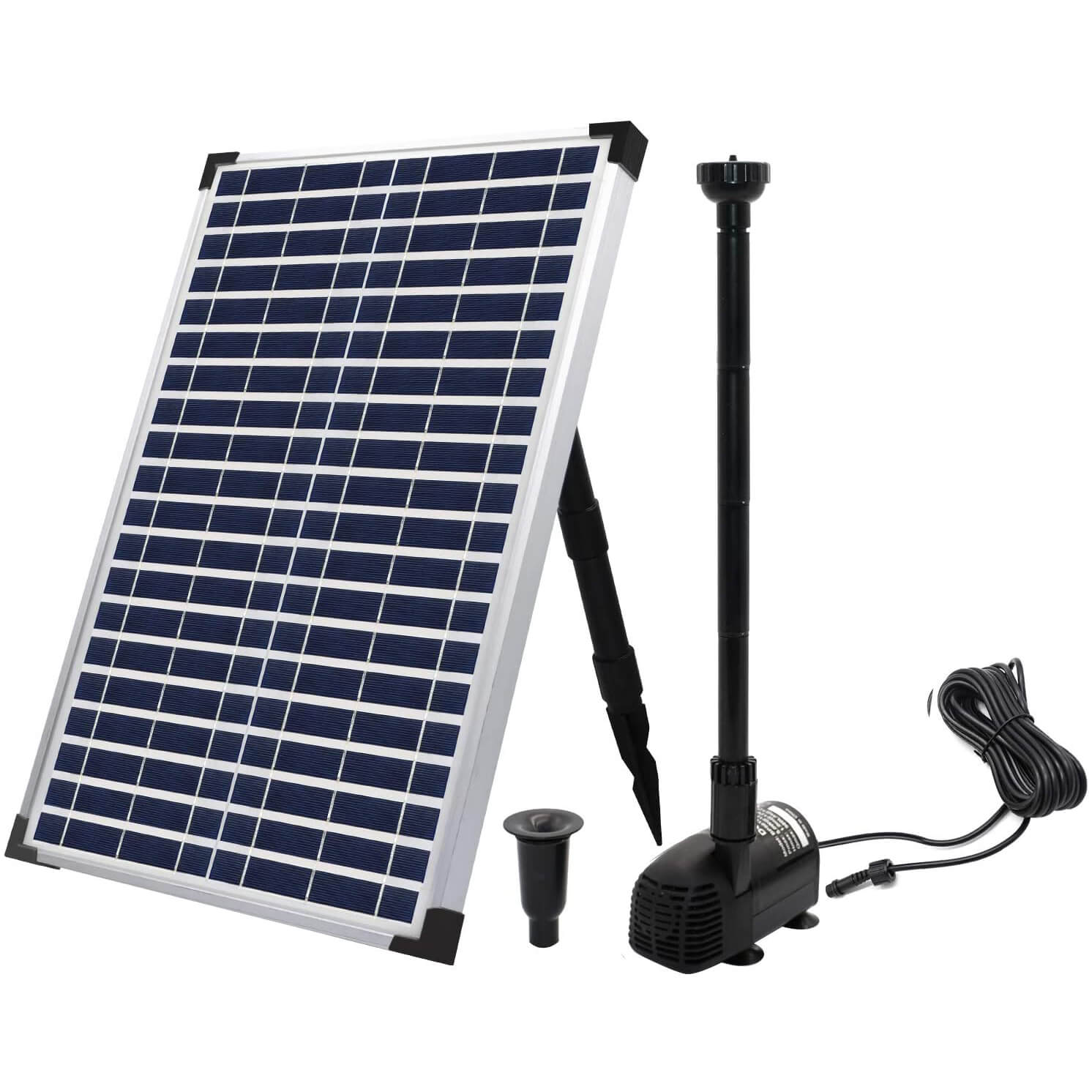
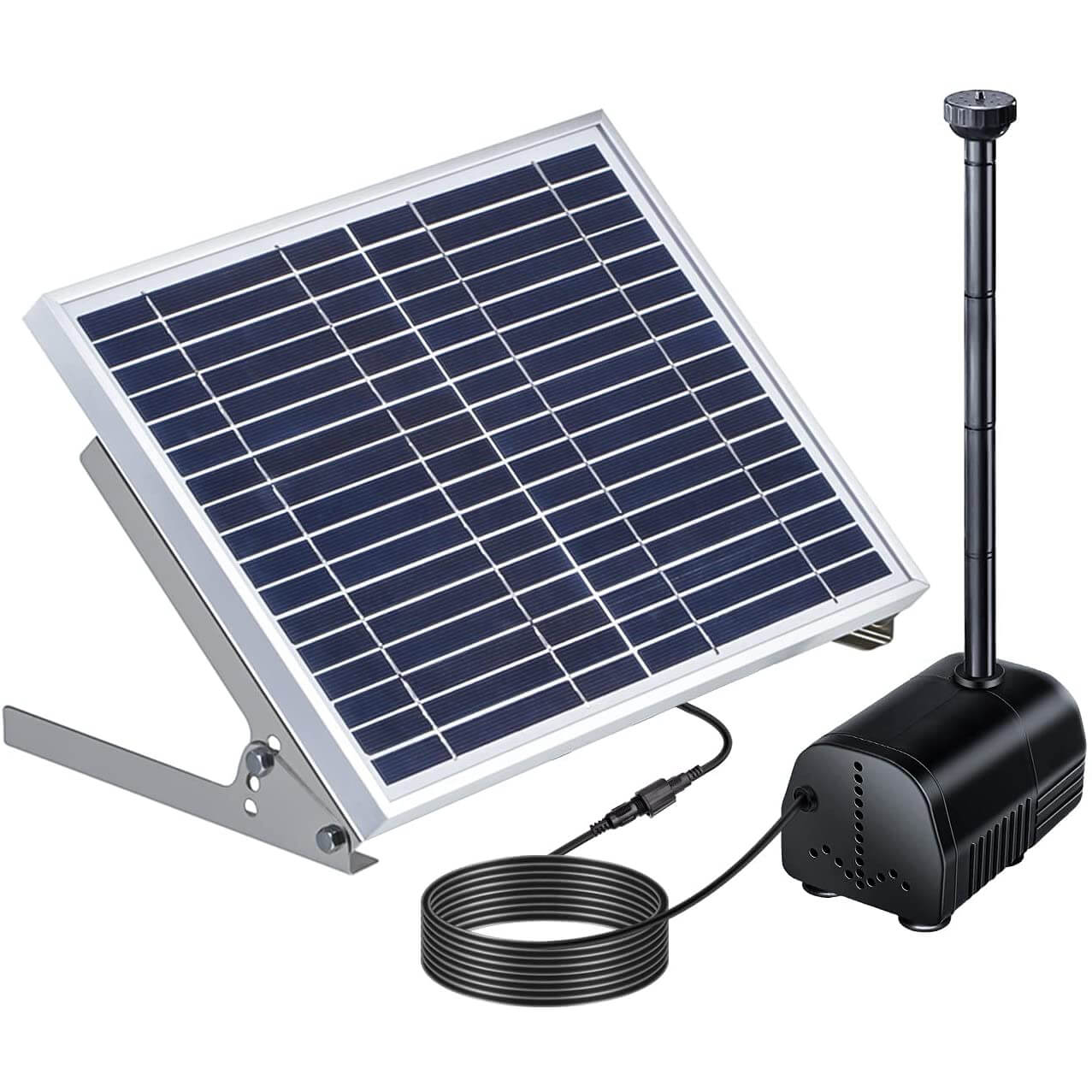
The ECO-WORTHY kit targets homeowners and hobby farmers who need reliable water movement without grid power. It comes as a complete package: 20W solar panel, 12V submersible pump, and wiring harness. For small ponds, garden fountains, drip irrigation systems, and livestock tanks up to about 8 feet of lift, it’s a solid choice.
Max lift is 26 feet and flow rate peaks at about 2.1 gallons per minute in direct sun. For shallow water sources, those numbers are excellent. The pump runs on any 12V source, so you can add a battery for overnight operation or on cloudy days. The 20W panel is appropriately sized to run the pump in full sun without battery storage.
Build quality is decent for the price. The pump body is plastic, not stainless steel, so it’s best suited for fresh water applications rather than wells with mineral-heavy water that could corrode it faster. The wiring is straightforward and the system requires no special tools to set up.
Features
- 20W solar panel included
- 12V DC brushless motor
- Max lift: 26 feet
- Flow rate: up to 2.1 GPM
- Compatible with 12V battery backup
Pros:
- Complete kit, nothing extra needed
- Works with battery backup
- Easy DIY installation
Cons:
- Plastic body limits durability
- Limited to shallow applications
- Low output in partial shade
3. Sunnydaze Solar Pump Kit with Battery Backup
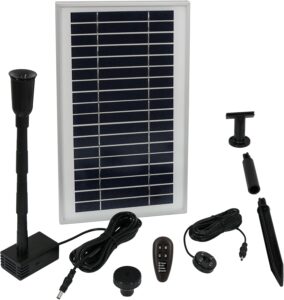
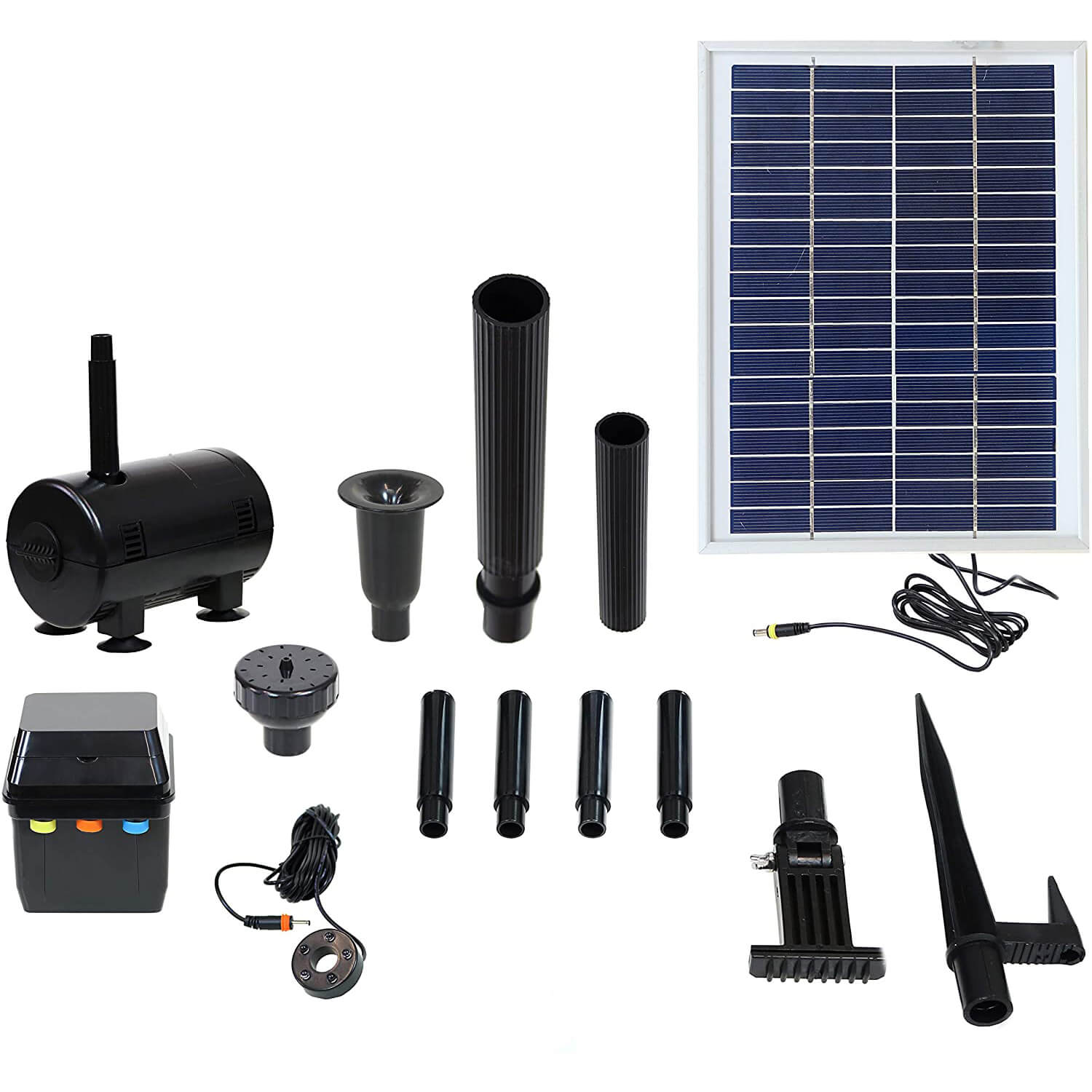
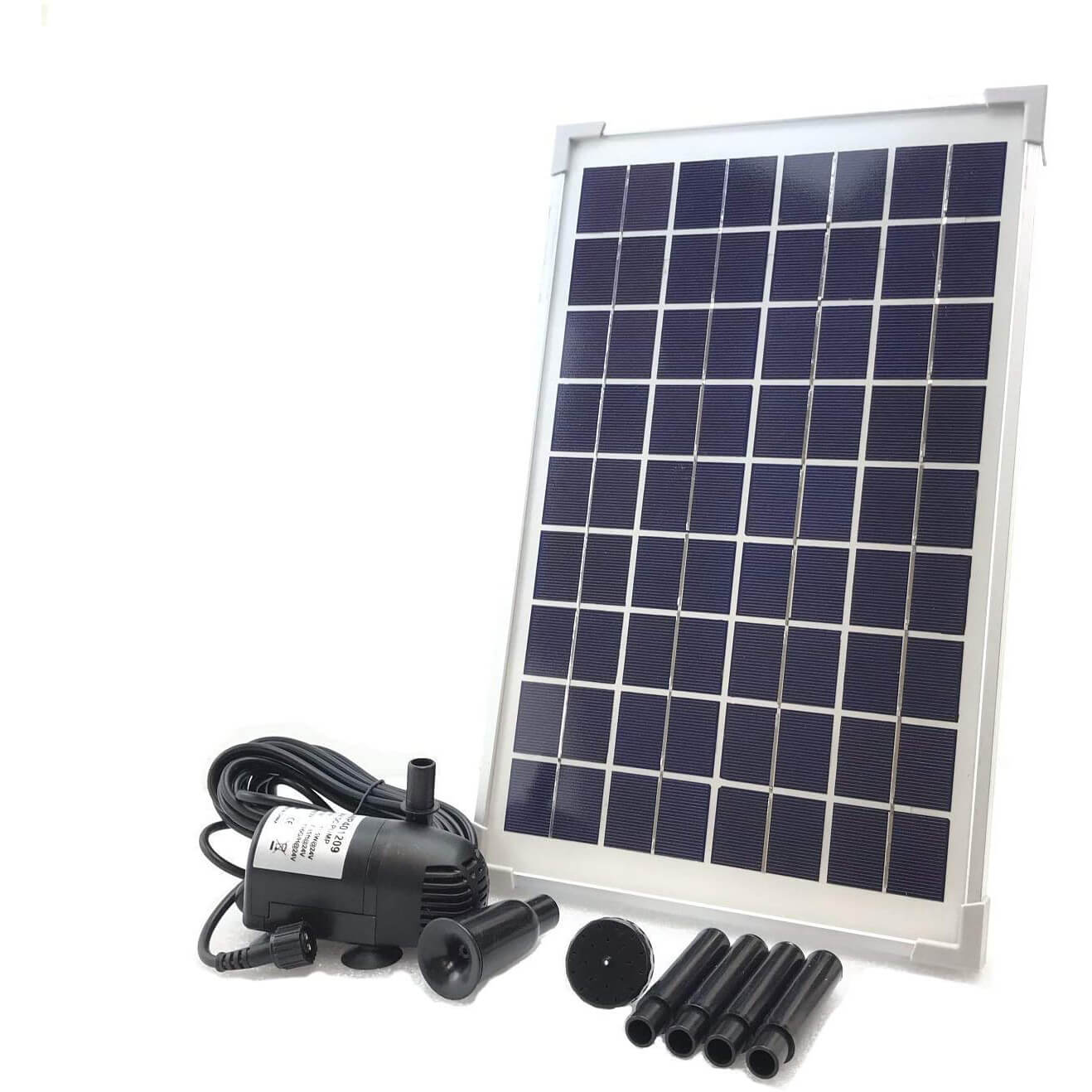
If uninterrupted operation matters, the Sunnydaze solar pump kit with battery backup is worth the extra investment. The built-in lithium battery stores enough power to run the pump for several hours after sundown or through a cloudy period, which makes it a dependable choice for garden fountains and decorative water features that you want running around the clock.
The 10W panel, 800L/H flow rate, and three included fountain heads cover most ornamental pond and fountain applications. It’s not a deep-well pump, and with a 4.5-foot max lift height, it won’t work for irrigation beyond a very small garden bed. But for what it’s designed for, a self-contained solar fountain with overnight capability, it delivers reliably.
Features
- 10W solar panel with built-in battery
- 800 liters per hour flow rate
- 4.5-foot max lift
- Three interchangeable fountain heads
- Operates at night on stored battery power
Pros:
- Battery backup for overnight operation
- Multiple fountain head options
- Compact and easy to install
Cons:
- Not suitable for irrigation or wells
- Limited lift height
4. LEWISIA Solar Fountain Pump
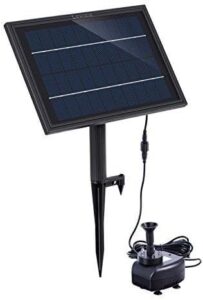
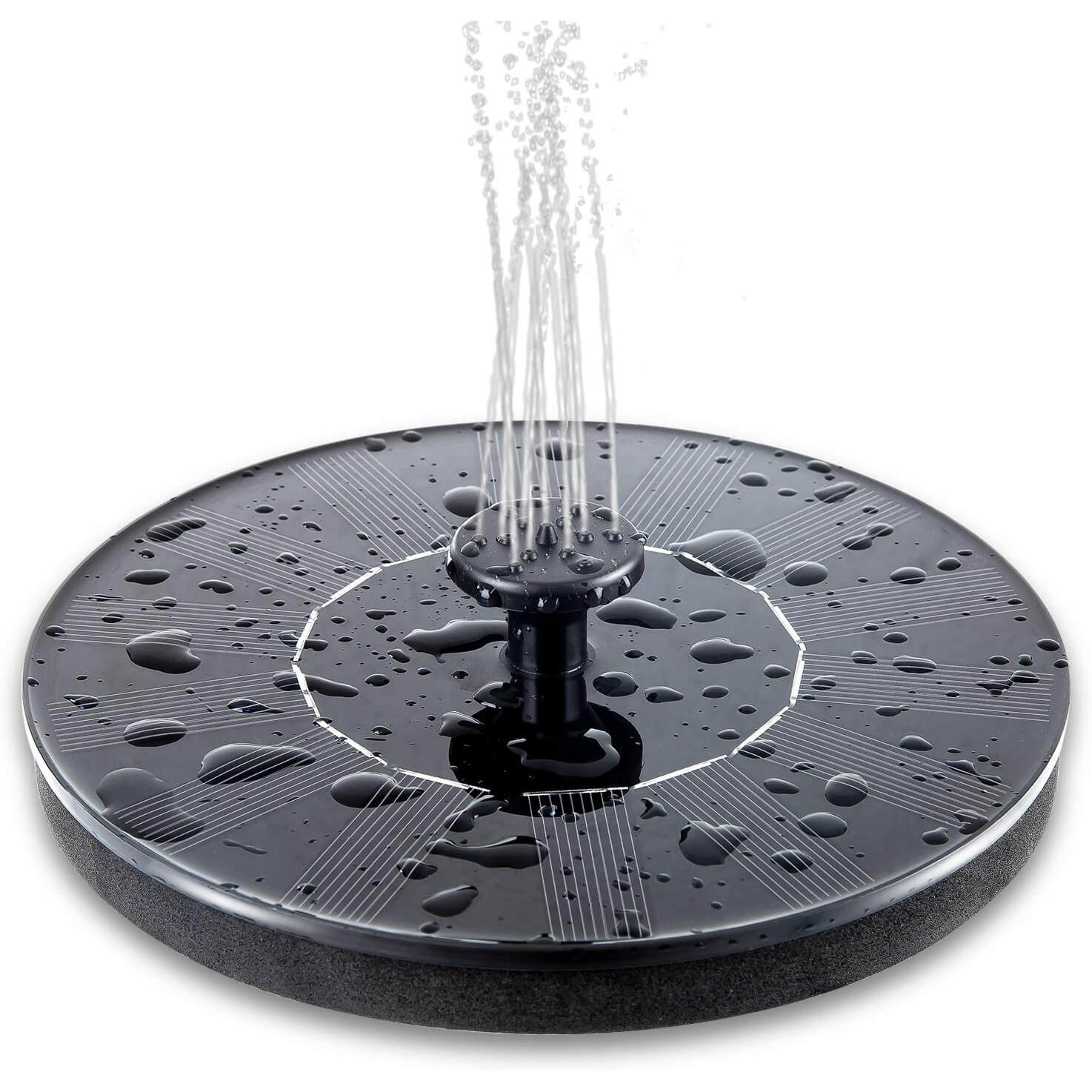
The LEWISIA solar fountain pump is the most popular entry-level pick on this list, and for good reason. It’s inexpensive, delivers a surprisingly strong spray for its price point, and works out of the box with no wiring required beyond dropping it in water and aiming the panel at the sun. For small ponds, birdbaths, and garden water features, it’s all most people need.
Seven interchangeable spray heads let you adjust the pattern from a tight column to a wide fan spray. There’s no battery, so it only runs in direct sun. Output is immediate and proportional to sunlight, meaning it picks up speed as clouds pass. The 1.4W panel is modest but appropriate for the small pump it drives.
Features
- 1.4W solar panel
- 7 interchangeable spray heads
- No wiring required
- Float or submersible installation
- Max flow: 132 GPH
Pros:
- Very affordable entry point
- No wiring needed
- Good spray variety
Cons:
- No battery, stops without direct sun
- Not for irrigation or wells
- Low lift height
5. SUNFERRY Solar Birdbath Fountain Pump
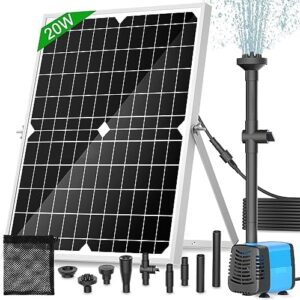
SUNFERRY has built a following among birdbath owners specifically because their pump is sized and configured to work in very shallow water, as little as 1 inch deep. Most solar pumps need deeper water to run without burning out, but the SUNFERRY’s intake is positioned to draw from minimal water depth without sucking air.
The 2W panel is mounted on a flexible gooseneck that you can angle precisely toward the sun even when the birdbath is in a partially shaded area. Output ranges from 200 to 600L/H depending on sun intensity, and four spray heads are included. It’s a narrow use-case product, but it does that one thing better than anything else on this list.
Features
- 2W panel on adjustable gooseneck mount
- Works in as little as 1 inch of water
- 200 to 600 L/H flow rate
- 4 spray heads included
Pros:
- Works in very shallow water
- Adjustable panel angle
- Purpose-built for birdbaths
Cons:
- Limited to ornamental use
- No battery backup
- Small panel, sun-dependent output
6. Duda Diesel Solar Pump System for Irrigation

The Duda Diesel pump system is designed for serious agricultural irrigation where you need reliable, high-volume water delivery. With panel options from 100W to 600W and centrifugal pump configurations for high-flow, low-head surface applications, this is the pick for homesteaders with large garden beds, small farms, or stock watering systems.
Unlike the submersible pumps above, Duda’s centrifugal pumps are surface-mounted. They draw from ponds, streams, or storage tanks and push water through drip lines or sprinkler systems. Flow rates depend on configuration but can reach 8 to 20 GPM at moderate head heights. The MPPT controller is included and handles variable sunlight conditions effectively.
Features
- 100W to 600W panel configurations
- Centrifugal surface pump
- MPPT controller included
- High flow rates for irrigation
- Suitable for ponds, streams, storage tanks
Pros:
- High flow rates for serious irrigation
- Scalable system configurations
- MPPT controller maximizes output
Cons:
- Higher cost
- Surface mount requires dry installation location
- More complex setup
7. Anself Solar Powered Pond Pump
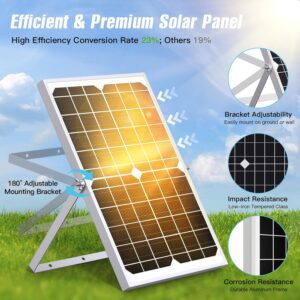
The Anself solar pond pump targets small decorative ponds and water garden features. It runs a 600L/H brushless pump from a 5W panel without needing battery storage. Unlike the very small birdbath pumps, the Anself produces enough flow to aerate a small koi pond or power a modest waterfall feature up to about 2 feet of lift.
Build quality is above average for the price. The tubing connections are secure, the pump body is resistant to pond algae and minor debris, and the panel is durable enough to leave outdoors year-round in most US climates. For the modest investment, it’s a solid middle-ground option for pond owners who want aeration without running a power cord.
Features
- 5W solar panel
- 600 L/H brushless pump
- Max lift: 6.5 feet
- Includes tubing and fittings
- Outdoor-rated panel housing
Pros:
- Good value for pond aeration
- Brushless motor for durability
- Handles 6.5 feet of lift
Cons:
- No battery, stops at night
- Not for wells or deep water
8. AISITIN Solar Fountain Pump (Budget Pick)
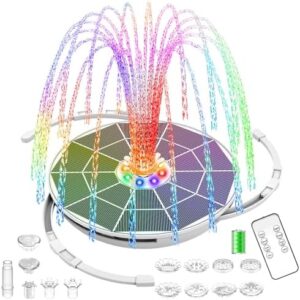
The AISITIN is the value buy on this list. It’s inexpensive, it works, and it’s popular precisely because it delivers decent fountain spray without requiring any setup beyond dropping it in water. The 3.5W upgraded panel produces noticeably more output than cheaper 1.4W models, which means better performance in partial shade and faster recovery after cloud cover.
Six spray heads are included. Output in direct sun is strong enough for a legitimate water feature display, not just a trickle. Like all panel-only solar pumps, it stops at night and slows in clouds. But for anyone who just wants a no-fuss solar fountain that actually works, the AISITIN is hard to beat at its price.
Features
- 3.5W upgraded solar panel
- 6 interchangeable spray heads
- No battery, direct solar operation
- Float or submersible installation
Pros:
- Excellent value
- Stronger panel than budget competitors
- Six spray heads included
Cons:
- No battery, sun-dependent
- Ornamental use only
- Plastic build won’t last decades
Solar Pump Buying Guide
Solar vs. Grid-Powered Water Pumps: Where Solar Makes Sense
Solar water pumps are the right choice in specific situations and a poor choice in others. They excel where electrical infrastructure doesn’t exist or would be expensive to install: remote ponds, livestock watering troughs in fields, irrigation systems in gardens far from the house, and decorative water features in locations where running power cable is impractical. They’re also the sustainable choice for applications where pumping time naturally aligns with sun availability — drip irrigation systems that run during daylight hours are ideally suited to solar power. Solar pumps struggle where continuous 24-hour operation is required (fish pond aeration in hot summers, for instance), where precise flow rate control is needed regardless of sun conditions, or where very high flow rates (over 2,000 GPH) are required for short periods. For applications within easy reach of a power outlet, a standard low-voltage or AC pump will often be more reliable and cost-effective. The solar premium makes sense when wire installation would cost $200–$500+ or when operating off-grid is a priority.
Flow Rate (GPH) and Head Height: Sizing Calculations
Flow rate and head height are the two critical specifications for any water pump selection. Flow rate (measured in gallons per hour, GPH) determines how much water moves per unit time. Head height is the vertical distance the pump must push water upward, from the pump intake to the discharge point. Pump performance drops predictably with increasing head height — a pump rated for 500 GPH at zero head might deliver only 250 GPH at 3 feet of head and 100 GPH at 6 feet of head. Always request the pump’s performance curve (head vs. flow chart) and size to your actual operating head, not the zero-head rating. For pond biological filtration, the rule of thumb is to circulate the full pond volume once per hour at your actual head height. A 500-gallon pond with a filter 3 feet above the pond surface needs a pump delivering at least 500 GPH at 3 feet of head — which might require a pump rated for 1,200+ GPH at zero head. For irrigation applications, flow rate determines how many emitters you can supply — calculate total emitter flow rate and add 20% for friction losses in the tubing run.
Direct Solar vs. Battery-Backed: Choosing the Right Power Design
Direct solar pumps (no battery) run only when the solar panel produces power — typically from mid-morning to late afternoon, with reduced flow during morning and evening hours. This is perfectly adequate for irrigation systems (plants don’t need water at night), decorative fountains (intermittent operation is acceptable), and livestock watering systems where there’s a storage tank that fills during the day and provides water through the night. Battery-backed pumps run continuously regardless of time of day or cloud cover — necessary for fish pond aeration where oxygen-depleted water can harm fish overnight, for systems where consistent pressure is required, or for applications in partial-shade locations where direct solar produces erratic output. The battery adds cost, complexity, and maintenance requirements (eventual battery replacement). For direct solar systems in partial shade, a larger panel compensates for lower irradiance — a 10W panel in 50% shade produces roughly as much power as a 5W panel in full sun. For battery-backed systems, size the battery for 24–48 hours of operation without solar input to handle cloudy periods without disrupting the application.
Submersible vs. Surface Mount: Application Matching
Solar water pumps are available in submersible and surface-mount configurations, each suited to different applications. Submersible pumps sit fully underwater, drawing water through an intake screen and pushing it through an outlet pipe. They’re quieter than surface pumps (the water around them muffles motor noise), handle debris-laden water well (with adequate pre-filtration), and maintain prime automatically. They’re the correct choice for ponds, water features, rain barrels, and any application where the water source is a contained basin. Surface-mount pumps (also called centrifugal or jet pumps) sit above the water source and draw water up through suction — limited to approximately 25 feet of suction lift in practice. They’re appropriate for drawing from shallow wells, streams, or reservoirs where submerging the pump isn’t practical. DC solar surface pumps are available for stream and shallow well applications; submersible DC solar pumps handle most pond and garden water feature applications. The key specification for submersible solar pumps is maximum submersion depth — most are rated for 3–10 feet; deep ponds or cisterns require pumps with higher depth ratings.
Panel Sizing and Positioning for Consistent Performance
Solar water pump panels range from 5W for small decorative fountain pumps to 100W+ for agricultural irrigation systems. Panel sizing must account for both the pump’s power requirement and your location’s peak sun hours. A pump requiring 20W of power at peak needs more than a 20W panel — it needs a panel sized so that at your lowest-sun-hour location, the panel still provides 20W during operating hours. In a 5 peak-sun-hour location, this is straightforward. In a 3 peak-sun-hour location (Pacific Northwest in winter), that same 20W demand might require a 30W panel to maintain adequate flow during low-irradiance hours. Panel orientation matters significantly for solar pumps: tilting the panel at latitude angle (30° in Phoenix, 45° in Portland) rather than mounting it flat captures significantly more annual energy. For irrigation systems that are most needed in summer, a tilt angle 10–15° less than latitude optimizes summer production. Track-mounted panels that rotate to follow the sun can increase daily production by 25–40%, justified for high-power applications where the pump must run for maximum hours each day.
Applications: Irrigation, Livestock, Ponds, and Features
Solar water pumps serve meaningfully different applications, and the specifications that matter vary by use case. Irrigation systems need consistent flow rate during daylight hours, compatibility with drip emitters or sprinkler heads, and a pump that can handle the sand and particulate content of well or surface water — fine mesh pre-filters are essential. Livestock watering systems need robust, corrosion-resistant materials (stainless pump internals for water that may contain minerals), high flow rates to fill large troughs quickly, and reliability in extreme temperatures from southern summers to northern winters. Pond circulation and filtration requires pumps compatible with filter media backpressure, pre-filtration to protect the impeller, and for fish ponds, materials that are safe for aquatic life (no copper components). Decorative water features value aesthetics (hidden pump housings) and adjustable flow rate for different nozzle effects, along with sufficient head height for multi-tier fountains. Solar-powered well pumps for remote water sources require high-head capability (50–200+ feet), submersible AC or DC pump designs rated for well installation, and appropriate controller sizing.
Installation and Maintenance Considerations
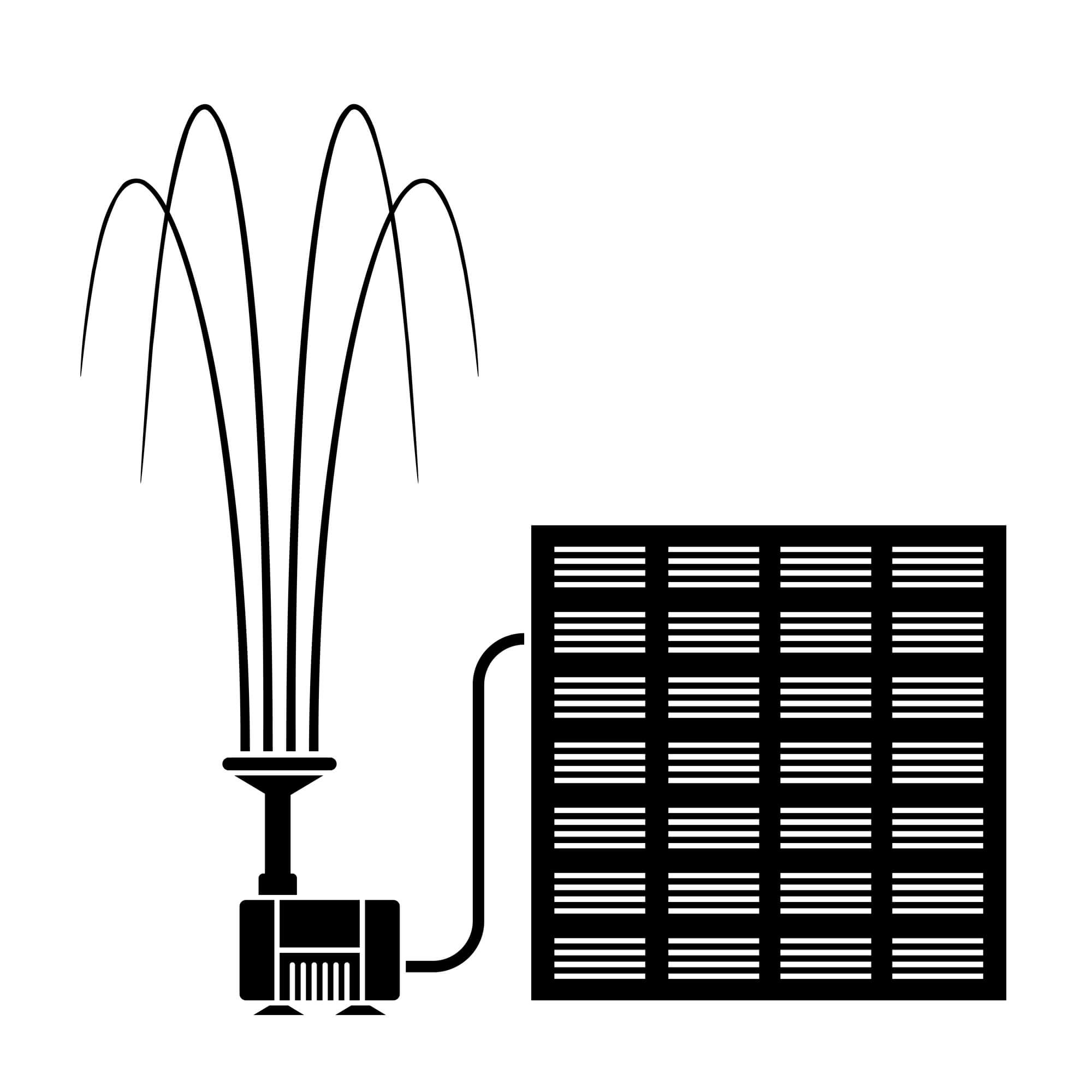
Installing a solar water pump system involves four components: the panel, the charge controller or direct-drive connection, the pump, and the plumbing. For direct-drive systems, the panel connects directly to the pump via DC cable — simpler but requiring a panel specifically voltage-matched to the pump. For battery-backed systems, the panel charges a battery through a charge controller, and the pump draws from the battery through an appropriate load connection. Plumbing considerations: use flexible tubing rated for continuous water pressure; secure all connections with hose clamps rather than relying on friction fit alone; protect exposed tubing from UV degradation and physical damage with conduit or cover where it runs above ground. Pre-filter maintenance is the most common neglect point — clean intake screens weekly during high-debris periods (autumn leaf fall, algae bloom season) and monthly at other times. An annual pump inspection (removing from the water source, checking impeller condition, clearing any mineral scale from the housing) extends pump life significantly. For winterization in cold climates, drain submersible pumps and store indoors — ice formation in a submerged pump cracks the housing.
Price Tiers Across Pump Applications
Solar water pump pricing varies widely by application. Decorative fountain and small pond pumps: $20–$80 for complete units including panel and pump — adequate for features up to 500 gallons with modest head heights. Garden irrigation and medium pond kits: $80–$200 for complete systems with 10–30W panels, adequate flow for gardens up to half an acre or ponds up to 2,000 gallons. Agricultural and livestock water systems: $200–$600 for robust systems with 50–100W panels, high flow rates, and commercial-grade pump construction — sized for large stock tanks or significant irrigation areas. Solar well pump systems: $300–$1,200+ depending on well depth and flow requirements, with high-head submersible pumps and appropriately sized controllers. For decorative and garden applications, mid-range complete kits offer the best value. For agricultural applications where reliability is critical and system failure has real costs, investing in commercial-grade components and oversizing the panel by 20–30% provides meaningful resilience against cloudy periods and seasonal sun variation.
Frequently Asked Questions
Can a solar water pump work without a battery?
Yes. Most solar pumps run directly from the panel without battery storage. They operate only when the sun is shining and slow down in partial shade. For applications where continuous operation isn’t required, such as daytime irrigation or filling a storage tank, a battery-free system works well.
How deep can a solar submersible pump reach?
Consumer solar submersible pumps typically handle 25 to 230 feet of depth. Higher-wattage systems with larger panels reach deeper. Always confirm the pump’s rated head height matches or exceeds your well depth before purchasing.
What size solar panel do I need for a water pump?
Match panel wattage to pump wattage. A 12V pump drawing 5 amps needs about 60W of panel in ideal conditions. Add 20 to 30 percent buffer for real-world losses. Most pump kits include an appropriately sized panel, which is the simplest way to get the sizing right.
Do solar water pumps work on cloudy days?
Yes, but at reduced output. On heavily overcast days, output may drop to 10 to 25 percent of peak capacity. MPPT controllers help maximize what’s available. For critical applications, add battery storage or a backup power source.
How long do solar water pumps last?
Brushless DC pump motors typically last 10,000 to 30,000 hours of operation. The solar panel will outlast the pump and usually carries a 25-year warranty. Seals and O-rings may need periodic replacement in submersible applications, typically every 5 to 8 years depending on water chemistry.
Summing Up
A solar water pump is one of the most practical ways to move water off-grid — whether you’re drawing from a well, circulating a pond, or running an irrigation system without grid power. The picks above cover the full range from submersible well pumps to surface pumps and decorative fountain units, all running entirely on sunlight.
If you’re also thinking about solar panels for your home, call (855) 427-0058 for a free quote — it takes just a few minutes to find out what installation would cost and save you in your area.
Updated